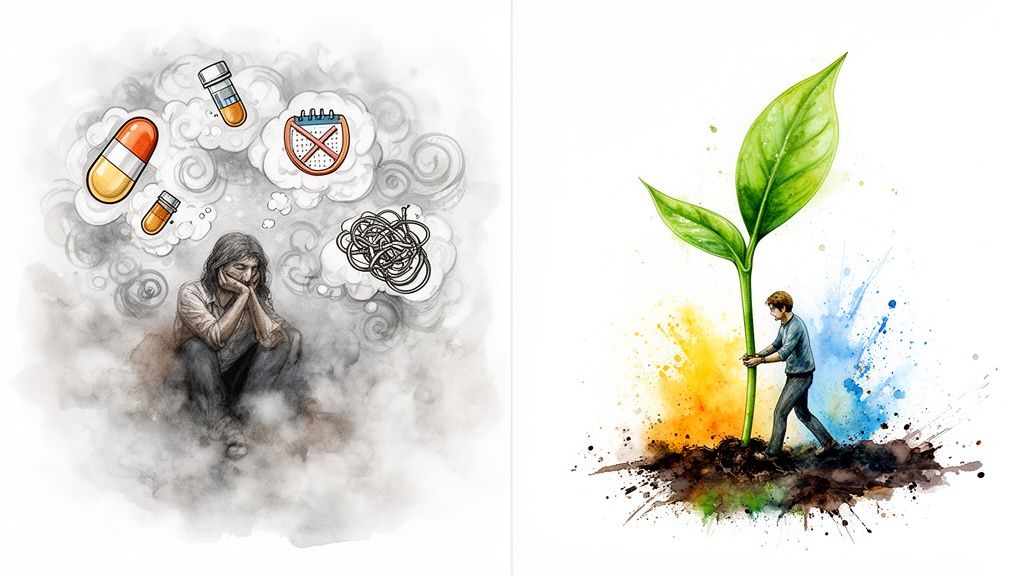
When you feel trapped by anxiety, your first instinct is to find the fastest way out. Maladaptive coping mechanisms are those tempting escape routes—the behaviors that give you instant relief from the panic but, without you realizing it, dig the hole you're in even deeper.
The Hidden Traps Keeping You Stuck in Anxiety
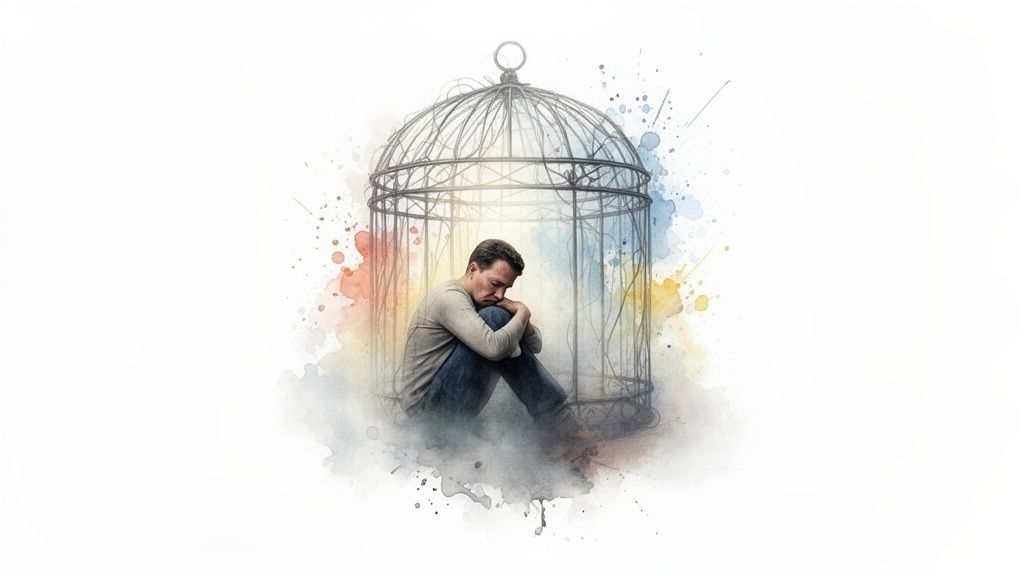
If you're exhausted from fighting a battle with anxiety that you never seem to win, there’s something you need to hear: it’s not your fault, and a life free from panic is entirely possible. It’s very likely that the strategies you’re using to control the fear are the very things feeding it.
These aren't character flaws. They’re simply your brain's understandable—but ultimately counterproductive—attempts to find safety when panic strikes.
This guide is your roadmap to a calmer, more empowered life. We’re going to pull back the curtain on what maladaptive coping mechanisms are, why they feel so essential, and how they quietly sabotage your well-being. Recognizing these patterns is the first, most powerful step toward breaking the cycle and finally healing.
Why Hope Is Not Just a Feeling—It’s a Strategy
Understanding these hidden traps is the key to dismantling them. They often spring from warped ways of thinking about ourselves and the world. To get a better handle on this, you can check out our guide on cognitive distortions, which explains how these negative thought patterns fuel unhealthy behaviors.
These patterns are especially common when people don't get professional help. A 2022 study of adolescents revealed that about 12.3% were experiencing significant psychological distress, often relying on maladaptive strategies instead of seeking support. You can read more about these youth mental health findings to see just how widespread this problem is.
The most hopeful message is this: Maladaptive coping mechanisms are learned behaviors. And because they are learned, they can be unlearned and replaced with skills that lead to lasting peace.
This is not a life sentence. You have the power to make a profound and lasting change. By learning to spot these traps, you can start building a new set of tools—ones that don't just put a band-aid on anxiety but actually start to heal it, opening the door to a panic-free life.
What Are Maladaptive Coping Mechanisms, Really?
Imagine you’re lost in a thick, foggy forest. You can barely see your hand in front of your face. Two paths appear. One is long and winding, but you can see it’s a clear, solid trail. The other is a short, straight path that vanishes into the mist. Your anxiety is screaming at you to take the shortcut—it feels faster, like an immediate escape from the scary unknown.
This is the perfect picture of a maladaptive coping mechanism.
They're the shortcuts we grab when we need to feel better right now. These aren’t character flaws or signs of weakness. They are learned behaviors, born from a desperate, primal need to dial down overwhelming distress. When your brain is flooded with fear, its only goal is to find safety as fast as possible, and these habits deliver that quick hit of relief.
The Brain's Flawed Survival Guide
Think of it like a faulty survival guide your mind has written for itself over time. It’s filled with notes like, "When threatened, avoid the situation," or "When feeling overwhelmed, numb the feeling." And in the short term, it feels like it works. You skip the social event you were dreading, and poof—the anxiety vanishes. You’ve successfully "survived" the threat.
The problem is, this relief just reinforces the flawed guide. Your brain logs it as a win: avoidance is the answer to anxiety. This makes you far more likely to use that same shortcut the next time you feel that way. Each time you do, the "real" path—the one that actually teaches you how to navigate the forest—grows more and more intimidating.
Maladaptive coping mechanisms offer a temporary truce in the war against anxiety. The price? Your long-term peace and freedom. They promise safety but deliver a smaller, more restrictive world.
Learned, Not Permanent
Here’s the most critical—and hopeful—truth: these patterns are learned. And because they're learned, they can be unlearned and replaced.
Understanding why you developed these habits is the first step. It allows you to look at them without judgment, which is essential for change. It’s not about blaming yourself for getting lost in the fog; it’s about learning to read a new map that leads you out of the forest for good.
This process of dismantling old patterns and building healthier ones is the cornerstone of many therapeutic approaches. Exploring different kinds of psychotherapy for anxiety can give you a structured, supportive space to do just that. The journey out of the forest isn’t about finding a magic shortcut. It’s about learning to walk the clear path, confident you have the skills to handle whatever comes your way and live a life without constant fear.
Recognizing Common Anxiety Traps in Your Daily Life
Maladaptive coping habits often fly under the radar, masquerading as simple preferences or necessary precautions. They’re the quiet, knee-jerk reactions you have to sidestep discomfort, but spotting them is the first real step toward taking your life back from anxiety.
These aren't dramatic moral failures; they're subtle, everyday traps.
The goal isn’t to judge yourself for falling into them. Instead, it's about becoming a curious observer of your own patterns. When you shine a light on these behaviors, you start to see their true cost. More importantly, you begin the journey of replacing them with strategies that actually support your healing.
This simple graphic shows how the brain gets stuck in this loop: anxiety triggers a desire for a quick fix, which feels like a smart shortcut but ultimately creates more harm down the road.
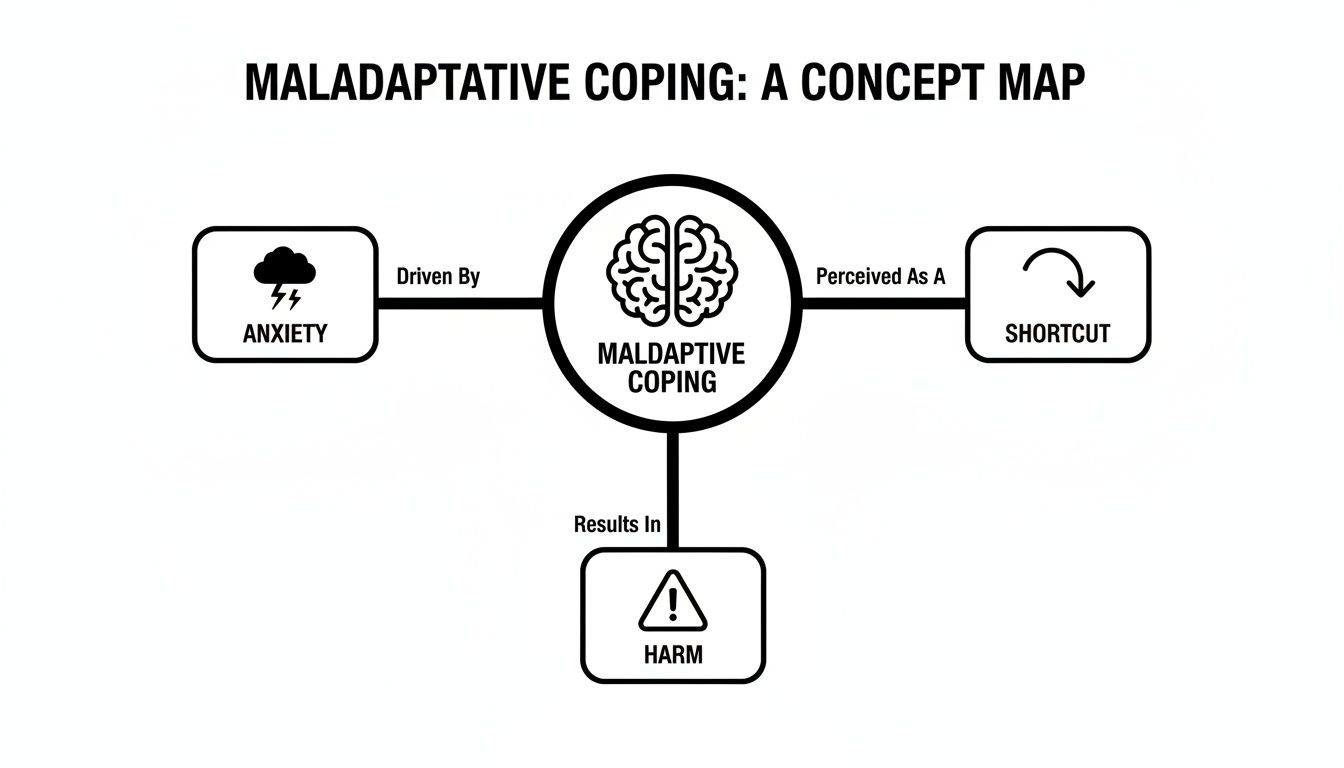
This cycle is fueled by a powerful lie—that relief is just one shortcut away—while hiding the long-term damage it causes.
Common Maladaptive Coping Mechanisms
Let's break down some of the most common anxiety traps. See if any of these feel familiar.
-
Avoidance: This is the big one. It’s not just canceling plans for a party you dread; it’s not opening that important email, putting off a tough conversation, or taking the long way to work just to avoid a specific street. Every time you avoid something, you send a powerful message to your brain: "That thing was truly dangerous, and I was right to be afraid."
-
Rumination: Ever catch yourself replaying a mistake or an awkward conversation on a loop? That’s rumination. It’s like a hamster wheel for your mind—you’re spinning and spinning, putting in a ton of mental effort, but you aren't actually solving anything or getting anywhere.
-
Safety Behaviors: These are the little rituals you perform to feel "safe" enough to face a situation. It might be constantly checking your phone for a reassuring text, always sitting near an exit in a crowded room, or carrying "just in case" medication you don't actually need. These behaviors rob you of the chance to learn that you can handle things on your own.
The ultimate irony of maladaptive coping is that the very actions you take to control anxiety are the ones that give it complete control over your life. Healing begins the moment you decide to stop playing its game.
The "Quieter" Habits That Keep Anxiety Alive
For many people, anxiety isn’t fueled by major addictions but by smaller, more socially acceptable habits. A 2023 study on healthcare workers found that everyday strategies like self-distraction, denial, venting, and self-blame were far more common than substance use for managing distress.
With over half the participants reporting high stress alongside these habits, the findings highlight a clear need for skills that replace numbing with practical action. You can learn more about these coping strategy findings and see just how widespread these patterns are.
These traps often develop in response to specific fears or worries. Identifying your personal triggers is a powerful step in mapping out how and when these coping mechanisms show up for you. Our guide on common anxiety triggers can help you connect the dots between your fears and your reactions.
By honestly identifying these patterns, you take away their power. You move from being a passenger in anxiety's car to grabbing the steering wheel, ready to choose a new, healthier direction. This awareness is where the real hope for change begins.
Understanding the Vicious Cycle of Anxiety

Maladaptive coping skills can feel impossible to break because they’re not just bad habits—they're part of a powerful, self-reinforcing loop. We call this the anxiety cycle.
Think of it like being stuck on a hamster wheel. You run faster and faster, convinced you're getting somewhere, only to find yourself exhausted and in the exact same spot. Understanding how this cycle works is the first real step to finally getting off the wheel and finding freedom.
The cycle itself is deceptively simple, but its grip is incredibly strong. It follows a predictable pattern that can lock you into a state of chronic anxiety, making it feel like there's no way out. But there is a way out, and it starts with understanding the map of the trap.
The Four Stages of the Anxiety Cycle
This vicious pattern always unfolds in four distinct steps, with each one feeding directly into the next. Learning to spot these stages in your own life is the key to finally interrupting them for good.
- The Trigger: It all starts with a trigger. This could be a thought, a feeling, a physical sensation, or a situation that your brain flags as a threat.
- The Anxiety Spike: Instantly, your brain's alarm system blares. You're flooded with intense fear, dread, and panic. It’s deeply uncomfortable, and your only instinct is to make it stop. Now.
- The Maladaptive Response: This is when you reach for your go-to coping tool. You might avoid the situation, start overthinking everything, or engage in a familiar safety behavior.
- The Temporary Relief: For a fleeting moment, it actually works. The anxiety dials down, and a wave of relief washes over you. This relief is a powerful reward, but it teaches your brain a dangerous lesson.
That feeling of relief is the glue holding this entire cycle together. Your brain doesn't care about the long-term cost; it just knows that the avoidance or the rumination made the immediate pain go away.
Every time you complete this loop, the connection between the trigger and your response gets stronger. Soon enough, the habit feels automatic, even necessary.
How Relief Becomes a Trap
Imagine you touch a hot stove. You instinctively pull your hand back to stop the pain. Your brain quickly learns: hot stove = pain = pull away. The anxiety cycle operates on the exact same logic. Your brain learns: anxious thought = pain = avoid.
The problem is, by constantly pulling your hand away, you never teach your brain the most important lesson of all: that you can handle the discomfort. Maladaptive coping mechanisms rob you of the chance to see that the "threat" wasn't nearly as dangerous as your anxiety made it out to be.
By seeking short-term relief, you are accidentally teaching your brain to be more afraid. You are validating the initial fear, ensuring it will come back even stronger the next time.
At its core, this pattern is an internal struggle, a battle fought inside your own mind against fears and self-defeating beliefs. Grasping this fundamental idea of inner turmoil helps shine a light on why we get stuck. To better understand these internal battles, you can explore the concept of man vs self conflict.
But this is also where the real hope comes in. This cycle is a learned process, which means anything that has been learned can also be unlearned.
By making the choice to face the discomfort instead of running from it, you can break the loop. This isn't about becoming fearless overnight. It's about proving to yourself, one small step at a time, that you are far more capable than your anxiety has led you to believe, and a life free from panic is within your reach.
Your Toolkit for Building Healthy Coping Skills
Knowing how the anxiety cycle works is one thing. Actually dismantling it is another. This is where we shift from understanding the problem to building your solution—and where your journey toward a calmer life really begins.
Hope isn't just a feeling; it's an action plan. And this toolkit is your blueprint for healing.
You have the power to replace those old, worn-out habits with new, effective ones. Maladaptive coping mechanisms are learned behaviors. And just like any other habit, they can be unlearned and updated with something that actually works for you, not against you. It all comes down to consciously choosing a different path when anxiety shows up—one that leads to lasting peace instead of a temporary fix.
Trading Avoidance for Action
The single most powerful way to break the anxiety cycle is to stop feeding it. This means stepping away from avoidance, rumination, and procrastination and moving toward active, healthy strategies. Instead of letting anxiety call the shots, you learn to manage the feeling without letting it take over.
These adaptive skills aren't complicated, but they do require practice. They work by teaching your brain a new and powerful lesson: you can handle discomfort.
Here’s how to make the trade:
-
Mindfulness Instead of Rumination: Instead of getting swept away by a tornado of worried thoughts, mindfulness anchors you in the here and now. It’s about noticing your thoughts and feelings without judging them, letting them drift by like clouds. A great starting point is learning some simple breathing exercises for anxiety.
-
Graded Exposure Instead of Avoidance: This just means facing your fears one small, manageable step at a time. If you’re terrified of social events, you don’t have to dive into a massive party. Maybe you start by just texting a friend to grab a coffee. Every small win rewires your brain and dials down the fear.
-
Problem-Solving Instead of Procrastination: When a task feels huge and overwhelming, break it down into the smallest possible pieces. Seriously, make the first step ridiculously easy. Focusing on one tiny part of the puzzle makes it feel doable and builds momentum, turning that feeling of dread into a sense of accomplishment.
Building Healthier Habits in a Distracted World
Actively building these skills is more critical now than ever. Younger generations, for example, often default to digital distractions or sleep aids to cope. One U.S. study found that during the pandemic, 63.9% of Gen Z and 62.9% of Millennials increased their use of sleep aids.
On top of that, 53.5% of adolescents reported using social media excessively as a coping strategy—a pattern directly linked to higher anxiety. These findings underscore the urgent need to replace passive numbing with structured, adaptive skills.
Your future isn't defined by your past coping habits. Every time you choose a healthy strategy over an old, unhelpful one, you are actively building a new, more resilient version of yourself.
This journey is all about empowerment. It’s about realizing you don’t need shortcuts or escape routes because you are more than capable of navigating the path ahead.
For powerful, evidence-based strategies that help you reshape your thought patterns and move away from these automatic reactions, digging into Cognitive Behavioral Therapy techniques is a fantastic next step. You’re not broken; you just need a better set of tools to heal.
Your Path to a Fearless Life Starts Now
Knowing what these coping mechanisms are is a huge first step. But the real game-changer? Believing you can actually change them.
These habits aren’t a life sentence. They’re just patterns you learned along the way. And anything that can be learned can also be unlearned, updated, and replaced with strategies that build you up instead of keeping you stuck in fear.
The journey away from anxiety isn’t some giant, overnight leap. It’s a series of small, intentional choices you make every single day—choosing a moment of mindfulness over hours of rumination, taking a tiny step forward instead of avoiding, and offering yourself some compassion instead of criticism. Each time you choose a healthier way to cope, you cast a vote for a calmer, more empowered future.
Your past does not have to dictate your future. Freedom from panic and chronic anxiety is not a distant dream; it's a series of achievable steps that can begin right now, with one small, brave decision.
This is about reclaiming your life from the grip of fear, one moment at a time. If you’re ready to see what that looks like, we’ve laid out a clear path in our guide to the anxiety recovery steps.
Take that first step today. Your fearless life is waiting.
Questions You Might Be Asking
Changing habits that feel wired into your DNA can bring up a lot of questions. It’s completely normal to feel a little overwhelmed. Let's walk through some of the most common concerns, because clarity is the first step toward building a calmer future.
Remember, this journey is about patience and self-compassion, not perfection. There is always a way forward.
How Long Does It Take to Change a Maladaptive Coping Mechanism?
There's no magic timeline here. Everyone's journey looks a little different. Think of it like building a muscle you haven't used in years—it takes time and consistent effort.
Progress is almost never a straight line. You'll have good days and you'll have challenging ones, and that's okay. The real key is consistency over perfection. If you celebrate the small wins and keep practicing new, healthier strategies, you could start to feel a real shift in just a few weeks. Lasting change, the kind that leads to a life free of panic, builds over several months of dedicated practice.
Can I Overcome These Habits on My Own?
Absolutely. Plenty of people make incredible progress on their own with the right information and practical tools. Real change happens in the small, consistent actions you take every single day, and you are more than capable of putting these strategies into practice.
That said, if your coping mechanisms feel severe—like substance dependency or self-harm—or if anxiety is making it impossible to function, reaching out to a therapist is a sign of incredible strength, not weakness. A professional can offer personalized guidance that often speeds up the healing process.
The most critical step is the first one: awareness without judgment. You cannot change a pattern you don't recognize.
What Is the Very First Step I Should Take?
Just start by gently observing yourself. No judgment, no pressure to fix anything yet. When you feel that spike of anxiety, what’s your immediate gut reaction? Do you grab your phone and start scrolling? Do you ask someone for reassurance again and again?
Keep a simple log in a notebook or on your phone. Just noticing the habit—"Oh, there I go again"—is the foundational step that makes every other change possible. This simple act of awareness is your first, and most powerful, move toward a life free from panic.
Ready to turn understanding into action? The Anxiety Checklist provides a structured, step-by-step system to help you replace these old habits with powerful new skills. Get your comprehensive toolkit at https://anxietychecklist.com and start building your path to a fearless life today.