
Cognitive defusion is a powerful way to put some distance between you and your anxious thoughts. It helps you see them for what they are—just mental chatter, like words or pictures floating through your mind—instead of undeniable truths that have to control your every move. It is one of the most effective tools for finding lasting freedom from anxiety and panic.
Your First Step Toward a Panic-Free Life
If you’ve ever felt trapped by a racing mind or stuck in a loop of anxious thoughts, you know how isolating it can get. The constant "what if" scenarios and self-critical stories feel like an unbreakable reality, hijacking your peace and dictating your life.
But there’s a real, practical path toward freedom, and it starts by changing your relationship with your own thoughts. This isn't about fighting them or forcing yourself to "think positive." It's about learning a skill that lets you step back and simply observe them without getting tangled up in the drama. This is not just a coping mechanism; it's a way to heal.
This skill is a cornerstone of Acceptance and Commitment Therapy (ACT), a proven way to manage anxiety. It empowers you to live a full life, even when difficult thoughts show up. You are not your anxiety, and you don't have to be a prisoner to your mind. A calm, panic-free life is entirely possible for you.
You Are Not Your Thoughts
One of the most liberating moments in anxiety recovery is realizing that you are the observer of your thoughts, not the thoughts themselves.
Imagine your mind is like a radio, constantly playing music. Some songs are happy, some are sad, and some are just noise. Cognitive defusion teaches you that you don't have to dance to every single song. You can notice the tune without letting it take over your entire day. This simple shift in perspective is the first real step toward lasting peace and a hopeful future.
Anxious thoughts are not commands you must obey; they are merely suggestions your mind offers. The power lies in realizing you have the choice not to act on them.
And this approach works. Cognitive defusion, a key technique from Acceptance and Commitment Therapy (ACT), helps people detach from their anxious thoughts by seeing them as just words, not literal truths. In fact, experimental research shows that even a brief defusion session can reduce how much you believe a thought and can slash distress in up to 27% of cases. You can dive deeper into these findings in a comprehensive doctoral thesis on the subject.
By practicing these skills, you can break the cycle of panic and avoidance. You can start building a life driven by your values, not your fears. To see how this fits into a bigger strategy, check out our guide on the essential steps for anxiety recovery.
Cognitive Fusion Versus Defusion Explained
Have you ever felt like your anxious thoughts are glued to you, dictating every feeling and action? That sticky, tangled state has a name: cognitive fusion.
It’s that moment your mind says, "This meeting will be a disaster," and you believe it so completely that your heart starts pounding as if the disaster is already happening. When we're fused with our thoughts, we see the world through them, not just with them. They stop being just mental events and become our reality.
This fusion is the engine behind anxiety's power. It convinces us that every worrisome thought is an urgent command or an undeniable fact.
But this is where the hope for a panic-free life begins. The opposite of fusion is cognitive defusion—the skill of creating a small pocket of space between you and your thoughts. It’s about learning to step back and observe your mind's chatter without getting caught in the storm. This is a skill you can learn, and it is the key to your healing.
Unhooking from Anxious Thoughts
Think of it this way: cognitive fusion is like having your face pressed up against a movie screen, completely lost in the drama. Defusion is taking a few steps back into a seat, where you can see the screen for what it is—just a projection of images and sounds.
The movie is still playing, but it no longer feels like it's happening to you.
This simple flowchart illustrates that mental process—creating that crucial space between yourself and the anxious thoughts your mind produces.
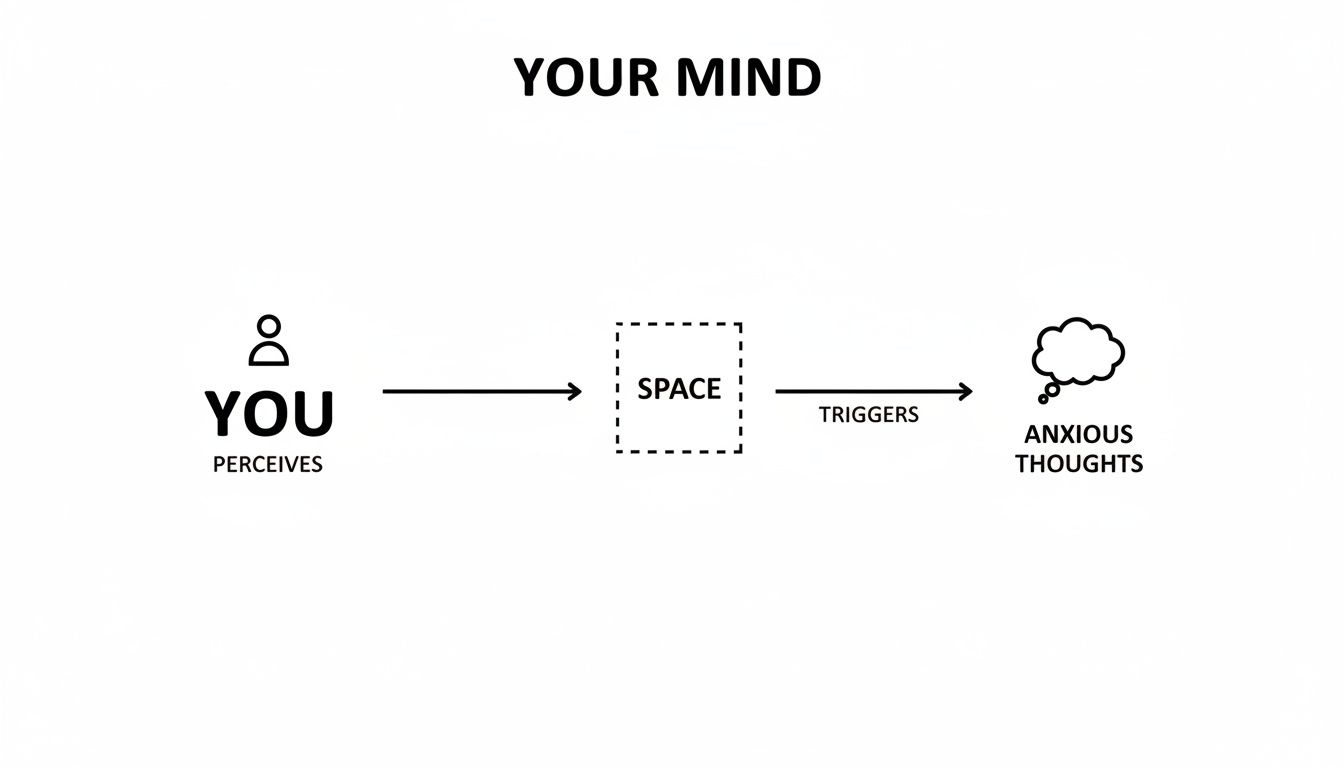
As the visualization shows, defusion gives you the room to notice your thoughts without automatically getting tangled up in them. This creates the freedom to choose how you respond, paving the way for a calmer, more peaceful life.
Anxious thoughts often show up as specific, unhelpful thinking patterns. You can learn to spot these by exploring our guide on common cognitive distortions.
Cognitive defusion isn't about getting rid of unwanted thoughts. It's about reducing their impact on your behavior so you can get back to living your life.
This mindset shift from being stuck in your thoughts to observing them from a distance is the key to loosening anxiety's grip and finally feeling free.
From Being Fused to Feeling Free: A Mindset Shift
The difference between being fused with a thought and being defused from it is night and day. It changes how you see your thoughts, your role in relation to them, and ultimately, the kind of life you can lead. The table below breaks down this powerful shift.
| Characteristic | Cognitive Fusion (Stuck) | Cognitive Defusion (Unstuck) |
|---|---|---|
| View of Thoughts | Thoughts are absolute truths and commands. | Thoughts are just mental events—words and pictures. |
| Your Role | You are your thoughts; you are inside them. | You are the observer of your thoughts; you notice them. |
| Response | Automatic reaction, avoidance, and struggle. | Mindful observation and chosen, valued action. |
| Impact on Life | Life becomes smaller, ruled by fear and anxiety. | Life expands, guided by your values, not your fears. |
Moving from the "Stuck" column to the "Unstuck" one isn't about silencing your mind—it's about changing your relationship with it. And that simple change makes all the difference in healing from anxiety.
How Defusion Rewires Your Brain for Calm
Practicing cognitive defusion isn't just a clever mental trick. It’s a way to fundamentally change your relationship with anxiety and, over time, actually rewire your brain for calm. There is incredible hope in knowing that you have the power to create new neural pathways for peace.
Every time you manage to step back from an anxious thought, you weaken its automatic grip on you. You're building a new neural pathway—one that leads to intentional action instead of reflexive fear.
This practice builds a powerful skill called psychological flexibility. Think of it as a mental superpower that lets you stay present and act on your values, even when difficult thoughts and feelings show up.
It's the difference between feeling anxious but still giving the presentation, or hearing self-doubt but still going to the party.
When you're fused with a thought like, "No one will talk to me," the predictable result is avoidance. You stay home. Your world gets a little smaller. Defusion breaks that cycle, giving you the freedom to choose your actions based on what matters to you, not just what your anxious mind is screaming. This is how you reclaim your life.
Building Resilience One Thought at a Time
Cognitive defusion shifts you from being a passenger on a runaway train of thoughts to being the conductor—someone who can observe the scenery and choose the next stop. This shift is what builds true resilience against anxiety and panic.
And this isn't just a nice idea; it’s a measurable process. A randomized trial on cognitive defusion techniques showed a dramatic drop in how fused people were with their thoughts.
Participant scores fell from 34.37 to 23.40 after the intervention—that’s an 82.1% effect size improvement. This ability to detach from thoughts that fuel panic was highly significant compared to a control group, showing a clear path toward managing chronic anxiety and living a healed life.
The goal isn't a quiet mind, but a flexible one. A flexible mind can hold anxiety and still move toward a meaningful life, offering a genuine and sustainable path to living panic-free.
Over time, this process helps calm your body's internal alarm system. When you stop reacting to every anxious thought as if it's a real and immediate threat, you teach your nervous system that it doesn’t need to trigger a full-blown emergency.
If you want to understand this biological reaction better, you can read our guide on the fight or flight response.
While defusion offers a powerful mental pathway to a calmer mind, some people also find that dedicated relaxation services, like a Signature Mind Unwind, help them find a sense of peace. Ultimately, creating lasting calm is about finding the right combination of tools that work for you.
Simple Defusion Exercises You Can Use Today
Knowing the theory is one thing, but putting it into practice is where your healing journey truly begins. The goal here isn't to get rid of anxious thoughts—it's to change your relationship with them.
These exercises are your in-the-moment toolkit. You don't need anything special to get started, just a willingness to observe your mind without getting tangled up in its stories. They’re designed to be simple, practical, and effective, helping you unhook from worry and get back to living your life.
Think of it this way: the goal isn't to silence the noise, but to learn how to not let it run the show. Here are four proven techniques you can try right now.
1. Label Your Thoughts
One of the fastest ways to create a little breathing room between you and your anxiety is to simply name what your mind is doing. Instead of being in the thought, you become the person noticing the thought.
This subtle shift in perspective can be incredibly powerful and hopeful.
- How it works: When a worried thought pops up, just stick this phrase on the front of it: "I'm having the thought that…"
- For example: The thought "I'm going to fail this presentation" becomes, "I'm having the thought that I'm going to fail this presentation." Feel that? It’s a small change, but it turns a supposed fact into just another piece of mental chatter.
This technique acknowledges the thought is there without stamping it as "true." It’s like noticing a cloud passing in the sky. You see it, you recognize it's a cloud, but you know you are not the cloud.
2. Use a Silly Voice
Anxious thoughts get a lot of their power from their tone. They often sound serious, urgent, and incredibly believable. This exercise pulls the rug out from under them by changing how they sound, which often makes their content seem almost absurd.
Here's how to deflate an anxious thought:
- Catch the thought: Notice a sticky, repetitive thought like, "I'm not good enough" or "Something awful is about to happen."
- Pick a voice: Think of a cartoon character, a ridiculously posh accent, or maybe even an over-the-top opera singer. The sillier, the better.
- "Hear" the thought in that voice: Now, replay the anxious thought in your head using that voice. Imagine Bugs Bunny saying, "Ehh, what's up, doc? I'm not good enough!"
When you hear that critical inner voice sounding completely ridiculous, the message loses its sting. It reminds you that thoughts are just words strung together, and you can choose not to take them so seriously. This small bit of humor can be a giant step toward freedom.
3. Thank Your Mind
Let's be honest: fighting with your mind is exhausting, and it usually just makes the thoughts louder. A much gentler and surprisingly effective approach is to simply acknowledge your mind's effort and then get back to your day. After all, your brain is just trying to protect you, even if its methods are a bit… outdated.
Think of your mind like an overeager puppy that keeps bringing you a soggy, dirty stick. You don't have to yell at it. You can just say, "Thanks for the stick!" and gently set it aside.
This simple act of acknowledgment stops the internal tug-of-war.
- How it works: When your mind starts its usual anxious routine, just say to yourself, "Thank you, mind."
- For example: Your brain screams, "You're going to completely embarrass yourself!" You can respond internally with a calm, "Thank you, mind, for looking out for me," and then gently shift your attention back to what's in front of you. If you need more help anchoring in the present, our guide on grounding techniques for anxiety has some great tools.
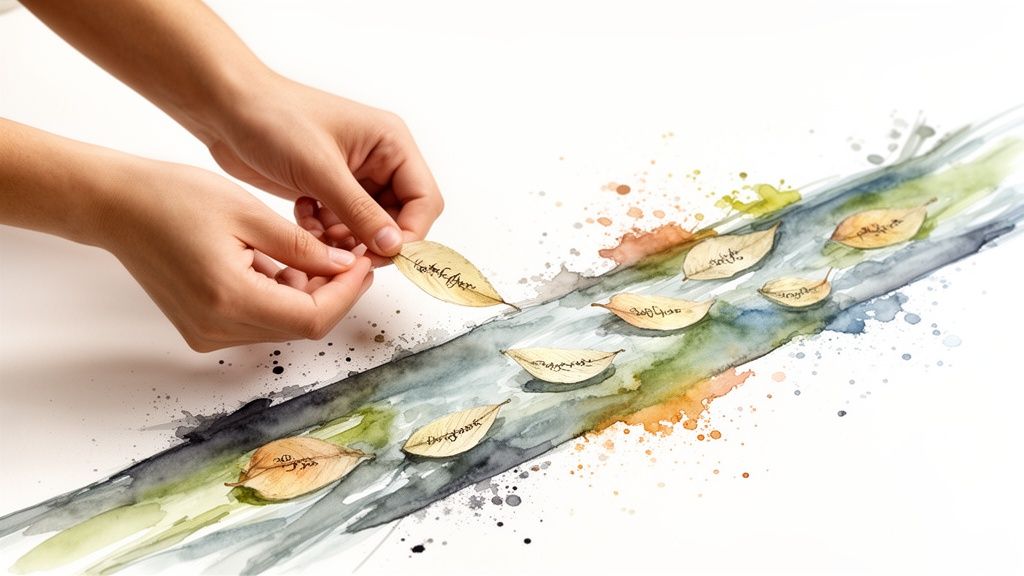
4. Leaves on a Stream
This is a classic visualization exercise that perfectly captures the essence of cognitive defusion. It's all about practicing the skill of letting thoughts come and go without grabbing onto them, judging them, or following them down a rabbit hole.
Here’s how to do it:
- Find a comfortable spot: Sit down, close your eyes if you feel comfortable, and take a couple of slow, deep breaths.
- Picture a stream: Imagine yourself sitting beside a gentle, flowing stream. The water is moving at a steady, unhurried pace.
- Watch the leaves float by: Notice leaves of all shapes and colors drifting along on the surface of the water.
- Place your thoughts on the leaves: As thoughts, feelings, or sensations pop into your mind, gently place each one on a leaf. A worry, a memory, a judgment—it doesn't matter what it is.
- Let them go: Watch as the stream carries the leaf and its thought away, downstream and eventually out of sight. Don't try to push the leaf or speed it up. Just observe it floating away on its own.
The point isn't to have an empty mind. Thoughts will keep coming, and that's okay. The practice is in letting them pass by without getting swept away by the current. Each leaf that floats by is a small victory on your path to healing.
Making Defusion a Daily Habit for Lasting Peace

Knowing how to use a few defusion exercises is a great start. But the real, life-changing results happen when you move beyond using these skills as an emergency rescue and start weaving them into the fabric of your everyday life.
Think of it this way: defusion isn’t just a fire extinguisher for panic. It’s daily mental hygiene. The goal is to build the mental muscle to notice and handle anxious thoughts long before they have a chance to spiral out of control.
When you practice defusion during calm moments, you’re basically running drills for your brain. This consistency builds deep resilience, so when panic does try to creep in, your mind already knows the moves. This is how you build a life that is no longer defined by anxiety.
From Rescue Tool to Daily Routine
Here’s the good news: integrating defusion into your life doesn’t require hours of meditation. It’s all about finding small, repeatable moments to practice. The key is to start small and make it feel almost effortless.
Here are a few practical ways to get started:
- Morning Mind Check-In: Before your feet even hit the floor, take 60 seconds to just notice what your mind is up to. Label the thoughts gently—"Ah, a worry thought," or "There's the planning mind again"—without getting pulled into the story.
- "Thought of the Day" Journal: At the end of the day, jot down one sticky, unhelpful thought that showed up. Acknowledge it, thank your mind for trying to protect you, and then mentally let it go.
- Set Mindful Reminders: Use your phone or a sticky note to pop a simple question throughout the day: "What’s my mind telling me right now?"
These tiny actions, repeated daily, create a profound shift. You’re gently training yourself to be the observer of your mind, not a prisoner of its chatter.
Lasting freedom from anxiety isn't about winning a single, epic battle against your thoughts. It's about winning thousands of tiny, quiet moments by choosing not to get tangled up in them.
Building Your Foundation with Mindfulness
Mindfulness is the soil where cognitive defusion grows best. It's the simple act of paying attention to the present moment without judgment—noticing your breath, the feeling of your feet on the floor, or the sounds around you.
Practicing mindfulness strengthens the exact muscle you need for defusion: the ability to notice thoughts without immediately reacting to them. You’re creating a calm inner space you can return to when anxiety flares up, which makes it much easier to apply defusion techniques when you need them most.
By consistently practicing these skills, you build a life guided by your values, not your fears. For a structured way to apply this to your recovery, check out our guide on setting SMART goals for anxiety recovery.
Got Questions About Cognitive Defusion?
This skill can feel a bit abstract at first, so let’s clear up a few things. Getting these answers straight will help you start applying these ideas to your own life and move closer to lasting peace.
Is Cognitive Defusion Just a Fancy Term for Positive Thinking?
Absolutely not, and this is a really important distinction to make.
Positive thinking often forces you to fight with a negative thought, trying to wrestle it into submission and replace it with a positive one. It can feel like an exhausting, unwinnable war inside your own head.
Cognitive defusion, on the other hand, doesn’t try to change your thoughts at all. It changes your relationship with them. It’s about letting an anxious thought float by without grabbing onto it and letting it drag you under. It’s about noticing, not fighting. This gentle approach is what makes it so effective for long-term healing.
How Quickly Can I Expect to See Results?
You might feel a small flicker of relief the very first time you try an exercise like labeling your thoughts. That tiny sliver of space between you and the anxiety can be incredibly empowering and a sign of the hope to come.
But the real, life-changing power comes from consistent practice. Think of it like building a muscle—the more you do it, the stronger you get. Using these techniques regularly helps you unhook from anxious thoughts faster and more automatically over time, building a solid foundation for a panic-free life.
The goal isn’t to instantly silence your mind. It’s to gradually turn down the volume on your thoughts so they no longer dictate your actions. That's where real healing begins.
Can I Really Use This During a Full-Blown Panic Attack?
Yes, and that’s one of the most important times to try. I know it’s incredibly challenging in the heat of the moment, but even a simple technique can create a crucial gap between you and that overwhelming wave of fear.
Just labeling a thought—"I'm having the thought that I'm in danger"—reminds you that a thought is not a fact, even when it feels intensely, terrifyingly real.
The trick is to practice when you're calm. That way, the skill becomes second nature and is much easier to access when you need it most. It becomes a reliable tool you can pull out to face down panic, giving you the power to navigate even the most intense moments and come out the other side. You can heal.
Are you ready to stop letting anxiety run your life? The tools in this guide are just the beginning. The Anxiety Checklist system provides a complete, step-by-step roadmap to build resilience, manage panic, and create a truly fearless life. Start your journey toward lasting peace today at https://anxietychecklist.com.