If you’re constantly battling worry, panic, or a feeling of being overwhelmed, I want you to know there’s profound hope. The path to a calmer, panic-free life begins with one simple, powerful idea: you can learn to work with your body, not against it, to find a lasting sense of peace.
This whole process starts by understanding what “nervous system regulation” really means.
In short, nervous system regulation is learning how to intentionally guide your body from a state of high-alert anxiety back to a state of calm and safety. It’s about understanding your internal wiring so you can better manage feelings of panic, overwhelm, and fear. This isn't just about coping; it's about healing.
This isn’t about trying to eliminate stress altogether. It’s about building the resilience to move through it without getting stuck, proving to yourself that a life with less panic is not just possible—it's achievable.
Your Path From Anxiety To Calm Starts Now
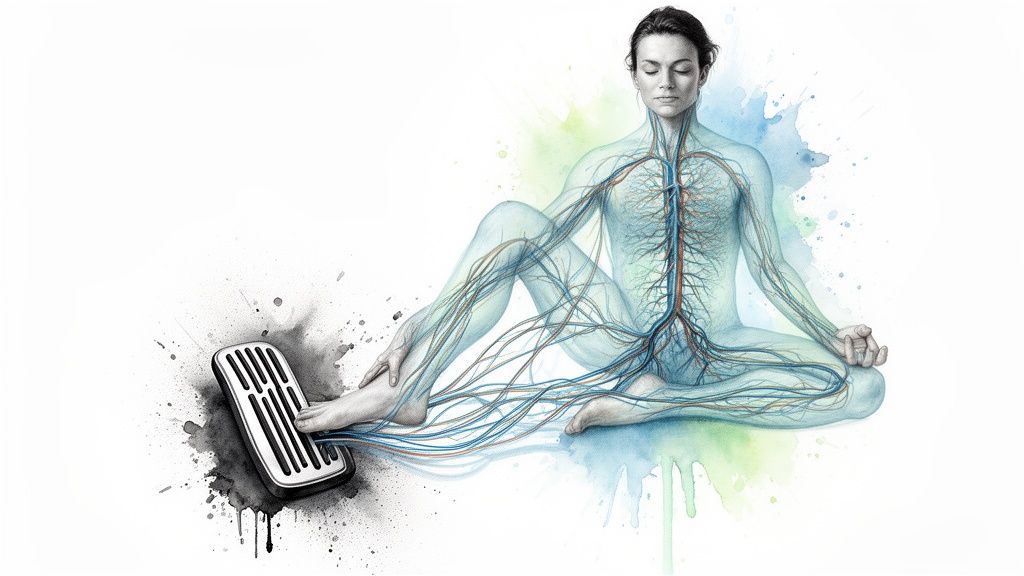
Think of your nervous system like a car. It has an accelerator and a brake, and both are essential for getting you where you need to go.
The accelerator is your sympathetic nervous system. It’s the "fight-or-flight" system that revs you up when it senses danger—real or perceived. The brake is your parasympathetic nervous system, which helps you slow down, "rest-and-digest," and recover when the threat is gone.
For so many people struggling with anxiety, it feels like the accelerator is jammed to the floor, leaving you stuck in a constant state of high alert. Nervous system regulation is simply learning how to gently and consciously apply the brakes, giving you back control.
To get a clearer picture, here’s a quick breakdown of your nervous system's two primary modes.
Your Nervous System's Two Key Modes
| System | Nickname | Primary Role | Felt Experience with Anxiety |
|---|---|---|---|
| Sympathetic | "Fight-or-Flight" | Mobilizes the body for action and survival. | Racing heart, shallow breathing, tense muscles, feeling "on edge." |
| Parasympathetic | "Rest-and-Digest" | Calms the body down and conserves energy. | Deep breaths, relaxed muscles, feeling grounded and safe. |
When your system is regulated, you can switch between these two modes smoothly. But when it’s dysregulated, you get stuck in "fight-or-flight," even when there’s no real danger. This is something you can learn to change.
Understanding Your Body's Signals
This isn’t about fighting your anxiety with brute force. It's about getting curious about its physiological roots and using practical tools to find your way back to balance. When your system feels dysregulated, it’s not a sign of weakness. It’s just a signal that your body's alarm system is working overtime to protect you. The key is to learn its language and gently guide it back to safety.
Feeling this way is far more common than you might think. Anxiety disorders, which are a prime example of chronic nervous system dysregulation, affect 4% to 5% of the global population at any given time. That’s hundreds of millions of people. You can explore the data on global anxiety rates to see just how widespread this is.
This makes it one of the most common mental health challenges worldwide—and one that often goes unsupported because there just aren't enough trained professionals to go around. This is why accessible, self-guided tools that empower you to take an active role in your own healing are so critical for finding a way forward.
The goal is not to eliminate your body's stress response—it's a vital survival tool. Instead, the goal is to build flexibility, so you can move from a state of high alert back to a state of safety with greater ease and confidence. This is the foundation of a panic-free life.
This journey starts right now, with the foundational knowledge that you are not broken. Your body is already equipped with everything it needs to heal. The sections that follow will give you a clear map, showing you exactly how to navigate your inner world and use your body’s own mechanisms to find the calm you deserve.
You have the capacity to feel safe and grounded again.
Understanding the Map of Your Inner World
Before you can learn to regulate your nervous system, you need a map of your inner world. Think about it: you can’t navigate a new city without knowing the key districts. The same goes for your body’s responses. To get a handle on them, you first have to know the core "states" your nervous system operates from.
This goes way beyond the simple "fight-or-flight" response we hear about all the time. A much more detailed and compassionate map comes from Polyvagal Theory, which is a game-changer for explaining why you feel the way you do during moments of stress, connection, or total overwhelm. It demystifies your reactions, turning confusion into clarity and self-judgment into self-awareness.
This map shows that your body is constantly shifting between three main states, each with a very specific survival purpose. Learning to identify which one you're in is the first crucial step toward consciously guiding yourself back to a feeling of safety.
The Three Core States of Your Nervous System
Your autonomic nervous system is always on the job, working behind the scenes to keep you safe. It automatically adjusts your internal state based on cues from your environment—both the obvious and the subtle ones. These automatic adjustments are what create the feelings you experience every single day.
The Social Engagement State (Ventral Vagal): This is where you want to be, and where you can return to. It's your state of safety and connection. When you're here, you feel grounded, calm, and open to interacting with others. Your breathing is steady, you can make eye contact without feeling weird, and you feel capable of handling whatever life throws at you. This is the state where real healing and recovery happen.
The Mobilized State (Sympathetic): This is the familiar fight-or-flight mode. When your brain perceives a threat—real or imagined—it floods your body with adrenaline and cortisol. Your heart races, your muscles tense up, and your focus narrows to a pinpoint. This state is designed for taking action and is absolutely essential for survival, but it becomes exhausting and draining when you get stuck in it.
The Shutdown State (Dorsal Vagal): What happens when a threat feels too overwhelming to fight or run from? Your nervous system has an ancient, last-resort survival strategy: immobilization or shutdown. This can feel like numbness, disconnection, exhaustion, or being completely "frozen." It’s a protective mechanism designed to conserve energy and help you endure a situation that feels inescapable.
Many people who struggle with panic attacks and anxiety find themselves bouncing between the mobilized (Sympathetic) and shutdown (Dorsal Vagal) states. They rarely get to experience the calm and ease of the Social Engagement state. But the hopeful truth is, you can learn to spend more time there.
This infographic gives you a simplified look at the two key systems that either push you into action or pull you back into calm.
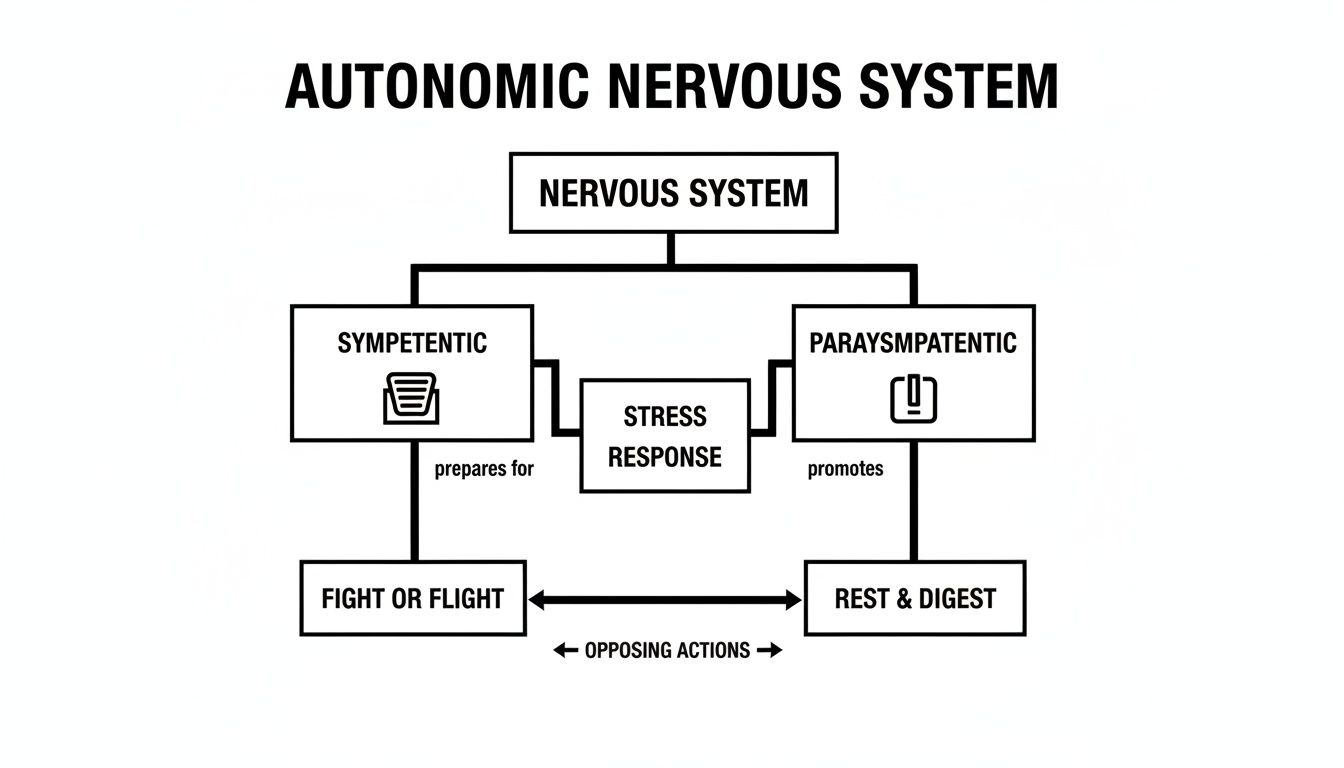
It illustrates the constant dance between your body's accelerator (Sympathetic) and its brake (Parasympathetic)—a dance you can absolutely learn to influence.
From Science to Lived Experience
Understanding these states is profoundly empowering because it completely reframes your experience. That sudden jolt of panic? That's your Sympathetic system kicking into high gear. The heavy, bone-deep exhaustion that follows a day of high anxiety? That’s often your Dorsal Vagal system taking over to conserve energy.
These are not character flaws or personal failures. They are predictable, physiological responses from a nervous system that is trying its best to protect you.
When you really get this, you can stop blaming yourself for feeling anxious or overwhelmed. You can start seeing your reactions for what they are: signals. They're just information your body is giving you about its current state. You can learn more about how the body reacts to perceived threats in our detailed guide on the fight-or-flight response.
This knowledge is the foundation for hope. It means your feelings make sense. And because they're tied to physiological processes, they can be influenced. You can learn techniques to gently signal safety to your body, helping it move out of those survival modes and back into the calm, connected state of Social Engagement. To gain a deeper understanding of the systems at play in your emotional responses, exploring resources on limbic system retraining can be very insightful.
This is the very heart of nervous system regulation: learning to read your inner map and skillfully navigate your way back to safety, one small step at a time. It's a journey that proves a life with less panic isn't just possible—it's achievable.
Recognizing the Signs of a Dysregulated System
Your body is constantly talking to you, sending signals about your internal state. When you're wrestling with anxiety, it can feel like these signals are just chaotic, overwhelming alarms.
But what if you could learn to see them not as proof that you’re broken, but as intelligent messages from a system that is simply stuck in survival mode? This shift in perspective is the first—and most powerful—step toward healing.
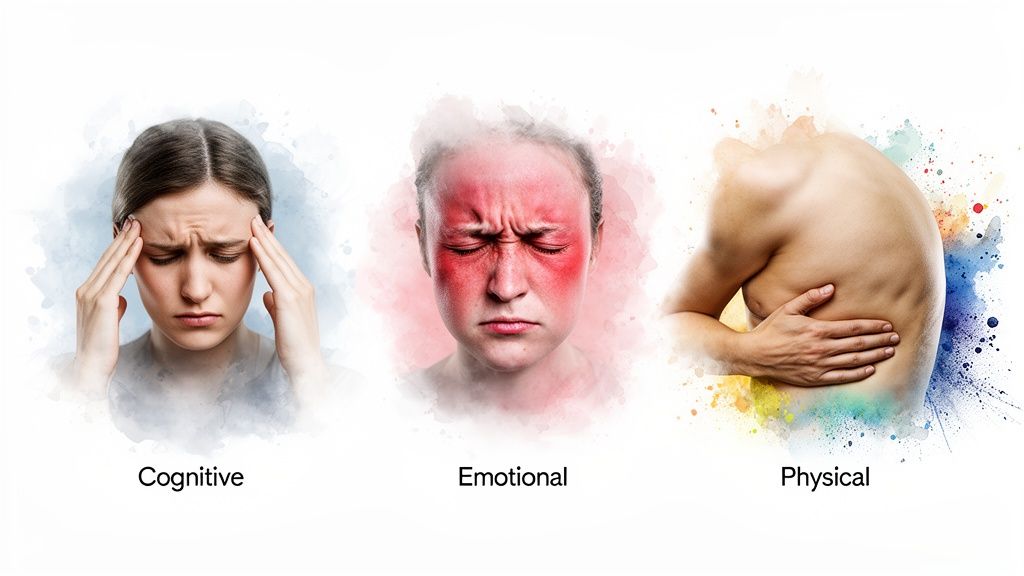
Learning to decode these signals is the key to understanding what nervous system regulation truly is and how to get there.
When your system is dysregulated, it means you're stuck on "high alert" (sympathetic) or in a state of shutdown (dorsal vagal), even when there's no real danger around. This isn't a personal failing; it's just your body's ancient survival programming working overtime.
The goal is to start recognizing these patterns across your physical, emotional, and cognitive experiences—without judgment. It’s how you begin to listen with compassion instead of fear.
Physical Signals of Dysregulation
Often, the clearest signs that your nervous system is overwhelmed show up in your body. Because the mind and body are so deeply connected, chronic stress takes a direct toll on your physical well-being.
These aren't "just in your head"; they are real, physiological responses.
- Chronic Fatigue: A deep, persistent exhaustion that sleep just can’t seem to fix. This can be a sign your body is stuck in a low-power shutdown state.
- Digestive Issues: Problems like indigestion, IBS, or frequent stomach upset are incredibly common. When you’re in survival mode, your "rest-and-digest" system is knocked offline.
- Muscle Tension and Aches: Unexplained aches, frequent headaches, or a constantly tight jaw and shoulders are classic signs that your body is braced for a threat that never arrives.
- Sleep Disturbances: Trouble falling asleep, staying asleep, or waking up feeling completely unrested are hallmarks of a system that can’t find its "off" switch.
Think of these physical signs as your body's way of waving a big red flag, telling you it needs help finding its way back to safety.
Emotional and Cognitive Warning Signs
Dysregulation also profoundly reshapes how you feel and think. When your nervous system is stuck on high alert, your emotional landscape and mental clarity can feel like a battleground.
You might feel like your mind is betraying you, but it’s actually just reflecting your internal physiological state.
Recognizing these patterns is not about diagnosing a flaw. It is about gathering crucial information. Each sign is a clue that empowers you to respond with care, guiding your body back toward balance and proving that a panic-free life is within reach.
Common emotional and cognitive signs include:
- Heightened Anxiety or Dread: A persistent feeling of worry, fear, or hypervigilance that seems to have no specific cause.
- Irritability or Anger Outbursts: Feeling easily agitated or having a "short fuse" can happen when your system is primed for a fight.
- Brain Fog and Confusion: Difficulty concentrating, making decisions, or remembering things is a sign your brain's resources are being diverted to survival tasks.
- Racing Thoughts: An overthinking mind that won't shut down, often spiraling into worst-case scenarios.
If these experiences sound painfully familiar, you are far from alone. Many people wonder if their level of worry points to a bigger issue.
For a clearer picture, you can explore tools like the GAD-7, a respected screening test for Generalized Anxiety Disorder. Learning to identify your own unique patterns is the most empowering step you can take. It’s the beginning of reclaiming your sense of well-being from the inside out.
Practical Techniques to Reclaim Your Calm
Knowledge is great, but real change happens when you put that knowledge into action. This is where you learn to actively talk to your body in a language it understands—the language of sensation, breath, and movement. These aren't complicated theories. They're simple, powerful practices you can use anytime, anywhere, to guide your nervous system back to a state of safety.
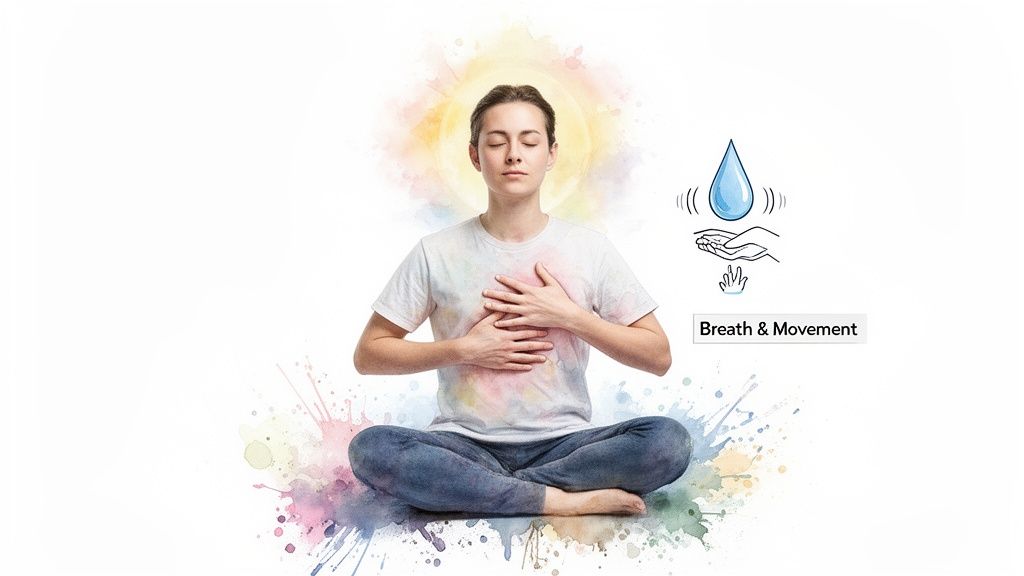
The idea is to build your own personal toolkit. Experiment with these techniques and find what feels right for you. This isn't just about feeling better in the moment; it's about building confidence and proving to yourself that you have the power to influence how you feel. That's real hope.
Breathwork: The Body's Brake Pedal
The quickest, most direct way to influence your nervous system is through your breath. When you intentionally change your breathing pattern, you send a powerful, immediate signal to your brain that says, "I'm safe." This is what flips the switch on your parasympathetic "rest-and-digest" response.
One of the most effective techniques out there is the Physiological Sigh. Your body actually does this automatically to release tension and reset. The cool part is, you can do it on purpose to find calm when stress is high.
- Step 1: Take a deep inhale through your nose.
- Step 2: Right when you think your lungs are full, take another quick, sharp sip of air to expand them just a little bit more.
- Step 3: Now, let it all go with a long, slow, complete exhale through your mouth. Make it last longer than the two inhales combined.
Just two or three rounds of this can make a world of difference. It efficiently offloads carbon dioxide and literally relaxes your nervous system. For more ways to use your breath as a tool, check out our full guide on breathing exercises for anxiety.
Somatic Practices: Releasing Stored Tension
Anxiety and stress aren't just in your head—they get trapped in your body as physical tension. Somatic (body-based) practices help you release that stored energy, which signals to your body that the threat has passed and the stress cycle is complete.
A surprisingly simple yet powerful practice is shaking. Wild animals do this instinctively after a stressful encounter to discharge adrenaline. You can do the exact same thing.
- Stand with your feet about shoulder-width apart, knees soft.
- Start by gently shaking your hands, then let it move into your arms and up into your shoulders.
- Allow the shaking to move through your whole body—your torso, your legs—for a minute or two. Try to let go of feeling self-conscious and just focus on the sensation of release.
When you're done, stand still for a moment. Notice the tingling or the sense of calm that follows. That's your nervous system settling back down.
Sensory Grounding: Anchoring in the Present
When your mind is racing with anxious thoughts, sensory grounding is your ticket out of your head and back into the present moment. By using your five senses, you anchor yourself to the "here and now," which your nervous system reads as safety.
A dysregulated nervous system is often stuck in the past (rumination) or the future (worry). Grounding techniques bring you back to the safety of the present moment, interrupting the cycle of anxiety.
One of the most effective sensory tools is cold exposure. You don’t need a full-on ice bath. Simply splashing cold water on your face or holding an ice cube can trigger what’s known as the "mammalian dive reflex." This physiological response instantly slows your heart rate and redirects blood flow, creating a powerful calming effect.
If you're looking to actively train your body to better manage stress, exploring something like biofeedback therapy can also be incredibly helpful, as it teaches you how to consciously control bodily functions you thought were automatic.
These tools are living proof that you are not powerless against anxiety. In fact, proactive strategies for nervous system regulation have a massive impact on our health. Research shows that from 1990 to 2021, a better understanding of how to manage neurological conditions led to a 33.6% drop in age-standardized death rates. This incredible progress shows just how much consistent practice—much like the techniques taught in programs like The Anxiety Checklist—can lead to significant, life-changing results.
By practicing these techniques, you're not just coping. You're actively retraining your nervous system, building new pathways for resilience, and proving to yourself—one breath at a time—that a calm, panic-free life is absolutely within your reach.
Building Your Daily Regulation Practice
Living a panic-free life isn't about finding a magic bullet or a one-time fix. The real secret is much simpler: consistent, daily practice.
This is where all the techniques we've talked about stop being isolated actions and start becoming a genuine habit of self-care. It’s about intentionally carving out small moments in your day to regulate your nervous system, gradually building a new baseline of calm and resilience.
This isn't a journey of perfection. It’s about progress, patience, and proving to yourself—day by day—that you have the power to influence how you feel. By setting up a simple routine, you turn abstract concepts into a concrete, personalized plan for getting better.
From Theory to a Tangible Plan
The best way to build a new habit is to make it visible and intentional. This is where a framework like The Anxiety Checklist becomes an indispensable ally. It’s the difference between knowing what to do and actually doing it—and then seeing the results for yourself.
A simple tracking system turns you into a detective of your own nervous system. You’ll start noticing patterns, pinpointing your triggers, and—most importantly—discovering which regulation tools actually bring you the most relief. This isn't just about ticking boxes; it's about gathering personal data that proves your efforts are making a difference, which builds incredible momentum and hope.
True healing comes from showing up for yourself consistently, even in small ways. Each time you choose a regulation practice, you are casting a vote for a calmer future and reinforcing the belief that you can live a life free from panic.
By tracking your progress, you create tangible proof of your journey. You can look back and see how far you've come, celebrating the small wins that add up to significant, life-altering change.
How to Weave Regulation into Your Day
You don’t need to overhaul your entire schedule. It's about finding small, strategic pockets of time to send those crucial signals of safety to your body. Think of it as creating intentional pauses in a world that’s always pushing you to go faster.
Here are a few practical examples of what this could look like:
- Schedule 'Regulation Breaks': Just like a meeting, block out two 5-minute slots in your workday. Use one for a few rounds of the physiological sigh and the other for a quick grounding exercise, like just feeling your feet on the floor.
- Create a Wind-Down Ritual: Before bed, dedicate 15 minutes to something that soothes your nervous system. This could be some gentle stretching, listening to calming music, or trying a short, guided meditation. For those interested in going deeper, you can learn more about how meditation can ease anxiety here.
- Anchor Practices to Existing Habits: Link a new regulation habit to something you already do every day. For instance, while your morning coffee is brewing, do a minute of shaking to release any tension stored up from the night.
This approach isn’t just about putting out fires; it’s about proactively building a more resilient, regulated nervous system from the ground up. It’s a compassionate, data-informed strategy that puts you back in the driver's seat of your own healing, proving that a peaceful, panic-free life isn't just a dream—it's an achievable reality.
Your Future Beyond Anxiety Is Within Reach
Starting the journey to understand your own nervous system isn’t just some intellectual exercise—it's one of the most profound acts of self-compassion you can undertake. It’s the first real step toward a future where you feel in control, grounded, and free from the constant threat of panic. Your body isn't broken. It's brilliantly designed for healing, and you have the power to guide it there.
The most powerful truth to hold onto is that your body's intense responses are not your fault. They are intelligent, protective mechanisms that have simply gotten stuck in overdrive. When you learn to listen to these signals with curiosity instead of fear, you can start to gently guide yourself back to a state of safety.
This process is about so much more than just “managing” anxiety symptoms. It's about unlocking a life filled with more presence, more joy, and more meaningful connection. It’s about having the energy to chase your goals and the inner calm to actually enjoy the quiet moments in between.
It's a Journey of Progress, Not Perfection
Healing isn't a straight line with a finish line you cross once and for all. It’s a journey of progress, marked by small, consistent steps that build resilience over time. There will be good days and challenging days. But with the right knowledge and tools, you’ll be equipped to navigate them all with a growing sense of confidence.
A life where you feel in control and free from the constant grip of panic is not just a distant dream—it is absolutely achievable. You are capable, you are resilient, and your future can be calm.
Mastering this skill has never been more critical. In 2021, neurological disorders became the leading global cause of illness, impacting a staggering 3.4 billion people—or 43% of the world's population. This number isn't meant to scare you; it's meant to show you why learning to regulate your nervous system isn't just self-help. It’s a vital practice for long-term well-being, turning an overwhelming statistic into your personal story of recovery. You can read the full analysis of this global health challenge to learn more.
Each time you practice a grounding technique or take a mindful breath, you are actively rewiring your nervous system for safety. You are proving to yourself, moment by moment, that you can always return to a state of balance. This is the foundation of a hopeful, peaceful future that you not only deserve but can actively create for yourself.
Frequently Asked Questions
It's natural to have questions when you start exploring something as personal as your own nervous system. Below are answers to a few common ones we hear, meant to clear things up and remind you that a calmer, more grounded life is well within your reach.
How Long Does It Take to Regulate Your Nervous System
This is probably the most common question people ask, and for good reason. The honest answer? Learning to regulate your nervous system is a lifelong practice, not a one-and-done fix. Think of it less like a project with a deadline and more like learning to play an instrument—it becomes more natural and intuitive the more you practice.
But here’s the beautiful part: you don’t have to wait months to feel a difference. Many people feel a wave of relief and empowerment almost immediately, just from understanding what's happening in their bodies. The goal isn't perfection; it's consistency.
Can You Completely Heal a Dysregulated Nervous System
The aim here isn't to reach some mythical, permanent state of zen where nothing ever bothers you. A healthy nervous system isn't one that never feels stress; it's one that can move through stress and find its way back to safety. True strength is in that flexibility.
So, can you heal? Absolutely. Healing, in this context, means building the capacity to handle life’s storms without getting stuck in survival mode. It’s about building a deep trust that even when anxiety hits, you have the tools to guide yourself back to solid ground. This is how you build a life that isn't dictated by chronic panic.
The ultimate goal isn't to erase your body's stress response but to build a compassionate, working relationship with it. This resilience allows you to face challenges and return to calm with confidence, proving that a peaceful life is something you can create for yourself.
Do I Need a Therapist for These Techniques
You can make incredible progress on your own. The self-help tools and daily practices we've discussed are powerful because they put the controls back in your hands. They are specifically designed to empower you directly, day by day.
That said, these tools also work beautifully alongside professional support. If you're working through deep-seated trauma or managing a severe condition, a good therapist is invaluable. They can offer personalized guidance and hold a safe space for the deeper work. To learn more about what that looks like, you can explore our resources on finding the right psychotherapy for anxiety.
At The Anxiety Checklist, we believe everyone deserves to live free from the grip of panic. Our Fearless Living system gives you a clear, step-by-step framework to finally understand your nervous system and build a personalized toolkit for lasting calm. Start your journey toward a more fearless life today.