
Feeling trapped by anxiety or panic attacks can be incredibly isolating, but a hopeful and proven path to healing starts right where you are—at home. With Cognitive Behavioral Therapy at home, you can learn real, practical skills to manage your thoughts and actions, finally breaking free from the cycle of fear and reclaiming your life.
This guide is here to show you that a life without constant panic isn't just a fantasy; it's an achievable goal, and you have the power to make it your reality.
Your Path to a Panic-Free Life Begins Now

Living with constant anxiety feels like being on high alert 24/7, just waiting for the next wave of panic to hit. It has a way of shrinking your world, making simple things like going to the grocery store feel like climbing a mountain.
If that sounds familiar, you might feel broken or completely alone. The truth is, you're not. Millions of people have navigated these exact same feelings and have found lasting relief, stepping into a life of freedom and peace.
This guide isn't just a list of techniques. It's a message of hope. Overcoming anxiety isn't about finding a magic cure; it’s about building a set of skills to heal. Cognitive Behavioral Therapy (CBT) gives you a structured, evidence-based roadmap for doing just that. The principle is simple but incredibly powerful: when you change your patterns of thinking and behaving, you can change how you feel, opening the door to a calmer, happier life.
The Power of Self-Directed Healing
The idea of starting cognitive behavioral therapy at home might seem a little intimidating, but it puts the power to heal directly into your hands. You become the expert on your own mind, guided by a process that has helped so many others find their way back to themselves.
This approach gives you incredible flexibility. You can learn and practice at your own speed, in the one place you feel safest and most comfortable.
There’s no need to wait for an appointment or shuffle your entire schedule around. You can start this empowering journey today, taking small, manageable steps toward a future free from panic. By learning to understand your anxiety from the inside out, you build a deep sense of self-reliance that becomes a permanent part of who you are. These are skills that will serve you for a lifetime, helping you navigate any challenge with newfound confidence.
This journey is about progress, not perfection. Every small step you take to understand and challenge your anxiety is a victory. You already have the strength to begin this healing journey, and self-directed CBT is an incredible tool to help you take back control and live the life you deserve.
What You Can Achieve
By committing to a structured at-home CBT practice, you're not just hoping for change—you're actively building it. This is about transforming your relationship with anxiety and creating a future defined by freedom, not fear. A panic-free life is within your reach.
You'll learn to:
- Gain Clarity: Pinpoint the specific thoughts and situations that trigger your anxiety and panic.
- Reclaim Control: Learn how to challenge and reframe the negative thought loops that fuel the fear.
- Build Confidence: Gradually face the situations you've been avoiding, proving to yourself that you're far more capable and resilient than you think.
- Live Freely: Reduce the frequency and intensity of panic attacks, opening the door to engage more fully and joyfully with your life.
This guide will walk you through the process, offering practical tools and compassionate advice every step of the way. To support your journey, you can explore these detailed anxiety recovery steps for a clearer roadmap.
Remember, healing isn't just a possibility; it's a destination you can start walking toward right now.
Setting Up Your At-Home CBT Practice for Success

Starting this self-guided healing journey is a huge and hopeful step. Before diving into the techniques, let’s talk about setting the stage for success. Think of it as creating a personal sanctuary for your mental wellness—a dedicated space and time where you can focus entirely on your growth and healing.
Successfully practicing cognitive behavioral therapy at home isn't about perfection. It’s about creating an environment that supports you, day in and day out. When you carve out even a small pocket of your life for this work, you’re sending a clear message to yourself: your healing is a priority, and you are worthy of this peace.
This initial setup takes abstract ideas and turns them into concrete actions, putting you in the driver’s seat of your recovery from the very beginning.
Creating Your Dedicated CBT Space and Time
First things first, find your corner. This doesn't need to be a whole room. It could be a comfy chair in your bedroom or a specific spot at the kitchen table during a quiet hour. The real key here is consistency. Your physical space becomes a mental cue, signaling to your brain that it’s time to nurture your well-being.
Just as important is scheduling your practice. Block out 15-20 minutes on your calendar a few times a week. When you treat these sessions like real appointments, you build a powerful habit and make sure this vital self-care doesn't get lost in the shuffle of daily life.
Assembling Your At-Home CBT Toolkit
Your toolkit doesn't need to be fancy. In fact, the most effective tools are often the simplest ones—the ones that help get your thoughts out of your head and onto paper where you can really look at them with clarity and compassion.
The single most essential item is a dedicated notebook or journal. This is where you’ll do thought records, track your progress, and celebrate your insights. The benefits of journaling for anxiety are well-documented, and it’s a simple practice that can make a massive difference on your path to healing.
To get started, you'll need just a few key items. The following table breaks down the essentials for your at-home practice, explaining what each tool does and how it supports your journey to a panic-free life.
Your At-Home CBT Toolkit Essentials
| Toolkit Component | Purpose and Benefit | Practical Application Example |
|---|---|---|
| A Dedicated Journal | Your space for all written exercises, especially thought records, making thoughts tangible and easier to challenge. | After a stressful meeting, you write down the automatic thought, "I probably sounded incompetent," and then work through a thought record to find a more balanced perspective. |
| Reliable Timer | Keeps you focused during timed exercises like worry periods or behavioral activation, preventing overwhelm. | Setting a 10-minute timer to engage in a pleasant activity you've been avoiding, like reading a chapter of a book, to gently reintroduce positive routines. |
| The Anxiety Checklist | Provides a structured framework to guide self-assessment and systematically monitor your symptoms and progress over time. | Using the checklist weekly to notice patterns, like realizing your anxiety spikes on Sunday evenings, which helps you pinpoint specific triggers to work on. |
| Calming Objects | Items that help ground you in the present moment through your senses, reducing the intensity of anxious feelings. | Squeezing a stress ball or sipping a warm cup of herbal tea during a journaling session to help regulate your nervous system while processing difficult emotions. |
Putting these simple tools together creates a supportive environment that makes it easier to show up for yourself, even on the tough days.
The goal isn’t to create a perfect, therapist-office environment. It's about building a consistent, personal ritual that makes you feel safe, focused, and empowered to engage with your thoughts and feelings constructively.
And the evidence for at-home CBT is incredibly encouraging, especially with a bit of guidance. Research on internet-based CBT shows it can deliver lasting relief. A large-scale analysis found that guided digital CBT had a massive impact on reducing anxiety symptoms. Even better, another study reported that 52% of participants achieved full remission from moderate-to-severe anxiety, showing that profound healing is possible.
Identifying Your Primary Anxiety Triggers
Before you can start challenging anxious thoughts, you have to know what sparks them in the first place. Think of self-assessment as turning on a light in a dark room—suddenly, you can see the obstacles clearly, and they become far less intimidating.
Start by just paying attention with gentle curiosity. When do you feel that familiar knot of anxiety tighten in your stomach?
- Is it right before a work meeting?
- When you think about an upcoming social event?
- While you're driving on the highway?
- Late at night when you're trying to fall asleep?
Use your new journal to become a detective of your own anxiety. For one week, just note down when you feel anxious and what was happening at that moment. Don't judge it or analyze it yet—just observe and record. This simple act of monitoring gives you the raw data you need to begin the transformative work of healing.
How to Challenge Anxious Thoughts and Regain Control
Anxious thoughts have a way of feeling like undeniable truths, don't they? They just show up, uninvited, and start painting these worst-case scenarios that feel incredibly real. It's like they hijack your attention completely.
But what if those thoughts aren't facts? What if they're just well-practiced stories your mind tells you out of habit—habits that can be changed?
The heart of doing cognitive behavioral therapy at home is learning to see this difference. We call this process cognitive restructuring, and it's all about becoming a curious detective of your own mind. This isn't about forcing yourself to "just think positive." It's about learning to see things with more accuracy and balance, which naturally leads to more peace.
This is where you start to take your power back. When you learn to question the thoughts that fuel your anxiety, you realize you don't have to believe everything you think. That skill is the foundation for lasting freedom from panic and a key to living a truly peaceful life.
Spotting Common Thinking Traps
Anxious minds tend to fall into predictable patterns of negative thinking. Therapists often call these cognitive distortions or "thinking traps." Think of them like filters that twist reality, making everything seem way more threatening than it actually is.
Just learning to recognize them is the first step toward taking away their power and freeing yourself from their grip.
Here are a few common ones you might recognize in yourself:
- Catastrophizing: This is the ultimate "what if" trap. Your mind immediately jumps to the worst possible conclusion, even when it's super unlikely. For example, you make a tiny mistake at work and your first thought is, "I'm going to get fired."
- All-or-Nothing Thinking: You see things in rigid, black-and-white terms. If something isn't perfect, you view it as a total failure. For instance, you feel awkward for a second at a party and think, "I'm a complete social disaster."
- Mind Reading: You just assume you know what other people are thinking about you, and it's almost always negative. You might think, "Everyone in this meeting thinks my idea is stupid," without a shred of actual evidence.
Once you start putting a name to these patterns, they lose some of their authority. You begin to see them not as reality, but as old, unhelpful habits of thought that you have the power to change. To go a bit deeper, check out this helpful list of common cognitive distortions and how they trip us up.
Using a Thought Record to Find Balance
A thought record is one of the most powerful, practical tools in CBT. It's a structured way to slow down, catch an anxious thought in the act, examine it with compassion, and then build a more helpful, balanced response. It gets the chaotic storm of anxiety out of your head and onto paper, where you can deal with it calmly and rationally.
Let's walk through a real-world example. Imagine you have a big presentation coming up at work and your anxiety is through the roof.
Here’s how you’d use a thought record to work through it:
The Situation: First, just describe the event that triggered the anxiety. Be specific.
- Example: "Thinking about my team presentation tomorrow morning."
The Automatic Thought: Now, write down the very first thought that popped into your head. No filter.
- Example: "I'm going to freeze up, forget everything I'm supposed to say, and everyone will think I'm incompetent."
The Emotion: Name the feeling this thought creates and rate how intense it is from 0-100%.
- Example: Anxiety (90%), Shame (70%).
Evidence For the Thought: Put on your prosecutor hat. What's all the evidence that supports this negative thought?
- Example: "I felt nervous during my last presentation. I stumbled over a word once."
Evidence Against the Thought: Okay, now be a defense attorney. What are the cold, hard facts that contradict this thought?
- Example: "I’ve given dozens of presentations and I've never completely frozen. I practiced this one for hours and I really know the material. My boss even gave me positive feedback last time."
The Balanced Thought: Based on all the evidence, create a new, more realistic and compassionate thought.
- Example: "I'm probably going to feel nervous, and that's okay, but I am well-prepared. Even if I stumble on a word, it doesn't mean I'm incompetent. I am capable of getting through it and delivering the key points."
This isn't about pretending you won't feel anxious. It’s about proving to yourself that the catastrophic outcome you fear is just a thought, not a destiny. You are teaching your brain a new, more balanced way to interpret situations, paving the way for lasting peace.
After you've landed on a balanced thought, you'd go back and re-rate your emotions. You’d almost certainly find that the intensity of your anxiety has dropped—a lot. Doing this consistently retrains your brain, making this new, balanced way of thinking become your default over time. This simple exercise, practiced regularly, can be the key that unlocks a panic-free life.
Using Behavioral Experiments to Overcome Avoidance
Challenging your anxious thoughts is a huge leap forward, but real, lasting change happens when you start shifting what you do, not just what you think. This is where we get into the "behavioral" side of cognitive behavioral therapy at home. That urge to avoid things that scare you? It’s powerful, but it’s also a trap that keeps the anxiety cycle spinning.
Avoidance gives you a quick hit of relief, but it comes at a steep price. Every time you dodge a feared situation—like skipping a party or putting off a tough conversation—you accidentally teach your brain that you couldn't have handled it. Your brain learns that avoidance is the key to safety, and slowly, your world starts to shrink.
Breaking this cycle takes courage, and it's the path to true freedom. It's more straightforward than you might think, and it all starts with something called a behavioral experiment.
Testing Your Anxious Beliefs in the Real World
A behavioral experiment is your chance to put on a lab coat and treat your anxious predictions like a scientist. Instead of just accepting a scary thought as a fact, you design a small, safe experiment to see what really happens. The goal is to collect actual evidence, not just listen to the stories your anxiety tells you.
Think about a belief that’s fueling your anxiety. Maybe it’s something like, "If I share my idea in the team meeting, everyone will think it's dumb and judge me."
Here’s how you could turn that into an experiment:
- The Prediction: My colleagues will probably roll their eyes, dismiss my idea, or think I don't know what I'm talking about.
- The Experiment: During the next meeting, I’ll share one small, well-thought-out comment or question.
- The Observation: Now, pay close attention to what actually happens. Did anyone scoff? Or did they listen, nod, or maybe even build on your point?
More often than not, the catastrophe you’re bracing for never materializes. When you see the real outcome, you give your brain solid proof that the anxious belief was wrong. This is how you start taking apart the fear, one small, brave action at a time, and expand your world again.
Safely Facing Your Fears with an Exposure Ladder
For bigger, more intense fears or phobias, we need a more structured game plan. This is called exposure therapy. And no, it’s not about throwing yourself into the deep end. It’s a gentle, gradual process of facing your fears in tiny, doable steps to build confidence and retrain your nervous system to feel safe.
The main tool we use for this is the fear ladder, sometimes called an exposure hierarchy. You basically break down a huge, terrifying goal into a series of smaller, less scary steps that you can conquer one by one.
Let's take a common one: overcoming a fear of driving. The end goal—driving alone on the highway—might feel totally out of reach right now. So, we build a ladder to get there.
- Step 1 (Lowest Anxiety): Sit in the driver's seat of the parked car for five minutes. Engine off.
- Step 2: Turn the car on and just sit there for five minutes, listening to the engine.
- Step 3: Back the car out of the driveway and immediately pull back in.
- Step 4: Drive once around your quiet residential block when there's no traffic.
- Step 5: Drive to a nearby store on a familiar, quiet street.
- Step 6: Drive on a slightly busier road for just a few minutes.
- Step 7 (Highest Anxiety): Merge onto the highway and drive to the very next exit.
You only move up to the next rung on the ladder once the current one feels pretty boring and causes very little anxiety. This gradual approach proves to your brain, through direct experience, that you are safe and you are capable. For more help with this, you can learn how to build your own custom fear ladder as a powerful anxiety tool.
This entire process—from challenging thoughts to taking action—can be broken down into a simple flow: identify the thought, examine the evidence, and then reframe your perspective based on what you learn.
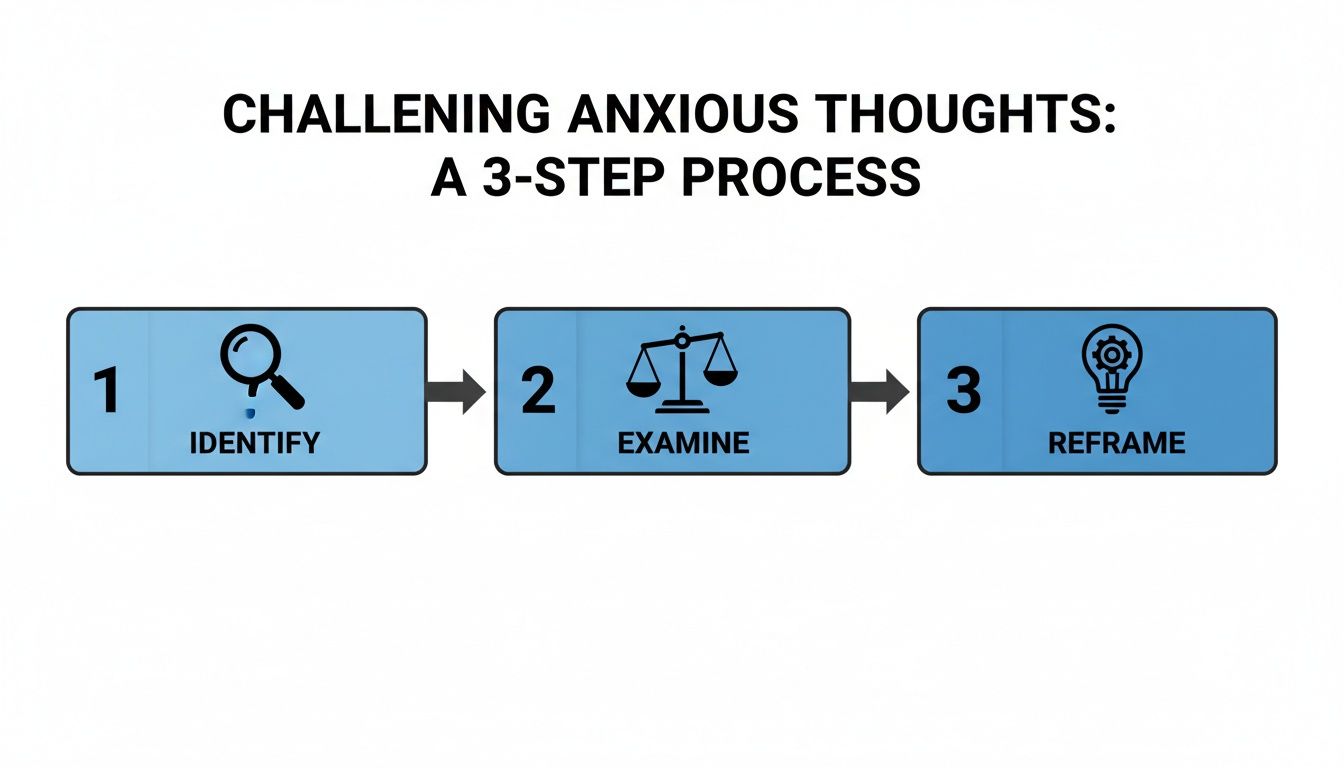
This visual shows that getting a handle on anxiety isn't an overwhelming battle; it's a systematic, hopeful process you can absolutely learn.
This is where the real healing happens. You’re moving from just thinking about change to actively creating it. Every small step you take on your fear ladder is a powerful message to your brain that anxiety is no longer in charge and a panic-free life is possible.
And if you’re wondering if you can really do this on your own, the science is firmly on your side. One massive review of 54 controlled trials involving over 5,400 patients found that therapist-guided CBT delivered remotely is just as effective as meeting in person. This holds up across a ton of studies focused specifically on anxiety, proving that your own home can be an incredibly powerful and effective place to heal.
Building a Sustainable Routine for Lasting Wellness
The skills you've been learning—challenging your thoughts, facing your fears—are the essential building blocks for a calmer, more peaceful life. The real magic happens when you weave these practices into a sustainable routine, creating lasting change.
Lasting wellness isn't born from a handful of intense sessions. It's cultivated through small, consistent actions that eventually become second nature, allowing you to live with more ease and joy.
This isn’t about adding another stressful chore to your to-do list. Think of it as creating a personal wellness ritual that empowers you, builds resilience, and protects the peace you've worked so hard to find. A steady routine transforms your cognitive behavioral therapy at home practice from a set of exercises into a durable shield against anxiety, ensuring you can maintain your progress for years to come.
Crafting Your CBT Wellness Routine
Consider this your personal blueprint for maintaining mental balance and protecting your peace. The goal here is to make these tools a natural part of your week, so you’re proactively managing anxiety instead of just reacting when it flares up. A good routine is flexible, compassionate, and built just for you.
Here’s a simple template you can adapt:
- Daily Check-In (5 minutes): Start or end your day with a quick thought record. Just focus on catching one automatic negative thought and walking it through the process of finding a more balanced perspective.
- Weekly Behavioral Goal (1 hour): Set aside a small block of time each week for one behavioral experiment or a single step on your fear ladder. This keeps you moving forward and building confidence.
- Regular Symptom Monitoring (10 minutes): Use the Anxiety Checklist once a week to track where you're at. Seeing how far you’ve come is an incredibly powerful motivator for your healing journey.
This kind of structure provides a sense of control and predictability, which is so grounding when life feels chaotic. To foster a stronger sense of connection and accountability while building your routine, exploring the principles of social learning can offer some really helpful insights.
Tracking Progress and Celebrating Wins
Your healing journey is going to have its own rhythm. There will be peaks, valleys, and plateaus. Tracking your progress helps you see the bigger picture and reminds you that even on the tough days, you are still moving forward toward a panic-free life.
When you complete a step on your fear ladder or successfully reframe a powerful anxious thought, pause and acknowledge it. Celebrate these small victories. They are tangible proof that your hard work is paying off and that healing is happening.
Remember, the goal isn't to eliminate anxiety forever—it’s a normal human emotion. The goal is to get to a place where anxiety no longer runs the show. You are learning to be the compassionate and capable manager of your own mind, free to live your life fully.
Practicing CBT at home is not just an effective path to wellness; it's also a remarkably practical one. One study on in-home CBT found it boosted participants' quality of life and actually reduced overall costs, with moms in the program experiencing 345.6 fewer days of depression compared to those receiving standard care. You can read the full research about these cost-effective outcomes and see the data for yourself.
Spotting Early Warnings and Preventing Relapse
Life is unpredictable, and stress can sometimes cause old anxiety patterns to bubble back up. This is completely normal and not a sign of failure; it's a sign you're human. The key is to recognize the early warning signs and have a compassionate plan ready to go.
Early warning signs might look like:
- Increased Avoidance: You start making excuses to skip social events or put off challenging tasks you were previously handling well.
- Catastrophic Thinking: You notice your thoughts are frequently jumping to worst-case scenarios again.
- Physical Symptoms: You experience a return of physical anxiety symptoms like a tight chest, an upset stomach, or tension headaches.
When you spot these signs, don't panic. View them as a signal to re-engage with your CBT tools with kindness. This is the moment to double down on your thought records, revisit your fear ladder, and recommit to your routine. For more help, check out our guide on setting SMART goals for anxiety to create a clear and actionable plan.
By building this sustainable practice, you're not just getting through the day; you're building a foundation for a life lived with more freedom, confidence, and peace.
Got Questions About Doing CBT at Home? Let's Talk.
Starting any new path comes with questions, and when that path is as personal as healing from anxiety, it's completely normal to want some clarity before you dive in. Frankly, it’s a good sign—it means you're taking your well-being seriously, and that's the foundation for real, lasting change.
Let’s tackle some of the most common questions I hear about practicing cognitive behavioral therapy at home. The goal here is to give you direct, practical answers that clear up any confusion and fill you with confidence and hope for the journey ahead.
How Do I Know if At-Home CBT Is Right for Me?
Deciding to start CBT on your own is a big step, and it’s a fantastic, hopeful option for a lot of people. Self-guided work is especially effective for those dealing with mild to moderate anxiety, specific phobias, or panic disorder—especially if you're motivated and ready to really engage with the exercises.
It gives you the flexibility to learn life-changing skills on your own time, in your own space, and without the high cost of traditional therapy. If you need a structured but adaptable approach that fits into your life, at-home CBT can be a perfect match on your path to a panic-free life.
But it’s also crucial to know when to call in a professional. If you're struggling with severe depression, complex trauma, or thoughts of self-harm, the safest and most effective move is to connect with a licensed therapist. For some, a guide like this is a powerful standalone tool; for others, it's the perfect sidekick to professional therapy.
The most important thing is that you're taking a step toward healing. Recognizing you need support and seeking it out—whether through a guide like this or with a professional—is a profound act of self-care and courage. You deserve to feel better, and there is a path forward.
While this guide empowers you to practice CBT at home, for more complex mental health challenges or if you just feel you need more personalized guidance, exploring options for finding a CBT therapist is always a smart move.
What Is the Biggest Mistake People Make with Self-Directed CBT?
Hands down, the most common pitfall is giving up too soon. It’s easy to start with a ton of enthusiasm, but healing isn't a straight line. You're essentially unlearning years of deeply ingrained thought patterns and behaviors. That takes patience and self-compassion.
So many people expect to see huge, overnight results. When progress feels slow or they hit a rough patch, they get discouraged. They might have one bad day and see it as proof that "it's not working," then abandon the whole process.
True progress is built on consistency, not intensity. The real healing happens when you commit to the process, especially on the days you don’t feel like it. Celebrate the small wins, be kind to yourself during setbacks, and remember that every thought record you fill out and every small fear you face is literally rewiring your brain for peace and freedom.
Can I Really Do Exposure Therapy Safely by Myself?
Yes, you absolutely can, as long as you stick to the golden rule: "start low and go slow." The entire method is designed to be gentle, gradual, and systematic, so you should never feel completely overwhelmed. The power is in your hands.
The key is to build a detailed and very manageable fear ladder. You start on the lowest rung—an action that causes just a little bit of anxiety—and you stay there until that anxiety naturally fades. This process is called habituation, and it teaches your brain, on a deep, experiential level, that the scary thing you predicted doesn't happen. You learn you're safe, and you build unshakable confidence.
You are always in the driver's seat. You decide when to move up the ladder, and you never have to throw yourself into a high-anxiety situation before you're ready. That said, for severe phobias, obsessive-compulsive disorder (OCD), or trauma-related avoidance, it's always best to work with a trained professional who can guide you through it.
Starting your journey with The Anxiety Checklist provides the structure and tools you need to apply these CBT principles effectively. Our system is designed to give you a clear roadmap, transforming these powerful concepts into a personalized, actionable plan for achieving a life free from the grip of anxiety. Take the first step toward fearless living and get your copy today at anxietychecklist.com.