Fear Ladder App: Face Your Fears One Step at a Time
Avoiding what scares you brings relief now, but keeps the fear alive. The Fear Ladder helps you face it gradually, one manageable step at a time.
- Build a ladder of up to 6 steps
- 7 example ladders to get you started
- Tick off each step as you climb



Exposure therapy, made step by step
Exposure is a core part of CBT for fears and phobias. Instead of avoiding what you fear, you approach it gradually, in a planned way, starting with steps that feel manageable. Learn about exposure therapy for anxiety.
You choose the steps. You set the pace. The app keeps it organized.
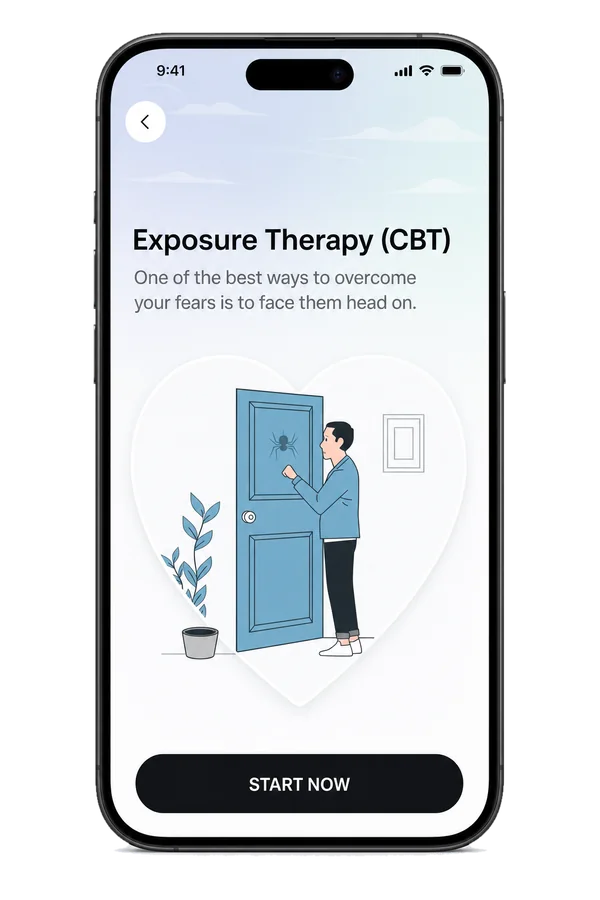
Why avoidance keeps fear going
Avoiding brings quick relief. But it also teaches your brain: “That was dangerous. Good thing we got away.”
So the fear grows, and your world gets smaller. Facing the fear in small steps teaches your brain something new.

How it works
The app guides you through 3 stages: “Identify Fear” → “Brainstorm” → “Fear Ladder”. Want the full method first? Read our step-by-step fear ladder guide.
- Identify Fear
- Brainstorm
- Fear Ladder
Step 1: Identify Fear
Answer “What fear do you want to overcome?” For example, spiders.
Step 2: Brainstorm
“Brainstorm some steps.” Browse example ladders for ideas. Make a step easier or harder by changing how long you do it, how close you get, or who is with you.
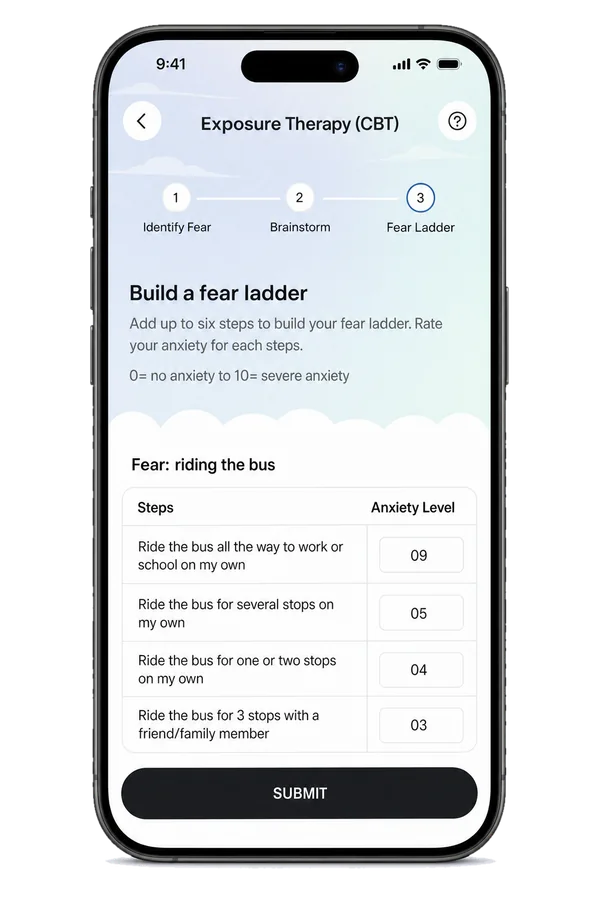
Step 3: Fear Ladder
“Build a fear ladder.” Add up to six steps and rate your anxiety for each, from 0 (no anxiety) to 10 (severe anxiety). The app sorts them from easiest to hardest.
Step 4: Start at the bottom
Face the easiest step. Stay with it until your anxiety drops, which often takes 20 to 40 minutes. Repeat it on different days until it causes only a little anxiety.
Step 5: Tap the step
You’ll see “Yes! You did it”. Tap “TRY NEXT STEP” to move up. Finished steps get a check.
Step 6: Reach the top
Complete the last step and you’ll see “Congratulations!” Press completed, then check in.
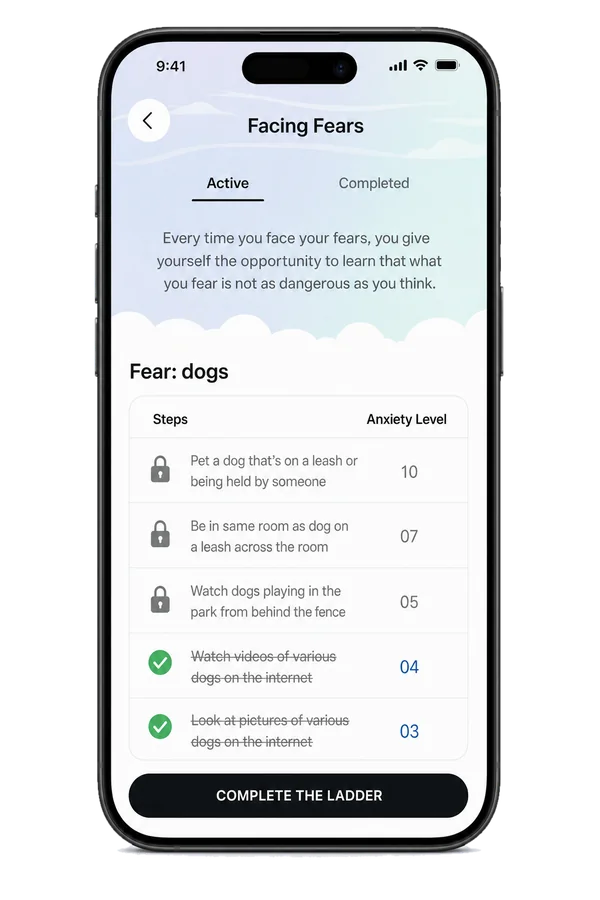
The ladder uses its own 0 to 10 anxiety scale, where higher means more anxious. The before-and-after check-in is different: 1 (Panic) to 10 (Calm).
 The ladder uses its own 0 to 10 anxiety scale, where higher means more anxious. The before-and-after check-in is different: 1 (Panic) to 10 (Calm).
What a fear ladder can look like
Example: fear of talking to others. Anxiety rated from 0 (none) to 10 (severe). If this sounds like you, read about social anxiety.
- Anxiety level 3 out of 10:Make eye contact
- Anxiety level 4 out of 10:Smile at someone
- Anxiety level 5 out of 10:Say “hi”
- Anxiety level 7 out of 10:Make a comment
- Anxiety level 8 out of 10:Ask a question
- Anxiety level 10 out of 10:Share something personal
Your ladder will look different. Build the steps around your own fear.
What’s inside
A 3-stage ladder builder
Identify Fear, Brainstorm, Fear Ladder.
7 example ladders
Dogs, talking to others, needles, riding the bus, physical sensations of panic, uncertainty and making mistakes.
Up to 6 steps, auto-sorted
Rated 0 to 10 and ordered from easiest to hardest.
Tips for adjusting steps
Change the time, the distance or who is with you.
Your active ladder
A clear table of Steps and Anxiety Level, with locks and checks.
Completed ladders
Saved with dates, so you can see how far you’ve come.





New: help building your fear ladder
Building the ladder is often the hardest part. Now you don’t have to start from a blank page.
- Stuck? Get an idea: start from an example ladder and make it yours
- Help me: describe your fear and AI suggests steps. You choose what to keep
- Work on several fear ladders at once

Why facing fears helps
“Every time you face your fears, you give yourself the opportunity to learn that what you fear is not as dangerous as you think.”
When you stay with a feared situation, anxiety usually rises, peaks and then falls on its own.
Each time, your brain gets new information: the feared outcome is less likely, or more manageable, than it predicted.
Starting small matters. Each step you complete builds confidence for the next one.
- Breaks the avoidance cycle
- Lets your brain learn from experience
- Builds confidence step by step

Check in. See what works for you.
Rate how you feel from 1 (Panic) to 10 (Calm) before and after, and see what works for you.
Scale from 1, Panic, to 10, Calm. Higher is calmer.
Before we begin the exercise
How do you feel?
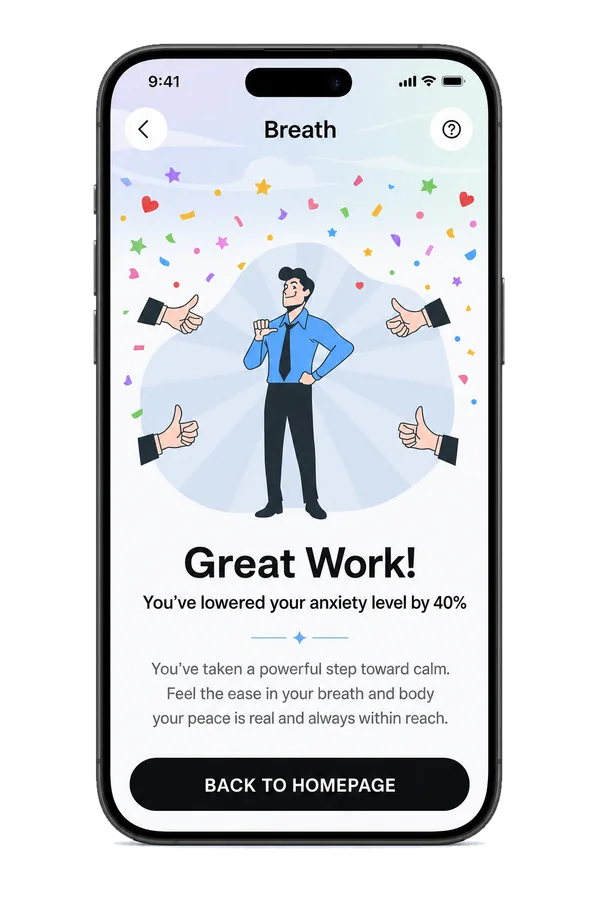
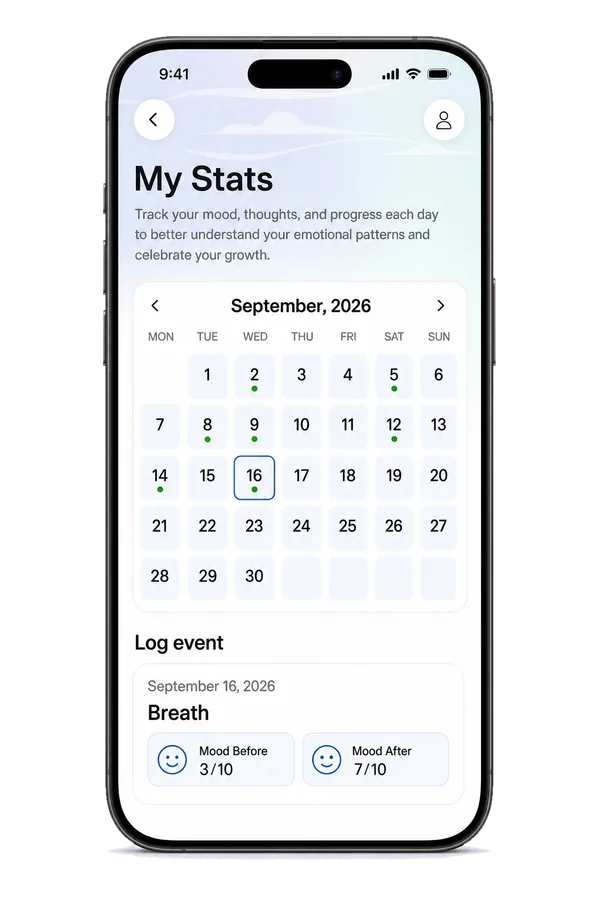
Your check-ins are saved in My Stats, which is free.

Go at a safe pace
Choose steps that feel challenging but doable. Never use exposure for situations that are truly dangerous.
If a fear is linked to trauma, feels overwhelming, or involves physical sensations and you have a heart or breathing condition, work through it with a professional.

Use it alongside therapy
Exposure is often done with a therapist’s guidance. Plan your ladder together, practice the next step between sessions, and bring back what you noticed.
More Feel more in Control tools



Questions about the Fear Ladder
What is a fear ladder?
A list of steps toward a fear, ordered from least to most scary. You face them one at a time, from the bottom up. It’s also called an exposure hierarchy.
How do I rate each step?
From 0 (no anxiety) to 10 (severe anxiety), based on how anxious you expect to feel. The app sorts your steps for you.
How long should I stay with a step?
Until your anxiety comes down, which often takes 20 to 40 minutes. Repeat on different days until the step feels much easier.
What if a step feels too hard?
Make it easier. Try a shorter time, more distance, or bring someone with you. Small steps still count.
Is the Fear Ladder free?
The Fear Ladder is part of Premium, which starts with a free trial: 7 days on the monthly plan, 14 days on the yearly plan. Free forever in the app: SOS panic relief, the CBT Thought Journal and Anxiety University.
Can I do exposure on my own?
Many people use a fear ladder for everyday fears. For intense fears, trauma, or if you feel stuck, work with a therapist.
How is this different from Belief Experiments?
The Fear Ladder helps you face a fear gradually. Belief Experiments test whether a specific anxious prediction comes true.
Take the first small step.
The Fear Ladder is part of Premium. Start with a free trial.
Premium includes a free trial: 7 days on the monthly plan, 14 days on the yearly plan. Cancel anytime.