The mental, emotional, and behavioral habits that allow you to adapt to stress and adversity are the very definition of resilience. It isn't a fixed trait you're born with. Instead, think of it as a set of practical skills like cognitive reframing, emotional regulation, and purposeful action that can be learned and strengthened over time. For anyone struggling with anxiety, understanding these traits is the first, hopeful step toward healing and taking your life back.
Your Path from Anxiety to Calm Starts Now

If you're feeling trapped by anxiety or panic, I want you to hold onto this truth: a different reality is possible, one where you can heal and live a life free from panic. This guide is your first step on that journey from fear to freedom. We're going to explore resilience not as some rare superpower, but as a set of practical, learnable skills.
Think of it as building your personal fortress against anxiety, one hopeful stone at a time. By understanding the core characteristics of resilience, you'll have a clear blueprint for reclaiming control and peace. Your struggle is real, but it doesn't have to define your future. A life beyond anxiety is waiting for you.
Building Your Resilience Toolkit
This guide moves beyond theory and straight into action. We’ll focus on the five pillars that form the foundation of a resilient mind and body—each one a direct, empowering counter to the patterns that keep anxiety in charge.
This table gives you a quick overview of the core characteristics of resilience and how each one directly helps you dismantle anxiety's hold, opening the door to a panic-free life.
The 5 Pillars of Resilience to Overcome Anxiety
| Resilience Pillar | What It Means | How It Fights Anxiety |
|---|---|---|
| Cognitive | Your ability to challenge anxious thoughts and shift your perspective. | It breaks the cycle of "what if" thinking, creating hope and mental space. |
| Emotional | Your capacity to feel your emotions without letting them overwhelm you. | It helps you tolerate discomfort, proving you can handle panic and it will pass. |
| Behavioral | Your willingness to take brave steps, even when you feel afraid. | It reverses avoidance and retrains your brain, proving a panic-free life is possible. |
| Social | Your skill in building a support system that buffers against stress. | It provides connection and resources, reminding you that you are not alone in your healing. |
| Physiological | Your power to use your body to create a state of calm and safety. | It directly calms a revved-up nervous system, giving you immediate control and relief. |
Throughout this guide, we'll connect these powerful concepts to tangible tools, like our guide The Anxiety Checklist, to help you turn this knowledge into real, lasting change and hope.
Resilience does not mean we aren’t impacted by a challenge, but instead that we are less overcome by hardship. We’re able to continue forward, as the difficulty walks beside us.
This distinction is everything. The goal isn't to become immune to hardship, but to develop the inner resources to navigate it with confidence. You absolutely can heal from anxiety and live a panic-free life by systematically strengthening these abilities.
Let’s get started on your path to healing.
Rewiring Your Thoughts for Cognitive Resilience

If you live with anxiety, you know the feeling of your mind turning against you, trapping you in loops of worst-case scenarios and what-ifs. Cognitive resilience is your power to step in and break that cycle. It’s the skill of noticing, questioning, and ultimately reframing the negative thoughts that fuel fear and panic, replacing them with hope and truth.
Think of your anxious mind as a radio stuck on a distorted station, playing nothing but bad news on repeat. Building this characteristic of resilience is like learning how to calmly walk over, tune out the static, and change the channel to something more balanced and true. This isn't about pretending problems don't exist. It’s about reclaiming control over your inner narrative so you can face challenges with a newfound sense of possibility.
This skill has become non-negotiable in modern life. The American Psychological Association's 2023 Work in America Survey found that a staggering 77% of workers experienced work-related stress, leading to psychological symptoms like emotional exhaustion and a lack of motivation. These pressures directly attack our cognitive well-being, making it essential to have tools to manage our minds. You can read more about these findings on the APA's website.
Recognizing Anxious Thinking Patterns
You can't change a thought you don't notice. Anxiety loves to use mental shortcuts called cognitive distortions—biased ways of thinking that reinforce negative feelings and keep you stuck. Learning to spot them is the first step toward disarming them and freeing yourself.
Here are a few common traps your mind might set for you:
- All-or-Nothing Thinking: You see things in black-and-white. If a situation isn't perfect, it's a total failure. There's no in-between.
- Catastrophizing: You automatically jump to the worst possible conclusion. A vague email from your boss doesn't just mean a quick question; it means you're definitely getting fired.
- Mind Reading: You assume you know what other people are thinking, and it's always negative. You might leave a social gathering early because you're convinced everyone thinks you're boring.
Once you can name these patterns, you start to take back their power. You can learn more about these mental traps in our detailed guide on cognitive distortions.
Use “Catch, Challenge, Change” to Rewire Your Brain
One of the most practical ways to build cognitive resilience is a simple, three-step method. This technique, a core part of The Anxiety Checklist, helps you intercept anxious thoughts before they spiral, giving you hope and control.
"The greatest weapon against stress is our ability to choose one thought over another."
— William James
Here’s how it works:
- Catch the Thought: The moment you feel a jolt of anxiety, pause. Ask yourself, "What was the exact thought that just went through my mind?" Name it. For example, "I'm going to mess up this presentation and everyone will think I'm incompetent."
- Challenge the Thought: Gently question it. Is this thought 100% true? Is there a more balanced or compassionate way to see this? You might counter with, "I've given good presentations before. Even if I'm nervous, it doesn't mean I'm incompetent."
- Change the Thought: Replace the original thought with one that is more realistic, hopeful, and supportive. Try something like, "I am prepared for this presentation. It's okay to feel nervous, and I will do my best."
This isn't a one-and-done fix; it’s a practice. But every time you do it, you weaken old, fear-based neural pathways and strengthen new ones grounded in hope and self-trust. You're not just managing anxiety—you're actively rewiring your brain for peace.
Navigating Feelings with Emotional Resilience
For so many people living with anxiety, the most terrifying part isn’t a specific thought—it's the raw feeling itself. That sudden, racing heart. The tightness in your chest. The wave of pure dread that seems to come out of nowhere.
This physical and emotional storm is often the very core of a panic attack. The fear of it happening again can feel absolutely paralyzing, shrinking your world one avoided situation at a time.
Emotional resilience is one of the most vital traits we can build because it speaks directly to this fear, offering a path to healing. It’s your capacity to experience these intense feelings without letting them hijack your entire being. Think of it like this: emotional resilience is the difference between being drowned by a powerful ocean wave and learning how to surf it until it passes.
This skill isn't about pretending you aren't scared or stuffing your feelings down. It’s about a profound shift in how you relate to your inner world. You learn to observe your emotions—even the big, scary ones—as temporary signals, not as permanent threats. This shift gives you immense hope, showing there's a way to heal from anxiety and live panic-free, not by eliminating feelings, but by changing your relationship with them.
Naming Your Feelings to Tame Them
The first step to surfing an emotional wave is simply knowing what kind of wave it is. When you can put a name to a feeling, you create a little bit of distance from it. It's no longer a terrifying, all-consuming "thing"; it's a specific emotion, like "fear," "sadness," or "vulnerability."
A powerful exercise from The Anxiety Checklist is keeping a simple 'Feelings Log.' When a strong emotion pops up, take a moment to write it down without any judgment.
- What am I feeling right now? (e.g., a sense of dread)
- Where do I feel it in my body? (e.g., a knot in my stomach)
- What was happening right before I felt this? (e.g., I got an unexpected text from my boss)
This simple act creates a small but crucial space between you and the emotion. It gives you room to breathe and respond with hope, rather than just react in fear. This practice can be especially helpful if you're working through unresolved emotional wounds, which often act as hidden fuel for anxiety.
You are bigger than your biggest fears. By learning to sit with your emotions, you prove to yourself that they are visitors, not residents. They can be intense, but they will pass, and you will remain. This is a core truth on the path to a panic-free life.
Practice the RAIN Method for Emotional Relief
Once you can name a feeling, you can start to engage with it compassionately instead of fighting it. The RAIN method is a beautifully simple mindfulness technique that guides you through this exact process, offering immediate hope and relief.
- R – Recognize: Gently acknowledge what's happening. You can say to yourself, "Anxiety is here," or "I'm feeling fear."
- A – Allow: Let the feeling just be there, without trying to fix it, change it, or push it away. This step is a courageous act of non-resistance.
- I – Investigate: Get curious. Gently explore the feeling. Ask yourself, "What does this feel like in my body? What does this feeling need from me right now?"
- N – Nurture: Offer yourself a dose of self-compassion. You might place a hand over your heart and say, "This is hard, but I am strong enough to handle it."
Practicing RAIN helps you build trust in your own ability to manage emotional discomfort. It shows you that healing is possible and offers a clear path to living panic-free, proving that no feeling, no matter how strong, has to control you.
Taking Action with Behavioral Resilience

Anxiety has a simple, yet devastating, strategy: it shrinks your world. It whispers that safety lies in avoidance, convincing you to skip the social event, put off that important phone call, or stick to rigid, “safe” routines. Behavioral resilience is your direct and powerful countermove toward a bigger, freer life.
This is where you learn to take brave, purposeful action even when your mind is screaming "danger!" It’s not about being fearless; it’s about acting with the fear. Think of it like building a muscle: every small step you take outside your comfort zone strengthens your capacity for bigger challenges, proving to yourself, with each action, that a life beyond panic is possible.
From Avoidance to Action
Avoidance is the fuel that keeps anxiety's engine running. When you sidestep a feared situation, you get a quick hit of relief, which accidentally teaches your brain that the situation was, in fact, dangerous. This locks you into a self-perpetuating cycle of fear.
Behavioral resilience shatters this cycle by intentionally doing the opposite. It shows your brain through direct experience that you can handle the discomfort and that your worst-case scenarios rarely ever happen. One brave step at a time, you're literally rewiring your brain's fear response and walking toward freedom.
Interestingly, societal factors can sometimes add another hurdle. The 2023 Wellbeing and Resilience Report uncovered a 'gender resilience gap,' showing that men often report 11% higher self-belief than women. For anyone managing anxiety, especially women, this highlights just how crucial it is to deliberately build both behavioral resilience and self-belief. You can explore the complete findings in The Wellbeing and Resilience Report.
Building a Fear Ladder to Reclaim Your Life
The idea of facing a major fear head-on can feel impossible. That's why we don't do that. Instead, we break it down. A "Fear Ladder," a core tool from The Anxiety Checklist, helps you approach a scary goal with small, manageable steps. It turns an overwhelming mountain into a series of small, climbable hills, filling you with hope along the way.
The journey of a thousand miles begins with a single step. By focusing on the very next step, instead of the entire staircase, you make progress not just possible, but inevitable.
Here’s how to build one. Let's say your big fear is "attending a networking event."
- Define the Goal (Top of the Ladder): Go to a one-hour networking event and speak to two new people.
- Brainstorm Smaller Steps: Think of all the actions that lead up to that goal, from easiest to hardest.
- Arrange the Steps: Order them from least scary (bottom rung) to most scary (top rung).
Your ladder might look something like this:
- Step 1 (Lowest Fear): Research local networking events online.
- Step 2: RSVP to one event that is two weeks away.
- Step 3: Drive to the venue and sit in your car for five minutes, then leave.
- Step 4: Walk into the event, stay for ten minutes without talking to anyone, then leave.
- Step 5: Attend and stand near a group, just listening.
- Step 6 (Your Goal): Attend and introduce yourself to two people.
This structured approach helps you build momentum and gather real-world evidence that you are far more capable than anxiety tells you. If you're looking for more ways to structure your goals, our guide on setting SMART goals for anxiety can give you even more support. Each step you conquer is a victory that takes back a piece of your world and proves that healing is happening.
Finding Strength in Your Body and Community
You don't have to build resilience alone. In fact, two of your greatest allies are your own body and the people you trust. These form the last two powerful characteristics of resilience: social and physiological.
Anxiety loves to isolate you, but connection is a powerful antidote. At the same time, simple physical practices can directly calm a nervous system that’s been stuck on high alert.
This is a profoundly hopeful part of the journey. It shows that strength doesn't just come from your mind; it's also found in the hands you hold and the very rhythm of your breath. These tools are immediate and tangible. They give you a way to create safety in the here and now, proving to yourself that a life with less panic is absolutely within reach.
Building Social Resilience and Connection
Anxiety often makes us feel intensely alone, but as human beings, we are fundamentally wired for connection. Social resilience is the skill of intentionally building a support system that can act as a buffer when life gets stressful, reminding you of the hope and help available to you.
This isn't about having hundreds of friends. It's about having a few trusted people who can offer empathy, a different perspective, and that crucial sense of belonging that is essential for healing.
Connection is one of the best medicines for the challenges of life. By learning to lean on others, we not only recover from hardship but learn to move forward with the support of our community.
A 'Support System Audit' is a great way to see where your connections are strong and where they might need a little more nurturing. It’s a practical step you can take right now to push back against the isolation that anxiety thrives on.
Your Support System Audit:
- Identify Your Core People: List 1-3 people you feel you could call during a tough time. Who comes to mind first?
- Assess the Quality: For each person, ask yourself: "Do I feel seen and heard by them? Or do I feel judged?" Focus on nurturing the relationships that feel genuinely supportive.
- Schedule Connection: Don't wait for a crisis. Make a point to schedule a call, a coffee, or a walk with someone on your list this week. Proactive connection builds the foundation for support before you need it most.
Harnessing Physiological Resilience for Calm
While social support is your external fortress, physiological resilience is your internal anchor. It’s all about using your body to regulate your mind—not the other way around. This gives you immediate power and a sense of control, which is incredibly hopeful.
Simple practices like deep breathing and getting quality sleep can directly counteract the 'fight-or-flight' response that keeps you on edge. Your physical well-being is a powerful tool. Understanding how diet impacts your body can be empowering; for instance, you might explore foods by symptom to address specific needs. Our guide on lifestyle and diet changes for anxiety management also offers more in-depth strategies.
The 'Physiological Reset Routine' from The Anxiety Checklist gives you a simple way to use your body as a source of calm. Let's start with a foundational breathing exercise.
- Find a comfortable seat and place one hand on your belly.
- Inhale slowly through your nose for a count of four, feeling your belly expand like a balloon.
- Hold your breath gently for a count of four.
- Exhale slowly through your mouth for a count of six, feeling your belly draw back in.
- Repeat 5-10 times, focusing on the sensation of your breath.
This technique, a variation of box breathing with an extended exhale, activates your parasympathetic nervous system—the body's "rest and digest" mode. It's a direct and powerful way to tell your body it's safe, pulling you out of an anxiety spiral and back into a state of control and hope.
Your Toolkit for a Panic-Free Life
We’ve walked through the five core characteristics of resilience—cognitive, emotional, behavioral, social, and physiological. Now, it's time to pull them all together into a real, workable plan. This isn't just theory anymore. This is your hopeful roadmap to a life defined by courage, not by fear.
Think of each characteristic as an instrument in an orchestra. Individually, they’re powerful. But when they play together in harmony, they create something truly profound: a complete, supportive system for healing from anxiety.
Bringing Your Resilience Pillars Together
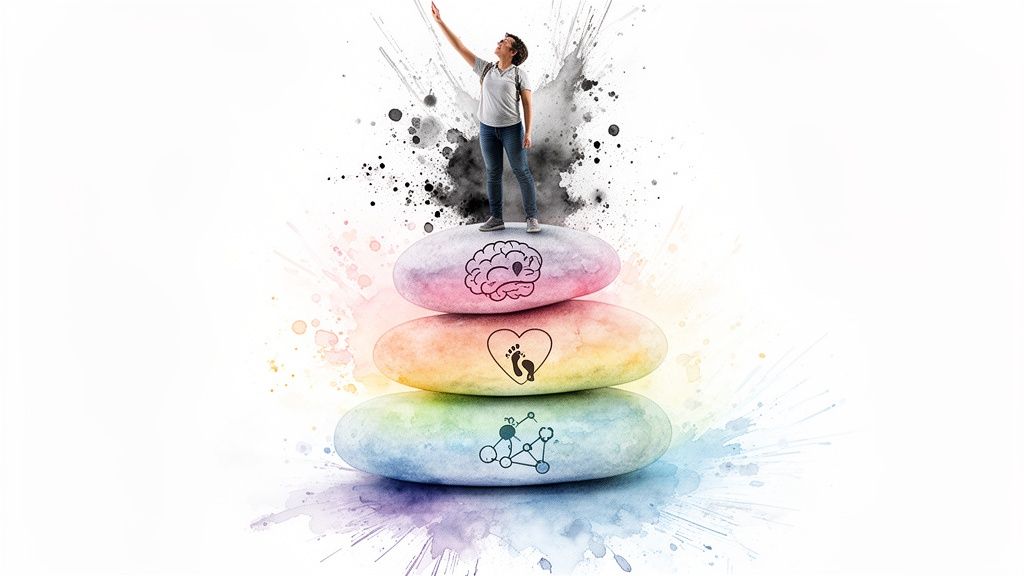
This is where The Anxiety Checklist becomes your go-to toolkit, turning these big concepts into a structured, step-by-step system for healing. This guide gives you the "why," and the 93-point checklist delivers the "how," letting you track your progress across all five areas of resilience. This infographic shows just how these pillars form the foundation of that system.

As you can see, all five pillars—cognitive, emotional, behavioral, social, and physiological—interlock to support a truly resilient mind. No single pillar stands on its own; they all work together to build a solid foundation for lasting well-being and a panic-free life.
It's time to stop just coping and start building a hopeful future. To help manage those sharp, in-the-moment spikes of stress or simply to cultivate a calmer state of mind, you might also explore tools like these calming crystals for anxiety. Your journey is waiting.
This is your moment to shift from merely surviving to actively thriving. The path to a resilient, panic-free life isn't about finding a magic cure, but about consistently using the right tools to build your strength, one day at a time.
This structured approach is what gives you a real, tangible sense of hope. You have a plan. You have tools. For example, mastering a few key breathing exercises for anxiety can give you immediate physiological relief. That calm then makes it easier to tackle a cognitive or behavioral challenge. Each piece reinforces the others, creating a powerful, upward spiral toward freedom.
Frequently Asked Questions About Resilience
Navigating the path toward a life free from panic often brings up some questions. This section tackles the most common ones with clear, hopeful answers about building the resilience you’ve been learning about.
Can You Really Learn Resilience or Are You Born With It?
It’s easy to think of resilience as something you either have or you don't, like blue eyes or brown hair. But that's not how it works. Think of it more like a muscle. Research shows that resilience is a dynamic skill set—a collection of thoughts, actions, and behaviors that anyone can learn and strengthen with dedicated practice.
That’s exactly what this guide is designed to help you do. By consistently using the techniques for cognitive, emotional, and behavioral resilience, you’re actively building that muscle. Every small win proves you can heal from anxiety, offering real, tangible hope for a different future.
How Long Does It Take to Build Resilience Against Anxiety?
There’s no magic number here—everyone’s journey to healing is different. But the most encouraging part? You can start feeling a difference almost immediately through small, consistent actions. This isn't about some dramatic, overnight transformation. It’s about the steady accumulation of small victories.
Using a structured tool like The Anxiety Checklist helps you see and track these wins, which builds momentum and makes the whole process feel manageable and hopeful. The goal is always progress, not perfection. Every step forward, no matter how small, is a step toward living a panic-free life.
What if I Have a Setback While Trying to Build Resilience?
Setbacks are a normal and expected part of the journey—they are not failures. In fact, a setback is one of the most powerful opportunities you’ll get to practice resilience in the real world. These are the moments when you get to use the very tools you're learning.
A tough day isn’t a sign of weakness; it’s a chance to apply your strength. Each time you navigate a setback, you strengthen your resilience even more, proving you can handle what comes your way.
When you face a difficult day, you get to actively use skills like emotional regulation or cognitive reframing. This is how true, lasting resilience is built, reinforcing the deep-seated, hopeful belief that you have what it takes to overcome anxiety and heal.
Ready to turn these concepts into a concrete action plan? The Anxiety Checklist provides a 93-point interactive system to track your progress and build your resilience toolkit. Start your journey to a fearless, panic-free life today at https://anxietychecklist.com.