


In short
EMDR is an evidence-based psychotherapy that uses guided side-to-side eye movements or other bilateral stimulation while a traumatic memory is recalled. Treatment follows eight phases, from history-taking and preparation to re-evaluation, aiming to reduce the memory’s emotional impact and strengthen positive beliefs. It may process trauma faster and require less detailed disclosure, but sessions can feel intense and it is not suitable for everyone.
Key takeaways
- EMDR is used for trauma and anxiety-related conditions, including PTSD, panic attacks, phobias and intrusive thoughts.
- Treatment usually involves eight phases, with sessions lasting between 60 and 90 minutes.
- One traumatic event may require three to six sessions; repeated or complex trauma may take longer.
- Grounding and calming techniques help people remain stable during and between sessions.
- Active psychosis or severe dissociation may require stabilisation before EMDR begins.
What is EMDR Therapy?
EMDR means Eye Movement Desensitization and Reprocessing. It’s an evidence-based psychotherapy that helps people heal from trauma. It’s believed that the body keeps the score of past hurts, which prolongs the healing journey.
When you haven’t healed from trauma, it causes you physical and emotional pain. EMDR therapy gives your brain the conditions it needs to heal emotional wounds naturally.
The history of EMDR therapy began in 1987. Psychologist Francine Shapiro noticed that her distressing thoughts lost their emotional charge as her eyes moved from side to side.
She began researching the connection between eye movements and emotional distress. She tested it on Vietnam War veterans and rape victims carrying heavy trauma.
People who had struggled with trauma for years felt relief after a few EMDR therapy sessions. In 1989, Shapiro published her findings in a paper titled “Eye Movement Desensitization.”
Today, the World Health Organization (WHO) and the American Psychological Association endorse it. It’s used in the treatment of post-traumatic stress disorder (PTSD) and other traumas.
How Does EMDR Therapy Work?
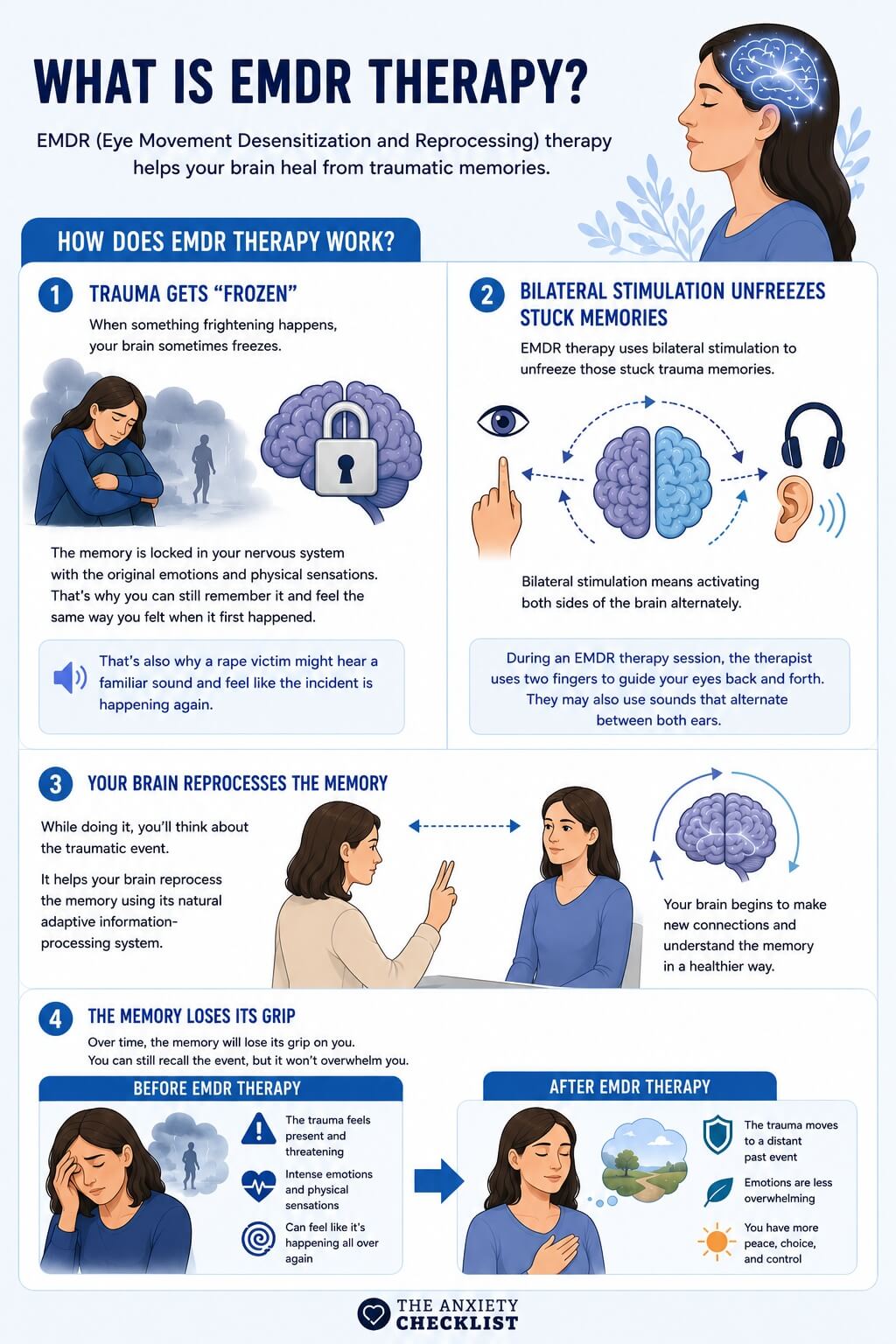
EMDR therapy works by targeting the way your brain stores traumatic memories. When something frightening happens, your brain sometimes freezes.
The memory is locked in your nervous system with the original emotions and physical sensations. That’s why you can still remember it and feel the same way you felt when it first happened.
It also explains why a rape victim might hear a familiar sound and feel like the incident is happening again.
EMDR therapy uses bilateral stimulation to unfreeze those stuck trauma memories. Bilateral stimulation means activating both sides of the brain alternately.
During an EMDR therapy session, the therapist uses two fingers to guide your eyes back and forth. They may also use sounds that alternate between both ears.
While doing it, you’ll think about the traumatic event. It helps your brain reprocess the memory using its natural adaptive information-processing system.
Over time, the memory will lose its grip on you. You can still recall the event, but it won’t overwhelm you. The trauma moves from being present and threatening to a distant past event. It might still be painful, but it no longer controls you.
What Happens in an EMDR Therapy Session?
EMDR therapy has eight phases. You’ll need between three and six sessions for one traumatic event. But if you’re dealing with repeated trauma, it might be more. Each therapy session lasts between 60 and 90 minutes.
Here are the exact steps involved.
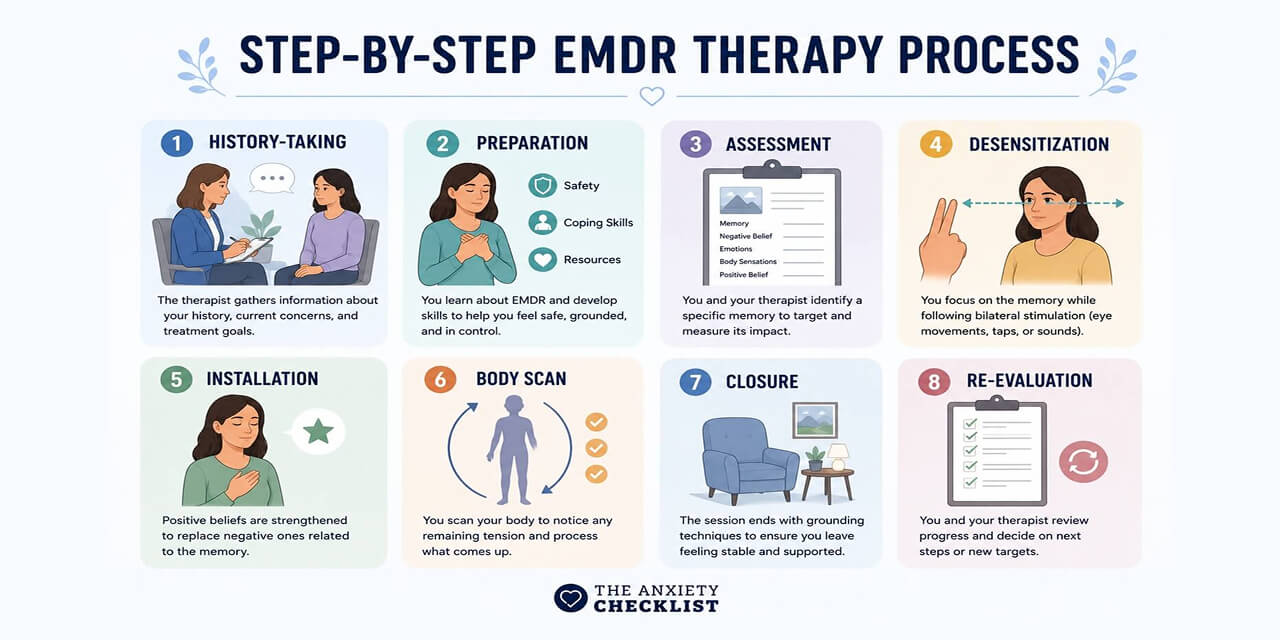
1. History-Taking
In this phase, your therapist gets to know you. They’ll ask about your life experiences, your current symptoms, and what wounds you hope to heal. This helps them understand whether you need EMDR therapy and identify which traumatic memories to target.
2. Preparation
Before EMDR therapy begins, your therapist will explain the treatment. They’ll also provide all the informational resources you need. You’ll learn grounding techniques, such as naming an object around you.
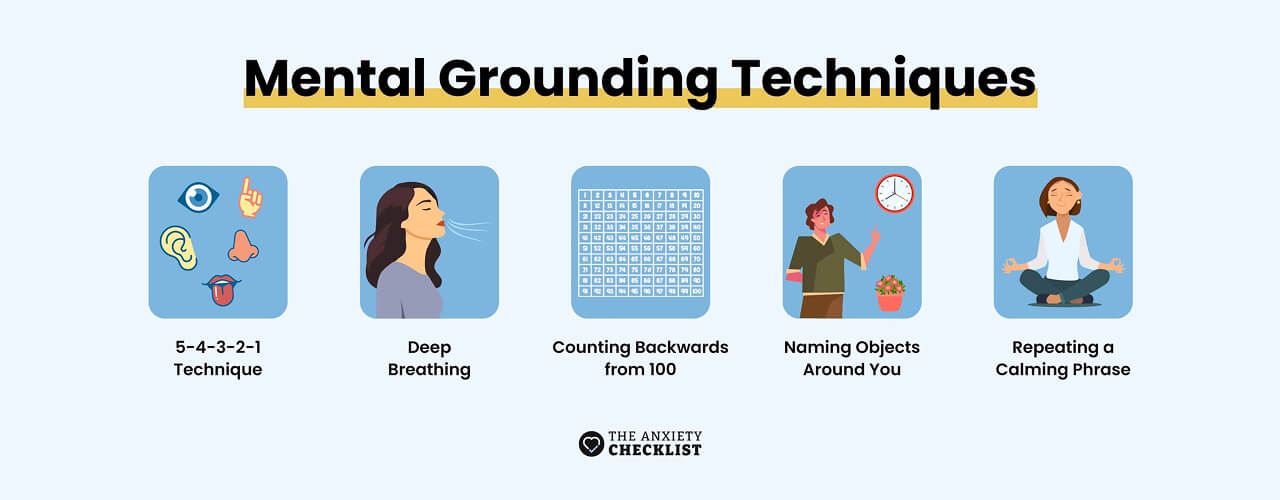
You’ll also learn calming exercises, such as journaling.
They’ll come in handy during and between sessions. This phase ensures you’re stable enough to handle what comes next.
3. Assessment
In this phase of the EMDR therapy, you and your therapist will identify a specific target memory. You’ll identify:
You’ll rate your feelings about the trauma on a scale of 1-7. The lowest score means the feelings are false, while the highest score means they’re true. The aim is to make sure you no longer believe in the negative feelings.
4. Desensitization
This is where the eye movement desensitization work begins. While recalling the traumatic event, follow the therapist’s guidance.
This is usually side-to-side eye movements or tapping sounds. But it may also involve listening to alternating tones, such as binaural beats.
After each set, your therapist pauses and asks what you notice. It might be a memory you hadn’t thought about in years or a physical sensation loosening in your chest.
You don’t need to analyze any of it. Report it, and your therapist will guide you into the next set. This back-and-forth continues until the feelings associated with the memory subside.
Your therapist will use the Subjective Units of Disturbance (SUD) scale to measure this. It’s a 0-10 rating of how disturbing the memory feels. 0 signifies total calm, and 10 signifies panic, distress, or significant disturbance. The goal is to bring your score as close to zero as possible.
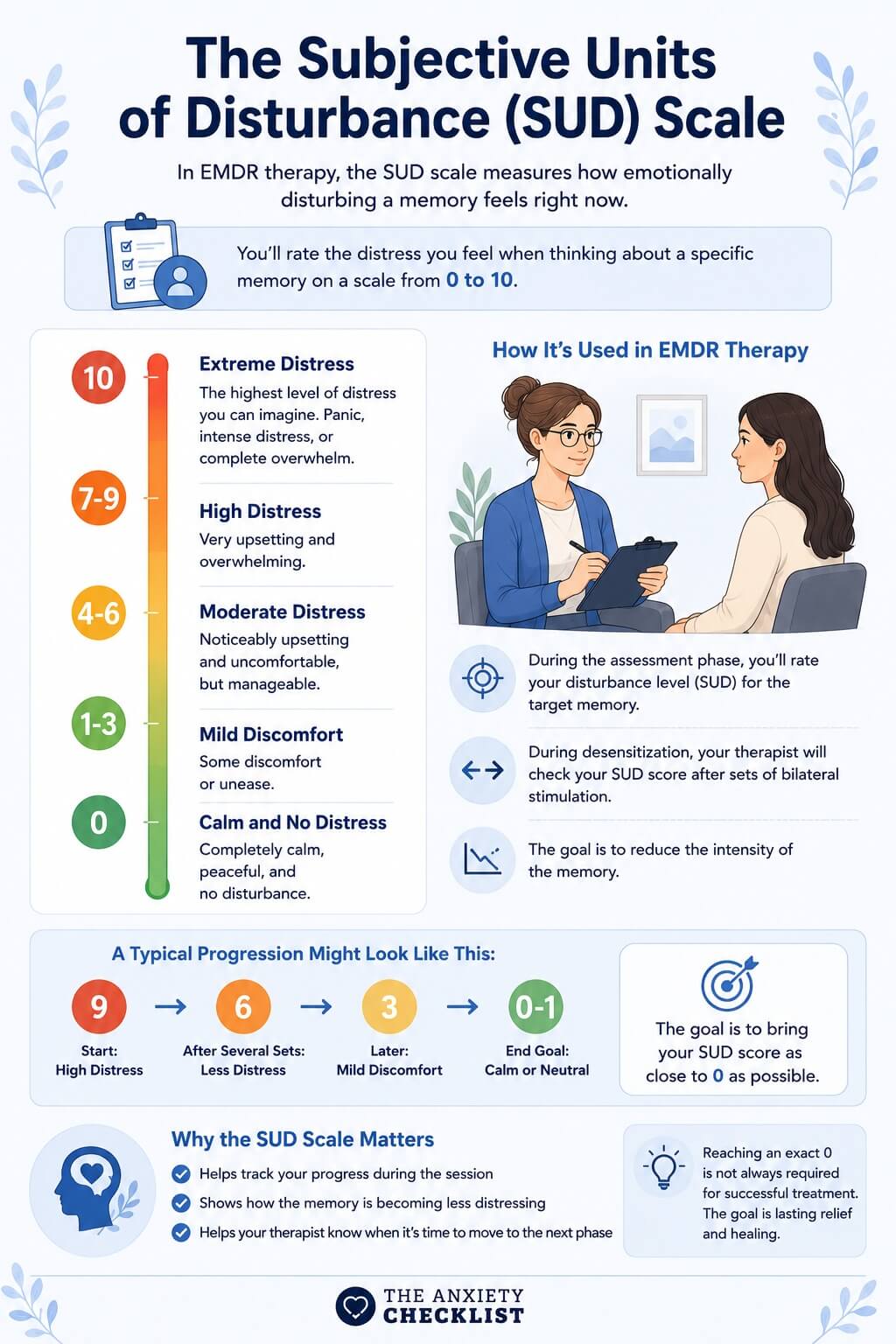
This phase of the EMDR therapy is emotionally intense. But you’re not alone in it. Your therapist tracks everything and knows when to slow down or pause. Also, the grounding techniques you practiced earlier will help you become stable.
5. Installation
In step three, you identified a negative belief attached to the traumatic memory. Something like “It was my fault” or “I am not safe.” In this EMDR therapy phase, you will choose a positive belief, such as “I am enough” and “I am safe now.”
Using the bilateral stimulation, you’ll hold the memory and the positive belief. The connection between them strengthens until you believe the positive affirmations.
The therapist measures your progress using the Validity of Cognition (VOC) scale. It’s rated from 1 (completely false) to 7 (completely true). You should aim for a 6 or 7.
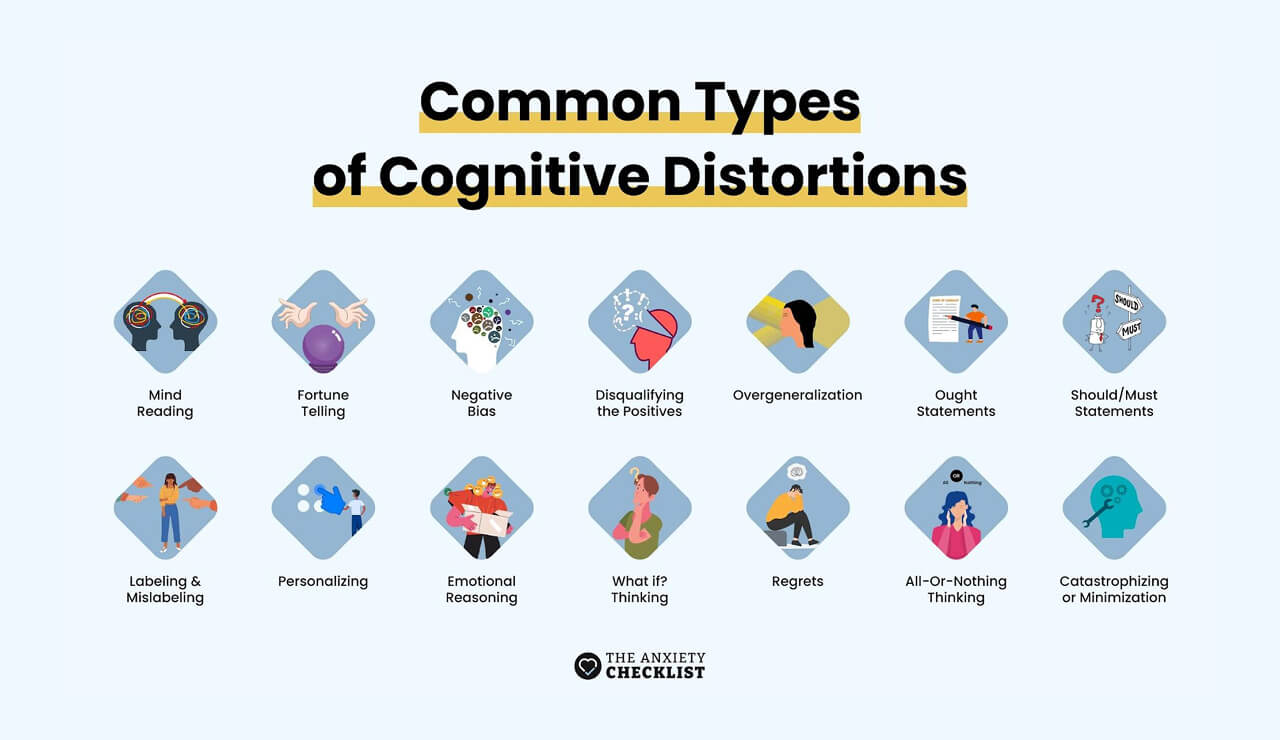
This phase matters because trauma leaves cognitive distortions. These include beliefs that you’re broken, unlovable, or to blame. Installation targets those distortions, replacing them with something more flexible and true.
6. Body Scan
When it comes to trauma, the mind and body aren’t separate. Emotional wounds live in the body even when you’re not conscious of them.
You’ll notice it in the way you react when a similar event happens. You may even experience tightness in the chest, a knot in the stomach, or a jaw that won’t unclench.
To make sure you’re winning against those trauma memories, your therapist will ask you to recall them. They’ll slowly ask you to scan your body from head to toe in search of built-up tension.
They’ll ask whether you notice any tension, discomfort, or unusual sensations. If you do, those physical residues become the next target for bilateral stimulation. You’ll process them until your mind and body feel better.
7. Closure
Every EMDR therapy session ends with closure, whether the processing is complete or not. Trauma processing doesn’t always wrap up neatly in one session. Sometimes a session ends with the work still in progress, and that’s okay.
This phase ensures you leave the session feeling stable and grounded. Your therapist will guide you back to the present using calming techniques. These include breathing exercises, visualization, or a safe-place exercise established during the second phase of the EMDR therapy.
The therapist will also brief you on what to expect between sessions. Your brain will continue processing events even after EMDR therapy. You may experience vivid dreams, unexpected emotions, or fragments of old memories surfacing without warning.
This is normal and a sign that the healing process is active. Your therapist may suggest keeping a brief journal of anything that comes up, so you can bring it to the next session.
8. Re-evaluation
This is the last phase of EMDR therapy, during which the therapist checks your progress. Your psychological state will determine whether you need more sessions.
Also, if any new emotions or memories arise, the therapist may adjust the targets you set in phase one. This ensures the healing process is continuous.
What Can EMDR Therapy Treat?
Eye Movement Desensitization and Reprocessing (EMDR) therapy is used to treat trauma and other anxiety-related conditions. These include:
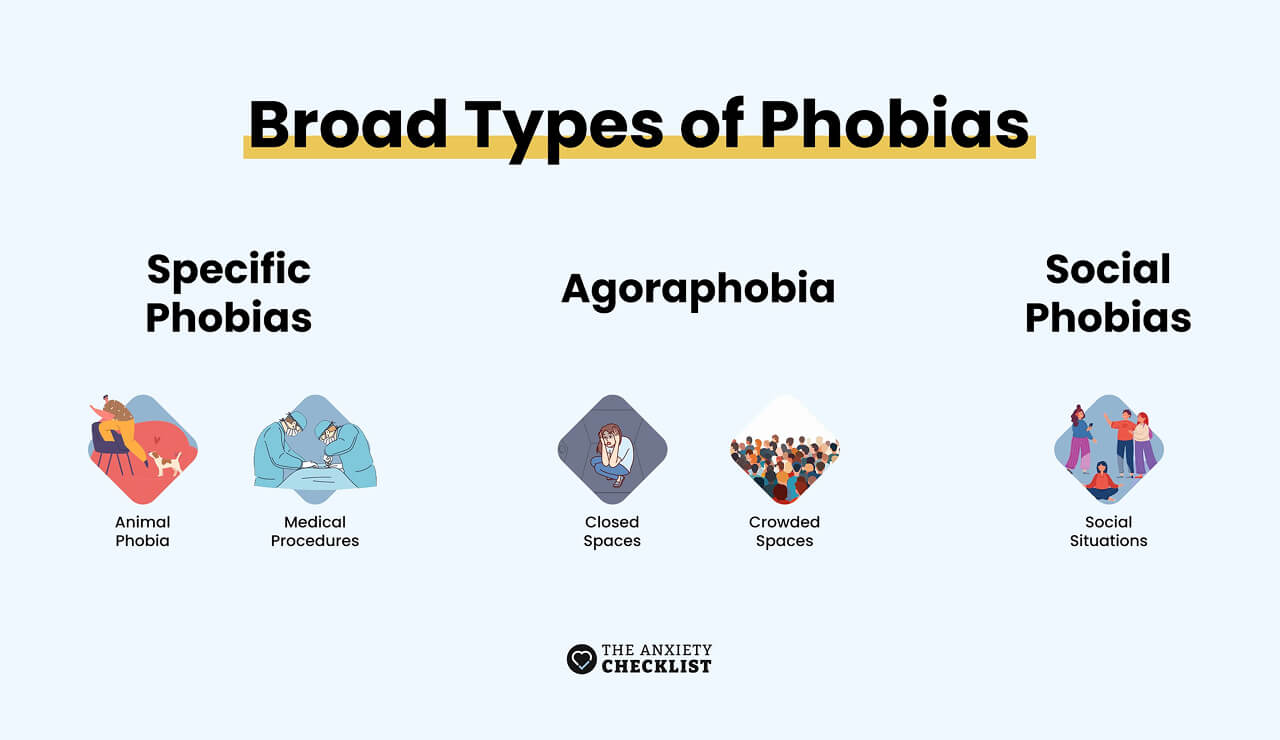
The common thread across all of these is unprocessed memory. EMDR therapy works when the brain has stored distress in a way that keeps you reacting to the present as if you’re still in the past.
This is also why EMDR therapy differs from traditional talk therapy. In talk therapy, healing happens through understanding why you feel a certain way.
EMDR therapy goes deeper by working directly with the memory network in your brain. It aims to change how you think about a traumatic event and how your body and emotions respond to it.
What Are the Benefits and Drawbacks of EMDR Therapy?
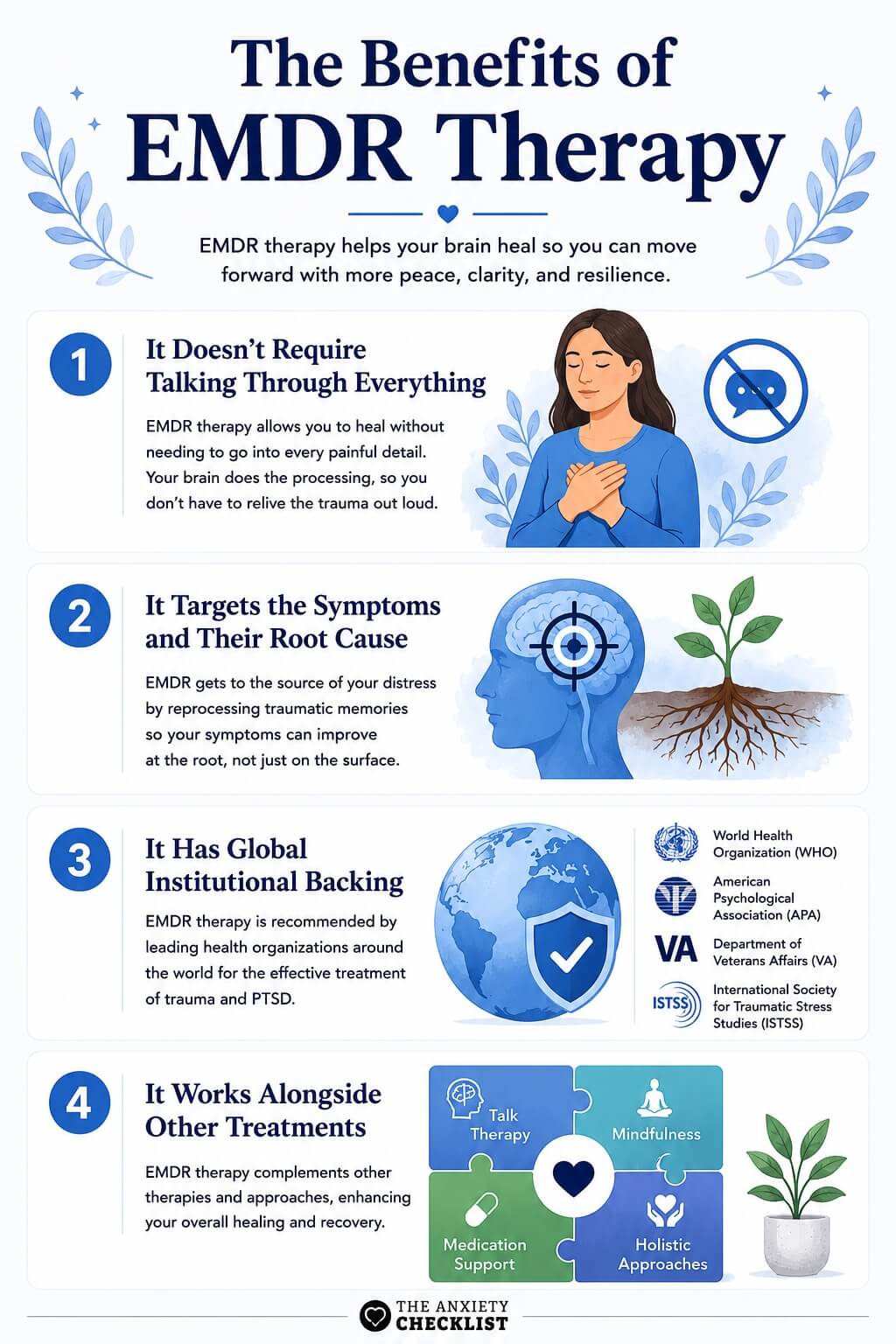
EMDR therapy has proven benefits, such as faster trauma processing. You don’t need to verbalize your experience in detail, and it has strong backing from bodies like the World Health Organization.
But it also has drawbacks. Some sessions can be emotionally intense, and it isn't suitable for everyone. Understanding the advantages and disadvantages helps you start EMDR therapy with honest expectations.
Benefits
Drawbacks
How does EMDR Therapy Compare to Other Options for Trauma and Anxiety?
EMDR therapy processes trauma faster than other options for trauma and anxiety. It also requires less verbal disclosure compared to cognitive behavioral therapy. Unlike exposure therapy, it pairs memory recall with bilateral stimulation to speed up desensitization. Below, we take a closer look at EMDR therapy vs other treatments.
EMDR Therapy vs CBT
Cognitive Behavioral Therapy (CBT) focuses on identifying and changing distorted thought patterns. It’s highly effective and widely used for anxiety disorders, such as generalized anxiety disorder and social anxiety disorder.
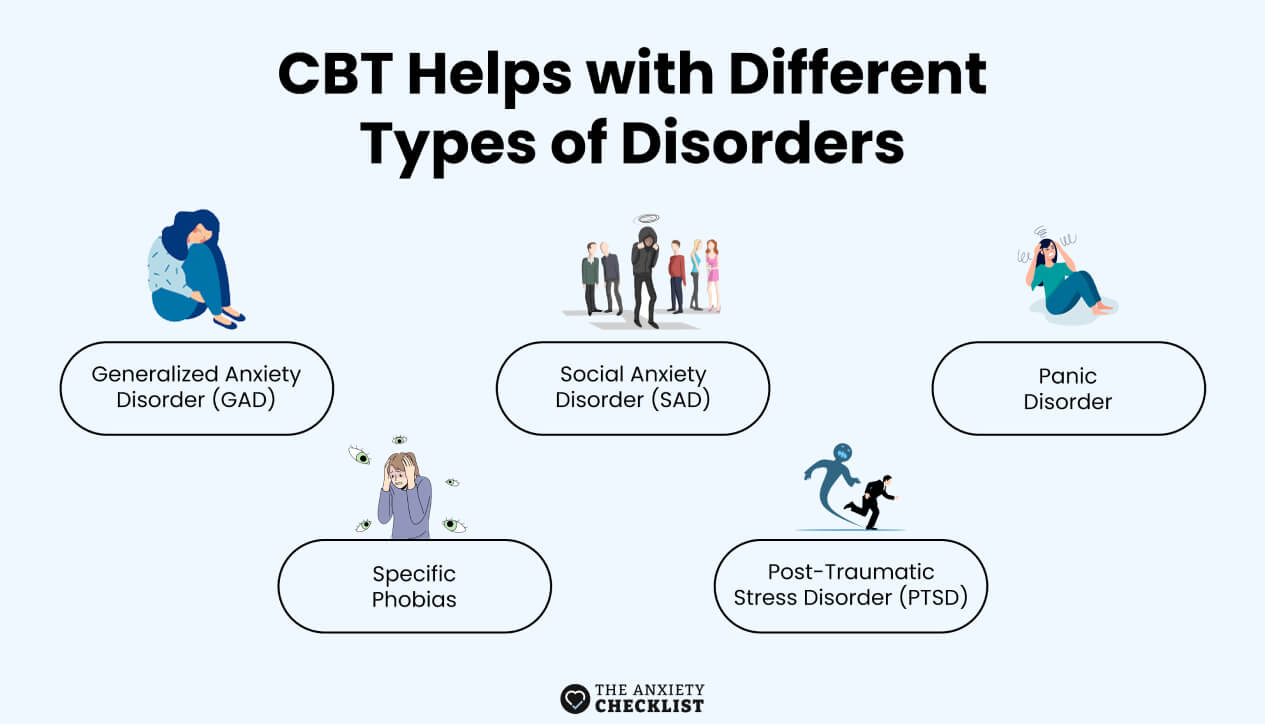
EMDR therapy, by contrast, doesn’t require you to analyze your thoughts in depth. It targets the underlying memory directly. Some people find EMDR therapy more tolerable because you don’t have to talk about the traumatic event. This matters when trauma feels too raw to put into words.
EMDR Therapy vs Exposure Therapy
Exposure therapy works by gradually facing feared situations or memories until they no longer feel threatening. Both exposure therapy and EMDR therapy involve facing the trauma. But EMDR therapy pairs that exposure with bilateral stimulation, and the processing happens more rapidly.
EMDR Therapy vs Medication
Medication can reduce symptoms of PTSD and anxiety, but it doesn’t help you process the underlying trauma. Many people use EMDR therapy alongside medication, especially early in treatment when distress is very high. Later on, their physician can gradually reduce the medication as therapy takes hold.
There’s no single best treatment for trauma and anxiety. The right approach depends on your history, your nervous system, and what feels manageable. If you’re unsure where to start, consult a psychiatrist for anxiety, who can help you weigh your options.
Frequently Asked Questions
Others report vivid dreams, heightened anxiety, or emotional rawness in the days following a session. These reactions are usually temporary and manageable with the right support.
Over time, the triggers lose their power because the memory network has been reprocessed. EMDR therapy is particularly effective for anxiety rooted in past trauma, phobias, or panic disorder.
Final Thoughts
Anxiety University
Explore the Anxiety University
Free guides to help you understand anxiety, one topic at a time.
- Getting StartedThe basics of anxiety and how it works
- Self-Assessments & Anxiety TestsCheck in on your symptoms with free tests
- Cognitive Traps & Thought PatternsSpot the thinking habits that fuel anxiety
- Stress ReductionPractical ways to calm your body and mind
- Common Anxiety PhobiasUnderstand specific fears and how they are treated
- Inspiring StoriesReal stories and words that remind you you are not alone