


In short
Neurofeedback therapy may ease anxiety for some people, but evidence remains limited and mixed, and benefits are unpredictable. It is best considered a complementary option alongside proven treatments, not a cure or replacement for CBT, exposure therapy, or healthy routines. Before trying it, weigh the cost, time commitment, access to qualified providers, and how progress will be measured.
Key takeaways
- Some research is promising, but small studies, mixed results and inconsistent protocols limit firm conclusions.
- Sessions usually last 30 to 60 minutes, with many programmes recommending 20 to 40 sessions.
- Costs can reach thousands of dollars, and insurance does not always cover treatment.
- Choose a licensed clinician with neurofeedback credentials and ask how progress in daily life will be measured.
- CBT and exposure therapy should usually come first for severe anxiety, untreated panic, strong avoidance or unresolved trauma.
What Is Neurofeedback Therapy?
Neurofeedback therapy is a non-invasive, drug-free technique that lets you see your own brain activity in real time and then nudges you to shift it toward calmer patterns.
It’s a type of EEG biofeedback for your brain. Small sensors rest on your scalp and read your brain activity as electrical signals.
A computer turns this electrical activity into feedback you can see or hear. Sometimes it looks like a game that responds when your brain waves settle into calmer patterns.
Your brain produces several kinds of waves.
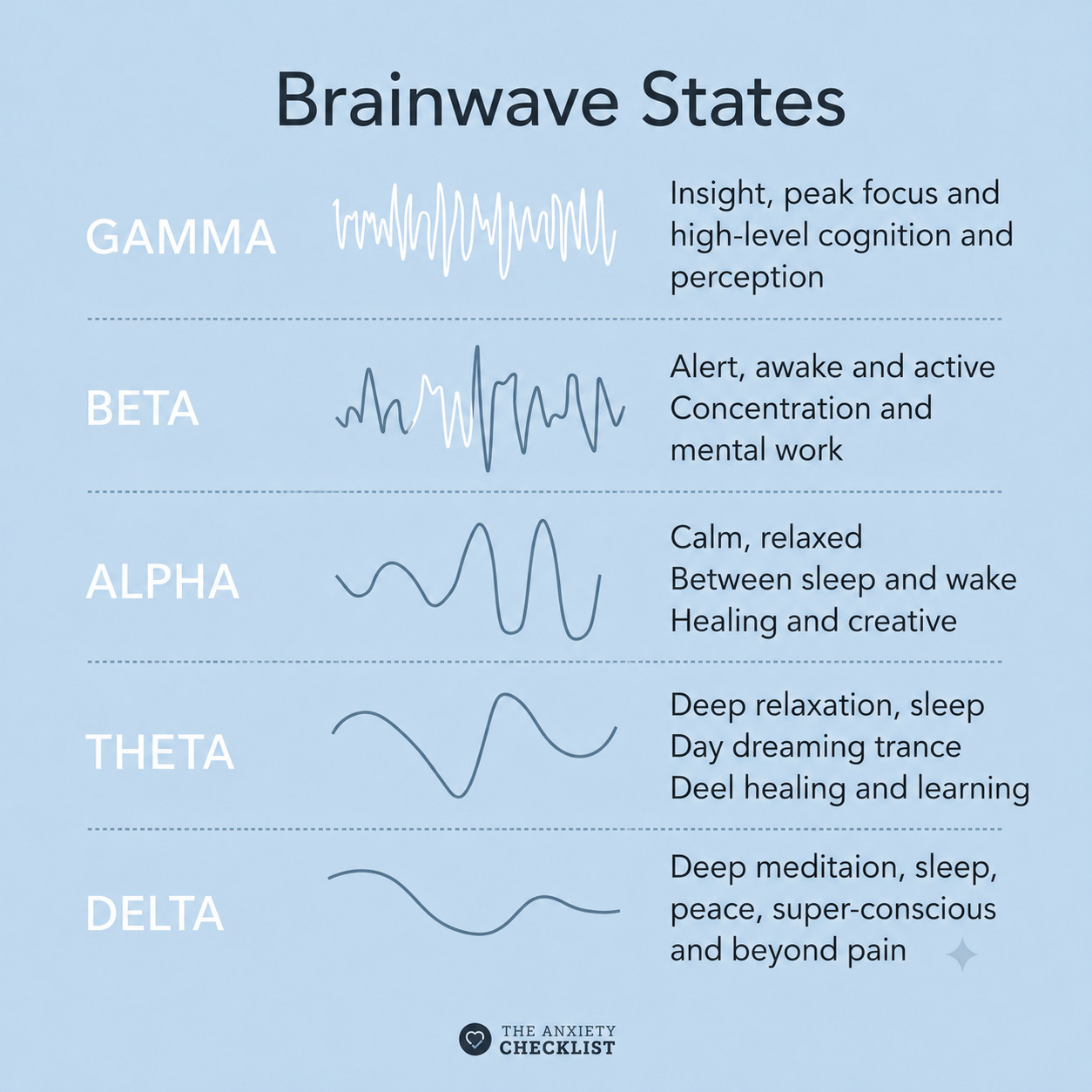
Increasing beta waves may improve focus, cognitive functioning, and overall mental performance. Balancing theta and alpha waves can support restful sleep and emotional stability.
In simple terms, faster brain waves show up when you’re focused, thinking hard, or feeling stressed. Slower brain wave patterns are more common during rest, meditation, or deep sleep.
Some neurofeedback treatments aim to gently increase alpha waves or encourage calmer brainwave patterns that may help settle an overactive mind.
The idea behind the neurofeedback process is simple and gradual. It’s based on a type of learning called operant conditioning. When your brain function drifts toward a calmer state, you get immediate positive feedback through visual or auditory cues.
Over many sessions, the goal is to help your brain learn to settle into calmer, healthier patterns easily and on its own. Still, it helps keep expectations realistic. Seeing brainwave activity on a screen is not the same as proof that changing it will fix anxiety.
How a Typical Neurofeedback Session Works
A neurofeedback session is simpler than most people would expect. Here's the usual flow:
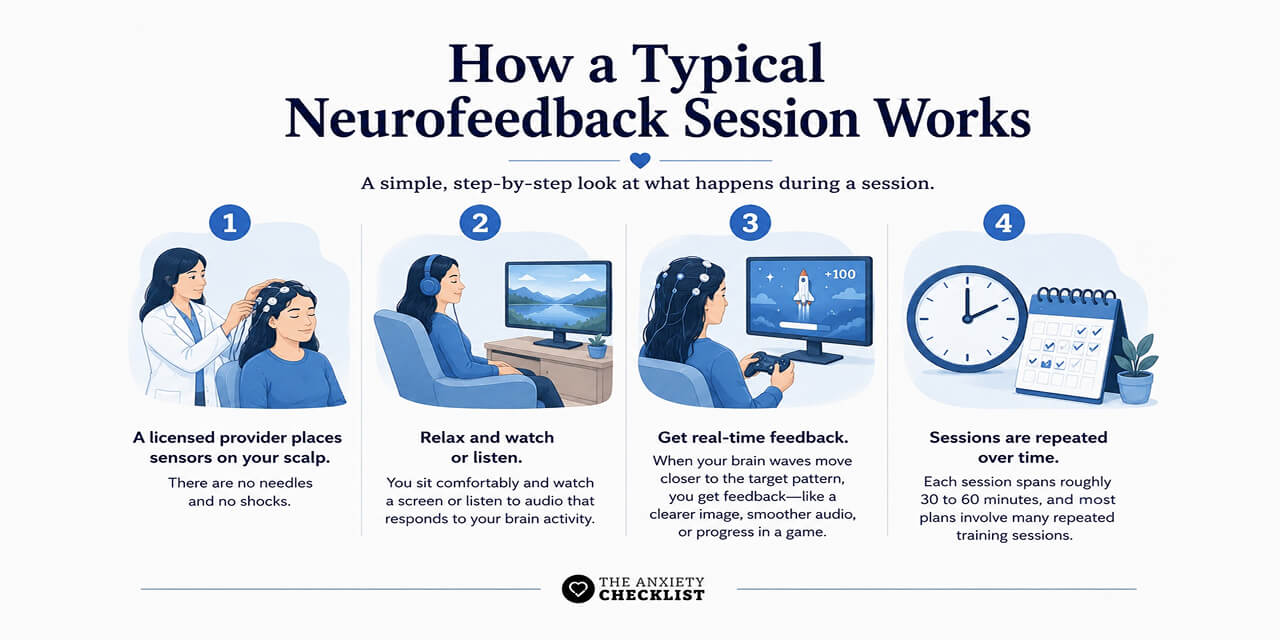
It's repetitive on purpose. Think of it like building a meditation habit or progressive muscle relaxation, rather than flipping a switch. The idea is brain training through gradual practice, not a single dramatic breakthrough.
Why Are People Using Neurofeedback Therapy for Anxiety?
Most people don’t start looking into neurofeedback therapy because they’re curious about brain health. They do so because they’re tired. Chronic anxiety wears them down in ways that are hard to explain to anyone who hasn't felt it.
If overthinking and anxiety keep you replaying the same worry at 2 am, the thought of using neurofeedback to manage anxiety sounds like immediate relief.
Here are some struggles that could lead you to seek neurofeedback therapy.
When you've tried a lot of things, a non-invasive treatment that directly targets your brain health feels promising. That hope is real, it just deserves honest information and data beside it.
Now, let’s get to what science actually shows.
What Does Research Say About Neurofeedback Therapy?
This is the most important part, so let's keep it honest. The research on neurofeedback therapy is genuinely interesting, and some findings look promising. But it's far from established.
What Research Looks Promising
These are a few reasons people are paying attention to the neurofeedback process.
For example, a 2025 systematic review found early signs that pairing neurofeedback therapy with approaches like CBT or mindfulness may reduce anxiety and depression symptoms in some people. But researchers also stressed that we need better-quality studies before drawing solid conclusions.
Researchers have also explored neurofeedback in people with post-traumatic stress disorder (PTSD), where a study reported significant improvements in trauma symptoms.
Since anxiety often overlaps with trauma, that’s partly why interest in neurofeedback therapy keeps growing. So yes, there are encouraging signals; however, this is also where the data matters most.
Where the Evidence Is Still Limited
Here’s where researchers have real questions. Many of the promising studies have a few important limitations:
One of the biggest unanswered questions is the placebo effect.
Per this research report, people undergoing real neurofeedback didn't improve any more than those receiving a convincing placebo.
That doesn't mean people aren’t feeling better. It simply means that we can't yet be sure what’s driving the improvement. Is it neurofeedback or the brain training itself doing the work, rather than the calm, attention, and care around it?
That's exactly why many basic and clinical neuroscience and mental health experts remain interested, but cautious.
Can Neurofeedback Therapy Help Ease Anxiety?
Here’s the honest answer: it might help some people, but the results vary widely.
Right now, there’s no reliable way to predict who’ll benefit and who won’t. So, we can't promise it will help you.
Some people who try neurofeedback therapy describe real, meaningful changes such as:
Those experiences matter. At the same time, some people spend months on neurofeedback therapy and notice very little change. Both outcomes are common, and there's no clear way to predict which one you'll get.
Personal stories aren't the same as strong scientific evidence, and researchers are still figuring out who benefits, why, and for how long. So if you're exploring neurofeedback, it helps to go in with realistic expectations.
Think of it as a possible supportive tool, not a cure or guaranteed fix. If it helps, great. If it doesn't, you haven't skipped the treatments with the strongest evidence.
Neurofeedback Therapy vs Proven Anxiety Treatments
Here's where the comparison gets clear. Unlike talk therapy and other established forms of care, neurofeedback therapy doesn’t yet have the same level of evidence.
When it comes to anxiety, the strongest research still supports traditional treatments with repeated evidence. Here’s a quick overview of the different anxiety treatments.
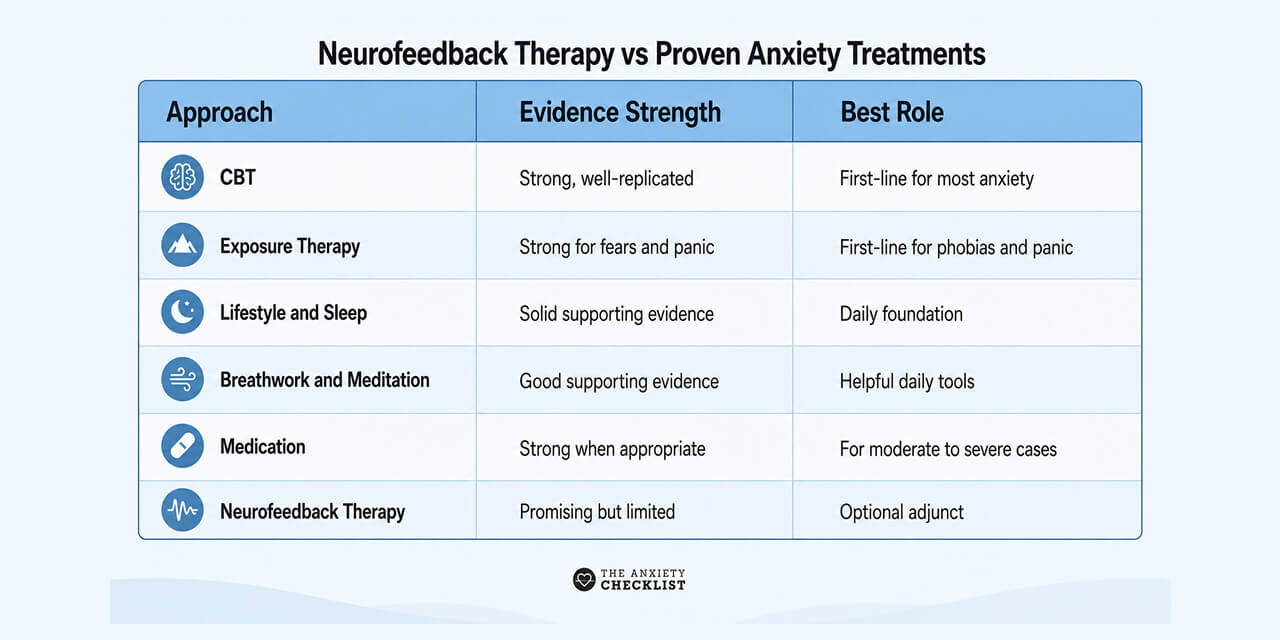
CBT and exposure therapy, including social anxiety disorder, have been studied for decades. They help people challenge their fearful thoughts and reduce the avoidance patterns that keep their anxiety disorders alive.
Add in the basics, such as lifestyle and dietary changes, breathing exercises and meditation, and you've got a practical, affordable, and well-supported foundation.
Even complementary options like mindfulness-based therapies and hypnotherapy have been explored for anxiety longer than neurofeedback.
Neurofeedback therapy doesn't replace any of these. It complements proven treatments rather than being a substitute. Some people do report meaningful benefits of neurofeedback, but currently, the evidence supports treatments we already know work well.
Practical Things to Consider Before Trying Neurofeedback Therapy
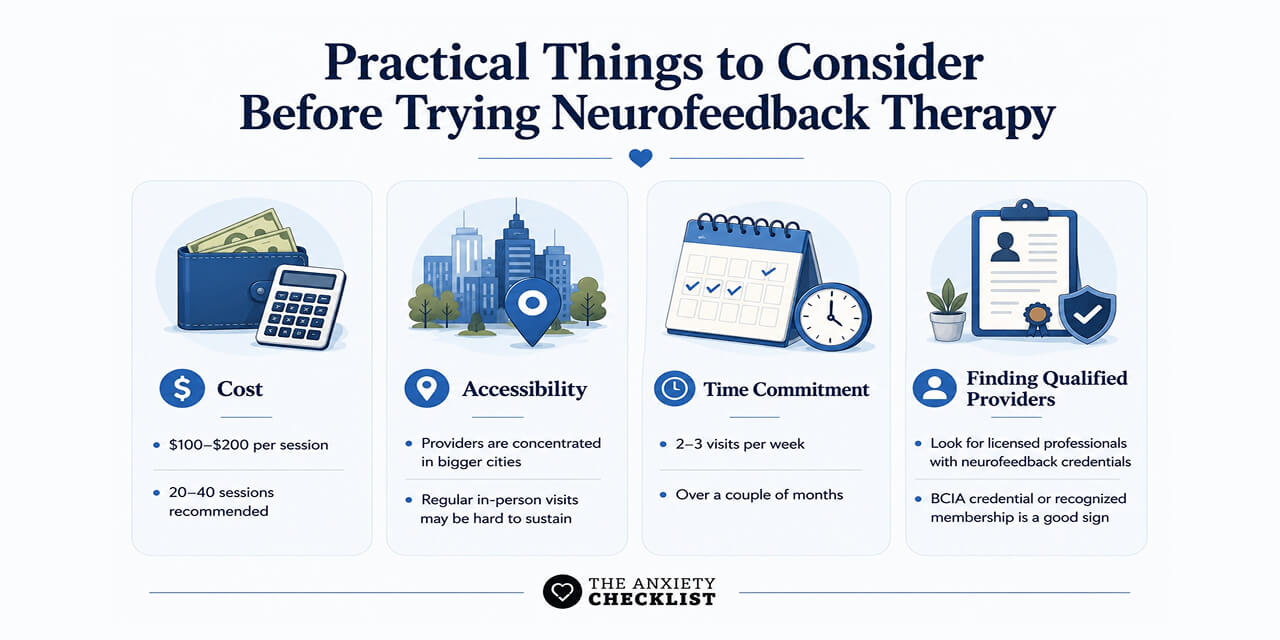
If you're still curious about neurofeedback therapy, just go in with realistic expectations and a clear understanding.
Cost
Sessions can cost a couple of hundred dollars, and many programs recommend 20 to 40 sessions. That can add up to thousands of dollars, especially since insurance doesn’t always cover neurofeedback services.
Accessibility
Qualified providers are concentrated in bigger cities. If you live elsewhere, regular in-person visits may be hard to sustain, which matters because consistency is the whole point in any therapy.
Time Commitment
Plan for two to three visits a week over a couple of months. For an already overstretched, anxious life, that's a real commitment worth thinking through honestly.
Finding Qualified Providers
If you decide to try it, look for licensed mental health professionals with specific neurofeedback credentials, not just anyone with fancy equipment.
Membership in a recognized international society or a Biofeedback Certification International Alliance credential is a good sign, especially when accompanied by real training.
A psychiatrist for anxiety can also help you judge whether it realistically fits your care plan.
Questions to Ask Before Starting
Before spending time or money, ask a few direct questions.
The gist is : Before trying neurofeedback therapy, consider costs, time commitment, access, and expectations. A good licensed neurofeedback provider should be qualified, transparent, and realistic about what neurofeedback can and can’t do.
Who Should Consider Neurofeedback Therapy?
Neurofeedback therapy isn't for everyone. It makes the most sense as an extra layer of support for people with a solid foundation.
It may be worth exploring if you:
Notice the pattern. Neurofeedback works best as an addition, not the foundation.
It’s sometimes explored for major depressive disorder or brain injury recovery, too, but always as a part of a broader care routine. It's not an alternative to evidence-based treatment, and a good provider will tell you the same.
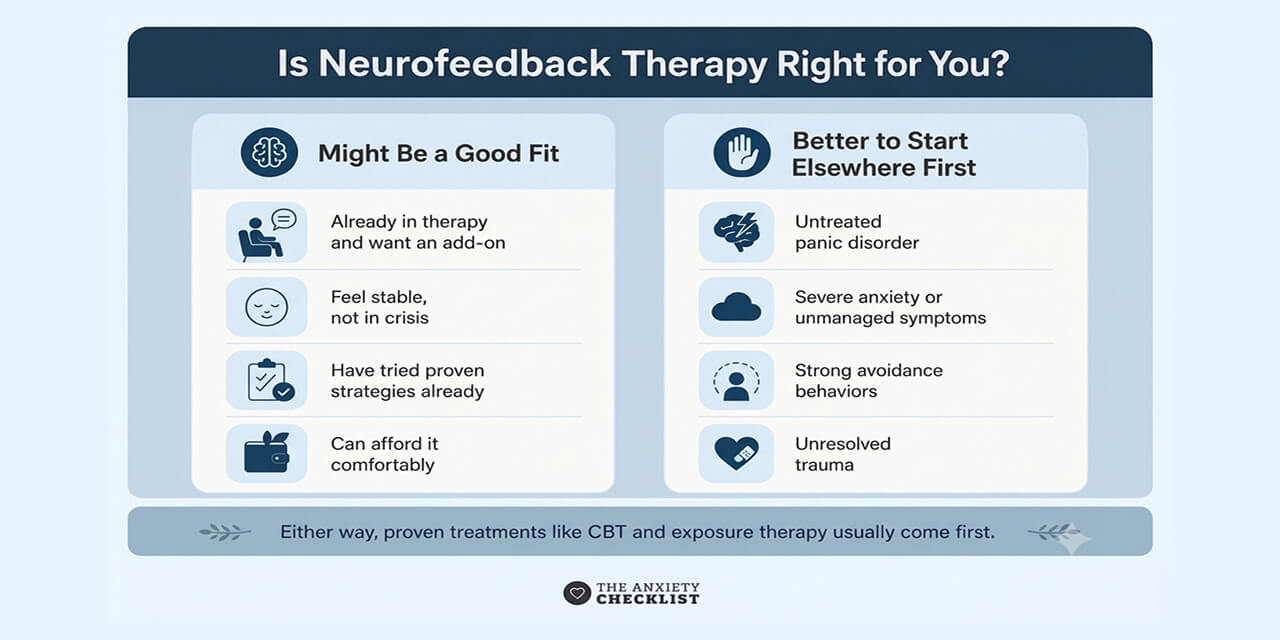
When Neurofeedback Therapy May Not Be the Best Starting Point
There are times when reaching for neurofeedback first may not be the best decision.
It's not the place to start if you’re dealing with:
In situations like these, CBT and exposure therapy usually come first because they directly address the avoidance and fear cycles driving the anxiety.
If you're not sure where you stand, a quick GAD-7 anxiety test can help you have a more informed conversation with a mental health professional.
If you have untreated panic, severe anxiety, strong avoidance, or unresolved generational trauma, proven treatments like CBT and exposure therapy should usually come first.
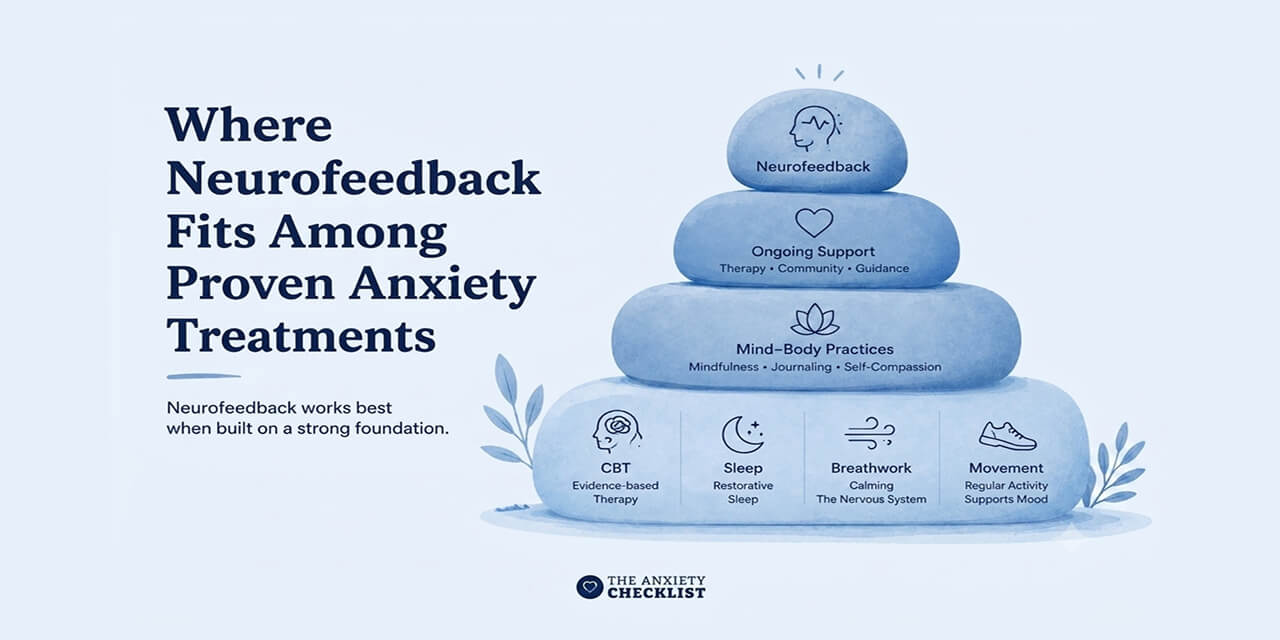
Anxiety Checklist's Ranking of Anxiety Interventions
If there’s one thing you must take away from this article, it’s this: not all anxiety treatments carry the same weight of evidence.
Here’s the order you can prioritize based on what research consistently supports.
CBT and Exposure Therapy
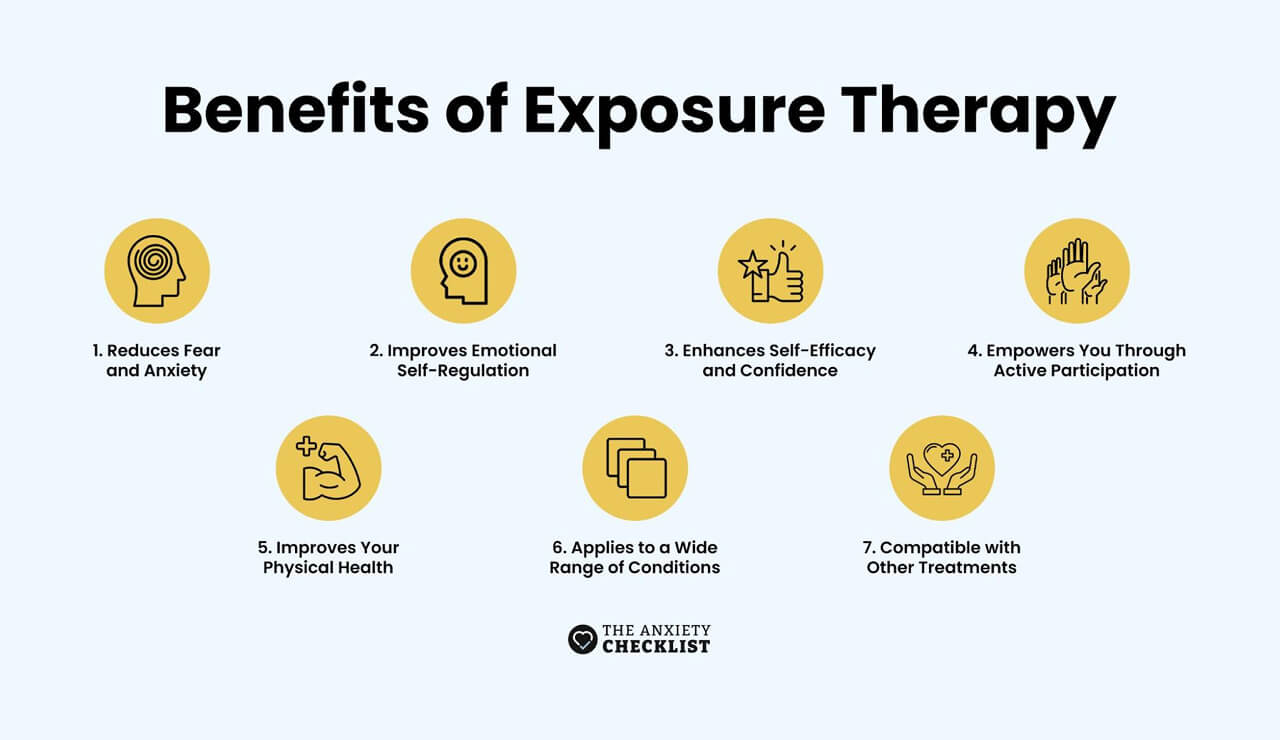
CBT and exposure therapy sit at the top for a reason. They have been studied for decades and consistently show strong results across different anxiety disorders.
More importantly, they help people work directly with thoughts, fears, and avoidance patterns that tend to keep anxiety going. For many people, this is where real change starts.
The following are seven proven benefits of exposure therapy.
Sleep, Exercise, and Nervous System Regulation
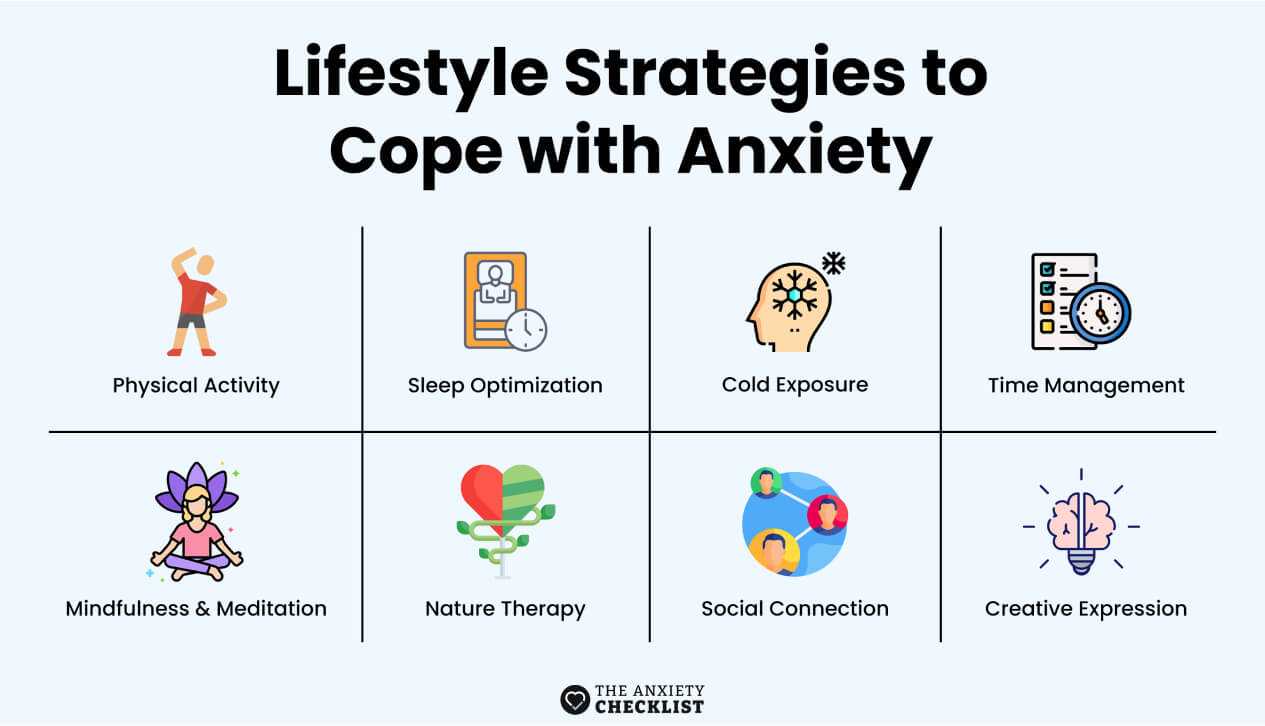
Anxiety just doesn’t sit in your mind; it sits in your body, too. Steady sleep, regular movement, and everyday lifestyle changes for anxiety calm an overactive nervous system in ways most people don’t expect.
Understanding your common anxiety triggers helps you protect this foundation.
The following are a few lifestyle strategies to cope with anxiety starting today.
Meditation and Breathwork
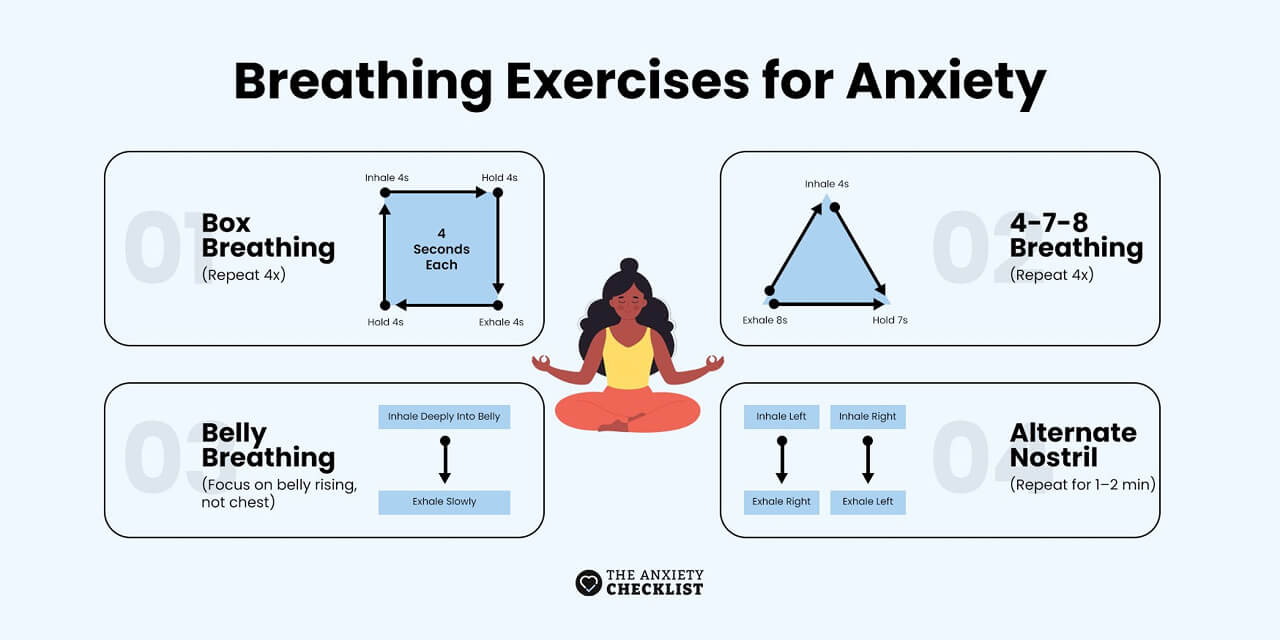
Meditation and breathing exercises are gentle, free, and surprisingly powerful. On their own, they may not resolve anxiety completely. But they make the harder work more manageable.
Grounding techniques, journaling, and mindfulness practices fit here, too.
Start with the easiest breathing exercise today to manage your anxiety.
Medication (When Appropriate)
For some people, especially with severe anxiety, medication is a sensible and evidence-backed part of care. There's no shame in it. It's simply a decision to make with a psychiatrist for anxiety, often alongside therapy.
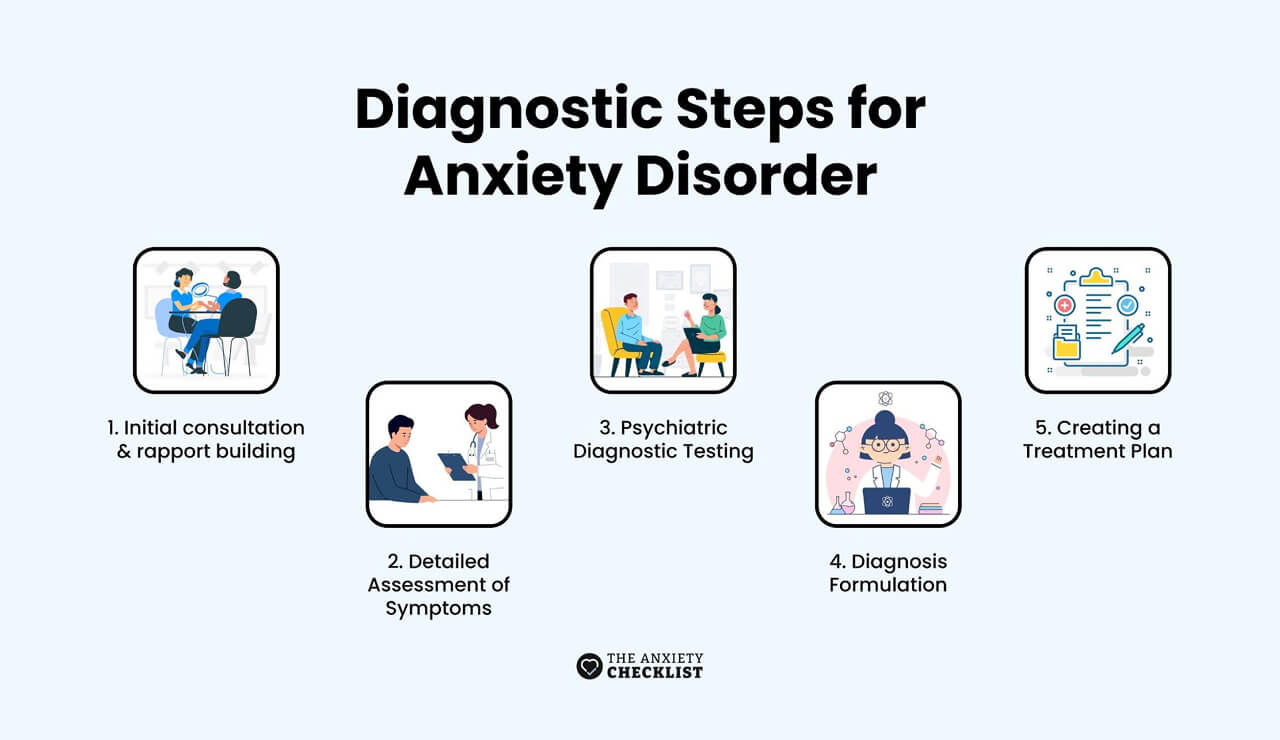
Follow this 5-step approach after you filter your research to the best psychiatrist near you.
Neurofeedback Therapy
This is where neurofeedback therapy lands: optional, promising, but still emerging and supplementary. It may help some people as an add-on, but it shouldn't be prioritized over treatments with stronger evidence.
FAQ
So, Where Does This Leave You?
Anxiety University
Explore the Anxiety University
Free guides to help you understand anxiety, one topic at a time.
- Getting StartedThe basics of anxiety and how it works
- Self-Assessments & Anxiety TestsCheck in on your symptoms with free tests
- Cognitive Traps & Thought PatternsSpot the thinking habits that fuel anxiety
- Stress ReductionPractical ways to calm your body and mind
- Common Anxiety PhobiasUnderstand specific fears and how they are treated
- Inspiring StoriesReal stories and words that remind you you are not alone