

In short
Pressure points such as Yintang between the eyebrows, Neiguan on the inner forearm and Ear Shen Men may ease anxiety briefly for some people. Apply firm, comfortable pressure for one to three minutes while breathing slowly, but stop if it hurts or symptoms worsen. Acupressure is not a proven treatment for anxiety disorders and should not replace professional care.
Key takeaways
- Research is strongest for Yintang, Neiguan and Ear Shen Men.
- Use steady pressure or small circles while making your exhale slightly longer than your inhale.
- Avoid Hegu, Jian Jing and San Yin Jiao during pregnancy unless a clinician advises otherwise.
- Stop immediately if you feel pain, become dizzy or your anxiety worsens.
- Seek professional help if anxiety is persistent, severe or disrupts daily life.
Quick Summary
When anxiety builds, do you ever wish you had something to do with your hands? Well, pressing on certain points on the body, such as the center of forehead or inner wrist crease, can make you feel calmer. Many people look for pressure points for anxiety because they are simple, free, and safe to try.
If you deal with anxiety and are looking for ways to calm yourself, you’re not alone.
A 2025 poll by the American Psychiatric Association shows that anxiety is quite prevalent in the US. The most common causes of anxiety are current events and bill payments, as cited by 62% of people.
In this guide, you'll learn about 11 pressure points for anxiety. You’ll also learn where to find them, how to use them safely, and what the research says.
What Are Pressure Points, and How Can They Help With Anxiety?
Pressure points are spots you press to ease anxious feelings. They may bring short-term, low-risk anxiety relief for some people.
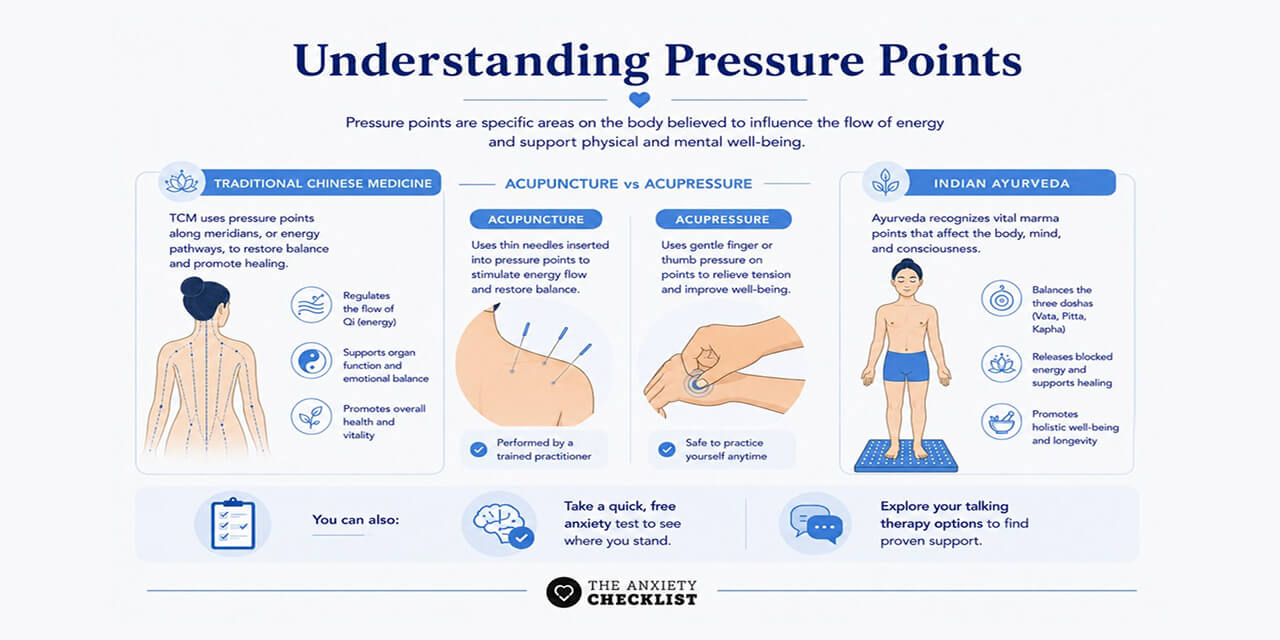
Traditional Chinese medicine has used pressure points for anxiety relief for centuries. They use these through acupuncture or acupressure.
Acupuncture involves needles, while acupressure is the practice of pressing these points with a finger or thumb. It uses the same map as acupuncture, just without the needles.
In this tradition, the points sit along channels said to carry your energy, or "qi." Pressing them is thought to ease the flow. That idea is part of a belief system, not established biology, so we hold it lightly here.
Using pressure points for anxiety is not unique to Chinese medicine. Indian Ayurvedic practices also use pressure points on the body called Marma points. Today, some people even use Marma mats and massage tools as part of their wellness routine.
Here’s a simple illustration of what pressure points for anxiety relief are.
So, can pressure points help with anxiety?
They might. Some people feel calmer after gently pressing certain points. It’s simple, free, and safe for most people to try.
Just remember that the effects are usually short-term. Acupressure works best alongside other anxiety treatments, not instead of them.
It fits well with naturopathic treatments for anxiety and lifestyle changes.
Do Pressure Points Really Work for Anxiety? What the Research Says
Acupressure may help you feel calmer for a short time, but there’s limited scientific research to back its effects. It’s safe for most people to try, but it’s not a proven treatment for anxiety disorders.
So, what does the research actually say about using pressure points for anxiety?
The best evidence is for short-term anxiety, especially before medical procedures.
A 2023 systematic review published on the National Library of Medicine sheds light on this. It shows that acupressure can help calm anxiety before elective surgeries.
Another meta-analysis was published in 2024 on Frontiers. It showed that acupressure has some positive effects in relieving anxiety.
All other research is older, and none is conclusive. These studies vary a lot in quality, and results differ from trial to trial.
So, while people can use pressure points for anxiety, they may not work for everyone. Given that this tactic is free and easy to use, there’s no harm in trying. Combine it with breathing exercises or meditation practices, and you’ll have a good routine to deal with anxiety.
How to Use Pressure Points for Anxiety (Step by Step)
Press a point with firm, comfortable pressure for one to three minutes while you breathe slowly. Using pressure points for anxiety relief should never hurt.
The good news is that you need no equipment, and the method is simple. Here is a gentle routine you can use.
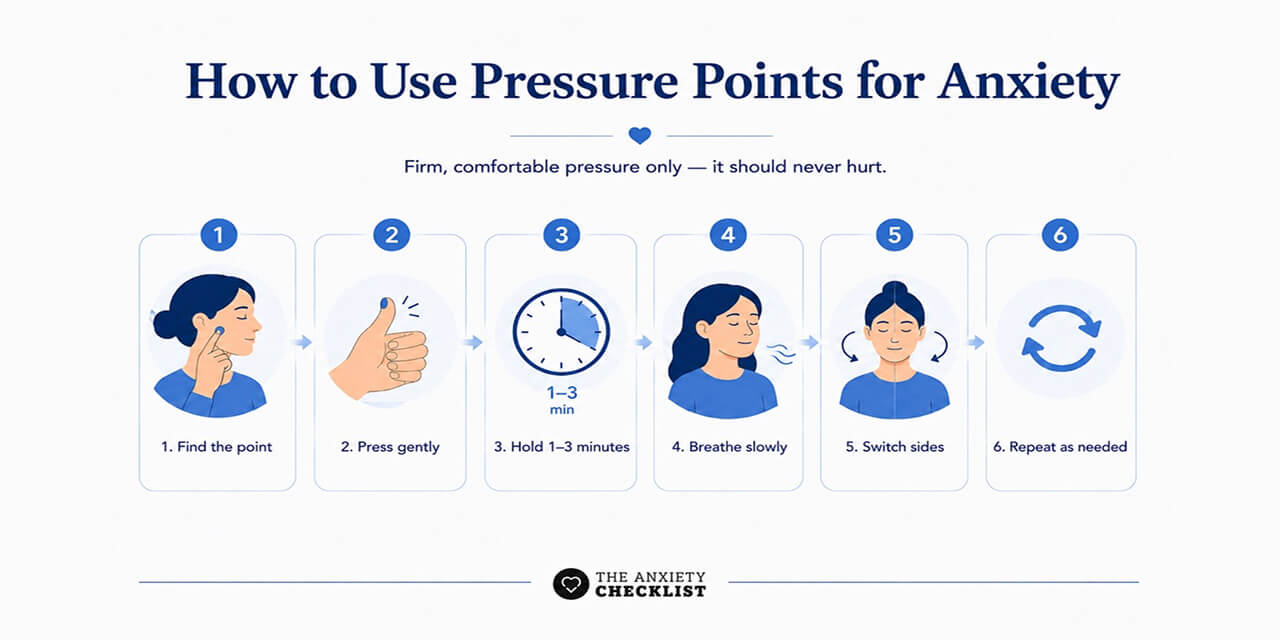
You don't have to follow these timings exactly. Experts don't all agree on how long to press each point, so use these as a guide. Stop straight away if you feel pain, get dizzy, or your anxiety gets worse.
Another technique you may also find helpful is EFT Tapping. Instead of applying steady pressure, EFT uses gentle tapping on specific points while focusing on anxious thoughts. Some people find it easier to learn and quicker to perform during stressful moments. You can learn more in our guide to EFT Tapping for anxiety.
Slow breathing can make acupressure feel even more calming. Try taking a few slow breaths as you hold each point. If you want to build a steady habit, setting SMART goals for anxiety can help with that.
Which are the Key Pressure Points for Anxiety Relief?
Popular points include Yintang between the eyebrows, Neiguan on the inner forearm, and the ear point. Start with whichever is easiest to reach.
These are traditional acupressure points that people use for anxiety and stress. The evidence is strongest for a few, such as Yintang and the ear point. The rest are mostly traditional. You do not have to use all 11. Start with whichever ones are easiest for you to reach.
1. Hall of Impression (Yintang, EX-HN3)
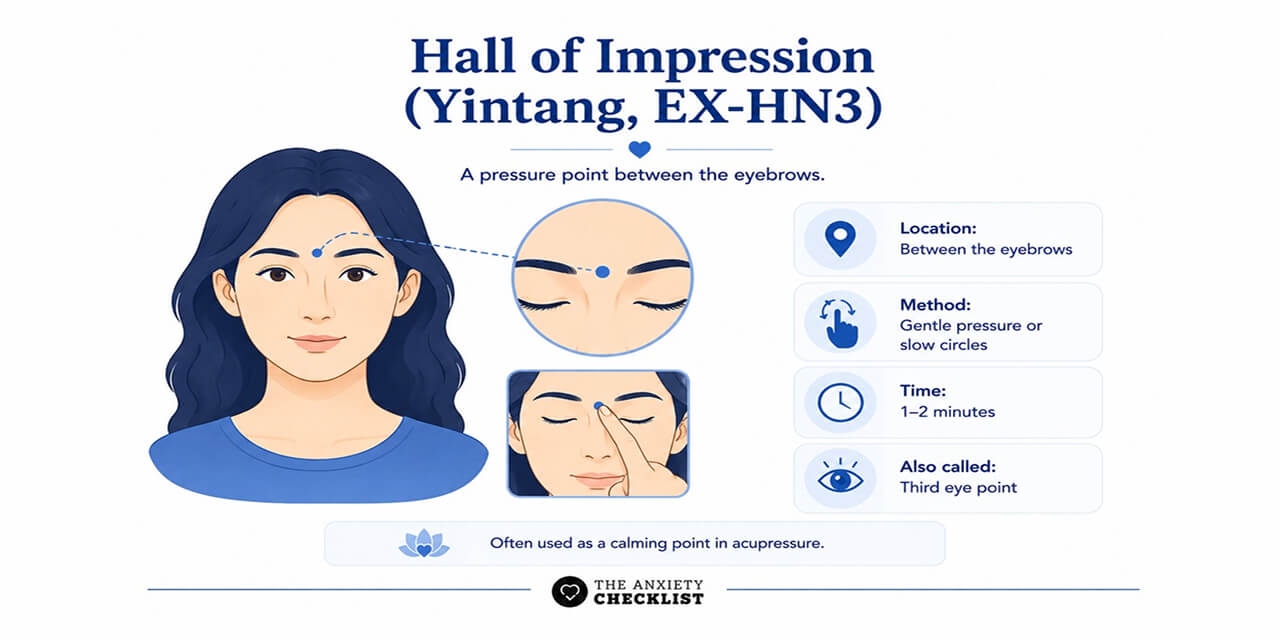
You will find this point right between your eyebrows, where the bridge of your nose meets your forehead.
Press gently with one fingertip, or make slow circles, for a minute or two. Often called the "third eye," Yintang is the most studied point for anxiety.
2. Inner Gate (Neiguan, PC6)
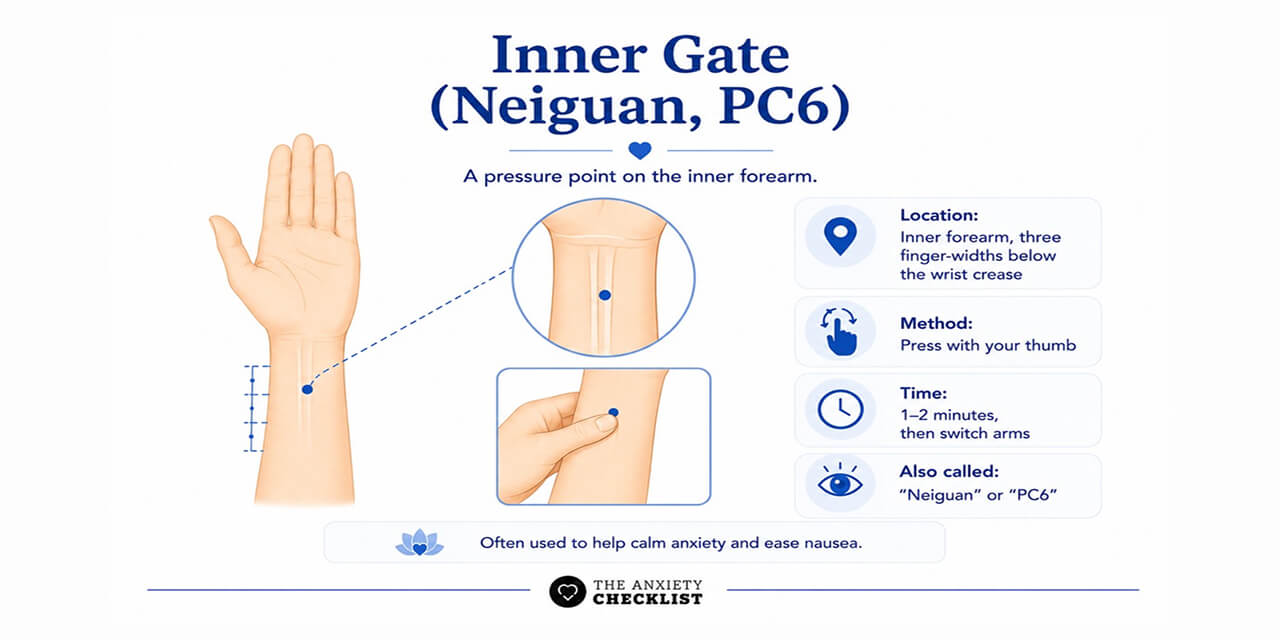
Neiguan is one of the key pressure points for anxiety relief and recovery. It sits on the inside of your forearm, about three finger-widths below your wrist, between two tendons.
Press the spot gently with your thumb for one to two minutes, then switch to the other arm. It has been studied more than most pressure points and is also widely used to help with nausea. Better yet, you can use it almost anywhere without anyone noticing.
3. Spirit Gate (Shen Men, HT7)
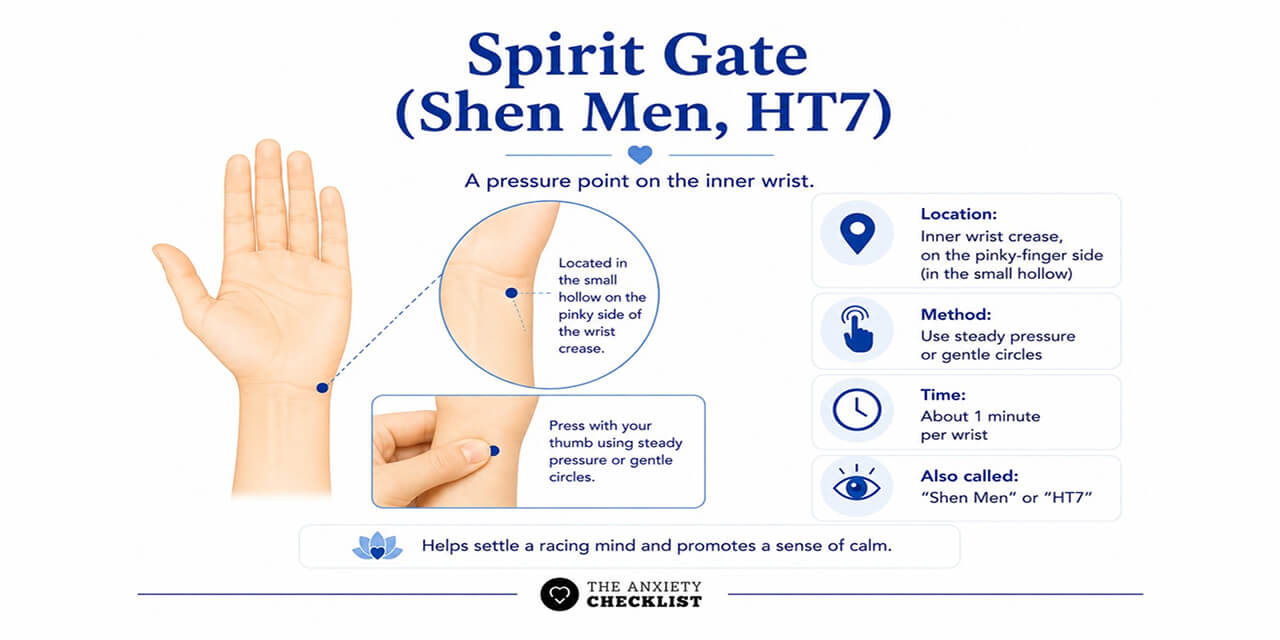
Look for this point on your inner wrist crease, on the pinky-finger side, in the small hollow there. Apply steady pressure or gentle circles for about a minute per wrist.
Shen Men means "spirit gate," and it is a classic point for a racing mind. It was one of the two most common points in acupressure anxiety trials. That makes it a sensible place to start.
4. Ear Gate (Ear Shen Men)
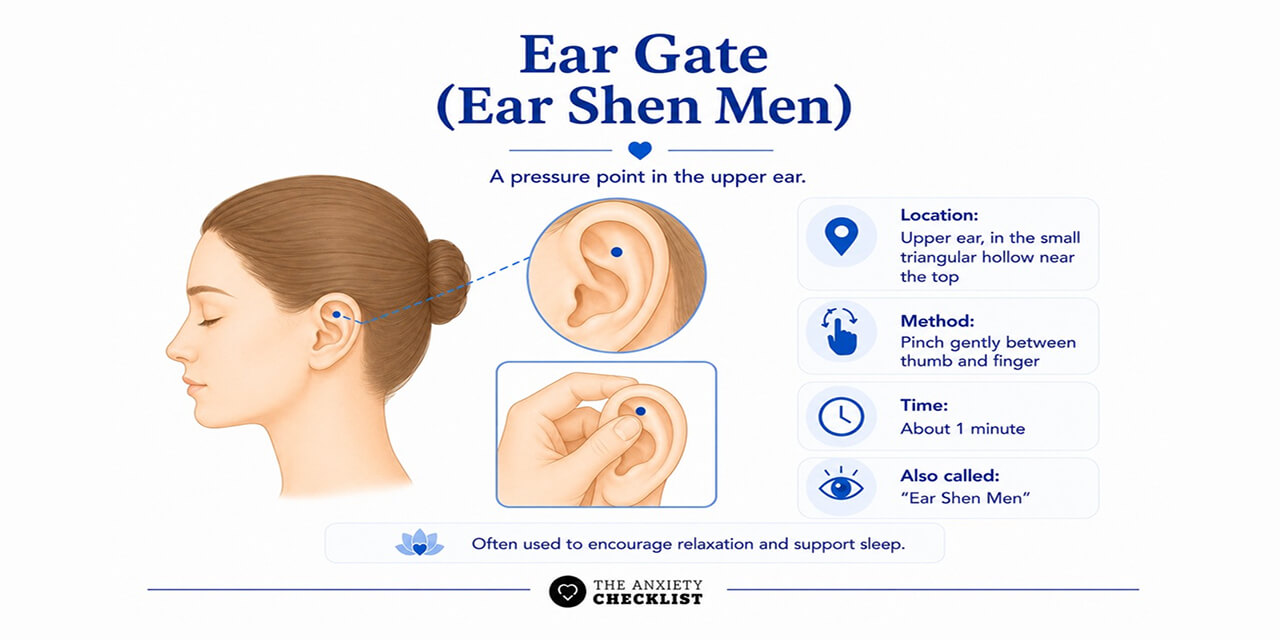
This point is in the upper part of your ear, tucked in the small triangular hollow near the top. Pinch it gently between your thumb and finger for a minute or so.
Ear acupressure has some of the better evidence among pressure points for anxiety relief. In a 2023 trial in medical students, pressing points on the ear helped lower test anxiety.
5. Union Valley (Hegu, LI4)
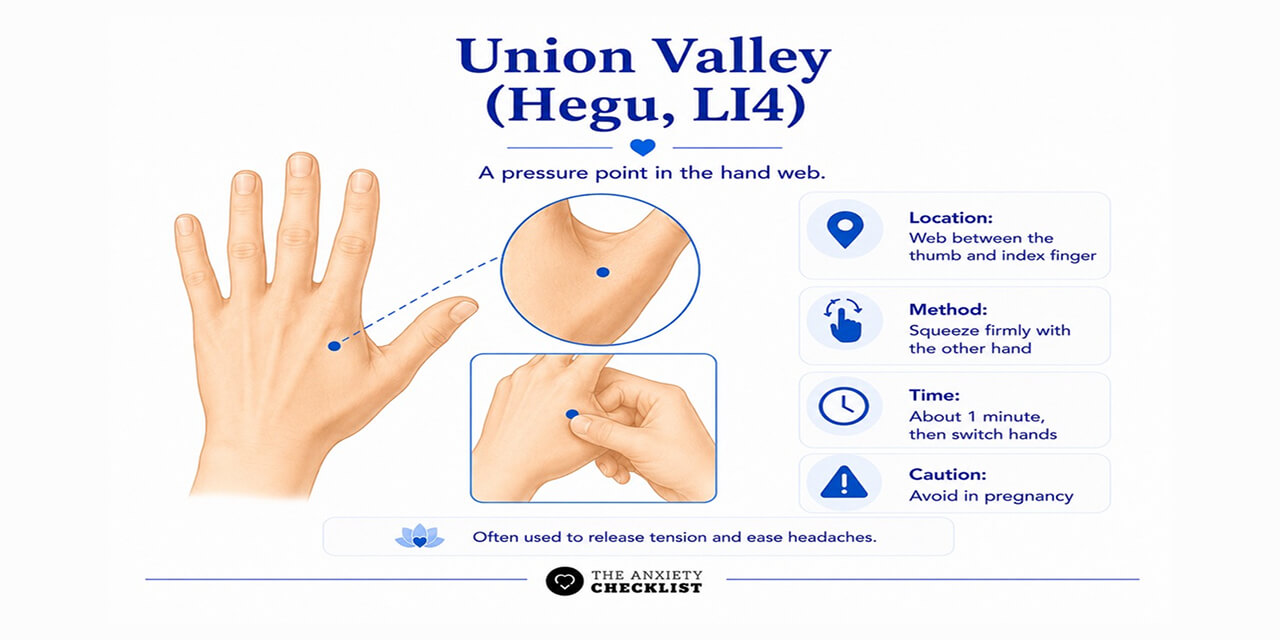
You'll find Hegu in the web between your thumb and index finger. It’s one of the pressure points for anxiety relief that you can use anytime, anywhere.
Give the spot a firm squeeze for about a minute, then switch to the other hand. It’s a favorite pressure point for relieving tension and headaches because it is easy to reach wherever you are.
If you’re pregnant, avoid this point as it has traditionally been used to encourage labor. Instead, use other pressure points for anxiety relief.
6. Great Surge (Tai Chong, LR3)
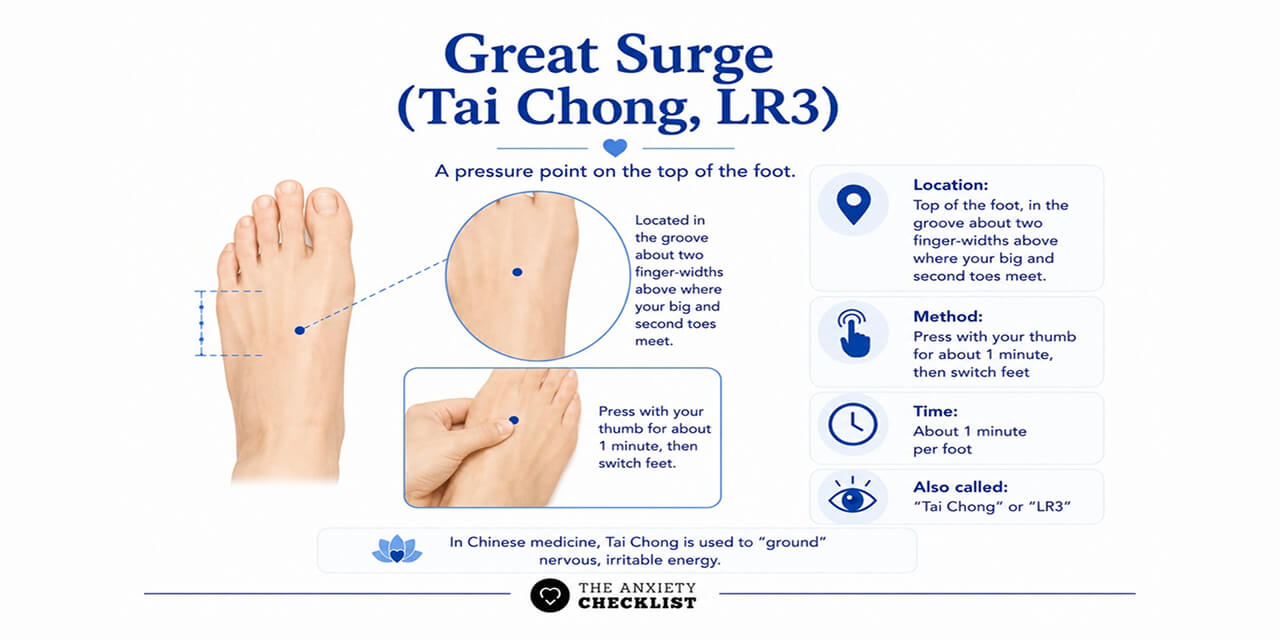
You will find this point on the top of your foot. Look in the groove about two finger-widths above where your big and second toes meet. Press with your thumb for a minute, then switch feet.
In Chinese medicine, Tai Chong is used to "ground" nervous, irritable energy. Sitting down to reach your foot can be a calming pause in itself.
7. Sea of Tranquility (Shanzhong, CV17)
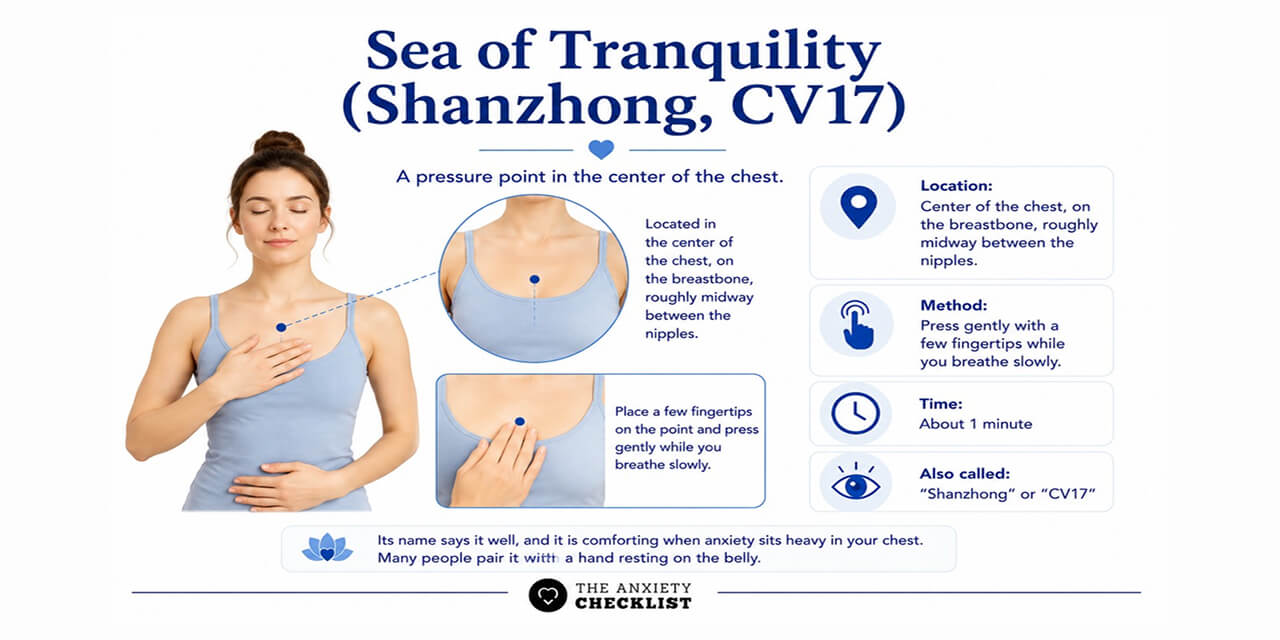
Shanzhong is one of the few pressure points for anxiety found on the chest. It sits in the middle of your chest, on your breastbone, about halfway between your nipples.
It’s often used when stress feels physical. Press the area gently while taking slow , steady breaths. If it feels comfortable, place your other hand on your belly to focus on your breathing.
8. Hundred Meetings (Baihui, GV20)
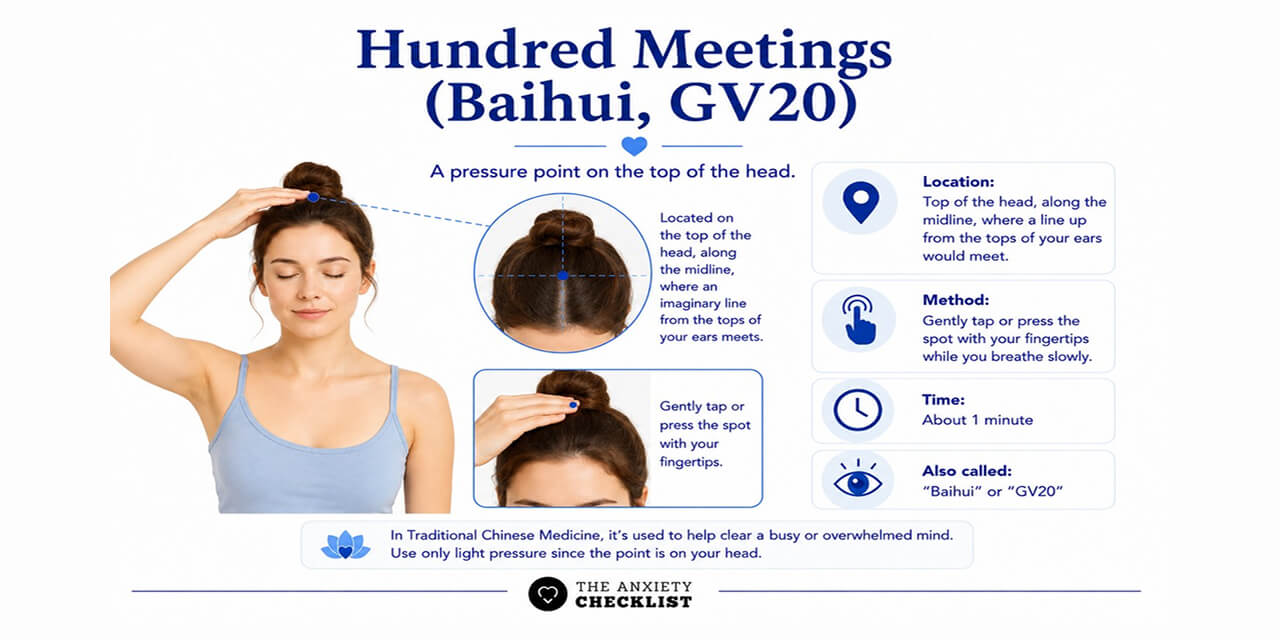
Baihui is one of the pressure points for anxiety relief found on the top of your head. It’s along the midline, where an imaginary line running up from the tops of your ears would meet.
Gently tap or press the spot with your fingertips for about a minute. In Traditional Chinese Medicine, it’s used to help clear a busy or overwhelmed mind. Use only light pressure since the point is on your head.
9. Wind Pool (Feng Chi, GB20)
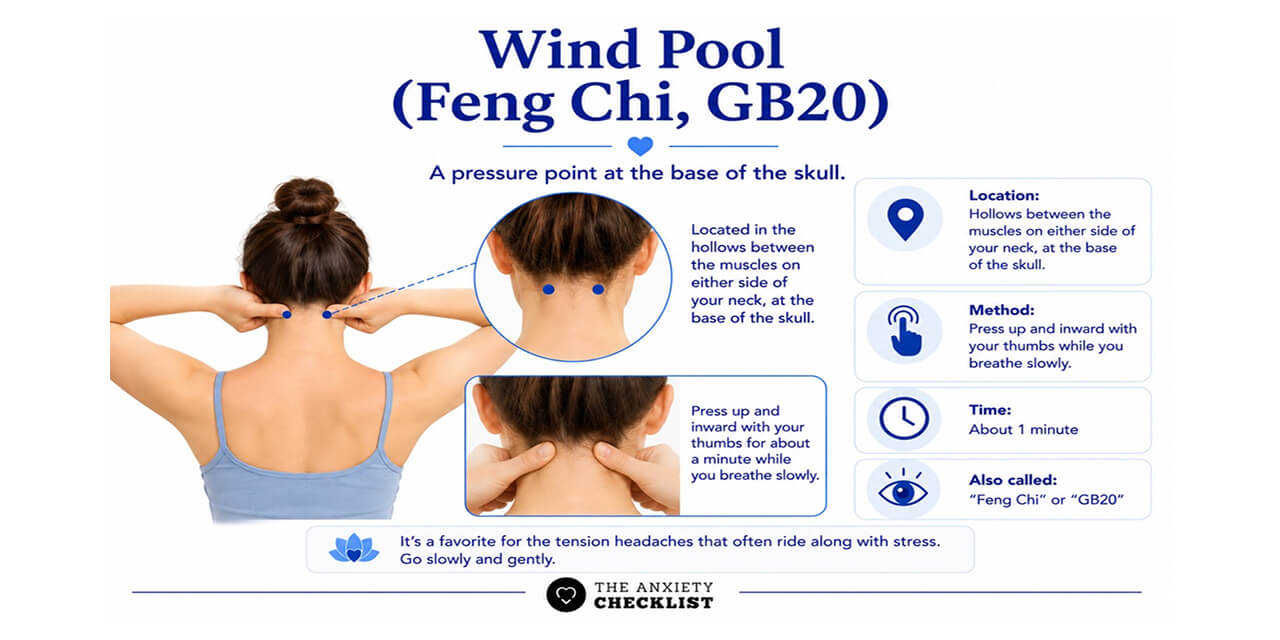
Feng Chi sits at the base of your skull. Find the two hollows between the muscles on either side of your neck. Press up and inward with your thumbs for a minute while you let your shoulders drop.
It’s a favorite for the tension headaches that often ride along with stress. Go slowly and gently.
10. Shoulder Well (Jian Jing, GB21)
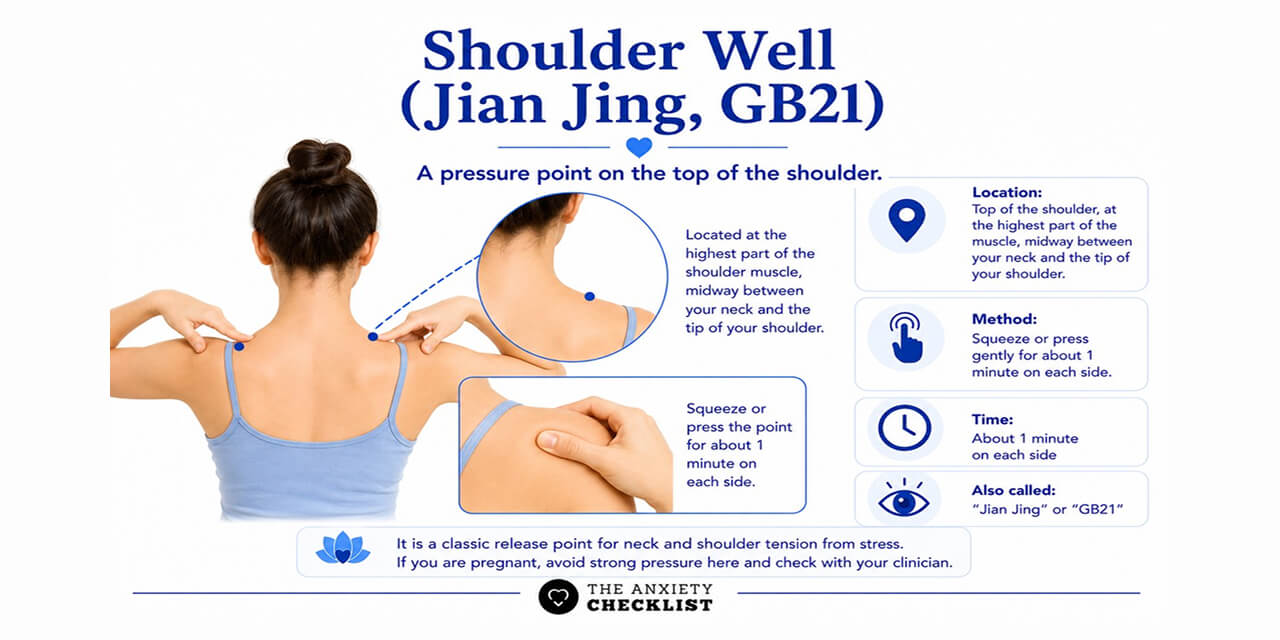
You will find this point on the top of your shoulder, at the highest part of the muscle. It sits midway between your neck and the tip of your shoulder. Squeeze or press it for a minute on each side.
It’s a classic release point for the neck and shoulder tension that stress creates. If you are pregnant, avoid strong pressure here and check with your clinician.
11. Three Yin Crossing (San Yin Jiao, SP6)
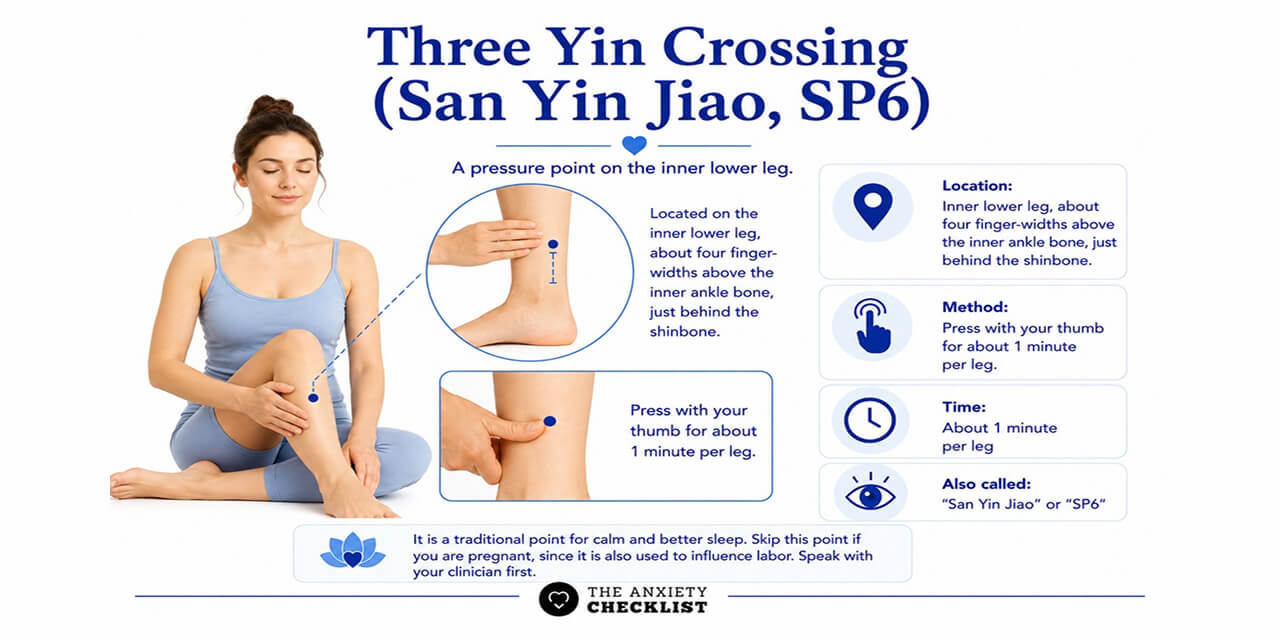
This point is on your inner lower leg, above the ankle. Measure about four finger-widths above your inner ankle bone, just behind the shinbone. Press with your thumb for about a minute per leg. It is a traditional point for calm and better sleep.
Skip this point if you are pregnant, since it is also used to influence labor. Speak with your clinician first.
Which Pressure Points for Anxiety Relief Work Best?
Research is strongest for Yintang, Neiguan, and Ear Shen Men. The other points are based mostly on traditional use and may still help some people relax. You don't need to use every point — start with one or two that are easy to reach.
Where Do These Points Come From? Chinese Acupressure vs Indian Marma
Most pressure points for anxiety relief come from Chinese acupressure. A separate Indian tradition, Ayurvedic Marma, uses its own map, though its anxiety support evidence is thin.
Let’s understand the difference between these two ancient traditions.
Chinese Acupressure
This is the source of nearly every point above. In Traditional Chinese Medicine, points sit along channels, or meridians, said to carry your energy, or "qi." Pressing them is meant to balance that flow. Acupressure is simply the needle-free version of acupuncture, using the same map.
Indian Marma Therapy
Ayurveda, the traditional medicine of India, describes its own map of 107 vital points called marma. Classical texts define them as meeting places of muscle, blood vessels, ligaments, bone, and joints.
Marma points are seen as important energy points where prana, or life force, is believed to flow. Marma therapy uses gentle pressure or massage, often with herbal oils, and is guided by the body's doshas instead of qi. Although some Marma points are close to Chinese pressure points, the two traditions are not the same.
The biggest difference between the two is the evidence. Acupressure has been studied in clinical research, especially for short-term anxiety.
Marma therapy has not. Researchers have yet to carry out enough high-quality studies to know whether it works for anxiety. If you enjoy it, think of it as a calming self-care practice rather than a proven anxiety treatment.
How is Marma Therapy Different From Chinese Acupressure?
Marma therapy comes from Ayurveda and focuses on prana and the doshas. Chinese acupressure comes from Traditional Chinese Medicine and follows meridians and qi. Research for anxiety is much stronger for acupressure.
What are the Safety Precautions for Using Pressure Points for Anxiety?
You shouldn't feel sharp pain when using pressure points for anxiety. Gentle pressure is enough. Stay away from broken skin, and avoid certain points if you're pregnant.
Acupressure is gentle and low-risk for most people. Still, a few simple cautions keep it safe.
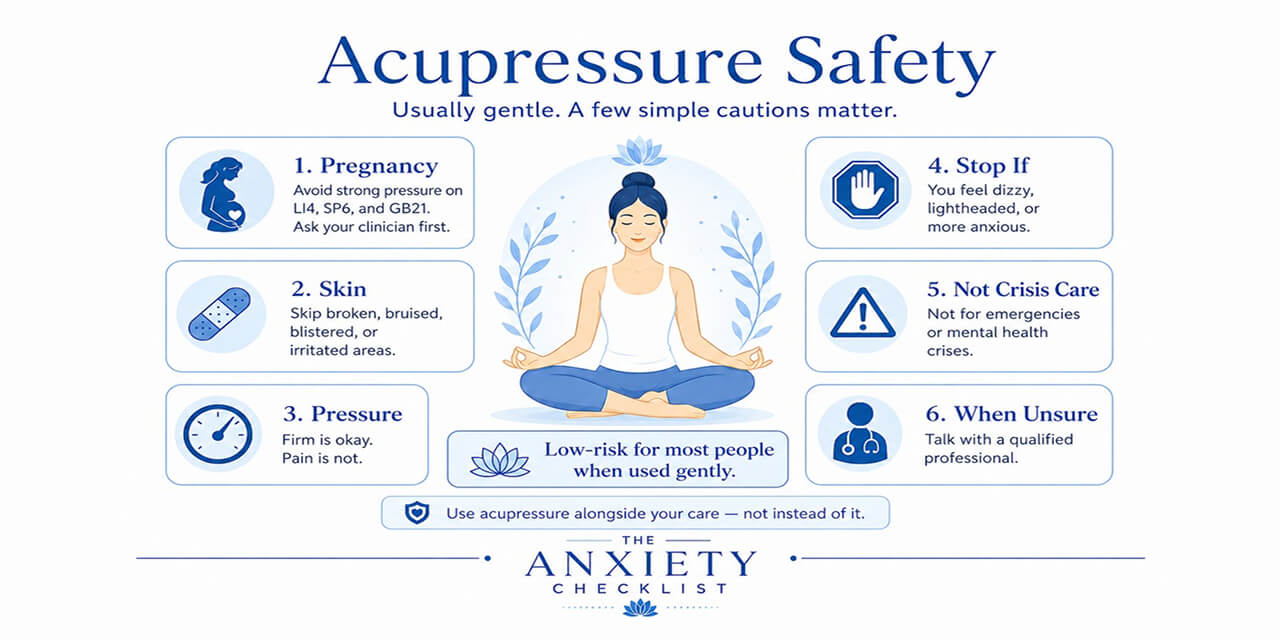
If you have a health condition or any concern, talk to a qualified professional before starting. Acupressure is meant to sit alongside your care, not replace any treatment you rely on.
When Should You See a Professional About Your Anxiety?
If you feel anxious regularly and it disrupts your life, see a professional. If you're in crisis, call 988 or your local emergency services.
Pressure points may take the edge off anxiety but they won't treat an anxiety disorder. That’s why you should reach out for help if anxiety becomes a regular part of life. You deserve support before things become overwhelming.
Consider talking to a doctor or therapist if your anxiety is persistent or feels severe. Reach out to them if it gets in the way of work, sleep, or relationships. The same is true if you have frequent panic attacks, or notice your worry is growing.
A quick, private anxiety self-check can help you see where you stand.
Effective help exists. Talk therapy, such as psychotherapy for anxiety, works well for many people. A psychiatrist for anxiety can also discuss other options with you. Asking for help is a sign of strength, not weakness.
If you are in crisis or thinking about harming yourself, please reach out right away. In the US, you can call or text the 988 Suicide and Crisis Lifeline. You can also visit our Get Help Now page for resources near you.
FAQ
Final Thoughts
Anxiety University
Explore the Anxiety University
Free guides to help you understand anxiety, one topic at a time.
- Getting StartedThe basics of anxiety and how it works
- Self-Assessments & Anxiety TestsCheck in on your symptoms with free tests
- Cognitive Traps & Thought PatternsSpot the thinking habits that fuel anxiety
- Stress ReductionPractical ways to calm your body and mind
- Common Anxiety PhobiasUnderstand specific fears and how they are treated
- Inspiring StoriesReal stories and words that remind you you are not alone