

In short
EFT tapping may reduce anxiety symptoms in the moment, but research remains limited and debated, and it is not a cure or replacement for standard treatment. It combines gentle tapping on nine points with focusing on a specific worry, accepting the feeling and using calmer self-talk. Start at the side of the hand, move from the eyebrow down the face and body, and finish at the top of the head.
Key takeaways
- The points are side of hand, eyebrow, side of eye, under-eye, under-nose, chin, collarbone, underarm and crown.
- Rate one specific worry from 0 to 10 before and after each round.
- Tap each point gently about five to seven times with two fingertips.
- Many people do two or three rounds, but stop if distress worsens or feels overwhelming.
- Severe or worsening anxiety needs support from a licensed professional.
Quick Summary
Does your mind start racing the moment you try to relax? Do your chest, shoulders, or stomach tense up before you can even name what’s wrong?
If so, you’re not alone, and you’re not broken.
Tapping for anxiety, also called EFT, or Emotional Freedom Techniques, is a simple self-help strategy you can do anywhere.
You gently tap your fingertips on acupressure points while repeating a few focused phrases.
Many people use tapping for anxiety to feel calmer within minutes.
This guide walks through what tapping for anxiety is and how it may work. Then we cover a simple sequence, what the research shows, and when to get professional help instead.
Anxiety is the most common mental health condition in the world, and it often overlaps with depression. In a 2026 American Psychiatric Association poll, 48% of US adults reported feeling more anxious than the year before.
Whether it is passing worry or a diagnosed anxiety disorder, a calming tool you can reach for has real appeal.
Table of Contents
What Is EFT Tapping?
Tapping for anxiety, or the emotional freedom technique (EFT), is a simple self-help tapping technique you can learn in minutes. You tap your fingertips on specific acupressure points while focusing on a worry and repeating short phrases.
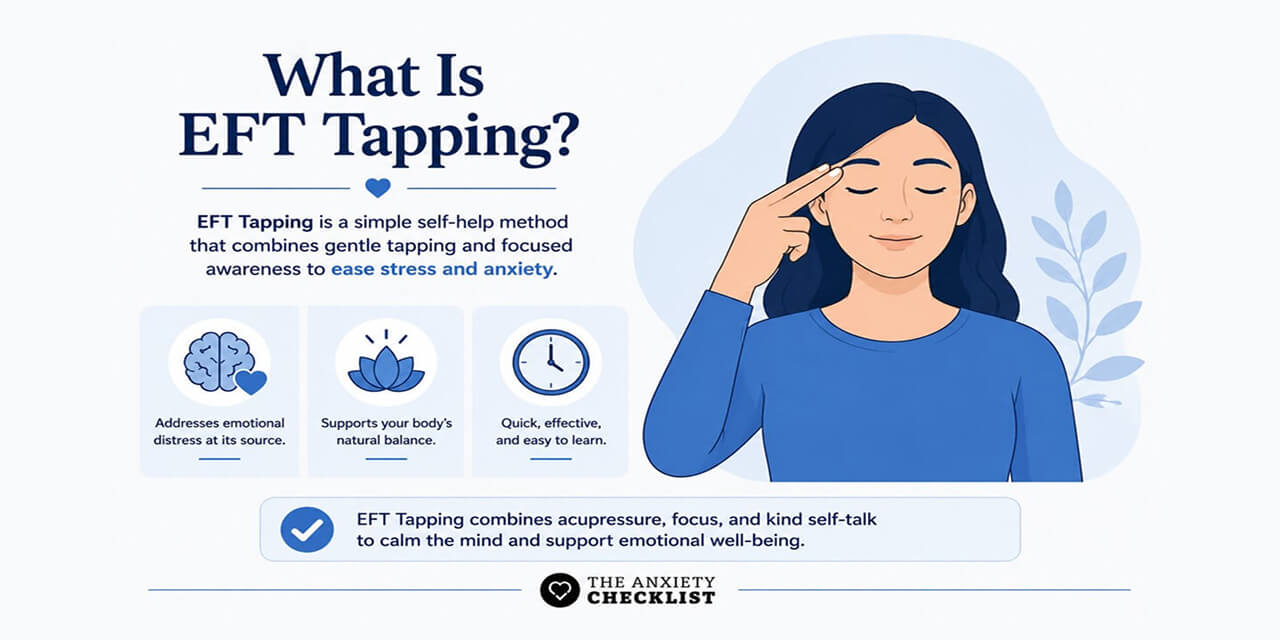
Gary Craig developed the practice in the 1990s. He simplified an earlier method called Thought Field Therapy, built on ideas from traditional Chinese medicine.
Those same acupressure points, sometimes called meridian points, are the ones used in acupuncture. Instead of needles, though, you use two fingers to tap lightly on the skin.
Craig paired that acupressure with elements of exposure therapy and cognitive therapy, the kind used in mainstream anxiety treatment.
Tapping for anxiety follows a straightforward method. You bring an anxious feeling to mind on purpose. Then you tap through certain points in a set order while using calm, accepting language.
Supporters believe this steadies the stress response, so the feeling loosens its grip.
Tapping is not time-consuming, and you need no equipment or therapist to try a round.
That’s why the emotional freedom technique has become an in-the-moment tool for everyday stress and anxiety, including panic attacks.
What Is Tapping for Anxiety?
Tapping for anxiety, or EFT, is a self-help method that pairs gentle fingertip tapping on pressure points with focused phrases. People use it to calm anxious feelings in the moment, often alongside other coping tools.
How Does Tapping Work for Anxiety?
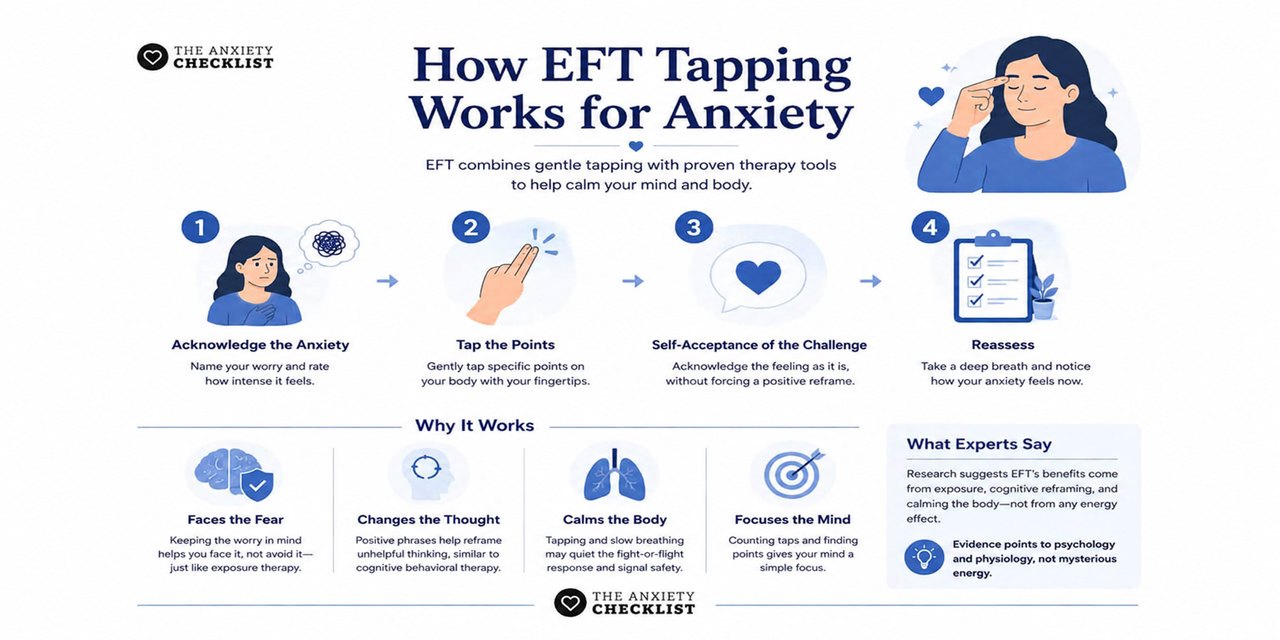
Tapping for anxiety works by combining gentle tapping on acupressure points with two proven calming methods, exposure and cognitive reframing. Together, these help settle the body's stress response.
Scientists are still pinning down exactly how much each part matters, but the pieces themselves are well understood.
The first tool is exposure. When you name your worry and hold it in mind, you face the feeling rather than avoid it. That’s the same principle behind exposure therapy.
The second is cognitive reframing. The accepting phrases you repeat echo the thought work done in cognitive behavioral therapy.
There’s a physical side too. Slow, repetitive tapping and simple breathing exercises can signal your brain that you’re safe. This may quiet the fight-or-flight response that drives so many stress and anxiety symptoms.
Counting taps and finding each point also gives a racing mind something plain to focus on, much like meditation.
Here’s a simple illustration of how tapping works for anxiety.
A 2026 Frontiers in Psychology paper by Robert Schwarz and Peta Stapleton lays out EFT's likely active ingredients. It points to acupoint tapping paired with facing the feeling and reframing it, rather than anything mysterious.
The authors also describe tapping as a way to calm the brain and settle the body's physical stress response. We look at the evidence for anxiety and cortisol in detail later.
Notice what’s missing from all of this.
EFT's founding idea, borrowed from acupuncture, was that negative emotions come from a disruption in the body's energy. Tapping the points was meant to clear that disruption.
Modern evidence has not confirmed that energy exists or moves that way.
So when tapping delivers benefits, most experts credit the exposure and cognitive work rather than any energy effect.
How Does Tapping Calm Anxiety?
Tapping for anxiety may calm the mind by pairing gentle tapping on those points with exposure to the worry and slower breathing. Facing the feeling while steadying your body can ease the stress response.
What Are the 9 EFT Tapping Points?
The nine main EFT tapping points, sometimes called the nine meridian points, run from the side of your hand to the top of your head. They cover the face and upper body.
For tapping for anxiety, there’s one setup point, plus eight more you tap in order. You tap each spot gently with two fingertips, about five to seven times. Here’s where to find them.
The 9 Tapping Points
Here are the nine key EFT tapping points.
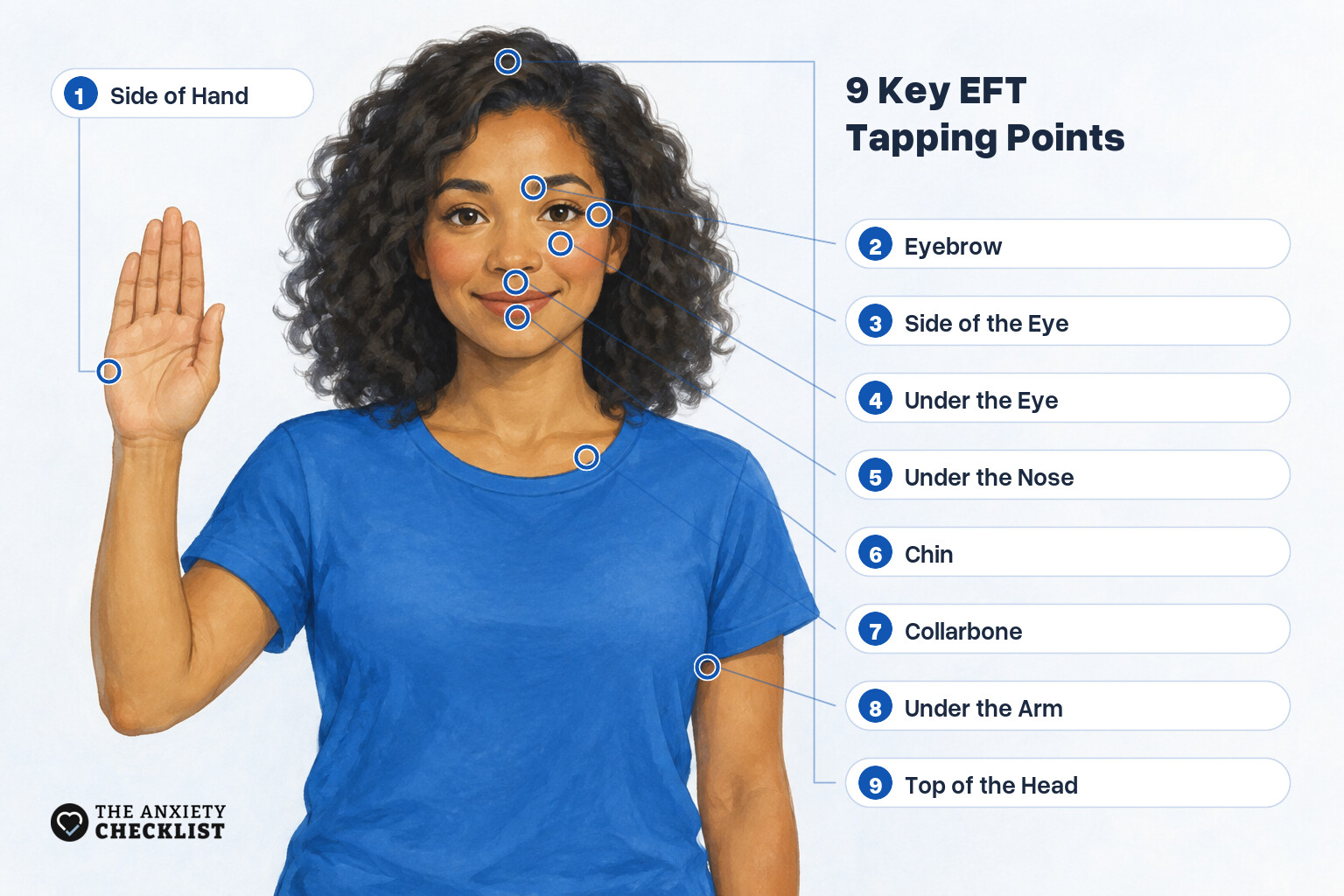
You always begin tapping on the Side of Hand point. From there, you move down the face and body, from where the eyebrows begin to under the arm. You finish at the top of the head. EFT International now uses the name Side of Hand point for what older guides call the Karate Chop point. The location has not changed.
It looks like a lot at first, but most people memorize the order after a round or two.
What Are the EFT Tapping Points?
The nine EFT tapping points are the Side of Hand point, eyebrow, side of the eye, and under the eye. The rest are under the nose, chin, collarbone, under the arm, and top of the head. You tap them in that order, starting at the Side of Hand point.
How Do You Tap for Anxiety?
To do tapping for anxiety, you name one worry and rate how strong it feels. Then you tap the points while repeating a short phrase. A full tapping sequence takes only a few minutes. Here’s the tapping sequence, step by step.
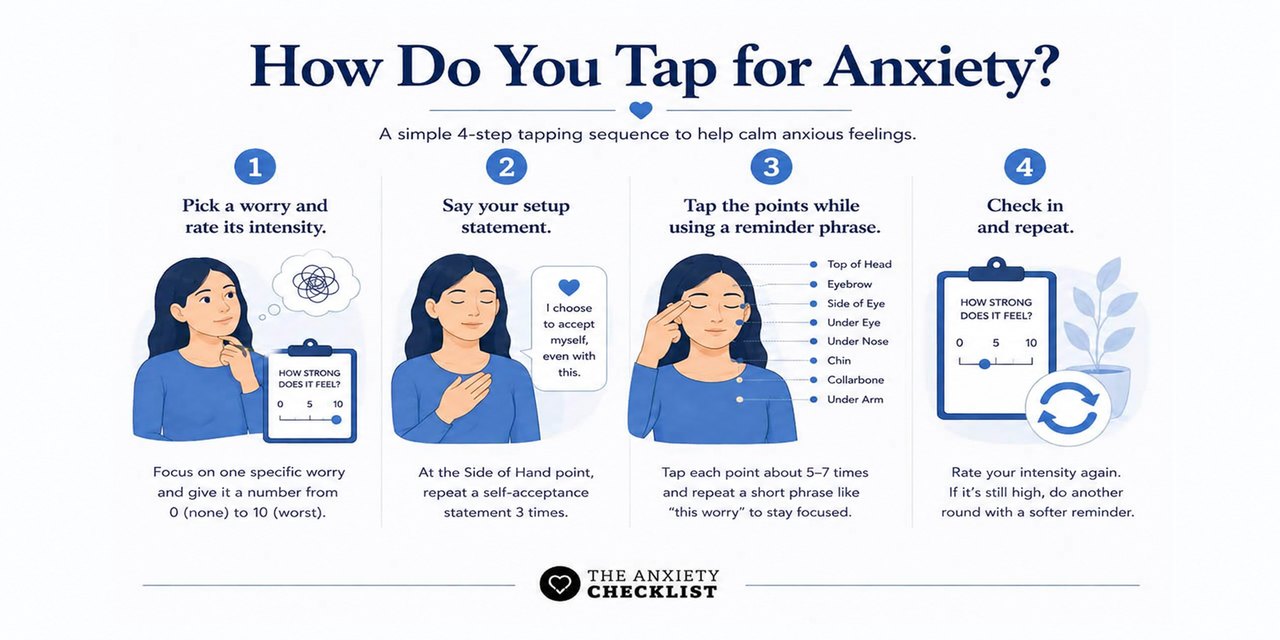
1. Name the Problem and Rate It From 0 to 10
Identify one specific worry to focus on, like a looming deadline or a recurring anxiety trigger. Naming one issue helps you identify the exact fear.
Be as concrete as you can. Not "my anxiety", but the moment itself: the knot in your stomach when you picture introducing yourself at tomorrow's meeting. Practitioners find that tapping works better on one specific event than on a general feeling, which is why EFT trainers put so much weight on being specific.
We'll carry that one example through the steps below. Swap in your own wording, and pick one manageable situation at a time rather than everything at once.
Then rate its intensity level on a scale of 0 to 10, where 10 is the most distress. This starting intensity is your baseline, so you can tell whether tapping helped.
2. Create Your Setup Statement
Keep tapping the Side of Hand point while you say your setup statement three times. It names the feeling, then adds a line of self-acceptance, a bit like a calming affirmation.
Using our example, that would be: "Even though I feel a knot in my stomach when I picture introducing myself at tomorrow's meeting, I accept how I feel right now." Say it out loud if you can.
Name the feeling and where you notice it, then the moment that brings it on. The goal is to acknowledge the feeling without judging yourself for having it.
3. Tap Through the Points With a Reminder Phrase
Now tap each point from the eyebrow down to the top of the head, about five to seven taps each.
At every point, repeat a short reminder phrase that points back at the same specific thing. For our example, that is "this knot about introducing myself." A few words are enough — it only has to hold your attention on the thing you started with.
You’re not forcing yourself to feel calm. You’re simply keeping your attention on the feeling as you tap.
4. Reassess and Repeat
After a full round, rate the same feeling again on a scale of 0 to 10. The number may drop, it may stay where it is, and either is normal — you are checking what happened, not aiming for a particular score.
If it eased and you want to carry on, run another round and narrow the wording to what is left: "this bit of the knot that's still there." Many people do two or three rounds in one sitting.
If you feel worse, overwhelmed, or find yourself somewhere you did not expect to go, stop. Put your attention on something ordinary around you, and come back to it another time or with someone qualified alongside you. Stopping is a reasonable outcome, not a failed round.
What you have here is a simple self-help introduction. Clinical EFT, as practised by a trained practitioner, is a good deal more individual than this: they work with the particular memories and events underneath a feeling, and adjust as things surface. That is the right setting for anything heavy.
Try a Simple Anxiety Round
Tap the Side of Hand point while you repeat this setup line 3 times: "Even though I feel a knot in my stomach when I picture introducing myself at tomorrow's meeting, I accept how I feel right now."
Then tap through the points, repeating "this knot about introducing myself" at each one.
Finish the round and rate it again. Use your own situation and your own words — the example is only there to show the shape of it.
If it helps, settle your body first with a few grounding techniques.
If you want to go further than a single round, the EFT Nation podcast has more than 70 short episodes on applying tapping to yourself, and on how it sits next to other approaches such as EMDR and Brainspotting.
How Do You Tap for Anxiety?
To tap for anxiety, name one specific worry and rate it on a scale of 0 to 10. Tap the Side of Hand point while you say a setup phrase about that exact worry. Then tap from the eyebrow to the top of the head, repeating a short reminder phrase. Rate it again afterwards, and stop if you feel worse rather than pushing on.
Does Tapping Really Work for Anxiety?
Tapping for anxiety can reduce symptoms for many people, though the evidence is still limited and openly debated. Here is a balanced look at what recent research shows.
The clearest recent picture comes from a 2025 systematic review that pooled data from seven randomized trials involving 506 people. Every trial comparing tapping to no treatment found a significant drop in anxiety, and some also tracked depression.
Against active methods, tapping for anxiety matched or beat breathing therapy and muscle relaxation. It did not outperform standard treatments like CBT for anxiety, which remain the stronger, better-tested choices.
Researchers also point to a calmer brain and nervous system as a likely reason tapping for anxiety helps. A single tapping session seems to lower the body's stress signals, though the effect varies from person to person.
Beyond anxiety, tapping has also been studied for related concerns, from depression and specific phobias to physical pain, with similarly mixed results. More research from independent teams would strengthen the case.
If you would rather read the studies yourself than take anyone's summary of them, EFT International maintains an up-to-date database of published EFT research covering anxiety alongside depression, PTSD and pain. It is the quickest way to see the supportive trials and their limitations side by side, rather than one or the other.
Tapping for anxiety is a low-risk tool that may take the edge off, especially in the moment.
Does EFT Tapping Work for Anxiety?
A 2025 review found that EFT tapping eased anxiety more than no treatment but worked no better than CBT. The research is still limited and debated. Tapping is best seen as a helpful self-help tool, not a proven replacement for standard treatment.
Is Tapping Safe, and Why Do Some People Avoid It?
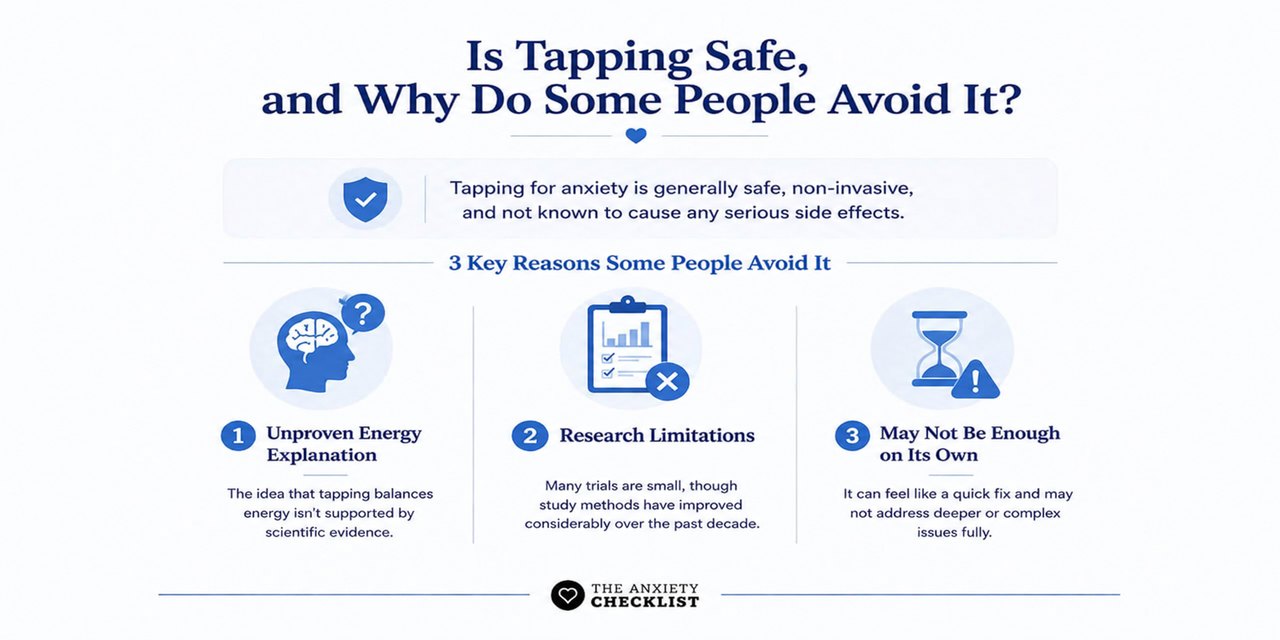
Tapping for anxiety is generally considered low-risk, and most studies report no major side effects. It also shouldn’t cause any pain when done correctly.
Even so, there are a few honest reasons to stay cautious:
A few situations call for extra caution. If you’re working through trauma, tapping for anxiety can surface intense memories, along with real emotional pain.
Therapies like EMDR are better suited there, ideally with a trained professional.
If your anxiety is severe or it comes with thoughts of harming yourself, please reach out for proper medical care.
Used sensibly, tapping for anxiety is a gentle practice. Try it, notice whether it helps you, and keep it as one option among many.
Why Do Some People Say Tapping Should Be Avoided?
Critics point out that tapping's energy theory is unproven and that many studies are small or run by supporters. They also warn against using it in place of professional care, especially for trauma or severe anxiety.
How Does Tapping Compare to Other Calming Techniques?
Tapping for anxiety is one tool in a much larger kit.
It helps to see how it compares with other proven ways to lower stress and anxiety. So you can mix and match what works for you.
Tapping for anxiety, breathing exercises, grounding, and meditation are quick tools for the moment. CBT and therapy do the slower, deeper work.
The two groups back each other up, so you can balance short-term benefits with long-term change. Pairing tapping with progressive muscle relaxation or meditation can also help you reduce stress on a hard day.
When Should You See a Professional About Anxiety?
Self-help has limits, and knowing them is a strength. Reach out to a licensed professional if:
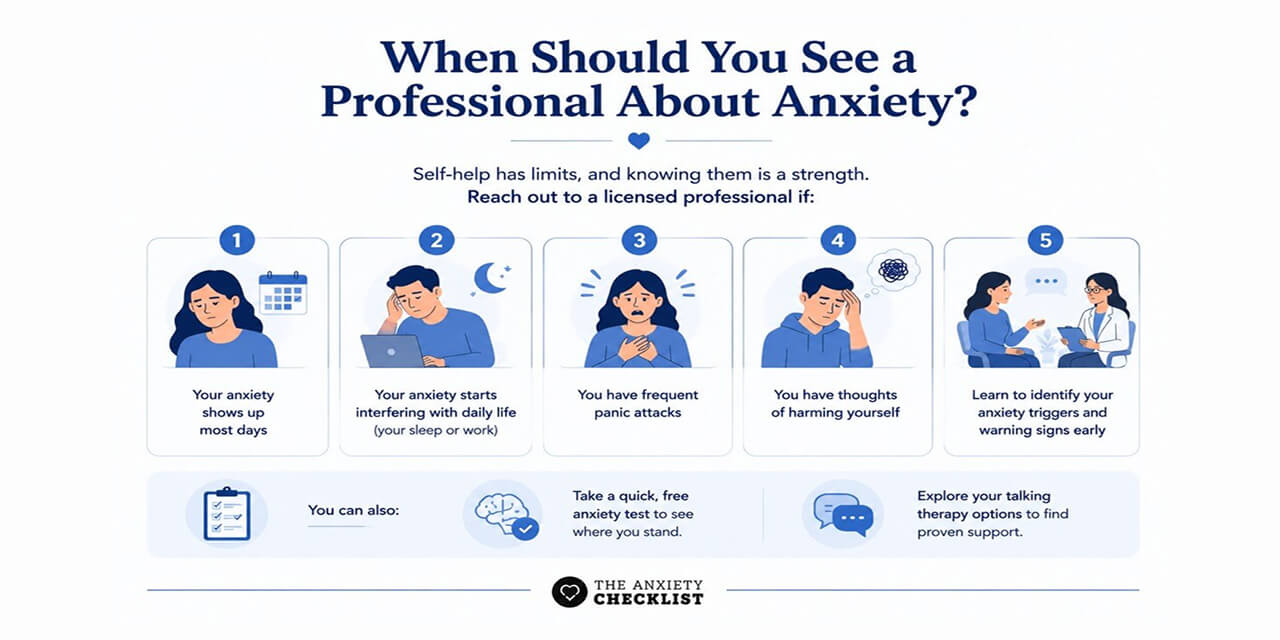
Learn to identify your anxiety triggers and warning signs early. A doctor or therapist can offer proven treatment and steady support.
You can also take a quick, free anxiety test to see where you stand. If you’re ready for more, read about your talking therapy options.
Can Tapping Replace Therapy?
No. Tapping for anxiety is a complement, not a replacement. It may help you settle in the moment, but it won’t treat an anxiety disorder on its own. For that, proven options like therapy or CBT, along with professional support, do the real work.
FAQ
Is Tapping for Anxiety Worth Trying?
Anxiety University
Explore the Anxiety University
Free guides to help you understand anxiety, one topic at a time.
- Getting StartedThe basics of anxiety and how it works
- Self-Assessments & Anxiety TestsCheck in on your symptoms with free tests
- Cognitive Traps & Thought PatternsSpot the thinking habits that fuel anxiety
- Stress ReductionPractical ways to calm your body and mind
- Common Anxiety PhobiasUnderstand specific fears and how they are treated
- Inspiring StoriesReal stories and words that remind you you are not alone