

In short
Set boundaries by noticing situations that leave you tense, drained or uneasy, then state a small, clear limit without over-explaining. Expect some guilt and manage it separately, rather than treating it as proof that the boundary is wrong. If someone repeatedly ignores the limit, follow through with a practical consequence while letting go of the need for everyone’s approval.
Key takeaways
- Healthy boundaries protect emotional, mental and physical wellbeing without controlling other people.
- Start with small limits, such as not replying immediately or requiring notice before visits.
- Use short statements like, “That doesn’t work for me,” instead of lengthy apologies.
- Naming guilt as anxiety may help reduce its intensity while you hold the boundary.
- Repeated boundary violations may require leaving, limiting access or no longer answering.
Why Boundary Setting Feels Hard When You’re Anxious
Setting boundaries is uncomfortable for everyone, but you struggle more because you’re dealing with anxiety.
The physical discomfort of turning down a dinner invite feels like a big gamble. When you try to set a limit, your nervous system interprets a possible conflict or rejection as actual danger, which triggers anxiety. Then you fall into the trap of trying to keep the peace, constantly deprioritizing your needs and thinking it's the safest option.
A 2024 survey by the American Psychiatric Association found that 43% of the US adults reported feeling more anxious than the year before, with stress and relationships as the top causes. This matters because anxious folks struggle most to set boundaries in relationships.
Here’s what gets in the way of anxious folks:
What Healthy Boundaries Actually Mean
A lot of people misunderstand boundaries. They’re not punishments, walls, or ways to control other people.
Boundaries are limits that protect your emotional, mental, and physical well-being. Healthy boundaries help you stay connected to your own needs.
Remember, boundaries can fail under two scenarios:
- With Limits That Are Too Porous: Some people say yes to everything, absorb everyone’s emotions, and have no real edge to where they end, and others begin.
- With Limits That Are Too Rigid: Others have walls built from old, hurtful experiences and generational trauma that keep safe people out, too.
For anxious folks, the porous pattern is more common. However, neither extreme serves you well. The goal is to be firm enough to protect yourself, and open enough to allow the right people in.
Signs You May Need Stronger Boundaries
Sometimes you don’t realize you need boundaries until you’re already exhausted. If this sounds familiar, you may need stronger boundaries to manage the following situations.
- You feel guilty for saying no
- You agree to things and then dread them
- You feel overwhelmed by other people’s needs
- You struggle to protect your personal space or time
- You keep taking on emotional labor that is not yours
- You worry about upsetting others more than protecting yourself
- You spend a lot of time trying to avoid conflict
- You say yes because it feels easier than explaining yourself
- You activate your fight or flight response when someone crosses a line
If these patterns feed your anxiety, it may help to look at the anxiety recovery framework to break the fear loop.
Different Types of Boundaries
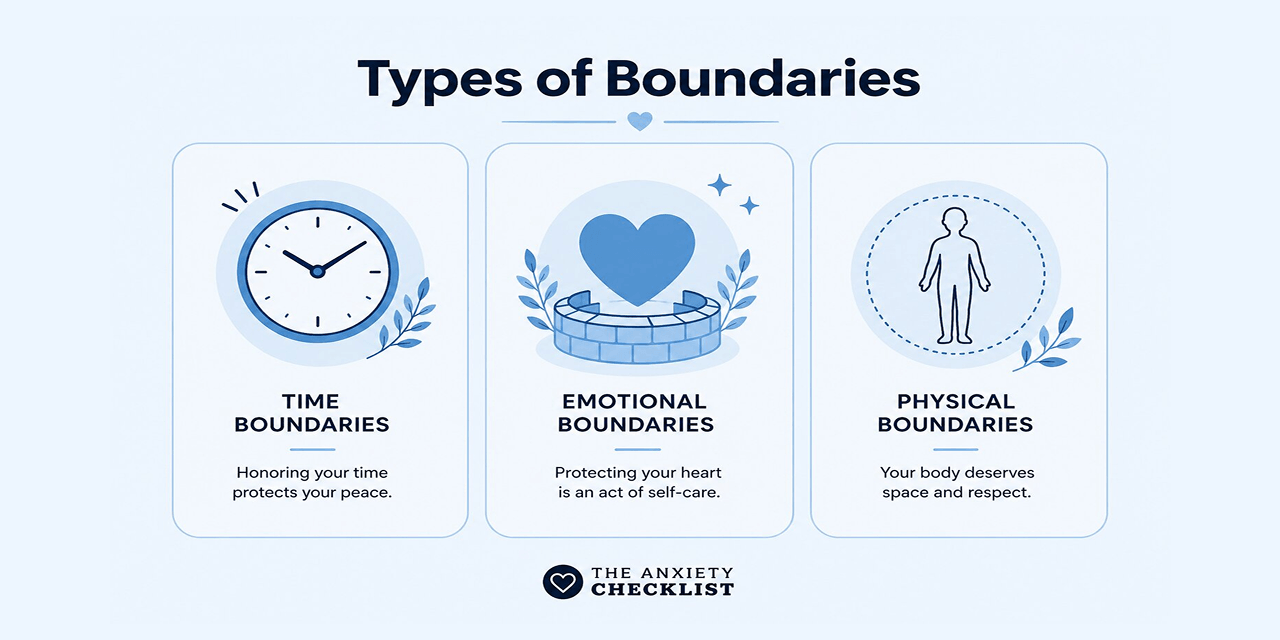
Saying no isn’t the only boundary that matters for anxious folks. There are three broad categories to keep in mind when learning how to set boundaries for anxious folks.
Physical Boundaries
These cover your body and physical space. A few examples include:
- Saying no to unwanted physical touch
- Asking for privacy
- Needing personal space
- Protecting your sleep time
- Not hugging when greeting
- Not wanting surprise visits
Emotional Boundaries
These protect your emotional space. Here are a few situations to take note of:
- Not being available for everyone’s emotional unloading
- Saying, “I can’t handle this conversation right now.”
- Not taking responsibility for others' emotions
- Refusing emotional manipulation
Time Boundaries
These protect your energy and schedule. The following are a few scenarios:
- Not answering messages right away
- Limiting phone calls
- Ending conversations on time
- Refusing last-minute requests
- Leaving events early
- Declining invites when emotionally exhausted
- Protecting work-life balance
If setting these boundaries makes you feel guilty, start by understanding your anxiety triggers to set clear boundaries.
How to Set Boundaries for Anxious Folks
This is where we get practical, building a skill one conversation at a time. Let’s break down how to set boundaries for anxious folks based on how their brains tend to function.
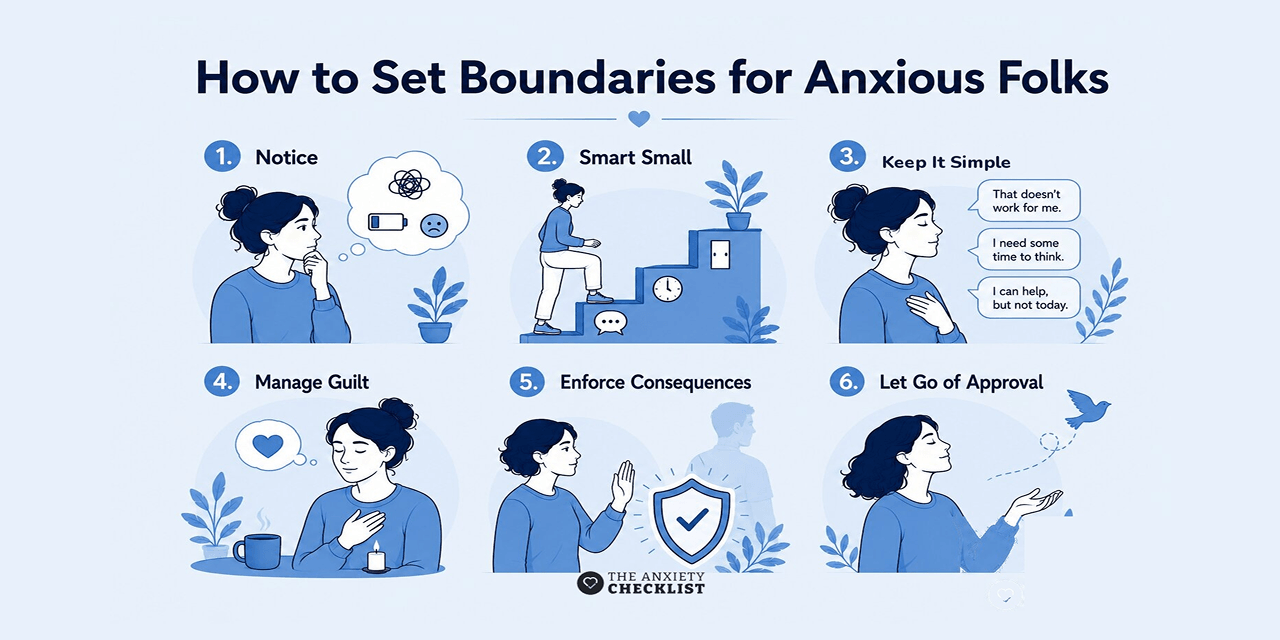
1. Notice When You Feel Strained
Start by noticing closely. Pay attention to what makes you tense, exhausted, or uneasy, because you can’t communicate a boundary you haven’t identified yet. Ask yourself:
- What situations drain me?
- Where do I feel pressure to say yes?
- Where do I quietly accept discomfort?
These feelings are signals that a boundary is needed. You don’t need absolute clarity to begin. Just a vague, “I think I need more alone time,” is enough. These reactions are often shaped by cognitive distortions your anxious brain has built over time.
2. Start Small, Don’t Reinvent
When you’re anxious, jumping straight to the hardest conversion never goes well. Instead of telling your boss you can’t be available after 7 pm, identify your actual boundary. In this case, a clear boundary, such as “I don’t answer work messages after 7 pm,” sounds more acceptable.
Use the fear ladder approach and start with the smallest possible limit. For example:
- I need a heads-up before visits
- I don’t take on extra work after 5 pm
- I’m not comfortable talking about it right now
- I don’t reply to texts immediately
Here’s a 7-step process to build a fear ladder.
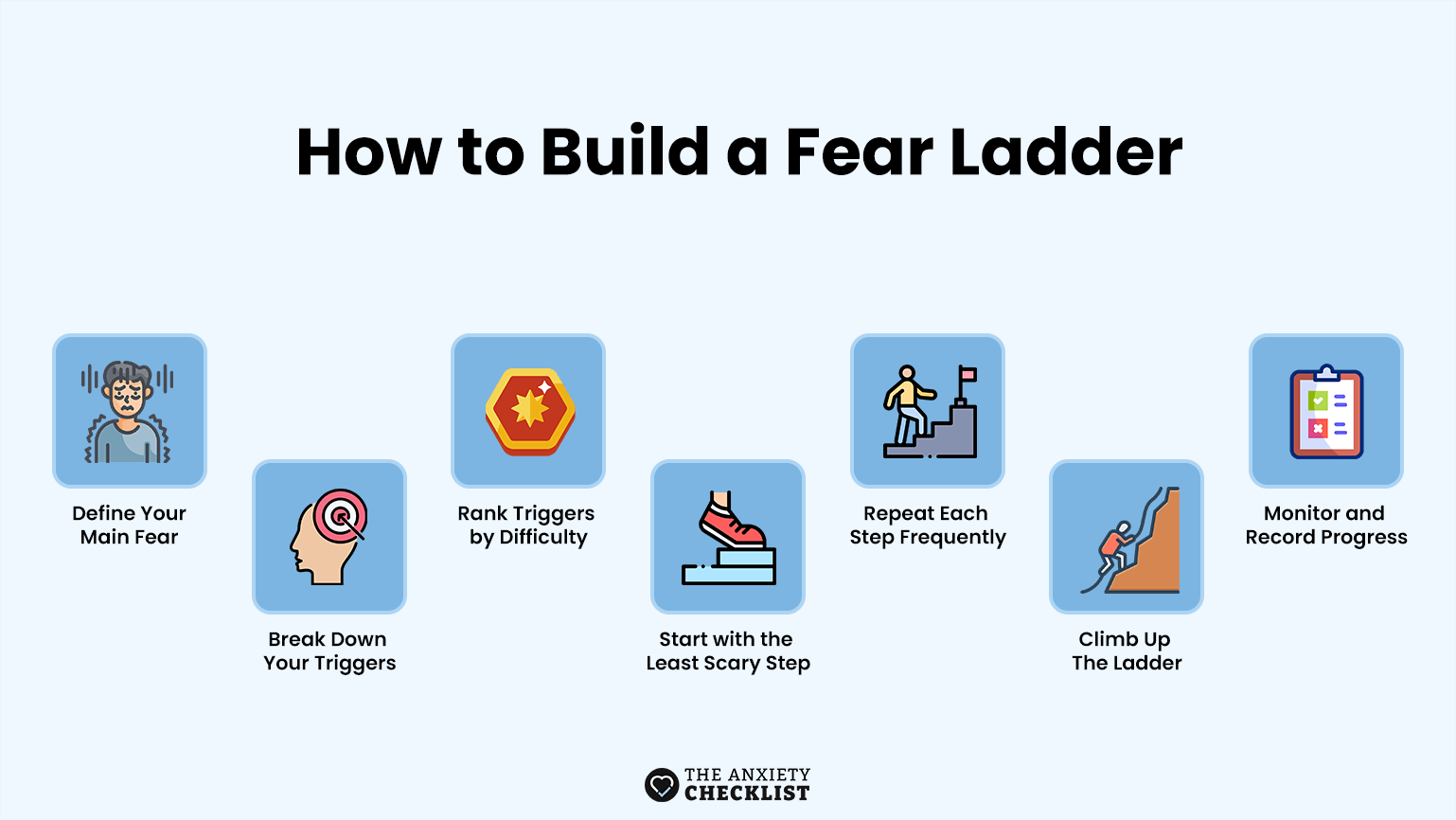
This helps you build emotional strength and confidence to set boundaries before you take on bigger commitments.
3. Keep the Message Simple, Don’t Over-Explain
If your brain is anxious, you tend to over-explain because you feel guilty and feel the need to justify. “I’m sorry, I know this is a bad time” becomes your default script.
The biggest problem with over-explaining is that your nervous system reads it as if you’re doing something wrong and need to defend yourself. Whereas, clear communication sounds more like:
- That doesn’t work for me
- I’m not available for a call now
- I need some time to think
- I can help, but not today
Short and calm is always stronger than long and apologetic.
4. Manage the Guilt Separately
Listen carefully, this is the most important step for anxious folks. You will feel guilty for holding your boundary, but it doesn’t mean you’re doing something wrong. It's just a sign you're doing something your brain isn't used to doing.
When you sense a spike in guilt, try naming it. Based on experience, we can say that identifying and naming an emotional state often reduces its intensity. Just saying, “I’m feeling guilty right now, but this is just anxiety,” calms you a great deal.
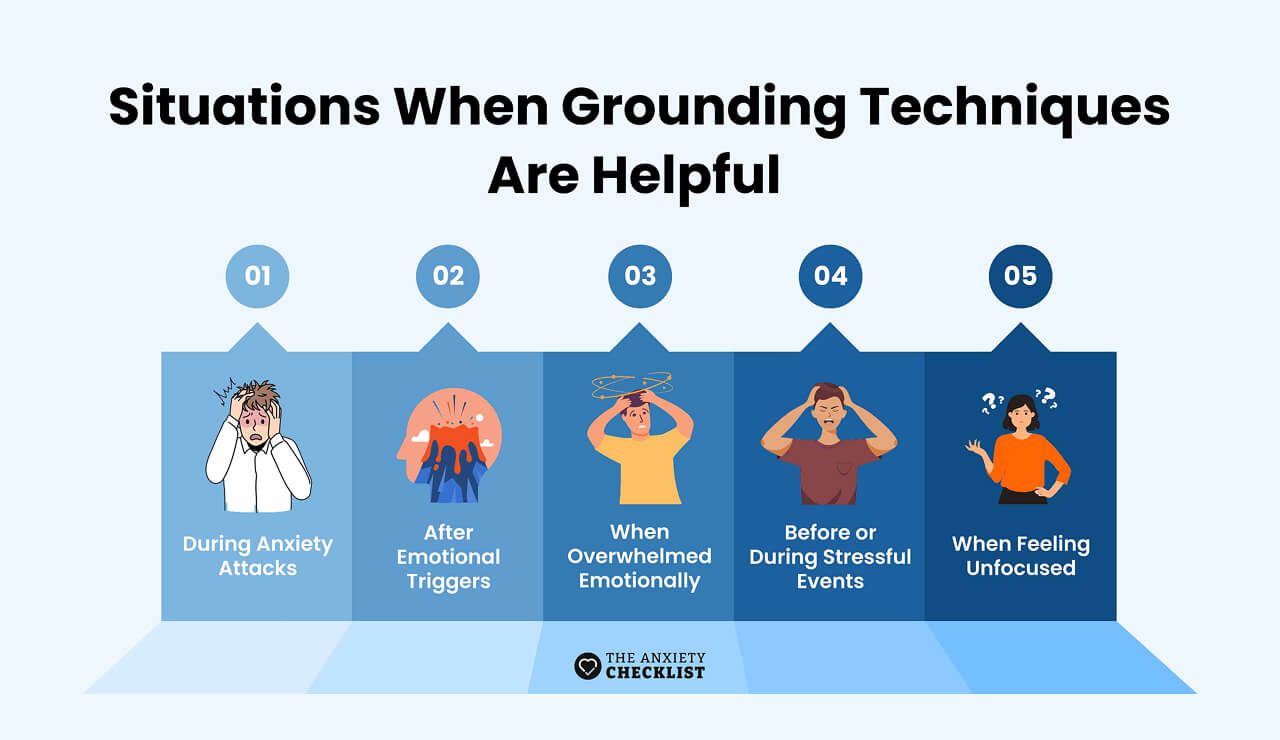
This is called cognitive labeling. Pair it with grounding techniques to stay regulated as the discomfort dilutes. Here are some situations where grounding techniques are helpful.
5. Enforce Consequences When Needed
Enforcing consequences can feel like conflict, but a boundary without a consequence is only a request. When someone repeatedly ignores your clear boundary, the consequence is the natural next step. They can be as simple as:
- If a colleague repeatedly calls outside work hours, stop answering
- If someone disrespects your personal space, leave the interaction
- If someone constantly drains your emotional energy, limit access
6. Let Go of the Need for Approval
Most of the time, people react badly when you start setting healthy boundaries. Not everyone will welcome your clear boundaries. This is where overthinking and anxiety can send you off track, as depicted in the loop here.
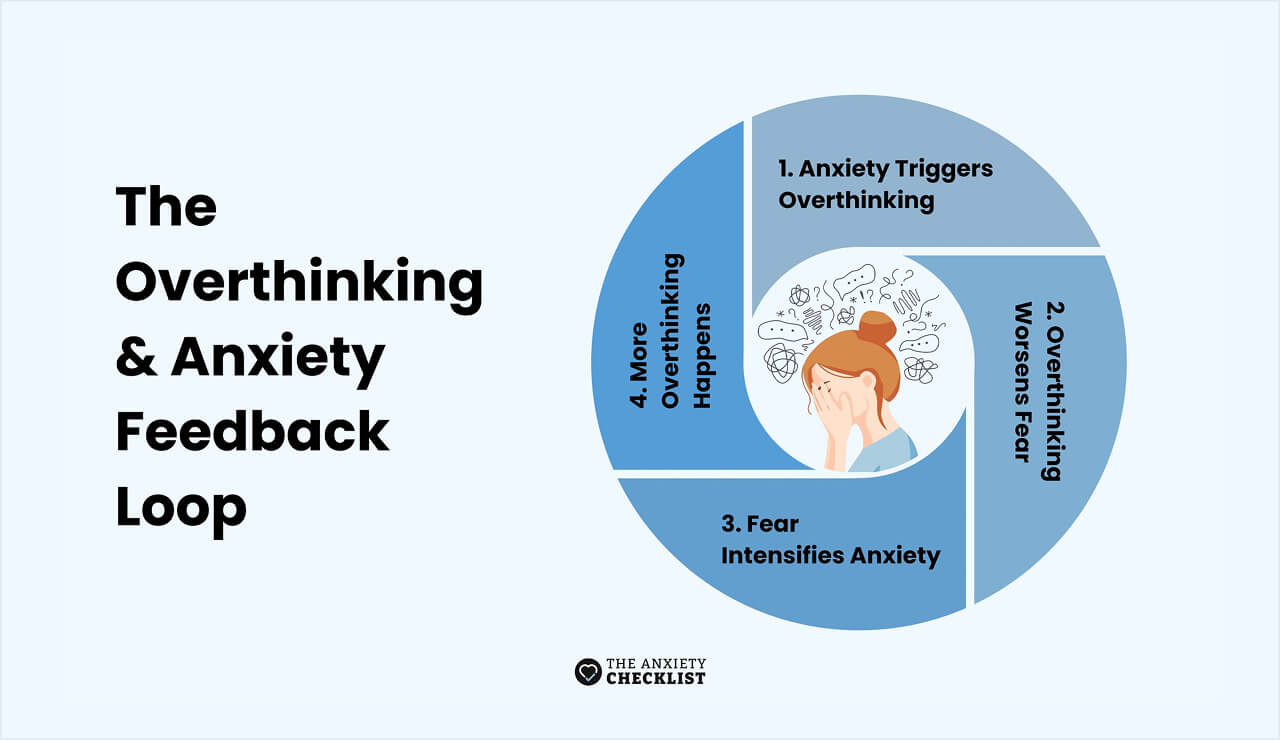
Your brain will replay the conversation on a loop, trying to justify it until everyone is okay with your limit. But setting boundaries isn’t about managing everyone’s response to it. People in healthy relationships will adjust, while others won’t, and that should be okay in the long run. here.
Boundary Examples for Different Situations
Boundary setting varies by relationship, and scripts make this easier. Let’s go over some realistic examples of how to set boundaries in different social environments.
At Work
Anxious people are over-workers because they fear appearing lazy or difficult.
With Family
Setting boundaries with family is the hardest because of high expectations and deep emotional patterns.
With Friends
Some friendships quietly become emotionally one-sided.
In Romantic Relationships
Boundary issues become intense, especially with anxious attachment.
How Anxious Attachment Affects Boundaries
If you’re in a relationship and the remark, “you’re too sensitive,” sounds too familiar, then this section is for you.
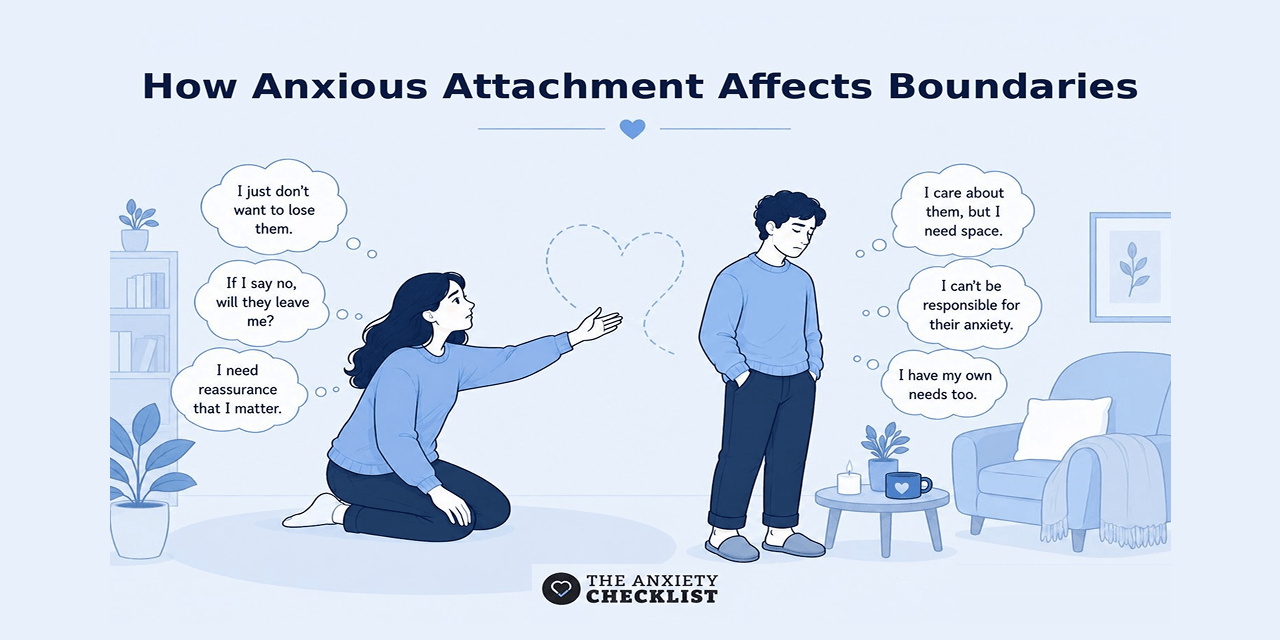
Anxious attachment doesn’t happen overnight; it’s rooted deep into your early caregiving days. Separation anxiety in early childhood is the most direct clinical reason for anxious attachment. You started working hard to keep people close because love and safety weren’t guaranteed from a very young age.
You are anxiously attached if you:
- Over-accommodate others
- Seek constant reassurance
- Fear of being “too much”
- Tolerate poor treatment
- Ignore your emotions
- Struggle with self-confidence
A 2024 study published in Frontiers in Psychology found that people with anxious attachment patterns have more difficulty with emotional self-regulation.
Their actual fear isn’t “they’ll be annoyed with me,” it’s, “they’ll leave me.” So they ignore their needs to manage the relationship, which eventually creates the emotional distance they were so afraid of.
The way forward is to build self-awareness around how your attachment is showing up. Practice the experience of holding up and surviving it. Ask yourself:
- Am I agreeing because I want to or because I fear rejection?
- Am I helping out of care or from anxiety?
- Am I protecting the relationship or avoiding abandonment?
This introspection prompts powerful self-reflection where patterns begin to change. If your anxious attachment affects your relationship, a mental health professional can help. Tools like CBT for anxiety can also make a difference.
You can also try to ease your anxiety through inner child healing.
Boundaries and Self-Esteem
Boundary setting and self-esteem are closely connected, and understanding the reasons helps you stay motivated when setting boundaries feels hard.
When you keep ignoring your own needs, you send yourself a quiet but powerful message: other people matter more than you do. That belief builds slowly, until your default setting becomes putting yourself last without even questioning it.
That’s what makes low self-esteem and social anxiety such a familiar combination. When you don’t believe your needs are worth protecting, you stop protecting them.
But every time you do hold a boundary, however small, you start to feel like someone whose time is worth protecting. That is how self-respect grows, from repeated small acts of choosing yourself.
It doesn’t need a dramatic personality change. You only need to practice treating yourself like someone worth protecting. Here are a few ways to do so:
- Saying no to something you don’t want to do
- Leaving a conversation that dismisses you
- Asking for what you need instead of hoping someone guesses
- Letting someone be disappointed without immediately fixing it
Over time, those choices accumulate. They change how you show up in relationships, at work, and in daily life. If you’re building self-worth and setting boundaries, exploring affirmations for anxiety can support that inner shift.
How to Handle Guilt
Feeling guilty is one of the biggest reasons people avoid setting boundaries. If you are a people pleaser, guilt may show up instantly, even when the boundary is reasonable. You may feel like you are doing something wrong simply because someone else is disappointed.
But sometimes guilt is just a sign that you are changing an old pattern. A helpful question is, "Is this guilt telling me I harmed someone, or is it telling me I stopped overextending myself?" This is an example of a shadow work prompt as well.
If you are being clear, respectful, and honest, then guilt may simply be your discomfort with protecting yourself. You do not need to obey every guilty feeling. Sometimes the healthiest thing you can do is let guilt pass without turning it into self-betrayal.
When Someone Keeps Pushing Back
One of the hardest moments in setting boundaries for anxious folks is when someone doesn’t accept it. Accepting your boundary is the only way to handle pushback without panic.
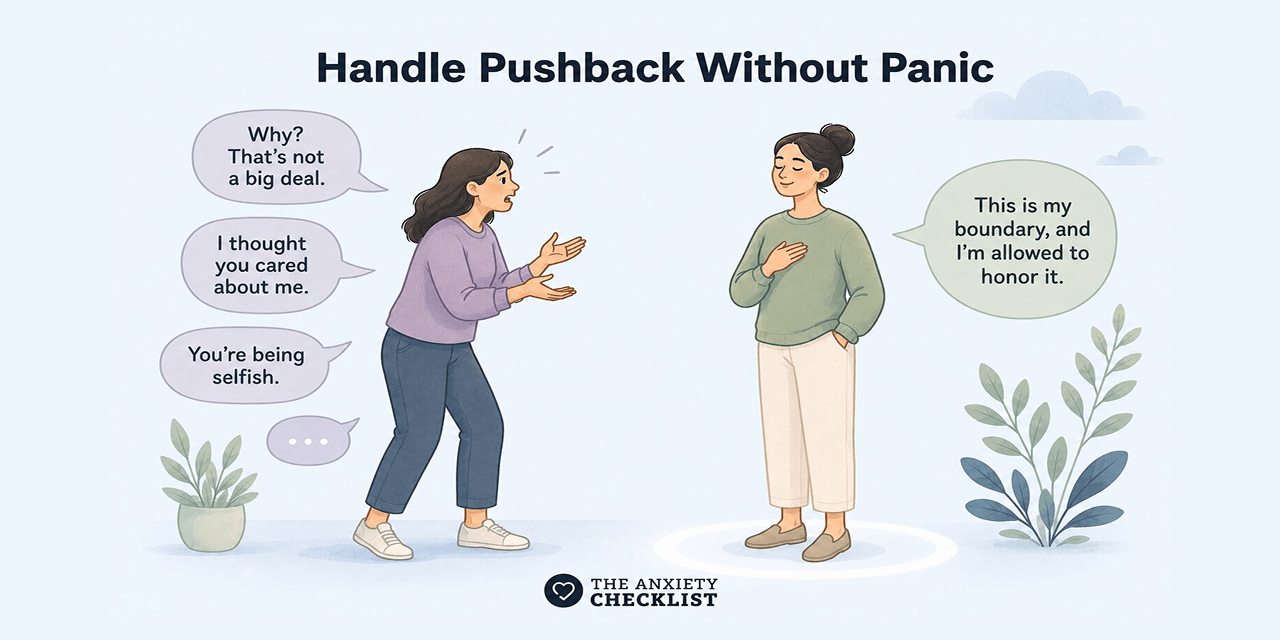
They might push back directly, “Why? That’s not a big deal.” Or they might use guilt, “I thought you cared about me.” Or they go quiet, and you spend the next three days anxiously waiting for things to feel normal again. Any of these responses can make you want to take the whole thing back.
What’s actually happening? The other person is used to the old version of you, the one who always said yes. Your boundary disrupts a pattern, and their reaction is about their adjustment to it.
What to do when someone pushes back
- Stay Calm and Repeat Yourself: You don’t need a new argument.“I understand you’re frustrated, but this is still my boundary.” is enough.
- Don’t Re-Explain or Justify: Adding more reasons just reopens the negotiation. Short and steady holds more ground than long and defensive.
- Notice the Pattern: If they often get angry, guilt-trip you, or pressure you when you set a boundary, it matters.
- Give it Time: Most people in healthy relationships do adjust. Especially once they see you’re not going to back down every time they push.
If the pushback feels strong, or you feel torn between love and anxiety, pay closer attention.
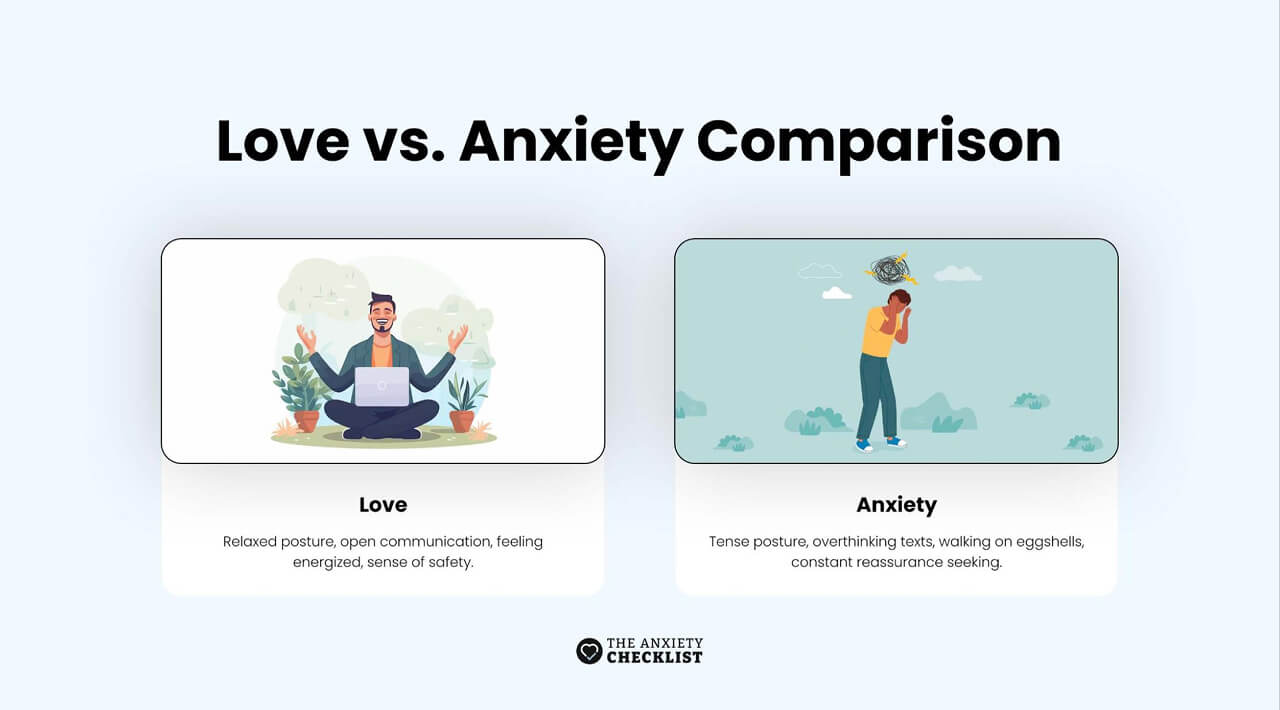
How Boundaries Improve Mental Health
A 2024 trial in the Journal of Education and Health Promotion found that assertiveness training lowered stress, reduced anxiety, and depression. It also outperformed the control group among college students.
The relationship is bi-directional. Anxiety makes it harder to set boundaries, and not setting boundaries makes anxiety worse.
This is what setting boundaries does for your mental health.
Reduces Chronic Stress
Every time you say yes to something you don't want to do, your stress load increases. Over time, that accumulation becomes chronic stress.
Setting healthy boundaries means you stop adding to that load, which directly improves your overall well-being. Also, try power poses or practice progressive muscle relaxation to ease anxiety symptoms.
Builds Self-Respect and Self-Worth
There's something that happens when you hold a line and see the world keep turning. You learn that your needs matter and you're allowed to have them, and that other people can handle hearing "no." That shift in self-worth comes about slowly but surely.
Improves Your Relationships
This sounds counterintuitive, but healthy relationships genuinely require healthy boundaries. Without them, you build up resentment, communicate less honestly, and start relating to people from a place of obligation rather than care. Mutual respect becomes possible when both parties feel safe expressing their needs.
Reduces Emotional Burnout
When you don't set and hold boundaries, you essentially take on emotional weight that isn't yours to carry. When building mental resilience, many find that emotional burnout is one of the biggest predictors of long-term anxiety and depression. Setting boundaries is one of the most direct ways to protect against it.
Builds Self-Confidence Over Time
Every small boundary is a deposit in your self-confidence account. You learn you can do uncomfortable things and be okay, and that compounds with time. If you're looking for additional ways to build that confidence while setting boundaries, exploring daily anxiety-relief practices can support the process.
What to Do When Boundary Setting Feels Impossible
Sometimes knowing what to do is not the same as being able to do it. If setting boundaries feels impossible, start here.
Regulate Before Responding
Do not answer emotionally overwhelming requests immediately. Instead, you should:
- Pause first
- Take a short walk
- Breathe slowly
- Drink water
- Take a cold shower
- Give your nervous system time to settle
Write Your Boundaries Down
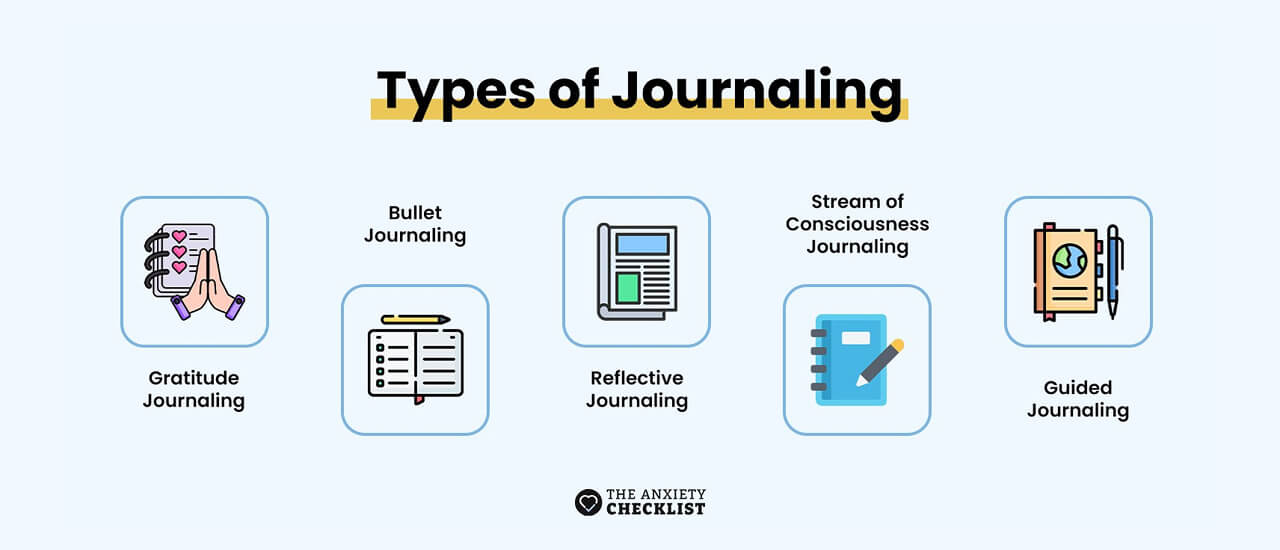
Many anxious folks struggle because they have never fully identified their own boundaries. Journaling can improve self-awareness and help clarify:
- What drains you
- What feels emotionally unsafe
- What behavior repeatedly hurts you
- Where you feel resentment
Learn how to begin journaling for anxiety and self-growth with easy techniques and prompts. Here’s a quick snapshot of different types of journaling to help you get started.
Use a Script the First time
Anxious folk tend to freeze when they’re caught off-guard. If saying no still feels impossible, start by having a script ready even before the moment hits. If you have to handle a last-minute request, a call that comes at the wrong time, or a face-to-face ask you didn’t see coming, having a script always comes in handy.
- I need to check my schedule
- That’s not going to work
- I appreciate you asking, but I’m not able to
Practice these with yourself first so the confidence doesn’t look borrowed. Say it to yourself in the mirror or to a friend, or/and write it down. Familiarize yourself to prepare for the real moment.
FAQ
Final Thoughts
Anxiety University
Explore the Anxiety University
Free guides to help you understand anxiety, one topic at a time.
- Getting StartedThe basics of anxiety and how it works
- Self-Assessments & Anxiety TestsCheck in on your symptoms with free tests
- Cognitive Traps & Thought PatternsSpot the thinking habits that fuel anxiety
- Stress ReductionPractical ways to calm your body and mind
- Common Anxiety PhobiasUnderstand specific fears and how they are treated
- Inspiring StoriesReal stories and words that remind you you are not alone