


In short
Anxiety in pregnancy is common, but it deserves attention when worry is hard to control, lasts, causes panic, disrupts sleep or daily life, or leads to avoidance. Tell a prenatal clinician early. Seek urgent help for thoughts of harm, hallucinations, severe confusion, chest pain, fainting, or trouble breathing.
Key takeaways
- A 2017 systematic review and meta-analysis found that 15.2% of pregnant participants met diagnostic criteria for an anxiety disorder, while symptom questionnaires produced higher estimates.
- Pregnancy worry becomes more concerning when it is difficult to control, persistent, disruptive, or driving repeated checking, reassurance-seeking, or avoidance.
- A racing heart, dizziness, chest discomfort, and shortness of breath can occur with anxiety, but new or severe physical symptoms during pregnancy should not automatically be treated as panic.
- Therapy can help, and medication may be appropriate, but prescribed medication should not be stopped or changed without the clinician responsible for pregnancy and mental-health care.
- Self-help tools can support grounding and symptom tracking, but they cannot diagnose anxiety, assess pregnancy complications, or replace prenatal and mental-health care.
Table of contents
- Is anxiety during pregnancy common?
- How can you tell normal pregnancy worry from anxiety?
- What can anxiety in pregnancy feel like?
- Why can anxiety start or get worse during pregnancy?
- Can anxiety during pregnancy affect the baby?
- When should you tell a prenatal clinician, and when is it urgent?
- What should you do if anxiety spikes tonight?
- Which self-care steps are reasonable during pregnancy?
- How can you prepare for a prenatal or mental-health appointment?
- What else do people ask about anxiety in pregnancy?
- What should you do next?
This guide is educational and cannot diagnose anxiety or assess the health of a pregnancy. Clinical pathways and emergency numbers vary by country, so use the prenatal, primary-care, maternity, mental-health, and emergency services available where you live.
Is anxiety during pregnancy common?
Yes. Some worry is expected during pregnancy, and anxiety disorders can also begin for the first time or return after a period of stability.
The 2017 review included 102 studies and 221,974 participants from 34 countries. It estimated that 15.2% met criteria for any anxiety disorder during pregnancy. Self-reported anxiety symptoms were more common, although estimates varied by trimester, location, measurement tool, and study design.
That difference matters. A symptom questionnaire identifies people who may need a closer assessment, while a diagnosis considers the type, duration, severity, context, and effect of the symptoms.
The American College of Obstetricians and Gynecologists, or ACOG, describes anxiety disorders as more than temporary fear. ACOG's patient guidance on anxiety and pregnancy focuses on anxiety that is intense, lasts, or interferes with daily life.
Anxiety through pregnancy may fluctuate. A scan, new physical symptom, previous loss anniversary, medical appointment, work problem, or approaching birth can temporarily increase worry. A difficult week does not automatically mean an anxiety disorder, but persistent distress still deserves support.
Anxiety during pregnancy is common enough to screen for and important enough not to dismiss.
How can you tell normal pregnancy worry from anxiety?
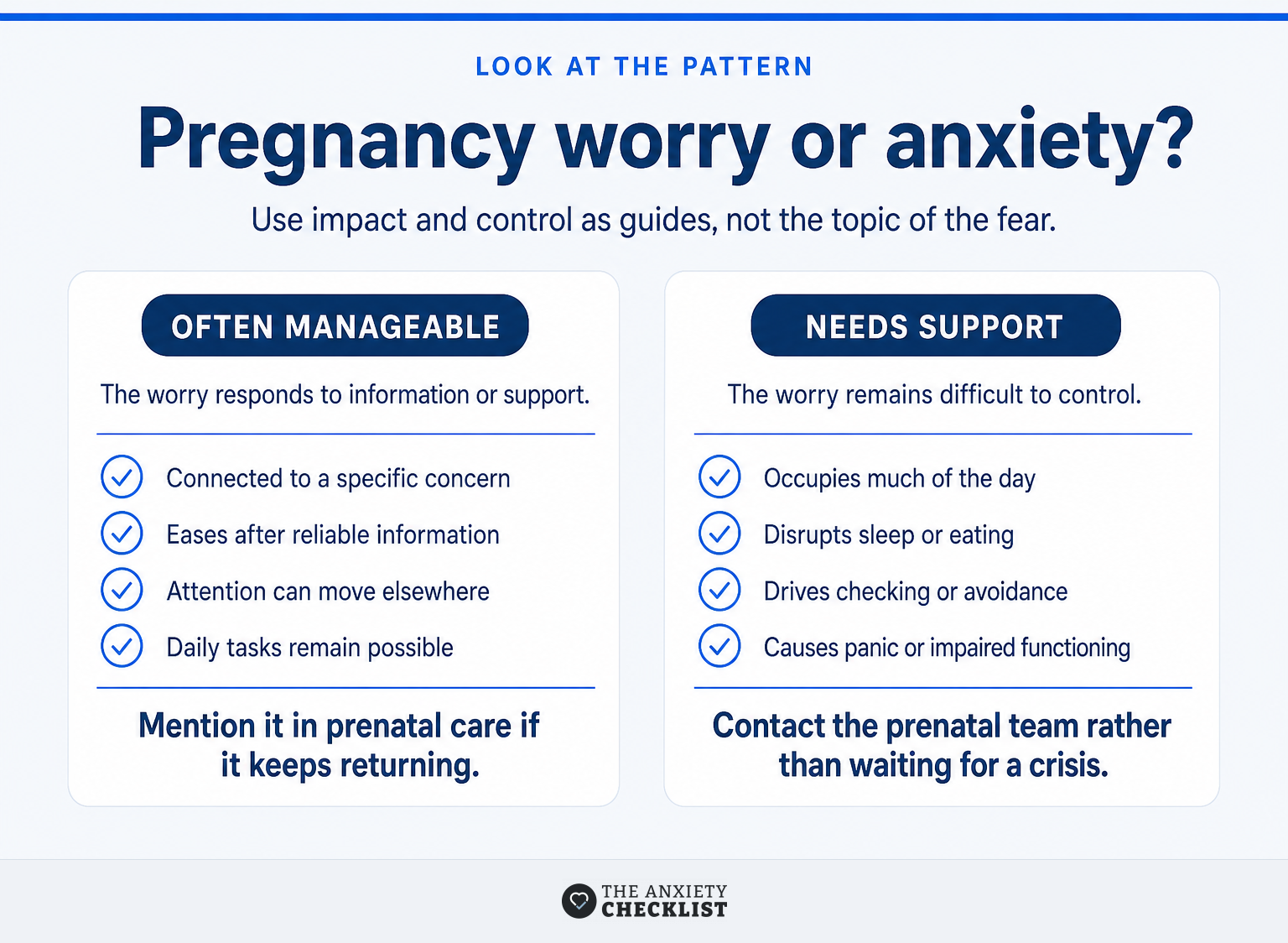
Ordinary worry tends to remain connected to a specific concern and becomes more manageable after reliable information, rest, or support. Anxiety is more likely when worry is difficult to control, occupies much of the day, or changes how a person sleeps, works, eats, attends appointments, or relates to others.
Common worries include miscarriage or pregnancy loss, the baby's health, test results, physical symptoms, labor, pain, parenting, finances, work, relationships, and loss of control. Anxiety around pregnancy can involve the same subjects, so the topic alone does not distinguish ordinary worry from a health condition.
The pattern is more useful than the subject. Consider these questions:
- Can attention move away from the worry, even for a while?
- Does reliable information settle the concern, or does the mind immediately find another danger?
- Is reassurance needed repeatedly from clinicians, relatives, online groups, or search engines?
- Are appointments, foods, activities, travel, work, sleep, or social contact being avoided because of fear?
- Does the worry cause panic attacks or make basic daily tasks harder?
- Is checking taking up substantial time without creating lasting relief?
The NHS guidance reviewed in March 2026 defines the main problem as worry that affects daily life and is difficult to control. ACOG similarly emphasizes intensity, duration, and disruption.
There is no need to wait until anxiety becomes unbearable. A prenatal clinician can discuss symptoms before they meet every criterion for a disorder, particularly when there is a history of anxiety, depression, obsessive-compulsive disorder, trauma, or pregnancy loss.
Pregnancy worry becomes a health concern when it is hard to control, persistent, or disruptive, not because the subject of the worry is unusual.
What can anxiety in pregnancy feel like?
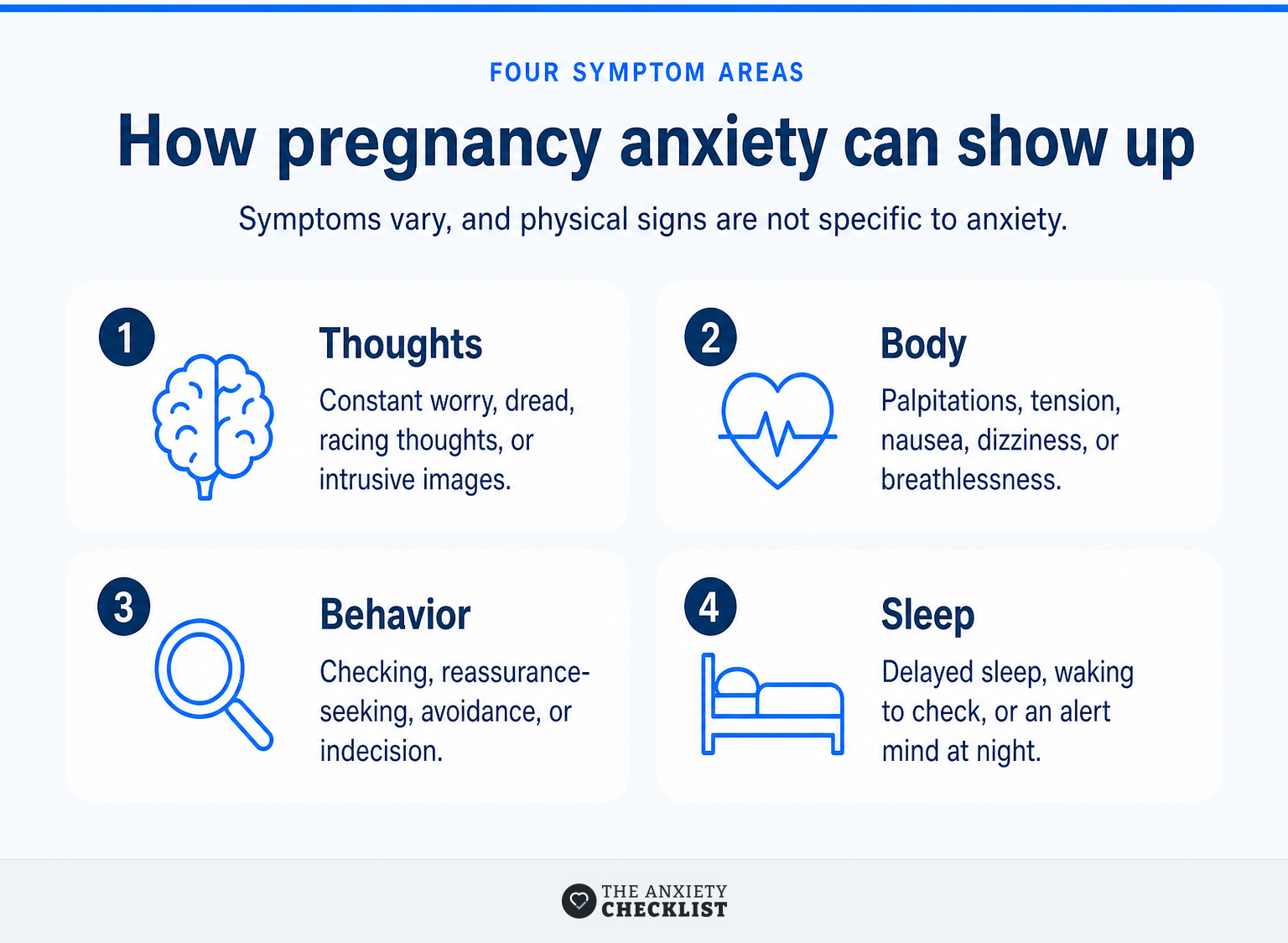
Anxiety can appear in thoughts, emotions, body sensations, behavior, sleep, or all of these at once. Symptoms can resemble ordinary pregnancy changes, which is why new, severe, or unusual physical symptoms need medical assessment rather than self-diagnosis.
Thoughts and emotions
Anxiety may involve constant worry, racing thoughts, irritability, tension, dread, a feeling that something bad is about to happen, or an inability to feel reassured. Concentration can become difficult because attention repeatedly returns to possible danger.
Some people experience unwanted intrusive thoughts or images. These can involve contamination, accidentally causing harm, making the wrong medical decision, or something happening to the baby.
Intrusive thoughts may occur with anxiety or perinatal obsessive-compulsive disorder. The Royal College of Psychiatrists' perinatal OCD guidance distinguishes distressing, unwanted OCD thoughts from a desire to act on them. Tell a clinician about recurring intrusive thoughts, especially when they cause avoidance, rituals, repeated checking, or intense shame. If there is intent, a plan, loss of control, or an inability to stay safe, seek emergency help.
Physical sensations
Possible anxiety and panic symptoms include:
- A rapid or pounding heartbeat
- Sweating or trembling
- Muscle tension
- Nausea or stomach discomfort
- Dizziness or lightheadedness
- A feeling of breathlessness
- Chest tightness or discomfort
- Headaches
- Tingling or numbness
- Feeling detached or unreal during panic
These sensations are real even when anxiety contributes to them. They are not proof that someone is weak or imagining a problem.
They are also not specific to anxiety. Pregnancy complications and other medical conditions can cause palpitations, dizziness, chest pain, breathlessness, headache, nausea, or fainting. Severe, sudden, worsening, or unfamiliar symptoms should be discussed with a maternity or medical service.
Behavior and sleep
Anxiety can lead to repeated symptom searches, body checking, reassurance-seeking, avoidance of appointments or activities, excessive preparation, or an inability to make decisions. Sleep may be delayed by worry, interrupted by checking, or shortened because the mind remains alert for danger.
Panic attacks cause a sudden surge of intense fear with physical symptoms. A first panic-like episode during pregnancy still warrants a medical conversation because symptoms such as chest pain, fainting, and breathing difficulty require careful assessment.
Anxiety can show up in thoughts, body sensations, behavior, and sleep, and physical symptoms should not be assigned to anxiety without considering medical causes.
Why can anxiety start or get worse during pregnancy?
Pregnancy anxiety rarely has one simple cause. Biological changes, uncertainty, previous experiences, current stress, health concerns, and existing mental-health vulnerabilities can interact differently for each person.
ACOG's patient guidance on anxiety and pregnancy identifies several factors associated with higher risk:
- A previous anxiety disorder or other mental-health condition
- A family history of anxiety disorders
- Previous pregnancy loss
- Health challenges during pregnancy
- Trauma, including childhood violence, abuse, or neglect
- Other significant personal health concerns
Relationship strain, financial pressure, insecure housing, work demands, limited practical support, discrimination, migration, and caregiving responsibilities may add to the load. A planned and wanted pregnancy does not prevent anxiety, and anxiety does not mean a person is ungrateful about the pregnancy.
Fear can also focus strongly on labor or birth. An extreme fear of childbirth is sometimes called tokophobia. A prenatal clinician can discuss birth-planning support, mental-health care, and referral to someone experienced in perinatal anxiety or birth trauma.
Anxiety may also return when a previously effective routine changes. Sleep, exercise, therapy access, social contact, or medication may have changed around conception or early pregnancy. Tell the prenatal team about previous treatment and what helped before.
History, loss, trauma, medical complications, and current stress can increase vulnerability, but anxiety can also begin without an obvious trigger.
Can anxiety during pregnancy affect the baby?
Occasional worry or one stressful day does not determine a baby's outcome. Research has found associations between persistent prenatal anxiety and some pregnancy outcomes, but an association across groups does not prove that one person's anxiety caused a particular complication.
MotherToBaby's March 2026 fact sheet states that anxiety alone is unlikely to increase the chance of birth defects. It also reports that untreated anxiety might contribute to outcomes such as preterm delivery or low birth weight.
A 2026 cumulative meta-analysis combined 40 observational studies published from 1996 to 2025, representing more than 1.97 million parent-child pairs. Prenatal anxiety was associated with adjusted odds ratios of 1.41 for preterm birth and 1.32 for low birth weight.
Those figures describe relative odds, not the absolute chance that an outcome will occur. Observational research can also be affected by depression, medical conditions, income, access to care, trauma, substance use, sleep, and other factors that are difficult to separate fully.
The useful response is not guilt. It is support. Anxiety is treatable, and professional care can improve sleep, functioning, prenatal self-care, and quality of life. Treatment decisions should weigh the effects of the condition alongside the benefits and possible risks of each treatment option.
Anxiety is associated with some adverse outcomes, but association is not destiny and the evidence is a reason to seek care, not to blame yourself.
When should you tell a prenatal clinician, and when is it urgent?
Tell a prenatal clinician when anxiety is persistent, difficult to control, causing panic, disturbing sleep, changing behavior, or interfering with daily life. Seek urgent or emergency help when safety is at risk, reality feels altered, or physical symptoms could represent a serious pregnancy complication.
As of November 2026, ACOG's 2023 screening guidance recommends anxiety and depression screening at the initial prenatal visit, later in pregnancy, and during postpartum care. Screening should be connected to assessment, treatment, monitoring, and follow-up rather than treated as a score alone.
| Situation | Suggested timing | First contact |
|---|---|---|
| Worry is recurring but daily life remains manageable | Mention it at the next prenatal appointment, or sooner if it is increasing | Midwife, obstetric clinician, GP, primary-care clinician, or therapist |
| Anxiety is present most days, disrupts sleep or eating, causes panic, or leads to avoidance or compulsive checking | Contact the prenatal team promptly rather than waiting for a routine visit | Prenatal clinician or perinatal mental-health service |
| A prescribed mental-health medication was being taken before pregnancy | Speak to the prescriber and prenatal clinician as soon as possible; do not change it alone | Prescriber, pharmacist, and prenatal clinician |
| There are recurring intrusive thoughts without an intention to act | Disclose them promptly for assessment, especially if they cause rituals or avoidance | Prenatal clinician or mental-health professional |
| There is an intention or plan to harm yourself or someone else, an inability to stay safe, hallucinations, delusions, severe confusion, or a loss of contact with reality | Seek emergency help now and do not remain alone | Local emergency services or the nearest emergency department |
| There is chest pain, trouble breathing, fainting, severe or persistent headache, vision change, heavy bleeding, fluid leakage, or a marked change in fetal movement | Seek immediate medical assessment | Maternity triage, emergency services, or an emergency department |
The CDC's 2024 urgent maternal warning signs include thoughts of harming yourself or the baby, trouble breathing, chest pain or a fast-beating heart, dizziness or fainting, and several obstetric warning signs. The list is not exhaustive.
If immediate danger is present, call the local emergency number. Anxiety Checklist also maintains country-specific crisis resource links, but a directory should not delay emergency services when someone may be in danger.
Persistent or disruptive anxiety deserves a prenatal conversation, while danger, psychosis, chest pain, fainting, or breathing trouble requires urgent assessment.
What should you do if anxiety spikes tonight?
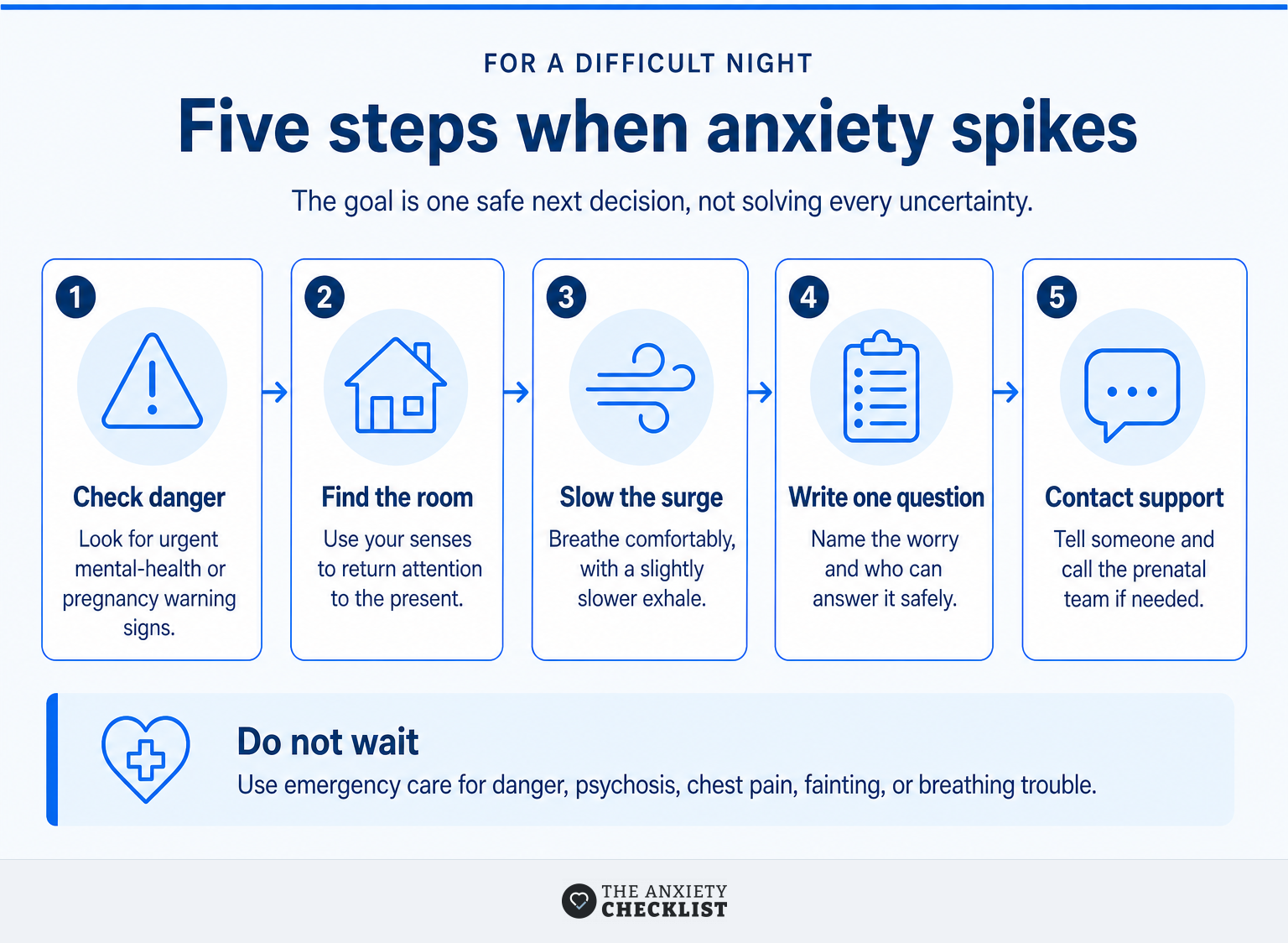
First check whether the situation includes an urgent mental-health or pregnancy warning sign. If it does not, the immediate goal is to lower the intensity enough to make one safe decision, not to solve every uncertainty before morning.
Try this short sequence:
- Check safety. Ask whether there is chest pain, fainting, severe breathing difficulty, heavy bleeding, a major change in fetal movement, an intention to cause harm, or an inability to stay safe. Contact urgent services if any answer is yes.
- Orient to the room. Place both feet on a stable surface. Name five things you can see, four you can feel, and three you can hear. This shifts attention from imagined future events to the present environment.
- Breathe comfortably. Allow the exhale to become slightly slower than the inhale without forcing a deep breath or holding it. Stop if the exercise causes dizziness or discomfort.
- Contain the question. Write the worry in one sentence, followed by the person or service that can answer it. Avoid trying to diagnose pregnancy symptoms through repeated nighttime searches.
- Make contact. Tell a trusted person that anxiety is high. If symptoms are persistent or escalating, contact the prenatal or mental-health service rather than relying only on reassurance from friends.
ACOG's patient guidance on anxiety and pregnancy includes slow breathing, social connection, sleep habits, and simple daily steps among its self-care suggestions. These techniques can reduce distress, but they do not rule out a pregnancy complication.
Why does pregnancy anxiety feel worse at night?
Night removes many daytime distractions, while fatigue can make uncertainty feel harder to tolerate. A quiet room can also make heartbeat, breathing, fetal movement, pain, and other body sensations more noticeable.
A short evening plan may help:
- Set aside a brief worry-writing period earlier in the evening.
- Put questions for the prenatal team in one note instead of searching repeatedly.
- Choose a stopping time for pregnancy forums, news, and symptom searches.
- Keep the prenatal service's after-hours number and local emergency number available.
- Ask a support person in advance what kind of help would be useful during a difficult night.
Seek help if anxiety repeatedly prevents sleep, because persistent sleep disruption is itself worth discussing with the prenatal team. Do not start a sleep remedy, antihistamine, herbal tea, supplement, or medication without checking whether it is appropriate during pregnancy.
The safest short-term plan checks for danger, settles the body, narrows the problem, and brings another person or service into the situation.
Which self-care steps are reasonable during pregnancy?
Low-risk self-care can support recovery, but persistent or severe anxiety may need therapy, medication, or both. Pregnancy-specific medical advice still applies to exercise, caffeine, supplements, sleep products, and prescribed medication.
Use support before anxiety becomes a crisis
Tell at least one trusted person what anxiety looks like and what would help. A useful request is specific: sit with me during the call, come to the appointment, take over one task, or help write down the clinician's instructions.
For broader education about anxiety patterns and coping concepts, Anxiety University provides free self-help information. Educational material should sit alongside prenatal care rather than replace it.
Stay active within pregnancy guidance
For people with a healthy, uncomplicated pregnancy, ACOG's pregnancy exercise guidance recommends at least 150 minutes of moderate aerobic activity each week. The appropriate amount and type depend on health, pregnancy complications, previous activity, pain, and clinician advice.
Walking, swimming, modified prenatal yoga, or another approved activity may provide routine and an outlet for physical tension. Stop and seek advice for warning signs such as bleeding, chest pain, dizziness, fluid leakage, or breathing difficulty before exercise.
Protect sleep without chasing perfect sleep
Use a consistent wind-down routine where possible. Reduce bright screens and symptom searches before bed, place written questions aside for the morning, and ask for practical help when responsibilities are preventing rest.
Tell a clinician if anxiety repeatedly prevents sleep or if there is a striking reduction in the need for sleep accompanied by unusual energy, agitation, impulsivity, or confusion. That pattern needs assessment rather than another sleep tip.
Review caffeine
Caffeine can increase jitteriness, palpitations, and difficulty sleeping in some people. ACOG's caffeine guidance uses less than 200 mg per day as its pregnancy threshold, but serving sizes vary and local recommendations may differ. Ask the prenatal clinician what limit applies to you.
Be cautious with natural remedies
Natural does not automatically mean safe during pregnancy. MotherToBaby's April 2025 herbal-products fact sheet reports that many herbal products have not been adequately studied in pregnancy and may vary in strength, contain unlisted ingredients, or interact with medication or anesthesia.
Check calming teas, tinctures, gummies, oils, powders, vitamins, and supplements with a prenatal clinician or pharmacist before using them. Bring the container or a photograph of the full ingredient list to the appointment.
Discuss therapy and medication without shame
Cognitive behavioral therapy and other psychological treatments can help with pregnancy anxiety. A clinician may also discuss medication when symptoms are severe, therapy is unavailable, or previous medication has been effective.
As of November 2026, ACOG's treatment guidance recommends against withholding or discontinuing mental-health medication solely because someone is pregnant or breastfeeding. NHS pregnancy mental-health guidance reviewed in March 2026 also advises people not to stop prescribed medication until they have spoken to their doctor or specialist.
There is no universal medication answer for every pregnancy. The decision depends on the condition, severity, previous response, dose, other medications, pregnancy stage, medical history, and risks of leaving symptoms untreated.
Self-care can support treatment, but supplements and medication changes require professional pregnancy-specific advice.
How can you prepare for a prenatal or mental-health appointment?
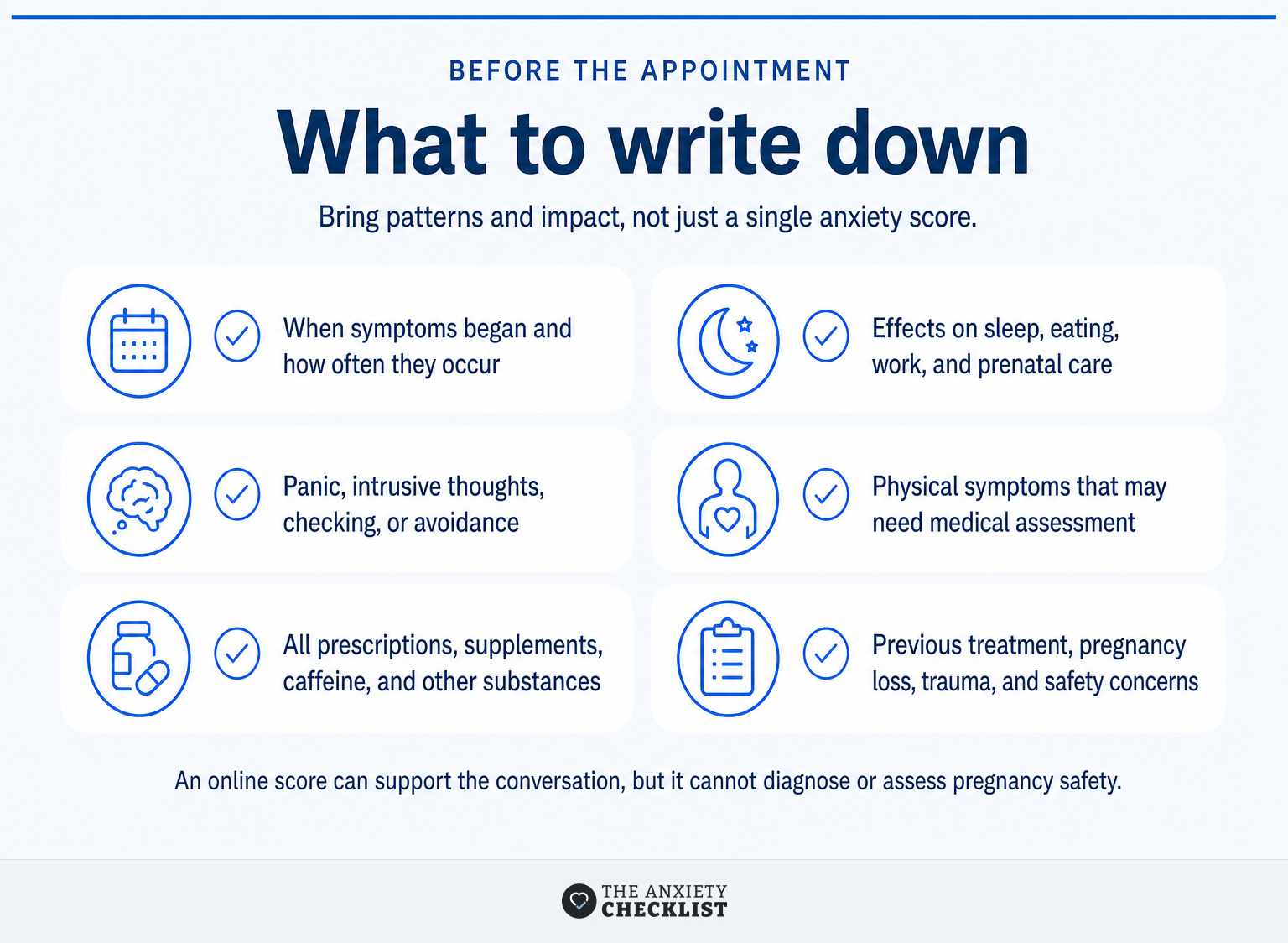
A short record of symptoms helps the clinician see the pattern instead of hearing only how you feel during one appointment. Include daily impact, safety concerns, physical symptoms, medication, supplements, and relevant mental-health or pregnancy history.
Write down:
- When the anxiety began and whether it is getting stronger
- The main worries, triggers, and avoided situations
- How often panic attacks or intense surges occur
- How sleep, eating, work, relationships, and prenatal care are affected
- Any intrusive thoughts, rituals, checking, or repeated reassurance-seeking
- Physical symptoms such as palpitations, dizziness, pain, or breathlessness
- Current prescriptions, over-the-counter products, supplements, caffeine, nicotine, alcohol, or other substances
- Previous anxiety, depression, OCD, PTSD, bipolar disorder, psychosis, therapy, or medication
- Previous pregnancy loss, difficult birth, fertility treatment, trauma, or current medical complications
- Any thoughts of harm, intention, plan, hallucinations, confusion, or concern about staying safe
Questions to ask include:
- Could any physical symptoms have a pregnancy-related or medical cause?
- Which screening or assessment tool is appropriate?
- Is referral to a perinatal mental-health specialist available?
- What should happen if symptoms worsen at night or between appointments?
- What are the benefits and risks of therapy, medication, or combined treatment in this pregnancy?
- Who should monitor symptoms and how soon should follow-up occur?
A general questionnaire can help organize a conversation. Anxiety Checklist's anxiety self-assessment information includes the GAD-2 and GAD-7, but an online score is not a diagnosis or a pregnancy-specific safety assessment.
ACOG recommends using validated tools alongside systems for diagnosis, treatment, monitoring, and follow-up. Bring the score to the appointment, but also describe anything the questions did not capture.
A concise symptom record gives the prenatal team better information for deciding what assessment, treatment, and follow-up are needed.
What else do people ask about anxiety in pregnancy?
Questions about fetal effects, nighttime worry, natural remedies, and medication need answers that account for symptom severity and individual pregnancy history. The following boundaries are useful, but they do not replace care from a clinician who knows the pregnancy.
Is anxiety during pregnancy common?
Yes. A 2017 systematic review found that 15.2% of pregnant participants met criteria for an anxiety disorder, while symptom questionnaires produced higher estimates. Common does not mean harmless or something to hide. If worry is difficult to control or affects daily life, tell a prenatal clinician.
Can anxiety during pregnancy affect the baby?
Persistent prenatal anxiety has been associated with higher odds of preterm birth and low birth weight, but observational associations cannot predict an individual pregnancy or prove that anxiety caused an outcome. MotherToBaby states that anxiety alone is unlikely to increase birth-defect risk. Treatment and support are preferable to guilt or silence.
Why is pregnancy anxiety worse at night?
Pregnancy anxiety may feel worse at night because there are fewer distractions, fatigue reduces coping capacity, and body sensations become more noticeable. Write questions down, limit repeated symptom searches, use a brief grounding routine, and contact the prenatal team if anxiety repeatedly prevents sleep or physical symptoms are concerning.
Are natural remedies for anxiety safe during pregnancy?
Not automatically. Many herbal calming products, supplements, tinctures, gummies, and teas have limited pregnancy-safety evidence, variable ingredient strength, or possible medication interactions. Ask a prenatal clinician or pharmacist to review the exact product and full ingredient list before using it, even when the label describes it as natural.
What can I take for severe anxiety while pregnant?
There is no universal medication that is appropriate for every pregnant person. Severe anxiety needs prompt assessment by the prenatal clinician and, when available, a perinatal mental-health specialist. Do not start, stop, or change prescribed or over-the-counter products without discussing the risks, benefits, previous treatment response, and pregnancy history.
Pregnancy anxiety is treatable, and the safest answer depends on symptom severity, medical history, and the individual pregnancy.
What should you do next?
Tell one qualified person how anxiety is affecting life today, rather than waiting for the next crisis. Use routine prenatal care for emerging concerns, request prompt support for persistent or disruptive symptoms, and use emergency services when safety or serious physical symptoms are involved.
For non-emergency support between appointments, the Anxiety Checklist Mobile App offers grounding, guided audio, and CBT-oriented self-help tools. The app does not diagnose anxiety, provide pregnancy treatment, or replace a prenatal clinician, therapist, psychiatrist, pharmacist, or emergency service.
The most useful next step is to describe the symptoms plainly and ask for a specific assessment and follow-up plan.