


You know the feeling. You're about to speak in a meeting, walk into a waiting room, answer a question at a party, or introduce yourself to someone new, and your body reacts before your mind can catch up. Your chest tightens. Your thoughts scatter. You start scanning yourself from the outside, wondering if everyone can see how anxious you are.
In moments like that, what many people want isn't arrogance or performance. They want an air of confidence. Something steady. Something visible. Something that helps them get through the moment without panic running the show.
That desire makes sense. It also isn't shallow. For people with anxiety, external confidence can become a bridge to internal safety. Not because you're pretending to be someone else, but because you're giving your nervous system a clearer script to follow.
Redefining Confidence When You Have Anxiety
A lot of anxious people assume confidence is a personality trait they missed out on. They look at someone calm, clear, and self-possessed and think, "They just have it." That belief keeps people stuck because it turns confidence into a fixed identity instead of a trainable skill.
Real confidence works differently. It often starts as behavior before it becomes belief.

Someone with anxiety might still feel shaky and choose to stand still instead of fidgeting. They might still feel dread and answer in a calm sentence anyway. They might still fear judgment and keep their shoulders open instead of folding inward. Those choices count. They aren't fake. They are practice.
Confidence is a skill your body can learn
When anxiety is loud, many people wait to feel better before they act confident. That usually backfires. Anxiety rarely rewards waiting. It tends to shrink your world, then present that shrinking as proof that you're not capable.
A more useful approach is outside-in. You act in ways that communicate steadiness, and over time your mind learns that these moments are survivable. That's the same basic reason some people are able to move from fear to confidence in settings that once felt impossible. The fear doesn't always vanish first. Safety grows through repeated, supported experience.
You don't need to feel fearless to look grounded. You need a repeatable way to behave when fear shows up.
The goal isn't to become a different person
The goal is to stop letting anxiety decide your posture, tone, and choices. If you're used to measuring progress by whether you felt nervous, you'll miss the wins that matter most. The better question is, "How did I respond when anxiety appeared?"
That's where structured learning helps. If you want a practical foundation for understanding how anxiety distorts thoughts and behavior, Anxiety University is a useful place to build that vocabulary.
An air of confidence isn't a costume. It's a set of visible habits that tell your brain, "I'm still here. I can function. I know what to do next." For many anxious people, that's the first step toward a more panic-free life.
Rewire Your Anxious Thoughts for Confidence
Anxiety doesn't just create sensations. It creates commentary. Fast, harsh, convincing commentary.
It says you're awkward before you've spoken. It predicts failure before you've started. It treats uncertainty like danger and treats discomfort like evidence. If you don't interrupt that inner monologue, it will leak into your face, your posture, and your voice.
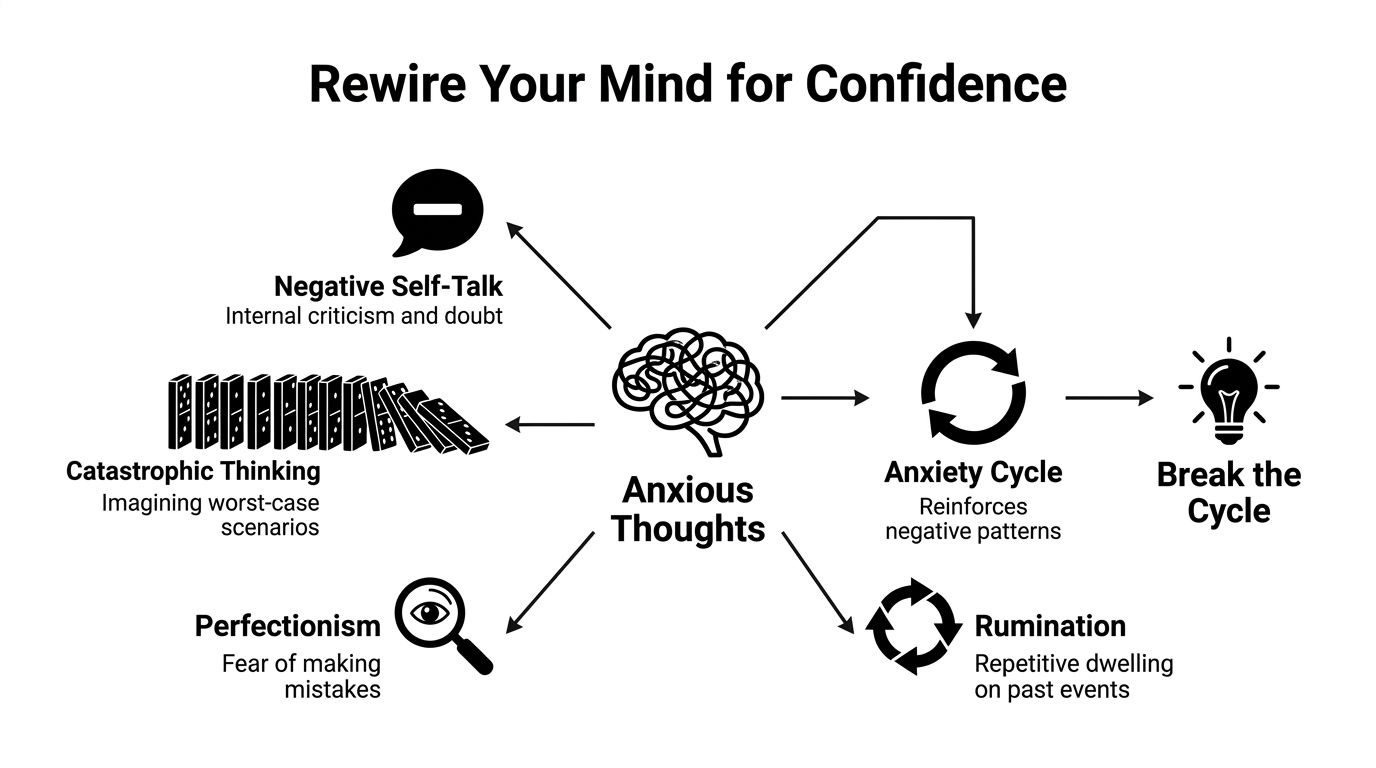
Catch the sentence that drives the spiral
Most anxious spirals start with a short thought that sounds like fact. Examples:
- Mind reading: "Everyone thinks I'm awkward."
- Catastrophizing: "If I stumble, this will be a disaster."
- Perfectionism: "If I can't do this well, I shouldn't do it at all."
- Rumination: "I sounded weird earlier. They probably noticed."
The useful move isn't positive thinking. It's accurate thinking. You're not trying to replace every hard thought with a cheerful one. You're trying to replace distorted thoughts with believable alternatives.
Here are stronger replacements:
- "I can't know what they're thinking."
- "Discomfort isn't the same as danger."
- "Doing this imperfectly is still progress."
- "That moment is over. I don't need to keep replaying it."
Use reframes that your nervous system will actually believe
If you go from "I'm going to humiliate myself" to "I'm amazing and everyone loves me," your body won't buy it. The gap is too wide. Better reframes sound grounded.
Try this pattern:
- Name the anxious thought
- Identify the distortion
- Write one more balanced sentence
- Pair it with one action
For example:
- Thought: "I'm going to fail this presentation."
- Balanced sentence: "I'm prepared enough to get through it."
- Action: Read the opening line slowly before speaking.
Or:
- Thought: "They'll think I'm incompetent."
- Balanced sentence: "One tense moment doesn't define my ability."
- Action: Ask one clarifying question instead of going silent.
Practical rule: A good reframe reduces panic without asking you to deny reality.
There is also a reason external behavior matters here. Data from mental health surveys shows 40% of anxiety sufferers report "faking it till making it" helps reduce panic symptoms by 25% in social settings according to this mental health discussion reference. That doesn't mean pretending solves anxiety. It means behavior can influence state.
Build a thought record you can reuse
When people say "change your thoughts," that can feel vague and useless. It gets practical when you write the pattern down. A simple thought record works well:
| Trigger | Automatic thought | Balanced response | Next action |
|---|---|---|---|
| Meeting | "I'll sound stupid" | "I can contribute one useful point" | Speak once |
| Social event | "I don't belong here" | "I only need one real conversation" | Ask one question |
| Phone call | "I'll mess this up" | "I can pause and speak slowly" | Use notes |
If you'd like a structured explanation of this process, understanding CBT for anxiety gives useful language for thought patterns and reframes. For a leadership-focused angle on staying steady under stress, this piece on how to lead with confidence, even when your nervous system says no is also worth reading.
Projecting Confidence Through Posture and Voice
Thought work matters, but your body often gets the first vote. When anxiety rises, individuals often physically contract. They fold their shoulders, shorten their breath, rush their words, and make themselves smaller. That posture doesn't just signal fear to other people. It reinforces fear internally.
A better strategy is to use your body as a regulator.

Posture that calms instead of performs
Confident posture isn't theatrical. It looks ordinary, stable, and unforced.
Try these corrections:
- Feet grounded: Place both feet flat instead of shifting constantly.
- Shoulders released: Let them drop and widen rather than pulling them tight.
- Hands visible: Keep them relaxed at your sides or lightly resting, instead of hiding them.
- Chest open: Not puffed up. Just not collapsed.
- Jaw unclenched: Tension in the face often makes your voice sound strained.
If this feels unnatural, that's normal. Anxiety trained your body in one direction. You're training it in another.
Eye contact without staring
A lot of anxious people hear "make eye contact" and immediately think of forced staring. That's not the goal. You want connected attention, not intensity.
The easiest method is the triangle technique. Let your gaze move gently between one eye, the other eye, and the mouth. This creates a natural rhythm and prevents the frozen look that comes from trying too hard.
If direct eye contact feels too activating, start smaller. Look at the bridge of the nose, then build up. Others are unlikely to notice the difference.
Looking engaged is often enough. You don't need perfect eye contact to create an air of confidence.
Your voice matters more than your script
People often overfocus on saying the perfect thing. In anxious moments, delivery usually matters more. A calm, slower sentence lands better than a brilliant sentence fired out in one breath.
Use these vocal adjustments:
- Breathe before the first sentence. One slow inhale is enough.
- Start slower than feels natural. Anxiety speeds you up.
- Let pauses do the work. Pauses sound thoughtful. Filler words sound apologetic.
- Speak from lower in the body. You don't need a deep voice. You need less throat tension.
- Finish the sentence. Don't trail off as if asking permission.
A lot of people find it easier to practice this in professional settings first. If interviews trigger anxiety, this guide on how to be confident in an interview offers practical prompts you can adapt.
If you want to practice body-led confidence directly, power poses for anxiety confidence can help you experiment with what feels stabilizing rather than performative.
A quick demonstration can help make this concrete:
A small rehearsal that works
Before a conversation, meeting, or appointment, do this in private:
- Stand with both feet planted.
- Exhale longer than you inhale.
- Relax your jaw.
- Say your opening sentence out loud once.
- Repeat it again, slower.
Not a pep talk. Not a personality transplant. Just a brief reset that helps your body stop broadcasting alarm.
Build Confidence with Daily Micro-Habits and Scripts
Big confidence goals often fail because they're too vague. "Be more confident" doesn't tell your nervous system what to do at 9:15 a.m. when you need to say hello to a coworker or ask a question on a call.
Micro-habits work better because they are specific, repeatable, and low drama. You don't need one brave leap. You need dozens of ordinary reps.
In aviation, pilots rely on forecast verification and checklists to build an air of confidence in their decisions, and that same logic applies here through forecast verification and operational checklists. When you practice and track small confident actions, you create a system that still works when pressure rises.
The habits should be almost boring
Anxious people often sabotage themselves by choosing exposure tasks that are too intense. Then they avoid them, feel ashamed, and call that proof they can't change.
Choose actions so small they feel slightly uncomfortable, not overwhelming:
- At a store: Make eye contact and say, "How's your day going?"
- At work: Offer one sentence in a meeting.
- By text: Send the message instead of rewriting it endlessly.
- On a walk: Keep your head up for one block instead of looking down.
- With a friend: State a preference instead of saying, "Anything is fine."
Confidence grows faster when the task is small enough to repeat tomorrow.
If you need a steady daily structure for this kind of practice, daily anxiety relief is a good model for turning vague goals into checkable actions.
Confidence scripts for anxious situations
You don't need to improvise your way through every triggering moment. Scripts reduce decision fatigue and help you sound composed even when you're activated.
| Situation | Anxious Script (What you might think) | Confident Script (What you can say) |
|---|---|---|
| Introducing yourself | "I sound awkward" | "Hi, I'm [name]. It's good to meet you." |
| Joining a conversation | "I'm interrupting" | "Can I jump in for a second?" |
| Asking for help | "They'll think I should know this already" | "Can you walk me through that once?" |
| Setting a boundary | "They'll be upset with me" | "I can't do that today, but I can do this instead." |
| Disagreeing politely | "I have to avoid conflict" | "I see it differently, and here's why." |
| Buying time | "I need to answer now" | "Let me think about that for a moment." |
| Correcting a mistake | "This proves I'm incompetent" | "You're right. Let me correct that." |
| Leaving a conversation | "I don't know how to exit normally" | "I'm going to step out, but it was nice talking with you." |
A weekly system that doesn't rely on mood
Instead of asking, "Did I feel confident today?" ask better questions:
- What action did I take while anxious?
- What script did I use?
- What happened next?
- What will I repeat?
That approach matters because it shifts confidence away from self-judgment and into evidence. You are no longer waiting for a magical feeling. You are collecting proof that you can function, communicate, and recover.
An air of confidence becomes sustainable when it comes from routine. Not intensity. Not overthinking. Routine.
Your Toolkit for Staying Confident During Anxious Moments
Even with good habits, anxiety will sometimes surge. That's not failure. That's being human, especially if your nervous system has a long history of sounding alarms.
The mistake is assuming a spike erases your progress. It doesn't. What matters is whether you have a response ready.
Aim for reliability, not perfection
In statistics, a 95% confidence interval is commonly used because it gives a range with high reliability rather than claiming total certainty, as explained in this overview of confidence factors in statistical analysis. Anxiety recovery works the same way. You don't need a life with zero fear. You need a system that makes you highly confident you can handle fear when it appears.
That mental shift changes everything. It replaces the impossible standard of "I must never panic" with a practical one: "I know what to do if panic starts."
A calm response plan for acute moments
Use a short sequence. Keep it simple enough to remember under stress.
Name the moment
Say to yourself, "This is anxiety." Not "I'm losing it." Not "Something terrible is happening." Just accurate labeling.
Ground through the senses
Use the 5-4-3-2-1 method. Notice five things you can see, four you can feel, three you can hear, two you can smell, and one you can taste or imagine tasting.
Slow the breath
Try box breathing. Inhale, hold, exhale, hold. Keep the pace comfortable. The purpose is rhythm, not perfection.
Release one muscle group
Drop your shoulders. Unclench your hands. Soften your jaw. Physical release often gives the mind something solid to follow.
Use one stabilizing sentence
Examples:
- "This is intense, but temporary."
- "My body is activated. I can still choose my next step."
- "I don't need to get rid of this feeling immediately."
The strongest form of confidence isn't "nothing scares me." It's "I can stay with myself when fear arrives."
Stay functional while the wave passes
If you're in public, don't pressure yourself to look perfect. Focus on appearing simple and steady. Sip water. Put both feet on the ground. Speak in shorter sentences. Excuse yourself briefly if you need space.
That is confidence too. Not polished confidence. Resilient confidence.
How to Track Your Progress and Find Your Authentic Confidence
Many anxious people discount their progress because they judge themselves by feelings alone. If they still feel nervous, they assume nothing is changing. That's often false.
Progress shows up first in behavior. You recover faster. You avoid less. You speak sooner. You stay in the room longer. You need a way to notice that.
Build evidence for your own capability
NASA's safety case work shows the value of building confidence from structured evidence rather than vague impressions, using quantitative safety case methodology to support high-stakes decisions. The anxiety version is simpler, but the principle holds. Track what you did, what you handled, and what improved.
A useful log might include:
- Trigger: What situation activated you
- Action taken: What confident behavior you used
- Recovery time: Whether you settled faster than before
- Self-talk: Which sentence helped
- Next rep: What you'll practice again
Over time, this gives you something anxiety hates: receipts.
Don't let the air of confidence become a mask
There is a real difference between building external steadiness and hiding ongoing distress. If you only learn how to look fine, you can end up performing wellness while still suffering in private.
Watch for these signs:
- You look composed but feel increasingly exhausted
- You use confident behavior to avoid asking for help
- You never admit fear to safe people
- You treat every hard day as a failure of your image
Those patterns don't mean the method is wrong. They mean authenticity needs to catch up with appearance.
A healthy air of confidence makes you more honest, not less. You stop collapsing in front of fear, but you also stop pretending fear doesn't exist.
Let confidence become congruent
Authentic confidence feels quieter than the anxious mind expects. It isn't flashy. It doesn't need constant proof. It sounds like speaking clearly, setting one boundary, asking one question, or staying present during a wave of discomfort.
If you want one place to organize those patterns over time, the Anxiety Checklist app can help you track symptoms, habits, and practical wins in one system.
A panic-free life usually doesn't begin with a giant breakthrough. It begins with repeated moments of steadiness. One slower breath. One grounded sentence. One choice not to disappear. Those moments add up, and eventually the air of confidence you practiced starts to feel like your real self.
If you want a practical system to turn these ideas into daily action, The Anxiety Checklist gives you a structured way to track symptoms, challenge anxious thinking, build confidence habits, and handle panic with a plan you can follow.