



Your mind may be doing this right now. You notice a small cramp, a change in discharge, a missed return call from your doctor, or one article about birth complications, and within minutes your body acts like an alarm has gone off. Your chest tightens. You check symptoms again. You tell yourself to calm down, but the fear gets louder.
That experience is frightening, and it can feel isolating, especially when everyone around you expects pregnancy to look joyful and glowing. But anxiety during pregnancy is real, common, and treatable. Healing is possible. People do get better. People do stop living in fear of the next panic wave. People do go from scanning for danger all day to feeling steady again.
This isn't about forcing yourself to “just relax.” It's about understanding what's happening, knowing what helps, and having a practical path forward that works both in the long term and in the exact moment panic starts to rise.
Table of Contents
- You Are Not Alone in This Feeling
- What Is Prenatal Anxiety Really
- Why You Might Be Feeling This Way
- How Untreated Anxiety Can Affect Your Pregnancy
- Your Path to a Calm and Confident Pregnancy
- What to Do During a Panic Attack
- A Hopeful Future for You and Your Baby
You Are Not Alone in This Feeling
One of the most painful parts of anxiety during pregnancy is how quickly it can make you doubt yourself. A person can feel excited about the baby and still lie awake wondering if every sensation means something is wrong. She can leave a routine appointment reassured, then panic again by evening because the reassurance didn't stick. She can know, logically, that her fear is bigger than the situation and still feel powerless against it.
That doesn't mean she's weak. It means her nervous system is overloaded.
I want you to hear this plainly. Anxiety during pregnancy is not a character flaw, a failure of gratitude, or a sign that you won't be a good parent. It's a health issue that can show up in a season of major physical change, intense uncertainty, and enormous emotional responsibility. Many capable, loving, intelligent people go through it.
Practical rule: If your fear keeps returning even after reassurance, interferes with sleep, steals your concentration, or makes daily life feel smaller, it deserves care.
Some people find comfort in hearing that anxiety can affect people you'd never expect, including public figures who seem outwardly composed. If that helps you feel less singled out, The Anxiety Checklist's celebrity insights can be a gentle reminder that anxiety doesn't only happen to people who are “bad at coping.”
The hopeful part is this. Panic is learnable in one direction, and calm is learnable in the other. With the right support, your body can stop treating ordinary pregnancy uncertainty like an emergency. You can heal from this. You can become less reactive, more grounded, and in many cases panic-free.
What Is Prenatal Anxiety Really
Prenatal anxiety is more than having worries about labor, the baby's health, or how life will change. Those concerns are normal. Most pregnant people have moments of uncertainty. The difference is intensity, persistence, and impact.
Normal concern versus clinical anxiety
A useful way to think about it is this. Normal worry is like a passing cloud. Clinical anxiety is like a fog. A cloud comes and goes. You can still see the road. A fog stays, follows you, and starts to limit how clearly you can function.
Clinical prenatal anxiety often looks like:
- Persistent mental loops about miscarriage, labor, fetal movement, appointments, or worst-case scenarios
- Body symptoms such as racing heart, shakiness, nausea, dizziness, muscle tension, or sudden surges of dread
- Reassurance-seeking that helps briefly, then wears off fast
- Avoidance of appointments, social plans, sleep, exercise, or even baby preparation because it all feels too activating
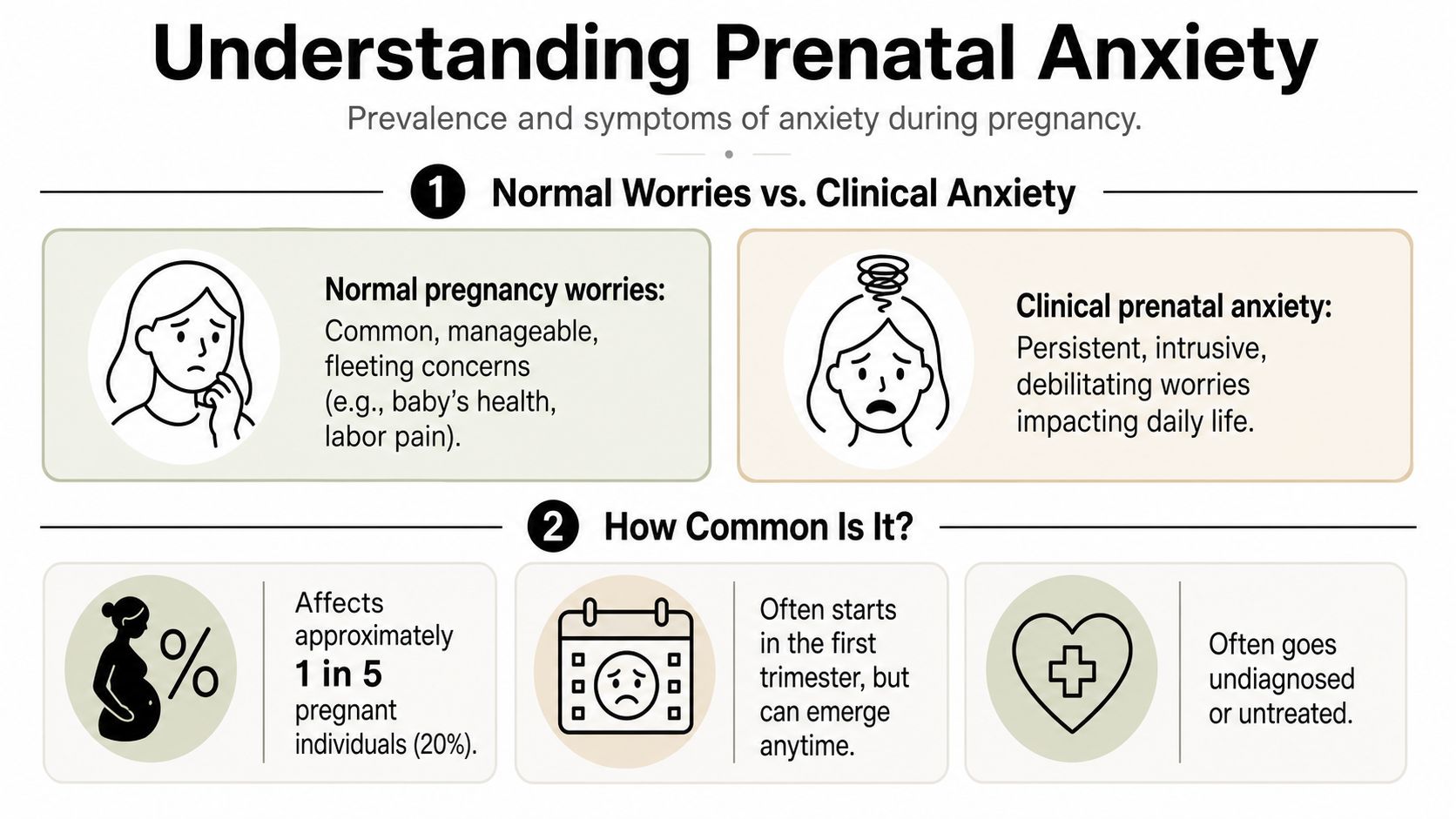
Anxiety can show up as generalized anxiety, panic attacks, intrusive fears, or a strong fixation on pregnancy-specific threats. Some people say, “I don't even feel anxious in general. I only panic about this pregnancy.” That still counts. The content matters.
How common it is
If you've been telling yourself “I'm the only one reacting like this,” the data says otherwise. A large meta-analysis found that approximately 20.7% of pregnant and postpartum women globally meet diagnostic criteria for at least one anxiety disorder, and anxiety symptoms rise from 18.2% in the first trimester to 24.6% in the third trimester according to self-reported data, as reported in JAMA Network Open.
That matters for two reasons. First, it confirms that this is not rare. Second, it helps separate shame from reality. You are not dealing with something bizarre or unknowable. You are dealing with a recognized perinatal mental health condition.
A few signs that point away from ordinary worry and toward something that needs active treatment:
| Experience | More likely normal worry | More likely prenatal anxiety |
|---|---|---|
| Duration | Brief and situational | Recurrent and hard to shut off |
| Effect on day | Annoying but manageable | Disrupts sleep, eating, focus, or functioning |
| Response to reassurance | Relief tends to last | Relief fades quickly |
| Body response | Mild tension | Panic, dizziness, chest tightness, or dread |
If you want a stronger foundation for naming what you're experiencing, you can learn about anxiety and panic attacks in plain language. Sometimes understanding the pattern is the first moment people stop blaming themselves.
Why You Might Be Feeling This Way
Many pregnant people search for one neat explanation. Usually there isn't one. Anxiety during pregnancy often grows from several pressures hitting the same nervous system at once.
Your body is changing fast
Pregnancy asks your body to adapt quickly. Sleep may get lighter. Nausea can make you feel physically unsettled. Normal sensations become harder to interpret because everything feels unfamiliar. For someone prone to anxiety, that uncertainty can become fuel for constant internal monitoring.
That doesn't mean the symptoms are “all in your head.” It means your brain is trying, imperfectly, to protect you by scanning for threat.
Your mind is carrying new responsibility
Pregnancy also changes your mental world. People often become less anxious once a problem can be solved. Pregnancy has many unknowns that can't be solved on demand. You can attend appointments, follow medical guidance, and still not control every outcome. That gap between responsibility and control is hard on an anxious brain.
During the COVID-19 pandemic, the global prevalence of perinatal anxiety rose to 31%, up from around 21% before the pandemic, and about 1 in 10 pregnant women experienced co-morbid anxiety and depression, according to this review in Frontiers in Global Women's Health. That sharp rise reflects something clinicians see often. When uncertainty rises, anxiety rises with it.
Anxiety often spikes when the mind gets no clear finish line. Pregnancy has many moments like that.
Past stress can get louder in pregnancy
A prior history of anxiety, panic, loss, fertility struggles, trauma, or chronic life stress can make pregnancy feel less like a fresh chapter and more like a season where old fears come back online. Some people don't realize how much pressure they're carrying until pregnancy removes their usual coping patterns. Travel changes. Sleep changes. Food tolerance changes. Work and family expectations may shift. Even routine discomforts can start to stack.
Sometimes the trigger isn't obvious at all. It may be a cluster of small stressors, including body discomfort, appointments, family opinions, and practical worries. Even something as ordinary as tooth sensitivity can become one more thing your brain treats as evidence that “something is wrong.” If oral discomfort has been adding to your stress, this guide on oral care for expecting mothers can help reduce one source of unnecessary worry.
If you're starting to recognize patterns in your own experience, it helps to spend time understanding anxiety triggers. Naming triggers doesn't solve everything, but it often lowers self-blame and gives treatment a clearer target.
How Untreated Anxiety Can Affect Your Pregnancy
One of the hardest thoughts in pregnancy is this one: “Can my anxiety hurt my baby?” That fear is common, and it deserves a careful answer. The goal isn't to frighten you. The goal is to show why support matters.
Why this matters without adding fear
Research suggests that pregnancy-specific anxiety is associated with shorter gestation and increased risk of preterm birth, and untreated anxiety can increase maternal cortisol and other stress hormones that cross the placenta, with potential effects on fetal growth, neurodevelopment, and later socio-emotional regulation, as summarized in this review in the National Library of Medicine.
That kind of information can land heavily, so here is the part I want to place right beside it. These findings do not mean that if you feel anxious, harm is inevitable. They mean that persistent, untreated distress deserves real care because care is protective.
The key distinction is untreated anxiety
A common stumbling block for many is hearing “anxiety can affect pregnancy” and concluding they have already failed. That is not the right conclusion. The more useful conclusion is: treatment matters, and treatment helps.
A practical way to approach this:
- Fear by itself is not destiny. Having anxious thoughts does not lock in a bad outcome.
- Severity and persistence matter. Ongoing distress that goes unsupported is what raises concern.
- Action changes the picture. Therapy, medication when appropriate, better sleep, calmer routines, and acute panic tools all reduce the load on your body.
Seeking treatment is not just for comfort. It is an active form of prenatal care.
It also helps to know that not all anxiety behaves the same way. Clinically, the content of the fear often matters. General nervousness and pregnancy-specific worry are not always equivalent in how they affect the body. That's one reason treatment shouldn't be generic. The plan needs to match what your mind keeps getting stuck on.
If reading about risks makes your body tense up, pause there. Put a hand on your chest or belly and come back to the central point. You do not need to be panic-free by tomorrow to protect yourself and your baby. You need a plan, steady support, and repeated moments of calming your system. Those things count. They add up.
Your Path to a Calm and Confident Pregnancy
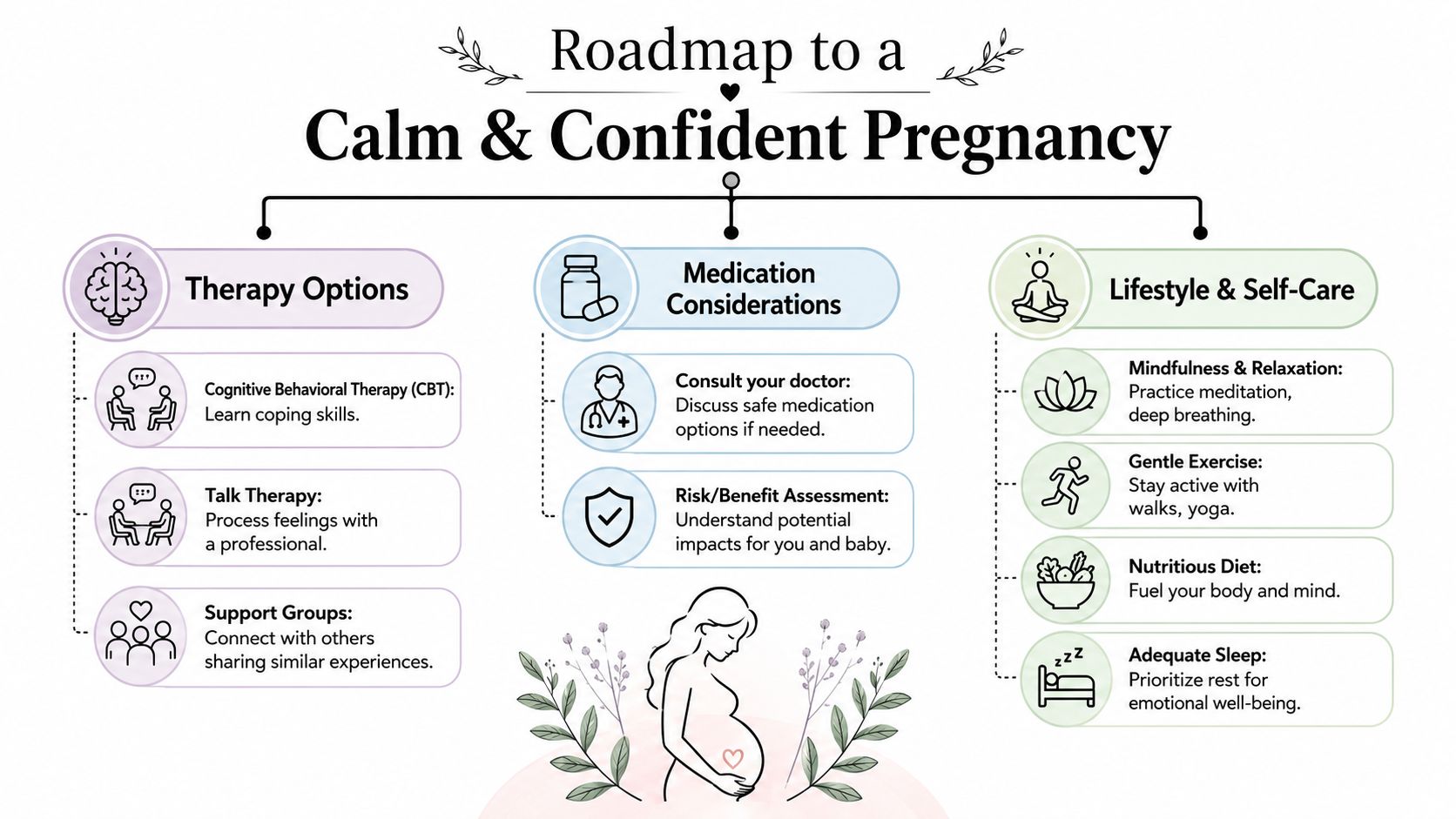
Relief usually doesn't come from one perfect trick. It comes from building a treatment plan that matches the severity of your symptoms and the realities of your pregnancy. For some people, that means therapy alone. For others, medication opens the door for therapy to work. For many, recovery is fastest when formal treatment and daily coping tools are used together.
A visual roadmap can help when your mind feels scattered.
Therapy options
Cognitive-behavioral therapy, or CBT, has a large effect size for reducing anxiety symptoms in pregnant women, and mindfulness-based interventions are also significantly effective, according to this published review on perinatal anxiety treatment. In practice, those are two of the most useful starting points because they work on different layers of the problem.
CBT helps when your mind gets trapped in catastrophic thinking, reassurance loops, and avoidance. It teaches skills such as identifying the thought that spikes panic, testing whether that thought is accurate, reducing checking behavior, and slowly facing situations your anxiety has labeled unsafe, as avoidance provides short-term relief but grants anxiety long-term power.
Mindfulness helps in a different way. Instead of arguing with every thought, you learn to notice it without immediately obeying it. That shift can be huge during pregnancy, where many fears can't be “solved” on command. A mindful response sounds like, “My brain is offering me a danger story right now. I don't have to treat it as fact.”
Common therapy targets include:
- Catastrophic interpretation of body sensations such as cramps, pressure, nausea, or changes in fetal movement
- Compulsive reassurance-seeking through repeated internet searches, repeated calls, or asking the same question in different ways
- Birth fear that grows bigger because it is never discussed directly
- Loss of trust in the body after prior panic, trauma, or a difficult medical experience
A good perinatal therapist won't dismiss your medical concerns. They'll help you sort medical issues from anxiety amplification, and they'll build coping strategies that respect both.
Here's a useful conversation starter for therapy: “I need help with what I do when fear spikes, not just why I have it.” That sentence often moves treatment from insight alone to practical change.
Later in this process, many parents also find that preparing for the newborn stage lowers anticipatory fear. If infant sleep safety is one of the topics feeding your worry, this resource on understanding SIDS and co-sleeping safety can give you grounded, calmer information without doom-scrolling.
A short guided resource can also help you reset when your nervous system is activated. This video is one option to use during quieter moments.
Medication considerations
Medication decisions in pregnancy are personal, and they should be made with your obstetric clinician and the professional managing your mental health care. But fear often fills in the gaps with worst-case assumptions, so it helps to be direct. Selective serotonin reuptake inhibitors, or SSRIs, are considered a safe first-choice medication option, with no increased risk of major congenital malformations in the evidence summarized in the treatment literature already cited above.
That does not mean medication is right for everyone. It means medication should not be ruled out because of shame or misinformation.
A simple decision frame looks like this:
| Question | Why it matters |
|---|---|
| How severe are the symptoms? | Mild anxiety may respond well to therapy and behavior changes alone |
| Is panic interfering with eating, sleeping, or appointments? | Functional impairment usually means stronger treatment is needed |
| Do you have a prior history of responding well to medication? | Past response can guide present choices |
| Are you avoiding treatment because of fear, not because it's a poor fit? | Fear-based avoidance often prolongs suffering |
Medication can be especially valuable when anxiety is so intense that you can't apply the coping skills you already know. In those cases, medication isn't “taking the easy way out.” It can create enough stability for therapy, sleep, and ordinary life to come back online.
Lifestyle and coping strategies
Lifestyle support isn't a substitute for treatment when anxiety is severe, but it does shape the nervous system every day. Small habits can either steady the body or keep it more reactive.
The strategies I return to most often with patients are:
- Protect sleep aggressively. Anxiety gets louder in an exhausted brain. Keep your wind-down simple, predictable, and boring.
- Eat regularly if you can. Long gaps without food can make shakiness and nausea feel like danger.
- Move gently and consistently. Walking, stretching, and prenatal yoga can help discharge physical tension.
- Limit symptom research spirals. Searching often feels productive, but for anxious minds it usually multiplies uncertainty.
- Create a panic plan before panic arrives. Write down your steps, your supports, and your reminders.
Your goal is not to eliminate every anxious thought. Your goal is to teach your body that not every thought needs an emergency response.
For immediate regulation, practical skills matter more than motivational advice. Slow exhale breathing, sensory grounding, hand-on-heart reassurance, and brief scripts can interrupt escalation. If you want a place to start, The Anxiety Checklist's grounding techniques offer examples of the kind of step-by-step nervous system support that many people find useful between appointments.
The path to becoming panic-free is rarely instant, but it is real. You learn your triggers. You reduce the behaviors that feed panic. You treat the symptoms early instead of after they explode. Over time, your brain stops assuming that every sensation is a threat. That's how calm gets built.
What to Do During a Panic Attack
Panic during pregnancy can feel especially frightening because the symptoms are physical. A racing heart, dizziness, tingling, nausea, heat, shaking, or shortness of breath can make you wonder whether this is anxiety or something more serious. That confusion is one reason people need a clear in-the-moment plan.
The literature has a real gap here. Existing guidance often recommends therapy or medication, but there is far less practical instruction for immediate, non-invasive grounding during acute distress in pregnancy, as noted in this overview of maternal anxiety.
A simple script for the first two minutes
Start with fewer words, not more. When panic hits, complex reasoning usually fails.
- Pause where you are. Sit down if you can.
- Say what is happening. “This is panic. It feels intense, but feelings rise and fall.”
- Lengthen the exhale. Breathe in gently through the nose. Breathe out longer than you breathed in. Don't force huge breaths.
- Drop your shoulders and unclench your jaw. Your body often signals safety to the brain before the brain believes it.
- Orient to the room. Name where you are, what day it is, and one person you can contact if needed.
“I am safe enough to slow down this next breath.”
Grounding methods that are pregnancy safe
Use whatever asks the least of you. During panic, simple beats elegant.
5 4 3 2 1 grounding
Name five things you see, four you feel, three you hear, two you smell, and one you taste. This pulls attention out of the threat story and back into the present room.Cold object in the hand
Hold a cool bottle, cloth, or glass. Focus on the temperature and texture. Sensory input can interrupt spiraling.Hand to chest and belly
Press gently and say, “My body is activated. I can help it settle.” This can reduce the fight you're having with the sensation itself.Count the out-breaths
Count only the exhale. Start at one and go to ten, then begin again. This keeps your breathing from turning into effortful hyperventilation.
If you freeze when panic starts, it may help to keep app-based help for panic bookmarked on your phone, along with your own written panic script. The key is removing decision-making when your brain is overloaded.
When panic and physical symptoms overlap
Pregnancy is not the time to dismiss real medical warning signs. If something feels different from your usual panic pattern, or if you have symptoms your medical team has told you to treat urgently, contact them. Trust both truths at once. You can have anxiety, and you can still deserve medical evaluation.
For non-emergency panic that follows a familiar pattern, the main task is not to make the feeling vanish instantly. It is to stop adding second-wave fear. The first wave is the panic response. The second wave is “This means something terrible is happening.” When you reduce that second wave, panic usually loses intensity faster.
A Hopeful Future for You and Your Baby
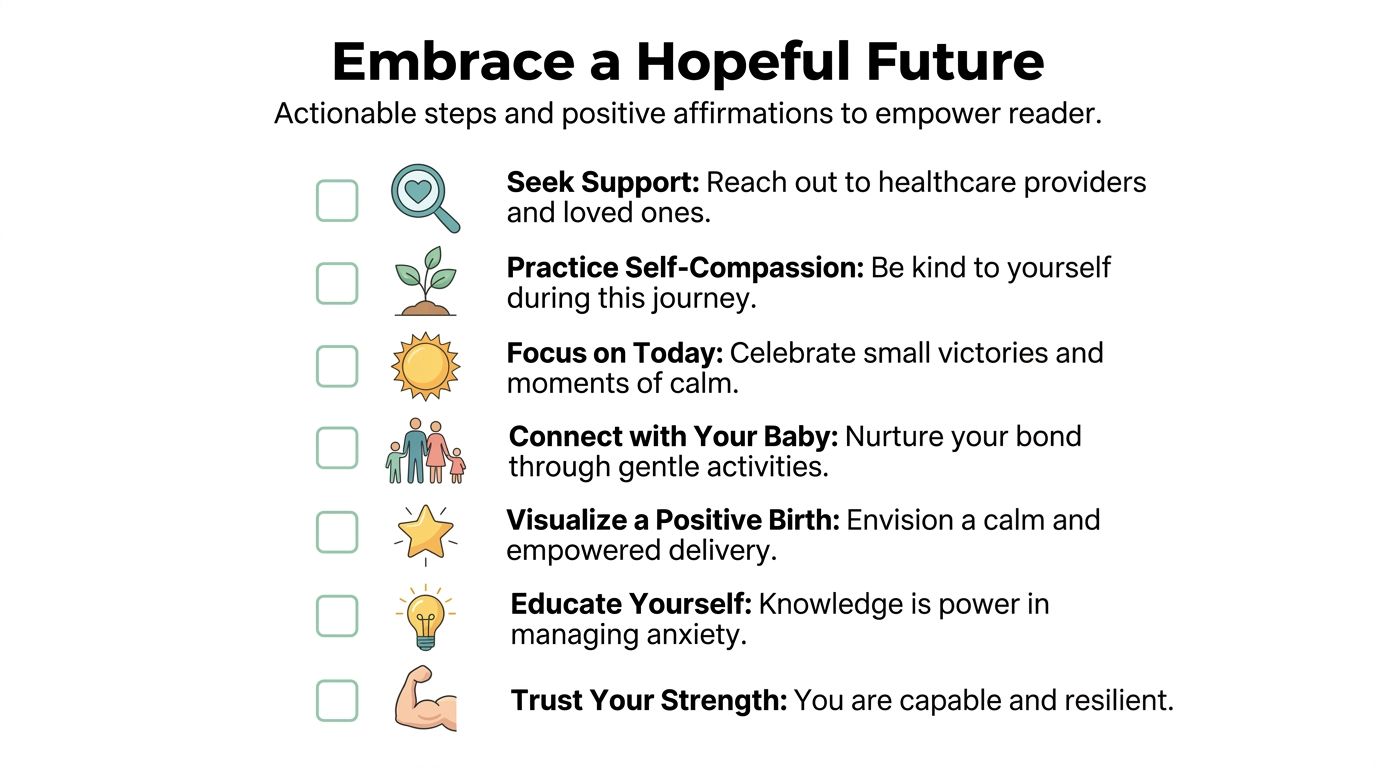
Healing from anxiety during pregnancy doesn't require perfection. It requires support, repetition, and a willingness to stop facing this alone. The most important thing I want you to take from this is simple. There is a way forward, and it does not have to be ruled by panic.
Some people need therapy. Some need therapy and medication. Some need stronger daily structure, fewer reassurance rituals, and a plan for the exact moment their fear spikes. None of those paths mean you are failing. They mean you are responding wisely to what your nervous system needs.
For partners and loved ones
Support works best when it is calm, practical, and non-judging. If you love someone with anxiety during pregnancy:
- Listen first. Don't rush to debate every fear.
- Help with structure. Offer food, water, rest, a walk, or company during appointments.
- Use steady language. “I'm here. Let's take this one step at a time.”
- Encourage treatment. Reassurance helps in the moment, but skilled care changes the pattern.
When to get urgent help
Get urgent medical or emergency support if you are worried about immediate safety, if panic includes thoughts of harming yourself, or if physical symptoms seem outside your usual anxiety pattern and could reflect a pregnancy complication. It is always appropriate to ask for help when you are unsure.
You are not supposed to white-knuckle your way through this. You are allowed to need care. You are allowed to want relief. And you are allowed to believe that calm is possible.
Many people who once felt trapped by constant dread now move through pregnancy and early parenthood with more steadiness, more trust in themselves, and much less fear. That future is available to you too.
If you want practical support between appointments, The Anxiety Checklist offers a simple place to start. Its always-free SOS mode is built for the moments when your mind goes blank and you need immediate grounding, prompts, and reassurance. For longer-term healing, it also includes guided meditations, sleep audios, hypnosis sessions, walking sessions, affirmations, CBT self-therapy tools, and educational resources that can help you build toward a calmer, panic-free life.