
Your Path from Overwhelm to Lasting Calm Starts Here
Does stress feel like a constant storm you can't escape? Do you find yourself bracing for the next wave of anxiety or panic, feeling like you're just surviving instead of living? You are not alone, and you don't have to stay there. Hope is not just a feeling. It's a strategy.
Healing from anxiety and living a panic-free life is possible with the right mix of tools, repeated often enough that your body starts to trust safety again. That matters, because anxiety isn't just “in your head.” It shows up in your breathing, sleep, muscles, thoughts, habits, and the way you interpret normal bodily sensations. Real relief usually comes from working on all of those layers together, not from chasing a single perfect fix.
That's why the best stress relief tools aren't random hacks. They form a system. Some help in the first 60 seconds of panic. Others rebuild your baseline over weeks and months. Some teach your brain to think differently. Others teach your nervous system to stop firing alarms when you're safe.
If you've been trying hard and still feel stuck, that doesn't mean you're broken. It usually means you need a more complete toolkit, plus a plan for using it consistently. Alongside medically-sound mental health changes, the tools below can help you move from emergency coping to lasting calm.
Table of Contents
- 1. Cognitive Behavioral Therapy CBT Self-Therapy Tools
- 2. Guided Meditation and Mindfulness Practices
- 3. Grounding Techniques and Sensory-Based Coping Strategies
- 4. Sleep Optimization and Rest-Based Healing
- 5. Therapeutic Affirmations and Positive Self-Talk Retraining
- 6. Walking Meditation and Movement-Based Therapy
- 7. Expert-Led Education and CBT Masterclasses
- 8. Anxiety-Focused Articles and Educational Resources Library
- 9. SOS Mode Emergency Panic Relief Tools and Guided Breathing
- 10. Progress Tracking and Accountability Systems
- Top 10 Stress-Relief Tools Comparison
- Building Your Personal Toolkit for a Panic-Free Life
1. Cognitive Behavioral Therapy CBT Self-Therapy Tools
If I had to choose one long-term tool for anxiety recovery, CBT would stay near the top. It helps you catch the thought patterns that turn discomfort into danger, then replace them with more accurate, less catastrophic interpretations. That's the difference between “my heart is racing, something is wrong” and “my body is stressed, but I'm safe.”
This isn't wishful thinking. CBT has been clinically proven to help up to 75% of patients with panic disorder achieve a panic-free state after structured treatment, according to clinical outcomes summarized by The Reeds Center. That should give people real hope. Panic can improve, and for many people it improves dramatically.
What self-therapy CBT tools look like
A good CBT routine is practical, not abstract. You might journal an anxious thought after a social interaction, identify the thinking error, then write a more balanced alternative. You might test a belief like “If I feel dizzy in the store, I'll lose control” by entering the store briefly, staying with the sensation, and noticing what happens.
- Thought records: Write the trigger, your automatic thought, the feeling it created, and a more grounded response.
- Belief experiments: Test feared predictions in small, controlled steps.
- Exposure ladders: Rank avoided situations from easier to harder, then work upward gradually.
Practical rule: Start exposure work small enough that you can repeat it. Winning comes from repetition, not heroics.
The trade-off is that CBT asks for honesty and consistency. It won't feel soothing every day. Some sessions will feel frustrating, especially when you face habits that have protected you for years. But it builds the deepest kind of relief, because it changes the pattern that keeps panic alive.
2. Guided Meditation and Mindfulness Practices
Meditation gets recommended so often that many anxious people tune it out. That's understandable. Generic advice like “just meditate” can feel useless when your chest is tight and your thoughts are sprinting. But guided mindfulness done well is one of the best stress relief tools because it teaches you how to stop fighting every sensation.
A 2023 randomized controlled trial with 208 participants found that mindfulness-based stress reduction was statistically noninferior to escitalopram for reducing anxiety symptoms, according to the NCCIH digest on mind and body approaches for stress. That matters. It means structured mindfulness isn't a soft extra. It's a clinically validated option for meaningful anxiety reduction.
How to make it work when you're anxious
A common mistake is starting too big. A ten-minute silent session can feel unbearable if you're already hypervigilant. Start with a three to five minute guided body scan or breathing practice. Let someone else's voice hold the structure until your mind stops treating stillness like a threat.
A useful real-world pattern looks like this: five minutes in the morning before checking your phone, a short breathing meditation in the afternoon when tension builds, and a calming audio before sleep. Over time, that repeated practice changes your relationship to anxious thoughts. You stop treating each one like an emergency.
You don't meditate to force calm. You meditate so anxiety stops being in charge of every decision.
The trade-off is patience. Mindfulness often feels messy before it feels helpful. That doesn't mean it's failing. It usually means you're finally noticing what your nervous system has been doing all along.
3. Grounding Techniques and Sensory-Based Coping Strategies
When panic hits hard, insight alone often isn't enough. You need something immediate and physical. Grounding works because it pulls attention away from the internal alarm and back into the present environment, where your senses can help prove that you're here, now, and safe enough to stay.
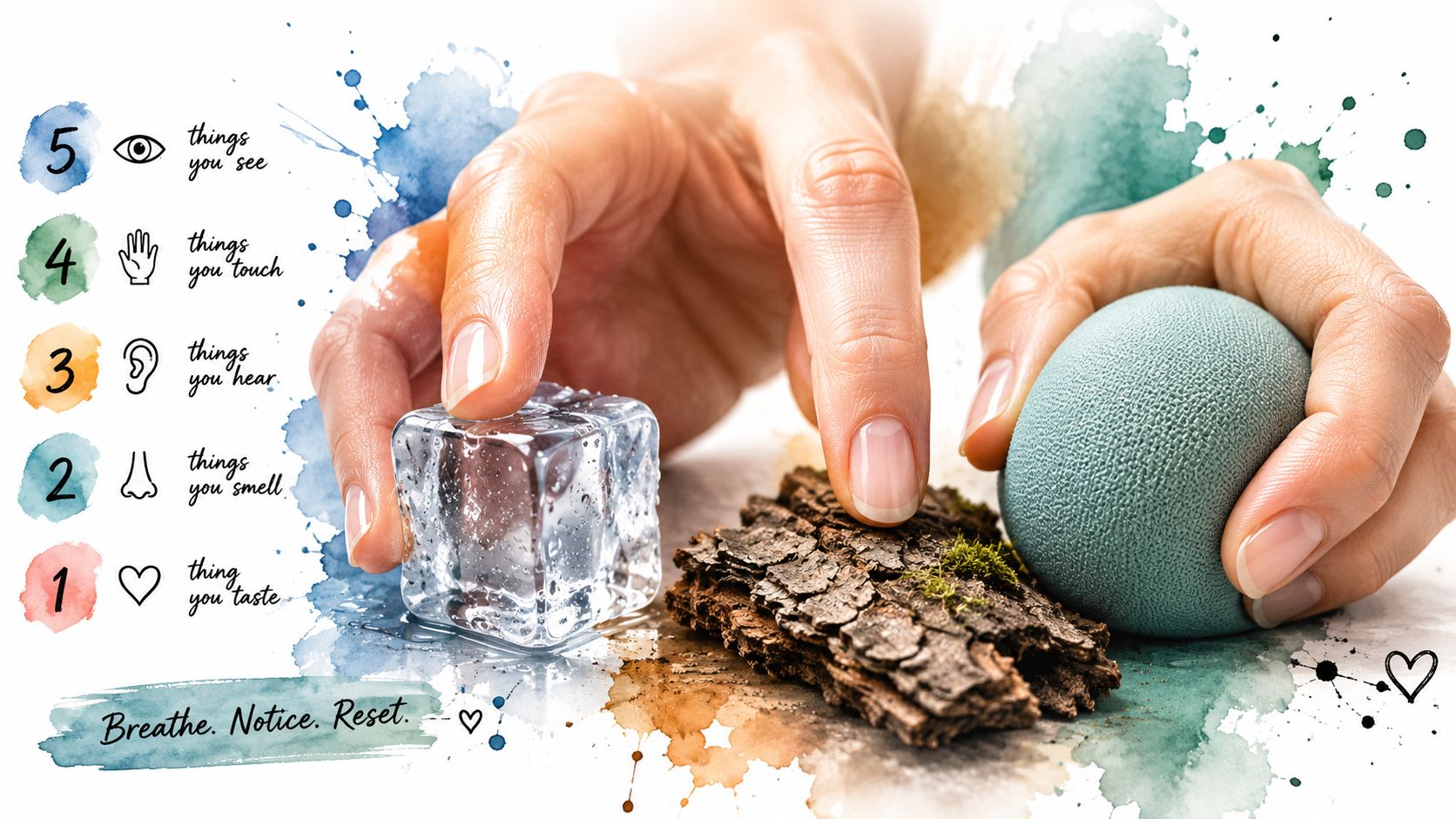
This is one reason sensory tools remain useful even if you're doing deeper therapy. They don't replace long-term healing, but they're excellent bridge tools. In practice, that might mean naming five things you see, four you can touch, three you hear, two you smell, and one you taste while your body rides out the spike.
Here's a visual guide many people find helpful during practice:
Fast tools that work in real life
Grounding is strongest when it's concrete. Hold an ice cube. Press both feet into the floor. Touch the edge of your desk and describe its temperature and texture. If you're in a checkout line and panic rises, look around and name objects by color or shape. That simple task interrupts the inward spiral.
For people with chronic panic, there's an important distinction between comfort toys and physiological tools. Broad “best stress relief tools” lists often mention stress balls and fidget items, but they miss the more active category of biofeedback and vagus-focused regulation. The NeuroLaunch overview of anxiety devices highlights that biofeedback monitors are among the most effective anxiety devices because they give measurable feedback on stress physiology rather than simple distraction.
A short training video can make these methods easier to remember under pressure:
The trade-off is that grounding doesn't always feel dramatic. Sometimes it lowers panic from an eight to a six, not to zero. That still matters. A smaller panic response is easier to tolerate, and tolerating it is how fear loses power.
4. Sleep Optimization and Rest-Based Healing
An anxious brain that isn't sleeping well tends to misread everything. Minor sensations feel bigger. Everyday uncertainty feels riskier. You become more reactive, less flexible, and more likely to panic from a body that's already running on strain.
That's why sleep isn't a side issue. It's a healing tool. If your nights are chaotic, your daytime stress threshold usually drops with them. Many people notice this clearly: one rough night can make the next day feel wired, shaky, and emotionally thin.
Build a sleep system, not a bedtime wish
A workable sleep routine needs cues your body can learn. Use the same wind-down sequence each night. Dim lights. Put your phone away early enough that your brain can settle. If guided sleep audios or hypnosis tracks help, use the same one repeatedly so your nervous system starts associating it with rest.
What works well in practice:
- Consistent timing: Go to bed and wake up on a similar schedule when you can.
- One final calming cue: Make a sleep audio, breathing practice, or muscle relaxation track the last step before sleep.
- Low-stimulation environment: Keep the room cool, dark, and quiet enough that your body gets the message.
The trade-off is that you can't force sleep. Trying too hard often creates more anxiety about not sleeping. A better aim is to create conditions for rest. When the body feels safe enough often enough, sleep usually follows more naturally.
If your anxiety spikes at night, don't evaluate your whole life at 2 a.m. Use your rest tools. Return to breath, sound, muscle release, or a familiar script. Healing often starts with teaching your body that bedtime is not a battleground.
5. Therapeutic Affirmations and Positive Self-Talk Retraining
Many people hear “affirmations” and think of fake positivity. That version usually fails anxious people fast. If you're panicking and tell yourself “I'm perfectly calm,” your brain may reject it immediately. Therapeutic affirmations work differently. They don't deny the moment. They steady it.
A useful affirmation sounds more like: “I feel activated, but I am safe.” Or, “This is a surge of anxiety, not proof of danger.” Those statements are believable. They reduce the extra fear you add when you mistake symptoms for catastrophe.
What good self-talk sounds like
The best self-talk is compassionate, specific, and grounded in evidence from your own life. If you've survived every panic attack you've ever had, that's not empty reassurance. It's data. Use it. Say, “I've been here before, and I know this feeling passes.”
You can also deepen this work with reflective practices like shadow work for anxiety, especially if your stress spikes around shame, perfectionism, or old emotional patterns. For some people, the true shift happens when self-talk becomes less about “calming down” and more about ending the inner attack.
- Use believable statements: “I can handle discomfort” works better than fantasy.
- Speak in the present tense: “I am safe right now” lands more directly.
- Pair words with proof: Recall a recent moment you coped better than you expected.
Speak to yourself the way you would speak to someone you love who is frightened, not someone you're trying to scold into control.
The trade-off is repetition. One affirmation won't undo years of catastrophic self-talk. But repeated often enough, especially during real stress, these phrases become cues of safety instead of slogans you don't believe.
6. Walking Meditation and Movement-Based Therapy
Some anxious people don't relax better by sitting still. They relax better by moving. That's why walking meditation belongs on any serious list of the best stress relief tools. It gives your body an outlet while keeping your attention anchored to the present.
The basic version is simple. Walk at an easy pace and keep returning attention to the sensation of your feet touching the ground, your breathing, and what you can see around you. If your thoughts wander, you don't need to force them away. Just come back to the step you're on.
A better option for restless minds
Walking meditation is especially useful after work, after conflict, or after too much time trapped in your head. A familiar route helps. So does a gentle audio guide. If you walk with a dog, the rhythm and external focus can make the practice even easier to sustain, much like this guide for Denver pet parents describes for movement with pets.
Try one of these patterns:
- Transition walk: Ten to twenty minutes between work and home to discharge mental tension.
- Nature focus walk: Notice trees, light, sound, and temperature instead of replaying worries.
- Body-scan walk: Move attention from jaw to shoulders to hands to feet as you walk.
The trade-off is that movement can become avoidance if you use it only to outrun feelings. Walking meditation works best when you stay gently connected to your body, not when you use motion to disappear from it. Done well, it teaches your nervous system that activation can settle without a fight.
7. Expert-Led Education and CBT Masterclasses
Panic feels less powerful when you understand what it's doing. Education won't always stop a panic attack in the moment, but it often removes the terror around it. That matters, because secondary fear is what keeps the cycle going. The more you misread symptoms, the more trapped you feel by them.
Expert-led teaching helps people name the loop. Sensation. Interpretation. Alarm. More sensation. Once that sequence becomes clear, you stop treating every racing heart or dizzy spell like a mystery that needs solving right now.
Learn from people who can explain the pattern
Structured learning can make a huge difference when anxiety has left you confused and discouraged. A strong free anxiety education hub can give you a place to revisit key ideas when you're calm enough to absorb them. That's when concepts stick.
This area also pairs well with app-based tools. The global digital mental health market is projected to reach USD 42.28 billion by 2035, expanding at a CAGR of 15%, according to Market Research Future's mental health apps outlook. The growth itself doesn't prove quality, but it does reflect how many people now use digital education and guided support as part of mental health care.
Good education has a clear trade-off. Learning can become a form of intellectual hiding if you consume content endlessly without practicing. Watch the lesson, then do the worksheet. Learn the panic cycle, then use the tool that interrupts it. Insight matters most when it changes behavior.
8. Anxiety-Focused Articles and Educational Resources Library
Sometimes the most stabilizing thing you can read is a plain explanation of what your body is doing. Not inspiration. Not hype. Just a grounded answer to “Why does my chest feel like this?” or “Why do I fear being stuck in public places?”
That's where a curated library of anxiety articles helps. The value isn't just information. It's orientation. When your mind starts making wild conclusions, a trusted article can pull you back toward reality and treatment options that make sense.
Keep a small library you can return to
A strong resource library becomes part of your support system. Save a few pieces that answer the questions you ask when anxiety is loud. One on panic physiology. One on intrusive thoughts. One on avoidance. If leaving home or public spaces has become a struggle, material on understanding agoraphobia anxiety can help put language around what's happening without shame.
This matters more than people think. If all your information comes from random forums or late-night searches, you may end up feeding the very fears you're trying to calm. A vetted library gives your brain fewer chances to spiral into misinformation.
One practical rhythm works well: read one article each week when you're relatively calm, then save key ideas in a note on your phone. Over time, that note becomes your own anxiety manual. When panic tells you “No one understands this,” your evidence is already waiting.
9. SOS Mode Emergency Panic Relief Tools and Guided Breathing
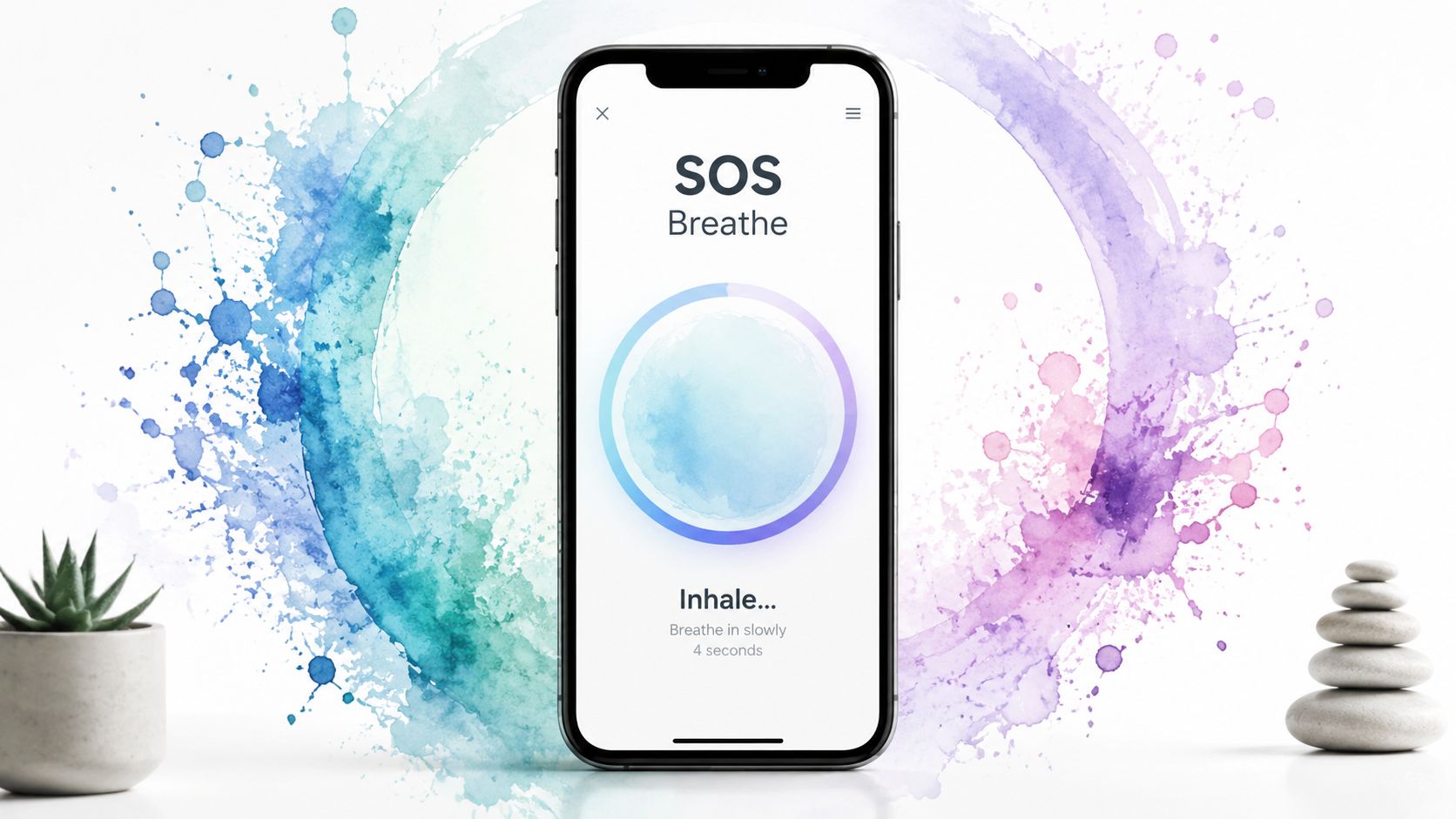
When panic is at full volume, you usually don't need more theory. You need a script. You need prompts simple enough to follow when your mind goes blank. That's why an SOS tool matters. It reduces the effort required to help yourself at the exact moment effort is hardest.
Breathing guidance is often the center of that emergency response. The physiological sigh, which uses two quick inhales through the nose followed by one long exhale through the mouth, can quickly lower heart rate and help interrupt acute panic, as described in Stanford-linked breathing guidance shared in this video reference. The same source notes that box breathing and resonant breathing can activate the parasympathetic nervous system within 60 seconds.
What to use when panic hits at work or in public
Guided tools offer an advantage over memory. At your desk, in a car park, or in a restroom stall, you can follow a short prompt instead of trying to remember the perfect sequence. That's exactly why many people keep panic and anxiety relief tools bookmarked on their phone.
A discreet workplace version can be especially useful. Existing advice often tells stressed people to meditate, stretch, or take a break, but that's not always realistic mid-meeting. The Nivati workplace stress techniques article points to practical in-chair options like left-nostril breathing for 5 to 10 cycles and face muscle scrunching to release tension quickly while seated.
If you already use breathwork during exercise, the mechanics may feel familiar, much like this breathing guide for recreational runners explains in a different context. The benefit during panic is the same. Your breath gives your body a job other than sounding the alarm.
The trade-off is that emergency tools are for interruption, not full recovery. They help you come down enough to function. Then your longer-term practices do the rebuilding.
10. Progress Tracking and Accountability Systems
Anxiety is a bad historian. It forgets your good days, dismisses your progress, and treats every setback like proof that nothing is changing. Tracking counters that bias. It shows you what's really happening, not just what panic says is happening.
You don't need a complicated spreadsheet. A few consistent notes are enough. Track the trigger, the intensity, the tool you used, and what happened next. Over time, patterns emerge. You may notice panic is more likely after poor sleep, less intense when you practice meditation regularly, or easier to recover from when you start grounding early.
What to track without obsessing
Keep it simple enough that you'll keep doing it. A short daily log is more useful than a perfect system you abandon after four days.
- Trigger: Where were you and what happened just before anxiety rose?
- Response: What tool did you use first?
- Outcome: Did the intensity ease, stay the same, or shift later?
- Pattern note: Anything repeating across days or weeks?
Tracking also fits the broader rise of digital support tools. The global stress relief gadget market is projected at $5.4 billion in 2026 and projected to reach $11.2 billion by 2034, growing at a CAGR of 9.6%, according to Global Information's stress relief gadget market forecast. Consumer demand for measurable mental well-being tools is part of why tracking, biofeedback, and guided monitoring are becoming more common.
The trade-off is obvious. Tracking can become compulsive if you use it to control every sensation. Use it to notice trends, not to police yourself. The goal is encouragement and adjustment, not self-surveillance.
Top 10 Stress-Relief Tools Comparison
| Tool / Feature | Core features ✨ | UX / Quality ★ | Value & Price 💰 | Target audience 👥 | Unique selling point 🏆 |
|---|---|---|---|---|---|
| Cognitive Behavioral Therapy (CBT) Self-Therapy Tools | Thought journaling, belief experiments, exposure, worksheets, progress tracking | ★★★★★ Evidence‑backed, structured | 💰 Premium (7‑day free trial); high long‑term ROI | 👥 Motivated self‑learners seeking lasting change | 🏆 Clinically proven CBT framework; builds enduring skills ✨ |
| Guided Meditation & Mindfulness Practices | Audio sessions (3–30+ min), body scan, breath work, progress tracking | ★★★★ Immediate calming; grows with practice | 💰 Free & premium sessions; low cost per use | 👥 Beginners to regular meditators; those needing quick calm | ✨ Short-to-long sessions; neuroscience‑supported calming |
| Grounding Techniques & Sensory Coping | 5‑4‑3‑2‑1, cold water, tactile tools; 2–5 min techniques | ★★★★★ Fast, discreet, immediate relief | 💰 Always‑free; no equipment needed | 👥 People in acute panic needing instant tools | 🏆 Rapid‑response SOS‑friendly techniques for on‑the‑spot calm ✨ |
| Sleep Optimization & Rest‑Based Healing | Sleep hypnosis, sleep meditations, tracking, PMR | ★★★★ Deep restorative benefits with consistency | 💰 Some premium audios; high long‑term value | 👥 Those with sleep‑linked anxiety or poor sleep | ✨ Hypnosis + sleep hygiene to rebuild nervous system |
| Therapeutic Affirmations & Self‑Talk Retraining | Personalized affirmations (audio/written), scenario‑based, tracking | ★★★☆ Cumulative benefits; takes consistent practice | 💰 Free to use; very low cost to implement | 👥 Users wanting daily, simple practice to shift mindset | ✨ Evidence‑based affirmations that validate struggle, not deny it |
| Walking Meditation & Movement‑Based Therapy | Guided walks, nature options, 10–60+ min sessions | ★★★★ Enjoyable, sustainable; physical + mental boost | 💰 Free/accessible; optional premium guides | 👥 People who prefer movement over sitting meditation | ✨ Combines mindfulness with exercise and nature benefits |
| Expert‑Led Education & CBT Masterclasses | Video courses, CBT framework, case studies, structured curriculum | ★★★★★ High credibility; deep learning (time needed) | 💰 Premium courses (may be included in subscription); high educational ROI | 👥 Learners wanting expert knowledge; pre/adjunct to therapy | 🏆 Masterclasses by credentialed experts; clinical depth ✨ |
| Anxiety‑Focused Articles & Resource Library | 65+ vetted articles, search, written by professionals | ★★★★ On‑demand answers; can be dense | 💰 Mostly free; excellent informational value | 👥 Self‑educators, family/friends, clinicians seeking refs | ✨ Comprehensive "Anxiety University", 24/7 vetted education |
| SOS Mode: Emergency Panic Relief & Breathing | One‑tap SOS, guided breathing, grounding, offline, minimal UI | ★★★★★ Instant, simple, designed for blanked thinking | 💰 Always‑free (no login required) | 👥 Anyone in acute panic or high‑anxiety moments | 🏆 Always‑available emergency toolkit with offline use ✨ |
| Progress Tracking & Accountability Systems | Daily logs, trigger mapping, charts, reminders, analytics | ★★★★ Motivational; shows measurable change | 💰 Included in app; high motivational value | 👥 Users who want measurable progress; therapy clients | ✨ Visual progress charts + pattern detection to sustain practice |
Building Your Personal Toolkit for a Panic-Free Life
The people who make the most progress with anxiety usually aren't the ones searching for a miracle tool. They're the ones building a system they can use. That's the hopeful truth here. You do not need to solve everything in one breakthrough moment. You need a set of stress relief tools that support you at different levels of the problem.
CBT helps you challenge fear at the thought level. Mindfulness teaches you to stop treating every sensation like a threat. Grounding and SOS breathing help during acute spikes. Sleep and walking meditation lower your baseline vulnerability. Education gives context. Tracking shows progress your anxious mind might otherwise ignore. Positive self-talk softens the internal pressure that keeps your system activated.
Used together, these tools can create something anxiety often tries to hide from you. Momentum. You start recovering faster. You start fearing symptoms less. You start seeing that a wave of panic is a wave, not a life sentence. That's how a panic-free life becomes believable. Not because fear never appears again, but because it stops running everything.
There's also room for select add-ons when they fit your needs. For example, World Metrics' stress management roundup reports that ashwagandha reduced stress levels by 22% in a 2023 study, and it also notes that structured stress management programs, problem-solving therapy, and mindfulness meditation are among the strongest approaches in digital stress tools. Supplements and apps aren't replacements for core skills, but for some people they can complement the basics.
The same goes for specialized modalities. The NCCIH digest cited earlier also notes a 2022 systematic review and meta-analysis of 19 trials that found positive effects for hypnotherapy in reducing dental anxiety and fear during medical procedures. That doesn't make hypnotherapy the answer for everyone, but it's a reminder that anxiety treatment is broader and more hopeful than many people realize.
If you want one place to practice these tools in daily life, The Anxiety Checklist is one relevant option. It includes an always-free SOS mode, CBT self-therapy tools, guided audios, educational content, and structured support for both immediate panic relief and longer-term habit building. What matters most isn't using every tool at once. It's choosing a few that meet you where you are, then repeating them until calm feels familiar again.
Your healing journey has already begun. If you're reading this, you're not giving up. Keep going. People do get better. Panic does lose its grip. A steadier life is possible.
If you want a simple place to start, The Anxiety Checklist brings together practical panic and anxiety tools in one app, including an always-free SOS mode, CBT exercises, guided audios, affirmations, and educational support you can use at your own pace.