


In short
A CBT anxiety treatment plan usually includes an assessment, a shared formulation of the anxiety cycle, measurable goals, selected cognitive and behavioral methods, between-session practice, progress reviews, and a maintenance plan. The exact plan should be individualized by a qualified clinician; a template can explain the structure, but it cannot diagnose anxiety or prescribe treatment.
Key takeaways
- A clinical CBT plan begins with assessment and formulation, not a standard list of worksheets.
- Goals should describe a measurable change in daily behavior or functioning, not only a wish to feel less anxious.
- Each exercise should address a pattern that appears to maintain anxiety, such as avoidance, reassurance-seeking, catastrophic predictions, or repeated worry.
- Progress reviews should consider symptoms, behavior, functioning, learning, and any worsening or new concerns.
- A self-help framework can organize practice, but it is not a substitute for diagnosis, risk assessment, or individualized treatment.
Table of contents
- What is a CBT anxiety treatment plan?
- What usually goes into a CBT anxiety treatment plan?
- What could an example CBT treatment plan for anxiety look like?
- How do the stages of a CBT anxiety plan usually unfold?
- Which CBT exercises might be assigned?
- How are goals and progress measured?
- When is a self-directed plan not enough?
- What else do people ask about CBT anxiety treatment plans?
- What should you do next?
What is a CBT anxiety treatment plan?
A CBT anxiety treatment plan is a revisable map linking a person's main difficulties and goals to an explanation of what may be keeping anxiety going and the methods chosen to change that pattern. The plan is developed collaboratively and may change when progress, preferences, risks, or new information change the working explanation.
The American Psychological Association's CBT overview describes CBT as collaborative work that can involve changing unhelpful thinking, changing behavior, facing fears, solving problems, and practicing skills between sessions. Not every person needs every method.
Three documents can look similar but have different purposes:
- A clinical treatment plan is based on assessment and an individualized formulation. It records goals, methods, monitoring, risks, and review decisions.
- A session agenda states what will be discussed or practiced during one appointment.
- A self-help practice plan organizes educational exercises but does not provide diagnosis, professional monitoring, or clinical decision-making.
A template becomes useful when it helps a person ask better questions, not when it is treated as a ready-made prescription.
A treatment plan is a working explanation and action map, not a fixed list of anxiety exercises.
What usually goes into a CBT anxiety treatment plan?
Most plans contain similar categories, but the information inside them should differ by person and anxiety problem. A useful plan states what is happening, what may maintain it, what change would matter, how progress will be observed, and when the approach will be reviewed.
Which parts belong in the plan?
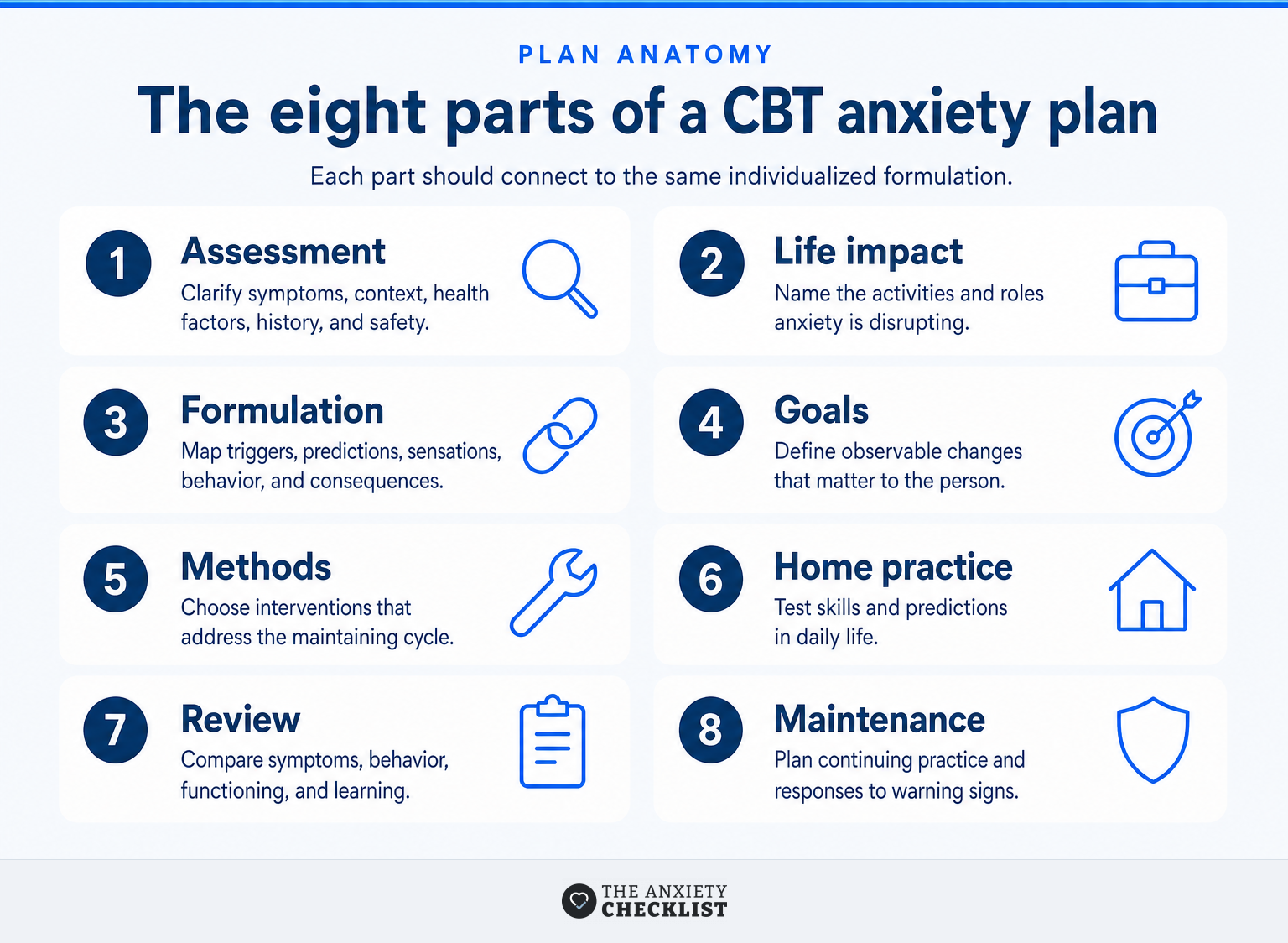
- Assessment and safety: Symptoms, duration, triggers, physical health, medication, substance use, previous treatment, other mental health concerns, and immediate risks.
- Problems and functional impact: Specific ways anxiety affects work, study, relationships, sleep, travel, health care, or ordinary activities.
- CBT formulation: A shared explanation connecting triggers, predictions, emotions, physical sensations, avoidance, safety behaviors, and short-term consequences.
- Goals: Observable changes that matter to the person and can be reviewed within a stated period.
- Selected interventions: Cognitive and behavioral methods chosen because they address the formulation.
- Between-session practice: Small, agreed tasks that allow skills and predictions to be tested in daily life.
- Progress measures and review points: Symptom measures, behavioral records, functioning, goal completion, and planned dates for reconsidering the approach.
- Maintenance planning: Warning signs, helpful responses, continuing practice, and steps to take if symptoms return or worsen.
The Beck Institute's professional case write-up guide separates case conceptualization, broad goals, the problem list, evidence-based interventions, treatment course, progress measures, and outcomes. That structure illustrates why a clinical plan is more than a worksheet schedule.
Medication may appear in a wider care plan, but medication selection, changes, side effects, and withdrawal require an appropriately qualified prescriber. A CBT article or self-help app cannot make those decisions.
Every intervention in the plan should have a stated reason for being there.
What could an example CBT treatment plan for anxiety look like?
An educational example can show the logic of a plan without pretending to prescribe care for a particular person. The template below uses placeholders that a clinician and client would replace after assessment and shared discussion.
How should the template be read?

| Plan field | Educational example wording | Review question |
|---|---|---|
| Problem and impact | Anxiety before [specific situation] leads to [avoidance or safety behavior] and interferes with [life area]. | Is the problem specific enough to observe? |
| Working formulation | [Trigger] leads to [feared prediction], physical anxiety, and [response]. Short-term relief may strengthen future fear. | Does this match what actually happens? |
| Goal | Complete [meaningful action] [frequency] for [time period], while reducing [maintaining behavior]. | Can progress be seen without guessing? |
| Baseline | Record frequency, avoidance, distress, functioning, and an appropriate symptom measure before changing the plan. | What is the starting point? |
| Methods | Choose thought work, behavioral experiments, exposure, problem-solving, worry management, or another suitable method. | Which maintaining process does each method address? |
| Home practice | Complete [small agreed task], record the prediction, and note what happened. | Is the task safe, realistic, and informative? |
| Review and maintenance | Review results on [date] and decide what to continue, adjust, stop, or discuss with another professional. | What evidence would justify changing the plan? |
The placeholders matter. A goal such as reduce anxiety is difficult to review because it does not say where change should occur or what the person wants to do differently.
What makes an example goal measurable?
Illustrative goals might include:
- Attend one planned meeting each week, remain for 30 minutes, and record avoidance and distress for four weeks.
- Ask one question during three of the next four suitable classes or meetings instead of staying silent because of an anxious prediction.
- Complete one agreed step on a fear ladder three times in a week while reducing one identified safety behavior.
- Use a scheduled worry period on five days, then review how often worries were postponed and whether daily tasks became easier to complete.
These are examples of structure, not recommendations for a particular reader. A meaningful goal does not require anxiety to fall to zero; it describes movement toward ordinary life despite anxiety.
A useful example plan shows how the parts connect while leaving personal clinical decisions open.
How do the stages of a CBT anxiety plan usually unfold?
CBT does not always follow a perfectly linear sequence, but treatment commonly moves from understanding the pattern to testing new responses and maintaining gains. A clinician may return to an earlier stage when the original formulation, goal, or method does not fit what is happening.
What are the five working stages?
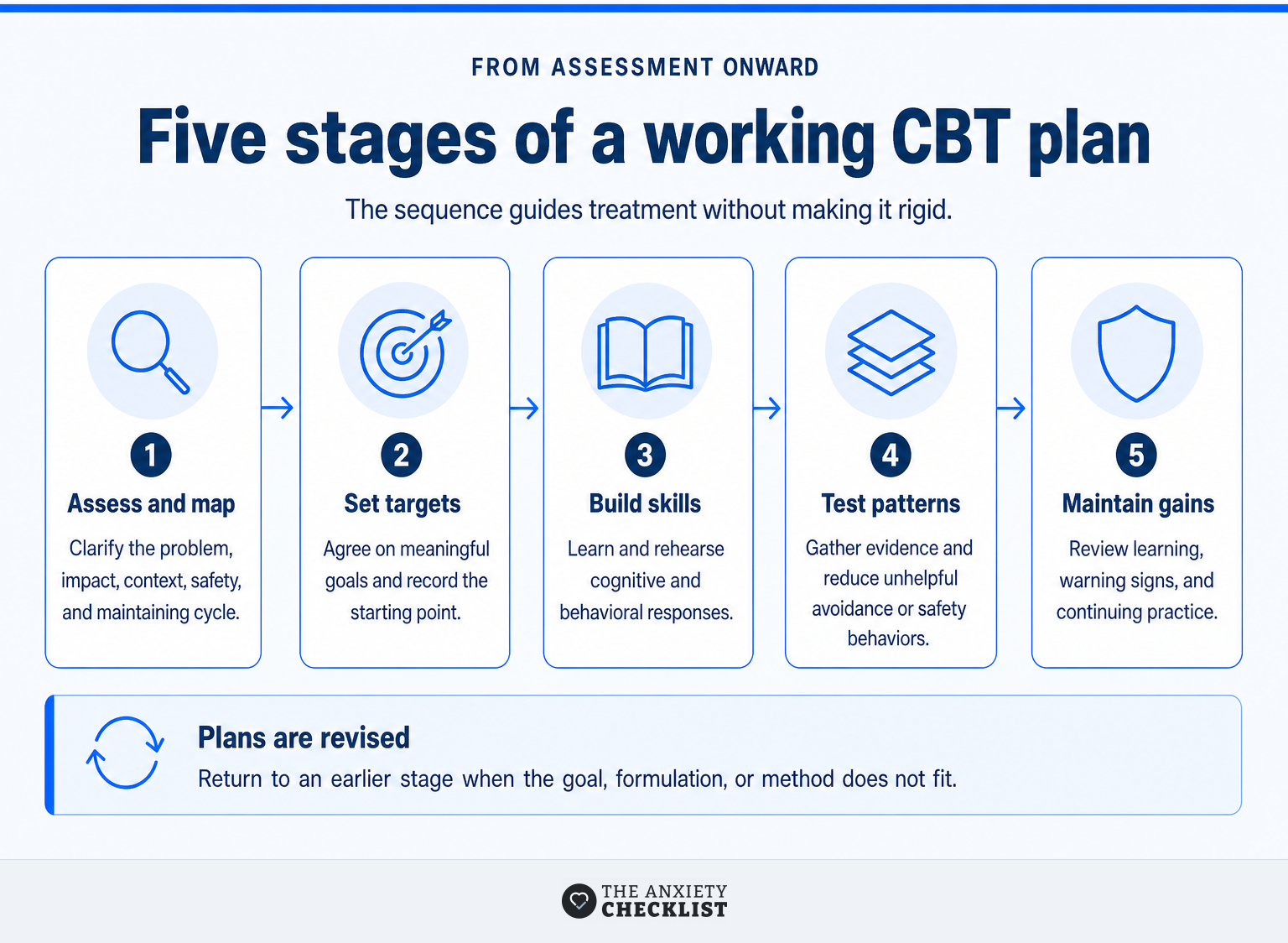
- Assess and formulate: Clarify the anxiety problem, functional impact, risks, context, and maintaining cycle.
- Set goals and baselines: Agree on meaningful targets and record a starting point.
- Learn and rehearse skills: Practice observing thoughts, separating predictions from facts, solving problems, or responding differently to physical anxiety.
- Test predictions and behavior: Use suitable experiments or gradual exposure to gather evidence and reduce unhelpful avoidance.
- Consolidate and maintain: Review learning, plan continued practice, identify warning signs, and decide what to do if progress stalls.
Treatment length is not fixed. As of November 2026, UK NICE guidance for GAD says high-intensity CBT for generalized anxiety disorder usually consists of 12 to 15 weekly one-hour sessions, with fewer or more when clinically appropriate. Other anxiety problems and treatment models may use different schedules.
The World Health Organization's 2023 recommendation recognizes individual, group, face-to-face, digital, guided, and unguided formats for brief structured CBT-based interventions. WHO labels that delivery-format recommendation conditional and the certainty of evidence low, so format should not be treated as interchangeable in every case.
People comparing delivery options can read more about online CBT for anxiety, including the differences between therapy, guided programs, courses, and self-help apps.
The stages provide direction, but the plan should change when the evidence from practice says it should.
Which CBT exercises might be assigned?
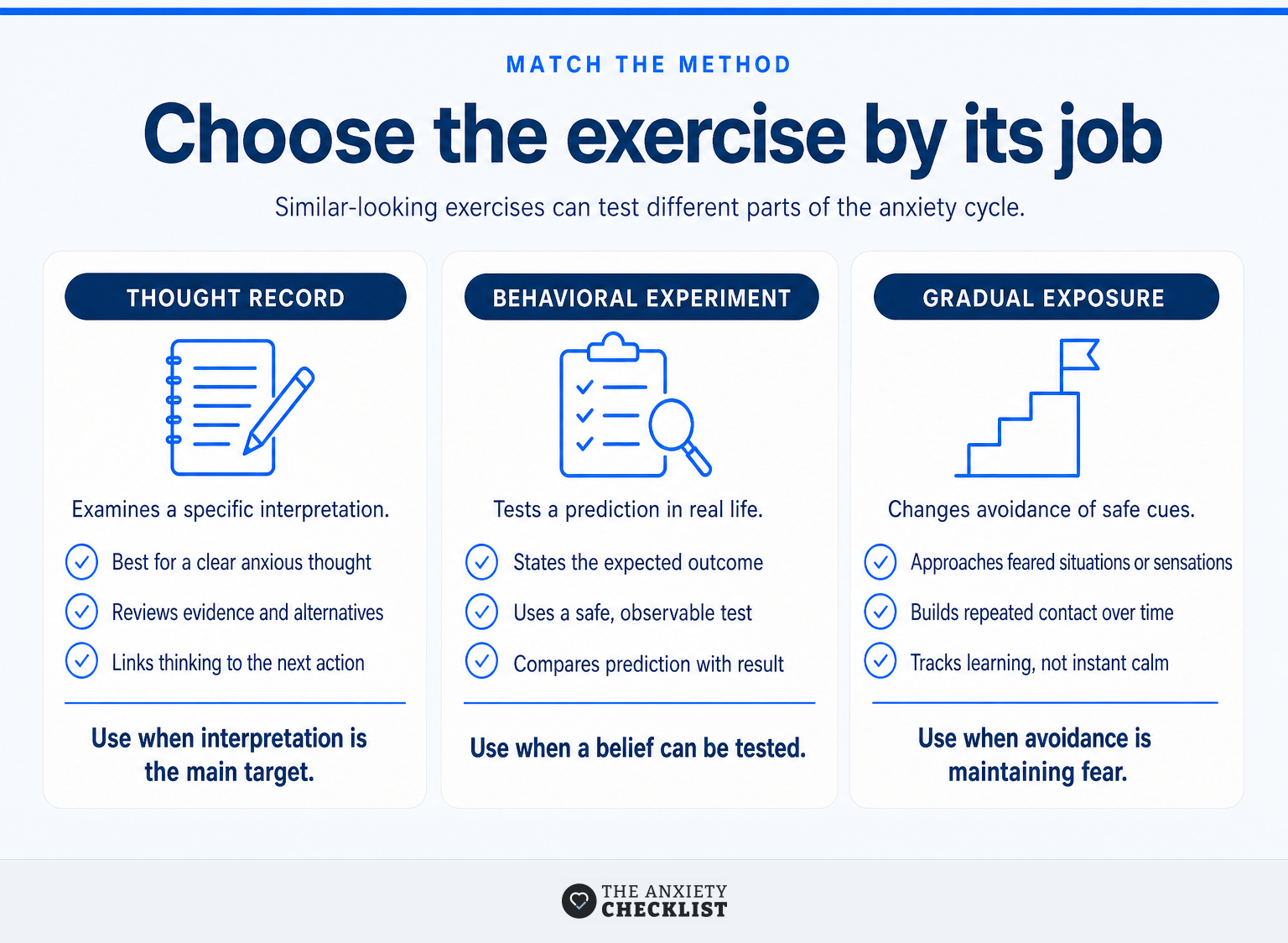
Exercises are selected because they target a maintaining process, not because every person with anxiety needs the same worksheet. Thought records fit some anxious predictions, behavioral experiments test beliefs, exposure addresses avoidance of safe situations, and problem-solving fits present problems that can be acted on.
How do common exercises differ?
When is a thought record useful?
A thought record can help when a specific prediction or interpretation is driving distress or avoidance. The person records the situation, automatic thought, emotions, evidence, and a more balanced conclusion, then observes whether the revised view changes the next action.
What does a behavioral experiment test?
A behavioral experiment turns a belief into a testable prediction. The plan states what the person expects, defines a safe way to test it, records what happened, and identifies what was learned without requiring a perfect or comfortable outcome.
When might gradual exposure be used?
Exposure may be considered when avoidance of objectively safe situations, sensations, memories, or cues is maintaining fear. The NIMH psychotherapy overview describes exposure as supported practice in tolerating distress associated with feared items, ideas, or imagined scenes.
Exposure should be matched to the anxiety problem and should never require enduring abuse, ignoring genuine danger, or treating unexplained medical symptoms as harmless. Complex exposure work may need direct professional guidance.
How are worry and solvable problems treated differently?
A current problem with an available action may suit structured problem-solving. Repetitive hypothetical worry may instead be monitored, postponed to a planned period, or examined for the beliefs and behaviors that keep the worry process active.
Where do relaxation and grounding fit?
Breathing, grounding, and relaxation may help a person stay present or practice another task. The plan should clarify whether a skill supports engagement or has become a safety behavior that the person believes is required to prevent catastrophe.
A broader guide to CBT exercises for anxiety explains thought records, worry postponement, behavioral experiments, exposure, and related practice in more detail.
The right exercise is the one that tests or changes the process identified in the formulation.
How are goals and progress measured?
Progress is measured with more than a single anxiety score. A useful review combines symptom change, behavior, functioning, goal completion, learning, personal feedback, and any signs that the approach is causing distress or failing to address the main problem.
Possible measures include:
- Symptoms: The frequency or intensity of worry, panic, fear, tension, or sleep disruption.
- Behavior: Avoidance, checking, reassurance-seeking, escape, procrastination, or use of safety behaviors.
- Functioning: Participation in work, study, relationships, health care, travel, rest, and valued activities.
- Goal completion: The agreed action completed, partly completed, changed, or not attempted.
- Learning: What predictions were supported, weakened, or left unanswered.
The GAD-7 is a seven-item self-report questionnaire developed to identify probable generalized anxiety disorder and assess anxiety severity. The 2006 GAD-7 validation study supports its reliability and validity, but a questionnaire score is not an individualized diagnosis or a complete account of functioning.
Reviews should ask what improved, what remained stuck, whether the task was completed as planned, and what the results suggest about the formulation. Lack of progress is information: the goal may be too broad, the exercise may target the wrong process, practical barriers may be interfering, or another condition may need assessment.
Readers working specifically with persistent, wide-ranging worry can use the plan structure alongside the fuller guide to CBT for generalized anxiety disorder.
Progress means learning and functioning are changing, not simply that every session produces a lower anxiety rating.
When is a self-directed plan not enough?
A self-directed framework is educational support, not a substitute for assessment when symptoms are severe, confusing, worsening, or linked to safety concerns. Professional input is especially relevant when anxiety overlaps with physical illness, trauma, compulsions, depression, substance use, medication effects, or thoughts of self-harm.
Seek assessment rather than relying on a template alone when:
- Anxiety causes marked disruption to eating, sleeping, working, studying, relationships, or leaving home.
- Symptoms are worsening, changing suddenly, or not improving despite consistent self-help.
- New or severe physical symptoms have not been medically assessed.
- Exercises trigger overwhelming distress, dissociation, dangerous behavior, or a sharp decline in functioning.
- Alcohol, drugs, medication changes, or another health condition may be contributing.
- There are thoughts of self-harm, suicide, harming someone else, or an inability to remain safe.
NIMH states that treatment planning should reflect individual needs and medical circumstances and notes that a health professional can help rule out physical causes for some symptoms. WHO also advises people with anxiety symptoms to seek care and identifies CBT-based psychological interventions as having the strongest evidence across a range of anxiety disorders.
If there is immediate danger or an inability to stay safe, contact local emergency services or a crisis service now. Do not wait to finish a worksheet or online course.
Self-help is most responsible when it includes a clear threshold for getting more support.
What else do people ask about CBT anxiety treatment plans?
People often want to know what belongs in a plan, how long CBT takes, whether they can write their own plan, and whether exposure is always required. The answers depend on the anxiety problem and level of support, but the distinctions below provide a safe starting point.
What does a CBT treatment plan for anxiety include?
A CBT treatment plan for anxiety usually includes an assessment, a shared explanation of the anxiety cycle, measurable goals, selected interventions, between-session practice, progress measures, review points, and a maintenance plan. Clinical plans may also address risk, other conditions, medication coordination, and barriers to taking part in treatment.
How long does CBT for anxiety take?
CBT length varies by the anxiety problem, severity, response, setting, and treatment model. UK NICE guidance says high-intensity CBT for generalized anxiety disorder usually involves 12 to 15 weekly one-hour sessions, with fewer or more when clinically appropriate; that range is not a universal schedule for every anxiety disorder.
Can I make my own CBT treatment plan?
You can use a template to organize goals, triggers, practice, and questions for a professional. A self-written document is not the same as a clinical treatment plan because it cannot provide diagnosis, risk assessment, case formulation, or individualized decisions about exposure, medication, trauma, or complex overlapping conditions.
Does every CBT anxiety plan include exposure?
No. Exposure is often used when avoidance of objectively safe situations is maintaining fear, but the form and pace depend on the problem. Some plans focus more on worry, cognitive reappraisal, problem-solving, behavioral experiments, or other methods, and exposure should never require entering genuinely unsafe situations.
A useful FAQ can explain the structure, but it cannot determine which plan is suitable for an individual reader.
What should you do next?
Start by deciding whether you need clinical treatment planning or an educational structure for self-guided practice. If anxiety causes marked impairment, persists despite self-help, or raises safety concerns, seek an appropriately qualified mental health professional rather than trying to complete a template alone.
For educational practice between moments of professional support, explore the Anxiety Checklist app's self-guided CBT tools. The app provides educational self-help resources and does not replace diagnosis, psychotherapy, medical advice, or emergency care.
Bring one specific problem, one meaningful goal, and one question about measurement to the next planning conversation.
The safest next step is the one that matches the level of support the problem actually requires.