


In short
Online CBT for anxiety can mean licensed video therapy, therapist-supported digital treatment, a structured educational course, or self-guided app tools. The right choice depends on symptom severity, the need for professional assessment, how much feedback helps you follow through, and whether the program has evidence for your age group and anxiety problem.
Key takeaways
- Online CBT is an umbrella term covering clinical treatment, guided programs, education, and self-help tools.
- Therapist-led telehealth and guided internet CBT include human support, while courses and apps may provide no clinical assessment or monitoring.
- A 2023 preliminary meta-analysis found only a small post-treatment advantage for guided over self-guided internet CBT.
- NICE's 2025 guidance warns that evidence for one digital technology or anxiety condition should not be generalized to another.
- Severe, worsening, confusing, or high-risk symptoms need professional assessment rather than reliance on a self-guided tool alone.
Table of contents
- Can you use CBT for anxiety online?
- What does online CBT actually mean?
- How does CBT for anxiety work online?
- Does online CBT work as well as in-person CBT?
- Which online CBT format fits your needs?
- What should you check before signing up?
- When is self-guided online CBT not enough?
- What else do people ask about online CBT?
- What should you do next?
CBT for anxiety online is not one product category. The same phrase can describe weekly psychotherapy over video, lessons completed with periodic clinician feedback, a self-paced course, or an app that helps with thought records and exposure practice. Choosing well starts with identifying which of those experiences is actually being offered.
Can you use CBT for anxiety online?
Yes, CBT for anxiety can be delivered online through live therapy, guided digital programs, structured courses, and self-help tools. Evidence supports internet-delivered CBT for many adult anxiety presentations, but effectiveness depends on the program, population, support level, and completion of the exercises.
The World Health Organization's 2026 anxiety disorders fact sheet states that psychological interventions can be provided online and identifies CBT-based approaches as having the most evidence across a range of anxiety disorders. The WHO includes exposure among the relevant CBT methods.
The WHO's 2023 recommendation on delivery formats says adults with generalized anxiety disorder or panic disorder may consider digital, face-to-face, guided, or unguided formats according to available resources and personal preferences. The recommendation is conditional, and the WHO rates the certainty of evidence as low.
A 2024 updated umbrella review included 39 meta-analyses and concluded that internet-delivered CBT can generally reduce symptoms across a wide range of mental and physical health conditions. The authors also found methodological weaknesses and evidence gaps, so the conclusion should not be stretched to every app carrying a CBT label.
Online delivery is a legitimate route for CBT, but the format and evidence for the exact program still matter.
What does “online CBT” actually mean?
Online CBT can describe four meaningfully different formats: therapist-led telehealth, guided internet CBT, structured education, and self-help tools. The key differences are who assesses the problem, who monitors progress, and whether a qualified professional is responsible for treatment.
How do the four formats differ?
| Format | What happens | Human support | Best fit | Important limit |
|---|---|---|---|---|
| Therapist-led telehealth CBT | Regular video or phone sessions follow an individualized treatment plan. | A licensed or registered clinician provides assessment, treatment, and monitoring. | People needing tailored clinical care, diagnosis clarification, or closer support. | Availability, professional registration, and permitted locations vary. |
| Guided internet CBT | Structured modules are completed independently, with scheduled or asynchronous practitioner feedback. | A therapist or trained practitioner reviews progress and may adjust support. | People who want flexible treatment with accountability and monitoring. | Guidance may be brief and may not include live therapy sessions. |
| Structured CBT course | Lessons, worksheets, and exercises teach CBT concepts in a planned sequence. | Usually none, or nonclinical educational support. | People seeking education and organized self-help practice. | A course is not psychotherapy unless qualified clinical care is explicitly included. |
| CBT app or self-help tool | Journals, reminders, coping exercises, exposure planners, or trackers support regular practice. | Usually none. | People wanting a convenient practice tool or support between therapy sessions. | A collection of CBT-based tools is not automatically a complete CBT protocol. |
The word guided also needs clarification. Guidance could mean feedback from a licensed therapist, support from another trained practitioner, automated reminders, or technical help. Check the provider's description instead of assuming that a guided program includes psychotherapy.
The screen is not the defining feature; clinical responsibility, assessment, feedback, and monitoring distinguish treatment from education or self-help.
How does CBT for anxiety work online?
A useful online CBT program does more than explain anxiety. It helps a person identify a specific anxiety cycle, practice cognitive and behavioral skills, test predictions in daily life, and review what happened.
What does the CBT practice loop look like?
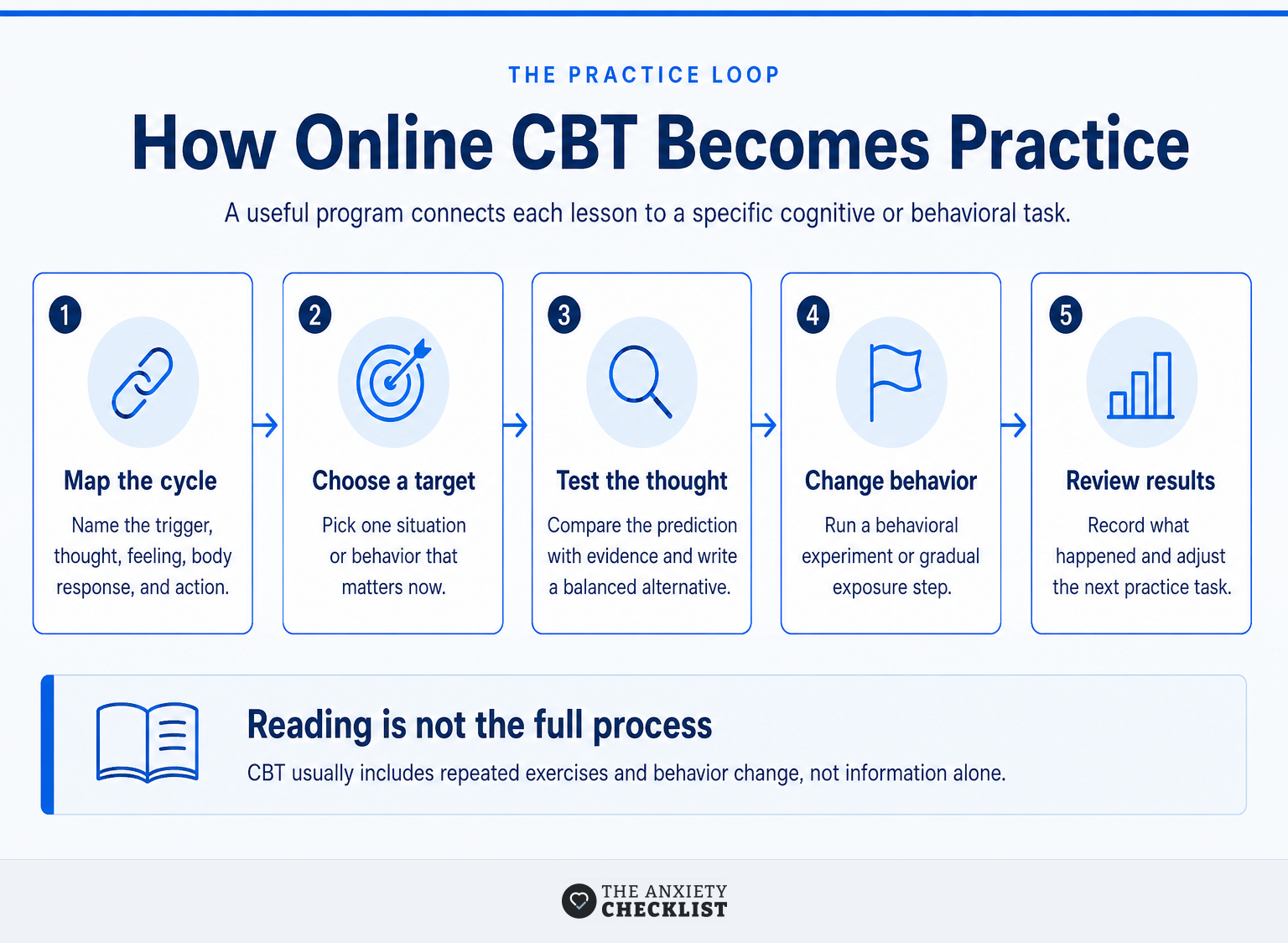
A complete practice loop moves from observation to a real-world test, then uses the result to update the next step. Repeated practice turns an abstract lesson into a skill that can be applied when anxiety appears.
Typical components include:
- Mapping the cycle: Identify the situation, automatic thought, emotion, physical response, and action or avoidance pattern.
- Setting a specific target: Choose one situation or behavior rather than trying to address every anxiety symptom at once.
- Examining predictions: Compare an anxious interpretation with available evidence and develop a more balanced alternative.
- Changing behavior: Use a behavioral experiment, planned activity, or gradual exposure step to test what anxiety predicts.
- Reviewing the result: Record what happened, what was learned, and what the next practice task should be.
The 2015 evidence update on CBT for anxiety disorders describes cognitive therapy and exposure as central evidence-based approaches across several anxiety disorders. NICE's 2025 digital-therapy guidance also describes digital programs containing psychoeducation, monitoring, behavioral experiments, and diagnosis-specific exercises.
The exact exercises should match the problem. Someone dealing with persistent worry can read more about CBT for generalized anxiety disorder, while CBT exercises for anxiety provides more detailed practice instructions than a format comparison can cover.
Useful online CBT connects learning to repeated cognitive and behavioral practice rather than stopping at information.
Does online CBT work as well as in-person CBT?
Therapist-supported internet CBT can produce outcomes similar to face-to-face CBT in some direct-comparison studies, but the evidence does not justify saying every online format is equivalent. Results change with the anxiety condition, program design, support, adherence, study population, and type of analysis.
A 2021 anxiety-specific meta-analysis directly compared therapist-guided internet CBT with face-to-face CBT in eight studies. The pooled post-treatment difference was close to zero, with Hedges' g of 0.01 and a 95% confidence interval from -0.16 to 0.18, but the authors said more research was needed to establish general equivalence.
Newer diagnosis-specific evidence is less straightforward. A 2025 network meta-analysis of CBT formats for GAD included 52 trials and 4,361 participants. Its network model favored individual CBT over remote CBT, although its direct pairwise analysis found no statistically significant difference between those formats. The authors noted heterogeneity, risk-of-bias concerns, and mixed direct and indirect results.
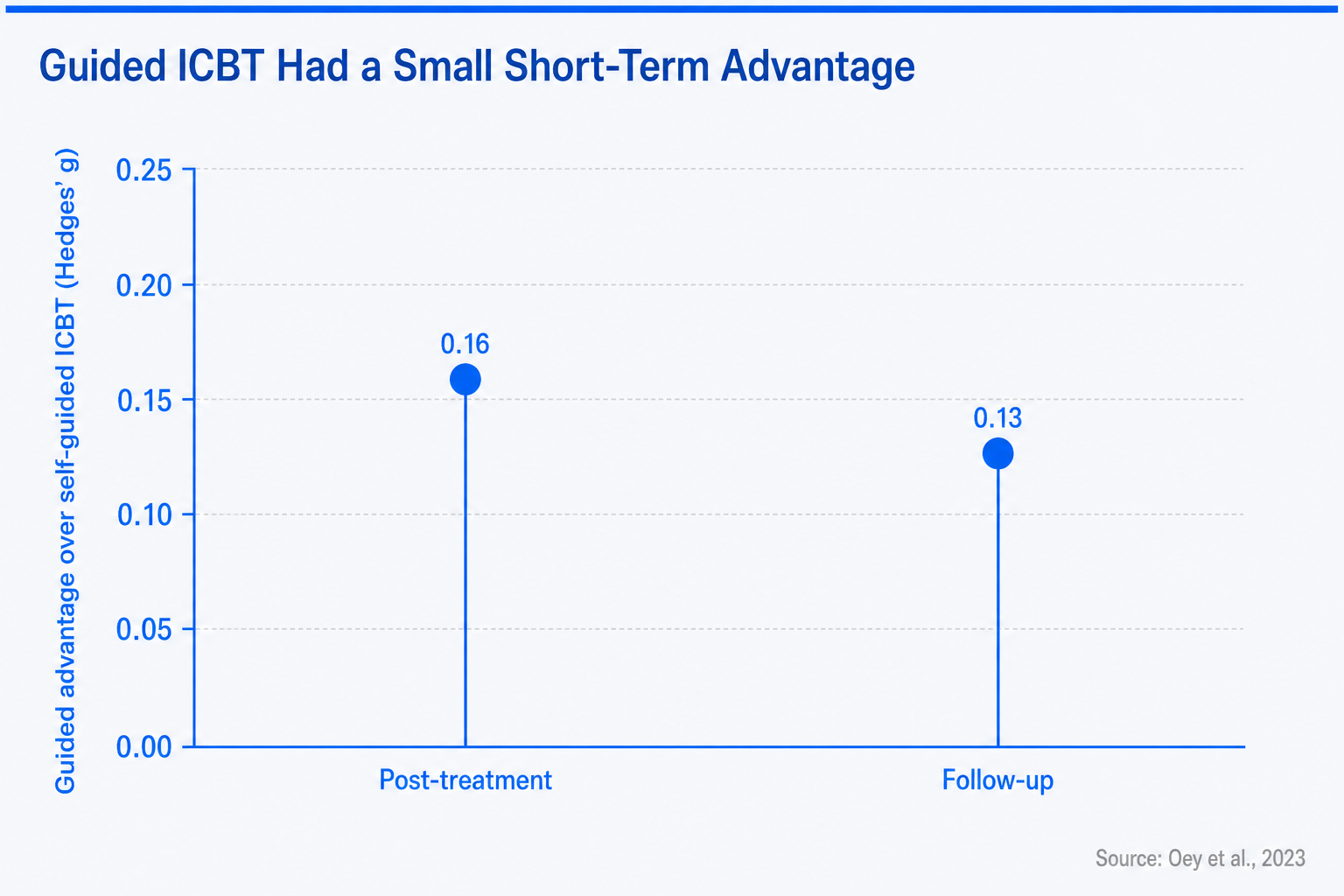
Guidance may offer a smaller distinction. A 2023 preliminary meta-analysis directly compared guided and self-guided internet CBT across 11 studies with 1,414 adults. Guided treatment had a small advantage immediately after treatment, with Hedges' g of 0.16. At follow-up, the difference was 0.13 and was not statistically significant.
How large is the guided advantage?
Longer-term findings are encouraging but still need careful interpretation. A 2024 meta-analysis of 154 randomized trials found sustained benefits for guided internet CBT at follow-ups of at least 12 months. Evidence for some self-guided long-term outcomes was more limited because too few studies reported comparable binary outcomes.
Therapist-supported online CBT can be a credible treatment route, but equivalence must be demonstrated for the population and program rather than assumed from the delivery label.
Which online CBT format fits your needs?
The suitable format is the least intensive option that still provides enough assessment, safety monitoring, personalization, and accountability. Convenience matters, but convenience should not be used to justify a lower level of support than the situation requires.
Consider the following starting points:
- Choose therapist-led online CBT when symptoms are severe, rapidly worsening, difficult to understand, or substantially disrupting work, study, sleep, relationships, or essential activities. Clinical care is also more appropriate when several mental or physical health concerns may be interacting.
- Choose guided internet CBT when a structured program fits the problem but regular feedback would help with motivation, exposure planning, symptom monitoring, or adjustments when an exercise becomes difficult.
- Choose a structured course when the main goal is learning CBT concepts and completing organized self-help exercises without expecting diagnosis or individualized treatment.
- Choose an app or practice tool when the goal is to record thoughts, plan gradual exposure, receive reminders, or practice a skill independently or between therapy sessions.
Age and diagnosis matter. Evidence from adults should not automatically be applied to children or teenagers, and a general worry program may not contain the specialized methods used for panic disorder, social anxiety, obsessive-compulsive disorder, trauma-related problems, or a specific phobia.
Practical access matters too. Audio, captions, screen-reader compatibility, language, reading level, device requirements, and internet access can determine whether a theoretically suitable program is usable in daily life.
Choose by the level and type of support required, not by which option has the most features or the strongest marketing claim.
What should you check before signing up?
Check the clinical scope, evidence, human support, safety process, privacy terms, accessibility, and full cost before starting an online CBT option. A credible provider should make these details understandable without requiring a purchase first.
Which six checks matter most?
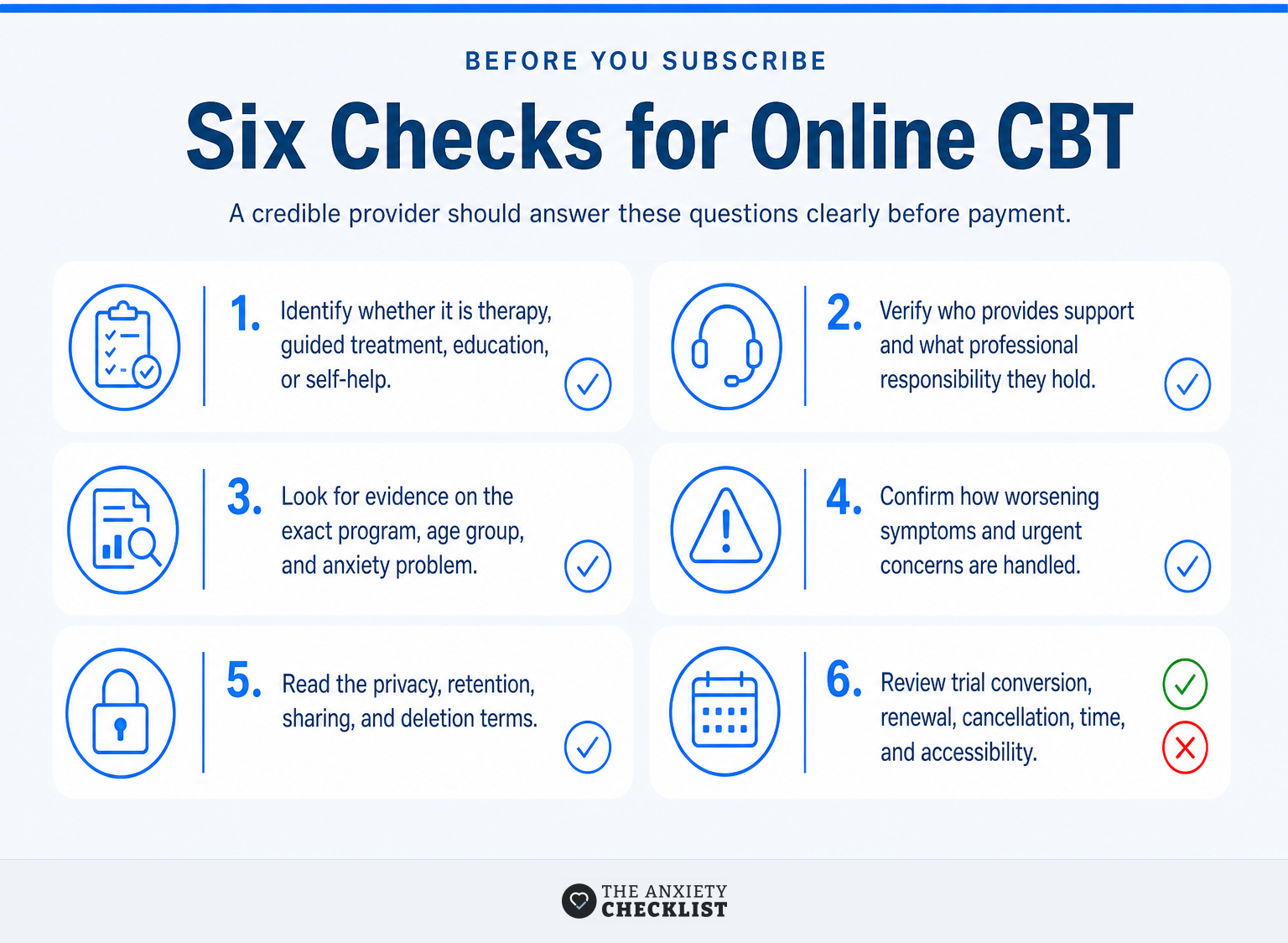
- What is the service actually offering? Look for a clear statement that identifies licensed therapy, guided treatment, education, or self-help. Do not assume that the words program or CBT-based mean psychotherapy.
- Who provides the support? Check the person's professional role, qualifications, regulatory body, location, response schedule, and responsibilities. Automated reminders are not therapist guidance.
- Has the exact program been studied? General evidence for CBT does not validate every course or app. Look for research involving the same program, target condition, age group, support model, and outcome measures.
- What happens if symptoms worsen? A treatment service should explain monitoring and escalation. A self-help provider should state its limits and direct users toward appropriate professional or emergency resources.
- How is personal information handled? Read what data is collected, why it is collected, who can receive it, how long it is retained, and how to request deletion. Check whether journal entries or health information receive different treatment from ordinary account data.
- What is the complete commitment? Review trial conversion, subscription renewal, cancellation steps, refund terms, program length, expected weekly practice, and any additional clinician fees.
NICE's 2025 assessment explicitly states that it is not appropriate to generalize evidence from a specific technology to other digital therapies or conditions. NICE also emphasizes assessment, safety monitoring, progress review, and a way to step up care when symptoms worsen.
A credible option makes its scope, evidence, support, data practices, costs, and limitations clear before asking for commitment.
When is self-guided online CBT not enough?
Self-guided online CBT is not enough when anxiety is severe, worsening, creating significant functional impairment, or accompanied by a risk of harm. Professional assessment is also appropriate when the symptoms are confusing, several conditions may overlap, or repeated self-help attempts have not produced meaningful progress.
NICE's 2025 digital-therapy guidance says people with more severe functional impairment or a greater need for support may require more intensive interventions. A qualified professional can assess the problem, discuss treatment choices, monitor risk, and adapt CBT to the person's circumstances.
Consider professional psychotherapy for anxiety if anxiety repeatedly prevents essential activities, exposure attempts become overwhelming, symptoms keep escalating, or it is unclear whether anxiety is the main problem.
If there is immediate danger or a risk of harming yourself or someone else, contact local emergency services or a crisis service now. An app, online course, article, or delayed message service is not emergency care.
Self-guided CBT is a learning and practice option, not a substitute for professional assessment when risk, severity, or impairment is high.
What else do people ask about online CBT?
The most useful questions focus on effectiveness, the meaning of therapy, app evidence, and program selection. The answers below keep those distinctions explicit so that educational self-help is not mistaken for clinical care.
Can online CBT help with anxiety?
Online CBT can help many adults with anxiety, especially when the program uses structured CBT methods and the person completes the exercises. Benefits cannot be assumed for every app or course. Match the program to the anxiety problem, age group, symptom severity, and level of professional support needed.
Is online CBT the same as seeing a therapist?
Not always. Live video CBT with a licensed or registered therapist is psychotherapy delivered remotely. Guided internet CBT may include periodic practitioner feedback. A course, workbook, or app can teach CBT skills without providing assessment, diagnosis, treatment, monitoring, or a therapist-client relationship.
Are CBT apps effective for anxiety?
A CBT app may be useful for practicing thought records, exposure plans, or coping skills, but the label “CBT-based” does not prove that the exact app has been tested. Check for program-specific evidence, a clear target population, transparent limitations, privacy terms, and a plan for getting professional help if needed.
How do I choose an online CBT program?
Start by identifying the support level you need: therapist-led care, guided digital treatment, a structured course, or a practice tool. Then check whether the program fits your age and anxiety problem, who monitors progress, what evidence exists, how data is handled, and what happens if symptoms worsen.
The best FAQ answer is the same decision rule used throughout the article: identify the service category before judging its claims.
What should you do next?
Choose the lowest-intensity format that still gives you enough support and a clear way to step up care. If symptoms are severe, worsening, confusing, or risky, start with a qualified professional rather than an app or course.
If self-guided practice is appropriate, try the free CBT Thought Journal with one specific anxious thought. The tool guides users through four steps for identifying the thought, spotting a thinking trap, balancing it, and writing a more realistic alternative. It remains educational self-help, not therapy or diagnosis.
Start with the service category, not the marketing label, and choose more support when risk or impairment is higher.