



You know the moment. Your chest tightens in the grocery aisle, your mind starts sprinting at 2 a.m., or you cancel plans again because it feels safer to stay home than risk a panic spike. That isn't weakness, and it isn't proof that this is just how life has to be now. It's a pattern, and cbt self help techniques give you a way to work with that pattern instead of obeying it.
CBT is one of the most studied psychotherapy approaches for anxiety, and a 2013 meta-analysis of 38 randomized controlled trials found a statistically significant overall effect size of Hedges' g = -0.49, a moderate benefit, with similar effects across guided, minimal contact, and self-administered formats (PubMed review). That matters because it means panic-free living isn't a fantasy reserved for other people. It grows out of repeatable skills, practiced in a steady order, until your brain starts trusting new evidence.
Table of Contents
- When Panic Hits and You Feel Hopeless
- The Thought Record That Changes How You Feel
- Graduated Exposure and Why Avoiding Makes Panic Stronger
- Body-Based Skills When Your Mind Goes Blank During Panic
- Matching the Right Technique to What You're Feeling Right Now
- When Self-Help Is Not Enough and Asking for Help Is the Skill
- Your 7-Day Starter Plan for Panic-Free Living
When Panic Hits and You Feel Hopeless
The panic story that feels familiar
You're standing in line and your heart starts hammering. A few seconds later, your mind starts checking every sensation, then checking the checking. That is the moment panic can turn into a loop, especially when fear of the fear itself takes over. phobophobia and panic attack cycle explains why that loop can feel so sticky, and why simple reassurance often fades fast.
A lot of people read those symptoms as proof that something is wrong with them. The more accurate picture is that your brain learned a strong alarm response, then began treating the alarm as danger in its own right. CBT helps by giving you specific ways to work with that pattern, notice it, test it, and choose a different response.
If you want a structured place to start, Cedar Hill Behavioral Health CBT is the kind of resource people often turn to when they want a clear overview of the model. The label matters less than the process. You learn how to spot thoughts, check them against what is happening, and face fear in smaller pieces so your nervous system gets new evidence.
Why this can change
That hopeful claim is not just motivational language. Reviews of CBT self-help have found that guided self-help, minimal contact, and self-administered formats can all help in meaningful ways, and that telephone support can strengthen guided approaches (PubMed review). In plain English, lower-intensity support can still matter when the method is solid.
Practical rule: do not wait to feel ready before practicing. Readiness usually shows up after repeated use, not before it.
One useful way to picture panic is as a smoke alarm that keeps going off after someone burnt toast. The alarm is real, but it is not always telling you the full story. CBT self-help techniques help you respond in sequence, first by catching the thought, then by testing it, then by facing the fear, and finally by using body-based skills so the whole process stays workable.
The Thought Record That Changes How You Feel
Five parts that make it work
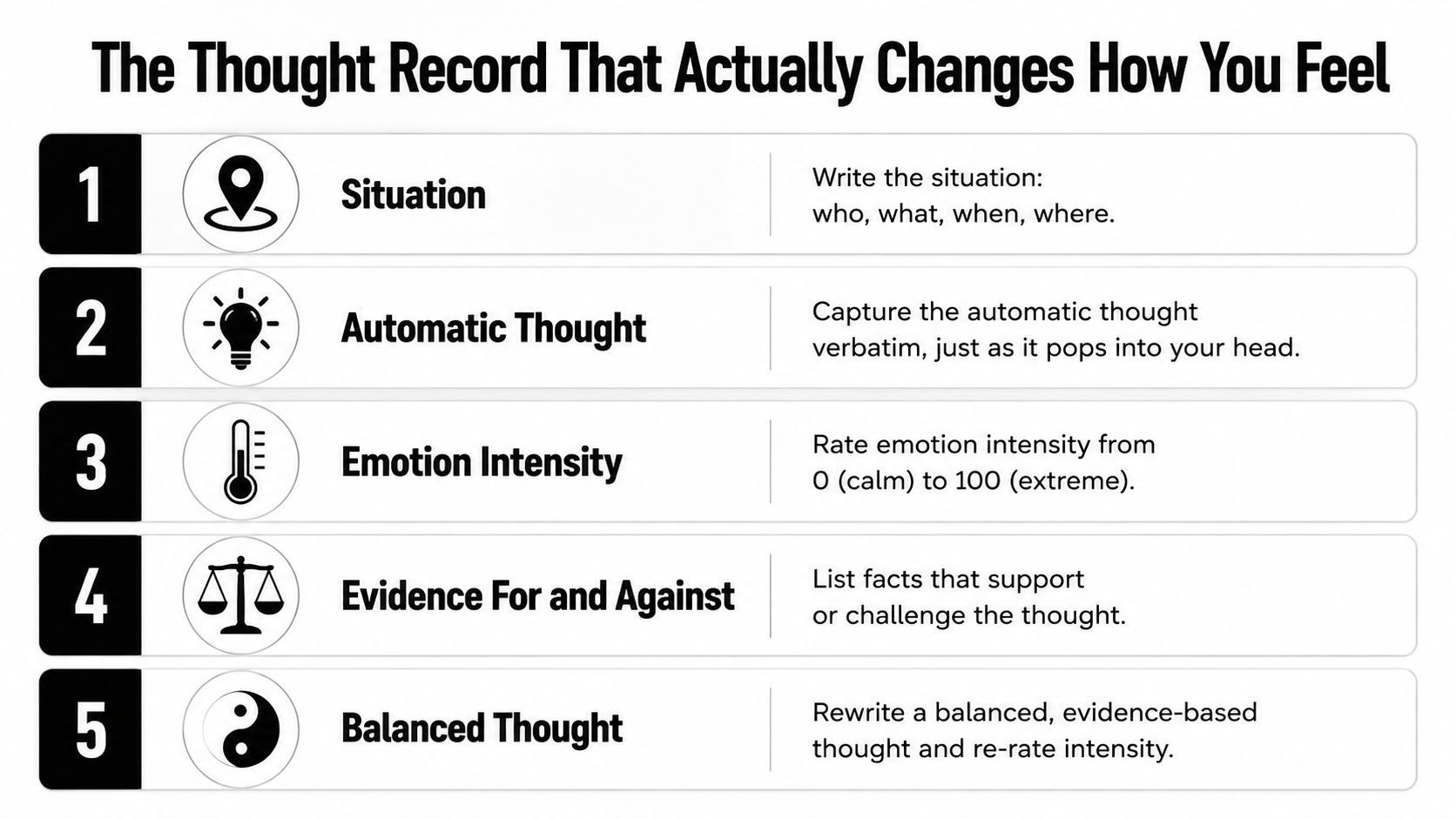
The thought record works because it turns a blur into something you can examine step by step. The structure stays simple on purpose, and it is meant to be brief enough to finish in about 10 to 15 minutes, not turned into a perfect essay (Washington Center for Cognitive Therapy PDF).
Write the situation as facts.
Keep it concrete. “My friend didn't text back after lunch” works. “Nobody cares about me” does not, because that is already a conclusion.Capture the automatic thought verbatim.
Do not polish it. Write the exact sentence that flashed through your mind, even if it sounds harsh or irrational.Rate the emotion intensity from 0 to 100.
This gives you a baseline. Fear at 80 is easier to track than “I felt bad.”List evidence for and against the thought.
This is the hinge of the exercise. The evidence has to be observable, not just a feeling.Write a balanced alternative and re-rate.
You are not pretending everything is fine. You are trying to make the thought more accurate.
A short example and the traps to avoid
A friend does not text back. The automatic thought is, “They're mad at me.” After you list evidence, you might notice they were busy yesterday too, or they usually reply later in the evening. A more balanced thought becomes, “I do not know yet. They may be busy, and I can check in later if needed.”
The common mistake is skipping the evidence-testing step and jumping straight to reassurance. That feels kind, but it weakens the method because it does not test the thought. Another trap is using global labels like always and never, which turn one situation into an identity and make the record too vague to challenge effectively.
A thought record fits naturally with The Anxiety Checklist's belief experiments if you have ever caught yourself trying to soothe anxiety without really checking what you believe. The point is not to argue with yourself. It is to gather enough concrete data that your brain has to update.
Write the event like a camera would record it, then write the thought like a transcript. That is what makes the record useful instead of just comforting.
Graduated Exposure and Why Avoiding Makes Panic Stronger
Build the ladder, then climb it
A phone rings, your chest tightens, and you start planning how to get out of the room. Graduated exposure is the part of CBT that interrupts that pattern. It gives panic a clear, repeatable test instead of letting avoidance decide for you.
You start by building a fear hierarchy, usually on a 0 to 100 distress scale, then choose steps in the 30 to 50 range so the task feels hard but still possible. The idea is to make the first rung manageable, the way you would not begin with the top stair if you were already shaky on the floor below.
A simple elevator ladder might look like this:
- Step 1: Stand near an elevator without entering.
- Step 2: Step inside with the doors open.
- Step 3: Ride one floor with the doors closed.
- Step 4: Ride several floors alone.
- Step 5: Use the elevator during a busy time.
The key benchmark is staying in the situation until anxiety drops by at least 50% from its peak before moving up the hierarchy (HPFT CBT workshop booklet). Your body gets repeated evidence that the alarm can rise, peak, and then settle without escape.
Daily or every-other-day practice matters more than heroic one-off attempts. Short, repeated exposures train learning better than occasional bursts of effort. If the feared task is part of ordinary life, repetition is what teaches the nervous system that the situation can be handled again.
Safety behaviors that quietly keep fear alive
The hardest part for many people is letting go of the crutches that make fear feel manageable. Always bringing a companion, sitting near exits, or keeping an escape route in mind can feel sensible in the moment, but they also block the lesson your brain needs. The brain concludes, “I got through that because of the safety step,” so the fear stays attached to the situation.
Practical rule: if the safety behavior would make you say, “I couldn't have done this without it,” it's probably keeping fear in place.
A common failure is leaving the exposure the moment anxiety spikes. That teaches escape, not learning. Another is making the first step too hard, which can lead to dropout and leave you thinking the method failed when the pacing was the problem.
The core principle is laid out clearly in the anxiety exposure therapy guide. Exposure works through contact, staying in the situation until the alarm loses its power. The goal is not to force bravery. The goal is to stay long enough for new learning to happen.
Body-Based Skills When Your Mind Goes Blank During Panic
Breathing, muscle release, and worry containment
When panic shows up in the body first, trying to talk yourself out of it can feel like arguing with a smoke alarm. That is the moment body-based tools matter most. They lower the background noise enough for thinking skills to come back online, and they work best when they sit beside the rest of the CBT plan.
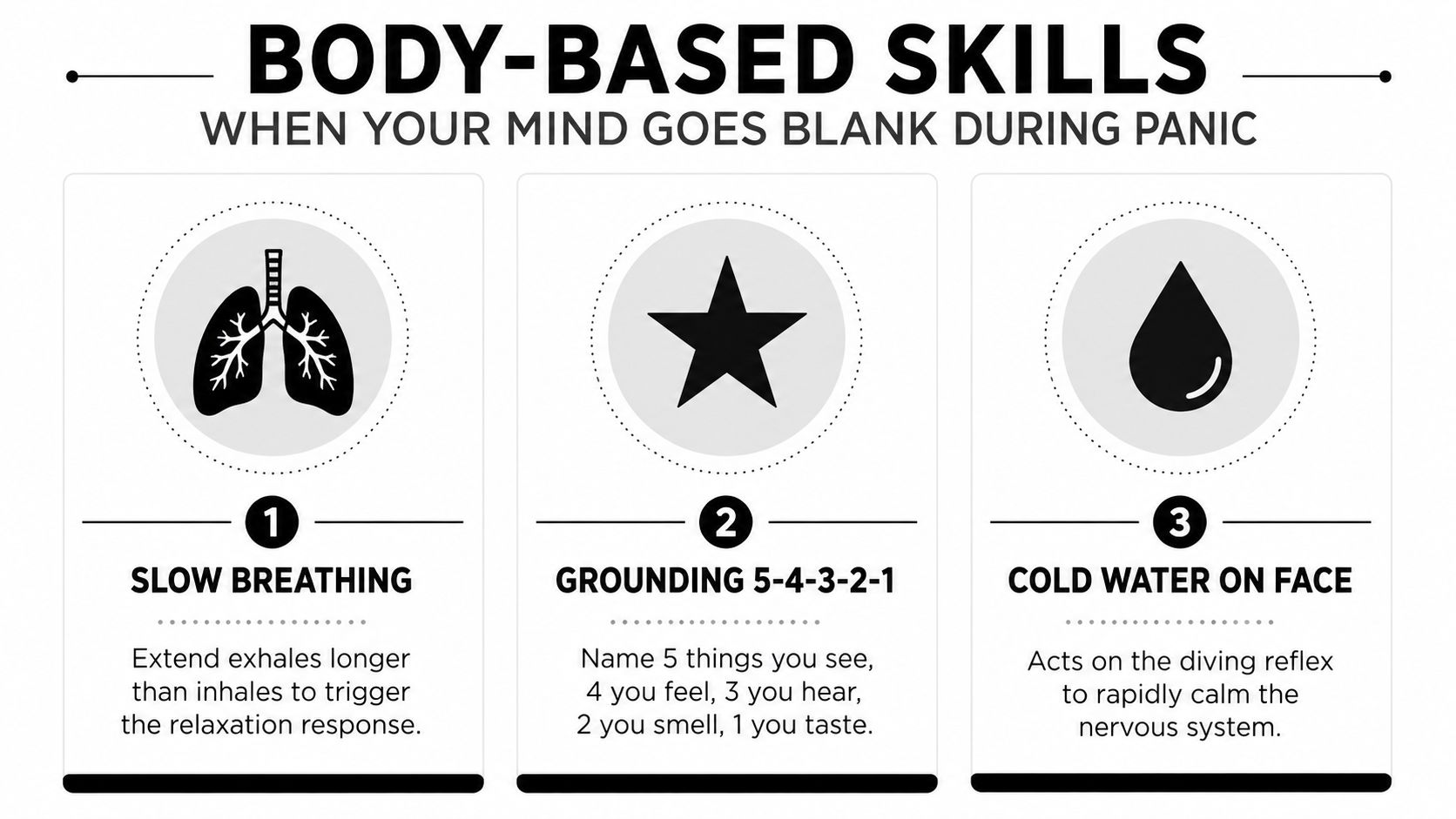
The first tool is breathing retraining, which means slow, exhale-focused breathing. The goal is not to “just breathe,” it is to lengthen the exhale so the body gets a clearer signal to settle. The second is progressive muscle relaxation, where you tense and release muscle groups on purpose to reduce overall strain.
The third is scheduled worry time, which the VA describes as a 15 to 30 minute window in the morning or afternoon for a week, with worries written down and not problem-solved during that time (VA CBT strategies PDF). It gives rumination a container, so it does not spill across the whole day and then follow you into bed.
How to use them during a spike
Suppose you are in a meeting and your heart starts racing. Your mind goes blank, and there is no clean thought to challenge yet. Start with a few slow breaths that lengthen the exhale. Then drop your shoulders, unclench your jaw, and let your hands rest where they are. If the panic keeps climbing, remind yourself that the sensation is a body alarm, not a command.
Short version: calm the body enough to stay present, then use the thought record or exposure plan later when your thinking is clearer.
That order matters. Breath work and relaxation can turn the volume down, but they do not by themselves teach the brain that the situation can be stayed in. That kind of learning usually comes from exposure and repeated practice. Body-based skills lower the pressure so the behavioral work can do its job.
Cold water on the face, paced breathing, or a quick grounding exercise can also help when the body feels flooded. These are the kinds of steps people often need in the moment, when panic makes words hard to reach and logic feels far away. A simple breathing script can be easier to follow than a long explanation, which is why The Anxiety Checklist's breathing guide can be useful as a reference you can return to when symptoms spike.
Matching the Right Technique to What You're Feeling Right Now
CBT self-help techniques at a glance
| Technique | Best Used When | Typical Time | Common Mistake |
|---|---|---|---|
| Thought record | A worry or scary prediction keeps repeating | 10 to 15 minutes | Skipping the evidence step |
| Exposure | Avoidance is shrinking your life | 30 to 60 minutes | Leaving as soon as anxiety spikes |
| Breathing retraining | Your body is revved up and you need a quick downshift | A few minutes | Treating it as the whole treatment |
| Progressive muscle relaxation | Tension is building through your body | 10 to 20 minutes | Rushing through the release phase |
| Scheduled worry time | Rumination keeps spilling into the whole day | 15 to 30 minutes | Doing it at bedtime |
The fastest way to choose is to ask what's dominant right now. Is it a thought loop, a body surge, or an avoidance pattern? Each one needs a different first move.
Three real-time scripts
Racing thoughts at bedtime.
Use scheduled worry time earlier in the day, then write the night worry down instead of debating it in bed. If the thought is sticky, do a brief thought record on paper and stop. Bed is for sleep, not for running an internal trial.
Sudden panic in public.
Start with breathing retraining just long enough to stop the spiral from climbing higher. Then stay in the situation if you can, because leaving too quickly teaches your nervous system that escape was the solution. If this happens often, exposure work belongs in the plan.
A creeping dread day with no clear trigger.
The thought record helps you find the sentence underneath the mood. If the dread is tied to a specific situation you've been avoiding, move toward exposure. If the main problem is endless mental rehearsal, use a worry window so the loop doesn't swallow the whole day.
The right choice is often less about perfection and more about sequence. Calm the body enough to think, check the thought if one is driving the panic, and face the avoided situation when avoidance is the engine.
When Self-Help Is Not Enough and Asking for Help Is the Skill
Self-help CBT works best when it is structured and supported rather than purely standalone, which is why guided formats often outperform unstructured do-it-yourself efforts. If your panic attacks are increasing despite consistent practice, if avoidance is spreading, or if you're dealing with suicidal thoughts, trauma flashbacks, or comorbid depression, it's time to reach out.
That's not failure. That's good CBT judgment. When symptoms are severe or persistent, the next skill is escalation, not stubbornness.
If you're in immediate danger or thinking about harming yourself, contact emergency services right away or go to the nearest emergency department. If you're unsure whether your situation needs professional care, a therapist, primary care clinician, or crisis line can help you sort that out quickly. The point is to keep you safe while the work continues.
Your 7-Day Starter Plan for Panic-Free Living
Use the first week as data collection, not as a pass-fail exam. Track your emotion ratings, sleep, and avoidance count, then notice what changes when you practice instead of react.
- Day 1: Do one thought record on a recent panic thought.
- Day 2: Run a tiny exposure step that feels mildly uncomfortable, not overwhelming.
- Day 3: Practice breathing retraining twice, once in the morning and once later in the day.
- Day 4: Set one worry window and keep worries out of bedtime.
- Day 5: Repeat the exposure step and stay long enough for the intensity to fall.
- Day 6: Review your notes for patterns in thoughts, body symptoms, and avoidance.
- Day 7: Write down what worked, what surprised you, and what you want to repeat.
If you want a place that gathers CBT tools for anxiety relief in one spot, The Anxiety Checklist offers thought journaling, belief experiments, exposure practice, and guided support you can use when your mind goes blank. Take one tool, use it today, and let the next seven days give you real evidence that panic can shrink when you practice the right steps.
If you want a structured companion while you work through panic and anxiety, The Anxiety Checklist brings together CBT tools, SOS support, and practical exercises you can use right away. It's built for the exact moments this article covers, when thoughts race, the body surges, and you need something concrete to do next.