


You open your phone because something feels off again. You missed a deadline you cared about. Your brain won't settle at night. You replay conversations, jump between tabs, forget what you were about to do, and wonder why simple tasks feel weirdly hard. Then the question lands: Do I have anxiety or ADD?
That question makes sense. Anxiety and ADHD can look similar from the outside, and they can feel tangled on the inside. You might be restless, distracted, overwhelmed, irritable, exhausted, or stuck in loops of overthinking. If that sounds familiar, you're not failing. You're trying to make sense of a nervous system that needs a clearer explanation.
Clarity matters because the path forward depends on the reason behind the struggle. For some people, worry is pulling attention away. For others, attention drifts even when they feel calm. For many, both are happening at once. If you've been searching for overthinking symptoms and solutions, you may already sense that your mind is working overtime. The hopeful part is this: once you understand the pattern, you can get support that fits, and healing from anxiety is possible.
Table of Contents
- That Feeling of Being Scattered and Overwhelmed
- The Confusing Overlap of Anxiety and ADD Symptoms
- Unpacking the Core Differences in Motivation and Triggers
- Your Personal Symptom Checklists for Self-Reflection
- How Professionals Determine an Accurate Diagnosis
- Finding Hope and Healing on Different Paths
- Your First Steps to Clarity and Calm Today
That Feeling of Being Scattered and Overwhelmed
Some people describe it as having a browser with too many tabs open. Others say it feels like being chased by their own thoughts. You may look busy all day and still end the day feeling like nothing important got done. That mix of mental noise and frustration is often what sends people searching, “Do I have anxiety or ADD?”
The tricky part is that both conditions can create a life that feels messy and exhausting. Anxiety can fill your mind with what-ifs, self-doubt, and dread about what might go wrong. ADHD can make it hard to direct attention, start tasks, finish tasks, and hold onto details long enough to use them. Either one can leave you feeling behind.
Why this feels so personal
When you can't focus, it's easy to blame your character instead of your symptoms. You might call yourself lazy, dramatic, careless, or disorganized. Those labels usually make things worse because they hide the underlying question: What is driving the problem?
You don't need to figure this out by force. You need patterns, context, and the right kind of help.
Sometimes the problem is fear. Sometimes it's attention regulation. Sometimes anxiety grows on top of ADHD because missed tasks and last-minute stress start to feel dangerous. That's one reason this can feel confusing for so long.
Clarity can change the whole experience
A useful way to think about mental health labels is that they're not judgments. They're frameworks. They help explain why your brain responds the way it does and what kind of support may help you feel calmer, more capable, and less alone.
If panic, dread, or constant tension are part of your story, there is reason for hope. Anxiety can become much more manageable, and many people learn how to live with far less fear and far more steadiness. The first turning point often isn't a treatment technique. It's understanding what you're dealing with.
The Confusing Overlap of Anxiety and ADD Symptoms
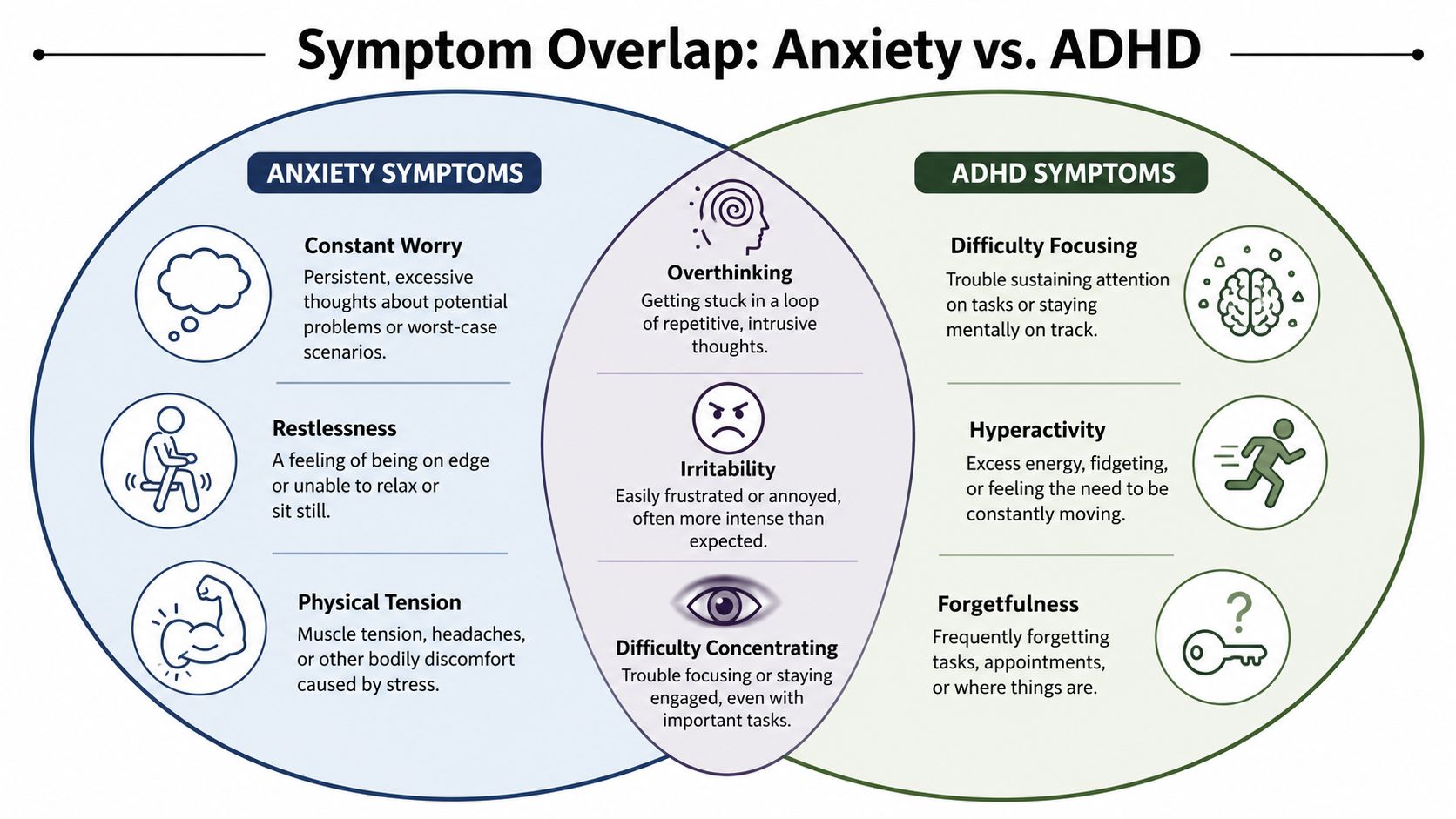
Anxiety and ADHD share enough surface-level symptoms that many people can't tell which one fits. You may notice trouble concentrating, a sense of inner restlessness, racing thoughts, irritability, or poor sleep. On paper, those can sound almost identical. In real life, they often come from different places.
One of the clearest reasons for the confusion is that about 25% to 50% of people with ADHD also have an anxiety disorder, which means the two conditions often show up together rather than separately, according to Neurodivergent Insights on ADHD vs anxiety. That overlap can make one condition hide the other.
The same behavior can have a different engine
Think about someone pacing before starting a task. That pacing could mean, “I'm afraid I'll mess this up.” It could also mean, “My brain cannot settle into a boring task.” Same behavior. Different engine.
Here's a simple side-by-side look:
| Symptom area | Often looks like anxiety | Often looks like ADD ADHD |
|---|---|---|
| Concentration | Attention gets pulled into worry, fear, or what-if thinking | Attention drifts, skips, or won't lock in, even without worry |
| Restlessness | Feels tense, keyed up, braced for something bad | Feels understimulated, fidgety, or unable to stay with one thing |
| Racing thoughts | Thoughts circle around threats, mistakes, or future problems | Thoughts jump quickly between ideas, tasks, or distractions |
| Avoidance | Putting things off because of fear, pressure, or dread | Putting things off because the task feels hard to start or sustain |
| Sleep trouble | Mind stays alert with worry at night | Mind stays active, distracted, or uncontained at night |
Why readers often get stuck
Many adults don't show up with a neat textbook version of either condition. They show up saying, “I can't focus,” “I can't turn my brain off,” or “I feel overwhelmed all the time.” That's why it helps to explore anxiety disorders in context instead of assuming every concentration problem is ADHD.
If you want a plain-language overview that speaks to adult life, work, and everyday functioning, this guide on ADHD information for UK adults can help round out the picture.
Practical rule: Don't ask only, “What symptom do I have?” Ask, “What seems to be causing it?”
That one question often opens the door to better answers.
Unpacking the Core Differences in Motivation and Triggers
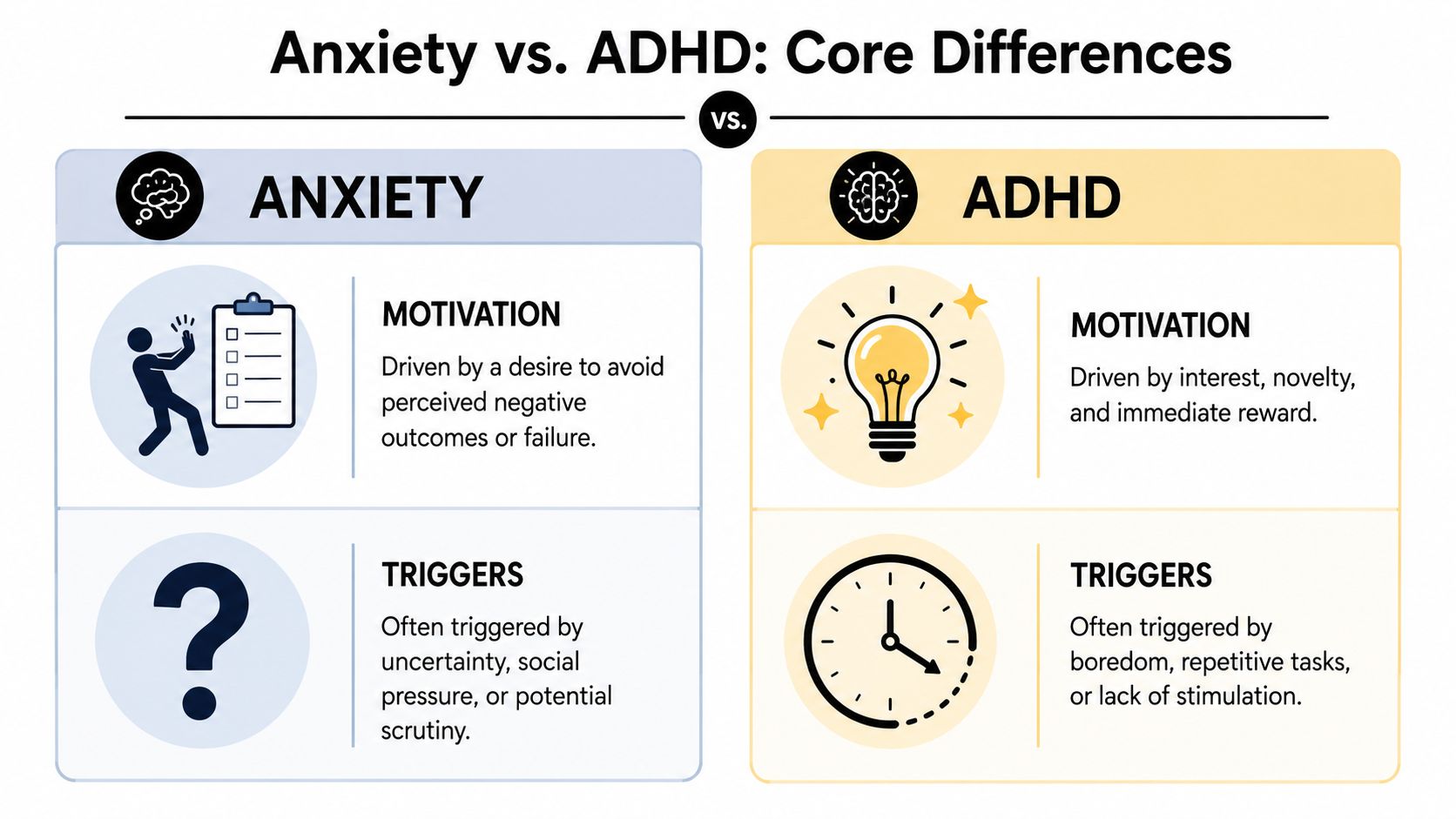
The most helpful distinction isn't the symptom itself. It's the pattern behind it. A clinician-reviewed explanation from ADD.org on ADD vs anxiety notes that ADHD-related inattention tends to be chronic and persists even when a person is calm, while anxiety-related inattention is often state-dependent, worsening when fear or worry is activated.
That means the same “I can't focus” complaint can point in two directions. If your focus improves when you feel safe and settled, anxiety may be a major factor. If your focus still slips even on calm days, ADHD becomes more relevant.
Anxiety vs. ADD ADHD at a glance
| Symptom Area | Primarily Driven by Anxiety | Primarily Driven by ADD (ADHD) |
|---|---|---|
| Focus | Mind gets hijacked by worry, fear, or scanning for problems | Mind wanders, skips, or resists focus even in neutral situations |
| Restlessness | Tension, dread, and physical alertness | Need for stimulation, movement, or novelty |
| Task management | Delay comes from fear of mistakes, judgment, or outcomes | Delay comes from difficulty starting, organizing, or sustaining effort |
| Emotional shifts | Reactions cluster around threat, uncertainty, or pressure | Reactions often follow frustration, interruption, boredom, or overload |
A real-world example helps. Say you have to answer an email.
- Anxiety pattern: You reread it repeatedly because you're scared of sounding foolish.
- ADHD pattern: You mean to answer it, open three other things, forget about it, then remember hours later.
- Both together: You forget it, remember late, panic about the delay, then avoid it because now it feels loaded.
Two gentle reflection lists
Use these as prompts, not proof.
Questions that lean toward anxiety
- When I can't focus, is worry taking up the space?
- Do tasks feel hard mainly when there's pressure, uncertainty, or fear of getting it wrong?
- When I feel reassured or safe, does my concentration improve?
- Do I avoid things because I'm afraid of what might happen?
Questions that lean toward ADHD
- Do I lose focus even during calm moments?
- Do I struggle more with boring, repetitive, or low-interest tasks than urgent or novel ones?
- Do I forget steps, misplace items, or jump between tasks without meaning to?
- Have these patterns shown up across settings, not just during stressful periods?
A lot of people find it helpful to write down answers for a week or two while identifying your anxiety triggers. Patterns are easier to see when you stop trying to solve everything in your head.
A short video can also help you hear the difference in a more conversational way.
Your Personal Symptom Checklists for Self-Reflection
Self-reflection can be useful if you treat it like note-taking, not diagnosis. The goal isn't to stamp yourself with a label. The goal is to gather clues that make a professional conversation more accurate and less overwhelming.
Reflections on anxiety
Read these slowly and notice what feels familiar.
- My mind fills with what-if scenarios.
- I have trouble focusing because I'm mentally scanning for problems.
- I delay tasks because they make me feel nervous, exposed, or judged.
- My body often feels tense, keyed up, or unable to fully relax.
- I replay conversations or decisions long after they're over.
- When the worry settles, my attention usually works better.
If several of those fit, write down when they happen most. Social situations, work pressure, health fears, conflict, uncertainty, and perfectionism can all matter.
Reflections on ADD ADHD
These prompts point toward attention regulation rather than fear.
- My thoughts jump topics even when nothing stressful is happening.
- I know what to do but can't reliably get started.
- I lose track of time, steps, objects, or plans.
- My focus is inconsistent. I may lock in hard on one thing and drift badly on another.
- I interrupt myself, switch tasks quickly, or forget what I intended to do next.
- Calm doesn't automatically fix the problem.
Write examples, not conclusions. “Forgot grocery list and left laundry in washer” is more useful than “I'm a mess.”
What a real evaluation usually asks about
A clinician usually wants more than your current stress level. They may ask about childhood patterns, school or work history, sleep, routines, relationships, substance use, mood, and whether symptoms show up across different settings. They're looking for consistency, timing, and context.
That's why self-check tools work best as preparation. You can bring notes, examples, and questions. If you want structured educational material while you sort through your experiences, anxiety coping guides and tools can help you organize what you're noticing without pushing you into self-diagnosis.
How Professionals Determine an Accurate Diagnosis
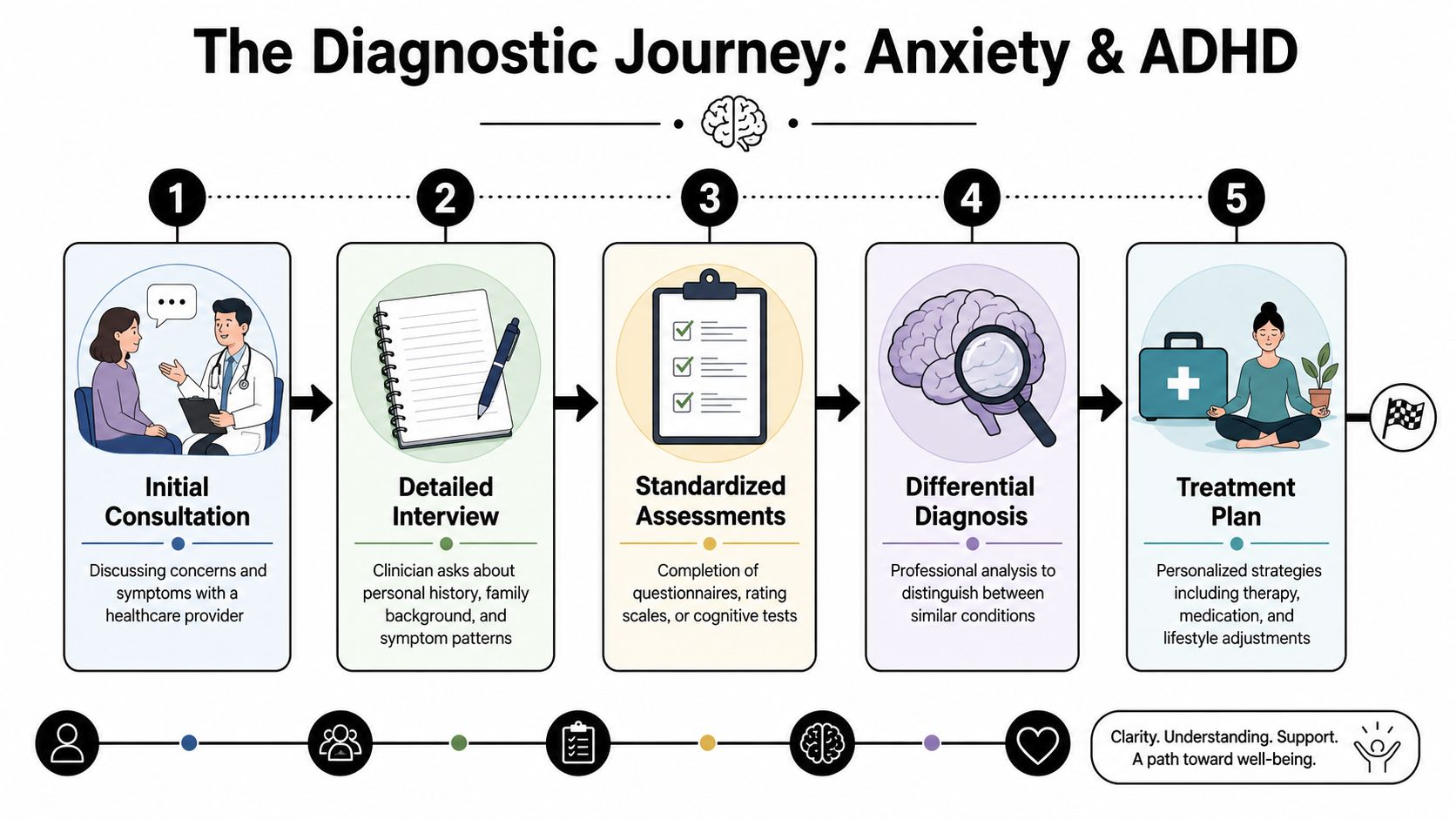
A good evaluation usually feels less like a quiz and more like a careful investigation. The clinician isn't just checking whether you feel distracted or nervous. They're trying to understand the full story of your attention, emotions, behavior, and daily functioning.
A psychiatrist-reviewed guide from Talkiatry on anxiety vs ADHD says that around 50% of adults with ADHD also have an anxiety disorder, and because of that overlap, a positive self-check for either should be treated as provisional until a licensed clinician determines whether symptoms reflect anxiety, ADHD, or both.
What clinicians look for
A strong assessment often includes several pieces working together:
Detailed history
They may ask when symptoms first appeared, whether they existed in childhood, and how they affect work, school, home, and relationships.Pattern questions
They want to know whether attention problems happen all the time or mainly under stress.Rule-outs
Sleep problems, burnout, trauma, depression, medical issues, or substance effects can complicate the picture.Standardized tools
These can support the interview, but they don't replace clinical judgment.
This is one reason getting help can be such a relief. You no longer have to act as your own detective, judge, and treatment planner all at once.
Why the right diagnosis can feel like relief
When people finally get clarity, they often stop moralizing their symptoms. “I'm lazy” becomes “I'm overloaded by worry.” Or “I'm irresponsible” becomes “I've been dealing with attention regulation problems that need real support.”
That shift matters because treatment works better when it matches the problem. If anxiety is central, therapy may focus on worry, panic, avoidance, and nervous system regulation. If ADHD is central, support may focus on structure, executive functioning, routines, and task design. If both are present, care can be coordinated around both.
If taking the next step feels intimidating, start with help finding an anxiety doctor. Reaching out doesn't lock you into anything. It moves you closer to accurate help.
A diagnosis should open doors, not close them.
Finding Hope and Healing on Different Paths
A lot of people reach this point feeling worn out by the question itself. If your mind keeps asking, "Is this anxiety or ADD?" it can start to feel like you have to solve the whole mystery before you deserve support. You do not.

Healing often depends on matching help to the pattern underneath your symptoms. Anxiety care usually focuses on calming a threat system that fires too often or too strongly. ADHD care usually focuses on supporting an attention system that struggles with regulation, follow-through, and task management. When both show up together, the plan often works best when it addresses both at the same time.
That matters because anxiety and ADHD can pull on each other like two tangled cords. Worry can make focus worse. Missed tasks, forgetfulness, and time blindness can create more worry. Once you see that loop, the situation often feels less personal and more workable. You are not failing a simple task. You may be dealing with two issues that amplify each other.
Support can still be practical.
For anxiety, treatment may include cognitive behavioral therapy, exposure work, grounding skills, panic education, relaxation practice, and medication for some people. The goal is to reduce fear, avoidance, and the body's false alarm response.
For ADHD, support may include medication, coaching, visual systems, simpler routines, environmental changes, shorter work blocks, and tools that reduce the number of steps between intention and action. It helps to picture this like building better ramps instead of demanding that your brain climb more stairs.
For both together, care often becomes more compassionate and more realistic. A clinician might help you settle your nervous system while also building external structure for memory, planning, and follow-through. That combined approach can ease shame as well as symptoms.
A few small steps can help while you sort things out:
- Notice the loop: When something goes wrong, ask, "Did fear make this harder to start, or did trouble starting it make me anxious?"
- Reduce pressure on your brain: Use one visible reminder, one calendar, and one place for your to-do list instead of juggling several systems.
- Protect sleep: Rest affects both focus and emotional regulation. If nights are difficult, this guide on improving your sleep quality may help.
- Use structured tools for anxiety symptoms: The Anxiety Checklist includes an always-free SOS mode for in-the-moment grounding, along with thought journaling, guided meditations, sleep audios, and CBT-based exercises.
Hope often starts subtly. It begins when your symptoms start making sense, when you stop blaming your character, and when you get support that fits the way your mind truly works.
Your First Steps to Clarity and Calm Today
If you're still wondering, “Do I have anxiety or ADD?” start with actions that reduce confusion instead of feeding it.
First, keep a simple note on your phone for the next several days. Write down three things when symptoms show up: what was happening, what you were thinking, and whether calm made the problem better. That alone can reveal more than hours of guessing.
Second, practice one short grounding exercise when you feel flooded. Try this: name five things you can see, four you can feel, three you can hear, two you can smell, and one you can taste. It won't solve the whole puzzle, but it can lower the intensity enough to think clearly again.
Third, if you're interested in broader wellness supports alongside professional care, you might also explore natural stress support as one part of a bigger coping plan. Keep expectations realistic and use it as a complement, not a substitute for assessment.
Finally, make the appointment. If symptoms are affecting work, sleep, relationships, or your sense of safety, you deserve more than self-diagnosis. You deserve a real answer and a plan built around your life.
Clarity is possible. Calm is possible. If anxiety has been driving the chaos, healing can happen, and panic doesn't have to run your future.
If you want practical support while you sort out your symptoms, The Anxiety Checklist offers a simple place to start. You can use its free SOS mode for in-the-moment grounding during panic or overwhelm, and explore longer-term tools like CBT exercises, guided meditations, sleep audios, and educational content when you're ready.