

Your chest tightens. Your thoughts start racing. One small sensation turns into a flood of what-ifs, and suddenly you're not just feeling anxious. You're bracing for disaster.
In moments like that, it can seem like emotion has taken the wheel and locked you out. Many people know this feeling well. Panic can arrive fast, and even when it fades, the fear of it coming back can shape your whole day.
There is hope here. Emotional regulation isn't something a lucky few are born with. It's a set of skills you can practice. A good emotion regulation mindfulness exercise helps you notice what's happening inside you, interrupt the spiral, and respond with more steadiness. That matters if your goal isn't just surviving anxiety, but healing from it.
If you're in the middle of trying to make sense of intense symptoms, this guide on Anxiety Checklist for panic can help you put words to what you're experiencing. And if you've been living with the constant fear of the next wave, know this: panic can become less powerful, less frequent, and less central to your life.
Table of Contents
- The Moment an Emotion Takes Over
- How Mindfulness Calms an Anxious Brain
- SOS Exercises for Immediate Emotional Relief
- Daily Practices to Build Lasting Resilience
- Using The Anxiety Checklist App for Guided Support
- Your Path to a Panic-Free Life Is Possible
The Moment an Emotion Takes Over
Anxiety rarely asks permission. It can start with a body sensation, a thought, a memory, or nothing obvious at all. Then your system reacts as if something urgent is happening right now.
That's why people often say things like, “I know I'm safe, but I don't feel safe.” The thinking part of the mind may still be present, but it gets drowned out by alarm, speed, and tension. In those moments, trying to reason your way out often doesn't work very well.
What overwhelm usually feels like
When emotion takes over, several things can happen at once:
- Attention narrows: You lock onto danger signals, body sensations, or worst-case thoughts.
- Your body mobilizes: Breathing changes, muscles tighten, and rest becomes difficult.
- Your mind becomes urgent: Every sensation feels loaded with meaning.
- You start fighting the feeling: You may try to suppress it, outrun it, or check it repeatedly.
None of this means you're failing. It means your nervous system is activated.
Panic feels personal, but the pattern is common. A triggered system doesn't need judgment. It needs guidance.
A useful emotion regulation mindfulness exercise doesn't ask you to become perfectly calm on command. It helps you do something more realistic. It teaches you to pause, notice, and come back to the present without adding another layer of fear.
The hopeful shift
Healing begins not in forcing your emotions away, but in changing your relationship to them.
Mindfulness is often misunderstood as sitting still and emptying your mind. In practice, it's much more concrete than that. It's learning to observe what's happening, name it gently, and return attention to something stable. That might be your breath, the feeling of your feet on the floor, or one simple task in front of you.
For people with anxiety, that shift is powerful. You stop treating every surge of emotion as proof that you're in danger. Over time, you start teaching your brain and body that intense feelings can rise and fall without taking you over.
That's how a panic-free life starts to become believable. Not because you never feel fear again, but because fear stops running the show.
How Mindfulness Calms an Anxious Brain
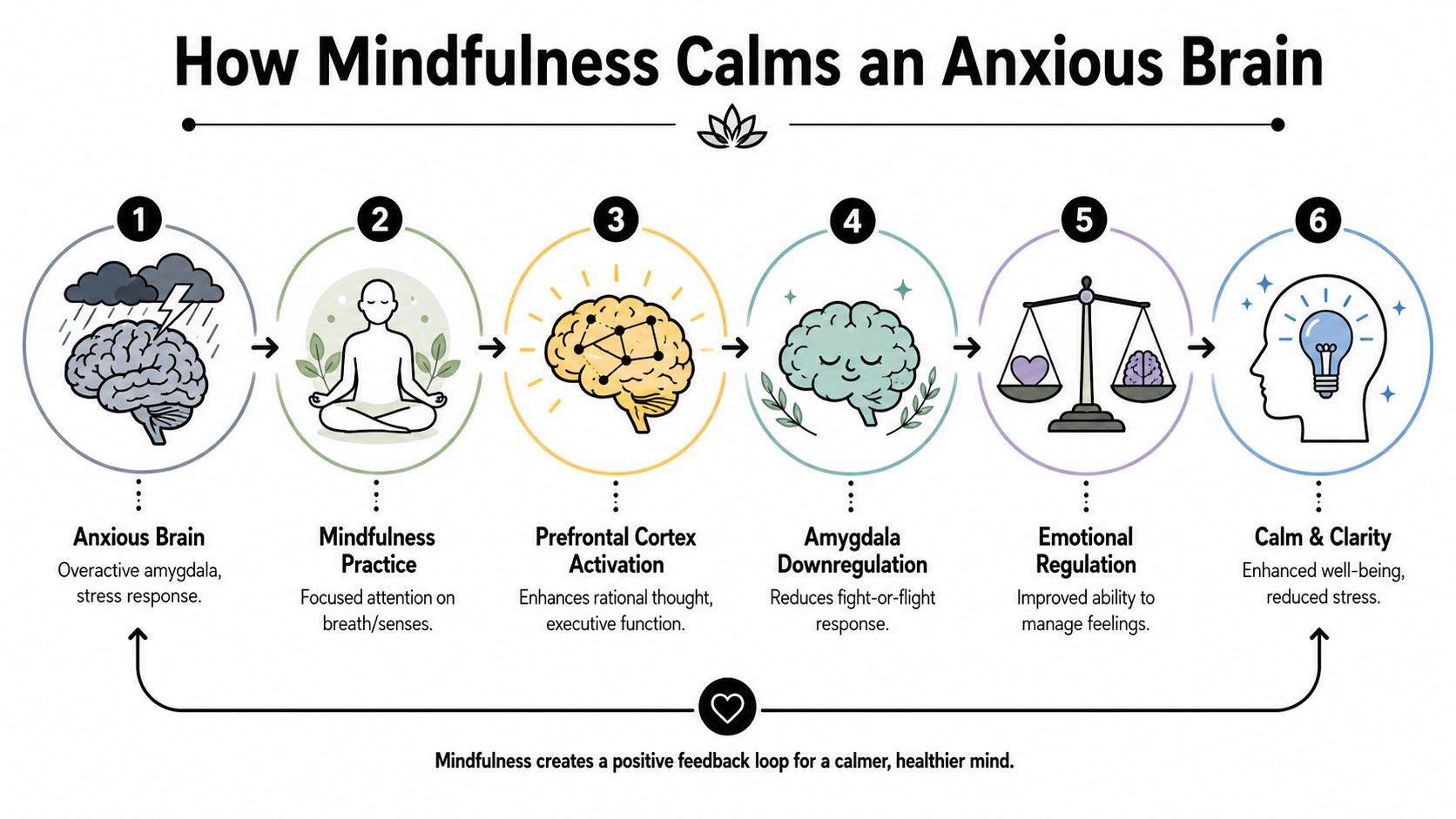
Mindfulness helps because it gives the mind a job that competes with spiraling. Instead of chasing every anxious thought, you place attention in the present moment and practice returning when it wanders.
That sounds simple. It isn't always easy. But it is trainable.
A 2010 meta-analysis of 39 trials with nearly 3,000 participants found that mindfulness meditation programs lead to moderate improvements in anxiety and depression, and the same review describes mechanisms such as present-moment attention, acceptance, and self-compassion as measurable parts of emotional regulation (mindfulness review and meta-analysis).
What mindfulness is actually training
A practical way to understand mindfulness is this. It acts like a pause button between feeling and reaction.
When anxiety spikes, your mind tends to fuse with the alarm. Mindfulness creates a little space. In that space, you can notice, “My heart is pounding. My thoughts are racing. I feel scared.” That isn't denial. It's orientation.
Several skills are being trained at once:
- Present-centered attention: Bringing awareness back to what is happening now.
- Acceptance: Letting a sensation exist without immediately trying to crush it.
- Reduced rumination: Spending less time feeding loops of worry.
- Self-compassion: Responding to distress with steadiness instead of self-attack.
If meditation has ever felt frustrating, that's common. Many people need support learning the difference between helpful practice and accidentally turning meditation into more struggle. This guide on calming anxiety during meditation can help clarify that.
Why this matters for anxiety recovery
Short-term calm matters, but long-term retraining matters even more. Each time you notice panic rising and return to a grounded focus, you're rehearsing a new response.
Practical rule: Don't measure mindfulness by whether you felt peaceful the whole time. Measure it by whether you noticed you drifted and came back.
That's one reason structured programs can help. If you want to see how mindfulness is used in a more organized recovery setting, Reflections' mindfulness initiatives offer a useful example of how these practices can fit into broader emotional healing.
Mindfulness won't erase every anxious thought. What it can do is reduce the authority those thoughts have over you.
SOS Exercises for Immediate Emotional Relief
When panic is building, you don't need a long explanation. You need a short sequence you can remember while your mind is loud.
These SOS practices are for exactly that. They aren't meant to solve every layer of anxiety in one sitting. They're designed to reduce escalation and help you regain enough steadiness to make your next decision well.

The good news is that short practices count. The Mayo Clinic notes that research shows even one minute of focused breathing can lower stress, and 10 minutes of mindfulness can make a positive difference (Mayo Clinic mindfulness exercises).
Three-breath pause
Use this when you feel the first wave of panic, dread, or emotional flooding.
Timing: About 30 seconds to 1 minute.
- Pause where you are. If closing your eyes feels unsafe, keep them open and soften your gaze.
- Take one natural breath. Notice the inhale. Notice the exhale.
- Take a second breath and label gently. “Anxiety is here.” Or, “My body is activated.”
- Take a third breath and ground. Feel your feet, chair, or hands.
Try this script:
“I don't need to fix this in one moment. I'm breathing. I'm here. This feeling can move through.”
This works best when you don't force giant breaths. Many anxious people accidentally over-breathe and feel worse. If that happens, smaller, softer breathing is usually more helpful. If you want more options, these breathing exercises for anxiety can give you a few simple patterns to test.
Five-senses grounding
Use this when your thoughts are spiraling and you need help reconnecting with the room around you.
Timing: 1 to 2 minutes.
Look around and name:
- Five things you can see
- Four things you can feel
- Three things you can hear
- Two things you can smell
- One thing you can taste
Don't rush. The point isn't performance. The point is shifting attention from internal alarm to external reality.
A good prompt is:
“My mind is predicting danger. Right now I'm checking what is here.”
This technique is especially useful in public spaces because it's invisible. No one has to know you're doing it.
One-mindfully reset
This one is borrowed from DBT-style mindfulness. It works well when panic makes you frantic, scattered, or tempted to do five things at once.
Choose one object of attention:
- the breath
- the feeling of your hands under running water
- the sensation of walking
- one everyday task, like drinking a glass of water
Then stay with that one thing for a brief stretch. When the mind jumps, return. When it jumps again, return again.
Below is a short guided option if you want a voice to follow in the moment.
If you're highly activated, open-eyed mindfulness is often easier than closed-eyed mindfulness.
What doesn't work well in SOS moments? Overanalyzing, judging yourself for being anxious, or expecting mindfulness to act like an off switch. These exercises are better thought of as stabilizers. They lower reactivity enough for you to stay present and ride the wave more safely.
Daily Practices to Build Lasting Resilience
A daily practice matters most on the days you do not urgently need it.
That is the difference between SOS skills and resilience-building skills. SOS exercises help you get through a spike. Daily practices train your attention and nervous system so spikes happen less often, pass faster, and feel less controlling. Many people give mindfulness one try in the middle of overwhelm and assume it failed. In practice, the benefit comes from repetition during ordinary life.
UCSF's mindfulness manual describes the core move clearly. You return attention to one point of focus “again and again and again,” and the returning is the training itself (UCSF mindfulness skills manual).
SOS exercises vs. daily practices at a glance
| Technique Type | Primary Goal | When to Use | Typical Duration |
|---|---|---|---|
| SOS exercises | Reduce escalation and regain orientation | During panic, overwhelm, sudden anxiety | 30 seconds to 2 minutes |
| Daily practices | Build attentional control and emotional steadiness | On calm days and mildly stressful days | A few minutes to about 10 minutes |
Ten-minute body scan
The body scan is one of the most reliable daily exercises for anxiety because it changes your relationship to sensation. Instead of treating every flutter, tight spot, or temperature shift as a warning sign, you practice noticing sensation with less alarm.
Sit or lie down in a position you can maintain without strain. Start at the feet and move attention upward at an unhurried pace. Notice pressure, warmth, tingling, heaviness, tightness, or restlessness. The task is not to force relaxation. The task is to stay in contact with what is present.
When the mind starts interpreting, return to simple labels. “Tight chest.” “Warm face.” “Buzzing stomach.” That naming style helps many anxious people stay grounded in observation rather than getting pulled into a debate about what the sensation means.
A simple sequence works well:
- Feet and legs: Notice contact with the floor, bed, or chair.
- Torso: Follow the movement of breathing without trying to change it.
- Shoulders and jaw: Check for bracing, clenching, or holding.
- Face and scalp: End with a wider sense of the whole body.
Some days a body scan feels settling. Some days it makes you more aware of discomfort. That does not mean you are doing it wrong. It means you are seeing your internal state more clearly, which is part of the training.
Mindful daily task practice
Formal meditation is useful, but it is not the only way to build resilience. Repeated daily tasks are often easier to stick with, especially for people who feel restless, skeptical, or pressed for time.
Choose one routine activity. Brushing your teeth, making tea, showering, washing dishes, or walking to the mailbox all work well. During that activity, keep returning to the physical details. Notice temperature, pressure, sound, movement, taste, or muscle effort. When your mind wanders, come back without adding self-criticism.
This kind of practice is simple, but it is not trivial. It builds the exact skill that supports emotion regulation later. You notice that attention drifted, and you return.
Recovery often grows through ordinary repetitions, not dramatic breakthroughs.
Movement can help too. If stillness makes you feel trapped or more activated, mindful movement may fit better than seated practice. The DFW guide to mind-body recovery offers ideas for bringing gentle movement into emotional healing.
If you're trying to manage chronic anxiety daily, consistency matters more than intensity. Five minutes most days usually does more than an occasional long session that is hard to repeat.
Using The Anxiety Checklist App for Guided Support
When anxiety is high, remembering steps can be hard. People often know a grounding skill in theory but lose access to it when panic hits. Guided support helps bridge that gap.
That's where the Anxiety Checklist app fits well as a practical tool. Its always-free SOS mode is built for the exact moments when your mind goes blank and you need prompts for grounding, affirmations, or brief calming steps. Instead of trying to remember what comes next, you can follow the sequence in real time.
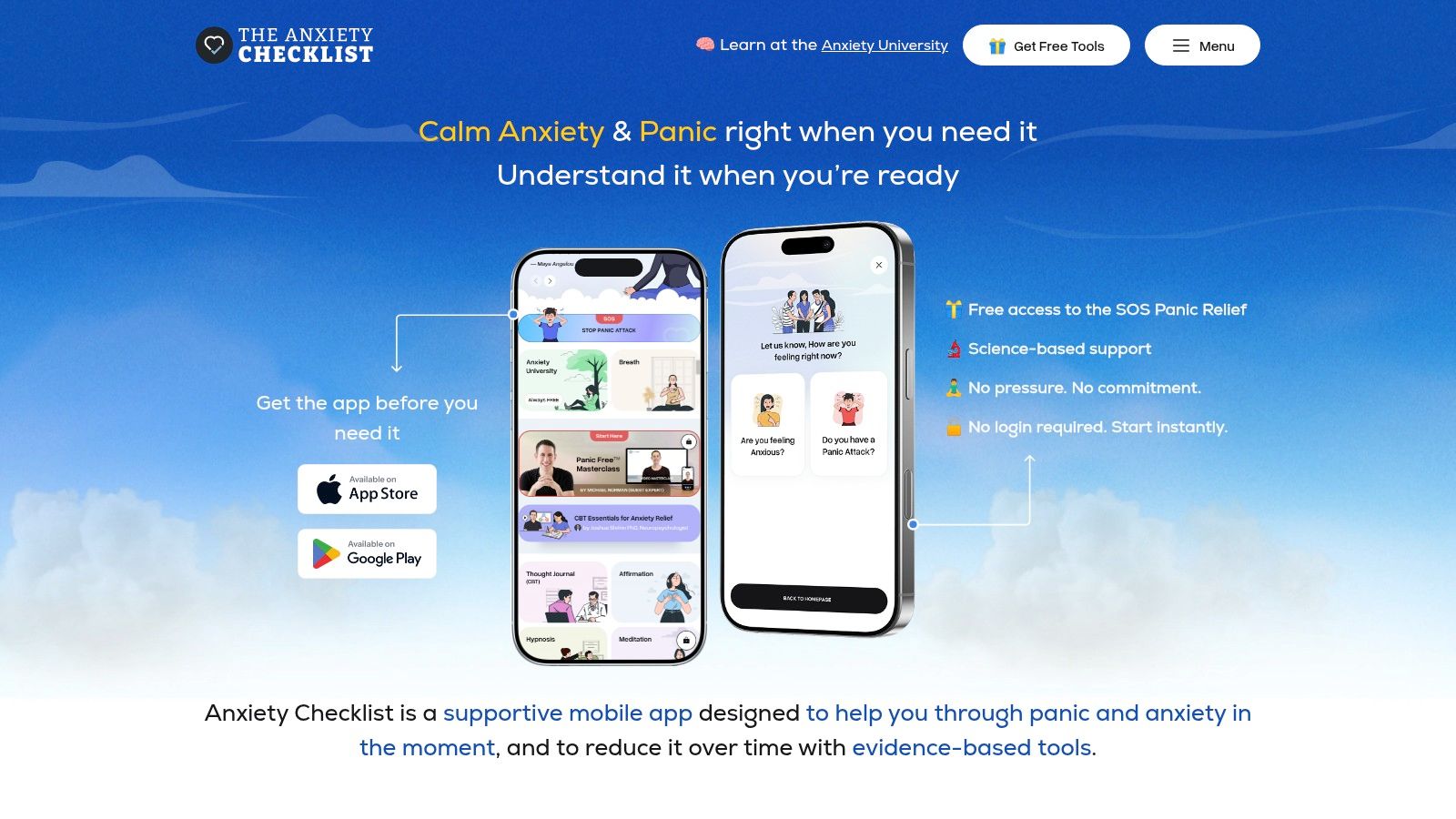
For the daily side of recovery, guided meditations, walking sessions, sleep audios, and other structured tools can reduce decision fatigue. That matters because the hardest part of building a practice usually isn't understanding mindfulness. It's doing it consistently when life is busy or your motivation drops.
The app also includes CBT-oriented tools such as thought journaling, belief experiments, and exposure support. That combination can be useful because mindfulness helps you notice the spiral, while CBT methods help you work with the beliefs and avoidance patterns that keep anxiety going.
In practice, a simple routine works well. Use SOS support during acute distress. Use guided audio or journaling during calmer parts of the day. Repetition turns scattered coping into an actual system.
Your Path to a Panic-Free Life Is Possible
A panic-free life doesn't usually begin with one perfect breakthrough. It begins with a different response to the next hard moment.
You pause. You breathe. You ground. You return.
Over time, those small actions add up to a major shift. As noted earlier, people often reach for mindfulness hoping for instant relief, but its deeper value is in changing long-term patterns like rumination, cognitive reactivity, and meta-awareness. That's why the practice can become so healing. You're not just trying to suppress anxiety. You're building a new relationship with it.
Some days you'll use SOS tools. Other days you'll strengthen the foundation with a daily practice. Both matter. One helps you through the wave. The other makes the wave less frightening over time.
If panic has been running your life, don't take today's interest in these skills lightly. This is how recovery often starts. Not with certainty, but with willingness. And willingness is enough to begin.
If you want steady support while you practice these skills, The Anxiety Checklist offers tools for both the urgent moments and the daily work of retraining your nervous system.