

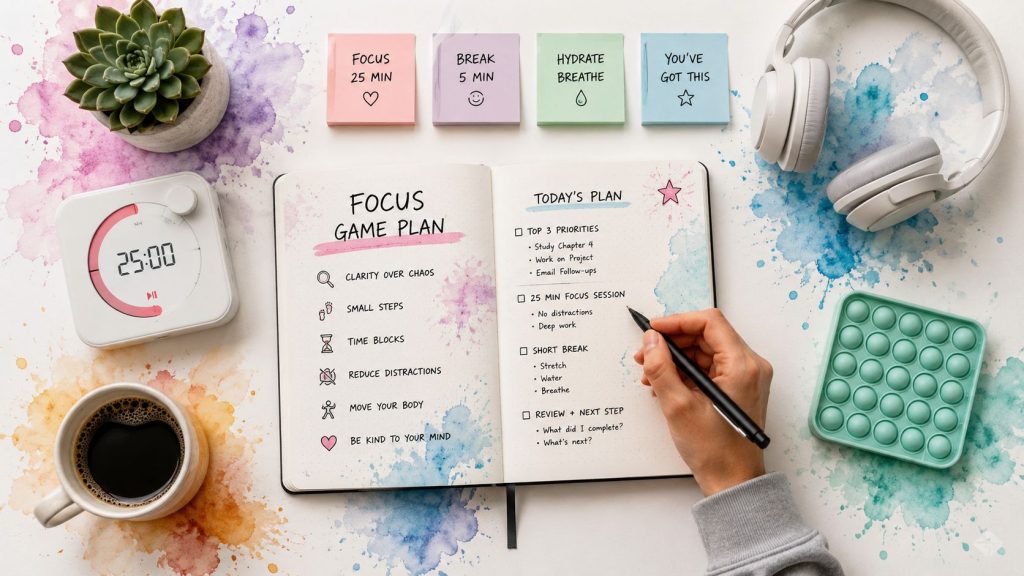
Living with ADHD can feel like your brain is a browser with too many tabs open, and anxiety is the alert box that keeps stealing the screen. You sit down to start one thing, remember five others, feel your chest tighten, and then lose another hour trying to calm down and catch up at the same time. If people have told you to "just focus," you already know that advice doesn't help much.
Better focus usually doesn't come from forcing harder. It comes from building conditions that make starting easier, distraction less sticky, and panic less likely to take over. That matters even more when ADHD and anxiety travel together, because the same system that supports attention can also lower the sense of threat in your body.
These focus tips for ADHD are built around that idea. They aren't about becoming perfectly productive. They're about creating a calmer way to work, recover, and follow through. If you're looking for support beyond self-help strategies, Cedar Hill's adult ADHD help can be a starting point for understanding what you're dealing with.
Table of Contents
- 1. The Pomodoro Technique with ADHD Modifications
- 2. Environmental Design and Distraction Elimination
- 3. Body Doubling and Accountability Partnerships
- 4. Gamification and Reward Systems
- 5. Hyperfocus Channeling and Interest-Based Task Organization
- 6. External Regulation Through Stimulation and Movement
- 7. Time Blindness Mitigation and Visual Time Systems
- 8. Medication Optimization, Timing Alignment and Professional Support
- 9. Task Breakdown and Microhabits
- 10. Implementation Intentions and If-Then Planning
- 10-Point Comparison of ADHD Focus Strategies
- Your Toolkit for Calm Focus and Lasting Change
1. The Pomodoro Technique with ADHD Modifications
For many people with ADHD, the hardest part isn't doing the work. It's getting past the first surge of resistance, dread, or restlessness. A long work block can feel like a trap, which is exactly why shorter, bounded sprints often work better.
One practical ADHD focus strategy is to use short, timed work sprints with a visible timer, a defined stopping point, and a low-stimulation break. An evidence-based workflow is to pick one task, estimate a realistic sprint length, work only on that task until the timer ends, then record the round and decide whether to continue, as described by the Sachs Center's ADHD focus techniques. That structure helps because it turns a vague intention into a clear loop.
Make the sprint smaller than your shame spiral
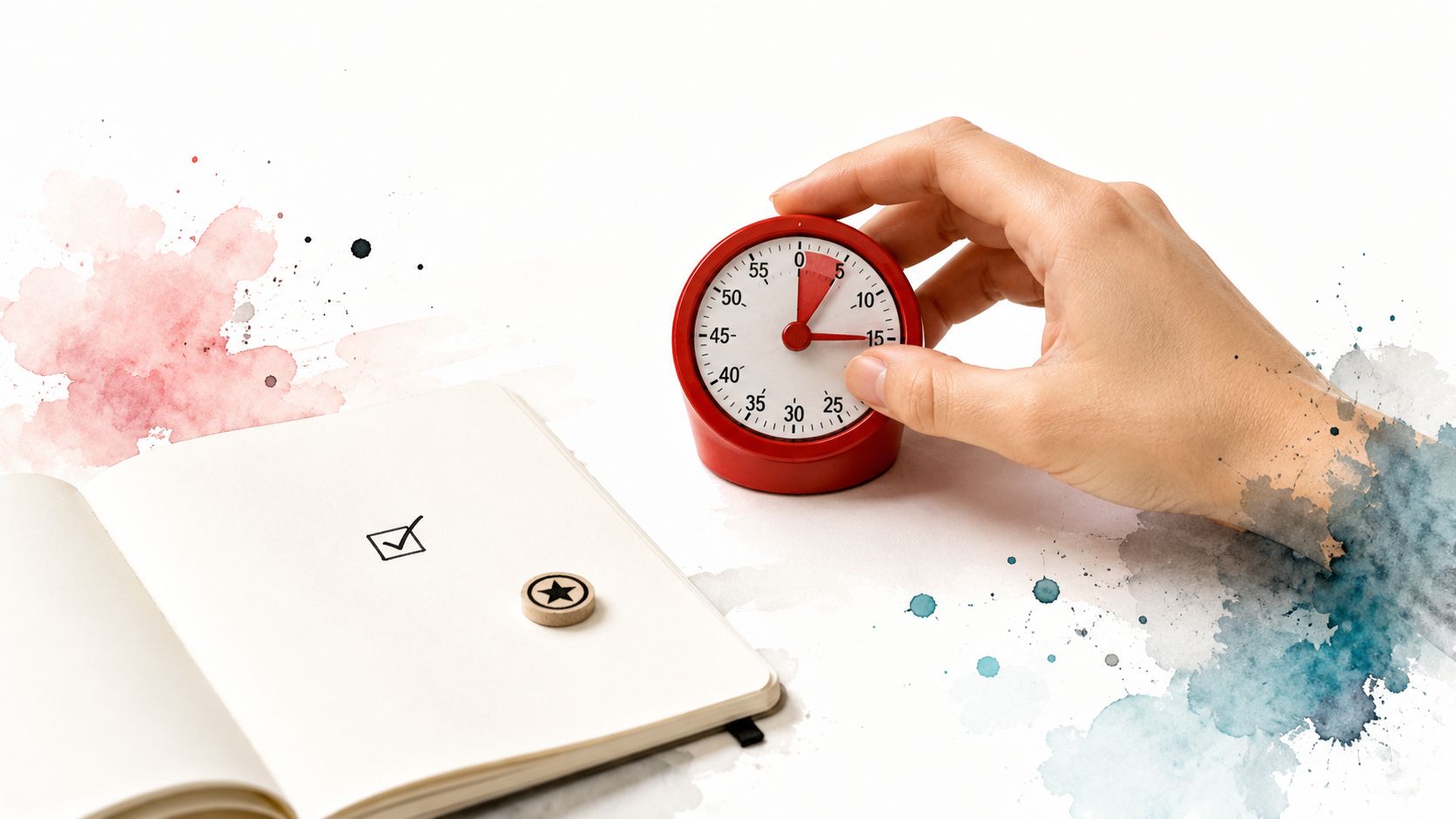
If a standard Pomodoro timer feels too long, shorten it. Many people do better when the first round feels almost laughably manageable. A student might use TomatoTimer for exam review, a writer might use Marinara Timer for a draft, and a developer might use Forest to stay off the phone while coding.
Practical rule: End the first sprint while you still feel capable. Success builds momentum better than grinding does.
How to run one calm sprint
Use this sequence:
- Choose one target: "Reply to three emails" works better than "get caught up."
- Set a visible timer: Use an analog timer, Time Timer, Forest, or your phone if the phone won't pull you into other apps.
- Prepare the stop point: Decide in advance what counts as done for this round.
- Take a low-stimulation break: Stretch, sip water, look outside, or walk the hallway. Don't jump straight into doomscrolling if anxiety is already high.
- Record the round: Put a tally mark on paper, a star in your notebook, or a check in an app.
What doesn't work as well is using sprint systems as a way to bully yourself. If every break turns into self-criticism about how little you did, the method becomes another anxiety trigger. Keep the language neutral. One round counts.
2. Environmental Design and Distraction Elimination
ADHD brains often notice everything. That's not a character flaw. It's part of why a cluttered desk, open tabs, kitchen noise, and a phone on the table can make focus feel impossible before you've even started.
A good environment won't cure distraction, but it can remove some of the fight. When the room, screen, and sensory input are calmer, your nervous system has fewer things to monitor.
Make focus the default
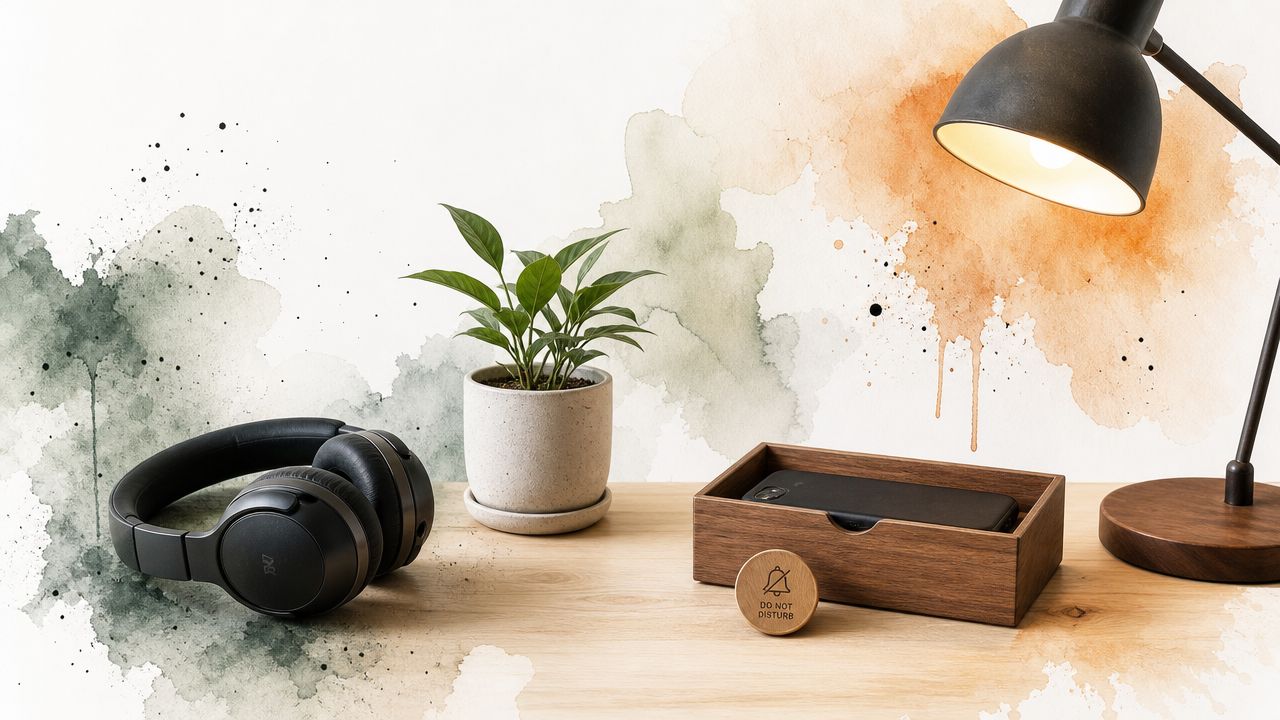
Start with the distractions that hook you fastest. For one person that's Instagram. For another it's household clutter, family noise, or the urge to keep checking messages "just for a second." Freedom, Cold Turkey, and LeechBlock can block websites. Noise-canceling headphones or white noise apps can soften unpredictable sound. A wooden phone box can do more than another notification setting if the phone is your biggest trigger.
A remote worker who keeps trying to focus at the kitchen table may do better with a small dedicated corner that signals "work happens here." That signal matters. The less your brain has to decide in the moment, the less room anxiety has to argue.
A low-friction setup that actually helps
Try this before each work session:
- Build a focus kit: Put water, notebook, charger, headphones, and the one document you need in reach before you begin.
- Use visual boundaries: Headphones, a desk lamp, or a small sign can cue your brain into work mode.
- Reduce visual noise: Clear the immediate work zone, not the whole room. Total decluttering can become a procrastination trap.
- Create a short entry ritual: Open the file, start the playlist, set the timer, and begin.
This short video shows how some people set up that kind of workspace rhythm.
What usually fails is trying to design a perfect space you'll never maintain. Aim for supportive, not spotless.
3. Body Doubling and Accountability Partnerships
Some tasks get easier the moment another person is present, even if they aren't helping. That's body doubling. You work near someone else, in person or virtually, and their presence helps your attention stay anchored.
This can feel strangely powerful if procrastination has been tied to anxiety. You stop carrying the whole burden alone, and that often lowers the emotional weight of starting.
Borrow attention from another nervous system
A college student might open Discord and study silently with a friend. A freelancer might book a Focusmate session before tackling invoices. A writer might meet a peer on video, say the goal out loud, mute, and work.
The benefit isn't magical accountability. It's structure, social pressure in a manageable dose, and fewer opportunities to disappear into avoidance.
Sometimes the sentence "I'll be there at 10" works better than a full motivational speech.
How to make body doubling useful instead of awkward
Keep it simple:
- Start with a brief check-in: Say what you're working on in one sentence.
- Stay mostly silent: Too much talking turns it into another distraction.
- Choose the right format: In-person can help for messy projects. Virtual often works better for daily consistency.
- Use a clear ending: Share what you finished, even if it's small.
A common mistake is choosing a partner who also wants to chat, vent, or multitask. Pick someone who respects the purpose of the session. If anxiety makes live interaction feel hard, start with a trusted friend or a recurring partner at the same time each week.
4. Gamification and Reward Systems
ADHD motivation often improves when effort becomes visible, immediate, and a little more interesting. That doesn't mean turning your whole life into a productivity contest. It means giving your brain a reason to care before the task itself becomes rewarding.
Gamification can help when chores, admin work, and repetitive tasks feel emotionally flat. It also helps anxious perfectionists because it shifts the focus from "Was this flawless?" to "Did I complete the next move?"
Motivation often needs to be visible
Habitica turns tasks into a role-playing game. Streaks gives you a clean visual of repeated wins. Beeminder and Stickk add stronger external commitment for people who respond to higher stakes. Some people even make a paper scoreboard on a whiteboard because analog systems are harder to ignore.
A content creator might earn points for script drafting, editing, and posting. A student might award stars for each completed review block. A parent with ADHD might collect tokens for invisible labor like meal prep and school forms, then trade them in for a guilt-free break.
Reward effort, not perfection
Keep rewards concrete and varied:
- Use small daily rewards: Tea, music, a walk, or ten minutes with a favorite app.
- Add medium rewards: A movie night, takeout, or extra hobby time after a steady week.
- Track completion visually: Stickers, check marks, and streak calendars are simple for a reason. They work.
- Rotate the rewards: Novelty matters. If the reward gets stale, the system loses power.
What doesn't help is punishment-heavy tracking. If every missed day feels like proof you've failed again, the game becomes another shame machine. Positive reinforcement usually lasts longer than self-criticism.
5. Hyperfocus Channeling and Interest-Based Task Organization
Hyperfocus can be frustrating when it locks onto the wrong thing. It can also become useful when you learn what reliably catches your attention and connect important work to that spark.
This takes honesty. Some tasks won't become fun. But many can become more engaging through novelty, challenge, urgency, or meaning.
Use interest on purpose
A designer may frame routine revisions as a creative constraint challenge. A student may turn drafting into a race against their previous start time. A manager may batch boring admin into one themed session with a specific playlist and a visible finish line.
Instead of asking, "How do I force myself to care?" ask, "What element would make this easier to enter?" Often the answer is challenge, speed, curiosity, or changing the context.
Reality check: Hyperfocus is helpful when you steer it. It's costly when you let it choose for you every time.
Turn boring work into a challenge your brain can grab
Try one of these shifts:
- Add a challenge: "Can I clear this inbox section before the timer ends?"
- Change the setting: Move to a library, coworking room, porch, or coffee shop.
- Change the tools: Draft on paper first, use colored pens, or outline on sticky notes.
- Create an earlier deadline: Don't wait for urgency to become terror.
This is one of the most practical focus tips for ADHD because it works with your attention patterns instead of pretending they don't exist. The trade-off is that interest-based systems need refreshes. What worked last month may need a new angle now.
6. External Regulation Through Stimulation and Movement
Sometimes focus problems aren't really about willingness. They're about under-stimulation, restlessness, or a nervous system that needs input before it can settle. In those moments, sitting more still can make things worse.
Movement and sensory support can help your body regulate enough for your mind to stay with the task. That matters for anxiety too, because a trapped, agitated body often reads as danger.
Your body may need help to let your mind focus
A standing desk can help one person. Another person does better with a stress ball, resistance band under the desk, or quiet background music in headphones. Students often focus better with a discreet fidget in lectures. Remote workers may think more clearly when they alternate between sitting and standing.
If you want more general movement ideas outside work blocks, fitness exercises can offer options you can adapt into brief resets.
Build a stimulation menu
Don't rely on one tool. Create a menu for different situations:
- For low energy: Walk, pace during calls, or do light stretching before starting.
- For restless hands: Use a stress ball, putty, fidget ring, or textured object.
- For sound support: Try lo-fi beats, nature sounds, white noise, or video game soundtracks.
- For full-body grounding: Use a weighted lap pad, firmer chair, or posture change.
What usually backfires is overstimulation. Loud music with lyrics, five different fidgets, bright notifications, and constant movement can push focus further off track. You're looking for enough input to stabilize, not so much that the task disappears.
7. Time Blindness Mitigation and Visual Time Systems
Many adults with ADHD don't just struggle with scheduling. They struggle with feeling time pass. That can turn an ordinary deadline into a panic event because the task seems far away until it suddenly feels late.
Visual time tools reduce that surprise. They make time concrete, which lowers the chance that anxiety has to step in as the emergency alarm.
Make time visible before panic makes it loud
A Time Timer can be especially helpful because you can see the countdown instead of only reading numbers. Analog clocks, wall calendars, and color-coded digital calendars do something similar. They pull time out of your head and into the room.
A student working on a paper might use colored blocks in Google Calendar for research, outlining, and drafting. A project manager might keep a visible whiteboard timeline near the desk. A parent may use a kitchen timer for transitions because phone timers easily become phone detours.
Simple tools that reduce deadline dread
Try combining a few layers:
- Use one visible timer during work sessions: Put it where your eyes can catch it without effort.
- Block tasks on a calendar: Not just the deadline, but the working time.
- Set reminder ladders: A prompt well before the final due time helps reduce last-minute panic.
- Check the clock on purpose: A brief hourly check-in can interrupt time drift.
This isn't about becoming rigid. It's about making time less mysterious. When time becomes easier to see, it often becomes less emotionally charged too.
8. Medication Optimization, Timing Alignment and Professional Support
Behavioral tools matter. So does medical support when it's appropriate. If medication is part of your care, the question isn't only whether it helps. It's when it helps, what it helps with, and what happens around the edges.
That observation piece is where many people miss useful patterns. They assume the day went badly because they "weren't disciplined," when the true issue was poor timing, side effects, sleep, food, or trying to do demanding work outside their best window.
Support works better when it is observed, not guessed
People respond differently to stimulant and non-stimulant options, and anxiety can complicate the picture. That's why working with a qualified prescriber matters. If you want a plain-language overview of common options, FindMyScript's guide to ADHD medications can help you frame better questions for your clinician.
Professional support can also include therapy, coaching, or skills work. Medication may improve access to focus, but it doesn't automatically create routines, boundaries, or self-trust.
What to track and how to use it
Keep a simple note for a few weeks with:
- Start time: When you took medication or began your workday.
- Focus quality: When concentration felt easier, scattered, or tense.
- Anxiety level: Whether work felt calm, activated, or panicky.
- Task match: Which work fit best at which time.
This helps you schedule demanding work when you're most supported and shift lighter tasks into lower-energy periods. What doesn't help is changing multiple variables at once and then trying to guess what mattered. Small observations beat dramatic overhauls.
9. Task Breakdown and Microhabits
When a task feels huge, the brain often treats it like danger. That's when paralysis shows up. You know the thing matters. You may even care a great deal. But the entry point is too big, so your nervous system stalls.
Microhabits and minimum viable tasks lower that threshold. They don't make the project trivial. They make it startable.
Small enough to start is the real standard
"Clean the room" is too broad for many ADHD brains. "Put laundry in one basket" is clearer. "Write the report" can trigger panic. "Open the document and type one ugly sentence" can get you moving.
The same principle helps anxiety because smaller steps create less internal threat. You aren't promising to finish everything. You're promising to do the next visible action.
Examples of minimum viable tasks
Break work down until the first step feels almost too small:
- Instead of cleaning the house: Clear one surface, then reset one sink.
- Instead of writing a paper: Open the file, write a rough title, list three points.
- Instead of fixing your inbox: Archive junk mail, then answer one message.
- Instead of learning a skill: Practice for a short block and stop on purpose.
A useful rule is to define "done" before you begin. Done might mean one paragraph, one drawer, one form, or one round with the timer. That protects you from sliding into endless, anxious overworking because the finish line keeps moving.
10. Implementation Intentions and If-Then Planning
Good intentions often disappear when ADHD and anxiety collide. In the moment, everything feels negotiable. You feel tired, unsure, distracted, or uneasy, and the decision gets postponed again.
If-then planning cuts down that decision load. You decide ahead of time what action follows what cue.
Decide before the moment gets emotional
These plans work best when they're specific and visible. "I should work tomorrow morning" is vague. "If I finish breakfast, then I open my laptop and do one timed sprint at the desk" is usable.
This approach also helps with anxious interruptions. Instead of arguing with every urge, you already know what you'll do when it shows up.
When the plan is written before panic arrives, you don't have to invent calm under pressure.
Useful if-then scripts to steal
Write a few that match your actual life:
- If I sit at my desk, then I put my phone in the drawer.
- If I feel the urge to switch tasks, then I write the thought down and return to the current sprint.
- If I finish one round, then I stand up and take a brief low-stimulation break.
- If anxiety spikes before work, then I do one grounding exercise before deciding what comes next.
Keep these rules short. Complex systems often collapse under stress. Review them weekly and rewrite the ones you keep ignoring. The best focus tips for ADHD are the ones you'll still use on a messy Tuesday, not only on a perfect Monday.
10-Point Comparison of ADHD Focus Strategies
| Method | 🔄 Implementation complexity | ⚡ Resource & maintenance | 📊 Expected outcomes (⭐) | Ideal use cases | 💡 Key advantage / tip |
|---|---|---|---|---|---|
| The Pomodoro Technique with ADHD Modifications | Low–Medium, set timers, adapt intervals | Minimal, timer/app + habit building | ⭐⭐⭐⭐, improves initiation and reduces overwhelm | Short, focused work bursts (students, developers, writers) | Start with 15–20 min intervals; pair breaks with movement and rewards |
| Environmental Design & Distraction Elimination | Medium, initial audit and setup, ongoing upkeep | Moderate–High, organizing tools, blockers, sensory tweaks | ⭐⭐⭐⭐, lowers cognitive load and anxiety | People overwhelmed by stimuli or chaotic spaces | Eliminate top 3 distractions first; use app blockers and sensory optimization |
| Body Doubling & Accountability Partnerships | Low, schedule partners/sessions | Low, platforms or a partner; recurring time commitment | ⭐⭐⭐⭐, boosts motivation and task initiation | Initiation problems, remote workers, study groups | Use short structured sessions (e.g., Focusmate) with quick check-ins |
| Gamification & Reward Systems | Medium, design points/rewards and maintain | Low–Medium, apps, reward budget, iteration | ⭐⭐⭐, increases engagement but may wane over time | Boring routines, habit formation, motivation gaps | Use meaningful real-world rewards; rotate incentives to avoid burnout |
| Hyperfocus Channeling & Interest-Based Organization | Medium, requires creative task reframing | Low, mainly planning and environment tweaks | ⭐⭐⭐⭐, can yield high-quality, fast work when aligned | Creative tasks or tasks reframed to personal interests | Create artificial deadlines and novelty; track what triggers hyperfocus |
| External Regulation Through Stimulation & Movement | Low–Medium, experiment to find right stimuli | Low–Medium, fidgets, music, standing desk options | ⭐⭐⭐, immediate but individual-dependent benefits | Low-arousal states, need for nervous-system regulation | Identify optimal stimulation level; schedule movement every 20–30 min |
| Time Blindness Mitigation & Visual Time Systems | Low, set up visual timers and color-coded blocks | Low, visual timers, calendars, alarms | ⭐⭐⭐⭐, reduces deadline panic and last-minute scrambling | Deadline management, transition-heavy days, time-blind users | Use visual timers (Time Timer) and countdown reminders; color-code blocks |
| Medication Optimization, Timing Alignment & Professional Support | High, medical oversight, monitoring, schedule alignment | High, healthcare access, time for titration and follow-ups | ⭐⭐⭐⭐⭐, can markedly increase baseline focus capacity | Moderate–severe ADHD or when other strategies are insufficient | Work with a specialist; align tasks with medication peak windows and ultradian cycles |
| Task Breakdown & Microhabits (Minimum Viable Tasks) | Low, requires planning and discipline | Minimal, lists, timers, tracking | ⭐⭐⭐⭐, greatly reduces initiation paralysis | Large overwhelming projects, perfectionism, procrastination | Define the tiniest possible step and a clear "done" criterion (e.g., 100 words) |
| Implementation Intentions & If‑Then Planning | Low, writing explicit rules and cues | Minimal, visible prompts, occasional refinement | ⭐⭐⭐⭐, automates behavior and reduces decision fatigue | Habit formation, decision-heavy days, anxiety-driven avoidance | Write specific if‑then rules, post them, and pair with environmental triggers |
Your Toolkit for Calm Focus and Lasting Change
Better focus with ADHD rarely comes from one dramatic breakthrough. It usually comes from stacking a few supports that reduce friction, lower panic, and make follow-through more likely. A timer may help you start. A body double may help you stay with the task. A visual calendar may keep time from sneaking up on you. A reward may help your brain care enough to begin again tomorrow.
That's why it's useful to think in terms of a toolkit instead of a personality fix. You are not trying to become a different kind of person. You are building a system that respects how your attention works and how your anxiety reacts under pressure. That shift matters. It replaces blame with observation, and it replaces unrealistic promises with practical adjustments.
You also don't need to implement all ten ideas at once. In fact, that usually backfires. If you're overwhelmed, pick the strategy that would make tomorrow easier, not the one that sounds most impressive. Maybe that's setting up Freedom on your laptop. Maybe it's putting a Time Timer on your desk. Maybe it's texting a friend and asking for a silent coworking session this week.
Expect some trial and error. One person calms down with white noise and a clean desk. Another needs background music and a little movement to think clearly. One person thrives on Habitica. Another finds paper stars on a notebook more motivating. Those differences don't mean you're doing it wrong. They mean you're learning the shape of your own nervous system.
Progress won't be linear, especially if you've spent a long time feeling behind, ashamed, or on edge. Some days you'll use your tools well. Some days you'll forget them and slide back into avoidance. That doesn't erase the progress. It just means you're human, and ADHD plus anxiety can be exhausting. The work is to return without turning the setback into a verdict about who you are.
If panic has become part of your focus struggle, calming your body has to be part of your productivity system. That's not extra. It's foundational. When your nervous system feels safer, attention gets more available. When attention gets more available, life feels less chaotic. That's where hope grows.
Start small. Pick one strategy. Use it long enough to notice what changes. Then add the next layer. A calmer, more focused life often begins just that way.
If you want support for both focus and the anxiety that often comes with ADHD, The Anxiety Checklist gives you practical tools you can use in real time. Its always-free SOS mode, grounding exercises, guided support, and deeper CBT-based resources can help when your mind goes blank, your body feels panicked, or you need a steadier way to reset and keep going.