


When you're considering a job burnout test, there's a good chance work doesn't just feel busy anymore. You may be waking up tired, dreading messages before the day starts, snapping more easily, or wondering why tasks that used to feel manageable now feel strangely heavy. You might even be asking yourself whether this is burnout, anxiety, stress, or just a rough week.
Those questions make sense. They also deserve a calm, clear answer.
A burnout screen isn't a verdict. It's a starting point. It can help you put words to what you've been carrying and show you where to focus next. That's especially important because burnout has become common across workplaces. One survey summary found that 76% of employees experience burnout at least occasionally, and people who regularly suffer from burnout are 63% more likely to take a sick day. The same source notes burnout rose to 52% of the workforce in 2021, up from 43% before the pandemic, which helps explain why more people are looking for ways to assess what they're feeling and recover with intention (workplace burnout trends summarized by Hubstaff).
If part of your stress is tied to fear around work itself, this guide on overcoming ergophobia anxiety may also help you sort out what you're experiencing.
Table of Contents
- Are You Feeling Burned Out or Just Busy?
- Understanding Job Burnout Beyond Just Stress
- The Science Behind Burnout Measurement
- Take Our Confidential Job Burnout Self-Test
- Interpreting Your Score A Guide to Your Results
- Your Action Plan for Immediate Relief
- Your Path to Recovery and Where to Find Support
Are You Feeling Burned Out or Just Busy?
Being busy usually feels intense but purposeful. You have a lot to do, but you can still imagine resting, recovering, and returning to yourself. Burnout feels different. It often carries a sense of depletion, detachment, and loss of meaning.
A simple way to tell them apart is to ask what happens after rest. If a weekend, a quiet evening, or a lighter day helps you bounce back, you're likely dealing with stress or overload. If rest barely touches the exhaustion, and work still feels emotionally flat or irritating, burnout becomes more likely.
What people often confuse
Many people use the same words for very different experiences. That confusion can make you feel stuck.
| Experience | What it often feels like |
|---|---|
| Busy | Full calendar, pressure, mental fatigue, but you can still engage |
| Stressed | Tense, keyed up, worried, reactive, but still emotionally connected |
| Burned out | Drained, detached, cynical, ineffective, and less able to recover |
Burnout also tends to change how you relate to your work. You may care less, not because you're lazy, but because your system has been under strain for too long. That numbness can feel alarming, especially if you used to take pride in what you do.
You don't have to prove that you're struggling "enough" before you take your exhaustion seriously.
Signs that point beyond a packed schedule
A job burnout test becomes useful when your experience sounds more like this:
- Energy stays low: You wake up tired, push through the day, and feel used up afterward.
- Distance grows: You find yourself mentally checking out, feeling irritable, or becoming more negative about work.
- Confidence slips: Tasks that once felt ordinary now feel difficult, and you start doubting your competence.
- Recovery shrinks: Time off helps less than it used to.
If that description fits, clarity can be a relief. Naming the pattern doesn't trap you. It helps you respond wisely.
Understanding Job Burnout Beyond Just Stress
If you've been telling yourself, "Maybe I'm just not coping well enough," pause there for a moment. Burnout often feels personal, but the pattern itself is tied to chronic work strain, not a lack of character, discipline, or grit.
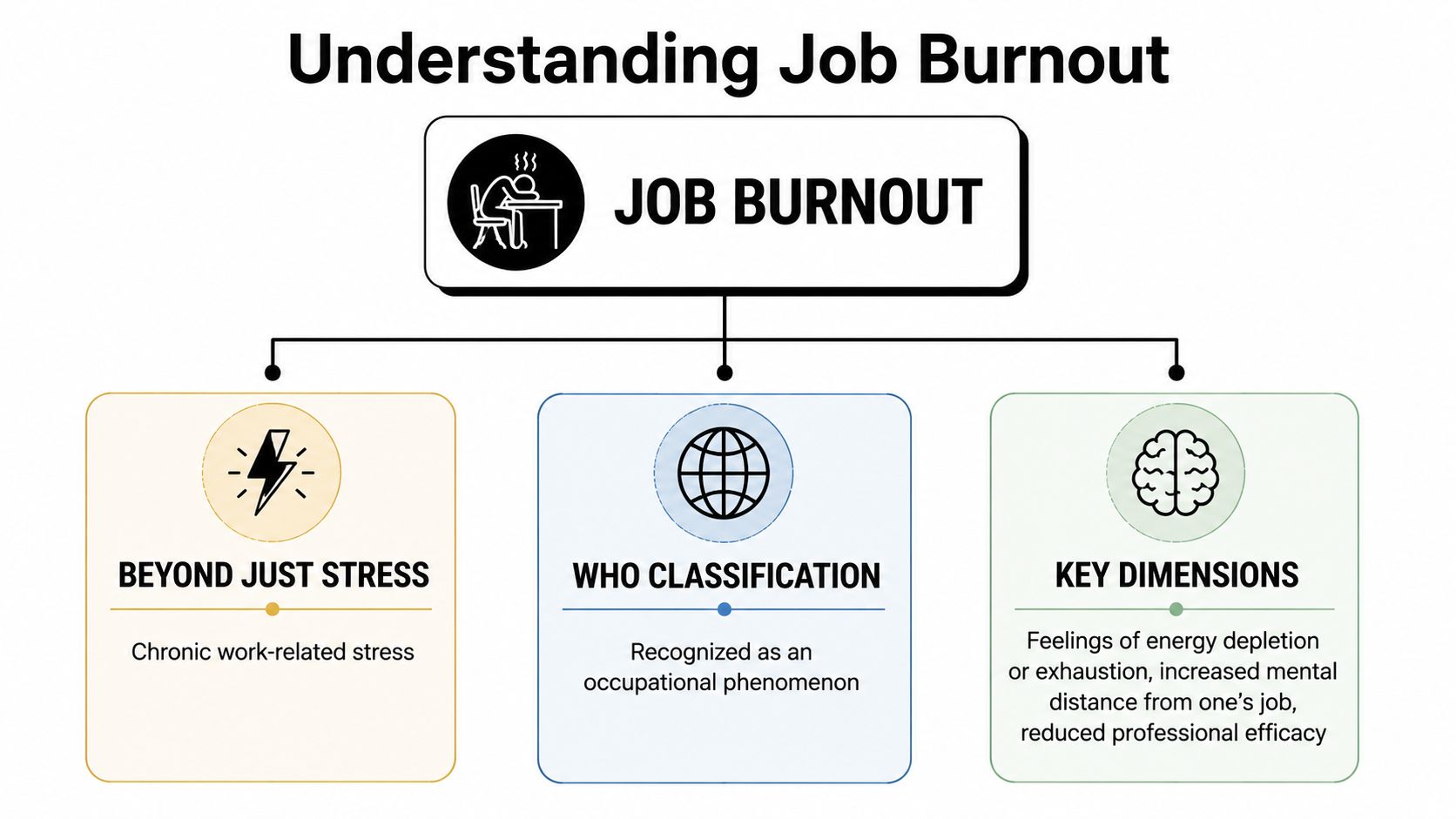
The World Health Organization classifies burnout in ICD-11 as an occupational phenomenon. That framing matters because it shifts the question from "What's wrong with me?" to "What has my work stress been doing to me over time?" A burnout test can help you name that pattern. Naming it is not a final verdict. It is often the first clear step toward relief.
When stress turns into burnout
Stress usually feels activated. Your mind races, your body stays tense, and you keep pushing because part of you still believes rest will reset things.
Burnout often feels different. The system starts to run low in several places at once, like a battery that recharges only halfway and drains faster each day. You may still be showing up, answering emails, and finishing tasks, yet something deeper feels worn down. Effort rises while your sense of return falls.
Researchers commonly describe burnout through three dimensions:
- Emotional exhaustion: You feel used up and low on emotional energy.
- Cynicism or depersonalization: You grow more detached, irritable, or emotionally distant from the work and the people around it.
- Reduced efficacy or accomplishment: You start to feel less effective, even when you're still trying hard.
That three-part pattern is what makes burnout different from an ordinary rough week.
Why this can shake your sense of self
Burnout often lands on identity. A person who once felt capable and engaged may start wondering why simple tasks now feel heavy, why patience is gone, or why work that used to matter now feels flat.
That reaction makes sense. Chronic strain changes attention, motivation, and emotional regulation. If your inner voice has gotten harsh, try replacing blame with observation. "I am failing" is a painful conclusion. "My system has been under too much strain for too long" is more accurate, and it points toward solutions.
Helpful check-in: If work stress is affecting your energy, your attitude toward work, and your confidence in what you can get done, a burnout screen may give you useful clarity.
Burnout can overlap with other struggles
People are rarely dealing with one neat, isolated issue. Burnout can exist alongside anxiety, depression, grief, trauma, sleep problems, or a toxic work environment. That is one reason self-assessment should be gentle and specific.
A job burnout test is designed to measure a work-related pattern. It does not answer every mental health question by itself. If your symptoms also include constant worry, physical tension, or racing thoughts across many parts of life, it may help to evaluate your anxiety using GAD-7 so you can sort out what is coming from work strain and what may need added support.
Clarity can feel surprisingly hopeful. Once you can see the pattern more clearly, the next steps become more manageable.
The Science Behind Burnout Measurement
A solid job burnout test should be grounded in real measurement, not just a catchy quiz result. The strongest research tradition in this area comes from the Maslach Burnout Inventory, often called the leading scientific tool for measuring burnout. It has been validated through over 35 years of research and uses three dimensions: exhaustion, cynicism, and efficacy. In some profiles, burnout is associated with exhaustion above 3.00 and depersonalization at or above 2.73. In another version, exhaustion above 2.90 and cynicism at or above 2.86 are part of the interpretation model. That structured scoring is one reason burnout assessment carries more weight than a generic online stress quiz (overview of the MBI and scoring framework).
Why validated tools matter
A validated instrument does two things that quick quizzes often don't.
First, it measures specific dimensions instead of collapsing everything into one vague score. Second, it gives professionals a framework for interpretation. That matters because two people can both feel awful at work for different reasons. One may be profoundly exhausted but still care intensely. Another may feel detached and cynical even if their physical energy is less impaired.
If you also want to evaluate your anxiety using GAD-7, that can help you separate general anxiety symptoms from work-specific strain.
Why a self-test is still useful
Individuals often lack immediate access to formal burnout assessment. They need something practical now.
A good self-screen can help you notice patterns, put language around your experience, and decide what kind of support makes sense. It isn't a diagnosis. It's a reflection tool. Used well, it can reduce confusion and help you move from "I don't know what's happening to me" to "I can see what needs attention."
Take Our Confidential Job Burnout Self-Test
Use this self-test as a private check-in. Answer based on your experience over the past several weeks at work. Try not to answer according to how you wish things were, or how you think you "should" be doing. Honest answers are more useful than brave ones.
How to score each question
Rate each statement from 0 to 4.
- 0 = Never
- 1 = Rarely
- 2 = Sometimes
- 3 = Often
- 4 = Very often
Write down your score for each item, then total them at the end.
The 12-question job burnout test
I feel emotionally drained by my work.
I feel tired before the workday even begins.
By the end of the day, I feel used up.
I feel more detached from my job than I used to.
I catch myself feeling cynical, numb, or negative about work.
I care less about tasks or people at work than I want to.
I struggle to feel effective, even when I put in effort.
Small work tasks feel harder than they used to.
I doubt whether I'm doing a good job.
Rest doesn't seem to restore me the way it used to.
I feel like work stress is spilling into the rest of my life.
I find it hard to imagine feeling engaged at work again.
Answering "often" or "very often" to several questions doesn't mean you've failed. It means your system is giving you information.
A simple way to notice patterns
Before you total your score, group your answers into three clusters:
| Cluster | Questions | What it may reflect |
|---|---|---|
| Exhaustion | 1, 2, 3, 10 | Depletion and low recovery |
| Detachment | 4, 5, 6, 12 | Mental distance or cynicism |
| Efficacy | 7, 8, 9, 11 | Reduced confidence and functioning |
Burnout rarely shows up in exactly the same way for everyone. Some people are mostly exhausted, while others feel the strongest shift in cynicism or self-doubt.
If you're looking for broader tools beyond this screening exercise, an anxiety self help platform can support reflection, coping, and daily symptom tracking.
Add your score
Total all 12 items. Your next step is not to panic about the number. It's to interpret it with context and compassion.
Interpreting Your Score A Guide to Your Results
If your number feels unsettling, pause for a moment. A burnout score is best used like a thermometer. It does not define you, and it does not deliver a final diagnosis. It shows how much strain your system may be carrying right now, which can help you choose the next right step with more clarity and less self-blame.
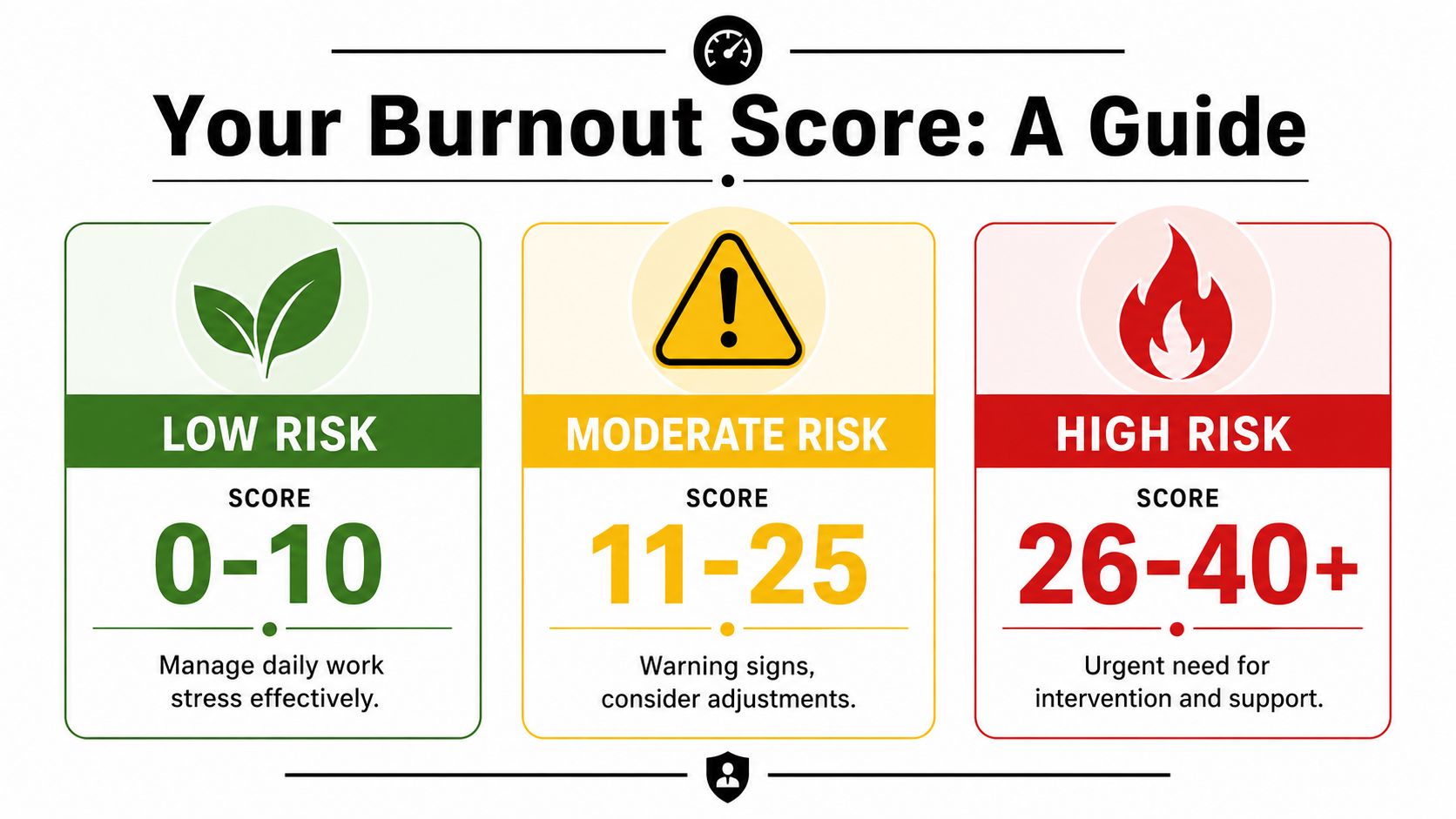
Use all 12 items from the self-test for your total score. If you rated each item from 0 to 4, your full score range is 0 to 48. That keeps the scoring consistent with the test you just completed and gives you a clearer picture of the overall pattern.
A score by itself has limits. Burnout researchers and clinicians often look at patterns across exhaustion, detachment, and effectiveness, rather than relying on one label alone, as noted in this guidance on valid and reliable burnout instruments.
Score ranges
| Range | What it may mean |
|---|---|
| 0 to 12 | Lower current concern. Work may be stressful, but some recovery, engagement, and sense of effectiveness are still available. |
| 13 to 28 | Moderate concern. Burnout signals are showing up more regularly, and your mind or body may be asking for change before the pattern hardens. |
| 29 to 48 | High concern. Burnout features appear more established, and added support, workload changes, or both deserve prompt attention. |
After you've looked at the range, watch this short video if you'd like a visual explanation of burnout patterns and recovery.
What each range can feel like in real life
A lower score often means strain is present, but your internal battery still recharges. You may have hard days without feeling emotionally emptied out by every task. This is a good point to make small repairs early, the way you would respond to a warning light in a car before the engine overheats.
A moderate score often fits people who look functional from the outside and feel worn down on the inside. You may still be getting things done, but with more dread, irritability, numbness, or self-doubt. Many people in this range tell themselves they should just push through. That usually adds pressure to a system that is already overworked.
A higher score often brings relief as much as concern. It can put words to an experience that has felt confusing or easy to dismiss. The hopeful part is this: a high score does not mean you are stuck. It means the need for recovery is clearer now, and clear signals are easier to respond to than vague distress.
A high score on a job burnout test can be the beginning of a recovery plan.
Why your pattern matters as much as your total
Two people can have the same total score and need different kinds of help. One person may be running on empty but still care a great deal about the work. Another may feel emotionally detached and cynical, even if their energy is only somewhat reduced. Looking back at your clusters helps you see where the strain is concentrated.
- High exhaustion often points to depleted energy, poor recovery, and too little margin. Gentle physical downshifting can help in the short term. If you need help settling your body, try these Anxiety Checklist breathing exercises.
- High detachment can reflect emotional self-protection, values conflict, or ongoing frustration with work conditions.
- High reduced efficacy often shows up as self-doubt, difficulty concentrating, and the sense that ordinary tasks now require much more effort.
Read your result with curiosity. A useful question is, What kind of strain does this score reveal, and what support would match that strain best? That question turns the test into what it should be: a first step toward relief, recovery, and feeling like yourself again.
Your Action Plan for Immediate Relief
When burnout starts to feel real, many people freeze. They know something is wrong, but they don't know what to do first. Start smaller than your mind wants to. You do not need a complete life overhaul tonight. You need a few stabilizing actions that lower the pressure enough for clearer thinking to return.
Research-based guidance on burnout recovery emphasizes that the next step isn't only self-care. It includes identifying and addressing the underlying work conditions driving the exhaustion and cynicism in the first place (clinical overview of burnout and response planning).

First aid for the next 24 hours
These steps won't solve every cause of burnout. They can, however, help you stop spiraling and regain a little control.
- Ground your body first: Use the 5-4-3-2-1 method. Name five things you can see, four you can feel, three you can hear, two you can smell, and one you can taste. This can interrupt the overwhelmed, panicky feeling that often rides alongside burnout.
- Take a no-guilt pause: Block one short period today that is restorative. Sit outside. Eat without multitasking. Lie down without scrolling. The key is to stop treating rest like something you must earn.
- Lower one demand: Pick one nonessential task and delay, delegate, or shrink it.
- Use one sentence to protect your capacity: Try, "I can't take that on today, but I can revisit it after I finish my current priorities."
If your body feels keyed up, these Anxiety Checklist breathing exercises can help you slow the stress response enough to think more clearly.
Make the problem more visible
Burnout gets more manageable when it becomes specific.
Ask yourself these questions and write down short answers:
- What part of work drains me the fastest?
- Where do I feel trapped, unclear, or unsupported?
- What would help immediately. More time, fewer interruptions, clearer expectations, or emotional support?
- What is one work condition that keeps triggering this pattern?
Decide what kind of relief you need
Not every action fits every kind of burnout. Match the response to the pattern you noticed in your self-test.
| If your main issue is… | Try this first |
|---|---|
| Exhaustion | Reduce output where possible, rest more deliberately, and protect sleep |
| Detachment | Limit unnecessary emotional labor and identify what feels misaligned |
| Low efficacy | Ask for clarity, prioritize fewer tasks, and break work into smaller wins |
A grounding reminder: You don't need to earn support by collapsing first.
A short script for work conversations
If you're considering talking to a manager, keep it concrete. You don't have to disclose everything.
Try: "My workload has become hard to sustain, and I'm noticing it affect my energy and focus. I'd like to talk about priorities and what can be adjusted."
That kind of statement keeps the focus where it belongs. On work conditions, not personal blame.
Your Path to Recovery and Where to Find Support
Immediate relief matters. Long-term recovery asks a different question: what has to change so you don't keep returning to the same depleted state?
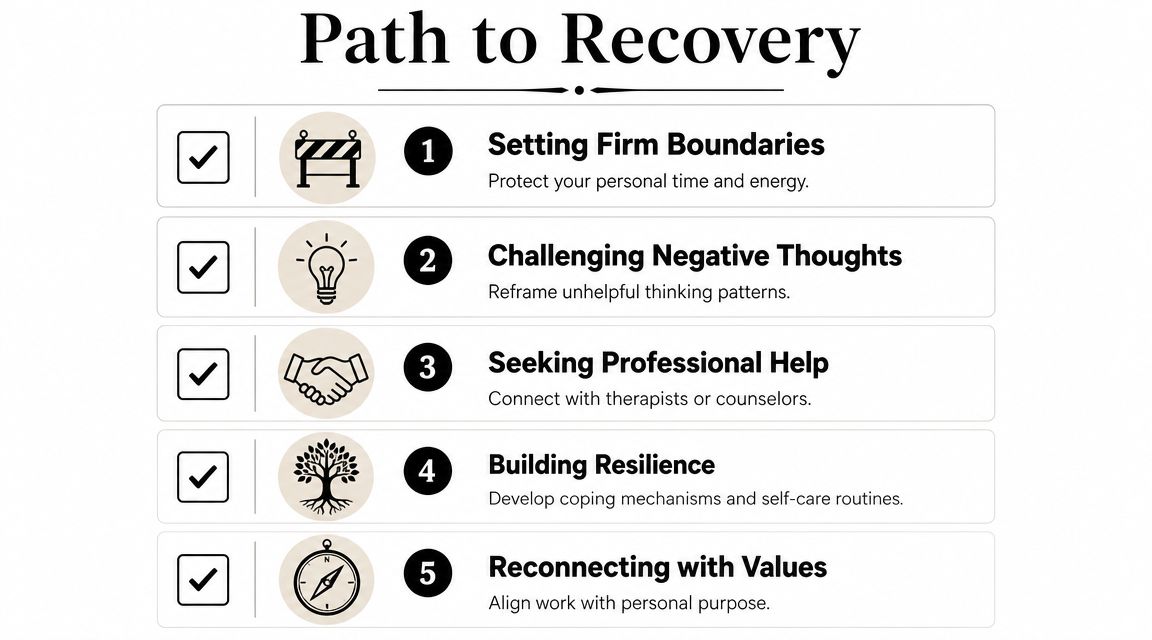
Burnout recovery usually works best when you address both the internal and external sides of the problem. Internal work includes calming your nervous system, challenging self-critical thinking, and rebuilding steadier routines. External work includes boundaries, workload changes, role clarity, and support from other people.
Five recovery moves that matter
- Set firmer boundaries: Protect off-hours where you can. Even one clear limit, such as not checking messages during meals or after a set time, can reduce the sense that work owns your entire nervous system.
- Challenge harsh thoughts: Burnout often comes with thoughts like "I'm failing," "I should handle this," or "Everyone else is coping better." CBT-style reflection helps you test those thoughts instead of automatically believing them.
- Reconnect with values: Ask what part of your work still matters to you, and what part feels misaligned. Sometimes recovery involves changing how you work. Sometimes it involves changing where you work.
- Use job crafting where possible: This means adjusting the shape of your role in small ways. You might batch draining tasks, ask for clearer priorities, or create more time for meaningful work.
- Build recovery rituals: Repeated, boring basics count. Sleep routines, walks, food, breaks, quiet time, and supportive conversations create the conditions for healing.
When to ask for more help
There are times when self-help tools aren't enough on their own.
Consider reaching out to a therapist, doctor, or other qualified professional if your distress feels severe, persistent, or hard to separate from anxiety, depression, panic, or hopelessness. You might also talk with a manager or HR contact if workload, staffing, role confusion, or a harmful culture is clearly driving your symptoms.
For a broader roadmap, these steps for anxiety recovery can support the nervous-system side of healing when burnout and anxiety overlap.
Recovery doesn't always begin with a dramatic decision. It often begins with one honest conversation, one protected boundary, and one moment of taking yourself seriously.
If work impairment becomes serious
Some people reach a point where symptoms affect their ability to work consistently or safely. If that happens, practical guidance matters. Resources on securing disability benefits for mental illness can help you understand options when depression, anxiety, or related conditions significantly impair functioning.
A hopeful way to think about healing
You don't have to solve your whole career to start feeling better. Many people recover by taking a sequence of manageable steps:
- Notice the pattern.
- Reduce the most harmful pressure where you can.
- Get support sooner than your inner critic says you should.
- Rebuild from the inside and the outside at the same time.
A job burnout test can be the first clear signal that something needs care. That's hopeful, not discouraging. Clearer understanding gives you choices. And choices are how people begin to feel like themselves again.
If you're dealing with burnout, anxiety, or panic and want gentle, practical support between appointments or on your own, The Anxiety Checklist offers tools for both immediate relief and longer-term recovery. You can use its free SOS features during moments of overwhelm, then explore guided calming exercises, journals, meditations, and structured self-help tools at your own pace.