

In short
Exam anxiety becomes more manageable when you prepare in small, realistic blocks and rehearse a short test-day routine before you need it. During the exam, slow the exhale, orient to the room, start with a workable question, and move on when stuck. Persistent panic, avoidance, or impairment deserves support from a qualified professional.
Key takeaways
- Practice retrieving information from memory instead of relying only on rereading notes.
- When anxiety causes avoidance, begin with the smallest available study task rather than waiting to feel confident.
- Rehearse one calming routine before test day so the steps are familiar when anxiety rises.
- Skipping a difficult question temporarily is usually more useful than fighting a blank mind in place.
- Ask about exam formats, accessibility processes, or academic support early because available arrangements vary.
Table of contents
- Why does exam anxiety make studying and recall harder?
- What should you do during the week before the exam?
- What should you do the evening before the exam?
- How can you calm exam anxiety when you arrive?
- What should you do in the first minute of the exam?
- What can you do if your mind goes blank or panic rises?
- What should you do after the exam to stop ruminating?
- When should exam anxiety get professional or academic support?
- What are the most common questions about exam anxiety?
- What should you do next?
Exam anxiety is not a character flaw or proof that you are unprepared. The practical goal is not to get rid of every anxious feeling; it is to keep anxiety from deciding how you study, how you begin the test, and what you do when a difficult moment arrives.
Why does exam anxiety make studying and recall harder?
Exam anxiety can interfere before the test begins by making the material itself feel threatening. It can push a student toward avoidance, restless sleep, frantic rereading, self-criticism, or repeated checking instead of focused preparation.
Common signs include racing thoughts, difficulty concentrating, procrastination, irritability, nausea, sweating, a rapid heartbeat, and trouble sleeping. The University of Colorado Boulder's 2024 test-anxiety guide notes that anxiety becomes especially problematic when it affects studying, attendance, or the ability to answer questions. (colorado.edu)
A 2022 study of 309 medical students found that test anxiety did not predict final performance once existing knowledge was taken into account. Higher trait test anxiety did, however, predict smaller knowledge gains during preparation. That finding supports addressing avoidance and ineffective study behavior before focusing only on test-day calm. (pubmed.ncbi.nlm.nih.gov)
The study involved one specific group and does not prove that anxiety never disrupts recall. It does show why a useful plan must protect the preparation period as well as the exam itself.
Treat exam anxiety as a preparation-and-recovery problem, not just a feeling to eliminate on test day.
What should you do during the week before the exam?
Use the preparation week to reduce uncertainty, build retrievable knowledge, and practice what you will do when anxiety appears. The target is not a perfectly calm week; it is repeated contact with the material without letting avoidance control the schedule.
What does a seven-day exam-anxiety plan look like?
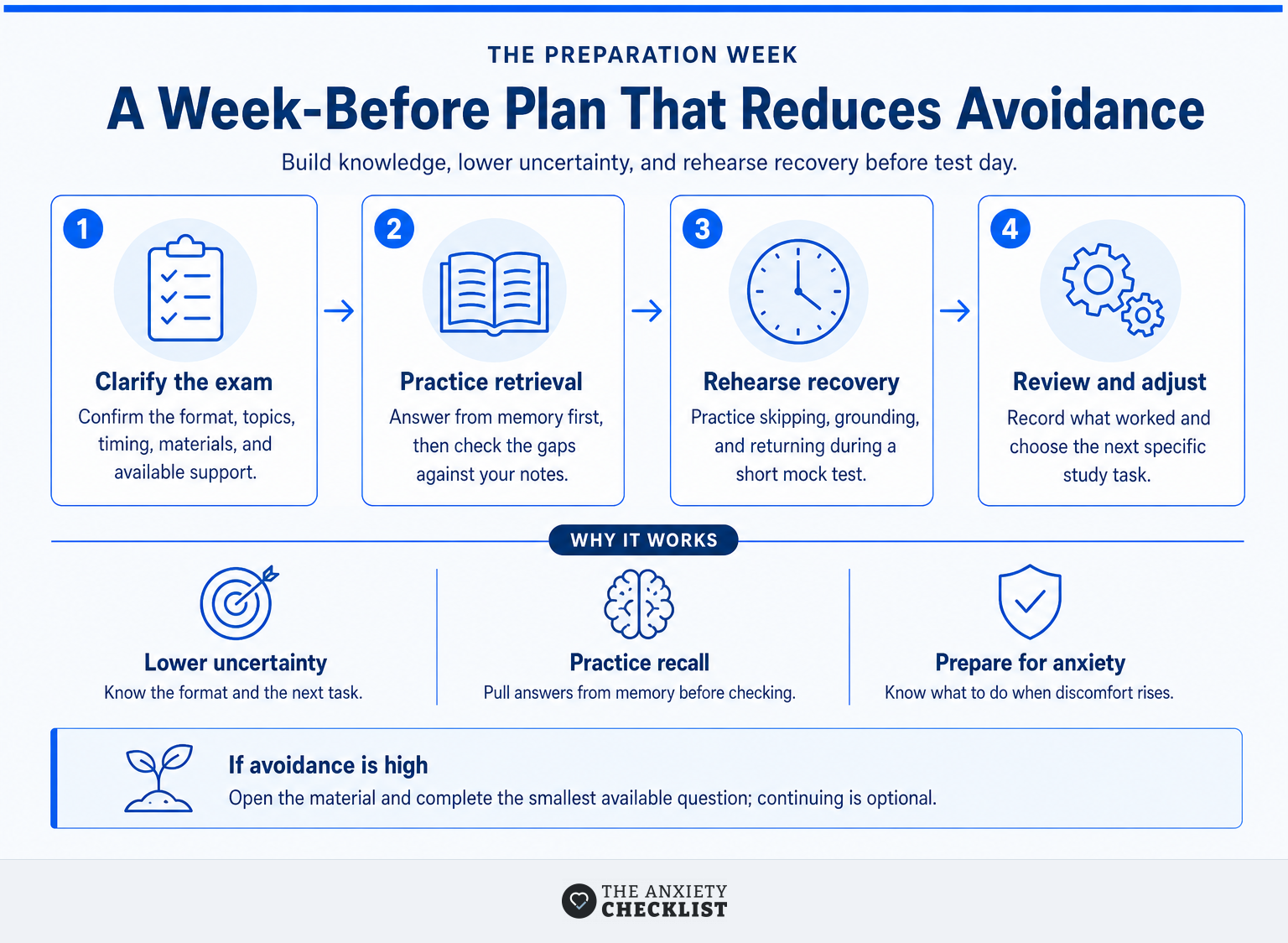
Use this sequence rather than trying to predict exactly how confident you should feel each day:
- Clarify the exam. Confirm the date, location, format, topics, time limit, permitted materials, login requirements, and how marks are distributed. Ask the instructor what effective preparation looks like if the expectations are unclear.
- Retrieve before reviewing. Close the notes and answer a practice question, write what you remember, teach the idea aloud, or complete a short problem set. Check the source material afterward and turn the gaps into the next study task.
- Make avoidance smaller. If opening the course material feels overwhelming, choose the smallest concrete action available: read one prompt, write one formula, or answer the easiest question. Continuing is useful, but beginning is the first goal.
- Rehearse test conditions. Complete a short timed practice, use the expected question format, and practice skipping and returning. Include a recovery drill rather than rehearsing only perfect performance.
- Answer the anxious prediction. Write the feared thought and a balanced response. For example: Feeling anxious means I will go blank can become Anxiety is uncomfortable, and I can still begin with one question. A guided CBT Thought Journal can help structure this exercise. (anxietychecklist.com)
Mayo Clinic's 2024 guidance recommends studying early, understanding what the test covers, establishing a consistent pretest routine, and practicing relaxation techniques before they are urgently needed. A 2025 Teachers College overview also describes how test anxiety can drive avoidance and passive rereading instead of effortful recall. (mayoclinic.org)
The best week-before plan builds knowledge, reduces uncertainty, and rehearses recovery before test day.
What should you do the evening before the exam?
The evening before should protect tomorrow's attention rather than become a rescue mission for the entire course. Finish with a short review, prepare the practical details, and give sleep a fair chance even if you do not feel completely relaxed.
- Set a stopping point for studying and use the final review to check a short list of high-value concepts.
- Prepare identification, permitted equipment, chargers, water, clothing, directions, and login details.
- Keep food and caffeine familiar rather than trying an unusual energy drink, supplement, or borrowed medication.
- Write a small morning card with the arrival plan, first test action, and recovery cue.
- If sleep does not come immediately, avoid treating wakefulness as proof that the exam is ruined. Rest quietly and return attention to the next ordinary step.
The NHS advises against all-night cramming and notes that sleep supports thinking and concentration. Its exam-stress guidance also recommends practice papers, a revision schedule, supportive conversation, and avoiding extra pressure from family members. (nhs.uk)
The evening before is for preparation and sleep, not a final attempt to learn everything.
How can you calm exam anxiety when you arrive?
Arrive with enough time to handle check-in, seating, or technology without rushing, but do not use the waiting period to monitor everyone else's confidence. The final minutes are best used to orient to the setting and follow the routine you practiced.
What can you do in the final five minutes?
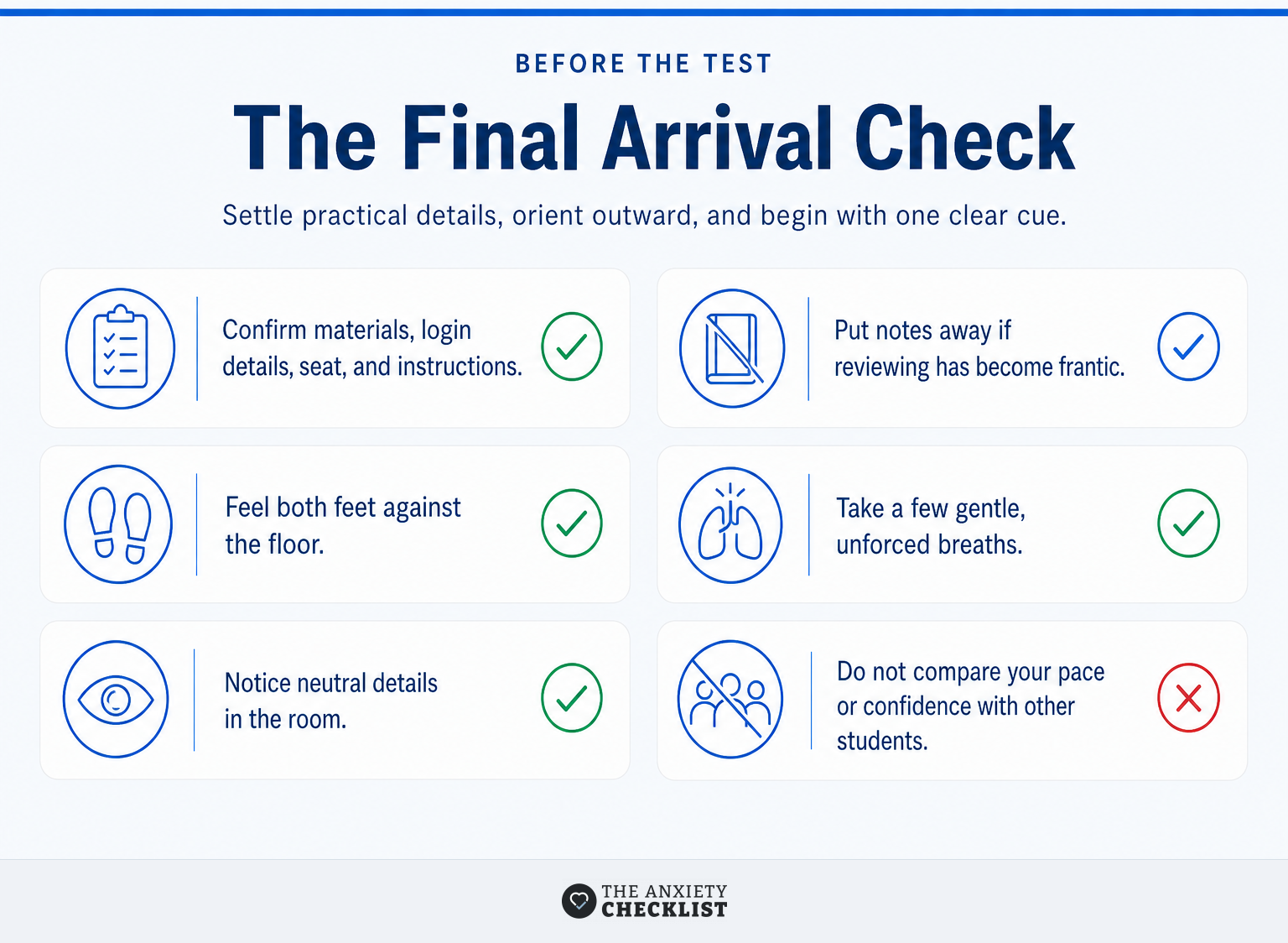
Use a short arrival check:
- Put away notes if reviewing has become frantic rather than useful.
- Confirm the required materials, login, seat, and instructions.
- Feel both feet against the floor and let your shoulders settle.
- Take a few gentle, unforced breaths without trying to force a dramatic change.
- Notice neutral details in the room and repeat a cue such as one question at a time.
The 3-3-3 rule is another discreet option: notice three things you see, identify three sounds, and move three parts of your body. Cleveland Clinic's October 2026 explanation describes it as a grounding technique while noting that direct scientific evidence for this specific rule remains limited. More grounding techniques for anxiety can be practiced before the exam so they feel familiar. (health.clevelandclinic.org)
Arrive ready to orient, not to measure your confidence against everyone else.
What should you do in the first minute of the exam?
Use the first minute to understand the test and create a route through it before deciding how well you are doing. Anxiety can be present while you read, plan, and begin one answer.
- Read the instructions fully. Check how answers are recorded, whether questions can be skipped, and whether incorrect answers carry a penalty.
- Scan the structure. Notice the number of sections, available marks, and questions that may require more time.
- Choose a workable starting point. Begin with a familiar question if the rules and format allow it.
- Externalize key information. For an essay, note a few keywords. For a calculation, write the formula or known values before solving.
- Set a move-on rule. If no useful step appears after a reasonable attempt, mark the question and continue.
The Child Mind Institute's test-anxiety guidance recommends understanding the format, using practice tests, avoiding excessive time on one question, and remembering that skipped questions can be revisited. (childmind.org)
The first minute should create a route through the paper, not prove that anxiety has disappeared.
What can you do if your mind goes blank or panic rises?
A blank mind is a signal to change tasks, not a command to stare harder at the same question. Move attention from internal alarm to one visible, physical, or test-related action that can be completed now.
What is a five-step recovery sequence?
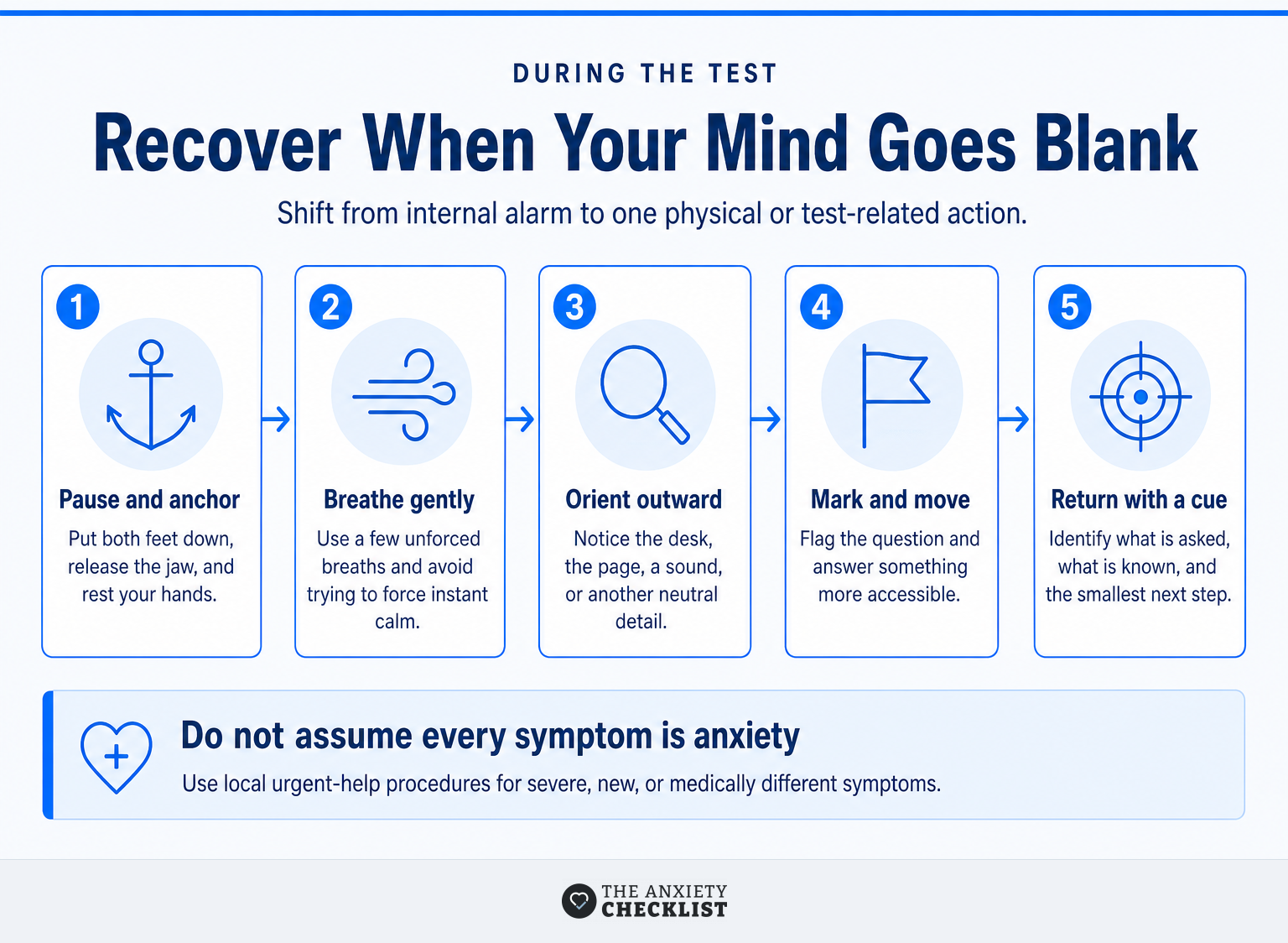
- Pause and anchor. Put both feet down, release the jaw, and let your hands rest on the desk.
- Breathe gently. Take a few unforced breaths and allow the exhale to be slightly longer if that feels comfortable.
- Orient outward. Notice the desk surface, a sound in the room, the position of the page, or another neutral detail.
- Mark and move. Leave space, flag the question, and answer something more accessible.
- Return with a cue. Ask what the question is requesting, what information is given, and what the smallest next step would be.
Familiar panic symptoms can include a racing heart, trembling, dizziness, nausea, breathlessness, chest discomfort, and a sense of losing control. The National Institute of Mental Health's panic-disorder guidance advises seeking professional help when anxiety begins disrupting school, work, relationships, or daily life. (nimh.nih.gov)
Panic-like symptoms can also overlap with medical problems. Seek urgent help according to local procedures if symptoms are new, severe, medically different from previous episodes, or include loss of consciousness, severe breathing difficulty, or concerning chest pain rather than automatically assuming anxiety. (nhs.uk)
If fear of evaluation also appears in meetings or speaking up, the guide to social anxiety at work provides a separate plan for that setting. (anxietychecklist.com)
When the mind goes blank, move attention outward, choose one manageable action, and keep the exam moving.
What should you do after the exam to stop ruminating?
Do not turn the minutes after submission into an unlimited search for mistakes. Decide when and how you will review the result, then use a short debrief to improve the next preparation cycle.
The University of Colorado Boulder advises students to review scores on their own terms rather than matching other people's timing. It also recommends shifting attention away from an outcome that can no longer be controlled. (colorado.edu)
A useful debrief answers three questions:
- What did I do that helped me begin or recover?
- What specific preparation gap should I address next time?
- Is there one question I should ask the instructor, tutor, or support service?
Record the answers and stop. Replaying every uncertain response may feel like preparation, but it cannot alter a submitted exam.
A short debrief can improve the next exam; repeated postmortems cannot change the one that is finished.
When should exam anxiety get professional or academic support?
Seek additional support when exam anxiety repeatedly changes attendance, studying, sleep, eating, subject choices, or daily functioning. Support is also appropriate when panic is frequent, self-help is not helping, or the student cannot enter or remain in the exam setting.
Which kind of support fits the problem?
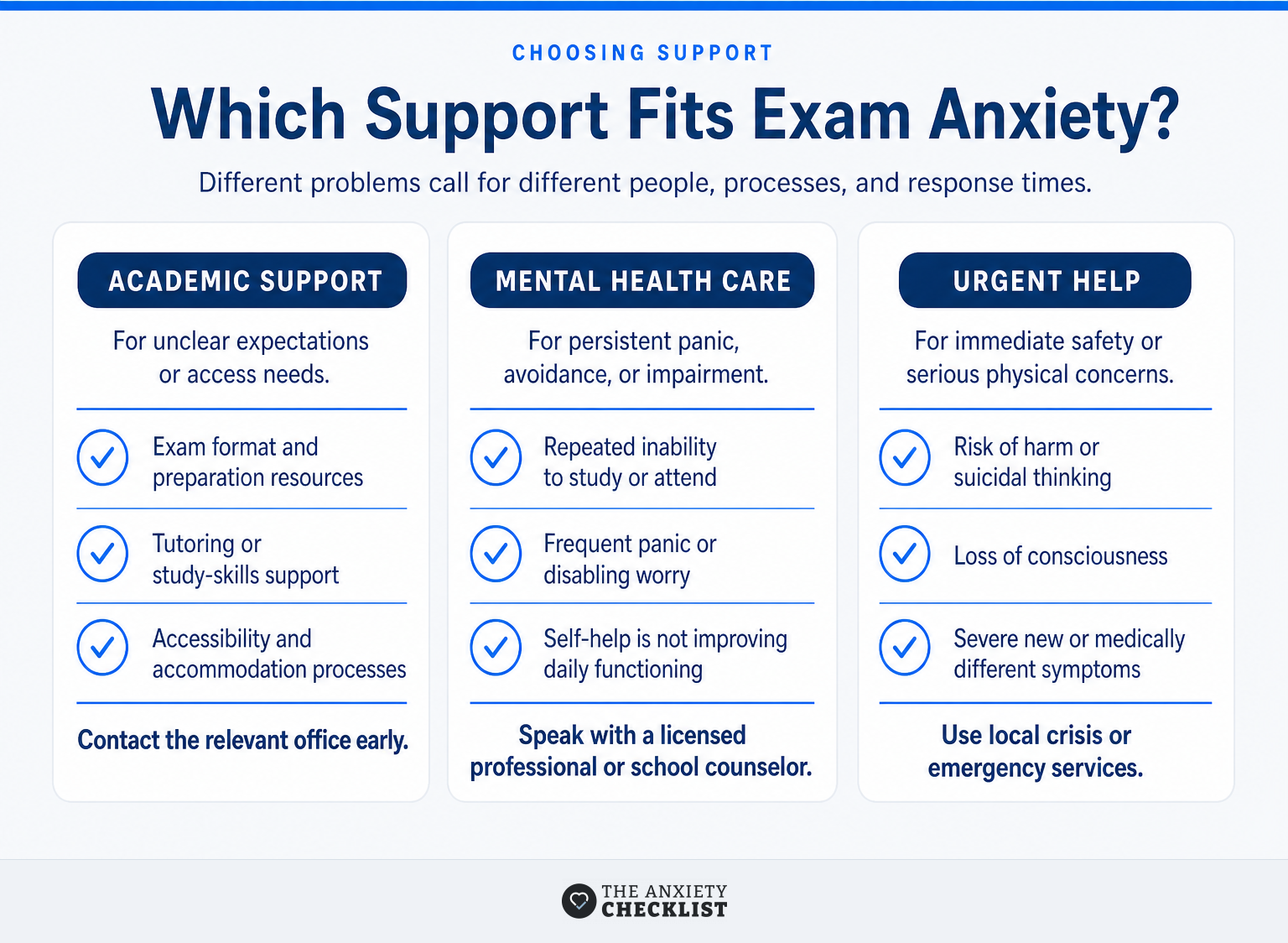
- Instructor or academic support: Ask about the exam format, preparation resources, tutoring, practice materials, and any steps available after a disrupted exam.
- Accessibility or disability support: Contact the relevant office early if a disability, learning difference, attention condition, or mental-health condition may require arrangements. Eligibility, documentation, and available accommodations vary by institution and jurisdiction.
- Mental-health support: A licensed clinician or school counselor can assess persistent anxiety, panic, avoidance, or other conditions that may be affecting concentration and learning.
- Urgent support: Use local crisis or emergency services when there is an immediate risk of harm, suicidal thinking, loss of consciousness, or severe new physical symptoms.
Mayo Clinic recommends professional counseling when needed and notes that students with certain diagnosed conditions may qualify for test-taking support. Child Mind Institute similarly explains that some students may be eligible for arrangements such as additional time or an approved break, but qualification is not automatic. (mayoclinic.org)
A 2024 systematic review of high-school academic-stress interventions found the strongest evidence for targeted cognitive behavioral programs, particularly among students with higher anxiety, while results for universal programs and some relaxation or mindfulness approaches were mixed. Self-help techniques can be useful, but they are not a diagnosis or a replacement for individualized care. (link.springer.com)
For a child or teenager, involve a trusted adult and supportive school staff early unless doing so would create a safety concern.
Seek support when anxiety repeatedly changes attendance, preparation, health, or daily functioning.
What are the most common questions about exam anxiety?
These brief answers address questions students and adult learners often ask before an exam. They support the plan above but cannot diagnose anxiety or determine individual accommodation eligibility.
How can I cope with exam stress?
Cope with exam stress by reducing uncertainty and using a short routine: confirm the format, study with practice questions, protect sleep, arrive with a buffer, and rehearse one calming technique. During the exam, read the instructions, begin with a workable item, and skip questions temporarily when you are stuck.
What is the 3-3-3 rule for anxiety?
The 3-3-3 rule is a grounding exercise: notice three things you can see, identify three sounds, and move three parts of your body. It may redirect attention to the present, but the evidence for this specific rule is limited. Use it as a brief attention tool, not a guaranteed treatment. (health.clevelandclinic.org)
How to deal with panic attacks during exams?
If familiar panic symptoms rise during an exam, plant both feet, breathe gently, name neutral details around you, and move to an easier question. Ask the proctor for an approved break if available. Seek urgent medical help for new, severe, or different symptoms rather than assuming every episode is anxiety.
Why am I nervous before an exam?
Nervousness before an exam is a normal threat response to uncertainty, evaluation, past difficulty, high expectations, or fear of failure. Exam anxiety becomes a bigger problem when it drives avoidance, sleep disruption, repeated panic, or difficulty functioning. Preparation and support should target those patterns, not demand perfect calm.
Exam anxiety is easier to manage when preparation, in-test recovery, and appropriate support work together.
What should you do next?
Choose one routine and practice it before the next study session: open the material, answer one question from memory, and rehearse the recovery sequence once. For guided breathing, grounding, sleep audio, meditation, and walking sessions between exams, explore the daily anxiety relief tools. (anxietychecklist.com)
The next useful step is one short practice session today, not a promise that you will feel no anxiety.