


In short
The anxiety-avoidance cycle starts when a trigger causes fear, avoidance brings immediate relief, and that relief teaches the brain to escape again. The pattern changes through small, safe, repeated approach steps that test anxious predictions. Success means learning that discomfort can be handled, not forcing anxiety to disappear on command.
Key takeaways
- Avoidance is reinforced by the relief it produces, not by weakness or a lack of willpower.
- A useful cycle map records the trigger, feared prediction, avoidance response, immediate payoff, and longer cost.
- A first approach step should be safe, specific, repeatable, and large enough to test one prediction.
- Current exposure models focus on new learning rather than requiring anxiety to reach zero during every practice.
- Trauma, compulsions, medical uncertainty, severe impairment, or safety risks call for qualified professional support.
Table of contents
- What is the anxiety-avoidance cycle?
- Why does relief make avoidance stronger?
- What does avoidance look like when it is not obvious?
- How can I break the anxiety avoidance cycle?
- What should I do if anxiety spikes during an approach step?
- When is self-help not the right starting point?
- What else do people ask about anxiety and avoidance?
- What should you do next?
Avoidance is not automatically unhealthy. Leaving a genuinely dangerous situation, respecting a medical restriction, setting a boundary, or using an accessibility aid can be sensible. The target is anxiety-driven avoidance of safe-enough, meaningful situations, especially when relief today produces greater restriction tomorrow.
Changing the cycle is not about proving that fear is irrational or making yourself feel fearless. It is about giving the brain repeated evidence that uncertainty, awkwardness, physical arousal, and imperfect performance can sometimes be handled without escape.
What is the anxiety-avoidance cycle?
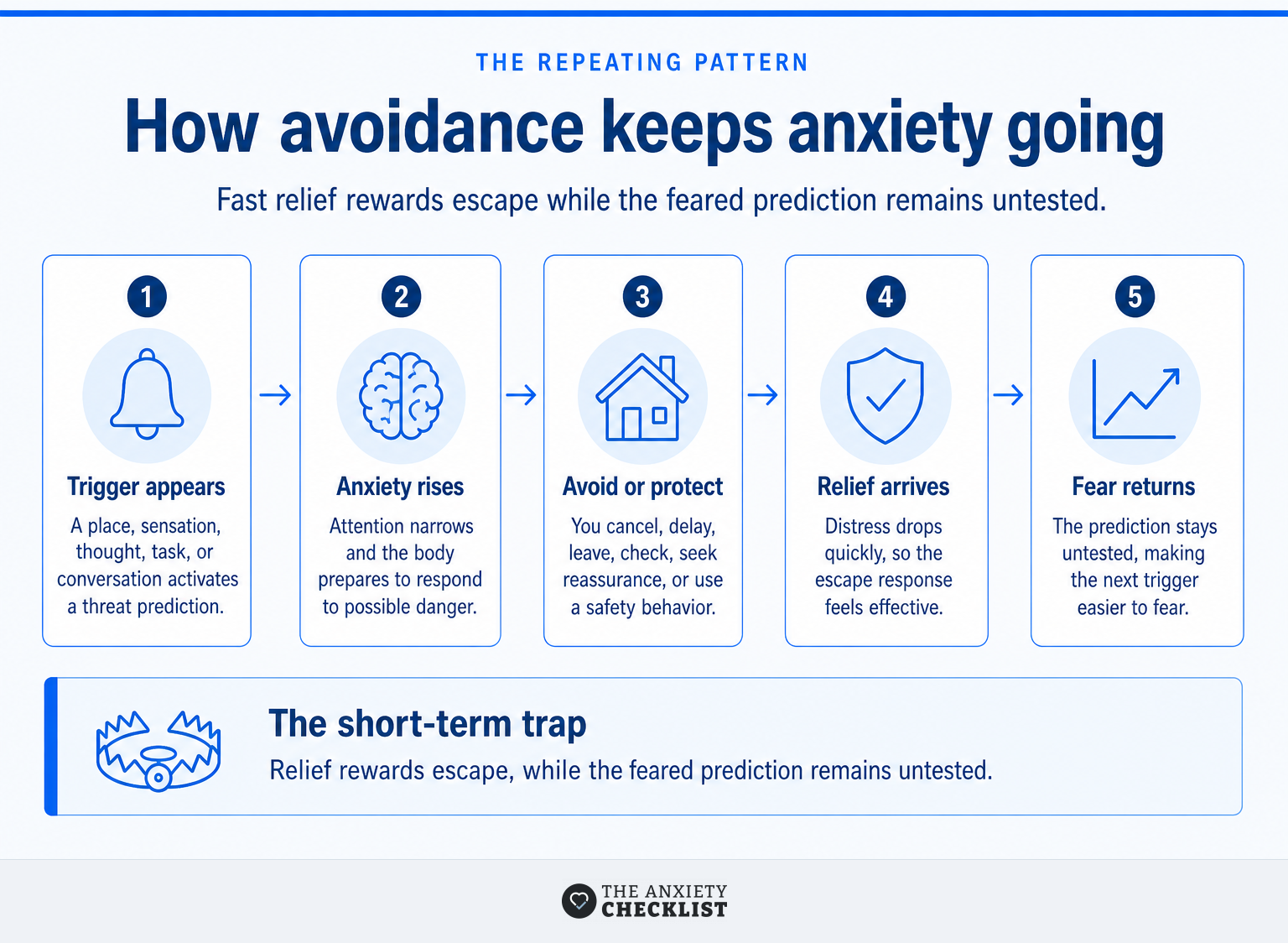
The anxiety-avoidance cycle is a learning loop in which a trigger produces a threat prediction, anxiety prompts escape or protection, and relief makes the same response more likely next time. The feared situation remains untested, so anxiety retains its influence over future choices.
The loop usually contains five parts:
- Trigger: A place, task, thought, sensation, memory, conversation, or uncertain outcome activates fear.
- Threat prediction: The mind predicts danger, humiliation, loss of control, unbearable discomfort, or another unwanted result.
- Avoidance or protection: The person cancels, delays, leaves, checks, seeks reassurance, distracts themselves, or depends on a safety behavior.
- Immediate payoff: Anxiety falls, uncertainty ends temporarily, or the feared test never happens.
- Longer cost: Confidence falls, the trigger remains threatening, and avoidance may spread to related situations.
For example, someone feels anxious before a team meeting and keeps the camera off. Relief arrives immediately, but the person never learns whether visible nervousness would actually be noticed or judged. The next meeting may then feel even more threatening.
The American Psychological Association explains that avoidance can reduce fear in the short term while making it worse over time. NHS Every Mind Matters likewise recommends facing fears gradually through a structured process rather than jumping directly to the hardest situation.
When the same sequence starts running automatically across worry, body sensations, checking, and escape, it can become an anxiety loop that affects several parts of daily life.
Avoidance keeps anxiety going because fast relief rewards escape and blocks corrective learning.
Why does relief make avoidance stronger?
Relief makes avoidance stronger because the brain learns from what changes distress quickly. Escaping does not prove the trigger was dangerous; it only proves that escape changed how the person felt in that moment.
Psychologists call this negative reinforcement. The word negative means that an unpleasant feeling was removed, not that the person did something morally wrong.
Suppose someone feels a racing heart while waiting in a store and immediately leaves. The physical alarm drops outside, so leaving feels protective. The person does not get to observe whether the sensations would have changed while remaining in the store or whether the feared outcome would have occurred.
Avoidance can also strengthen the original prediction by making it impossible to test. If the prediction is “My voice will shake and everyone will think I am incompetent,” skipping the presentation leaves both parts unanswered. The mind is free to treat the escape as evidence that disaster was prevented.
A 2026 BMJ review of anxiety treatments explains that modern inhibitory-learning approaches focus on changes in feared expectations and the learning that expected outcomes do not always occur. In the research reviewed, changes in expectations predicted improvement more consistently than changes in fear during the exercise.
This matters because practice does not have to end in complete calm to be useful. Anxiety may fall, stay level, or fluctuate. A more useful review asks: What was predicted, what actually happened, and what could be tested differently next time?
If escalating thoughts create urgency before the escape, strategies for interrupting an anxiety spiral can create enough space to make a deliberate choice. Calming the immediate spiral and changing long-term avoidance are related but separate tasks.
The useful goal is new evidence, not a guarantee that anxiety reaches zero during every practice.
What does avoidance look like when it is not obvious?

Avoidance is not limited to staying home or refusing to do something. It can appear as delay, excessive preparation, checking, reassurance, distraction, or rules that make participation feel possible only under tightly controlled conditions.
| Pattern | Everyday example | What remains untested |
|---|---|---|
| Escape | Leaving a store as soon as anxiety rises | Whether the sensations could be tolerated safely |
| Procrastination | Delaying an email because the reply is uncertain | Whether an imperfect message would be manageable |
| Reassurance | Asking several people if everything will be okay | Whether uncertainty can be carried without another answer |
| Over-preparation | Rehearsing every sentence before a routine call | Whether a small mistake would actually cause rejection |
| Safety positioning | Attending only when seated beside an exit | Whether remaining without the preferred escape route is possible |
| Mental avoidance | Suppressing a thought or constantly distracting from it | Whether the thought can be present without requiring action |
The function matters more than the surface behavior. Preparing for a presentation is reasonable; preparing for six hours because anxiety says one missed word would be disastrous may be part of the cycle. Asking for information once can solve a problem; asking the same question repeatedly may mainly remove uncertainty for a few minutes.
If fear and avoidance are concentrated in social or performance situations, the liebowitz social anxiety test can help describe the pattern of fear and avoidance. A screening score cannot diagnose social anxiety disorder by itself.
Safety behaviors also require nuance. A 2026 systematic review and meta-analysis found that reducing safety behaviors was associated with reductions in symptoms, but the authors also reported publication bias and called for more research. Earlier research has likewise debated when a temporary support helps participation and when it blocks learning.
Do not discard prescribed medication, accessibility aids, communication support, or sensible safety plans to prove that anxiety can be tolerated. When a behavior is mainly serving anxiety, reduce it gradually and observe what changes rather than removing every support at once.
A behavior becomes part of the cycle when its main job is preventing discomfort and it steadily narrows your choices.
How can I break the anxiety avoidance cycle?
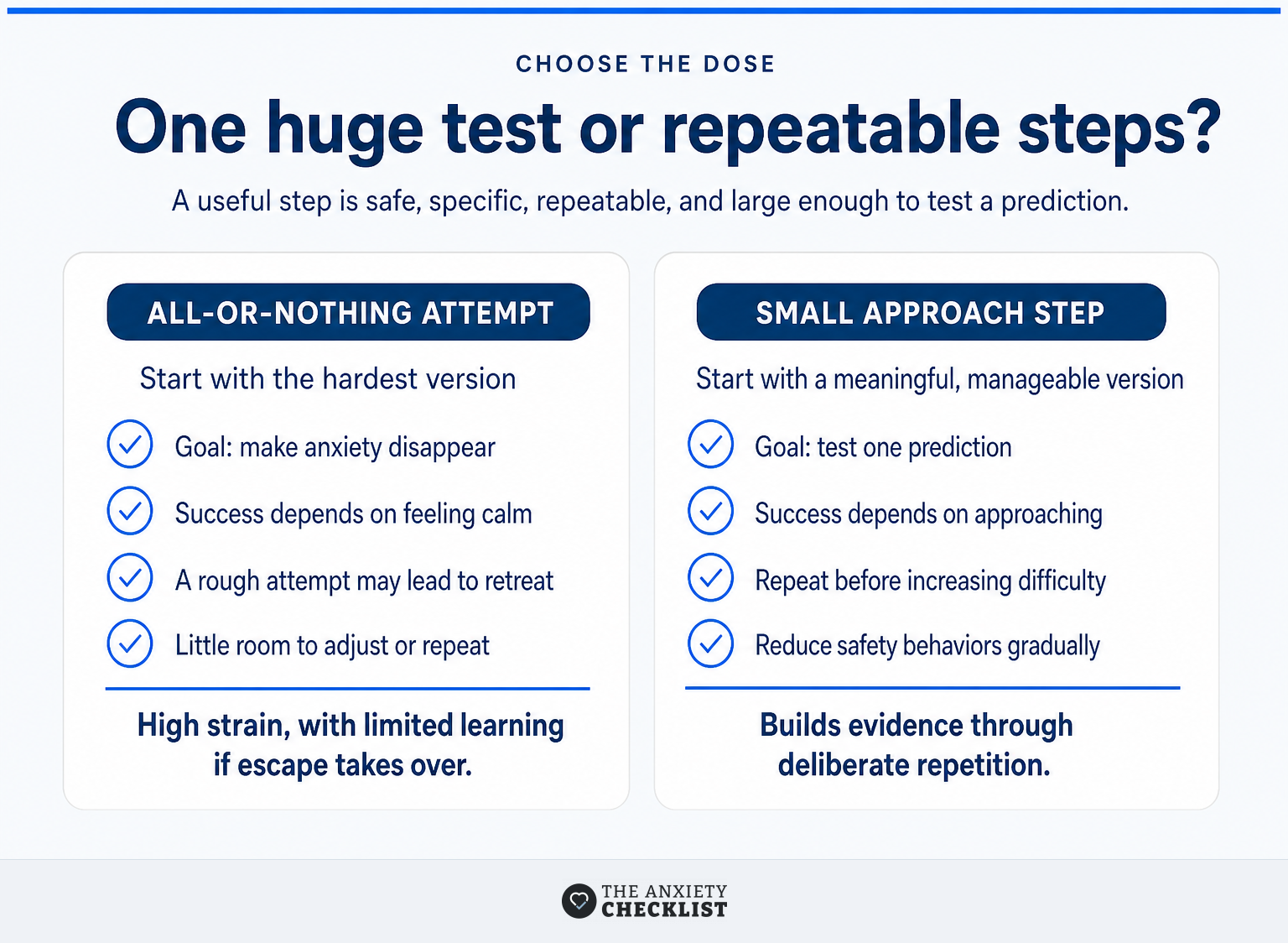
Break the anxiety avoidance cycle by mapping one repeated pattern and replacing escape with a small, safe approach experiment. The first goal is not to conquer the largest fear; it is to create an action that can be repeated and reviewed.
1. Map one loop without judging it
Choose a recent example and write down five details:
- Trigger: What happened immediately before anxiety rose?
- Prediction: What did anxiety say would happen?
- Response: What did you avoid, escape, check, or control?
- Immediate payoff: What uncomfortable feeling or uncertainty changed?
- Longer cost: What became harder, smaller, or more restricted afterward?
A completed map might read: “Weekly video call; I predict my voice will shake and colleagues will lose confidence in me; I claim a scheduling conflict; anxiety drops; the next call feels more threatening.”
The map is useful because it identifies the behavior that can change. Trying to settle every anxious thought first often leaves the avoidance untouched.
2. Build several versions of the feared action
Create easier and harder versions by changing one variable at a time. Useful variables include duration, distance, number of people, level of uncertainty, amount of preparation, or access to an easy exit.
For a feared video call, possible steps could include opening the meeting link early, joining with audio only, turning the camera on for the greeting, asking one prepared factual question, or giving a brief update with less rehearsal.
Rate anticipated difficulty from 0 to 10 and arrange the steps from easier to harder. Begin with a meaningful step that produces some discomfort but still feels safe, voluntary, and repeatable. Starting with the hardest item can turn the exercise into an endurance test rather than a learning opportunity.
3. Write the prediction before starting
A specific prediction is easier to test than “This will be awful.” Write what is expected to happen and, where possible, what could be observed.
For example:
- “My voice will shake for the entire call.”
- “At least two people will comment on it.”
- “I will be unable to finish one sentence.”
- “If anxiety reaches 7 out of 10, it will continue rising until I leave.”
Do not replace the anxious prediction with forced reassurance. The purpose is to make the original forecast clear enough to compare with the outcome.
4. Approach, observe, and record what happened
Complete the step while allowing some uncertainty to remain. If the situation is safe enough to continue, stay engaged long enough to observe something about the prediction rather than leaving automatically at the first rise in anxiety.
Record the outcome in concrete terms. Did the feared event happen, partly happen, or not happen? If something uncomfortable did happen, was it as severe or unmanageable as predicted? What action was possible while anxiety was present?
A successful practice is not defined only by a falling anxiety rating. Approaching the situation, gathering information, and discovering that action remained possible are also meaningful outcomes.
5. Repeat before making the step harder
Repeat the same step or a close variation so the new response is not treated as a one-time exception. Practice in more than one context when it is appropriate, because learning that occurs only in one tightly controlled setting may not transfer automatically.
After several attempts, adjust one variable. Increase the duration slightly, reduce preparation, sit a little farther from the exit, delay one reassurance request, or remove one nonessential safety behavior. Change one element so it remains clear what was learned.
Small, repeated approach experiments usually teach more than one overwhelming attempt.
What should I do if anxiety spikes during an approach step?
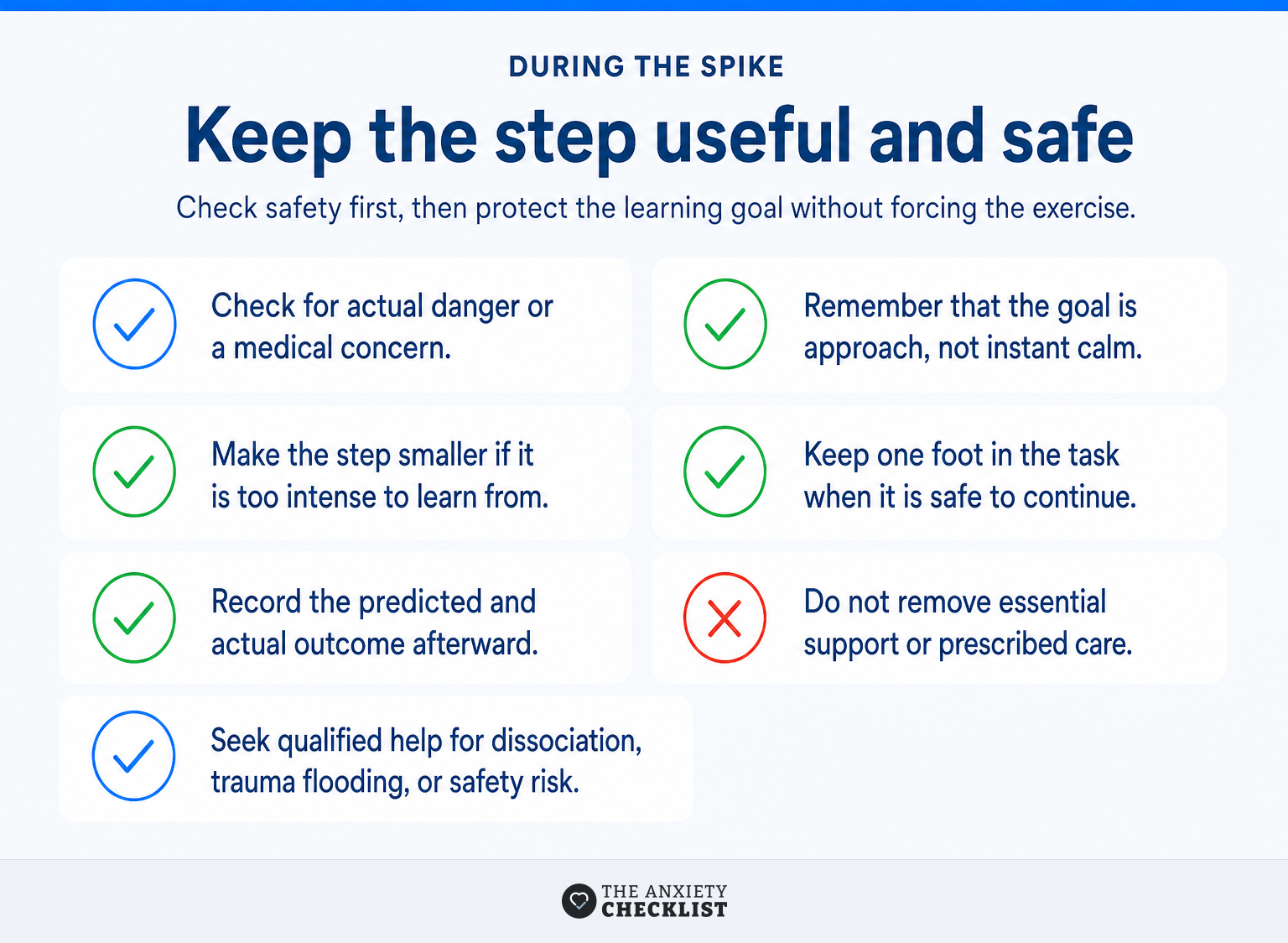
An anxiety spike does not automatically mean the approach step has failed or caused harm. First check for actual danger or a medical concern, then decide whether to continue, reduce the step, pause, or seek support based on safety rather than the urge to escape alone.
Use these questions in the moment:
- Is there an actual hazard? Move to safety if there is real danger, a new medical symptom, or a situation that violates consent or personal boundaries.
- What is the task? Return attention to the chosen action rather than repeatedly checking the anxiety level.
- Can the step be reduced without abandoning the direction? Speak for 30 seconds instead of five minutes, enter the doorway instead of crossing the entire room, or delay reassurance briefly rather than forbidding it completely.
- What prediction can still be observed? Even a shortened practice can test whether anxiety makes all action impossible.
- Am I using a coping method as orientation or as a guarantee? Grounding can help attention return to the present, but waiting for a ritual to produce complete calm may create another condition for participation.
Do not force a practice through dissociation, loss of awareness, escalating trauma memories, a medical warning sign, or a genuine safety risk. A step that repeatedly becomes overwhelming may need to be redesigned with a qualified professional.
An anxiety spike can still be useful practice if the situation is safe and the step remains deliberate.
When is self-help not the right starting point?

Self-help is not the right starting point when the feared material requires specialized assessment, when symptoms create significant safety concerns, or when the person cannot carry out daily responsibilities. Exposure methods are adapted to the condition and should not be treated as one generic exercise.
Seek qualified support before attempting self-directed exposure when:
- Avoidance centers on traumatic memories, flashbacks, or dissociation.
- Compulsions, contamination fears, intrusive thoughts, or mental rituals suggest that specialized exposure and response prevention may be needed.
- Eating, swallowing, exercise, driving, medication, or physical sensations involve unresolved medical questions.
- Alcohol, non-prescribed medication, or another substance is being used to enter or escape feared situations.
- Anxiety causes self-neglect, inability to work or study, severe isolation, or major disruption to relationships and daily tasks.
- The situation involves abuse, coercion, discrimination, unsafe working conditions, or another real threat that should not be reframed as anxiety.
- There is a risk of self-harm, suicide, or harm to another person.
The VA National Center for PTSD describes prolonged exposure for PTSD as an individual therapy that gradually addresses trauma-related memories, feelings, and situations. The NICE guideline for GAD and panic disorder, amended in 2020, states that high-intensity CBT for marked functional impairment should be delivered by trained and competent practitioners.
Anxiety Checklist provides educational self-help tools, not professional diagnosis, psychotherapy, medical treatment, or emergency support. If there is immediate danger or a risk of self-harm, contact local emergency services or a crisis service in the reader's country now.
Self-help should give way to qualified care when risk, trauma, compulsions, medical uncertainty, or severe impairment changes the task.
What else do people ask about anxiety and avoidance?
These short answers address common questions that appear beside searches for the anxiety-avoidance cycle. Grounding may help someone regain attention in the moment, but long-term change usually requires a different response to avoidance itself.
How can I break the anxiety avoidance cycle?
You can break the anxiety avoidance cycle by mapping one trigger, the feared prediction, the avoidance response, the immediate relief, and the longer cost. Then choose a small, safe approach step, repeat it, and record what actually happens. Professional guidance is advisable when symptoms are severe, trauma-related, compulsive, or disabling.
What is the #1 worst habit for anxiety?
There is no clinically established single worst habit for every person with anxiety. However, repeated avoidance is a common maintaining pattern because quick relief rewards escape and blocks new learning. Reassurance, checking, procrastination, and over-preparation can play the same role when they become automatic ways to prevent discomfort.
What is the 3-3-3 anxiety rule?
The 3-3-3 anxiety rule is a grounding exercise: notice three things you can see, identify three sounds, and move three body parts. It may redirect attention to the present, but it does not break avoidance by itself. Cleveland Clinic noted in 2026 that research on this specific exercise remains limited.
How to stop being afraid of everything?
Trying to eliminate every fear at once usually creates another all-or-nothing test. Start with one area that matters, separate genuine danger from anxiety's prediction, and practice a manageable approach repeatedly. If fear affects many areas, causes severe impairment, or involves trauma or compulsions, seek an assessment from a qualified mental health professional.
Grounding can help in the moment, but breaking avoidance requires repeated changes in behavior.
What should you do next?
Choose one safe, meaningful situation that anxiety has been making smaller, then write its trigger, prediction, avoidance response, quick payoff, and longer cost. Turn that map into one approach step that can be repeated rather than one dramatic test that must go perfectly.
Ready to organize the steps? As of October 2026, the Anxiety Checklist Mobile App's exposure therapy fear ladder app lets users build a ladder of up to six steps and mark steps as completed. The tool is educational self-help, not a substitute for diagnosis, psychotherapy, medical care, or emergency support.
Choose one safe, meaningful step that tests a prediction, then repeat it before making it harder.