


In short
The Liebowitz Social Anxiety Scale (LSAS) is a 24-situation screening and symptom-severity measure that rates both fear and avoidance over the past week. Add all 48 ratings for a total from 0 to 144. A higher score signals greater symptom burden, but no total can diagnose social anxiety disorder by itself. (heilbrigdisvisindastofnun.hi.is)
Key takeaways
- The adult LSAS contains 24 situations, and each receives a 0 to 3 fear rating plus a 0 to 3 avoidance rating, producing a total from 0 to 144. (heilbrigdisvisindastofnun.hi.is)
- A 2002 clinician study and a 2009 self-report study found 30 was the best screening cutoff in their clinical samples, but a cutoff is not a diagnosis. (sciencedirect.com)
- The often-cited score of 60 classified an older generalized subtype; the APA removed that subtype from DSM-5 in 2013. (psychiatry.org)
- Fear and avoidance subtotals can reveal different patterns even when two total scores match. (heilbrigdisvisindastofnun.hi.is)
- The LSAS is copyrighted, so publishers should link to a legitimate form rather than republish all 24 situations without confirmed permission. (watermark02.silverchair.com)
Table of contents
- What does the Liebowitz Social Anxiety Scale measure?
- How do you take the LSAS correctly?
- How do you calculate your LSAS score?
- What does your Liebowitz score mean?
- Why can two people with the same score need different help?
- Can the LSAS diagnose social anxiety disorder?
- What should you do after getting your score?
- What else do people ask about social anxiety?
- What is the next useful step?
What does the Liebowitz Social Anxiety Scale measure?
The LSAS measures how strongly adults fear and avoid 24 social-interaction and performance situations. Each situation is rated twice, so the result captures both internal distress and behavioral restriction.
Michael R. Liebowitz developed the scale in the 1980s, with its first publication appearing in 1987. Michael R. Liebowitz's 2003 administration guidelines divide the scale into 13 performance-related and 11 social-interaction situations and describe separate fear, avoidance, performance and social-interaction subscores. (heilbrigdisvisindastofnun.hi.is)
That two-part design answers a practical question other measures can miss: does a person feel intense fear but still endure the situation, or has avoidance already narrowed daily life? The manual also warns that a focal problem can cause serious impairment even when the overall total is not especially high. (heilbrigdisvisindastofnun.hi.is)
The LSAS is specific to social and performance anxiety. When worry is broad rather than mainly social, a free anxiety test selector may point to a more suitable general screening measure.
The LSAS is most useful because it separates what a person feels from what that person avoids.
How do you take the LSAS correctly?
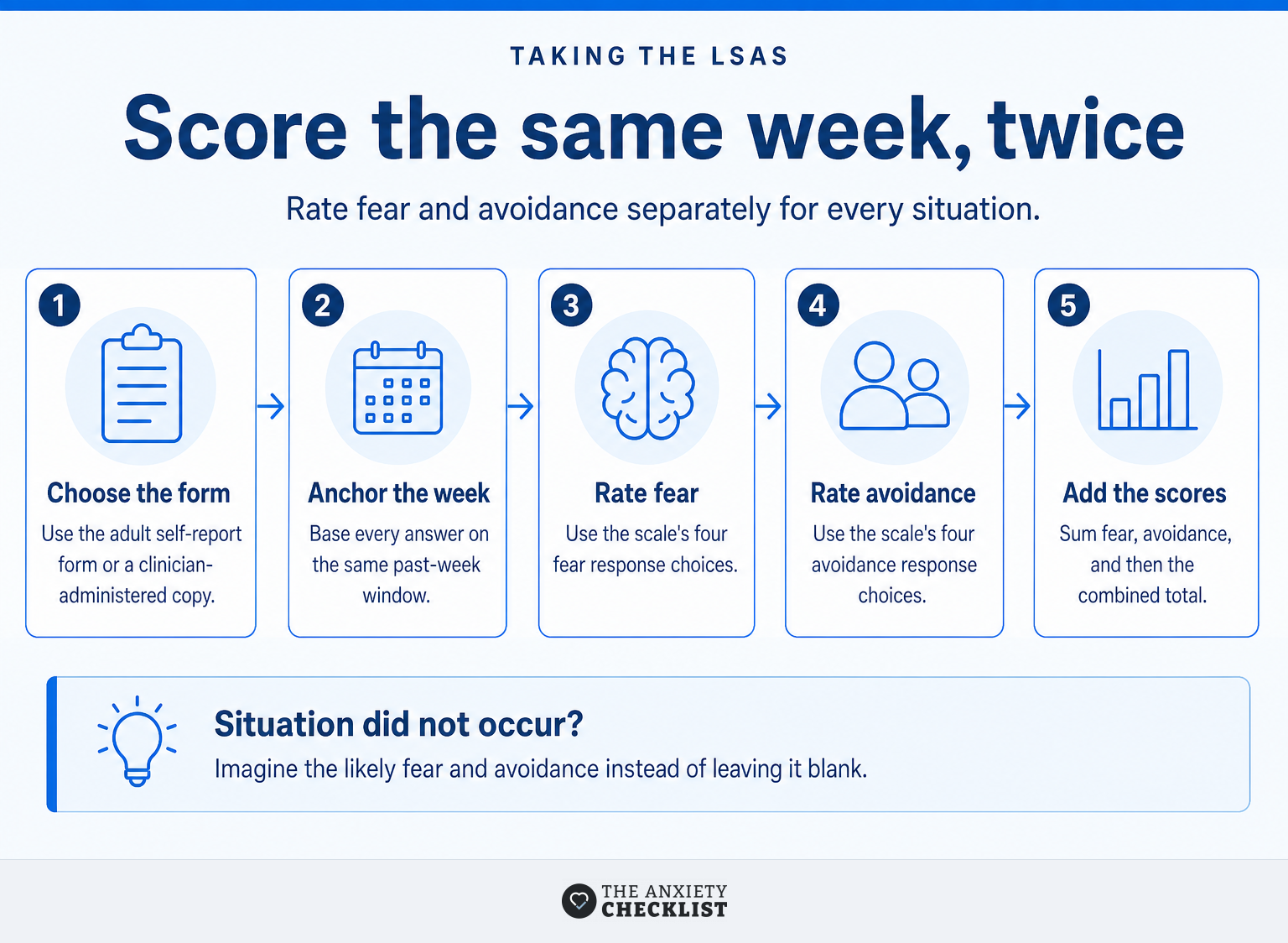
Use a legitimate adult self-report form or have a clinician administer the scale, then base every answer on the same past-week period. Rate fear and avoidance separately for every situation, including situations that did not actually occur during that week.
The Columbia University Department of Psychiatry LSAS-SR form is one legitimate place to access the adult self-report scale. The full questionnaire is not reproduced here because an Oxford Clinical Psychology reproduction notice states that the LSAS is copyrighted and may not be reproduced without the copyright holder's permission. (cumc.co1.qualtrics.com)
- Set the time frame. Think about the past week, not the worst week ever or a general average of adult life.
- Rate fear or anxiety. Give each situation one rating from 0 for none to 3 for severe.
- Rate avoidance. Give the same situation a second rating from 0 for never avoided to 3 for usually avoided.
- Imagine missing situations. If a situation did not occur, rate how much fear and avoidance would probably have occurred if it had.
- Use one answer. If the honest response feels between two choices, select the single rating that fits best rather than averaging them.
These instructions follow the 2003 administration guidelines, which emphasize a consistent past-week frame and the same interpretation of each situation when the scale is repeated. (heilbrigdisvisindastofnun.hi.is)
An unusually quiet, stressful or socially demanding week can influence the result. Record the date and context rather than trying to adjust the score afterward.
A careful LSAS result starts with one consistent week, two ratings per situation, and no skipped items.
How do you calculate your LSAS score?
Add the 24 fear ratings to obtain a fear subtotal, then add the 24 avoidance ratings to obtain an avoidance subtotal. Each subtotal ranges from 0 to 72, and adding the two produces the 0 to 144 total score.
| Score component | Calculation | Possible range |
|---|---|---|
| Fear subtotal | Add all 24 fear ratings | 0–72 |
| Avoidance subtotal | Add all 24 avoidance ratings | 0–72 |
| LSAS total | Fear subtotal plus avoidance subtotal | 0–144 |
| Performance subtotal | Add both ratings for the 13 performance situations | 0–78 |
| Social-interaction subtotal | Add both ratings for the 11 social situations | 0–66 |
The LSAS manual describes the global total, the two fear and avoidance subtotals, the performance and social-interaction subtotals, and four more detailed domain scores. (heilbrigdisvisindastofnun.hi.is)
For a simple arithmetic example, a fear rating of 2 and an avoidance rating of 3 contribute 5 points to the total. Repeat that addition for every situation, then check that the combined score equals the fear subtotal plus the avoidance subtotal.
Keep the subtotals. A single total is easier to compare, but the fear and avoidance numbers explain how that total was built.
The total is simple addition, but the fear and avoidance subtotals explain how the number was built.
What does your Liebowitz score mean?
An LSAS total estimates the burden of social-anxiety symptoms during the period being rated, but it does not have one universally accepted diagnostic meaning. Screening cutoffs and descriptive severity bands were created for different purposes, so they should not be treated as interchangeable.
| Total score | What the available evidence supports |
|---|---|
| 0–29 | Below the score of 30 that best separated cases and controls in two clinical studies. This does not rule out focal or impairing symptoms. |
| 30–49 | At or above the research screening cutoff. The 1999 author-reviewed score guide did not assign a severity label below 50. |
| 50–59 | Within the 50–69 moderate band in the 1999 scoring presentation. |
| 60–69 | Still within that moderate band. A score of 60 also separated the older generalized and nongeneralized subtypes in DSM-IV-era studies. |
| 70–89 | Marked in the 1999 scoring presentation. |
| 90–109 | Severe in the 1999 scoring presentation. |
| 110–144 | Very severe in the 1999 scoring presentation. |
The 1999 author-reviewed scoring presentation gives the severity bands beginning at 50. The 2002 clinician-administered cutoff study and 2009 LSAS-SR study found that scores of 30 and 60 provided the best balance of sensitivity and specificity in their respective clinical samples. (static1.squarespace.com)
Why do online calculators give different labels?
Online calculators often combine severity labels and research cutoffs into one simplified scale. If a calculator labels 30 to 49 as mild, that is the calculator's convention, not a DSM diagnostic category and not a label used in the 1999 author-reviewed guide.
The score of 60 needs another update. As of September 2026, current DSM-5-TR terminology no longer includes the generalized subtype used by the older cutoff studies; the APA removed that subtype in DSM-5 and replaced it with a performance-only specifier. (psychiatry.org)
Treat every LSAS range as an interpretation aid, not a diagnostic verdict.
Why can two people with the same score need different help?

The same LSAS total can be built from very different fear and avoidance patterns. The individual situations and their real-life consequences therefore matter as much as the combined number.
A total of 72, for example, could consist of 50 fear points and 22 avoidance points, or 30 fear points and 42 avoidance points. The arithmetic is equal. The experience may not be.
High fear with lower avoidance may mean a person is completing necessary tasks while enduring intense distress. Higher avoidance can mean that work, education, relationships or ordinary errands have already been reorganized around preventing social exposure. Avoidance should only count when social or performance anxiety is the reason for it. (heilbrigdisvisindastofnun.hi.is)
Concentrated high ratings also matter. The manual notes that one focal fear can cause substantial impairment despite a lower total, which is why the result should be read at three levels: the combined score, the fear-versus-avoidance pattern, and the situations affecting daily life. (heilbrigdisvisindastofnun.hi.is)
The same total can hide very different patterns of distress and restriction.
Can the LSAS diagnose social anxiety disorder?
No. The LSAS can screen for and measure the severity of social-anxiety symptoms, but the scale's own administration manual says it was not designed as a diagnostic instrument.
The National Institute of Mental Health overview of social anxiety disorder explains that diagnosis requires persistent fear or anxiety involving possible scrutiny, avoidance or extreme discomfort, symptoms lasting at least six months, and interference with work, school, relationships or daily life. A clinician also considers physical conditions, substances and other mental-health explanations. (nimh.nih.gov)
The LSAS only asks about a past-week window and cannot establish all those conditions. A broader guide to social anxiety disorder can help put the score beside symptoms, impairment and treatment options, but it still does not replace an individual assessment.
Evidence supports the scale's usefulness. A 2002 LSAS-SR psychometric study found good test-retest reliability, internal consistency, convergent validity and discriminant validity, as well as sensitivity to treatment change. The authors also said the self-report version's construct validity required further study. (pubmed.ncbi.nlm.nih.gov)
The adult LSAS should not be substituted for the separate LSAS-CA developed for children and adolescents. (heilbrigdisvisindastofnun.hi.is)
Only a clinical assessment can determine whether symptoms meet current diagnostic criteria.
What should you do after getting your score?
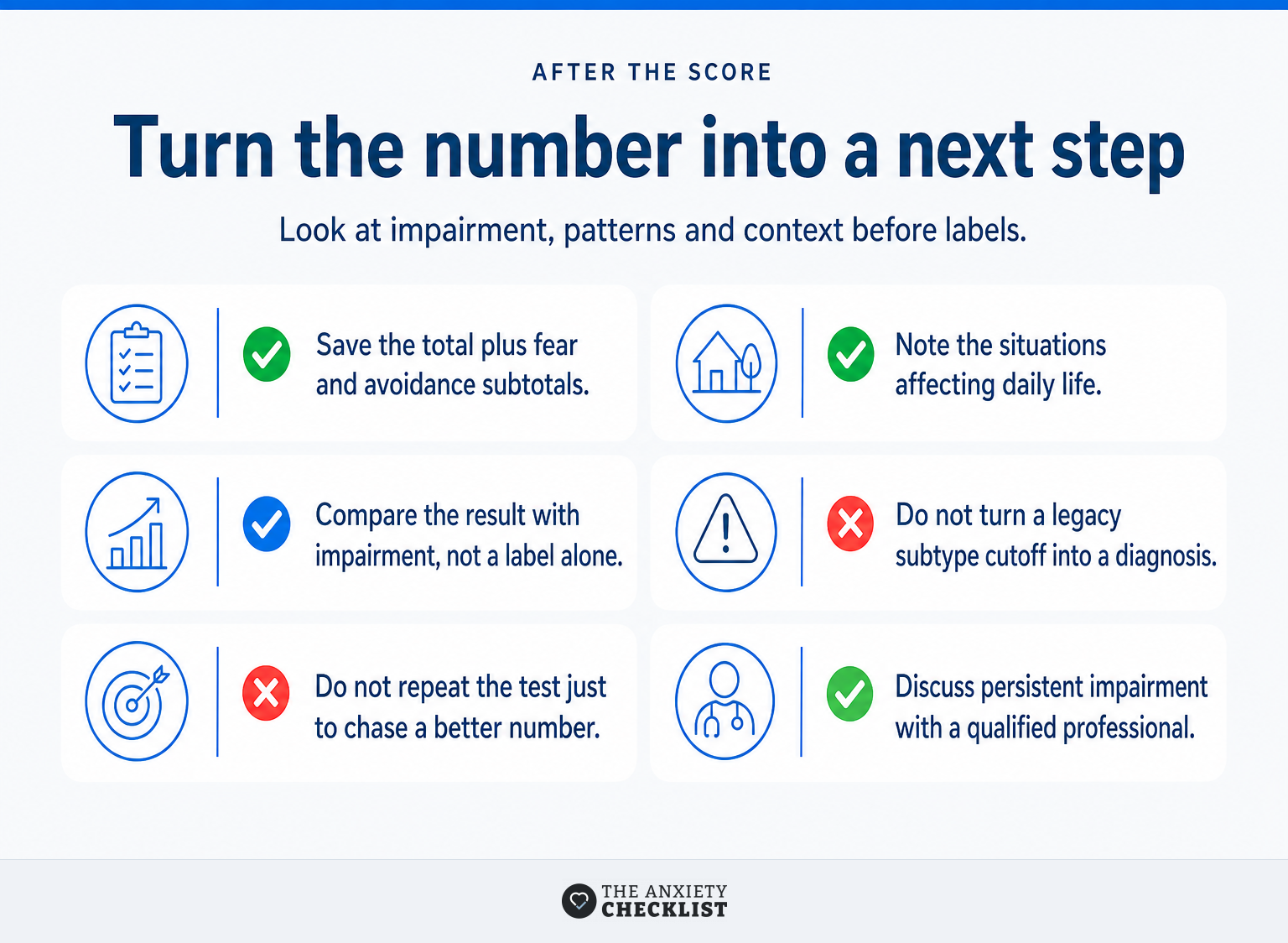
Use the result to identify the situations and avoidance patterns that deserve attention, not to assign yourself a diagnosis. Functional impairment and persistence should guide the next step more than one threshold or severity label.
- Save the full result. Record the date, total, fear subtotal and avoidance subtotal.
- Name the affected situations. Write down the three situations with the greatest effect on work, school, relationships, healthcare or ordinary errands.
- Do not dismiss a lower score automatically. Focal symptoms can still be highly impairing.
- Treat 30 as a screening signal, not confirmation. Discuss persistent or limiting symptoms with a qualified healthcare or mental-health professional.
- Do not turn 60 into a current generalized diagnosis. That cutoff refers to older subtype terminology.
- Repeat consistently. Use the same version, time frame and interpretation of each situation if the LSAS is used to observe change.
For tracking treatment, a 2018 German psychotherapy study found that a reduction of 28% on the LSAS-SR and 29% on the clinician-administered version best classified treatment response in that sample. Those percentages are research benchmarks, not personal pass-or-fail targets. (pubmed.ncbi.nlm.nih.gov)
If the result triggers repetitive predictions, self-criticism or post-event rumination, read anxiety spiral, explained for a separate look at how anxious thoughts escalate. An LSAS score can identify a pattern, but it does not interrupt that pattern by itself.
The LSAS does not assess suicide risk or determine whether a situation is an emergency. Contact local emergency or crisis services if there is immediate danger or a risk of self-harm. (nimh.nih.gov)
The next step should follow impairment and avoidance, not the score alone.
What else do people ask about social anxiety?
These common questions require broader diagnostic or treatment guidance than an LSAS score can provide. The answers below explain what the scale leaves unresolved.
What is the best medication for social anxiety disorder?
There is no single best medication for every person with social anxiety disorder. NIMH says SSRIs and SNRIs are commonly used; the NICE guideline used in England recommends individual CBT first and, when an adult prefers medication, names escitalopram or sertraline as initial options. Medication choice requires a prescriber who can assess risks, interactions and other conditions. (nimh.nih.gov)
What are the DSM-5 criteria for social anxiety disorder?
DSM-5-TR diagnosis requires marked fear or anxiety about social situations involving possible scrutiny, fear of negative evaluation, near-consistent anxiety or avoidance, a response out of proportion to the threat, persistence for at least six months, and significant distress or impairment. A clinician also rules out substances, medical causes and other mental disorders. (psychiatry.org)
What is high-functioning social anxiety?
High-functioning social anxiety is an informal phrase, not a DSM-5-TR diagnosis. It usually describes someone who keeps working, studying or socializing while experiencing intense fear, overpreparation, rumination or hidden avoidance. Outward performance does not reveal internal distress, so functioning and impairment need discussion alongside any LSAS score. (psychiatry.org)
What does social anxiety look like?
Social anxiety can look like blushing, sweating, trembling, nausea, a racing heart, a blank mind, soft speech or difficulty making eye contact. It can also look less visible: rehearsing conversations, expecting rejection, reviewing every perceived mistake afterward, declining opportunities, or enduring ordinary interactions with intense distress. (nimh.nih.gov)
The LSAS can organize questions about social anxiety, but it cannot choose treatment or establish a diagnosis.
What is the next useful step?
The next useful step is to save the total, fear subtotal and avoidance subtotal, then write down the three situations causing the greatest restriction or distress. If the pattern has lasted for months or limits daily life, bring that page to a qualified professional rather than trying to diagnose yourself from the number.
For ongoing self-guided support between decisions, use the Anxiety Checklist mobile app to record anxious thoughts and practice its available CBT-oriented exercises. Anxiety Checklist is educational self-help, not diagnosis, psychotherapy or emergency care. (anxietychecklist.com)
Use the LSAS as a conversation starter, not a verdict.