

In short
An anxiety spiral is best interrupted in two stages: first, reduce immediate arousal by orienting to safety, slowing the breath gently, grounding through the senses, and taking one small action. Later, when thinking is clearer, write down the trigger, identify the thinking pattern, test the evidence, and plan for the next recurrence. (cci.health.wa.gov.au)
Key takeaways
- The first goal is not to prove every fear wrong. It is to reduce urgency enough to make a deliberate choice.
- Immediate grounding and later CBT reflection are different tasks, and separating them makes the plan easier to follow.
- Gentle breathing may help, but a 2024 review found inconsistent results from brief breathing-only exercises, so changing methods is reasonable if breathing increases discomfort. (pubmed.ncbi.nlm.nih.gov)
- No credible clinical rule requires anxiety to end within 90 seconds; panic symptoms can last considerably longer. (nimh.nih.gov)
- Repeated, worsening, compulsive, or disabling spirals deserve assessment from a qualified health or mental-health professional.
Table of contents
- How to break an anxiety spiral?
- What does an anxiety spiral feel like?
- Why should you separate calming down from challenging the thought?
- How do you review the spiral after it passes?
- Is an anxiety spiral the same as a panic attack?
- When is self-help not enough?
- What else do people ask about anxiety spirals?
- What should you prepare before the next spiral?
How to break an anxiety spiral?
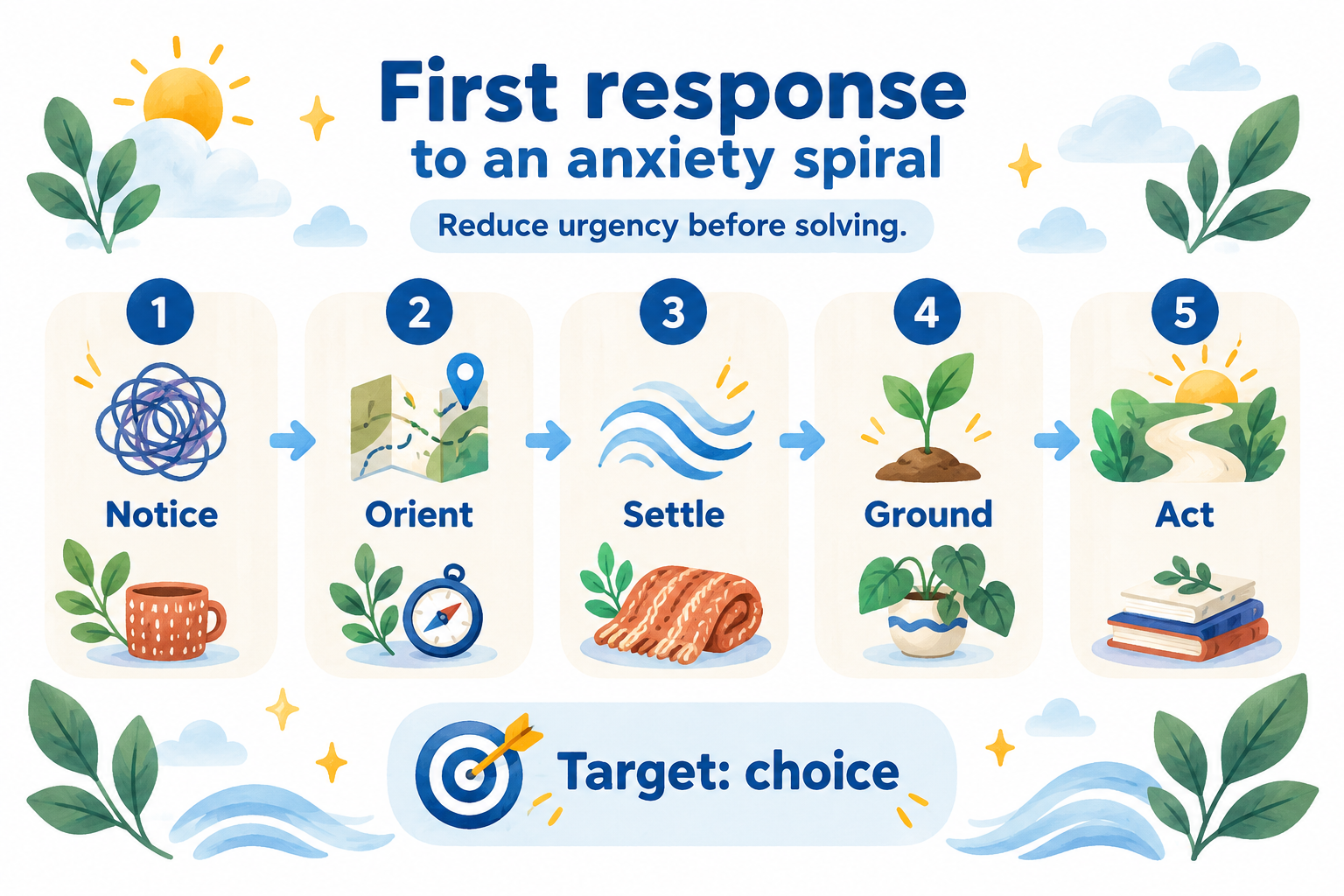
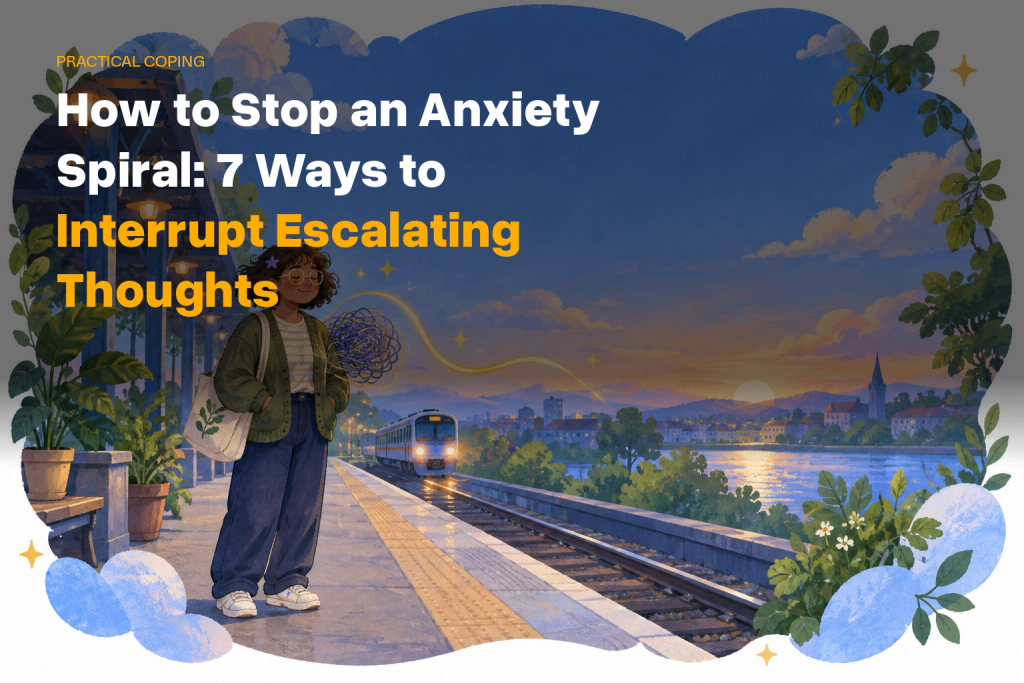
To break an anxiety spiral, interrupt whichever part of the loop is easiest to reach: the body, attention, language, or next action. Aim for a small reduction in urgency rather than waiting to feel completely calm. (cci.health.wa.gov.au)
The following seven options are entry points, not a test. Use the simplest one available and switch methods if a technique makes the experience harder.
1. Can you check what is happening right now?
Ask one factual question: Is a dangerous problem happening now, or is the mind predicting one? If there is immediate danger, take protective action. Otherwise, state where you are, what time it is, and what is actually happening: “I am at my desk, I received one difficult email, and I have not replied yet.”
Factual orientation is more credible than forcing reassurance such as “nothing bad will happen.” The purpose is to separate the present situation from the imagined chain that follows it.
2. Can you label the thought without agreeing with it?
Change “I am going to fail” to “I am having the thought that I am going to fail.” The second sentence does not dismiss the concern. It identifies it as a mental event that can be examined rather than an established outcome.
Keep the label short. A long argument can become another branch of the spiral.
3. Can you make the breath slower and easier?
The NHS breathing guidance, reviewed June 12, 2026 recommends letting the breath move into the belly as comfortably as possible, without forcing it, then breathing in and out gently while counting if helpful. Breath holding is not required. (nhs.uk)
A 2024 systematic review of brief interventions found that breathing-only exercises produced inconsistent results, while several combined cognitive and body-focused approaches were more consistent. If deliberate breathing causes more dizziness, air hunger, or monitoring, return to a natural breath and use sensory grounding instead. (pubmed.ncbi.nlm.nih.gov)
4. Can you move attention into the room?
Use a shortened sensory scan: name three things you see, two sensations you can feel, and one sound you hear. If more structure helps, follow the full grounding techniques for anxiety, including the 5-4-3-2-1 method.
The goal is not distraction at any cost. Sensory grounding gives attention a current, observable target.
5. Can you release one patch of tension?
Unclench the hands, lower the shoulders, soften the jaw, or press both feet into the floor for several seconds. If movement is safe, stand, stretch, or walk slowly to another part of the room.
Choose one area rather than scanning the entire body for signs that something is wrong.
6. Can you park the worry instead of solving it?
Write one sentence describing the concern and choose a specific time to return to it. The Centre for Clinical Interventions' postpone your worry worksheet recommends recording the worry briefly, returning attention to the present, and using a later worry period for problem-solving or thought-diary work. (cci.health.wa.gov.au)
Postponement is not denial. It is a decision that the concern does not need to be solved at peak intensity.
7. Can you choose one small, observable action?
Pick an action that has a visible endpoint: open the relevant document, send one factual message, drink some water, step into a quieter space, or ask a trusted person to sit nearby. Do not make “be completely calm” the task.
If helping someone in an anxiety spiral, keep choices short: “Would you rather put your feet on the floor or hold this cool glass?” Ask what usually helps, avoid giving ten instructions at once, and act immediately if the person cannot stay safe.
The goal during an anxiety spiral is not perfect calm; it is enough space to choose the next safe action.
What does an anxiety spiral feel like?
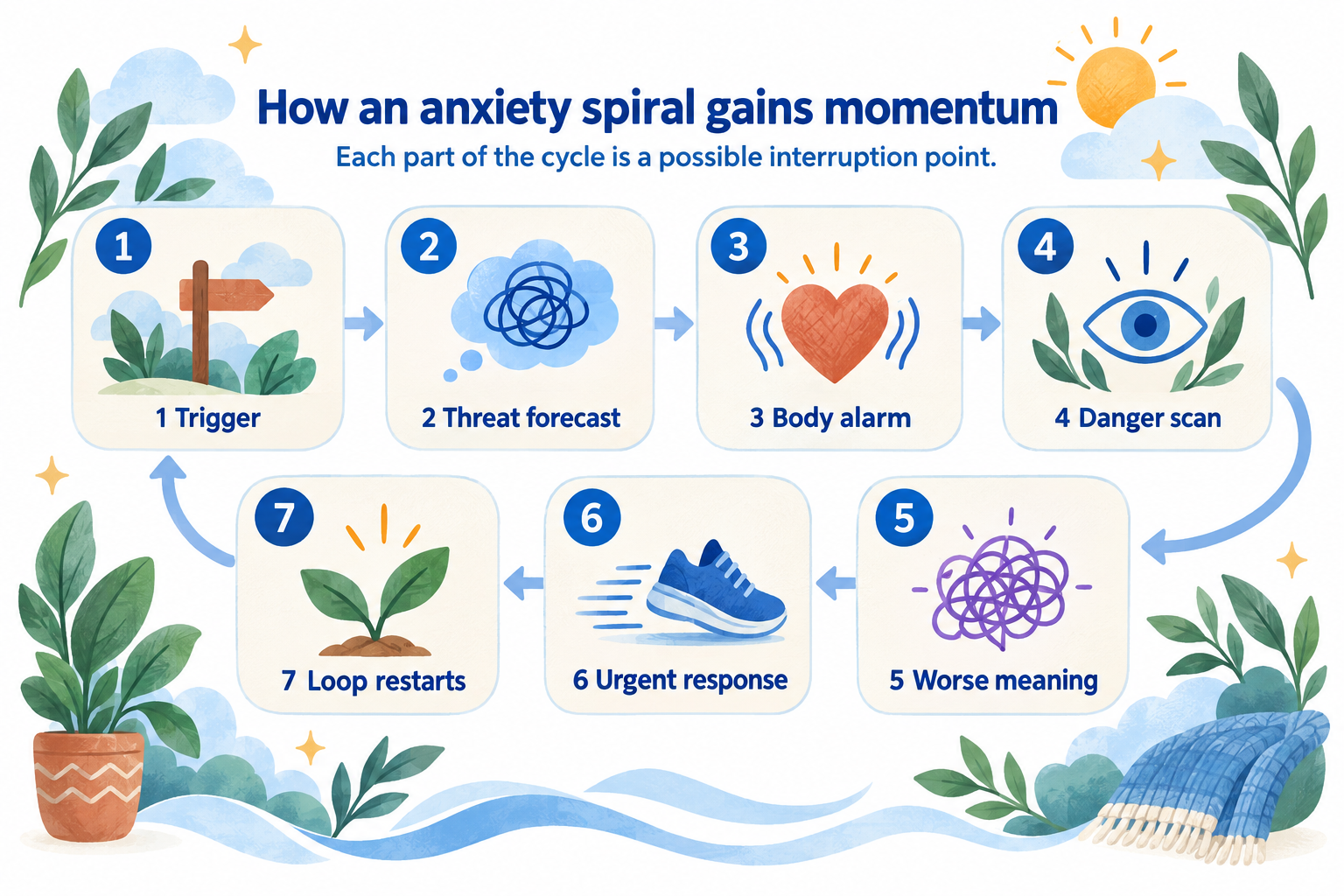
An anxiety spiral often feels like acceleration: one concern produces a worse prediction, physical tension rises, and the increased tension seems to confirm the prediction. Anxiety spiral symptoms may involve thoughts, emotions, bodily sensations, and urgent behavior rather than one single feeling. (cci.health.wa.gov.au)
A common sequence looks like this: a trigger leads to a threatening prediction, the body reacts, attention shifts toward signs of danger, and those sensations receive an even more alarming interpretation. Escape, avoidance, internet searching, or repeated reassurance may lower distress briefly without resolving the pattern.
Early warning signs can include:
- Repeating the same question with increasingly serious consequences.
- Jumping several steps into the future without checking the next likely event.
- Monitoring the heartbeat, breathing, memory, or emotions for proof of danger.
- Repeatedly searching for certainty or asking others to guarantee an outcome.
- Abandoning the current task because thinking feels urgent.
The phrase anxiety spiral describes a pattern rather than a diagnosis. Similar loops can occur with everyday stress and with several mental-health conditions, so the surrounding symptoms, frequency, and effect on daily life matter.
Early recognition turns an anxiety spiral from a mystery into a pattern with several possible interruption points.
Why should you separate calming down from challenging the thought?
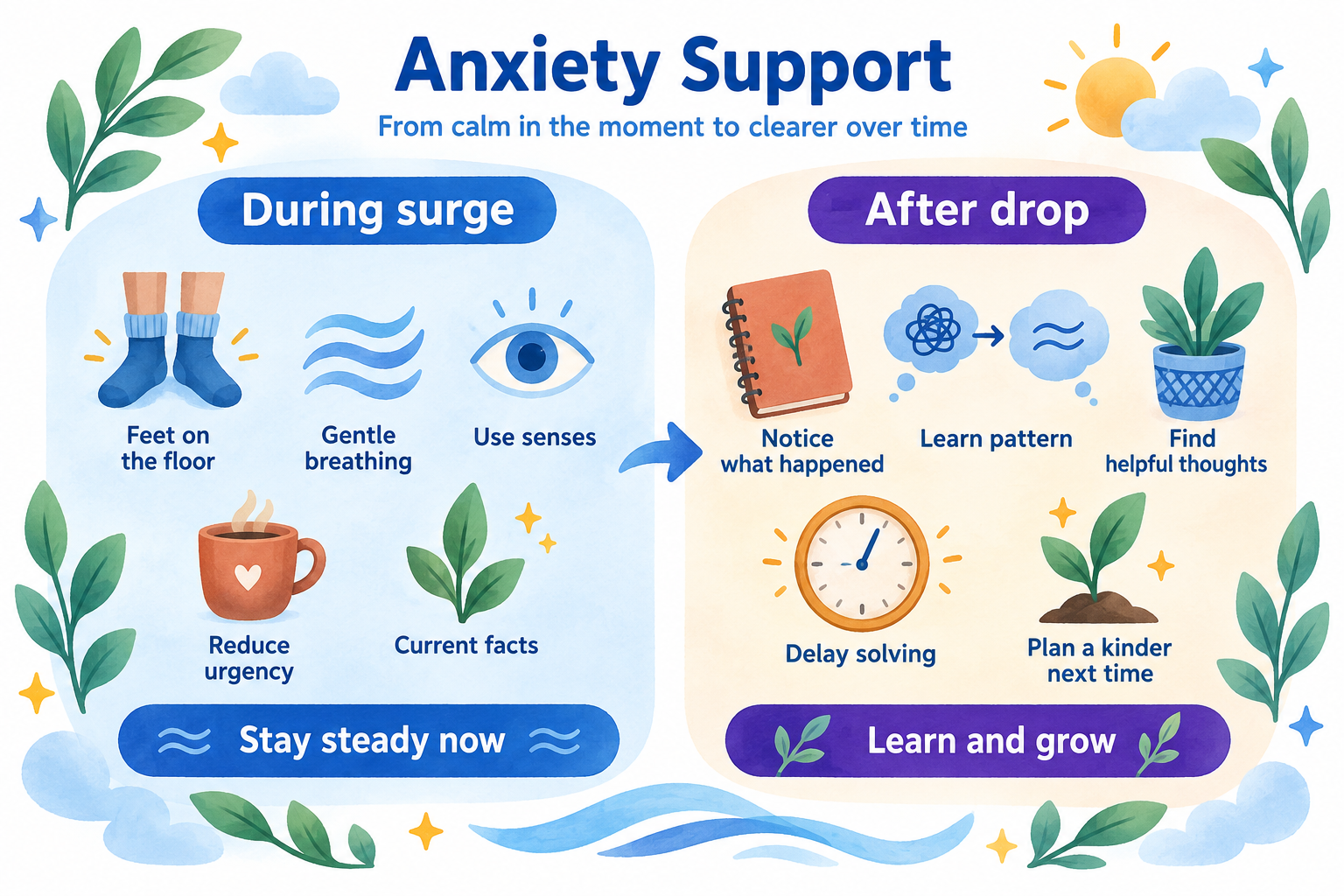
Immediate regulation and cognitive reflection require different kinds of attention. During the surge, use short body and attention tools; after the urgency falls, examine predictions, evidence, and behavior in more detail.
Trying to shut down the spiral with a long internal courtroom can keep attention fixed on the feared outcome. A shorter immediate plan reduces the number of decisions required:
- During the surge: orient, breathe gently if helpful, ground, postpone the worry, and choose one safe action.
- After the surge: record the trigger, identify the prediction, examine the evidence, and decide what behavior would provide useful information.
This order does not mean thinking is impossible while anxious. It means detailed thought work can wait until it is less likely to turn into rumination. The Centre for Clinical Interventions separates anxiety-cycle education, breathing, thought diaries, and behavioral experiments into distinct skills, while the 2024 review found that brief breathing practices do not affect everyone consistently. (cci.health.wa.gov.au)
Use body and attention tools during the surge, then use CBT reflection when thinking is clearer.
How do you review the spiral after it passes?
Review the episode by reconstructing the first trigger, the prediction that followed, and the behavior the anxiety encouraged. The purpose is to create a more accurate response and a practical experiment for next time, not to replace fear with forced optimism.
The Centre for Clinical Interventions' 2025 anxiety resources include thought diaries, thinking analysis, behavioral experiments, breathing retraining, and anxiety-cycle worksheets. The American Psychological Association likewise describes CBT as work on both thought patterns and behaviors that contribute to anxiety. (cci.health.wa.gov.au)
- Record the trigger. Describe what happened before the spiral in one or two factual sentences.
- Capture the first prediction. The first jump is often more useful than the worst thought reached ten minutes later.
- Separate facts from forecasts. List what is known, what is assumed, and what information is still missing.
- Name the pattern. Look for common cognitive distortions such as catastrophizing, mind reading, fortune telling, or all-or-nothing thinking.
- Write a balanced response. A balanced thought accepts uncertainty while correcting exaggeration: “The conversation may be uncomfortable, but I do not know that it will end the relationship.”
- Choose a behavior to test. Learning how CBT for anxiety works can help distinguish useful experiments from avoidance or repeated reassurance.
Finish with a short relapse card that can be read when concentration is limited:
- My earliest warning sign is: ____.
- My first body or grounding tool is: ____.
- The worry can wait until: ____.
- The person I can contact is: ____.
- The next small action is: ____.
A useful review produces one balanced thought and one behavior to try next time.
Is an anxiety spiral the same as a panic attack?
An anxiety spiral and a panic attack can overlap, but they are not interchangeable terms. A spiral emphasizes an escalating thought-and-feeling loop, while a panic attack is an episode of intense fear or discomfort with prominent physical or cognitive symptoms.
The NIMH panic disorder guide states that a panic attack can last from a few minutes to an hour or sometimes longer. That is one reason a rigid 90-second promise should not be used as a test of whether someone is responding correctly. (nimh.nih.gov)
| Feature | Anxiety spiral | Panic attack |
|---|---|---|
| Main pattern | Linked worries, interpretations, sensations, and reactions escalate one another | An intense episode of fear or discomfort with strong physical or cognitive symptoms |
| Onset | May build as one prediction leads to another | Often feels sudden and may occur with or without an obvious trigger |
| Duration | No standardized clinical duration | May last a few minutes to an hour or sometimes longer |
| Relationship | Can trigger panic or continue after panic eases | Can become the trigger for a later spiral about symptoms or recurrence |
A familiar panic pattern can still feel frightening. New, severe, or substantially different physical symptoms should not automatically be attributed to anxiety, particularly when urgent medical care may be needed.
An anxiety spiral can include panic, but a thought loop and a panic attack are not the same event.
When is self-help not enough?
Self-help is not enough when spirals are frequent, worsening, unsafe, or interfering with sleep, work, relationships, eating, driving, or basic responsibilities. Professional assessment is also appropriate when the pattern includes compulsions, medication concerns, unfamiliar physical symptoms, or repeated panic attacks.
Seek qualified support when:
- Anxiety repeatedly controls decisions or causes significant avoidance.
- Intrusive thoughts are followed by checking, reassurance, repeating phrases, reviewing memories, or other mental or physical rituals. NIMH's OCD guide explains that OCD treatment may include exposure and response prevention, a specific form of CBT, so a generic thought-challenging plan may need adaptation. (nimh.nih.gov)
- Physical symptoms are new, severe, or difficult to distinguish from a medical problem.
- Anxiety medication seems ineffective, causes side effects, or raises questions about changing the dose. Medication should be reviewed with the prescribing clinician rather than changed in response to one spiral.
NICE's guideline, amended in 2020 recommends different levels of self-help, CBT, applied relaxation, medication, and specialist care according to symptoms, impairment, treatment response, and risk. An educational app or article does not provide diagnosis, psychotherapy, medication management, or emergency care. (nice.org.uk)
If there is an immediate risk of self-harm or someone cannot stay safe, contact local emergency services. As of September 2026, people in the United States and its territories can call or text the 988 Suicide & Crisis Lifeline to reach a crisis counselor. (988lifeline.org)
Self-help is a support tool, not a substitute for assessment when symptoms are severe, persistent, compulsive, or unsafe.
What else do people ask about anxiety spirals?
These questions address the experience, mechanism, interruption, and duration of anxiety spirals. The answers describe common patterns and cannot determine the cause of one person's symptoms.
What does an anxiety spiral feel like?
An anxiety spiral can feel like one worry rapidly generating another while the body becomes more activated. Common experiences include racing thoughts, catastrophizing, scanning for danger, muscle tension, nausea, a fast heartbeat, and an urge to escape or seek repeated reassurance. The exact mix differs from person to person.
How to break an anxiety spiral?
To break an anxiety spiral, start with the body and attention rather than debating every prediction. Orient to the present, breathe gently, use sensory grounding, label the worry as a thought, and choose one small action. Review evidence and thinking patterns later, when the sense of urgency has fallen.
Why do people with anxiety spiral?
People may spiral when a trigger leads to a threatening prediction, physical arousal, increased monitoring, and a more catastrophic interpretation of what happens next. Avoidance or repeated reassurance can reduce distress briefly while leaving the cycle ready to restart. The pattern is common, but its causes differ.
How long does an anxiety spiral last?
There is no standard duration for an anxiety spiral because the phrase is not a formal diagnosis. A loop may ease within minutes or restart for hours as new thoughts reactivate it. Panic attacks are different: NIMH says they can last from a few minutes to an hour or sometimes longer. (nimh.nih.gov)
Anxiety spirals have no fixed timer, so judge progress by regained choice rather than a stopwatch.
What should you prepare before the next spiral?
Prepare a two-line plan while concentration is available. Write one “now” instruction, such as feet on the floor and three things in the room, followed by one “later” instruction to record the trigger, thinking pattern, and next action.
If a guided format would make the later step easier to repeat, use the Anxiety Checklist CBT journaling app to organize the thought, thinking pattern, and more balanced response. The tool is educational self-help and does not replace professional care.
Choose one immediate tool and one later reflection step before the next spiral starts.