


You take a deep breath because your heart is racing and your chest feels tight. Instead of settling, the room seems to tilt. Your fingers may tingle, your vision may narrow, and a frightening thought appears: Why does deep breathing make me dizzy?
This reaction can feel like proof that something is seriously wrong, but brief lightheadedness during forceful breathing often has a clear biological explanation. The problem usually isn't that your body needs more oxygen. It's that you're exhaling carbon dioxide faster than your body produces it.
That distinction matters because the solution isn't to inhale harder. It's to understand what your breathing is doing, reduce the habits that cause overbreathing, and practise a rhythm your nervous system can tolerate. If anxiety or panic is involved, recovery is possible, and managing fight or flight reactions becomes easier when you can interpret these sensations accurately.
Table of Contents
- What Is Really Happening When Deep Breathwork Makes You Dizzy
- The CO2 and Blood Flow Link Behind Breath-Induced Lightheadedness
- Common Mistakes That Turn Calming Breathwork Into Overbreathing
- How to Breathe Deeply Without Getting Lightheaded
- Building Long-Term Panic Freedom Beyond the Breath
- Red Flags That Mean Dizziness Needs Medical Evaluation
- A Hopeful Path to Panic-Free Breathing
What Is Really Happening When Deep Breathwork Makes You Dizzy
Your pulse is pounding during a panic surge. Your shoulders rise, your chest feels tight, and each breath seems too small. You respond by taking one large inhale, then another, trying to fill your lungs completely. Within moments, the room may feel tilted, or you may become floaty, unsteady, or detached.
The biology becomes clearer when you follow the breathing pattern rather than the intention behind it. Deliberate, oversized breaths can intensify dizziness if your breathing is already faster or stronger than your metabolism requires. Each large breath moves more air, and repeated breaths can lower carbon dioxide faster than your body replaces it. The sensation reflects a mismatch between ventilation and need, not a failure of calming breathwork.
The important distinction: A calming breath should feel quieter and more efficient, not larger and more effortful.
A common sequence begins with anxiety, a racing pulse, or chest tightness. You then focus intensely on inhaling, repeat deep breaths, and grow increasingly lightheaded. Tingling, chills, shaking, or unreality may follow. If your brain reads those sensations as danger, fear rises, breathing becomes more forceful, and the cycle feeds itself.
The dizziness is often a temporary body signal, not a verdict on your health or your ability to recover. Managing fight or flight reactions becomes easier when you can identify the pattern and respond without adding more air. As normal breathing returns, these sensations often settle.
The pattern worth noticing
Check what happens immediately before the dizziness:
- You enlarge every inhale: Each breath becomes a deliberate gulp instead of a quiet movement.
- You increase the pace: Breaths arrive close together, even when the pattern feels controlled.
- You chase the sensation: Lightheadedness prompts harder breathing because you assume more air will solve it.
- You monitor every breath: Attention turns an automatic process into a tense performance.
A useful correction has three parts. Learn how carbon dioxide influences blood flow and pH. Recognise the technique errors that create overbreathing. Then practise a sustainable rhythm, allowing the nervous system to relearn that breathing can feel safe. This reframes dizziness as a CO2 tolerance problem that can improve with gradual practice. Panic-driven breathing symptoms are treatable, and recovery can include breathing calmly without fearing every sensation.
The CO2 and Blood Flow Link Behind Breath-Induced Lightheadedness
Your bloodstream carries a balanced mixture of gases that shapes how you feel during and after breathing exercises. Oxygen matters, but carbon dioxide also provides important signals. If ventilation greatly exceeds what your metabolism requires, carbon dioxide leaves the body too quickly, even when oxygen levels are already adequate.
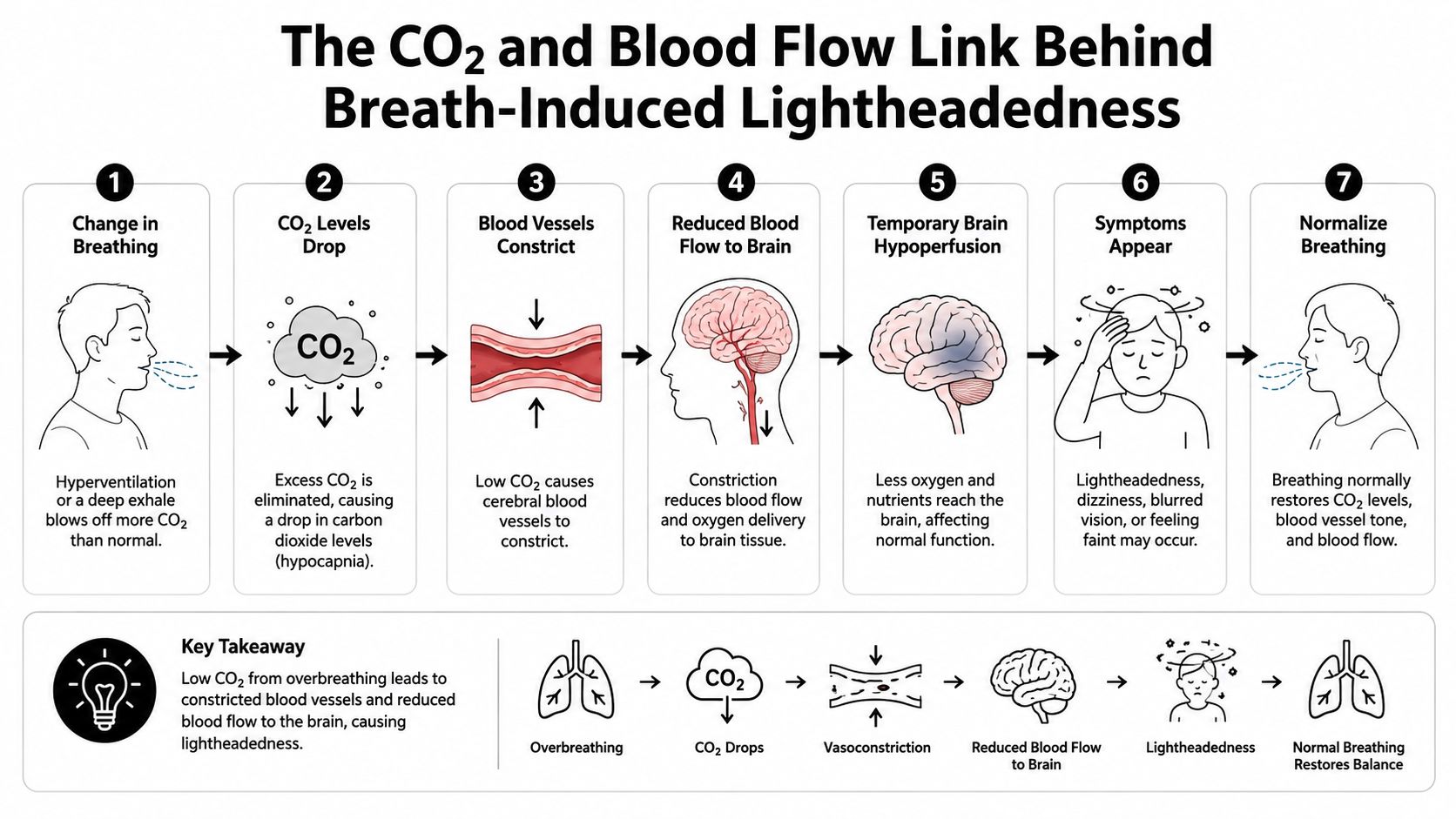
The biological sequence is straightforward:
- You breathe rapidly or forcefully. Large inhalations and exhalations move more air than your body needs at that moment.
- Carbon dioxide falls. The medical term for low carbon dioxide is hypocapnia.
- Blood pH rises. Lower carbon dioxide shifts the blood toward respiratory alkalosis.
- Cerebral blood vessels narrow. Reduced vessel diameter can lower blood flow reaching the brain.
- You feel lightheaded. Floating, tunnel vision, faintness, tingling, or mental fog may follow.
A single deep breath can produce a momentary 20–25% fall in blood carbon dioxide, while sustained overbreathing can reduce it rapidly to about half of normal, according to the clinical review and explanation of hyperventilation-related dizziness (the clinical review and explanation of hyperventilation-related dizziness).
Why it can feel so alarming
The brain's blood vessels respond quickly to carbon dioxide changes. As carbon dioxide drops, reduced cerebral blood flow can create the impression that you are about to faint, even though the original problem was excessive air exchange rather than too little air. The accompanying pH shift can also affect nerve and muscle activity.
That combination explains why overbreathing may produce several sensations together:
- Tingling in the fingers or around the mouth
- A buzzing or prickling sensation
- Tight or cramped hands
- A pounding heartbeat
- Breathlessness despite breathing more
- Visual narrowing or a dreamlike feeling
Controlled human testing documented hypocapnic symptoms in normal subjects at mean end-tidal carbon dioxide values of 20.3, 19.2, and 18.6 mmHg, showing that dizziness can appear when carbon dioxide falls far below typical resting levels (the PubMed-linked clinical discussion of hypocapnic symptoms). Respiratory alkalosis is clinically defined by blood pH above 7.45 and can result from hyperventilation or excessive breathing volume.
Some people also experience derealisation or disconnection during an episode. The sensation may overlap with understanding dpdr symptoms, while the breathing pattern remains a separate part of the process. The practical goal is to stop washing out carbon dioxide and let the gas balance normalise, rather than trying to force more oxygen into the body. With gradual practice, tolerance for these sensations can improve, making panic-free breathing a realistic skill to learn.
Common Mistakes That Turn Calming Breathwork Into Overbreathing
The phrase “take a deep breath” can hide several different instructions. A gentle diaphragmatic breath is not the same as repeatedly gulping air. During panic, people often make small technique changes that push ventilation higher and make dizziness more likely.
Four habits that create the problem
Breathing too fast is the first mistake. You may count each breath and assume the exercise is working because you're following the pattern, but the pace can still be too brisk for your state. A calming breath should resemble a slow tide. If your pulse, breathing, and internal alarm keep accelerating, the rhythm is not calming your system yet.
Making the inhale the main event is another common error. You pull air in dramatically, hold your chest open, then release it quickly or incompletely. The repeated large inhalations matter less than the overall air volume moving in and out. If the pattern leaves you feeling as though you must keep taking another breath, you may be overbreathing rather than calming down.
Lifting the upper chest can add strain. When the shoulders rise and the neck muscles work hard, the breath becomes associated with effort and threat. Letting the abdomen and lower ribs move gently can make breathing less performative, but you shouldn't force the belly outward or take a larger breath than feels natural.
Stacking deep breaths onto panic breathing compounds the issue. Someone may already be breathing quickly because of fear, then add a sequence of oversized inhales to “correct” the feeling. The added breaths can lower carbon dioxide further, which creates more dizziness and encourages still more inhalation.
Body cues that reveal overbreathing
Look for the combination rather than one isolated sensation. A racing pulse, hand tingling, chills, shaking, buzzing, or increasing breathlessness during the exercise suggests that the pattern needs to become smaller and slower. The answer isn't more willpower. Stop trying to make each breath impressive, and let the next breath be ordinary.
You can find additional context on breathing exercises anxiety relief, but the central rule is simple: reduce effort before you increase depth. A breath that feels modest may be more useful than one that fills the lungs dramatically.
How to Breathe Deeply Without Getting Lightheaded
The safest correction is a controlled, comfortable rhythm rather than a maximum-volume breath. A useful starting pattern is roughly 5 to 6 breaths per minute, with a 4-second nasal inhale, a gentle 1 to 2 second pause, and a relaxed 6 to 8 second exhale. These timings aren't a test. If they make you strain, shorten them while preserving the main principle, which is slow breathing with an unforced, slightly longer exhale.
Sit or lie down if you're already dizzy. Keep your jaw loose, lower your shoulders, and allow your abdomen and lower ribs to move without pushing them outward. Inhale through your nose for about four seconds, pause briefly without gripping your throat, then exhale through relaxed or gently pursed lips for six to eight seconds.
Nasal inhalation can naturally slow the incoming airflow and make it easier to avoid gulping. A longer exhale also gives your body time to release air without immediately starting another large inhalation. If you want another practical explanation of ways to calm anxiety with your breath, focus on softness and steadiness rather than trying to control every sensation.
A comparison you can use in real time
| Element | Common Mistake | Corrected Technique |
|---|---|---|
| Pace | Breaths arrive rapidly or unevenly | Aim for roughly 5 to 6 comfortable breaths per minute |
| Inhale | Large, audible, or forceful gulp | Inhale gently through the nose for about 4 seconds |
| Pause | Rigid breath-holding or no pause at all | Use a light 1 to 2 second pause only if comfortable |
| Exhale | Short, rushed, or incomplete | Exhale softly for about 6 to 8 seconds |
| Body movement | Shoulders lift and the upper chest dominates | Let the lower ribs and abdomen move naturally |
| Response to tingling | Take deeper breaths to get more air | Stop the exercise and return to normal breathing |
If your fingertips tingle, your vision narrows, or the room begins to feel unreal, don't push through. Pause the exercise and breathe normally for 30 seconds, then shorten the next exhale rather than extending it. You can also open your eyes, look around the room, and place both feet on the floor.
The rhythm may feel unfamiliar because it asks your body to stop chasing a perfect breath. Heart-rate variability naturally follows a cycle of roughly 5 seconds, so a slow pattern can feel physiological rather than theatrical. The aim isn't to create a dramatic calming sensation. It's to give your nervous system a repeatable experience of breathing without overventilating.
Building Long-Term Panic Freedom Beyond the Breath
Breath retraining helps, but it shouldn't carry the entire burden of panic recovery. Dizziness becomes especially frightening when you interpret it as evidence that you're fainting, losing control, or developing a dangerous illness. Cognitive behavioral therapy helps you examine those interpretations and test more accurate alternatives.
A therapist may also use interoceptive exposure, which involves gradually and safely encountering internal sensations that have become associated with panic. The purpose isn't to provoke suffering. It's to teach your brain that a racing heart, altered breathing, or mild lightheadedness can rise and fall without requiring escape.
Clinical evidence supports realistic hope. A review of CBT for panic disorder reports that up to 85% of patients responded positively after an average of 10 to 15 CBT sessions (the review of CBT for panic disorder). In a randomized trial, recovery based on panic severity was 73% with focused CBT compared with 35% with treatment as usual (the randomized focused CBT trial). These findings don't promise an identical timeline for every person, but they show that structured treatment can change the course of panic.
A broader recovery toolkit
Daily practice can include quiet breathing, realistic self-talk, and gradual exposure to sensations you currently fear. Diaphragmatic retraining aims to make a smaller, steadier breath feel normal over time, rather than turning every episode into an emergency breathing drill.
Medication is another evidence-based path for some people. International guidelines identify selective serotonin reuptake inhibitors and serotonin-norepinephrine reuptake inhibitors as first-line medications for anxiety disorders (international anxiety treatment guidelines). A clinician can help you weigh medication, therapy, or a combination according to your symptoms and preferences.
For readers exploring complementary approaches alongside professional care, a complete guide to CBD stress may provide general background, but it shouldn't replace medical advice or established panic treatments. Learning how to overcome fear of fear is often the deeper task. Once dizziness stops serving as proof of danger, breathing exercises become easier to practise.
Red Flags That Mean Dizziness Needs Medical Evaluation
Not every episode of dizziness during breathing practice should be dismissed as hyperventilation. Brief lightheadedness that follows forceful breathing and settles after normal breathing resumes can fit the pattern described above, but dizziness can also occur with medical problems that need assessment.
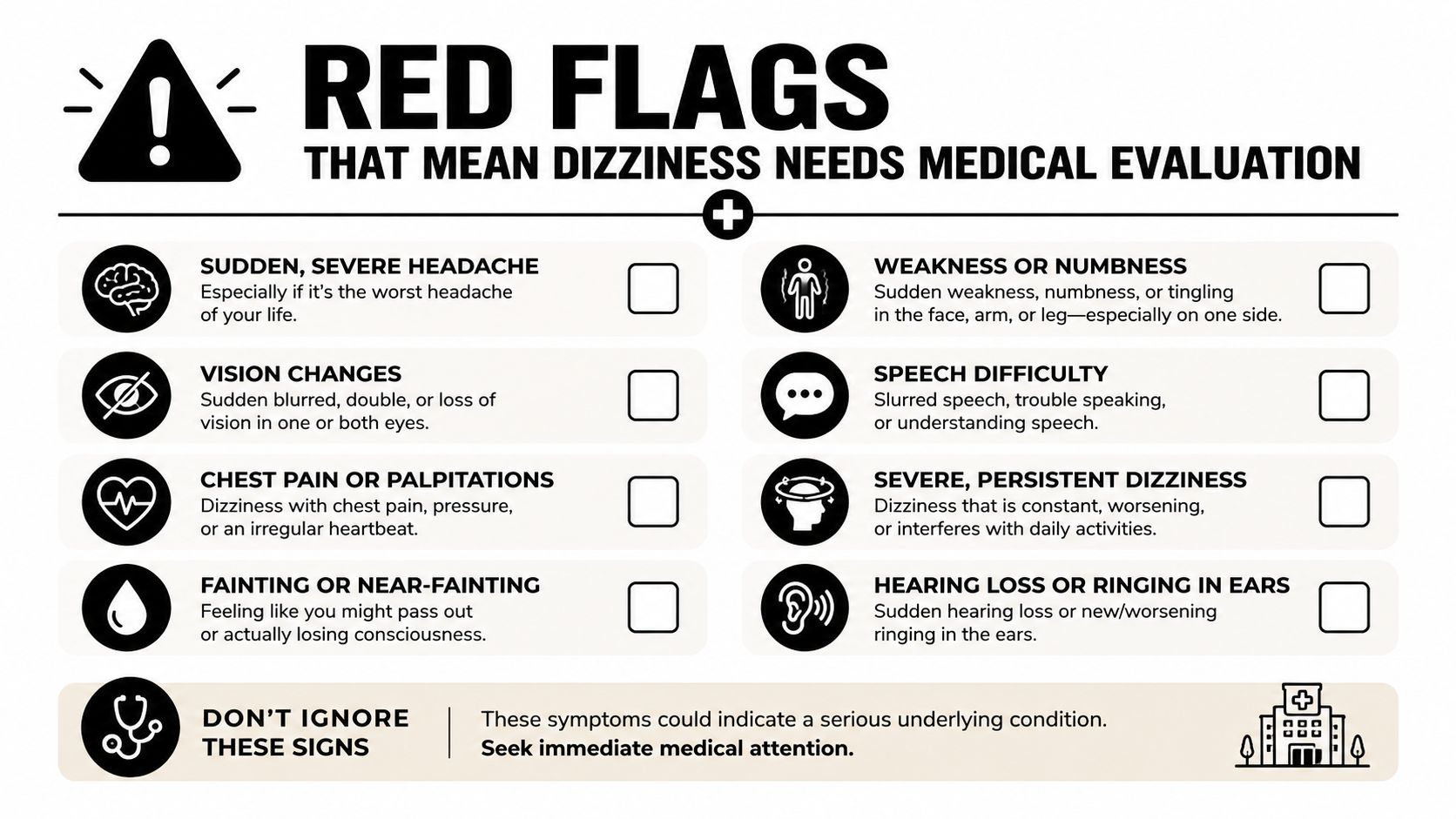
Seek urgent medical care if dizziness occurs with sudden one-sided weakness, facial drooping, slurred speech, a severe headache unlike any previous headache, chest pain or pressure, fainting with loss of consciousness, a cut in the visual field, or palpitations that continue after your breathing has normalised. Dizziness accompanied by vomiting, hearing loss, or significant speech or hearing changes also deserves prompt evaluation.
NHS guidance describes fast or deep breathing as a common panic symptom, while also advising medical review when symptoms such as hearing or speech changes accompany the episode (NHS panic guidance). Hyperventilation syndrome can be overlooked because its symptoms are nonspecific and can resemble other conditions, so a new, persistent, or worsening pattern shouldn't be self-diagnosed.
A clinician can also help if dizziness keeps returning outside breathing exercises, lasts longer than expected, or interferes with ordinary activities. Getting checked isn't an overreaction. It's responsible self-advocacy, especially when you're unsure whether anxiety explains everything.
If the symptoms are mild and clearly linked to overbreathing, grounding can help while you return to a natural rhythm. You can explore grounding techniques for anxiety, but don't use self-help exercises to delay urgent care when a warning sign is present.
A short visual guide can reinforce the distinction between common panic sensations and symptoms that call for medical attention:
A Hopeful Path to Panic-Free Breathing
The person who feels dizzy during deep breathing hasn't failed at relaxation. Their nervous system has learned to associate certain internal sensations with danger, and their breathing has become part of that learned loop. With consistent practice, the loop can change.
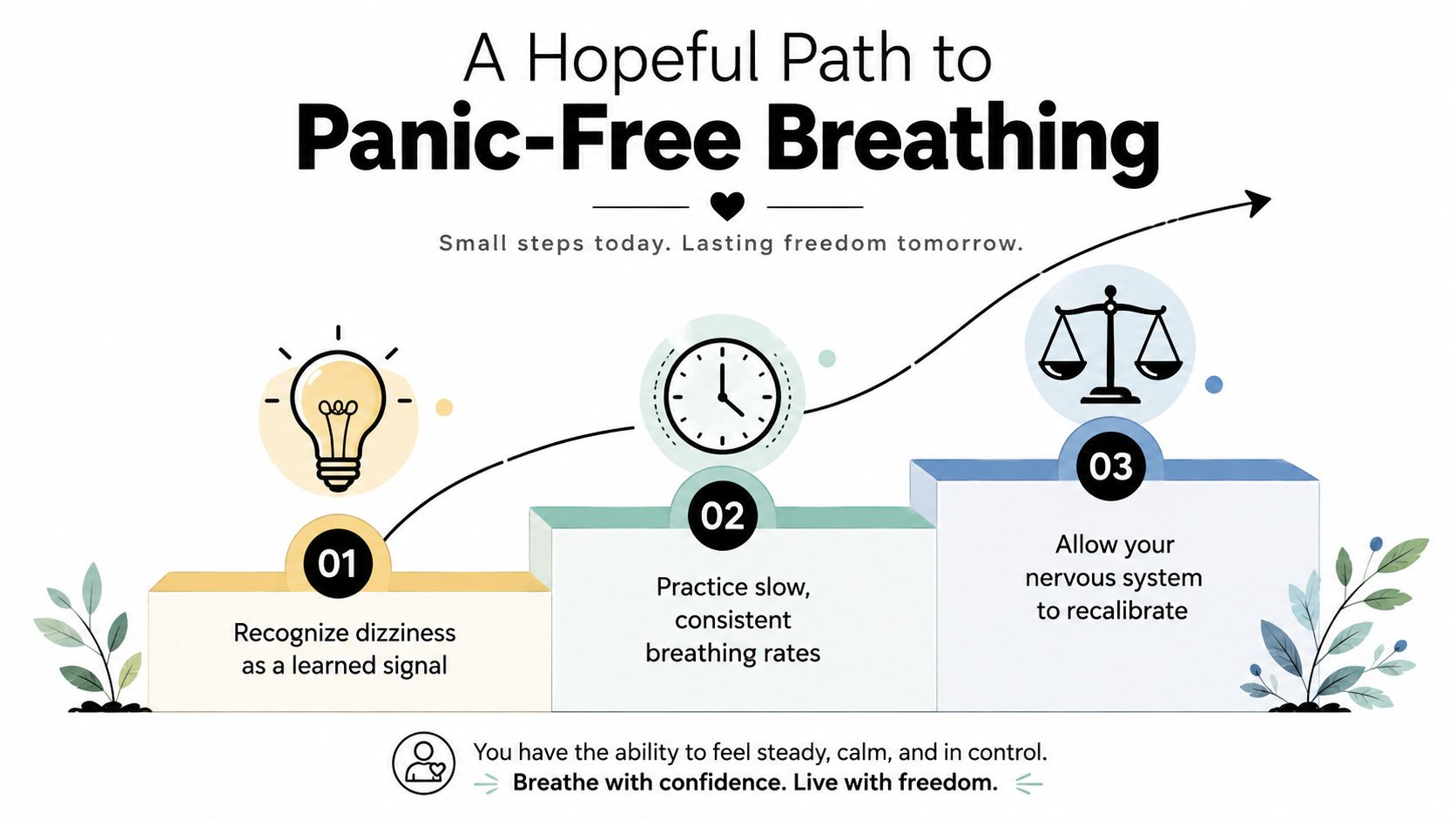
Start with the three principles from this guide:
- Recognise the signal. Dizziness after forceful breathing may reflect carbon dioxide loss and altered blood flow, not a lack of oxygen.
- Reduce the effort. Slow the rate, keep the inhale gentle, and allow the exhale to last slightly longer without forcing it.
- Respect the warning signs. Brief, self-resolving lightheadedness is different from dizziness paired with neurological, cardiac, hearing, or persistent symptoms.
Setbacks are feedback, not failure. Keep a simple journal that records the approximate breathing rate, how long you practised, whether you felt tingling or visual narrowing, and what happened after you returned to normal breathing. That record can reveal your personal thresholds and give a therapist useful information.
Progress doesn't require perfect sessions. A quiet practice that feels almost uneventful is often more valuable than a dramatic exercise that leaves you lightheaded. Combining breath retraining with CBT, therapist-guided panic protocols, or appropriate medical treatment can help your brain stop treating normal body sensations as emergencies.
Clinical literature supports the possibility of lasting recovery. A long-term follow-up study reported relapse rates for panic disorder with or without agoraphobia of 0% to 14% over 3 to 12 months after CBT (the long-term CBT follow-up study). For people who also use supportive complementary practices, information about reiki benefits for substance abuse recovery may be relevant to broader wellbeing, but panic symptoms still deserve evidence-based assessment and care.
Begin tonight with a comfortable posture, ordinary breathing, and a gentle rhythm. You don't need to wait until you feel fearless. Each calm, manageable breath teaches your body that dizziness is a solvable signal and that panic-free breathing is something you can learn.
The Anxiety Checklist offers an always-free SOS mode with grounding prompts, affirmations, and practical support for moments when panic makes it hard to think, alongside CBT self-therapy tools and educational resources for longer-term change. Visit The Anxiety Checklist to practise steadier breathing, record anxious thoughts, and build a personal recovery routine at your own pace.