

Have you ever wondered why calming advice often fails at the exact moment your thoughts race, your muscles tighten, and panic sensations take over? The problem may not be a lack of willpower. During intense distress, your body can become too activated for complex thinking, so a technique that works during a calm afternoon may feel unreachable during a crisis.
Distress tolerance techniques give you options for getting through the immediate wave without making the situation worse. They aren't a promise that anxiety will disappear instantly, and they aren't a replacement for treatment when panic repeatedly disrupts your life. Some techniques interrupt distress through the body, while others build longer-term flexibility through attention, behavior, thinking, and acceptance.
This guide moves through eight techniques, from fast physiological tools to gradual practices that can support lasting recovery. Start with the gentlest appropriate option. You don't need to force cold exposure, intense exercise, exposure practice, or meditation if a method makes you feel less safe. For a simple introduction to breathing through the nose, see this Resty nose breathing guide.
Table of Contents
- 1. TIPP Technique
- 2. Progressive Muscle Relaxation
- 3. Grounding Techniques
- 4. Box Breathing
- 5. Opposite Action
- 6. Mindfulness and Present-Moment Awareness
- 7. Cognitive Behavioral Therapy
- 8. Self-Compassion and Emotional Acceptance
- Distress Tolerance: 8-Technique Comparison
- Build Your Personal Path Back to Calm
1. TIPP Technique
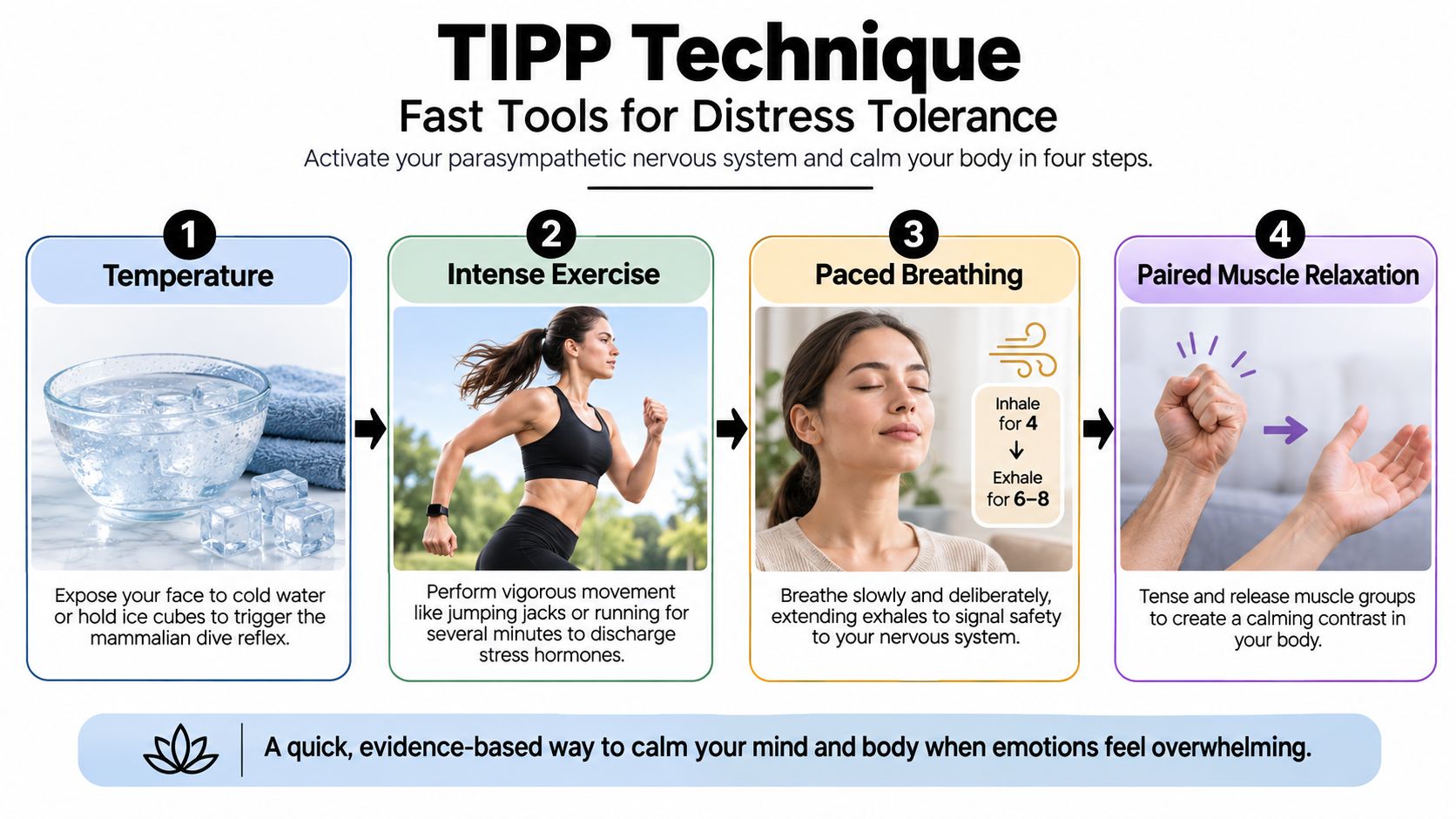
When panic makes reasoning feel out of reach, could changing the body's alarm signals create enough space for your next choice? TIPP, a crisis skill from Dialectical Behavior Therapy, or DBT, starts there. Its four components are temperature, intense exercise, paced breathing, and paired muscle relaxation. Like pressing a reset button on an overloaded system, the sequence can lower physical activation before you use a thinking-based strategy.
Use TIPP as an SOS skill
Temperature can interrupt the surge through a cold object or water on the face or hands. Brief, vigorous movement gives the body a controlled outlet for activation. Paced breathing slows the rhythm of the alarm, while paired muscle relaxation releases some of the bracing that often accompanies panic.
You might hold something cold against your face or hands, move briskly for a short period, slow your breathing, and then tense and release muscle groups. Once the intensity has eased, shift toward a cognitive tool or another longer-term practice.
Try this script:
“My body is in alarm mode. I'll change one physical signal, slow my breathing, and give myself room to choose.”
Keep cold water or another safe temperature tool available when high-stress periods are likely. Practise the sequence while calm, beginning with the component that feels most natural. Temperature may suit one person, while movement or breathing feels more manageable for another.
TIPP has trade-offs. Cold exposure and vigorous movement may be unsuitable for people with relevant medical conditions or injuries. Stop if you feel unwell, and ask a qualified clinician which options fit your circumstances. After the immediate wave passes, pair TIPP with CBT exercises, mindfulness, or a conversation with a therapist. These 2026 stress management tips offer further practical support.
Here's a demonstration of the sequence and pacing:
2. Progressive Muscle Relaxation
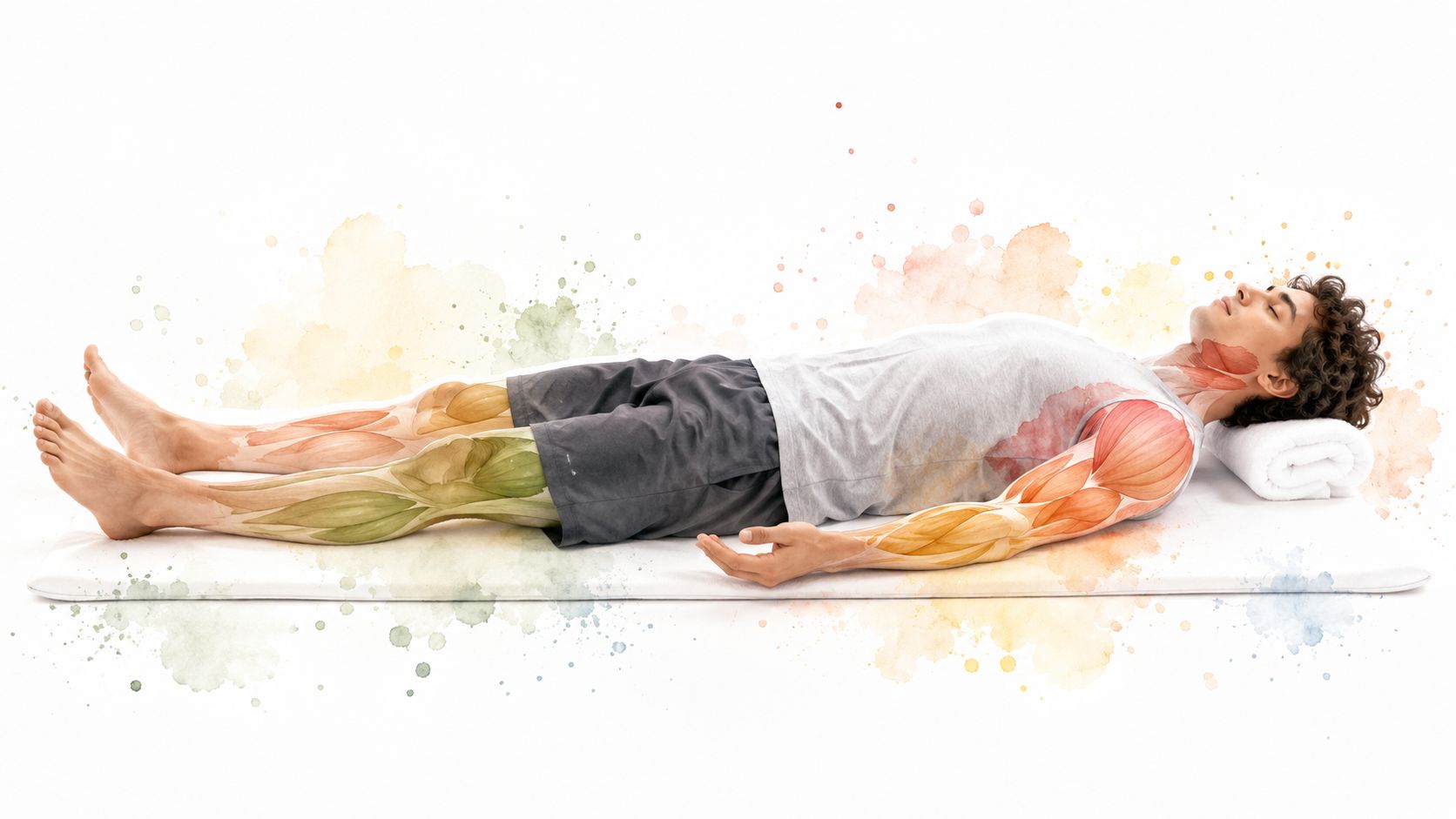
Anxiety often keeps the body braced without making the tension obvious. Progressive Muscle Relaxation, or PMR, makes that pattern easier to notice by asking you to tense and release muscle groups in sequence. The contrast teaches you what tension feels like and what release feels like, which can help you intervene earlier.
Start with a full-body practice when you have time. Sit or lie comfortably, tense one muscle group gently, release it, and notice the difference before moving through the body. Avoid straining, and skip any area affected by pain.
Turn PMR into a maintenance habit
A shorter version can fit before sleep, during a work break, or before a difficult meeting. For example, an office worker might relax the hands, shoulders, jaw, and face at a desk, while someone with nighttime anxiety might use a slower body sequence to associate bedtime with safety rather than vigilance.
Use this inner prompt:
“I can feel where I'm holding tension. I'll release one area at a time instead of demanding that my whole body relax at once.”
A guide to progressive muscle relaxation can help you follow the sequence without having to remember every step. Guided audio may also reduce mind-wandering, particularly when your attention is already scattered.
A useful practice pattern includes:
- Full-body learning: Establish the tense-and-release contrast when you're calm.
- Brief daily version: Use a shorter sequence for regular maintenance.
- Early detection: Notice jaw clenching, raised shoulders, tight hands, or a rigid stomach.
- Flexible pairing: Add slow breathing when distress begins to rise.
PMR may not be the best first choice during severe panic if focusing on bodily sensations makes you more frightened. In that situation, grounding through the environment may feel less demanding. Over time, however, regular practice can make physical tension more recognizable and give you a calm, repeatable response before the anxiety spiral grows.
3. Grounding Techniques
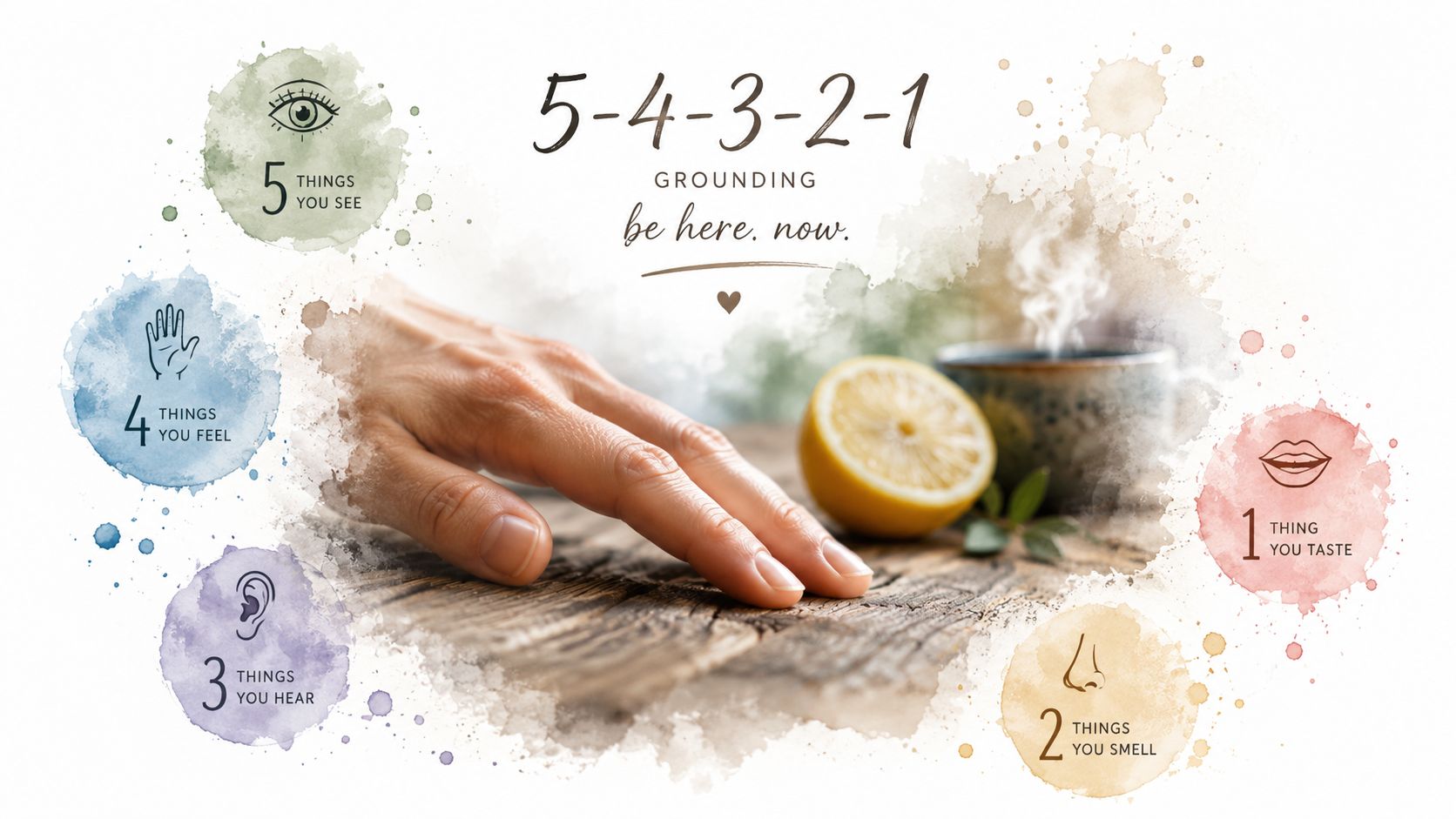
Grounding redirects attention from imagined futures, memories, and internal alarm signals to what is happening around you now. The 5-4-3-2-1 method gives your mind a simple structure: notice five things you see, four things you can touch, three sounds, two smells, and one taste.
The technique doesn't require you to decide whether every anxious thought is true. It gives attention a concrete task while your nervous system has time to settle.
Let the environment carry your attention
A person in a grocery store might notice shelf colors, the texture of a basket, nearby sounds, the scent of produce, and the taste of water. A student before an exam could focus on the desk surface, the room's sounds, the feeling of feet on the floor, and the temperature of the air.
Try saying:
“I'm noticing what is here, not solving every possible future. Right now, I can name one real sensation at a time.”
Be specific. “The desk” is less absorbing than “a cool, smooth edge beneath my fingertips.” Don't force yourself to find an unusual sensation, and modify the sequence if tasting or smelling something isn't practical. You can spend longer with touch, hearing, or visual details instead.
The technique works best when rehearsed during mild stress rather than saved for the worst moment. You can pair it with comfortable breathing, but don't turn breathing into another test you might fail. If slow breaths feel uncomfortable, return to sensory observation.
Grounding Techniques Anxiety can provide additional ideas, and Anxiety Checklist includes grounding in its free SOS mode for real-time prompts. Grounding is especially useful when you feel detached, overwhelmed by rumination, or pulled toward escape. It may not address the beliefs that maintain recurring panic, so use it as an immediate stabilizer and later add CBT, exposure, or acceptance-based work.
4. Box Breathing
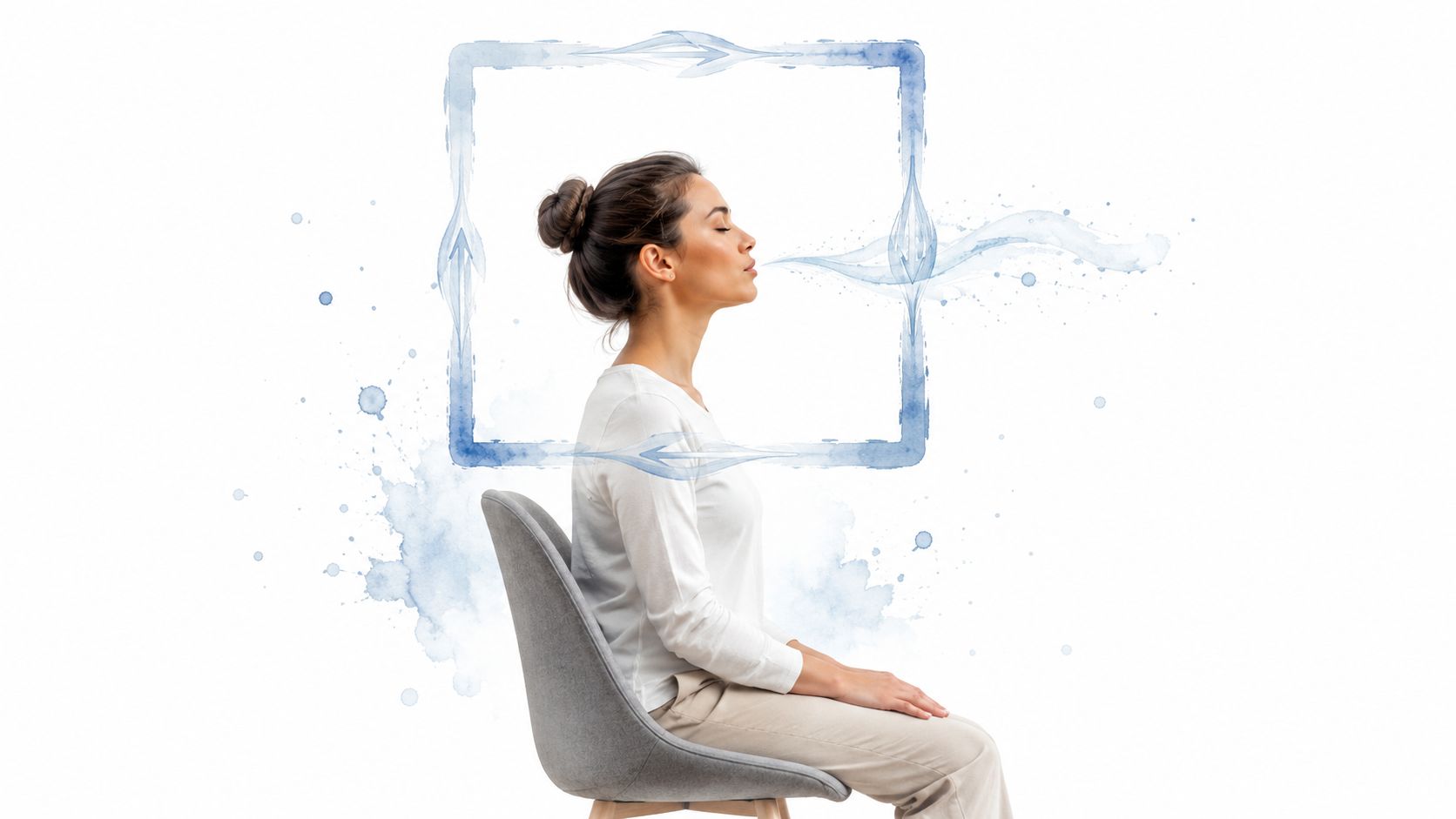
Box breathing uses an even pattern: inhale, hold, exhale, hold, with each phase counted evenly. The structure gives your attention something predictable to follow when panic makes breathing feel hurried or disorganized.
Begin with a comfortable rhythm. If an even four-part pattern feels too demanding, use a gentler count and avoid holding your breath in a way that increases discomfort. The goal is controlled pacing, not perfect performance.
Make the rhythm easy to remember
Trace an imaginary square with your finger or eyes. Move up during the inhale, across during the hold, down during the exhale, and back across during the final pause. You can practice before a meeting, after waking with anxious thoughts, or when you notice early signs of escalation.
Use this script:
“I'm not forcing calm. I'm giving my breathing a steady rhythm and allowing my body to follow.”
A visual animation can help you maintain the pattern, while breathing exercises for anxiety offers a broader set of options. You might also combine gentle breathing with sensory grounding, noticing the chair beneath you or the sounds in the room as you pace your breath.
Box breathing has a clear trade-off. Some people become more anxious when they monitor breathing or focus on bodily sensations. If that happens, open your eyes, return to ordinary breathing, and use an external anchor such as naming objects around you. Breathing can support acute relief, but it doesn't by itself retrain fear of panic sensations or avoidance patterns.
The question of whether distress tolerance is the best primary target for panic deserves care. Older panic-challenge data found that distress tolerance did not uniquely predict panic symptoms once anxiety sensitivity was controlled, as described in this analysis of panic symptoms and anxiety sensitivity. In plain language, learning to tolerate emotion and reducing fear of bodily sensations may overlap, but they aren't interchangeable goals.
5. Opposite Action
Anxiety often arrives with an action urge. You want to leave, cancel, check, seek reassurance, stay silent, or isolate. Opposite action asks whether that urge fits the facts and your values, then invites a deliberately small behavior in the other direction.
This isn't about forcing yourself into a terrifying situation without support. It's about reducing avoidance gradually enough that your nervous system can learn from direct experience.
Choose a small approach behavior
Someone with social anxiety might attend a gathering briefly rather than cancel. Someone avoiding driving might begin with a familiar short route, repeated thoughtfully rather than treated as a one-time test. A person withdrawing from friends could send one honest message or take a short walk before deciding what they need next.
Try this script:
“Anxiety is asking me to avoid. I'll choose the smallest safe step toward the life I want, and I'll let discomfort come with me.”
Write down the urge, the opposite action, and what happened afterward. The purpose isn't to produce a perfect outcome. You're collecting experience that challenges the rule that anxiety must disappear before you act.
A graduated approach might look like this:
- Name the urge: Identify the exact behavior anxiety is demanding.
- Check the facts: Decide whether the danger is current, likely, and proportionate.
- Shrink the step: Choose an action you can repeat rather than an overwhelming leap.
- Stay engaged: Use grounding or gentle breathing while remaining connected to the situation.
- Review the result: Compare what you predicted with what happened.
Opposite action can increase distress at first because approach behavior removes the short-term relief of avoidance. Structured CBT exposure can make this process safer and clearer, especially for panic, phobias, or agoraphobia. Panic disorder is treatable, and properly delivered CBT has produced positive responses for many patients. A review reported response rates of about 70% to 90%, while one randomized trial found 73% recovery with focused CBT compared with 35% with treatment as usual in the cited randomized CBT trial.
6. Mindfulness and Present-Moment Awareness
Could anxiety become easier to handle if you stopped treating every thought as an instruction? Mindfulness changes your relationship with distress by directing attention to thoughts, feelings, body sensations, and surroundings as they arise. You can notice them without immediately arguing, escaping, or obeying them.
Try saying, “I'm having the thought that something bad will happen.” This wording separates a mental event from a prediction. Comfort is not guaranteed, yet the shift creates space between experience and reaction.
Practice observation without a performance test
Begin with a short period of attention on your breathing, nearby sounds, or the chair supporting you. A wandering mind is expected. Each gentle return works like a repetition that strengthens the skill.
Use this sequence:
- Notice the strongest sensation or thought.
- Name it, such as “worry,” “tightness,” or “planning.”
- Observe where it appears and how it changes.
- Return attention to one chosen anchor.
- Continue with the next value-aligned action.
In the moment, tell yourself:
“This is anxiety happening in me, not the whole of me. I can notice it and still choose what matters.”
A mindfulness and anxiety resource can support guided practice. Informal practice also fits while walking, eating, showering, or listening to someone. Repeating it during ordinary moments helps connect immediate panic relief with steadier, longer-term recovery.
Mindfulness can increase distress for people who become unsettled by inward attention. Keep your eyes open, focus on external sounds, or practice with a therapist when internal observation feels destabilizing. Research suggests that emotion regulation and distress tolerance do not operate identically for everyone. Their relationship may be moderated by cognitive-control markers, including N2 amplitude, so the technique should match the person's cognitive capacity and type of distress rather than applying grounding or acceptance identically to every situation. See the research on emotion regulation, distress tolerance, and cognitive control.
7. Cognitive Behavioral Therapy
Could a frightening prediction be tested rather than followed? Cognitive Behavioral Therapy (CBT) helps you examine the link between a situation, an automatic thought, emotional distress, and your response. CBT involves more than positive thinking alone. You record the thought, review evidence for and against it, create a balanced alternative, and test the prediction through a carefully chosen behavioral experiment.
A person with health anxiety who notices chest discomfort might think, “This means I'm having a heart attack.” They can record the thought, review relevant medical information with a professional, consider other explanations, and avoid making reassurance-seeking the only response. New, severe, or medically concerning physical symptoms still require appropriate medical evaluation.
Turn predictions into testable questions
A person with social anxiety might predict, “Everyone will judge me if I speak.” They could speak once in a meeting, observe what happens, and compare the result with the prediction. Repeated experiments gradually improve realistic threat assessment, although some situations require professional guidance.
A simple record includes:
- Situation: What happened?
- Thought: What did your mind predict?
- Feeling: What emotion and body sensations appeared?
- Evidence: What supports and challenges the prediction?
- Balanced thought: What is a fairer interpretation?
- Outcome: What happened after you acted?
Use this in-the-moment script:
“A thought can feel urgent without being accurate. I'll test it carefully instead of obeying it automatically.”
An evidence-based anxiety treatment resource can help you learn the structure of CBT. The Anxiety Checklist also includes thought journaling, belief experiments, and exposure tools, alongside educational material such as Dr. Joshua Shifrin's CBT introduction and Michael Norman's PanicFree Masterclass.
Some experiments need professional planning, particularly when panic, trauma, compulsive behavior, medical fears, or severe avoidance are involved. CBT can interrupt panic by creating distance from an urgent prediction, then support longer-term recovery as new evidence reshapes expectations. Follow-up studies reported relapse rates ranging from 0% to 14% among the studies that provided those figures, including panic disorder, in this meta-analysis of long-term CBT outcomes.
8. Self-Compassion and Emotional Acceptance
Self-compassion replaces self-attack with the kind of steady response you'd offer a struggling friend. Acceptance and Commitment Therapy, or ACT, adds a practical direction: allow difficult internal experiences to be present while taking action guided by your values.
This doesn't mean approving of panic, giving up on treatment, or pretending that suffering is easy. It means dropping the extra judgment that says anxiety makes you weak, broken, or unworthy of ordinary life.
Allow anxiety without making it the decision-maker
A person facing a presentation might say, “I feel anxious because this matters to me. I can feel anxious and still present.” Someone experiencing panic might use, “My nervous system is trying to protect me, even if it has misread the situation. I can support myself while the wave passes.”
Try a brief self-compassion break:
- Acknowledge: “This is hard right now.”
- Normalize: “People experience fear and panic. I'm not failing by having a nervous system.”
- Offer kindness: “I can respond to myself with patience.”
- Choose a value: “What small action supports the person I want to be?”
Self-compassion can be combined with breathing, grounding, PMR, or exposure practice. Track how your relationship with anxiety changes, not only whether symptoms disappear. Acceptance is often useful precisely because it removes the demand that you must feel completely calm before living.
There is strong reason to hold hope without making unrealistic promises. Medication trials have reported endpoint panic-free rates of 54% to 61% for active treatment compared with 35% for placebo, with about 75% responding and nearly 45% reaching remission, according to this review of pharmacotherapy for panic disorder. Treatment choices belong with a qualified prescriber, and medication may be combined with psychotherapy and skills practice.
The field is also moving toward integrated use. A 2025 case study described distress-tolerance skills added to exposure-based CBT for social anxiety, while a 2026 OCD trial protocol is testing DBT distress-tolerance techniques in a randomized design, as reported in this publication on integrated distress-tolerance treatment. These developments support a balanced message: distress tolerance can help you stay engaged with treatment, but it shouldn't be treated as a universal standalone cure.
Distress Tolerance: 8-Technique Comparison
| Technique | 🔄 Implementation Complexity | 💡 Resource Requirements & Tips | ⚡ Speed / Efficiency | ⭐ Expected Outcomes | 📊 Ideal Use Cases & Key Advantages |
|---|---|---|---|---|---|
| TIPP Technique (Temperature, Intense Exercise, Paced Breathing, Paired Muscle Relaxation) | Medium, multi-step but learnable | Ice/cold water, short space for exercise; practice when calm | ⚡ Immediate (minutes) | ⭐⭐⭐⭐⭐, rapid physiological calming; short-term crisis relief | Panic attacks / acute distress; Advantage: very fast, body-based, empowers user |
| Progressive Muscle Relaxation (PMR) | Low–Medium, systematic sequence | Quiet space, 10–20 min (can shorten); guided audio helpful | ⚡ Minutes–20 min; cumulative effects over weeks | ⭐⭐⭐⭐, deep relaxation; lowers baseline tension over time | Sleep, daily maintenance; Advantage: builds body awareness, long-term retraining |
| Grounding (5-4-3-2-1 Sensory Awareness) | Low, simple sensory steps | None required; practice weekly to automate | ⚡ Immediate (2–5 min) | ⭐⭐⭐⭐, redirects attention to present; reduces acute panic | Discreet public use, panic onset; Advantage: highly accessible, quick attention reset |
| Box Breathing (Controlled Respiratory Pacing) | Low, structured timing | No equipment; start 3-3-3-3 if 4-4-4-4 feels slow | ⚡ Very fast (1–3 min) | ⭐⭐⭐⭐, measurable autonomic regulation and calmer heart rate | Before stressors or nighttime anxiety; Advantage: portable, easy to remember |
| Opposite Action (Behavioral Activation) | High, requires planning and repeated practice | Identify avoidance patterns; start small; track exposures | ⚡ Slow to change (weeks–months) | ⭐⭐⭐⭐, durable behavioral and neural change with repetition | Social anxiety, agoraphobia, avoidance patterns; Advantage: rewires threat beliefs via experience |
| Mindfulness & Present-Moment Awareness | Medium, skill-building practice | Daily short practices (5–10 min); guided meditations useful | ⚡ Gradual (weeks–months) | ⭐⭐⭐⭐⭐, reduces baseline anxiety; strengthens emotional metacognition | Long-term anxiety management, prevention; Advantage: broad neuroplastic benefits |
| Cognitive Behavioral Therapy (CBT), Thought Challenging & Behavioral Experiments | High, cognitive and behavioral training (often guided) | Thought records, therapist or structured program; 8–12+ weeks | ⚡ Moderate (weeks–months for measurable change) | ⭐⭐⭐⭐⭐, strong, evidence-based, lasting symptom reduction | GAD, panic disorder, health/social anxiety; Advantage: addresses root causes with high success rates |
| Self-Compassion & ACT-Based Approaches | Medium, attitudinal shift plus values work | Self-compassion exercises, values clarification; practice regularly | ⚡ Gradual (weeks–months) | ⭐⭐⭐⭐, reduces secondary suffering; increases flexibility and resilience | Perfectionism, shame-driven anxiety, chronic suffering; Advantage: reduces shame and supports values-aligned action |
Build Your Personal Path Back to Calm
You don't need to master all eight techniques at once. Begin with one rapid tool for acute distress, such as grounding, TIPP, or paced breathing. Choose the option that feels accessible in your actual environment, and rehearse it during calm moments so the steps are familiar when anxiety rises.
Add one daily practice that builds physical or attentional awareness. PMR can help you recognize tension and practice release, while mindfulness can help you notice thoughts and sensations without automatically treating them as danger. Keep the routine small enough to repeat. Consistency matters more than creating an ambitious plan that becomes another source of pressure.
Then choose a deeper-change skill. CBT can help you examine anxious predictions and run carefully designed behavioral experiments. Opposite action can reduce avoidance through gradual approach. Self-compassion and acceptance can weaken shame and the exhausting struggle to eliminate every uncomfortable feeling before you move forward.
A simple plan might sound like this: “When panic starts, I'll ground through my senses. Each day, I'll practice PMR. During the week, I'll record one anxious prediction and take one values-based action.” Write the plan where you can find it, and review what helped without judging yourself when a technique didn't work perfectly.
Professional support matters when anxiety or panic interferes with work, relationships, sleep, travel, or ordinary responsibilities. It also matters when symptoms feel unsafe, when you have urgent physical concerns, or when distress includes thoughts of self-harm. A primary-care effectiveness trial found that combined CBT and medication produced higher remission than usual care at both follow-up points, reaching 29% versus 16% at 12 months, as reported in this primary-care panic disorder trial. You don't have to reach a specialty clinic before recovery becomes possible.
Anxiety can change. Panic can become less frightening, less frequent, and less controlling. Each manageable repetition teaches you that a wave can be met safely, that an urge isn't an order, and that your life can expand even while some discomfort is present. Healing isn't measured by never feeling anxious again. It's measured by having more choices, more trust in yourself, and more days shaped by what matters to you.
For another low-pressure activity that can support attention and mental wellbeing, explore how solitaire supports mental health.
The Anxiety Checklist offers an always-free SOS mode with grounding, affirmations, and quick prompts, plus guided meditations, sleep audios, walking sessions, and CBT tools for longer-term practice. Visit The Anxiety Checklist to explore practical support for managing panic now and building calmer responses over time.