


In short
CBT can help with flight anxiety by changing the cycle of catastrophic predictions, body alarm, avoidance, and short-term safety behaviors. The process usually combines realistic thought testing with gradual exposure to flight triggers. Self-guided exercises can build skills, but severe fear, trauma-related symptoms, or repeated panic may need a qualified CBT clinician.
Key takeaways
- CBT for flight anxiety targets thoughts, avoidance, and exposure, not relaxation alone.
- A useful thought record replaces an absolute catastrophe with a balanced, believable response and a testable action.
- Exposure should be planned and repeated for learning, rather than judged by whether anxiety falls to zero.
- Alcohol is not a CBT strategy and can interact dangerously with prescription and over-the-counter medicines.
- Professional assessment is appropriate when fear causes major avoidance or may involve panic disorder, agoraphobia, trauma, or another condition.
Flight anxiety is not always one fear. One person predicts a crash, another fears having a panic attack without an escape, and another reacts to confinement, turbulence, bodily sensations, or loss of control.
That distinction matters because CBT works with the prediction underneath the anxiety. A general promise that flying is safe may provide brief reassurance, but it does not necessarily change what the nervous flyer expects to happen or what they do when anxiety rises.
Can CBT help with flying anxiety?
Yes. CBT can help with flying anxiety by combining realistic examination of anxious predictions with gradual practice around the situations, sensations, and uncertainties a person has been avoiding.
The NHS phobia guidance updated in March 2026 lists CBT among treatments for phobias. Flight-specific research also supports structured cognitive-behavioral and exposure programs, although the studies do not show that every person responds in the same way.
A 2026 randomized trial of 519 participants with clinically significant fear of flying studied a one-session program that included psychoeducation, debriefing, and an exposure flight. Participants experienced substantial short-term and longer-term symptom reductions across all four study conditions.
A separate randomized controlled trial of 150 participants found that both a behavioral group program and a cognitive-behavioral group program performed better than a waiting-list condition. The two-day cognitive-behavioral program produced stronger results on subjective fear and self-efficacy measures than the one-day behavioral program.
These studies examined structured programs, not a single worksheet completed the night before a flight. Self-help can introduce the method, but it should not be presented as a guaranteed or complete substitute for individualized treatment.
CBT is most useful when it changes both what a nervous flyer predicts and what the person does next.
How does CBT change the flight-anxiety cycle?
CBT maps flight anxiety as a repeating cycle: a trigger produces a catastrophic prediction, the body reacts, and the person escapes or uses a safety behavior. The immediate relief can unintentionally teach the brain that the escape or safety behavior prevented the feared event.
The five-part cycle
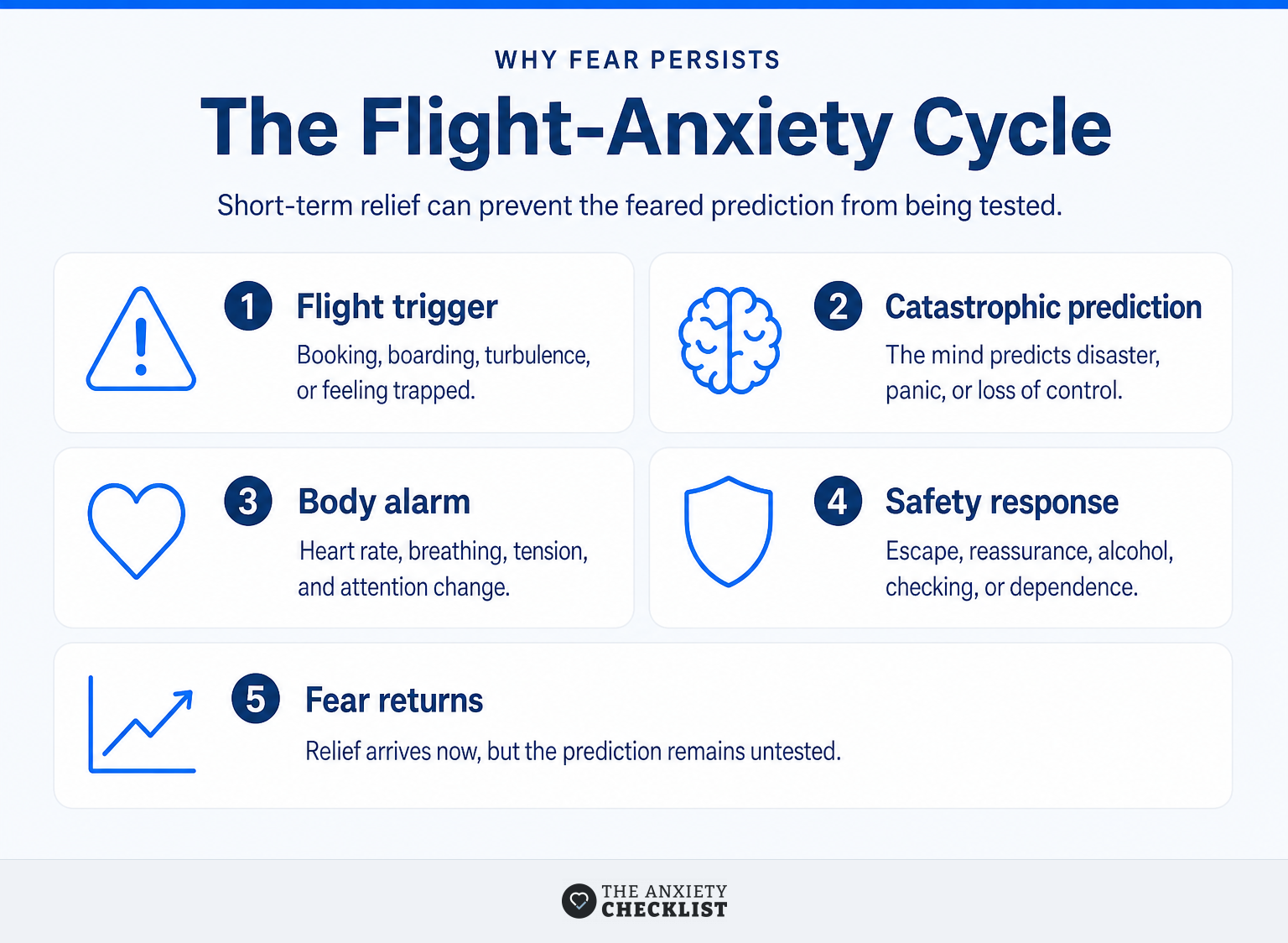
A flight-anxiety cycle may look like this:
- Trigger: A booking email arrives, boarding begins, the doors close, or the aircraft moves through turbulence.
- Prediction: The mind says, “The plane will crash,” “I will lose control,” or “I will be trapped with a panic attack.”
- Body alarm: The heart races, breathing changes, muscles tighten, and attention narrows toward possible danger.
- Response: The person cancels, repeatedly checks for reassurance, drinks alcohol, escapes the situation, or depends on another person to feel able to continue.
- Short-term result: Anxiety drops, but the feared prediction has not been tested under conditions that allow new learning.
The relevant core fear is not always an aviation accident. The broader guide to fear of flying can help separate fear of a crash from panic, confinement, heights, bodily symptoms, or loss of control.
CBT then intervenes at several points. It tests the prediction, changes the response to physical sensations, reduces avoidant behavior, and creates planned opportunities to discover what happens when the person remains in contact with the trigger.
Relaxation may support that work, but becoming completely calm is not the test of success. If a breathing technique becomes something a person believes must work before they can remain on the plane, it can become another condition placed on flying.
Short-term relief can keep flight anxiety alive when it teaches the brain that avoidance or a crutch prevented disaster.
How can you challenge a flight-anxiety thought without forcing positive thinking?
Use a thought record to turn a vague sense of danger into one specific, testable prediction. The replacement thought should be balanced and believable, not a promise that the flight will be smooth or that nothing difficult can happen.
A worked thought record

The following is a hypothetical example. Replace it with the exact moment and prediction that drive your anxiety.
| Thought-record prompt | Flight-anxiety example |
|---|---|
| Situation | The gate agent announces that boarding will begin in ten minutes. |
| Automatic prediction | “If my heart races after the doors close, I will lose control and there will be no escape.” |
| Emotion and body response | Fear, dread, rapid heartbeat, tense shoulders, and an urge to leave the gate. |
| Evidence that seems to support it | A previous flight included a panic attack, and the cabin is an enclosed space. |
| Missing evidence or another explanation | The previous panic episode ended without the predicted loss of control. A racing heart is a strong alarm signal, but the sensation alone does not establish what will happen next. |
| Balanced response | “My body may produce a strong alarm after boarding. The alarm will be uncomfortable, but I can let it change without treating it as a command to escape.” |
| Behavioral test | Board as planned, remain with the first wave of anxiety, and record the prediction and observed outcome rather than judging the exercise only by calmness. |
A balanced response admits uncertainty. “The flight will definitely be perfect” is another absolute statement and may be difficult to believe. “I cannot guarantee a smooth flight, but I can follow crew instructions and practice staying with anxious sensations” is more realistic.
A 2008 follow-up study reassessed 55 people an average of 2.3 years after CBT for fear of flying. Reported use of skills such as talking back to negative thoughts and continuing to fly was associated with lower flight anxiety. The authors also cautioned that attrition and reliance on self-report limited how widely the findings could be generalized.
The thought record should lead to an action. If it ends with another hour of researching aviation accidents or seeking certainty from someone else, the exercise may have changed the words without changing the cycle.
A balanced thought is believable, specific, and paired with an action.
How do you build a flight-anxiety exposure ladder?
Build an exposure ladder by listing flight-related situations from manageable to highly challenging, then practicing them deliberately. The purpose is to test predictions and increase the ability to remain engaged, not to force anxiety to disappear before moving forward.
A six-step flight ladder
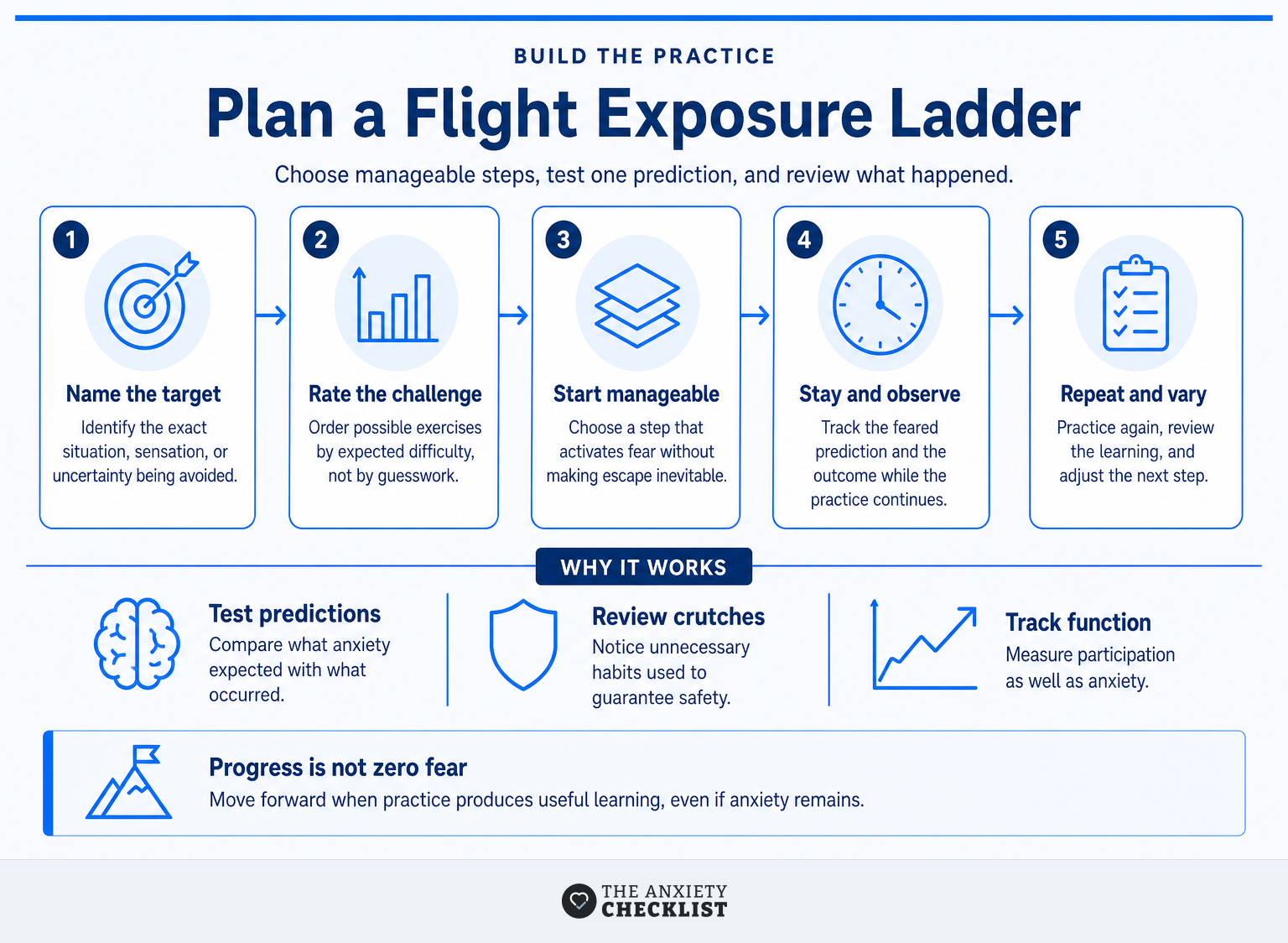
A sample ladder might include:
- Review the itinerary: Read the route, airport, and flight details while naming the feared prediction rather than distracting from it.
- Use flight cues: Look at cabin photographs and listen to boarding, engine, or takeoff sounds without repeatedly pausing to settle anxiety.
- Watch a complete flight segment: View a takeoff or turbulence video from beginning to end while tracking what the mind predicts and what actually occurs in the video.
- Visit an airport public area: Spend time near the terminal or departures area where local access rules permit it.
- Use a simulator or virtual environment: If available and appropriate, practice with flight cues that are more immersive than a photograph or recording.
- Take a planned flight: Use a realistic route and support plan, ideally as part of clinician-guided treatment when the fear is severe.
This is only an example. A step that feels manageable for one person may be overwhelming or irrelevant for another. Rate each potential step from 0 to 10 for expected difficulty, then choose a starting point that brings up the fear without making immediate escape the only realistic response.
A detailed guide to exposure therapy explains why gradual contact with a trigger differs from being pushed into the hardest situation without preparation. A fear ladder provides a structure for ordering and reviewing the steps.
During each practice, write down:
- What did anxiety predict?
- Which safety behavior felt necessary?
- What happened when the situation continued?
- What did the practice show about coping, uncertainty, or the prediction?
- What should be repeated or varied next time?
Do not change prescribed medication or remove disability-related support as an exposure experiment without professional guidance. The behaviors reduced during exposure should be unnecessary fear-maintaining habits, not legitimate medical care, accessibility support, or compliance with airline instructions.
Exposure works as practice in staying with uncertainty, not as a test of whether anxiety disappears.
What should you do before, during, and after the flight?
Use one short plan that connects preparation, the flight itself, and the review afterward. Too many coping rules can become another checklist that anxiety insists must be completed perfectly.
A plan you can carry

Before the flight
Write one feared prediction and one balanced response on a card or phone note. Decide which behavior will count as progress, such as arriving at the airport, remaining at the gate, boarding, or staying in the seat while anxiety rises.
Follow any medication instructions provided by a clinician. Do not borrow someone else’s medication, change a dose, or combine medication with alcohol in an attempt to guarantee calmness.
During the flight
Name what is happening in plain language: “My body is producing an anxiety response” or “My mind is predicting that this sensation will become unmanageable.” Then return attention to the planned action rather than beginning a debate with every new thought.
Breathing, grounding, or a conversation with a companion may help you remain present. Use these tools to support participation, not as proof that danger is absent or as rituals that must remove every sensation.
Follow cabin crew instructions. If practical help is needed, ask for it directly rather than hiding distress until it becomes harder to communicate.
After the flight
Review the prediction before memory turns the experience into “I only survived because I got lucky.” Record what was predicted, what happened, which behaviors helped you remain engaged, and which safety behaviors you want to discuss or reduce during future practice.
A flight can count as useful exposure even if anxiety was present. The stronger measure is whether you completed the planned behavior and collected information that can guide the next practice.
Judge a flight-day plan by what it helps you do, not by whether it eliminates every anxious sensation.
When is self-help not enough for severe flight anxiety?
Self-help may not be enough when fear repeatedly prevents essential travel, produces severe panic, follows a traumatic event, or leads to unsafe use of alcohol or medication. A professional assessment is also useful when the apparent fear of flying may instead be panic disorder, agoraphobia, claustrophobia, trauma-related anxiety, or another condition.
Seek qualified help when:
- Flights are repeatedly canceled or avoided despite major effects on work, relationships, or important life events.
- Panic is frequent, severe, or occurring in settings beyond air travel.
- The fear began after a traumatic flight or another traumatic experience.
- Alcohol, unprescribed medication, or escalating doses feel necessary to board.
- Exposure attempts cause overwhelming distress or make symptoms substantially worse.
- New or concerning physical symptoms are being assumed to be anxiety without medical assessment.
APA’s 2025 clinical overview notes that correct assessment matters because an apparent fear of flying may be driven by another primary problem, such as fear of having a panic attack while trapped. The exposure plan should target that underlying fear rather than treating every nervous flyer as if the concern were a crash.
Look for a licensed mental-health professional with experience in CBT and exposure-based treatment for phobias, panic, or agoraphobia. Ask how assessment works, how exposure is paced, and how progress is measured.
Severe flight anxiety deserves assessment when it restricts life, overlaps with another condition, or pushes a person toward unsafe coping.
What else do nervous flyers ask about CBT?
Nervous flyers often want to know how CBT compares with medication, alcohol, and immediate coping strategies. The answers below separate educational self-help from decisions that require an individual clinician.
How to deal with severe flight anxiety?
Severe flight anxiety is best addressed with an individualized assessment and a structured plan that often includes CBT and gradual exposure. Seek professional help if flying is being avoided, panic is recurrent, trauma is involved, or alcohol or medication feels necessary to board. Self-help should support care, not replace it.
Can CBT help with flying anxiety?
CBT can help flying anxiety by testing catastrophic predictions, reducing avoidance and safety behaviors, and practicing gradual exposure to flight-related cues. Trials have found improvement after cognitive-behavioral and exposure-based programs, although results vary and no exercise guarantees a calm flight. The practical goal is greater functioning and choice.
What is the best medication for panic attacks while flying?
There is no single best medication for panic attacks while flying. Choice depends on health history, other medicines, substance use, and the actual diagnosis, so it requires a prescriber. Do not borrow medication, change a prescription, or combine anxiety medicines with alcohol; the NIAAA lists potentially serious interactions with several sedating drugs.
Does alcohol help with flight anxiety?
Alcohol may briefly blunt anxiety, but it does not build the CBT skill of tolerating flight sensations and uncertainty. It can also impair coordination and interact dangerously with prescription and over-the-counter medicines. The safer plan is to avoid using alcohol as treatment and ask a clinician about any medication you intend to take, following NIAAA’s medication-interaction guidance.
CBT, medication, and alcohol are not interchangeable; a clinician should guide medication, and alcohol can add risk.
What should you do next?
Choose one specific flight prediction and complete one thought record before building an exposure ladder. Practice should begin early enough to repeat steps and review the results, rather than becoming an emergency project on the evening before departure.
If a guided self-help structure would help, start with the Anxiety Checklist app and use its CBT Thought Journal or Fear Ladder to turn the plan into repeatable practice. Anxiety Checklist is educational self-help, not diagnosis, psychotherapy, or emergency care.
The next useful step is one structured practice completed and reviewed, not another search for perfect reassurance.