

In short
To calm anxiety at night, lower the goal from “fall asleep now” to “rest quietly,” breathe gently, release muscle tension, and put looping thoughts on paper. If you wake anxious, avoid checking the time, ground yourself in the room, and leave bed for a dim, quiet activity if frustration keeps building.
Key takeaways
- Aim to reduce arousal first rather than treating sleep as a task that must be completed immediately.
- Keep breathing gentle and comfortable; switch to external grounding if focusing on the breath makes anxiety stronger.
- If wakefulness becomes frustrating, leave bed when feasible and return only when sleepiness comes back.
- A five-minute, specific to-do list has limited but direct research support for shortening sleep onset in healthy young adults.
- New chest pain, fainting or severe shortness of breath should not be assumed to be anxiety.
Table of contents
- What can I do right now before bed?
- What should I do if I wake anxious at 3 a.m.?
- How do I relax my mind from overthinking at night?
- What helps if the anxiety feels like a panic attack?
- What habits make nighttime anxiety less likely?
- When should I get professional or urgent help?
- What else do people ask about nighttime anxiety?
- What should I do tonight?
What can I do right now before bed?
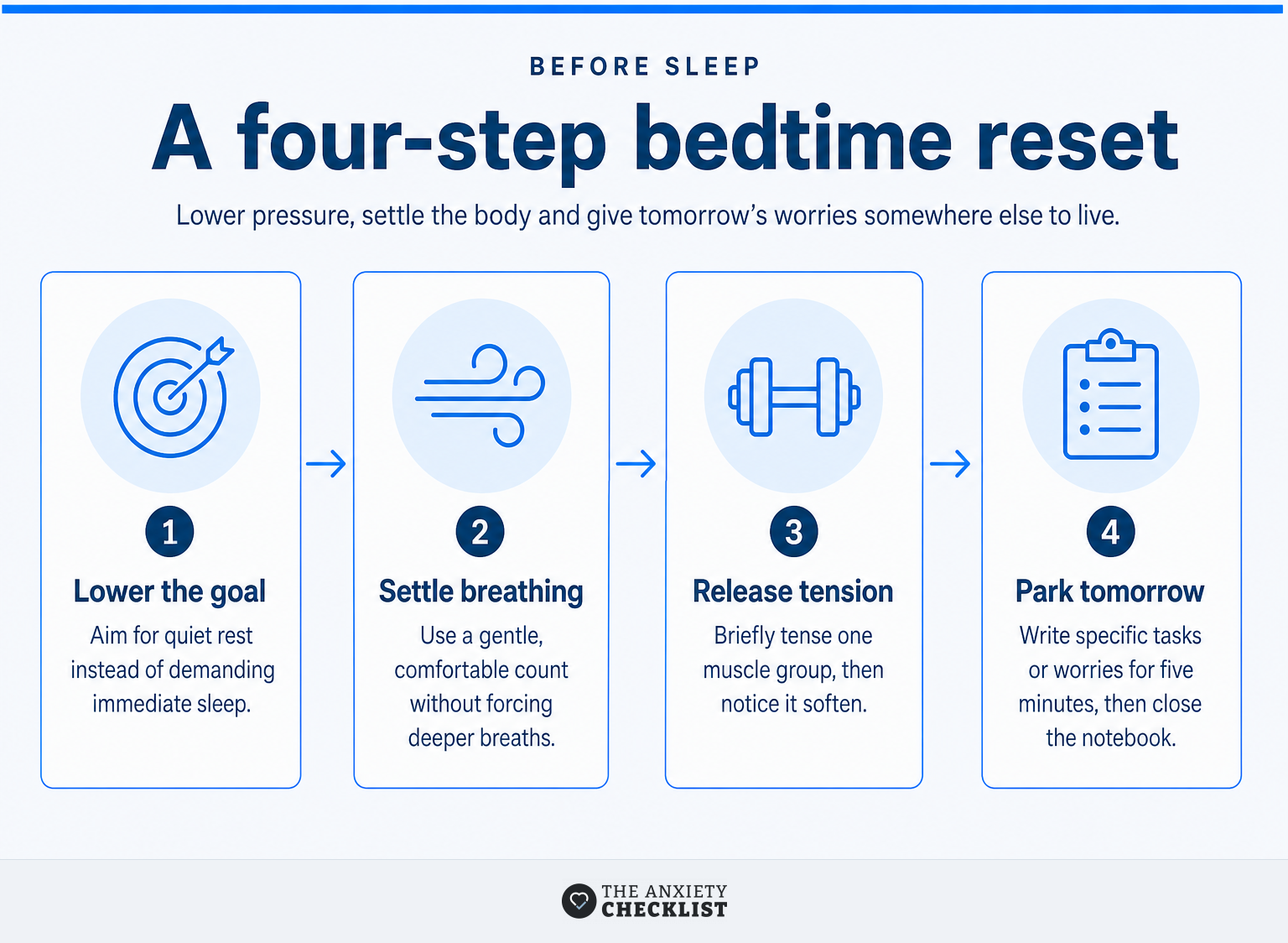
Use a four-step reset that lowers pressure, settles physical arousal and moves unfinished thinking out of bed. Give the sequence one calm pass instead of repeatedly testing whether it has made you sleepy.
This section focuses on what to do now. The broader guide to why anxiety gets worse at night explains common triggers and the anxiety-sleep cycle.
1. Lower the goal from sleep to quiet rest
Trying harder to sleep can turn the bed into a performance test. Replace “I must sleep now” with a smaller instruction: “Nothing needs to be solved right now; the next task is to rest quietly.”
This is not a promise that sleep will arrive. It is a way to stop adding fear about sleep to the anxiety already present. The 2025 VA/DoD clinical practice guideline strongly recommends cognitive behavioral therapy for insomnia, or CBT-I, which addresses the thoughts and behaviors that keep chronic insomnia going. (healthquality.va.gov)
2. Let the breath become gentle and regular
Rest one hand on the abdomen and let the breath move as deeply as is comfortable without forcing it. Breathe in through the nose and out gently, using an even count if counting helps.
The NHS breathing exercise suggests a comfortable count of up to five in and five out for at least five minutes. If deliberate breathing causes dizziness or more body monitoring, return to normal breathing and shift attention to sounds or touch instead. (nhs.uk)
3. Release tension one muscle group at a time
Briefly tense the jaw, shoulders, hands, abdomen and legs one area at a time, then notice the difference as each area softens. Skip any movement that causes pain, cramping or discomfort.
The NCCIH overview of relaxation techniques describes progressive muscle relaxation as tensing and releasing different muscles. NCCIH also notes that evidence for relaxation varies by condition, so progressive relaxation is best treated as a calming tool rather than a guaranteed sleep treatment. (nccih.nih.gov)
4. Put tomorrow on paper for five minutes
Write the tasks, worries or reminders your mind keeps rehearsing. Make each item specific, add the smallest next action where one exists, and close the notebook when the five minutes end.
A 2018 polysomnographic study randomly assigned 57 healthy adults ages 18 to 30 to write either a future to-do list or a completed-activity list before bed. The to-do group fell asleep faster, especially when the list was specific. This was a small laboratory study, not proof that a brain dump will work for everyone. (pubmed.ncbi.nlm.nih.gov)
The fastest bedtime reset lowers pressure, settles the body and gives tomorrow’s worries somewhere else to live.
What should I do if I wake anxious at 3 a.m.?
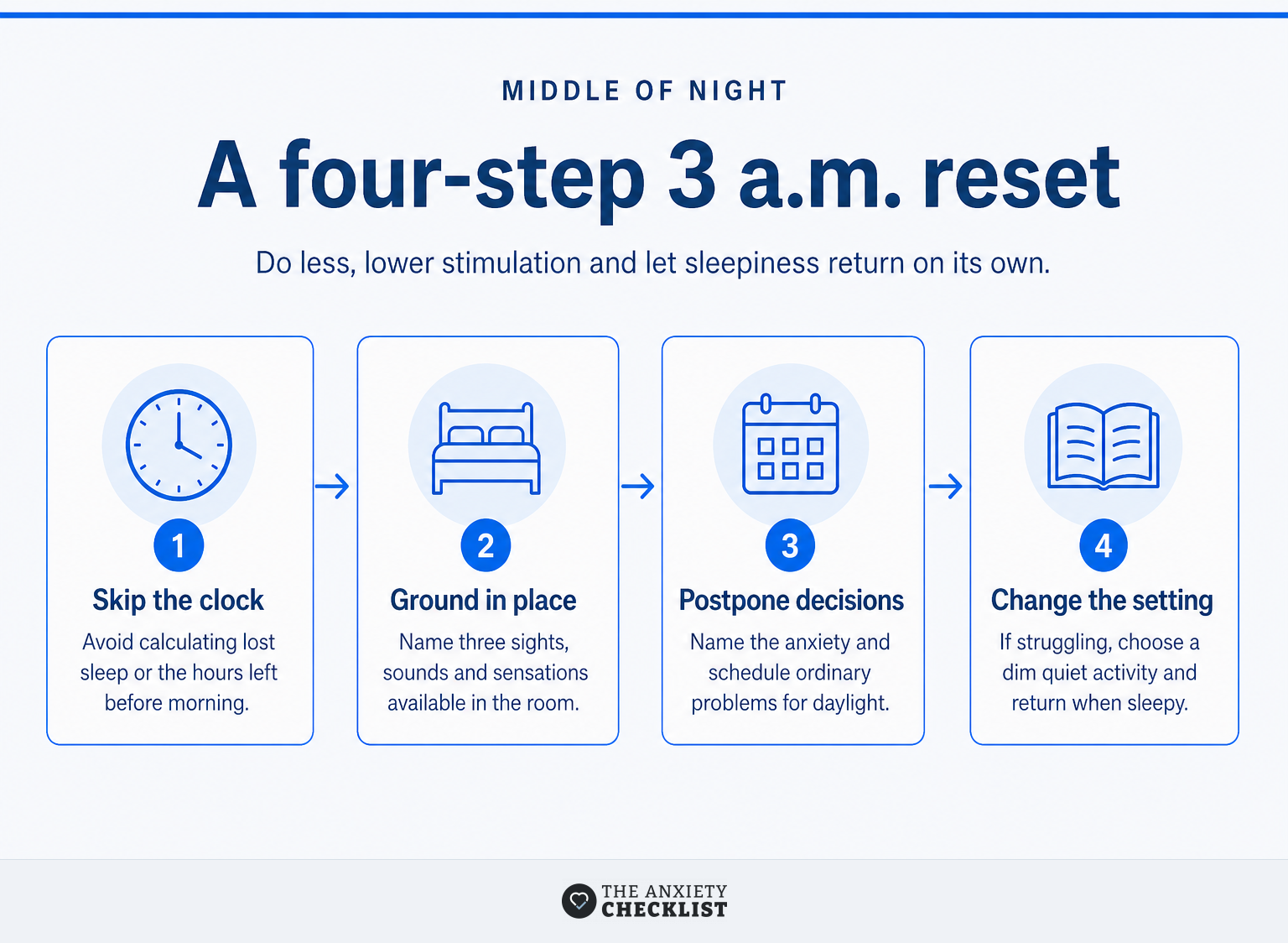
Use a shorter four-step reset that avoids bright light, time calculations and nighttime problem-solving. The goal is to reduce stimulation until sleepiness returns, not to force yourself unconscious.
5. Skip the clock check
Do not calculate how many hours remain or how badly tomorrow might go. Turn the clock face away and keep the phone out of reach unless it is needed for safety.
The National Heart, Lung, and Blood Institute notes that worrying about sleep and watching the clock can raise the risk of insomnia or make it worse. That does not mean one glance causes insomnia; it means repeated checking can feed the threat calculation already keeping the mind alert. (nhlbi.nih.gov)
6. Use the 3-3-3 rule as a grounding prompt
Name three things you can see, three sounds you can hear and three sensations you can feel or touch. In a dark room, the three sensations might be the pillow under your head, the blanket on your feet and the mattress supporting your back.
The NIH grounding guide published in 2025 describes sensory grounding as a way to refocus attention on the present environment. A Cleveland Clinic grounding guide describes the common three-sights, three-sounds and three-touch version. The 3-3-3 rule is a grounding prompt, not a treatment for chronic insomnia or anxiety. (training.nih.gov)
7. Name the state and postpone the problem
Use one prepared line: “This is anxiety, and nothing needs deciding before morning.” Then name when the issue will receive attention, such as after breakfast or during a scheduled worry period.
Postponing is appropriate for imagined scenarios and ordinary unfinished business. It is not appropriate when there is an actual safety problem, a medical emergency or something that genuinely requires immediate action.
8. Change the setting if wakefulness becomes a struggle
If you feel increasingly frustrated or have been awake for roughly 20 minutes, leave bed when it is safe and practical. Do not use the clock as a timer. Sit somewhere dim and do something quiet, such as reading a calm book, folding laundry or listening to low-key audio, then return when sleepy.
The VA stimulus-control guide, reviewed in 2025, recommends leaving bed when a person cannot sleep or starts struggling, avoiding the clock and returning when sleepiness returns. If mobility, caregiving or safety makes leaving bed impractical, sit up or change position and choose a quiet activity without bright screens. (veteranshealthlibrary.va.gov)
At 3 a.m., reduce stimulation and decisions instead of chasing sleep.
How do I relax my mind from overthinking at night?

Move the thought out of working memory instead of debating it in bed. Capture the concern, decide whether tomorrow contains an action, and postpone anything that cannot be solved tonight.
Use three short lines on paper:
- The thought: Write the prediction exactly as the mind is presenting it.
- Tomorrow’s action: Record one practical step, even if that step is only to gather more information.
- Not solvable tonight: Mark uncertainty that has no useful nighttime action.
A scheduled daytime worry period can make postponement more believable because the concern has somewhere to go. The official VA SleepEZ course includes planned worry time among its CBT-I techniques for reducing worry in bed. (veterantraining.va.gov)
Keep the note factual. A long journal entry that analyzes every possibility can become another form of nighttime problem-solving, while a phone note can lead straight into notifications and scrolling.
Overthinking usually quiets when thoughts are captured, sorted and postponed rather than argued with in bed.
What helps if the anxiety feels like a panic attack?
For a familiar panic pattern, stay somewhere safe, let breathing become gentle and direct attention toward the room rather than repeatedly checking the body. If the symptoms are new, severe or different from past panic, seek medical assessment rather than assuming anxiety is the cause.
The NHS panic guidance advises staying where you are when possible, breathing slowly, remembering that the attack will pass and focusing on a peaceful image. At night, pair that advice with one concrete anchor: the mattress under your back, a familiar sound or a cool object in your hand. (nhs.uk)
Use a brief sentence rather than a debate: “This is a surge of alarm. The feeling can rise and fall without an immediate decision.” If attention to breathing increases fear, stop controlling the breath and use external sensory grounding instead.
Self-help should not be used to diagnose physical symptoms. Anxiety can cause a racing heart, shaking and shortness of breath, but other conditions can cause similar sensations.
Treat familiar panic with gentle breathing and grounding, but never assume new or severe physical symptoms are anxiety.
What habits make nighttime anxiety less likely?
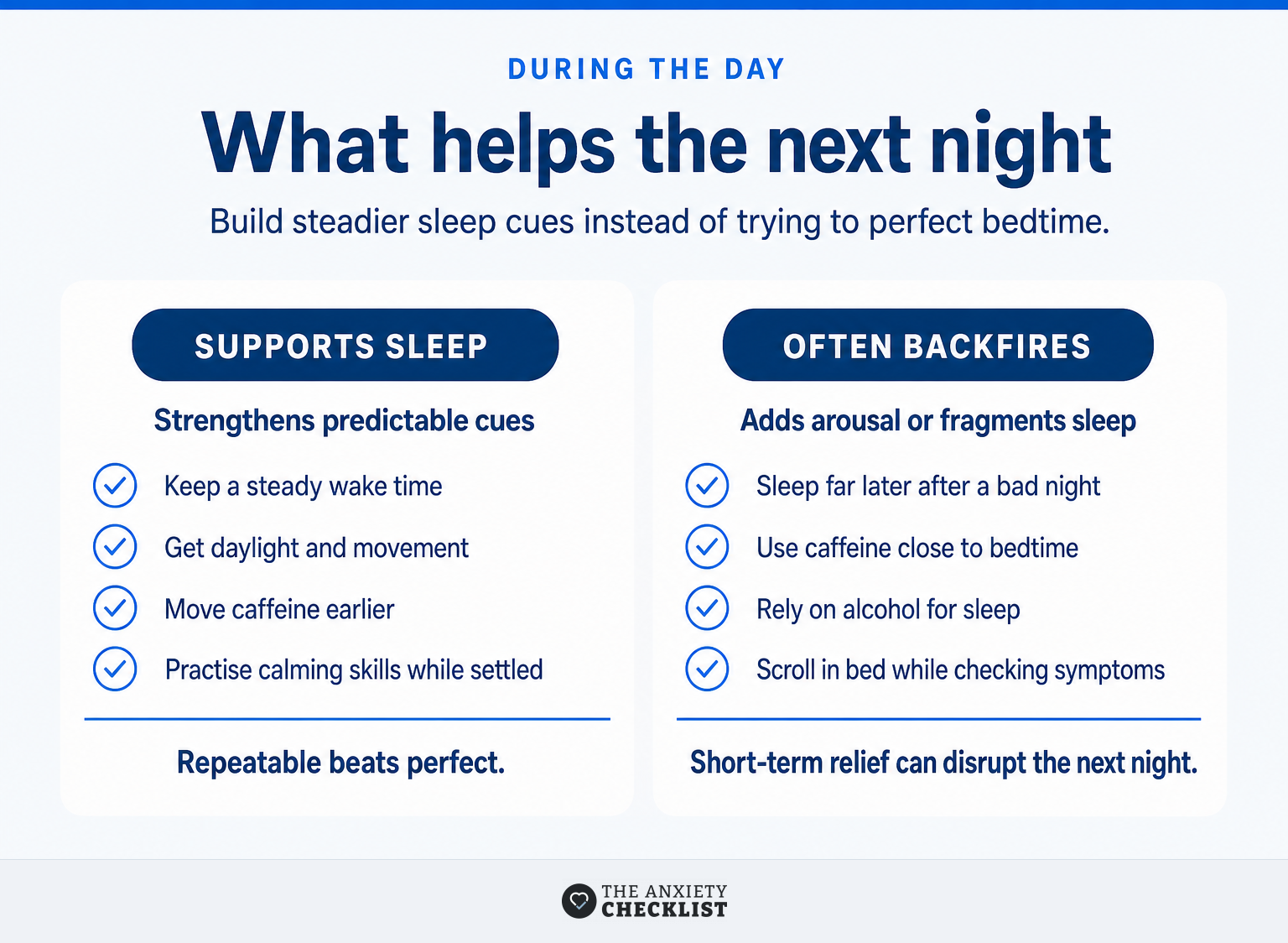
The most useful prevention work happens during the day: keep a steady wake time, get light and movement, move worry out of bed and practise calming skills before distress is high. A perfect evening routine cannot compensate for an irregular schedule or untreated anxiety.
The NHLBI healthy sleep guidance, updated in 2022 recommends a consistent sleep schedule, daytime outdoor activity and a quiet, cool, dark bedroom. It also notes that caffeine can interfere with sleep for up to eight hours and that alcohol before bed can disrupt sleep. (nhlbi.nih.gov)
A practical daytime plan includes:
- Keep the wake time steady. Sleeping far later after a difficult night can make the next bedtime less predictable.
- Get daylight and physical activity. Spend time outside when possible and move regularly during the day.
- Move caffeine earlier if sleep is sensitive. Count back from bedtime rather than relying on a universal afternoon cutoff.
- Do not use alcohol as a sleep tool. It may make sleep feel easier at first while contributing to lighter sleep and night waking.
- Practise while calm. Rehearse breathing, grounding or muscle relaxation in daylight so the steps require fewer decisions at night.
If guided practice is easier than remembering the sequence, a grounding techniques app can provide a repeatable prompt. It should support practice, not replace assessment or treatment when symptoms persist.
Sleep habits are useful, but they are not a full treatment for chronic insomnia. The 2025 VA/DoD guideline recommends CBT-I and advises against relying on sleep-hygiene education as a stand-alone treatment. (healthquality.va.gov)
A steady wake time and daytime practice matter more than a perfect bedtime ritual.
When should I get professional or urgent help?
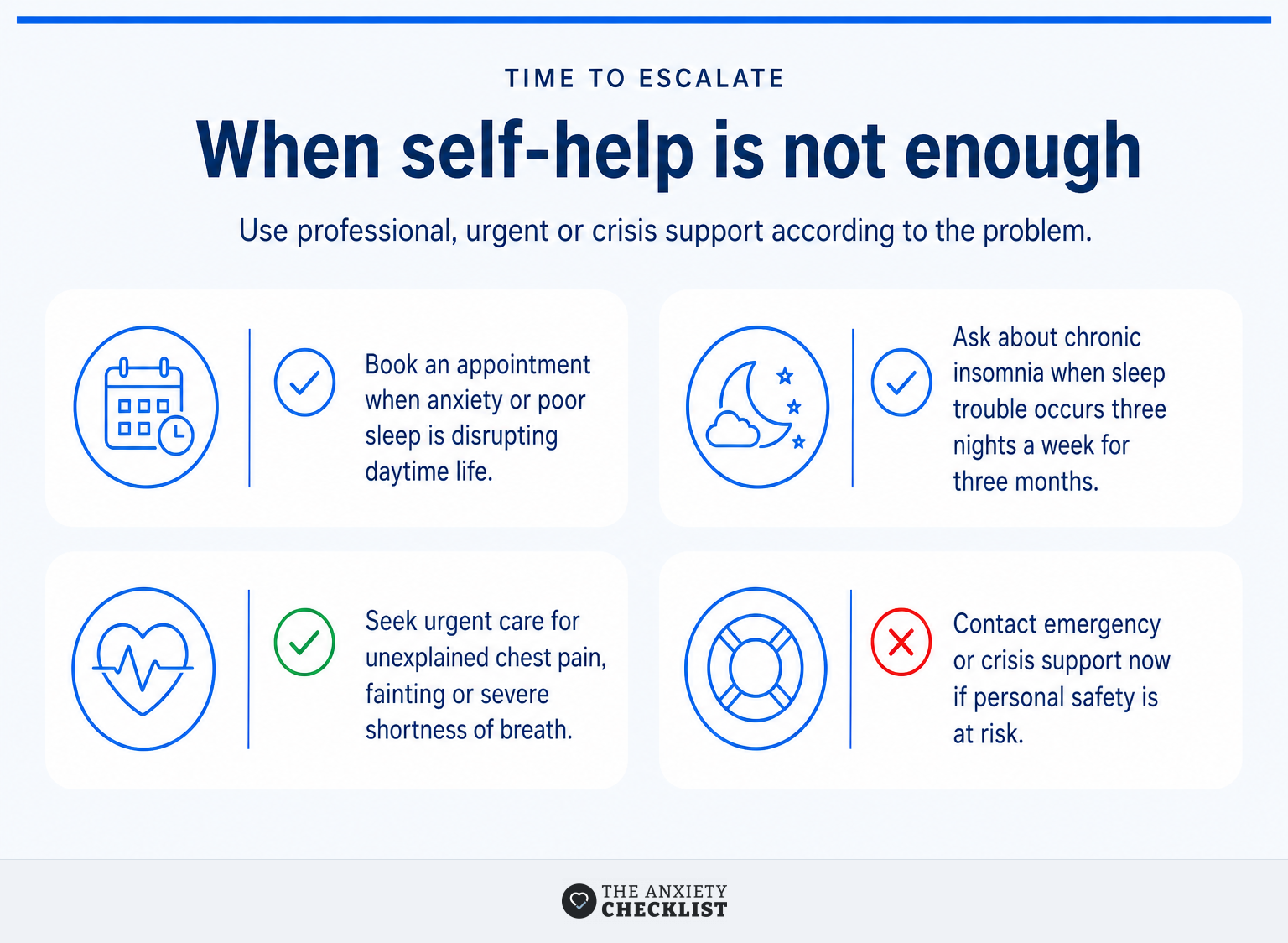
Arrange professional help when anxiety or sleep loss is recurring, difficult to control or interfering with daytime life. Seek urgent help when symptoms may reflect a medical emergency or when personal safety is at risk.
The NHLBI diagnostic guidance defines chronic insomnia as difficulty falling or staying asleep at least three nights a week for three months or longer. A clinician can also check for medical conditions, medication effects, sleep apnea, substance use and anxiety disorders that self-help cannot sort out. (nhlbi.nih.gov)
Ask specifically about CBT-I if persistent insomnia is part of the problem. The 2025 VA/DoD guideline recommends CBT-I for chronic insomnia and describes stimulus control, relaxation, sleep scheduling and cognitive work as treatment components. (healthquality.va.gov)
Do not assume unexplained chest pain, fainting or severe shortness of breath is panic. MedlinePlus chest-pain guidance advises immediate medical care for chest pressure or pain accompanied by symptoms such as sweating, dizziness, nausea or shortness of breath. (medlineplus.gov)
If anxiety brings thoughts of self-harm or you cannot stay safe, contact local emergency services or a crisis service now. In the United States, the 988 Suicide & Crisis Lifeline accepts calls and texts; readers elsewhere can use these global crisis and emergency resources. (988lifeline.org)
Get help when sleep loss persists, anxiety is shrinking daily life, symptoms could be medical or safety is at risk.
What else do people ask about nighttime anxiety?
These answers address the questions that commonly appear alongside searches for nighttime anxiety. Each technique is a short-term coping option, not a diagnosis or guaranteed treatment.
Why is my anxiety worse at night?
Anxiety can feel worse at night because daytime distractions drop away, fatigue reduces coping capacity, and a quiet room leaves more attention for body sensations and unfinished worries. Fear about not sleeping can then add a second layer of arousal. Repeated or severe nighttime anxiety deserves professional assessment.
What is the 3-3-3 rule for anxiety sleep?
The 3-3-3 rule is a grounding prompt: identify three things you can see, three you can hear, and three you can feel or touch. At night, use whatever senses are available without turning on bright lights. The rule may redirect attention, but it is not a treatment for chronic anxiety or insomnia.
How do I relax my mind from overthinking at night?
Move the thought out of working memory and onto paper. Write the worry, the next action that can wait until tomorrow, and what cannot be solved tonight. Then return attention to a neutral sensation or quiet task. If overthinking repeatedly disrupts sleep, ask about CBT-I or anxiety treatment.
How to stop a panic attack and go to sleep?
If symptoms match a familiar panic pattern, stay somewhere safe, breathe gently, ground through the senses, and remind yourself that the surge will pass. Do not assume new chest pain, fainting, or severe shortness of breath is panic. Seek urgent medical care when symptoms are new, severe, or uncertain.
The 3-3-3 rule is a grounding prompt, while persistent nighttime anxiety needs a broader plan.
What should I do tonight?
Choose the protocol that matches the moment and write it on a card beside the bed. Rehearse it once in daylight, when the steps are easier to remember and evaluate.
For guided in-the-moment support during panic or intense anxiety, open the free SOS Panic Relief tools. Anxiety Checklist is an educational self-help resource, not an emergency service or substitute for professional diagnosis and treatment.
Put the plan beside the bed before tonight, because the best nighttime protocol removes decisions.