

In short
An anxiety loop is a repeating pattern in which a trigger leads to a threatening thought, body alarm, and a coping behavior such as checking, reassurance, overthinking, or avoidance. That behavior may bring brief relief, which makes it more likely to happen again. Breaking the loop means mapping it, then changing one response at a time.
Key takeaways
- Brief relief after checking, reassurance, avoidance, or mental review can make the same response more likely the next time anxiety appears.
- A useful map records five core parts: trigger, prediction, body response, coping behavior, and immediate payoff, followed by the longer cost.
- The first change should be small, such as delaying one check, reducing one reassurance request, or approaching one manageable avoided step.
- Professional help is warranted when anxiety persists, worsens, disrupts daily life, or creates safety concerns.
Table of contents
- What is looping in anxiety?
- Why does the same anxious thought keep coming back?
- How can you map your own anxiety loop?
- What can you change first when you are stuck in an anxiety loop?
- When is self-help not enough?
- What else do people ask about anxiety loops?
- What should you do the next time the loop starts?
Feeling stuck in an anxiety loop does not mean the original fear must be solved before anything can change. The practical task is to identify the sequence that follows the trigger, especially the action that brings quick relief but leaves the fear ready to return.
What is looping in anxiety?
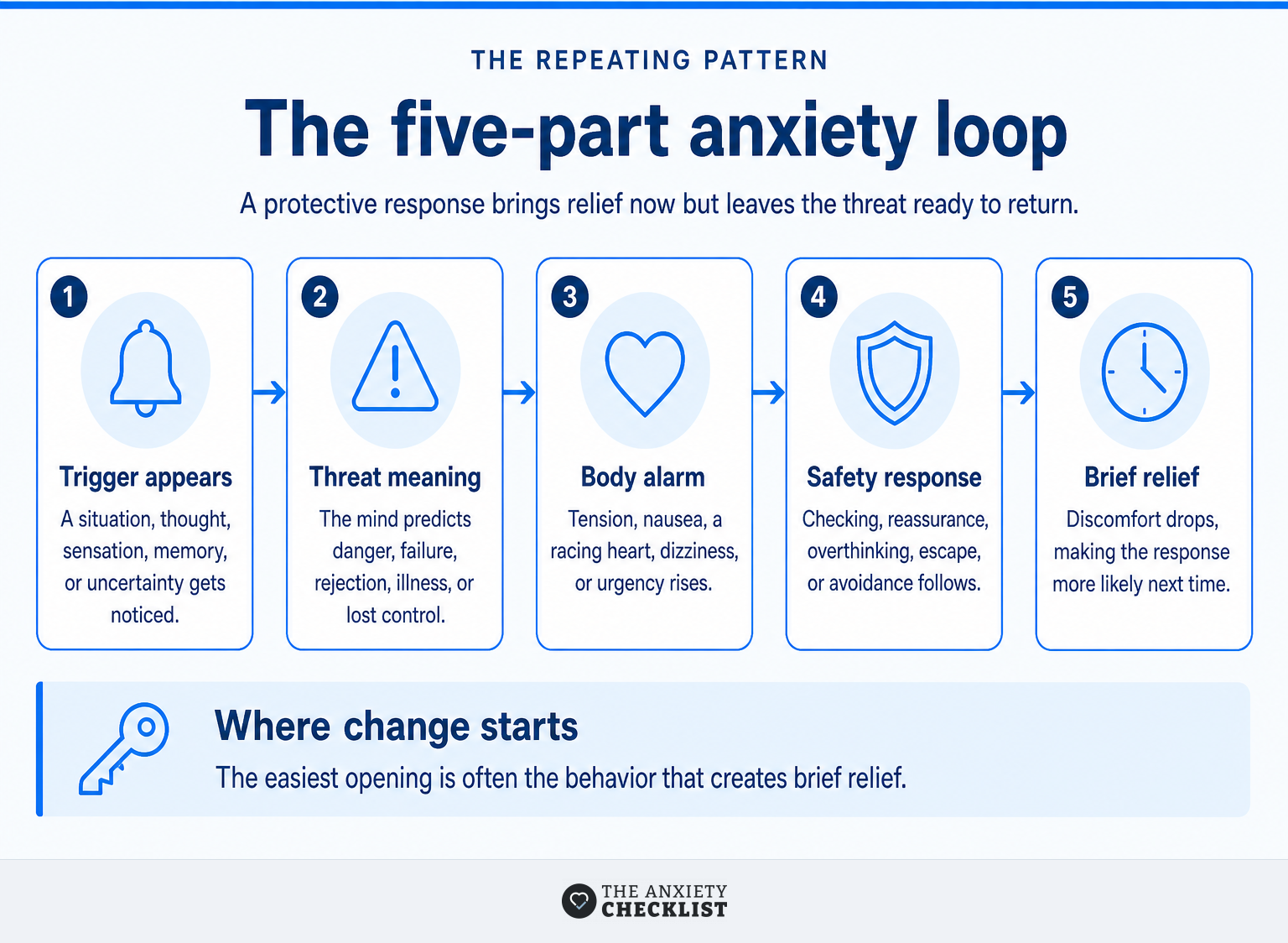
Looping in anxiety is the repetition of the same threat response across thoughts, physical sensations, and behavior. The phrase describes a pattern rather than one specific diagnosis, and the pattern can appear in several anxiety-related problems.
Western Australia's Centre for Clinical Interventions updated its anxiety self-help library in July 2025. Its vicious-cycle model connects danger scanning, stronger physical symptoms, escape or avoidance, short-term relief, and longer-term loss of confidence in coping.
The loop can be mapped in five stages:
- A trigger appears. A message, memory, sensation, decision, uncertain event, or intrusive thought gets noticed.
- The mind predicts a threat. The trigger is given a meaning such as rejection, illness, failure, embarrassment, danger, or loss of control.
- The body responds. Tension, nausea, heat, a racing heart, dizziness, restlessness, or mental urgency makes the prediction feel more credible.
- A protective behavior follows. The person checks, asks for reassurance, mentally reviews, searches for certainty, escapes, postpones, or avoids.
- Brief relief arrives. The discomfort drops for a while, but the original prediction is not fully tested.
Consider a hypothetical unread message from a manager. The prediction is that something has gone badly wrong, the body tightens, and the message is reread repeatedly before a coworker is asked what it means. Reassurance brings relief, but the next brief message is more likely to start the same sequence.
Some people call a version driven mainly by escape or postponement an anxiety avoidance cycle. Other loops are almost entirely mental, with repeated analysis replacing visible avoidance.
An anxiety loop is maintained less by the first thought than by what repeatedly happens after it.
Why does the same anxious thought keep coming back?
The thought often returns because the response after it reduces discomfort without resolving uncertainty. The brain learns that checking, reassurance, avoidance, or further thinking is the route to relief, so the urge appears again when a similar trigger occurs.
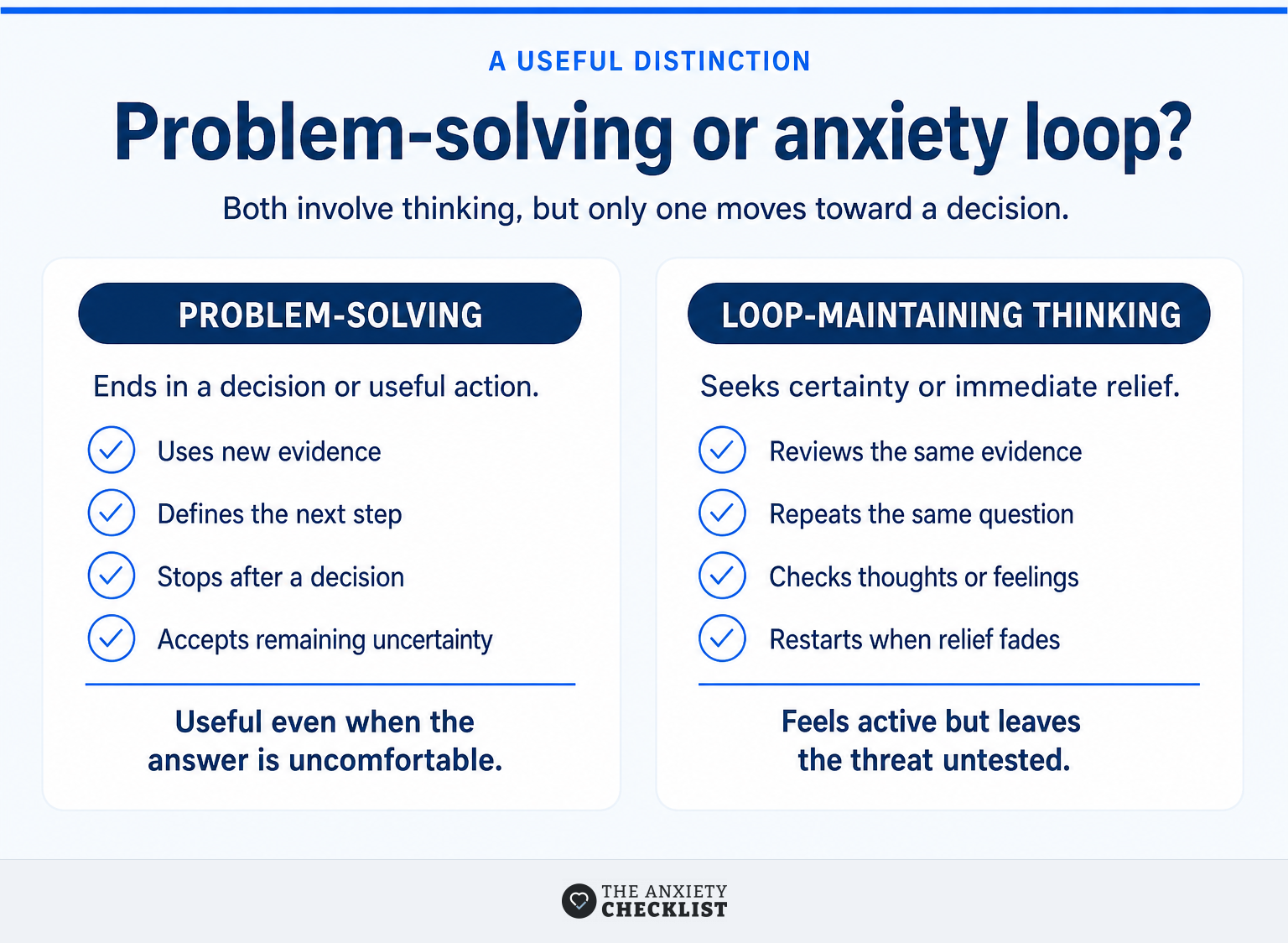
Not every check, question, or request for help is unhelpful. The issue is the behavior's purpose and repetition: does it gather necessary new information and lead to a decision, or does it briefly lower anxiety before the same question restarts?
Useful problem-solving usually has an endpoint:
- It considers new evidence rather than reviewing the same evidence again.
- It identifies a concrete action that can be taken now or scheduled.
- It stops once a reasonable decision has been made.
- It accepts that no decision removes every uncertainty.
Loop-maintaining thinking behaves differently. It adds another hypothetical outcome, checks the body for certainty, asks the same question in a new form, or restarts after reassurance fades. The activity can feel productive because it is effortful, but effort is not the same as progress.
Certain cognitive distortions, including catastrophizing, mind reading, emotional reasoning, and fortune telling, can supply the loop's threatening prediction. A loop can also attach to one frightening interpretation, such as a recurring fear of going insane, and then turn every anxious sensation into supposed evidence for that fear.
Repeated thinking becomes a loop when it seeks relief or certainty without producing a new decision.
How can you map your own anxiety loop?
Map one recent episode from beginning to end instead of trying to explain every anxiety pattern at once. A specific episode makes the sequence easier to observe and shows where a small change may be possible.
The Centre for Clinical Interventions' July 2025 resource library includes thought diaries, symptom records, exposure diaries, and behavioral-experiment worksheets. The following compact anxiety cycle worksheet focuses on the five-part loop and its longer consequence.
| Part of the loop | Question to answer | Hypothetical example |
|---|---|---|
| Trigger | What happened just before anxiety rose? | A manager sent a short message requesting a meeting. |
| Prediction | What did the mind say the trigger meant? | The meeting must be about a serious mistake. |
| Body response | What sensations or urges appeared? | Tight chest, heat, restlessness, and an urge to act immediately. |
| Coping behavior | What happened next to reduce uncertainty? | The message was reread, old work was checked, and reassurance was requested. |
| Immediate payoff | What changed in the next few minutes? | Anxiety fell after someone said the message was probably routine. |
| Longer cost | What remained untested or became harder? | Confidence in handling uncertain messages did not grow. |
Write observable facts where possible. Instead of recording that the trigger was failure, record the event that occurred and place failure under prediction. Separating the event from its anxious meaning makes the loop easier to examine.
Pay particular attention to the immediate payoff. If anxiety repeatedly falls after a behavior, that behavior may be the link that is teaching the cycle to continue, even when it looks sensible on the surface.
A useful loop map records the trigger, prediction, body alarm, coping response, brief payoff, and longer cost.
What can you change first when you are stuck in an anxiety loop?

Start by changing the easiest link you can reach, not by trying to eliminate anxiety. A small shift in checking, reassurance, avoidance, or mental review gives the brain new information while the feeling is still present.
If anxiety is rapidly escalating and deliberate thinking is difficult, begin with a shorter plan to stop an anxiety spiral. Return to the full loop map after the immediate urgency has dropped.
1. Can you label the loop without solving the whole threat?
Use a short, factual label such as: “This is the checking loop” or “The urge for reassurance is here.” The label does not prove the feared outcome wrong. It creates enough distance to notice that a familiar sequence is starting.
Avoid turning the label into a debate. A ten-minute internal argument about whether the fear is rational can become another form of mental checking.
2. Can you make enough room to choose?
Place both feet on the floor, loosen the jaw, notice three neutral objects, or let the breath move naturally. The aim is not to force the body to become completely calm. It is to lower urgency enough to choose what happens next.
A calming method can become part of the loop if it is treated as a requirement before every ordinary action. Use grounding as support for making a choice, not as proof that anxiety must disappear before life can continue.
3. Can you stop, reduce, or delay the relief-seeking behavior?
The Centre for Clinical Interventions' 2025 reassurance-seeking guide offers three options: stop the behavior, gradually reduce it, or delay it. The right starting point depends on how frequent and difficult the behavior has become.
Examples include waiting before repeating a question, checking a message once rather than several times, or reducing the number of people asked for the same opinion. The goal is not to ban normal support. It is to target repetition that produces only short-lived relief.
Do not reduce appropriate medical checks, protective actions, or requests for genuinely new information. If circumstances have changed or a real safety issue is unresolved, seek relevant help rather than assuming every concern is anxiety.
4. Can you run one manageable test?
When avoidance is maintaining the loop, choose a small approach step rather than the most frightening possible challenge. Current NHS guidance on facing fears explains that avoidance can bring short-term relief while making a situation harder to face, and recommends gradual practice beginning with easier steps.
A manageable test might involve reading an email once and drafting a reasonable response, remaining in an ordinary situation without asking for repeated reassurance, or completing one task before reviewing it. The test should be difficult enough to provide new information but not so large that it becomes unmanageable.
Do not use self-directed exposure to approach actual danger. Situations involving abuse, unsafe conditions, medical warning signs, or serious legal or financial consequences require protective action or qualified advice.
5. Can you review what happened after the urgency passes?
Record the prediction, what actually happened, what was done differently, and what the result suggests. The lesson does not have to be that nothing bad ever happens. A useful lesson may simply be that uncertainty was tolerated, one task was completed, or the feared outcome was less certain than it first appeared.
Use a structured record: The cbt journaling app guides users through defining the worry, identifying a thinking trap, balancing the thought, and reframing it. Use the CBT Thought Journal as educational self-help, not as a diagnosis or replacement for professional care.
Change one repeated response at a manageable scale, then let the result teach the brain something new.
When is self-help not enough?
Self-help is not enough when anxiety is persistent, worsening, disabling, or connected to an immediate safety concern. A loop map can organize information, but it cannot determine whether symptoms come from generalized anxiety, panic, obsessive-compulsive symptoms, trauma, depression, a medical condition, medication effects, or another cause.
The National Institute of Mental Health's revised 2025 guide to generalized anxiety disorder advises seeking professional help when anxiety begins causing problems at work, school, or in relationships. It lists possible symptoms such as difficult-to-control worry, restlessness, concentration problems, irritability, sleep disruption, muscle tension, trembling, sweating, lightheadedness, and shortness of breath.
Arrange an assessment when:
- The loop consumes substantial time or keeps spreading to new situations.
- Work, study, sleep, eating, relationships, driving, or leaving home is affected.
- Checking, reassurance, or avoidance feels impossible to resist.
- Panic, depression, trauma symptoms, substance use, or intrusive thoughts are also present.
- Physical symptoms are new, unexplained, or different from previous anxiety experiences.
- Self-help repeatedly increases distress or produces no meaningful improvement.
The NICE guideline CG113, last updated in June 2020 and reviewed in May 2024, includes CBT-based self-help among options for adults with generalized anxiety disorder. It also supports monitoring progress and considering other interventions when improvement is insufficient.
If there is immediate danger or a risk of self-harm, contact local emergency or crisis services. As of September 2026, people in the United States and its territories can call or text the 988 Suicide & Crisis Lifeline; readers elsewhere should use the emergency or crisis service for their location.
Self-help is a starting point, not a substitute for assessment when anxiety is persistent, disabling, or unsafe.
What else do people ask about anxiety loops?
These questions focus on duration, symptoms, and the fastest safe way to interrupt the pattern. Each answer describes general self-help, not a diagnosis for any one person.
How to get out of an anxiety loop?
To get out of an anxiety loop, name the trigger, notice the predicted threat, and identify the action that gives brief relief. Then change one manageable response, such as delaying a repeated check, asking for reassurance once instead of repeatedly, or taking one gradual approach step. Do not wait to feel completely calm.
How long does an anxiety loop last?
There is no standard duration for an anxiety loop because the phrase describes a repeating pattern, not one timed clinical episode. A loop may run for minutes, restart throughout a day, or recur around the same trigger for months. Duration matters less than frequency, impairment, and whether the pattern is worsening.
What is looping in anxiety?
Looping in anxiety is the repetition of a threat response: a trigger leads to an anxious prediction, body alarm, and a coping action such as checking, reassurance, overthinking, escape, or avoidance. Brief relief follows, but the original fear remains untested, so the same sequence is more likely to return.
What are the symptoms of extreme anxiety?
Extreme anxiety can involve uncontrollable worry, restlessness, irritability, concentration problems, sleep disruption, muscle tension, trembling, sweating, lightheadedness, shortness of breath, or difficulty functioning. The NIMH's revised 2025 guide advises professional help when anxiety disrupts work, school, or relationships. Immediate danger or self-harm risk requires urgent local crisis support.
The practical question is not how to force the loop to vanish, but which repeated response can be changed safely.
What should you do the next time the loop starts?
Open a note and record the trigger and predicted threat before doing anything else. The next useful move is to record one loop while it is fresh and choose one response to change next time.