


In short
Fear of going insane does not, by itself, mean that someone is losing touch with reality. Panic, intrusive thoughts, and depersonalization or derealization can all produce a frightening sense of losing control. Because fear alone cannot diagnose the cause, new reality-distortion symptoms or safety concerns need prompt professional assessment.
Key takeaways
- A sense of losing control can occur during panic and does not, by itself, establish psychosis.
- Intrusive thoughts and depersonalization or derealization can feel alarming without providing a diagnosis.
- Grounding first and checking the evidence second is more useful than trying to force certainty.
- New hallucinations, strong unusual beliefs, confused speech, safety risks, or difficulty distinguishing reality from fantasy need prompt assessment.
Table of contents
- Does fear of going insane mean you are losing touch with reality?
- Why can anxiety feel like losing control?
- What do intrusive thoughts and unreal feelings mean?
- What should you do in the next five minutes?
- How can you check the thought without feeding it?
- When should you get professional or urgent help?
- What else do people ask about the fear of going insane?
- What can you do today?
The phrase “going insane” is too broad to act as a diagnosis. A safer approach separates three questions: what the fear feels like, what may be maintaining it, and whether any symptom needs professional assessment now.
Does fear of going insane mean you are losing touch with reality?
Anxiety can create a powerful sense of losing control even when no clear danger is present. The NIMH panic guidance, accessed September 2026 lists feeling out of control among possible panic symptoms, but no webpage can determine the cause of one person’s experience.
The intensity of the fear does not settle the question. A person can be extremely frightened by a thought, sensation, or unreal feeling without that experience providing a diagnosis.
Look at what is happening rather than how frightening it feels:
- A catastrophic question such as “What if this means losing control?” may point to a fear loop, but it is not proof of anxiety.
- Hearing or seeing things others do not, holding strong beliefs that are difficult to reconsider, or struggling to tell reality from fantasy requires assessment.
- A sudden change after severe sleep loss, substance use, withdrawal, or a medication change also deserves medical attention.
Do not rely on the slogan that worrying about psychosis automatically proves it cannot be happening. NIMH psychosis guidance recommends contacting a health professional when warning signs intensify, persist, or disrupt functioning.
The fear is evidence that you are frightened, not proof of what is causing the fear.
Why can anxiety feel like losing control?
Anxiety can turn uncertainty into an emergency and then treat the body’s alarm response as evidence that the feared event is happening. NIMH describes panic as a possible false-alarm cycle in which catastrophic interpretations increase fear and physical symptoms.
The fear-of-fear cycle
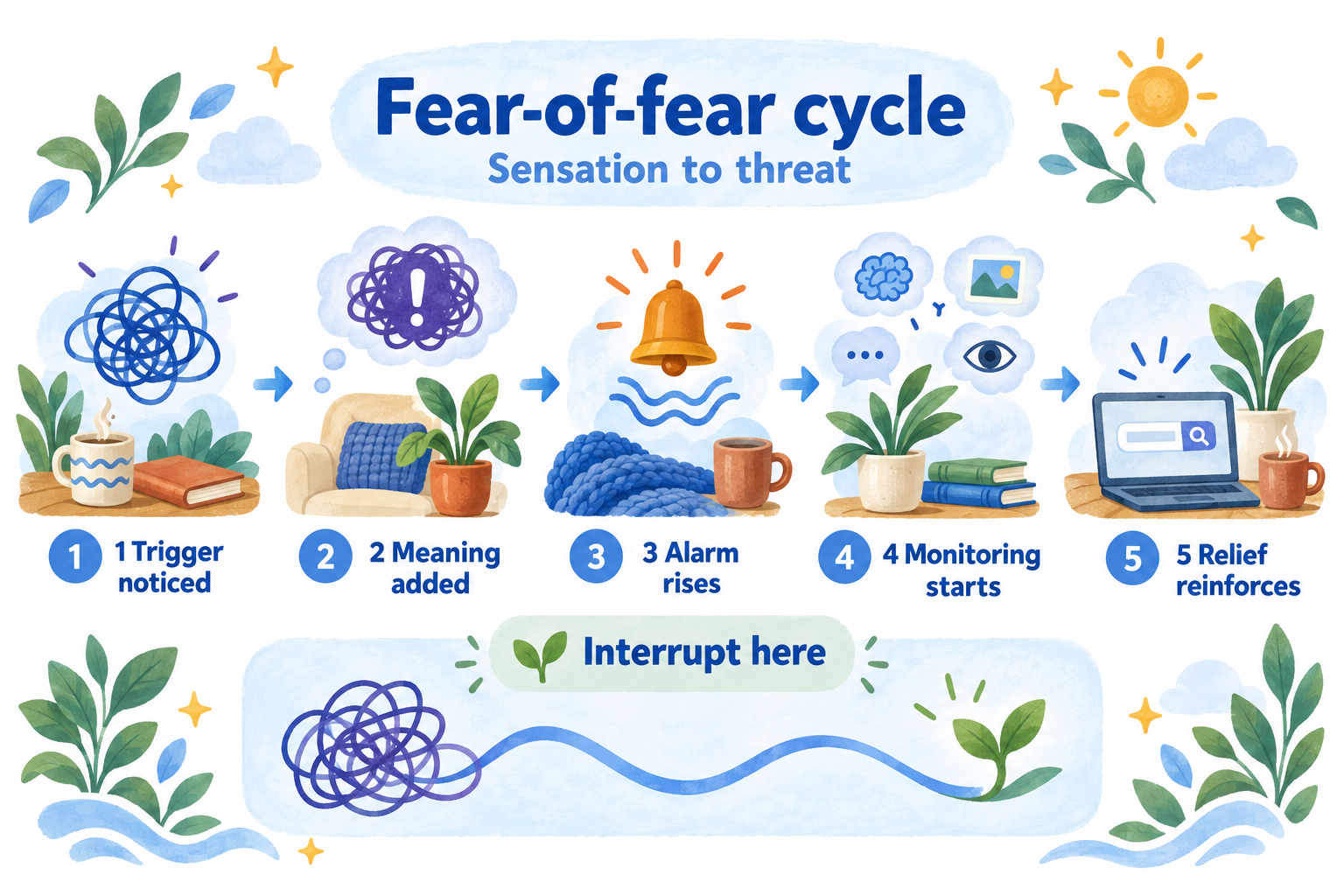
The cycle often develops in five stages:
- A trigger appears. An intrusive thought, unfamiliar sensation, memory lapse, or unreal feeling gets noticed.
- The mind adds a meaning. The experience is interpreted as evidence of an impending loss of control.
- The alarm rises. Adrenaline, mental urgency, dizziness, tension, or racing thoughts make the interpretation feel more credible.
- Monitoring begins. Attention scans thoughts, memories, speech, and surroundings for further proof.
- Short-term relief becomes the goal. Searching symptoms or repeatedly asking for reassurance settles the fear briefly, but leaves the original question unresolved.
The answer is not to win a perfect argument with the fear. It is to interrupt the escalation, as described in the guide to stop an anxiety spiral, and then respond to the original concern in proportion to the available evidence.
The cycle grows when a frightening sensation is treated as a verdict instead of a passing signal.
What do intrusive thoughts and unreal feelings mean?
Intrusive thoughts are unwanted thoughts that keep returning, but their presence alone does not diagnose OCD. NIMH’s 2024 OCD overview describes OCD as a pattern involving recurring obsessions, excessive repetitive behaviors, or both.
Depersonalization can feel like observing yourself from a distance. Derealization can make the world appear foggy, lifeless, or unreal, according to NHS dissociation guidance, last reviewed in 2023. A more detailed guide explains depersonalization and derealization and why the sensations can be mistaken for a loss of reality.
An intrusive thought is experienced as a distressing thought that has entered the mind. A hallucination is a sensory experience, such as hearing or seeing something others do not. Derealization describes the environment feeling unreal, but the description alone does not identify its cause.
These experiences can be hard to describe, and mixed or unfamiliar symptoms should be assessed rather than sorted through repeated online tests. Label the experience precisely, record when it started, and note any changes in sleep, medication, substance use, or daily functioning.
An unwanted thought or unreal feeling deserves context, not an automatic diagnosis.
What should you do in the next five minutes?
Do not try to settle a diagnosis while the alarm response is peaking. Use the next few minutes to orient to the present, reduce unnecessary stimulation, and decide whether urgent warning signs are present.
A five-minute grounding sequence
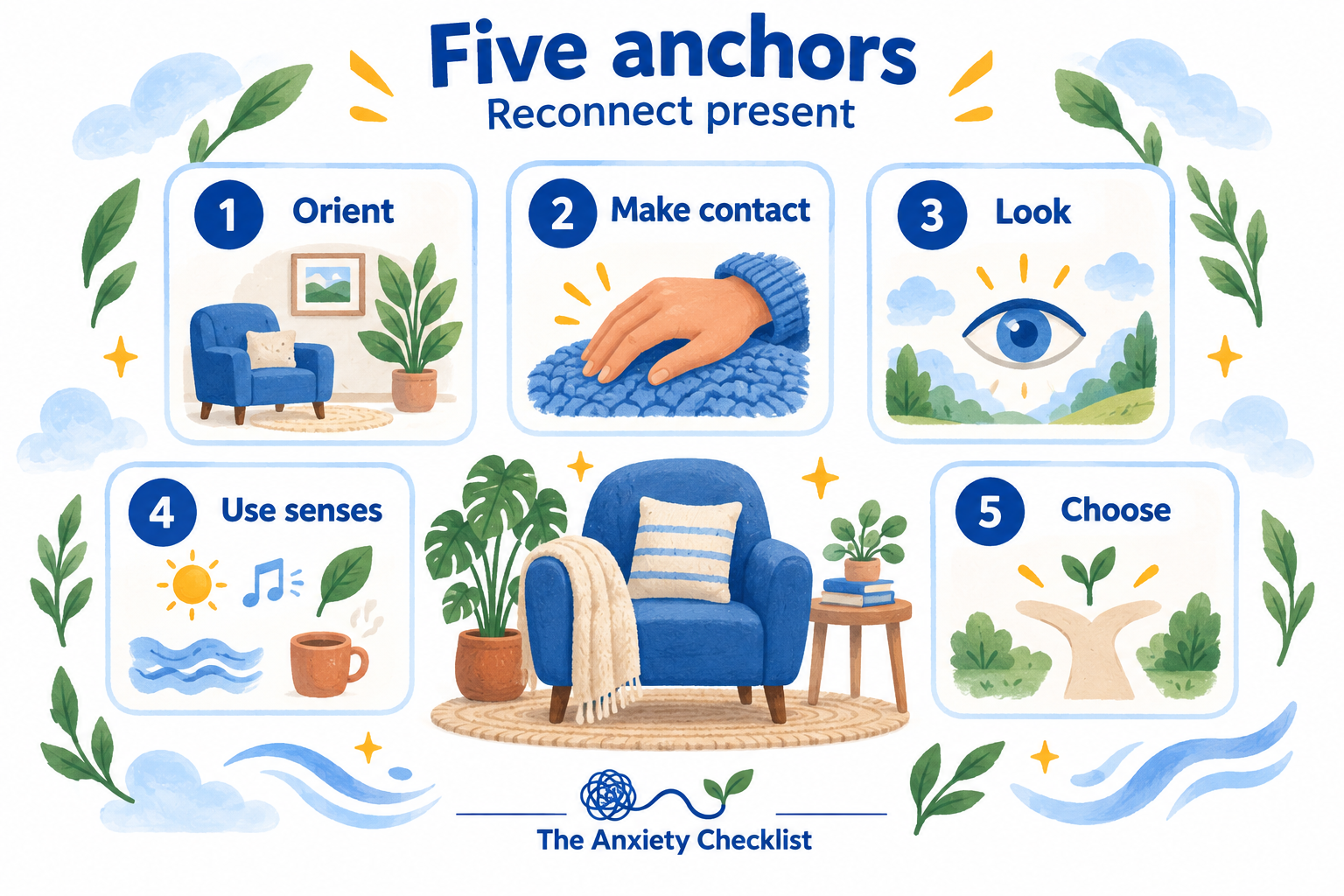
The Royal Berkshire NHS Foundation Trust’s April 2026 grounding guide uses attention and the senses to reconnect with the present environment.
- Orient. State the location, date, and current activity out loud or write them down.
- Feel physical support. Notice both feet on the floor, the chair beneath the body, or the texture and temperature of an object.
- Use the senses. Name five things visible, four things that can be felt, three sounds, two smells, and one taste.
- Pause symptom checking. Step away from searches and repeated reassurance for one chosen interval. Do not force a breathing exercise if it increases symptom monitoring.
- Choose one safe action. Continue a familiar task, contact a trusted person, arrange professional care, or seek urgent help if warning signs are present.
Grounding may not remove every sensation. Its purpose is to create enough space to make the next decision instead of letting the most frightening interpretation make it for you.
Grounding is a way to regain enough steadiness for the next decision, not a test of sanity.
How can you check the thought without feeding it?
Once the intensity shifts even slightly, write the feared prediction down. NHS CBT guidance, accessed September 2026 recommends examining the evidence and considering other explanations instead of immediately accepting an anxious prediction.
Five questions for a CBT thought check
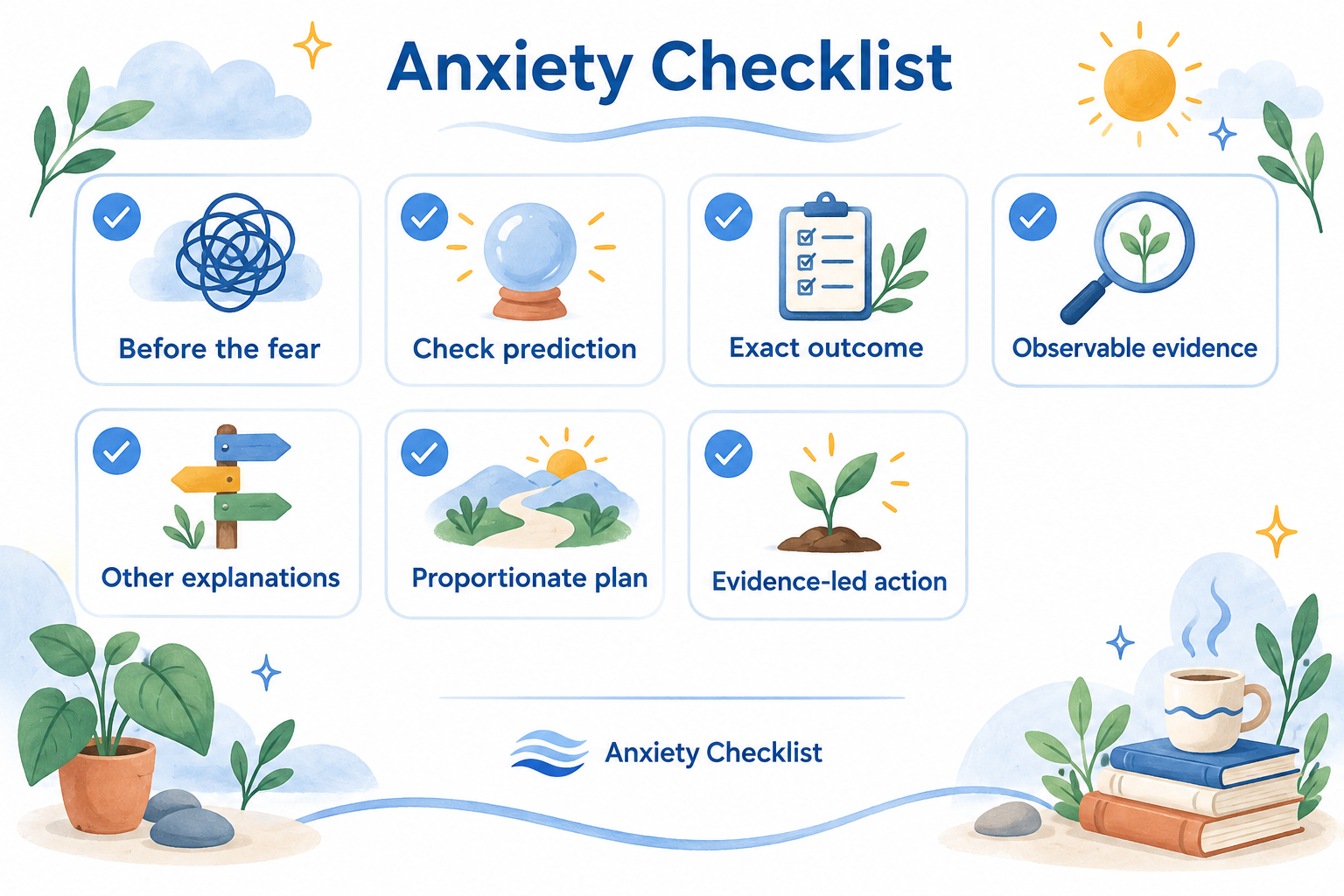
Ask these questions once, slowly:
- What happened immediately before the fear appeared?
- What exact outcome is the mind predicting?
- What observable evidence supports that prediction?
- What other explanations fit the same experience?
- What next action matches the evidence and the safety needs?
A brief record might contain:
- Situation: The room suddenly seemed distant after poor sleep.
- Alarm thought: The unreal feeling must mean a loss of control is starting.
- Balanced response: An unreal feeling can occur in several conditions and cannot establish a diagnosis. Grounding is reasonable now, with professional assessment if the experience persists, worsens, or appears with warning signs.
Balanced thinking is not a promise that nothing is wrong. It replaces an immediate catastrophe with a proportionate response. If journaling becomes repeated rewriting in search of absolute certainty, pause and discuss that pattern with a mental health professional.
A useful thought check makes room for uncertainty while choosing a proportionate next action.
When should you get professional or urgent help?
Seek urgent assessment when the experience includes a marked difficulty recognizing what is real, severe behavioral change, or a risk of harm. Arrange nonemergency professional care when recurring fear, checking, avoidance, or unreal feelings are disrupting sleep, work, relationships, or daily routines.
Seek urgent help for symptoms such as:
- Hearing or seeing things other people do not, particularly commands to act.
- Strong unusual beliefs that are difficult to reconsider despite contrary information.
- Difficulty telling reality from fantasy, confused speech, or severely disorganized behavior.
- A sudden, major decline in self-care or the ability to function.
- Thoughts of suicide, self-harm, harming another person, or an inability to remain safe.
NIMH also lists severe sleep deprivation, certain prescription medicines, and alcohol or drug misuse among possible causes of psychosis symptoms. New symptoms in those circumstances require medical assessment rather than an assumption that anxiety is responsible.
In the United States, call or text 988 for crisis support under the current 988 Lifeline guidance. Call 911 for immediate danger or a life-threatening emergency. Outside the United States, contact the local crisis service or emergency number.
For persistent but nonemergency concerns, a primary care clinician or licensed mental health professional can consider the full symptom pattern and rule out other causes. This guide explains when to talk to a mental health professional rather than relying on repeated self-diagnosis.
Symptoms that disrupt reality testing or safety need urgent assessment, and recurring fear that disrupts life also deserves professional help.
What else do people ask about the fear of going insane?

People often want a name, a quick reset, and a yes-or-no test. The safest answers explain what the words mean without turning them into a home diagnosis.
What is the phobia of going insane called?
People commonly call a persistent fear of going insane “dementophobia.” The word describes the feared outcome, not the reason the fear is happening. The American Psychiatric Association’s DSM overview, physician-reviewed in 2025 notes that diagnoses depend on criteria evaluated by trained professionals, so the label should not be used as a self-diagnosis.
How to reset your brain from anxiety?
There is no literal brain reset for anxiety. A practical short-term sequence is to orient to the room, use the five senses, let breathing stay easy, and postpone symptom checking. Once the alarm drops slightly, write down the feared prediction and compare it with the evidence instead of demanding certainty.
What is dementophobia?
Dementophobia is an informal term for an intense fear of losing one’s mind or becoming mentally unwell. The fear may occur in several patterns, including panic, health anxiety, intrusive-thought loops, or fear triggered by depersonalization and derealization. The term alone does not tell a clinician which pattern is present.
Am I going insane or is it anxiety?
Feeling afraid that you are going insane can occur during anxiety, but no single feeling can confirm the cause. NIMH’s description of psychosis focuses on symptoms such as hallucinations, delusions, confused speech, and difficulty telling reality from fantasy. New or worsening symptoms need professional assessment.
A label can name the fear, but only an assessment can identify what is driving it.
What can you do today?
Choose one recent episode and record the situation, body sensations, feared prediction, available evidence, alternative explanations, and the next safe action. If a guided format would help, use the CBT Thought Journal as an educational self-help tool, not as a diagnosis or a substitute for emergency or professional care.
The next useful step is a grounded record and appropriate care, not another hour of trying to prove the fear impossible.