


In short
Anxiety tremors at night can happen when a panic or stress response produces trembling, muscle tension, a racing heart, and rapid breathing, sometimes during sleep. Slow, comfortable breathing, grounding, and gentle muscle release may help, but new, persistent, one-sided, or otherwise unexplained shaking should be medically assessed rather than assumed to be anxiety. (nimh.nih.gov)
Key takeaways
- Panic attacks can occur during sleep and may include trembling, tingling, sweating, breathing difficulty, and a racing heart. (nimh.nih.gov)
- Nighttime timing does not prove that shaking is caused by anxiety because medicines, caffeine, thyroid disease, low glucose, and neurological conditions can also cause tremor. (medlineplus.gov)
- Gentle breathing and progressive muscle relaxation may help reduce anxious arousal, but relaxation techniques should not replace assessment of an unexplained medical symptom. (nhs.uk)
- Do not stop or change a prescription medicine because of shaking without first speaking to the prescribing clinician. (medlineplus.gov)
- Sudden weakness, facial drooping, speech difficulty, vision changes, or loss of coordination require emergency assessment for possible stroke. (cdc.gov)
Table of contents
- Why can anxiety make you shake at night?
- What should you do when shaking wakes you up?
- How do you know if the tremors are from anxiety?
- What else can cause nighttime tremors?
- When should nighttime shaking be assessed?
- Do anxiety tremors need medication?
- What else do people ask about anxiety tremors at night?
- What should you do before tonight?
People use words such as shaking, vibrating, trembling, and internal tremor for sensations that can feel similar but may have different causes. MedlinePlus defines tremor as involuntary shaking caused by muscle contractions, and the pattern must be assessed in context rather than diagnosed from one sensation. (medlineplus.gov)
Why can anxiety make you shake at night?
Yes, anxiety can cause shaking at night, including during a panic attack that begins while sleeping. As of September 2026, the National Institute of Mental Health lists trembling among panic symptoms and notes that panic attacks can occur during sleep. (nimh.nih.gov)
Anxiety activates a physical alarm response. Breathing may speed up, the heart may race, and muscles may tighten or tremble even when there is no immediate external danger.
The 2025 National Institute of Neurological Disorders and Stroke tremor guide also explains that stress, strong emotion, physical tiredness, posture, and movement can trigger or intensify some tremors. This means anxiety may cause the episode, amplify another tremor, or simply occur alongside it. (ninds.nih.gov)
An episode may begin while falling asleep, after waking suddenly, or when worry is already keeping the nervous system alert. The broader guide to anxiety worse at night explains how reduced distraction, sleep disruption, and nighttime worry can reinforce physical symptom monitoring.
Nighttime timing can fit anxiety, but it does not prove that anxiety is the cause.
What should you do when shaking wakes you up?
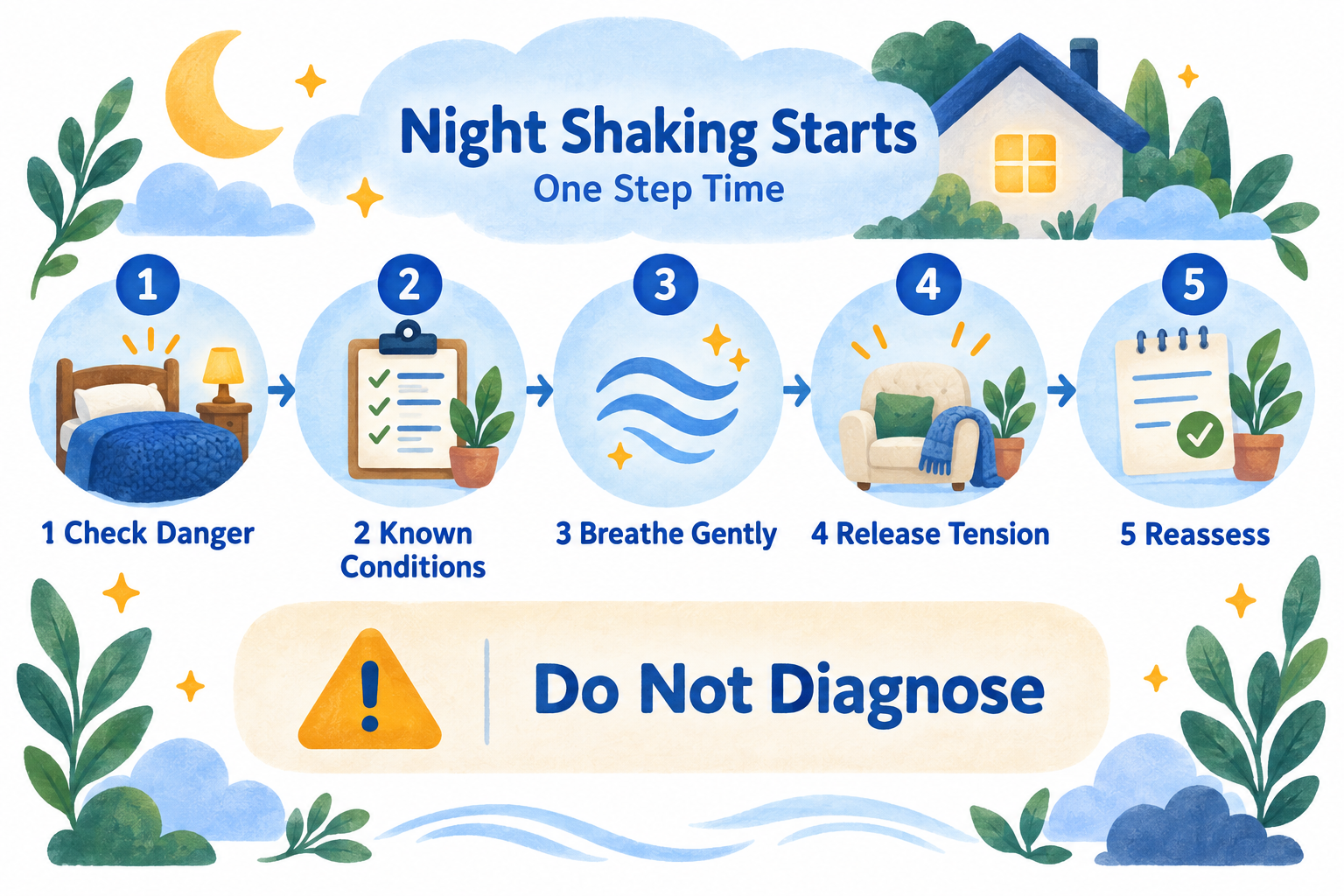
Start by checking for danger, then reduce stimulation and use one simple body-calming action at a time. Do not force the shaking to stop; the immediate goal is to stay safe, breathe comfortably, release avoidable tension, and see whether the episode begins to settle.
- Get physically safe and scan for emergency signs. Sit or lie somewhere you cannot fall. Call your local emergency number if shaking occurs with sudden one-sided weakness, facial drooping, speech or vision changes, severe new chest pain, loss of consciousness, or a first seizure. These warning signs are explained in more detail below.
- Follow any established medical plan. If you have diabetes and use a glucose meter or continuous monitor, check it and follow the treatment plan provided by your diabetes team. The CDC’s 2024 guidance defines blood glucose below 70 mg/dL as low and lists shaking, sweating, anxiety, dizziness, and a fast heartbeat among possible symptoms. People without diabetes should not assume shaking means low glucose. (cdc.gov)
- Slow the breath without forcing it. Let the breath move into the belly as comfortably as possible, breathe gently through the nose and out through the mouth, and use an easy count if it helps. The NHS breathing exercise suggests a comfortable count of up to five in each direction for several minutes. Skip long breath holds, and return to normal breathing if counting makes you dizzy. More options are available in this guide to breathing exercises for anxiety. (nhs.uk)
- Release muscle tension gently. Unclench the jaw, lower the shoulders, open the hands, and soften the legs. If it feels comfortable, tense one muscle group slightly for about five seconds and then release it without straining or working through pain. Progressive muscle relaxation provides a longer guided sequence. The National Center for Complementary and Integrative Health describes the method as deliberately tensing and releasing muscle groups to encourage a relaxation response. (nccih.nih.gov)
- Orient to the room and reassess. Name where you are, the approximate time, and several neutral things you can see or feel. Notice whether the shaking is visible, where it occurs, and whether other symptoms are changing. NIMH says a panic attack may last from a few minutes to an hour or sometimes longer, so duration by itself cannot confirm the cause. (nimh.nih.gov)
The safest first response is to reduce stimulation, slow the breath without forcing it, release muscle tension, and reassess.
How do you know if the tremors are from anxiety?

Anxiety is more likely when shaking starts during a wave of fear or worry and occurs with other panic symptoms, but that pattern is not diagnostic. Improvement after breathing or grounding is reassuring, yet it still does not prove that anxiety was the only cause.
A pattern that fits panic may include a sudden sense of danger, a racing heart, sweating, chills, rapid breathing, dizziness, tingling, nausea, or feeling out of control. NIMH lists these symptoms alongside trembling, but also warns that panic symptoms can resemble physical health problems. (nimh.nih.gov)
An internal tremor is usually the person’s description of a vibrating or shaking sensation that may not be obvious to anyone else. Anxiety can include trembling or tingling throughout the body, but the phrase internal tremor is not a diagnosis and does not rule out another cause.
A useful record includes when the episode began, how long it lasted, the body areas involved, whether movement was visible, whether it happened at rest or during movement, and any associated symptoms. MedlinePlus notes that clinicians also consider frequency, intensity, balance, speech, stiffness, medicines, and whether a tremor occurs at rest or with action. (medlineplus.gov)
An anxiety pattern is a clue, not a diagnosis.
What else can cause nighttime tremors?
Nighttime tremors can have medical, medication-related, substance-related, metabolic, or neurological causes in addition to anxiety. A symptom beginning at bedtime or during sleep should therefore be evaluated by its full pattern, not by the time on the clock.
Patterns to discuss with a clinician, not a self-diagnosis.
| Pattern to notice | Why it matters |
|---|---|
| Fear, rapid breathing, sweating, tingling, or a racing heart | This cluster can fit anxiety or a panic attack, including one that occurs during sleep. |
| A recent medicine, dose, supplement, or stimulant change | Some asthma medicines, antidepressants, steroids, lithium, stimulants, nicotine, and other substances can cause or worsen tremor. |
| Diabetes, missed food, evening alcohol, or an unusually active day | These factors may contribute to nighttime low blood glucose in someone with diabetes. |
| Weight loss, heat intolerance, sweating, fast heartbeat, or sleep difficulty | Shaky hands can occur with hyperthyroidism and usually require blood testing to diagnose. |
| Persistent rest tremor, one-sided symptoms, weakness, or balance changes | These patterns need assessment for neurological or other physical causes. |
Sources include MedlinePlus tremor guidance, the 2026 MedlinePlus drug-induced tremor review, CDC low-glucose guidance, and the National Institute of Diabetes and Digestive and Kidney Diseases hyperthyroidism guide. (medlineplus.gov)
Medication-related tremor can begin after starting a medicine or changing its dose, but the connection is not always obvious. Never stop an antidepressant, seizure medicine, steroid, thyroid medicine, or other prescription abruptly because shaking appears; ask the prescriber or pharmacist to review the timing and alternatives. (medlineplus.gov)
Hyperthyroidism can produce shaky hands, nervousness, trouble sleeping, sweating, heat intolerance, weight loss, and a rapid or irregular heartbeat. Low glucose can produce a similar cluster in people with diabetes, which is why symptom context and testing matter more than guessing. (niddk.nih.gov)
New nighttime shaking deserves a broader check because anxiety is only one possible cause.
When should nighttime shaking be assessed?
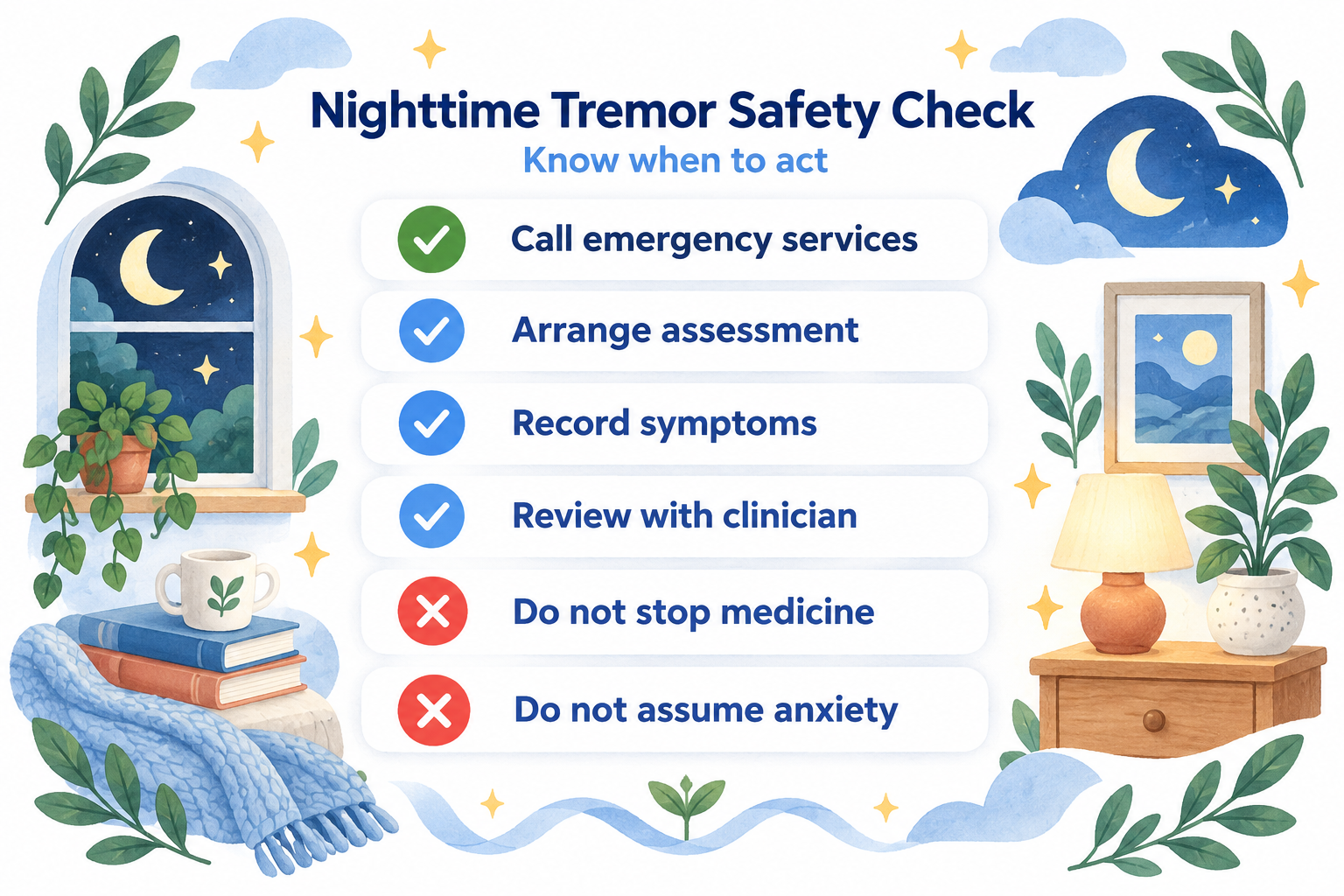
Call emergency services now when shaking occurs with possible stroke, heart attack, or seizure symptoms, or when the person cannot remain conscious or breathe normally. Arrange a clinical assessment for a new, persistent, worsening, severe, or otherwise unexplained tremor even when no emergency warning sign is present.
Use emergency care for:
- Sudden facial drooping, one-sided numbness or weakness, confusion, speech difficulty, vision changes, loss of balance, or a severe unexplained headache. The CDC’s May 2026 stroke guidance says to call emergency services immediately for these symptoms. (cdc.gov)
- New chest pressure or pain, shortness of breath, unexplained sweating, nausea, or pain spreading into the arm, back, neck, shoulder, or jaw. The National Heart, Lung, and Blood Institute advises emergency help whenever a heart attack may be occurring, even if the person is unsure. (nhlbi.nih.gov)
- A first seizure, a seizure lasting longer than five minutes, repeated seizures, injury, or difficulty breathing or waking afterward. These are emergency situations in the CDC’s 2024 seizure guidance. (cdc.gov)
- Severe low glucose with confusion, inability to swallow safely, loss of consciousness, or a seizure in someone with diabetes. Follow the person’s emergency diabetes plan and obtain medical help. (cdc.gov)
Contact a clinician when a tremor is prolonged, severe, interferes with normal activities, is more noticeable at rest, or occurs with headache, weakness, muscle tightening, abnormal tongue movements, or other uncontrolled movements. These are among the reasons to seek assessment in the MedlinePlus tremor review. (medlineplus.gov)
Bring a list of medicines and supplements, caffeine and alcohol use, sleep changes, recent illnesses, and a short record of each episode. A brief phone video may also help if the shaking is visible and recording can be done safely.
If anxiety becomes a mental health crisis or anyone may be in danger, the Anxiety Checklist gethelpnow page lists crisis and emergency resources by country. It is not a substitute for calling the local emergency number during an immediate medical emergency. (anxietychecklist.com)
Sudden neurological, cardiac, or seizure symptoms need emergency care, while recurrent or worsening tremors need a clinical assessment.
Do anxiety tremors need medication?
Anxiety tremors do not automatically require medication, and no single medicine is appropriate for every type of shaking. Treatment should follow an assessment of whether the main cause is panic, another tremor disorder, a medicine effect, thyroid disease, low glucose, or something else.
For recurrent panic attacks, NIMH says treatment may include psychotherapy, medication, or both. A clinician may consider antidepressants, short-term anti-anxiety medication, or medication for selected physical symptoms, but benefits, side effects, dependence risks, existing conditions, and other medicines must all be considered. (nimh.nih.gov)
A medicine-induced tremor may improve when the responsible treatment is changed, but that decision belongs with the prescriber. MedlinePlus specifically advises against stopping medication without first speaking to a health care provider. (medlineplus.gov)
If anxiety is the likely driver, practicing comfortable breathing and muscle relaxation while calm can make the skills easier to use at night. Reducing caffeine or other stimulants may also help when a clear trigger pattern is present, although persistent tremor still deserves assessment. (magazine.medlineplus.gov)
Medication is cause-specific and should be chosen or changed with a qualified clinician.
What else do people ask about anxiety tremors at night?

These questions focus on the two decisions that matter most: what can be done safely during an episode, and when shaking needs medical assessment. Each answer stands on its own, but none can diagnose an individual symptom pattern.
How do I know if my tremors are from anxiety?
Anxiety is more likely when shaking starts with fear, rapid breathing, sweating, tingling, or a racing heart and settles as the episode passes. That pattern is not proof. A new, persistent, one-sided, worsening, or unexplained tremor should be assessed because medicines, thyroid disease, low glucose, and neurological conditions can also cause shaking. (nimh.nih.gov)
What causes nighttime tremors?
Nighttime tremors can come from anxiety or a panic attack during sleep, but also from caffeine or other stimulants, medication effects, alcohol withdrawal, overactive thyroid, low blood glucose in people with diabetes, and neurological movement disorders. The timing alone cannot identify the cause, especially when the symptom is new or recurring. (medlineplus.gov)
What are some treatments for anxiety shaking?
Treatment depends on the cause. For anxiety-related episodes, psychotherapy, provider-prescribed medication, slow comfortable breathing, and relaxation skills may help. A medicine-induced, thyroid-related, glucose-related, or neurological tremor needs cause-specific care. Do not start, stop, or borrow medication for shaking without advice from a qualified clinician. (nimh.nih.gov)
Can anxiety cause internal tremors?
Anxiety can create a sensation of internal shaking even when movement is slight or not visible, and panic attacks commonly include trembling or tingling. Internal tremor is a symptom description, not a diagnosis. Recurrent or unexplained internal vibration should be discussed with a clinician, particularly when other neurological or systemic symptoms occur. (nimh.nih.gov)
The most useful answer separates immediate coping from the medical assessment needed for a new or unexplained symptom.
What should you do before tonight?
Prepare one low-friction plan while calm: learn the emergency signs, place the five-step sequence beside the bed, and decide who to contact if shaking returns. Arrange medical assessment rather than repeatedly self-treating a tremor that is new, worsening, persistent, or difficult to explain.
Next step: Install the Anxiety Checklist app and keep its free, no-sign-up SOS Panic Relief tool available before bedtime. The app offers self-help for a difficult panic moment, but it does not diagnose tremors and is not an emergency service. (anxietychecklist.com)
Prepare the plan while calm, and use medical assessment when the pattern is new, persistent, or unsafe.