

In short
A silent anxiety attack is an informal term for intense anxiety or panic that is felt internally but may not look obvious to other people. Someone may keep talking or working while experiencing a racing heart, breathlessness, dizziness, detachment, catastrophic thoughts, or a strong urge to escape. The term is not a clinical diagnosis. (health.clevelandclinic.org)
Key takeaways
- Silent anxiety attack is an informal description, not a diagnosis listed in DSM-5-TR. (health.clevelandclinic.org)
- A person can appear composed while experiencing intense heart, breathing, stomach, balance, or fear symptoms. (nimh.nih.gov)
- Silent usually means that other people cannot see the distress, not that the person feels nothing.
- New, severe, or unexplained chest pain and breathing difficulty should not be assumed to be anxiety. (medlineplus.gov)
- Recurrent episodes, avoidance, or disruption to sleep, work, or daily life are reasons to seek a professional assessment. (nimh.nih.gov)
Table of contents
- What is a silent anxiety attack?
- What does a silent anxiety attack feel like?
- How is a silent panic attack different from an anxiety attack?
- Can you have an anxiety attack without knowing it?
- What should you do during a silent anxiety attack?
- When should you get medical or mental health help?
- What can reduce future episodes?
- What else do people ask about silent anxiety attacks?
- What should you do next?
Someone can answer a question, sit through a meeting, or finish a checkout line while feeling intense fear inside. That mismatch between appearance and experience is what people usually mean by a silent attack, but the phrase alone cannot tell you whether the cause is panic, ongoing anxiety, a medical condition, medication, or another factor.
What is a silent anxiety attack?
Silent anxiety attack is a nonclinical phrase for an episode of anxiety or panic whose outward signs are slight or deliberately masked. The phrase does not identify a separate disorder, a particular cause, or a guaranteed level of severity.
As of September 2026, the 2026 Cleveland Clinic explanation of panic and anxiety attacks notes that DSM-5-TR does not define an anxiety attack. The American Psychiatric Association's anxiety-disorder overview recognizes conditions such as panic disorder, generalized anxiety disorder, social anxiety disorder, and specific phobias, but it does not list a condition named silent anxiety attack. (health.clevelandclinic.org)
Many consumer articles use the term as if it names a distinct condition. A more accurate interpretation is that silent describes visibility: the body and mind may be in distress even though crying, pacing, visible shaking, or obvious hyperventilation is absent.
One possible mechanism is the body's fight-or-flight response. The NIMH's panic disorder guide describes panic as a possible false alarm in which survival responses become active without a clear danger, producing sensations such as a rapid heartbeat, trembling, tingling, dizziness, nausea, or trouble breathing. (nimh.nih.gov)
Possible patterns include:
- A sudden wave of panic with no clear trigger.
- Anxiety that builds around conflict, work, health worries, crowds, travel, or another stressor.
- Symptoms during sleep or shortly after waking.
- Sensations worsened or mimicked by caffeine, substances, medication effects, thyroid problems, heart rhythm problems, or breathing conditions.
The MedlinePlus anxiety overview advises that physical health conditions, substances, and medicines can contribute to anxiety-like symptoms, which is one reason self-diagnosis is unreliable. (medlineplus.gov)
There is no reliable statistic for how common silent anxiety attacks are as a separate category. Because the term is not a defined diagnosis, official surveys measure panic attacks, panic disorder, and anxiety disorders rather than the visibility of each episode.
The word silent describes what other people can see, not how mild the episode is or what diagnosis caused it.
What does a silent anxiety attack feel like?
A silent anxiety attack may feel intensely physical, mentally consuming, or both, even when the person remains still and responsive. Symptoms vary, and no single sensation proves that anxiety or panic is the cause.
Internal signs people often notice
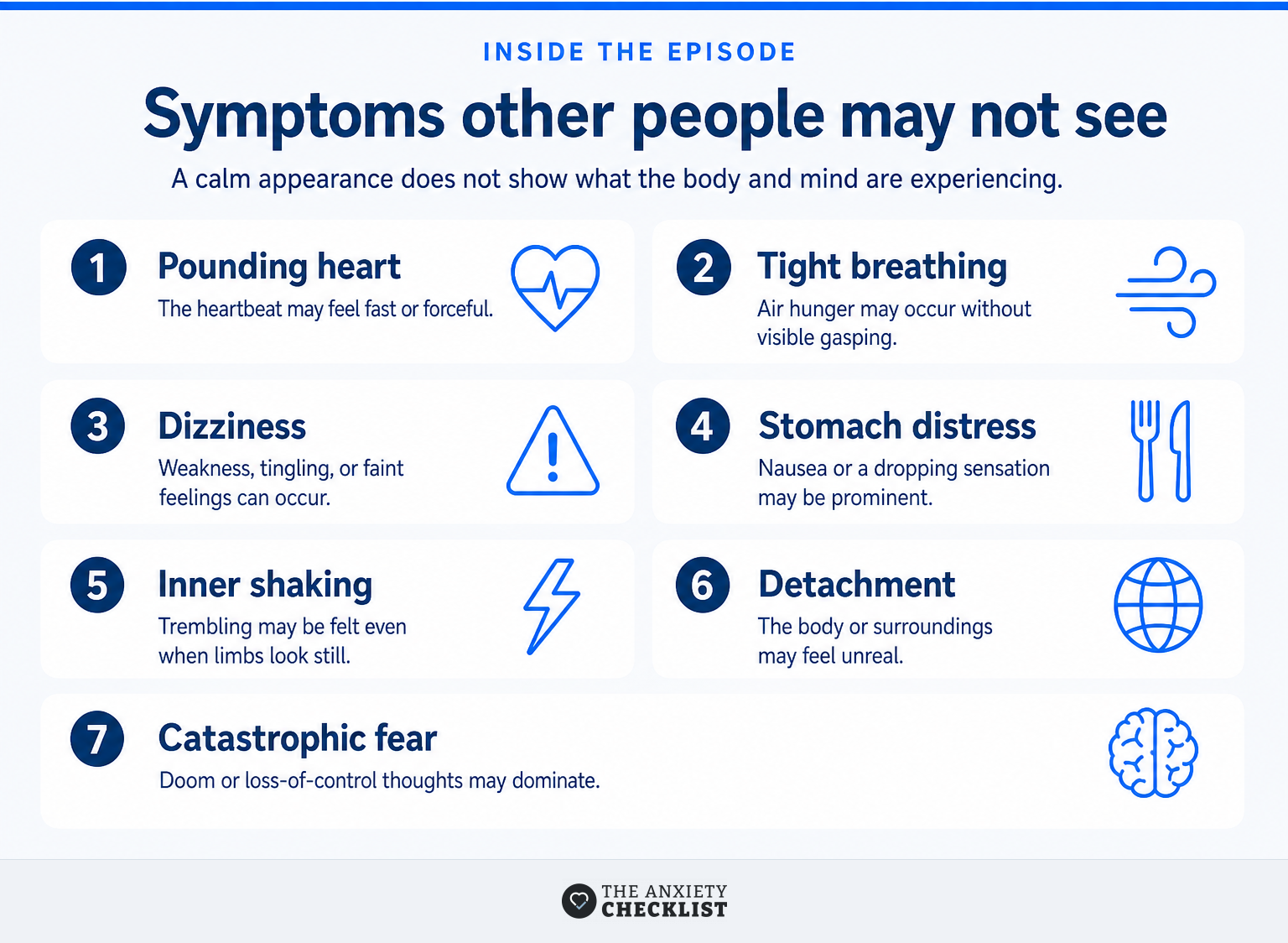
The symptom lists in the NIMH guide and the MedlinePlus panic disorder overview include heart, breathing, balance, stomach, temperature, and fear symptoms. The site's fuller guide to panic attack symptoms provides additional context, while the list below focuses on sensations that may not be obvious to an observer. (nimh.nih.gov)
- Heart and chest sensations: A pounding or racing heartbeat, chest discomfort, or awareness of every heartbeat.
- Breathing sensations: Shortness of breath, air hunger, chest tightness, or the feeling that a full breath will not arrive.
- Shaking and temperature changes: Internal trembling, chills, sweating, or feeling suddenly hot while the body appears still.
- Balance and nerve sensations: Dizziness, weakness, tingling, numbness, or feeling close to fainting.
- Stomach symptoms: Nausea, cramping, a dropping sensation, or an urgent need to use the bathroom.
- Detachment: Feeling unreal, disconnected from the body, or as if the room is distant or dreamlike.
- Fear and thought changes: A sense of doom, fear of losing control, difficulty concentrating, or a strong urge to leave.
Possible outward changes may be subtle. A person might speak less, pause before answering, leave a room, grip an object, focus intensely on a simple task, or become unusually still. Those behaviors are not diagnostic because tiredness, pain, distraction, and many other experiences can look similar.
The absence of crying, pacing, or visible hyperventilation does not rule out a panic attack. The American Psychiatric Association describes panic attacks through a combination of internal physical and emotional symptoms, not through one required outward behavior. (psychiatry.org)
A calm appearance can coexist with intense physical fear, so recognition depends on internal sensations and changes from the person's baseline.
How is a silent panic attack different from an anxiety attack?
Silent describes how visible an episode is, while panic attack and anxiety episode describe different symptom patterns. A panic attack is a recognized clinical event, but anxiety attack is an informal phrase whose meaning can vary.
Silent describes visibility, not a separate disorder
A panic attack usually involves a sudden surge of intense fear or discomfort, sometimes without an obvious trigger. Anxiety linked to stress often develops more gradually and may last longer, although everyday speech frequently mixes the terms. (nimh.nih.gov)
The most useful distinctions are:
- Silent anxiety or panic attack: An informal description emphasizing that other people may see few signs. The underlying episode could involve sudden panic, escalating anxiety, or another cause.
- Panic attack: A sudden cluster of intense mental and physical symptoms. A person can have one panic attack without having panic disorder.
- Anxiety attack or episode: A common, non-diagnostic phrase often used for intense anxiety that develops around stress, worry, or a feared situation.
Panic disorder is different again. The Mayo Clinic diagnosis and treatment guide explains that diagnosis generally involves recurrent unexpected panic attacks followed by ongoing concern, fear of consequences, or meaningful behavior changes, with other medical, substance-related, and mental health explanations considered. (mayoclinic.org)
One hidden episode does not establish panic disorder. Frequency, triggers, ongoing worry, avoidance, health history, and the effect on daily life all matter during an assessment.
Use silent only as a visibility description; sudden panic, gradually building anxiety, and panic disorder are not interchangeable.
Can you have an anxiety attack without knowing it?
A person can notice physical symptoms before recognizing that anxiety may be involved. Silent usually means the distress is hidden from other people, however, not that the person has no internal sensations or awareness.
Someone might first focus on dizziness, nausea, a racing heart, tingling, or an unreal feeling and only later notice the accompanying fear. Another person may assume the symptoms came from dehydration, caffeine, poor sleep, illness, or a heart problem. Any of those explanations could be correct, so labeling an unfamiliar episode as anxiety without assessment can delay appropriate care.
Questions that may help a clinician understand the pattern include:
- Did the symptoms begin suddenly or build over time?
- What was happening immediately before they started?
- Which physical sensation appeared first?
- Was there fear, dread, detachment, or an urge to escape?
- How long did the strongest symptoms last?
- Has the same pattern happened before?
- Were caffeine, alcohol, recreational substances, new medication, illness, or poor sleep involved?
Panic can also happen during sleep and wake a person with a rapid heart rate, sweating, trembling, breathlessness, or fear. Nocturnal symptoms still need assessment when they are new because sleep, breathing, thyroid, and heart conditions may produce overlapping sensations. (mayoclinic.org)
People may misread the sensations at first, but silent usually means hidden from others rather than hidden from the person experiencing them.
What should you do during a silent anxiety attack?
First make sure the situation is physically safe, then reduce the number of decisions required. The goal is not to force every sensation to stop immediately but to steady breathing, orient attention, and let the wave pass while watching for medical red flags.
A five-step plan you can follow quietly
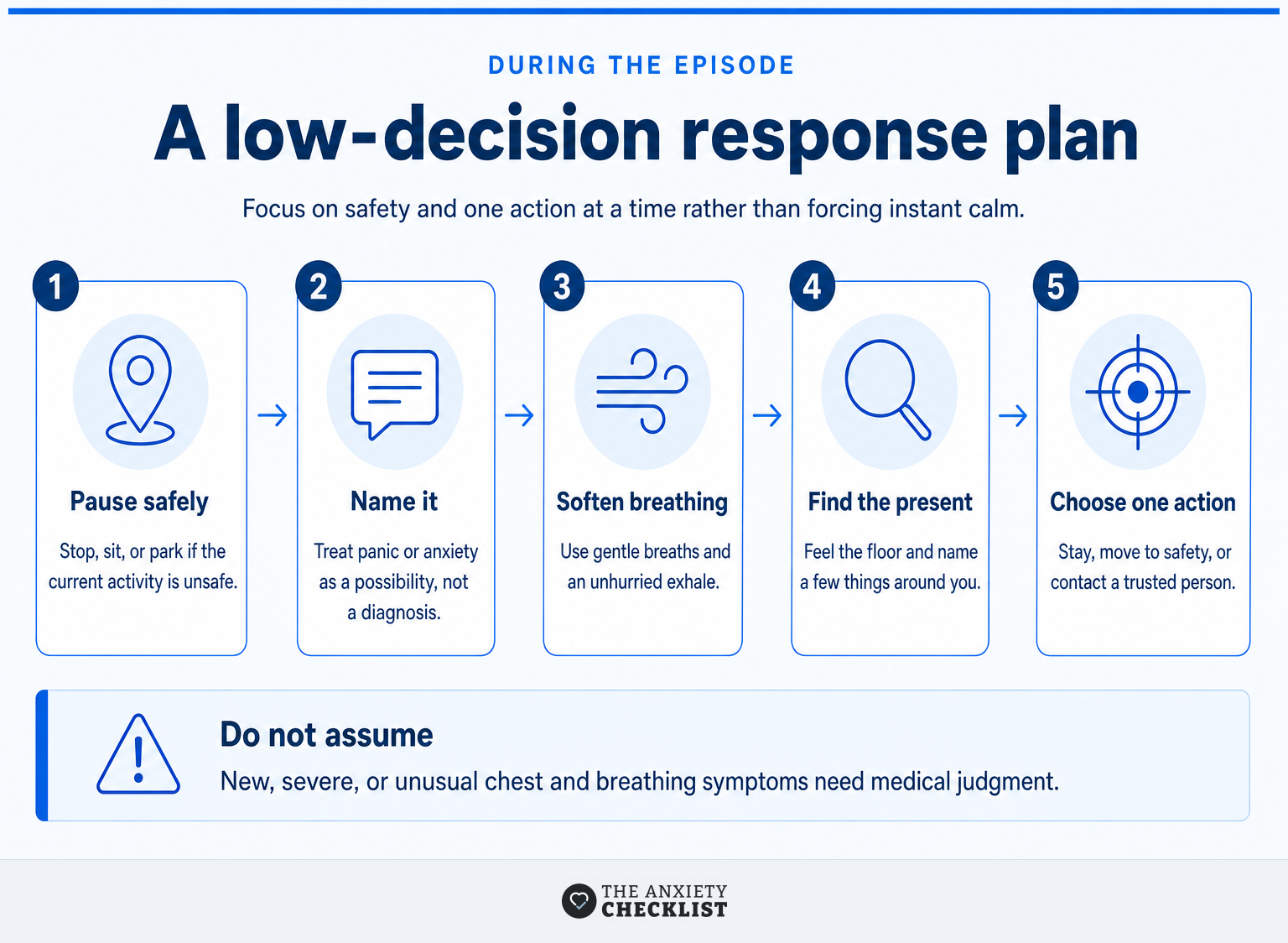
The NHS panic-disorder guidance recommends staying where you are when possible, breathing slowly, and reminding yourself that the attack will pass. The Kent NHS 5-4-3-2-1 grounding method also uses gentle breathing and sensory attention to reduce mental overload. (nhs.uk)
- Pause somewhere safe. Sit or stand where you are if remaining there is safe. If symptoms begin while driving, pull over and park safely rather than trying to push through them.
- Name the immediate experience. Use a short statement such as, “This may be panic or anxiety, and the sensations can pass.” Treat that as a working description, not a medical diagnosis.
- Let the breath become slower and gentler. Avoid gulping repeated large breaths. Relax the jaw and shoulders, allow a comfortable inhale, and make the exhale unhurried without forcing a strict count.
- Move attention outside the fear loop. Feel both feet against the floor. Name three things you can see, two things you can feel, and one sound you can hear. Use the full 5-4-3-2-1 sequence only if it is easy to remember.
- Choose one small next action. Stay with the grounding exercise, loosen restrictive clothing, move away from an unsafe environment, or send a brief message to a trusted person. Avoid trying five techniques at once.
If focusing on breathing increases distress, shift attention to external details such as the texture of a chair, the edges of a nearby object, or sounds in the room. A coping skill does not need to feel perfect to be useful.
These steps are not a test. Failure to feel calm immediately does not mean the episode is dangerous or that the technique has failed, but new or unusual physical symptoms still need medical judgment.
During the episode, aim for safety, slower breathing, present-moment attention, and one small action rather than a perfect technique.
When should you get medical or mental health help?
Seek urgent medical care when symptoms are new, severe, unexplained, or different from a previously assessed panic pattern. Arrange a non-emergency assessment when episodes recur, lead to avoidance, or begin disrupting daily life.
A safety check for new or unusual symptoms
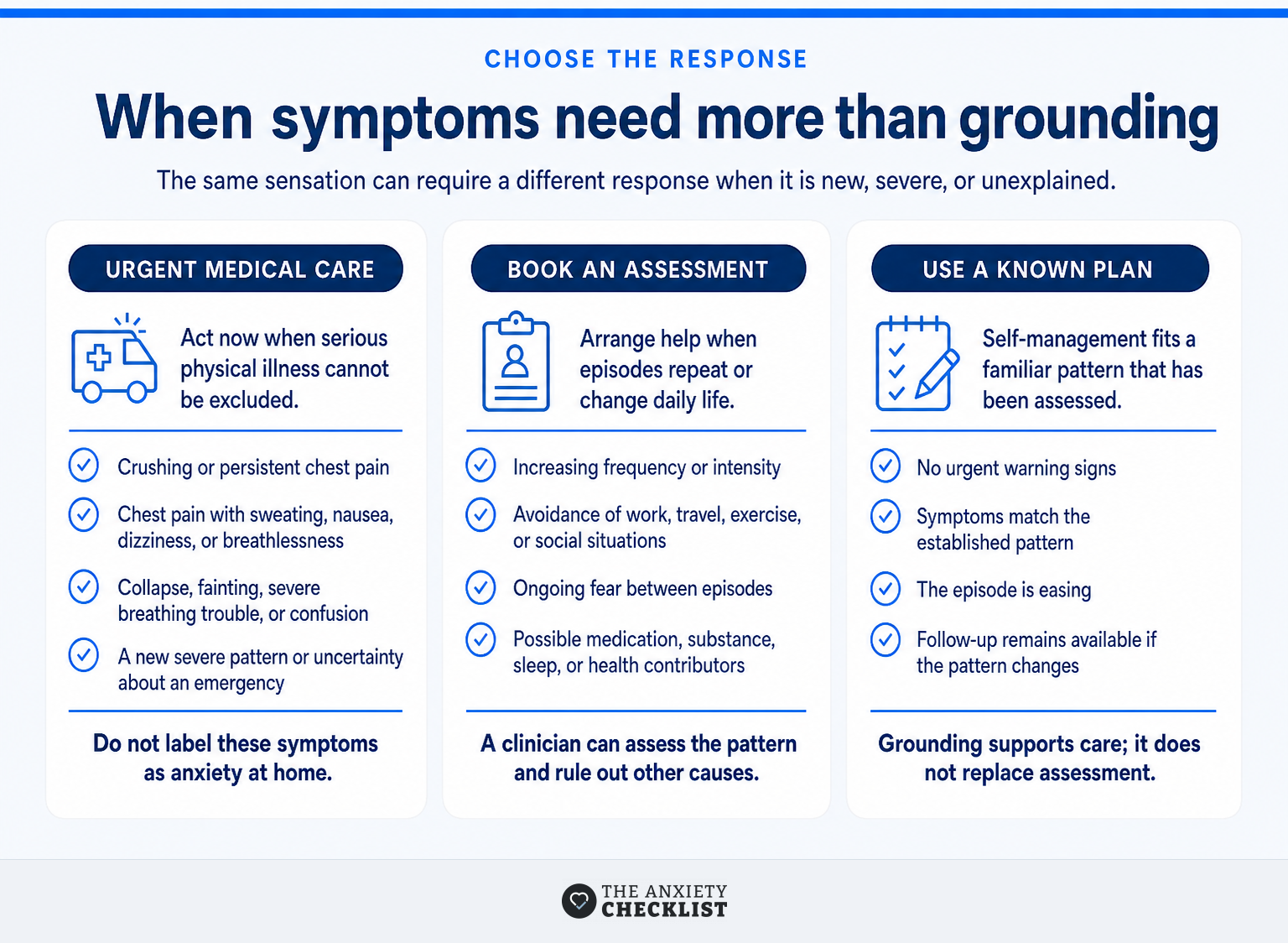
Do not use an online symptom list to decide that chest pain or breathing difficulty is anxiety. The MedlinePlus chest-pain guidance recommends immediate medical care for chest pain that does not go away, crushing pain or pressure, or chest pain with nausea, sweating, dizziness, or shortness of breath. (medlineplus.gov)
Urgent assessment is also appropriate when:
- The symptoms are the first episode of their kind and feel severe.
- Breathing difficulty is severe or continues rather than easing.
- Fainting, collapse, injury, confusion, or loss of consciousness occurs.
- The symptoms began after a medication change, substance use, or a possible allergic reaction.
- There is uncertainty about whether the episode is panic or a medical emergency.
Are silent panic attacks dangerous? NIMH states that panic attacks themselves are not life-threatening, but panic-like symptoms can resemble heart and other medical problems. A health professional may use the symptom history, physical examination, heart tests, or blood tests to rule out other causes. (nimh.nih.gov)
Book a routine medical or mental health appointment if:
- Attacks are recurring or becoming more intense.
- Fear of another episode is changing travel, work, sleep, exercise, or social plans.
- Avoidance is expanding to more places or situations.
- Alcohol, caffeine, substances, or medication may be affecting symptoms.
- Anxiety remains high between episodes.
If there is immediate danger, an intention to self-harm, or concern that someone cannot stay safe, contact local emergency services. In the United States and its territories, SAMHSA's 988 guidance says 988 provides 24-hour call, text, and chat support for mental health, suicide, and substance-use crises. Country-specific contacts are available through these global crisis and emergency resources. (samhsa.gov)
New, severe, unusual, or uncertain symptoms need medical judgment, while danger or self-harm risk needs immediate crisis support.
What can reduce future episodes?
Future episodes may become easier to understand when the pattern is recorded and professionally assessed. Treatment depends on the underlying cause, so repeated symptoms should not be managed through coping exercises alone.
What to record after an episode

A short note made after the symptoms ease can give a clinician more useful information than a general description such as “felt anxious.” Record only what happened, without trying to prove a diagnosis.
Useful details include:
- The date, time, location, and activity.
- The first physical or mental symptom noticed.
- How quickly the intensity increased.
- Thoughts, fears, detachment, or urges that occurred.
- Medication, caffeine, alcohol, illness, sleep loss, or recent stress.
- What helped and when the strongest symptoms eased.
The Mayo Clinic suggests preparing for an appointment by recording symptom onset, frequency, stressful events, medical information, medications, supplements, and the effect on daily life. (mayoclinic.org)
For diagnosed panic attacks or panic disorder, NIMH identifies cognitive behavioral therapy as a well-supported treatment. CBT may include learning new responses to panic sensations and gradual exposure to feared internal sensations, while medication may also be considered by a qualified prescriber. (nimh.nih.gov)
Regular sleep, meals, exercise, and reduced caffeine or alcohol may support an overall treatment plan, but they do not rule out medical causes or replace professional care. Practising one grounding routine while calm can make it easier to recall when concentration narrows during an episode. (medlineplus.gov)
Recurring episodes are a reason to track the pattern and seek assessment, not proof of a diagnosis.
What else do people ask about silent anxiety attacks?
These four questions are closely associated with the topic in search results. Each answer is brief, but none is a diagnosis or a substitute for urgent medical assessment when symptoms are new or unclear.
What does a silent anxiety attack feel like?
A silent anxiety attack can feel like a racing or pounding heart, shortness of breath, dizziness, nausea, internal shaking, numbness, detachment, or a sudden fear of losing control. The person may still speak, work, or sit quietly, so the intensity is not obvious to anyone nearby. (nimh.nih.gov)
How to stop a panic attack fast?
There is no guaranteed instant stop, but a simple sequence may lower the intensity: pause somewhere safe, loosen the breath instead of gulping air, feel both feet on the floor, name a few things you can see and touch, and remind yourself that panic sensations rise and pass. (nhs.uk)
What does anxiety feel like physically?
Anxiety can feel physical because the body's alarm response changes heart rate, breathing, muscle tension, digestion, temperature, and attention. Common sensations include palpitations, sweating, trembling, chest discomfort, breathlessness, dizziness, nausea, tingling, chills, and feeling unreal or detached. New or unusual symptoms still need medical assessment. (medlineplus.gov)
Can I have an anxiety attack without knowing it?
Someone can notice dizziness, stomach discomfort, tension, or a racing heart before recognizing anxiety as the cause. However, the word silent usually means the distress is not obvious to other people, not that the person has no internal awareness. A clinician can help rule out medical causes and identify the pattern. (medlineplus.gov)
The safest short answer is to treat the symptoms seriously, use simple coping steps, and get assessment when the pattern is new, recurrent, or unclear.
What should you do next?
Choose one response plan and save it before another episode happens. Recurrent or unclear episodes deserve a health professional's assessment, even when nobody else can see the distress.
Prepare while calm by opening Anxiety Checklist's free SOS Panic Relief, finding the grounding prompt, and keeping the app easy to reach. The tool is educational self-help, not a replacement for diagnosis, treatment, crisis support, or emergency medical care. (anxietychecklist.com)
Save one response plan while calm so the next episode requires fewer decisions.