

Your phone keeps buzzing. A video is still playing in the background. The overhead light feels too bright for some reason. Someone asks you a simple question, and suddenly your chest tightens, your thoughts scatter, and you can't tell whether you need a nap, a cry, or to run out of the room.
If that feels familiar, you're not weak, dramatic, or failing at life. You may be dealing with overstimulation and anxiety, a combination that can make ordinary days feel like too much, too fast, all at once.
A lot of people live with anxiety. The World Health Organization estimated that 359 million people were living with an anxiety disorder in 2021, equal to 4.4% of the world's population, and in the United States, 18.2% of adults had symptoms of anxiety in 2022 according to the World Health Organization fact sheet on anxiety disorders. That matters because it reminds you of something important. This struggle is widespread. It is not a personal flaw.
There is a way forward. You can learn how to calm your body in the moment, understand your triggers, and build habits that make panic less likely over time. If you want structured support while you practice, an anxiety self help platform can help you turn scattered coping into a repeatable routine.
Table of Contents
- You Are Not Broken You Are Overwhelmed
- The Flooded Brain How Overstimulation Triggers Anxiety
- Common Triggers and Signs of Sensory Overload
- Your SOS Plan Immediate Relief from Overstimulation
- From Coping to Healing Long-Term Strategies for Resilience
- Supporting Others and Knowing When to Seek Help
- Your Path to a Panic-Free Life Is Possible
You Are Not Broken You Are Overwhelmed
Some people hit their limit in a crowded grocery store. Others feel it after a full day of meetings, messages, traffic, and trying to be pleasant when their body is already screaming for quiet. By evening, a tiny inconvenience can feel enormous. The sink drips. A child asks for help. A text goes unanswered. Tears come out of nowhere.
That reaction often makes people ask, “What is wrong with me?”
A kinder and more accurate question is, “How much input has my system been carrying?”
When your brain and body are asked to process more noise, light, decisions, emotions, and digital stimulation than they can comfortably sort, they don't calmly file a complaint. They start sounding alarms. That can look like irritability, shutdown, racing thoughts, panic, or the urge to escape.
You are not failing to cope with normal life. Your nervous system may be reacting to an abnormal amount of input.
That shift matters. Self-blame keeps people stuck. Understanding creates room for action.
Overstimulation and anxiety often travel together because both involve a body that feels unsafe. If your system has been stretched thin for a while, you may notice that things you once handled easily now feel sharp, loud, urgent, or emotionally expensive. That doesn't mean you'll feel this way forever. It means your body needs support, not criticism.
Hope starts here. Relief isn't only for other people. It isn't reserved for those who have more time, more money, or fewer responsibilities. You can learn to catch overload earlier, lower the volume on your environment, and teach your body that calm is possible again.
The Flooded Brain How Overstimulation Triggers Anxiety
The easiest way to understand overstimulation is to think about a laptop with too many browser tabs open. At first, it still works. Then it slows down. Then the fan gets loud. Then one more tab pushes it over the edge and everything freezes.
Your brain does something similar.
Too many tabs open
Overstimulation happens when your brain is taking in more sensory input than it can sort efficiently. That input can be obvious, like loud music, crowded spaces, bright lights, and overlapping conversations. It can also be quieter, like constant notifications, poor sleep, social media scrolling, strong smells, caffeine, or stress that never fully shuts off.
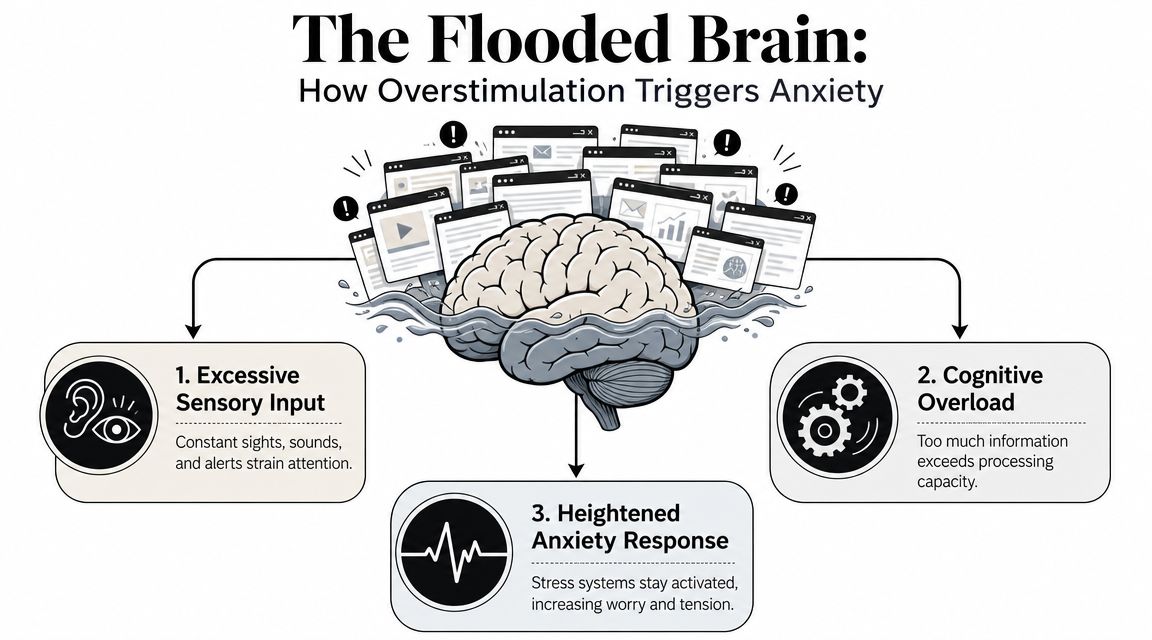
When the load gets too high, the brain stops prioritizing well. Attention gets jumpy. Simple choices feel weirdly hard. You may lose words, forget what you were doing, or feel suddenly trapped by an environment that seemed manageable an hour earlier.
Research also shows this isn't just a passing annoyance. A large prospective child study found that preschool sensory over-responsivity predicted higher school-age anxiety symptoms, according to this PMC study on sensory over-responsivity and later anxiety. In plain language, repeated sensory overload can come before anxiety and help intensify it over time.
Why your body reacts so fast
Once the brain reads “too much” as potential danger, the body shifts into protection mode. Heart rate can rise. Muscles tense. Sweating may increase. Thinking becomes less flexible. Decision-making gets worse. This is one reason people often say, “I knew I was safe, but my body acted like I wasn't.”
That response makes more sense when you understand how fight or flight affects anxiety. Your nervous system is trying to help, but it's using an emergency setting for a non-emergency problem.
Practical rule: The more flooded your brain feels, the less useful pure logic becomes. First lower the input, then ask your mind to reason.
This is why overstimulation and anxiety can spiral so quickly. Extra input creates overload. Overload triggers alarm. Alarm makes you more sensitive to input. Then even small things start to feel impossible.
The good news is that this loop can be interrupted. When you understand the mechanism, your symptoms stop feeling random. They become signals you can work with.
Common Triggers and Signs of Sensory Overload
Some triggers are dramatic. Many aren't. People often miss the early signs because they expect overload to feel like a crisis from the start. More often, it begins as friction. You get snappier. Your shoulders creep up. You reread the same sentence three times.
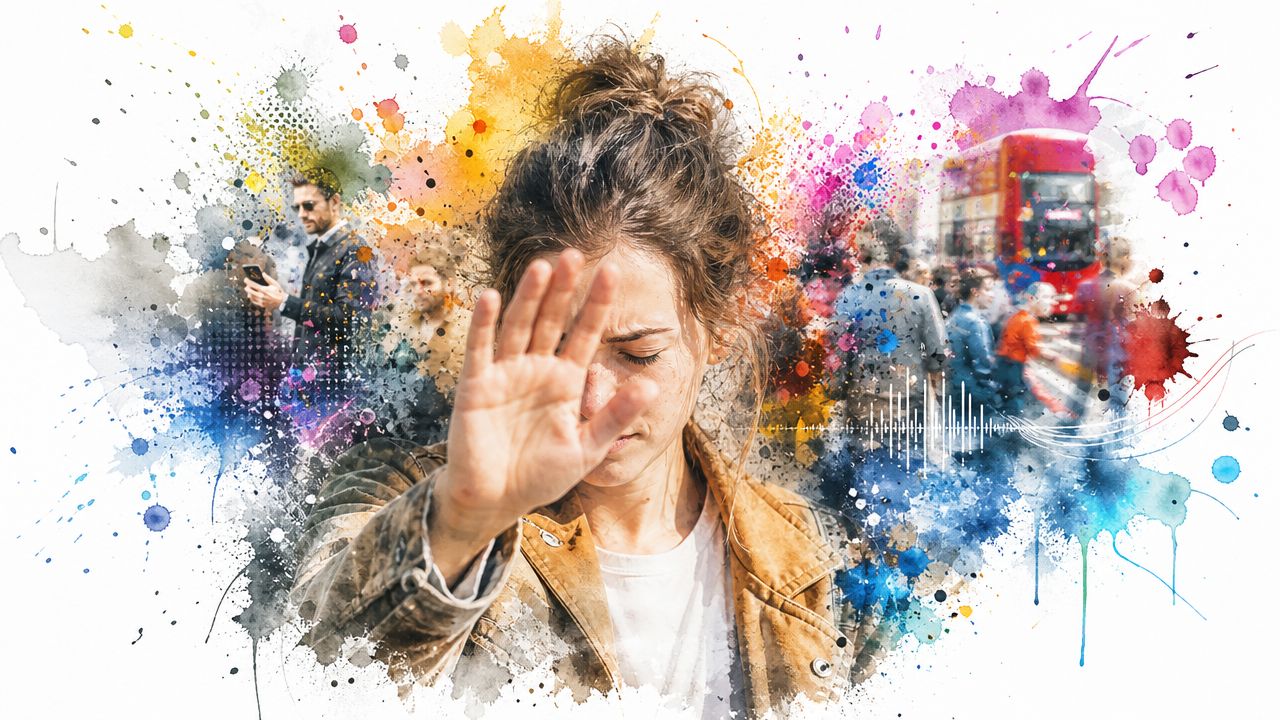
One reason this matters now is that screen-heavy living adds constant mental traffic. One survey found that 71% of Americans report experiencing overstimulation, with the average person spending 7.6 hours per day on screens, and Gen Z averages 8.4 hours daily, as noted in this reported survey discussion on overstimulation and screen use.
What tends to set it off
You may recognize your own pattern in this list:
- Noise stacking up: overlapping conversations, TV in the background, traffic, barking dogs, or office chatter.
- Light strain: bright overhead lighting, flashing screens, sunlight glare, or visual clutter. If light is a reliable trigger for you, some people look for specialized glasses for light discomfort as one practical way to reduce visual strain.
- Digital overload: nonstop notifications, multitasking across devices, doomscrolling, or feeling like you're always reachable.
- Body stress: too little sleep, hunger, caffeine, pain, or illness.
- Emotional spillover: conflict, tense social environments, absorbing other people's moods, or masking your own feelings for too long.
If you want a clearer personal map, understanding anxiety triggers can help you spot patterns you might otherwise dismiss.
What overload feels like
Sensory overload can show up in layers.
- Physical signs: tight jaw, tense shoulders, headache, nausea, restlessness, sweating, faster heartbeat, sudden fatigue.
- Mental signs: brain fog, difficulty concentrating, indecision, forgetting simple things, feeling mentally “jammed.”
- Emotional signs: irritability, panic, tears close to the surface, feeling trapped, wanting everyone to stop talking immediately.
- Behavioral signs: snapping at people, avoiding messages, leaving early, shutting down, or reaching for your phone even though it makes you feel worse.
The earlier you notice overload, the easier it is to prevent a full anxiety spike.
A useful question is, “What happens right before I say I'm fine when I'm clearly not fine?” That moment often contains your real warning signs.
Your SOS Plan Immediate Relief from Overstimulation
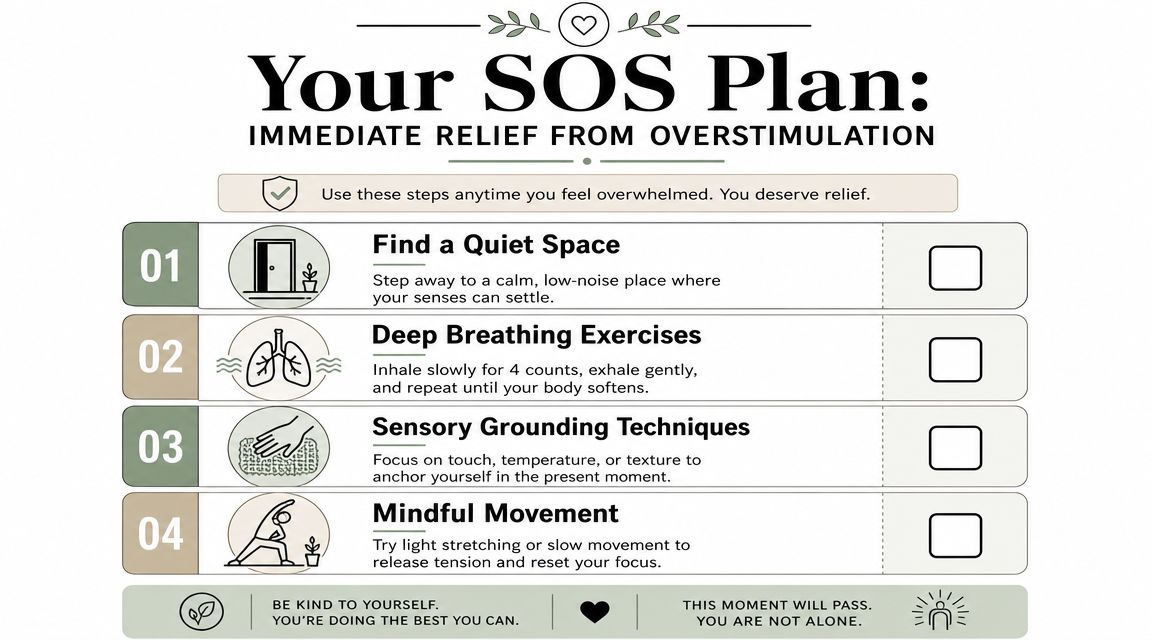
When overstimulation tips into anxiety, your best move is not to force yourself to power through. It's to respond quickly and directly. The goal is to lower incoming input and give your nervous system one clear message. You are safe enough to slow down.
A calm-down plan works best when it's short enough to remember under stress.
Step one reduce input fast
Start with the environment, not your thoughts.
If possible, step into a bathroom, hallway, parked car, stairwell, or quieter room. Lower brightness on your phone. Turn off music or video. Put in headphones, even if they're not noise-canceling. Loosen anything tight on your body. If you're in public, face a wall or corner for a minute so your eyes have less to process.
This works because overstimulation triggers a stress response with effects like increased heart rate and impaired cognitive function, and reducing sensory input can interrupt that escalation, as described in this clinical explainer on hyperstimulation and stress response.
Step two bring your mind back online
Once input drops, use a grounding tool. One of the simplest is the 5-4-3-2-1 method.
- Five things you see
- Four things you can touch
- Three things you hear
- Two things you smell
- One thing you taste
This gives your brain a concrete task. Instead of scanning for danger, it starts sorting real information from the present moment.
A guided practice can help when your mind goes blank. This short video is a good example of a simple calming reset:
You can also use Anxiety Checklist's grounding guide for additional grounding options.
Step three use your body to signal safety
Breathing helps most when it's slow and steady, not huge and dramatic. Try box breathing. Inhale for four counts, hold for four, exhale for four, hold for four. If holding feels uncomfortable, make the exhale longer than the inhale instead.
Then add a small movement cue. Press your feet into the floor. Unclench your hands. Roll your shoulders. Stretch your jaw.
When panic rises, don't ask your body to become peaceful instantly. Ask it to become a little less braced.
That smaller goal is often enough to stop the wave from climbing.
From Coping to Healing Long-Term Strategies for Resilience
Immediate relief matters. It can stop a spiral and help you get through the day. But real healing asks a second question. What will make your system less likely to flood so easily next time?
That's where resilience work comes in. Not perfection. Not constant calm. Resilience means your nervous system recovers faster, gets overwhelmed less often, and trusts safety more readily.
Build a steadier baseline
Long-term healing usually comes from doing a handful of simple things consistently.
First, work with your thoughts. If your mind often jumps from “I'm overloaded” to “I'm not safe” to “I'm going to lose control,” cognitive behavioral tools can help you slow that chain down. Thought journaling, belief checking, and behavior experiments teach you to question panic's first story instead of automatically obeying it. If spiraling thoughts are part of your pattern, this guide on https://anxietychecklist.com/overthinking-and-anxiety is a useful place to start.
Second, reduce avoidance carefully. It makes sense to avoid things that flood your system. But if avoidance spreads too far, anxiety learns that more and more situations are dangerous. Gentle, planned exposure can help rebuild confidence. That might mean entering a busy store for a short visit, muting some notifications instead of all social contact, or practicing one manageable stressor at a time.
Third, pace your life before your body forces you to. Many people wait until they're frayed to rest. Pacing means building recovery into ordinary days. Quiet moments between meetings. Fewer tabs open. Less background noise. A slower transition after work. You're not being lazy. You're preventing overload from becoming panic.
Healing often looks ordinary. Better sleep. Fewer inputs. Kinder self-talk. Repeating skills before crisis makes them easier to use during crisis.
Finally, support the body conditions that make anxiety louder or softer. Sleep, food, movement, and media habits don't fix everything, but they change the ground anxiety grows in. A tired, overstretched, over-caffeinated body is easier to overwhelm. A rested body with predictable rhythms usually has more room to cope.
SOS Techniques vs. Resilience Strategies
| Aspect | SOS Techniques (Immediate Relief) | Resilience Strategies (Long-Term Healing) |
|---|---|---|
| Main purpose | Lower distress in the moment | Reduce how often overload turns into anxiety |
| Best time to use | During a spike, panic wave, or shutdown | Daily or weekly, before distress peaks |
| Examples | Quiet space, dim lights, grounding, slow breathing | CBT tools, pacing, sleep routines, gradual exposure, meditation |
| What it changes | Current body alarm level | Baseline nervous system sensitivity |
| What to expect | Relief may be fairly quick | Progress is gradual and builds with repetition |
People sometimes get discouraged because they use emergency tools and still have anxiety next week. That doesn't mean the tools failed. It means emergency tools and healing tools do different jobs.
Use both. One helps you get through the storm. The other helps your system stop expecting storms all the time.
Supporting Others and Knowing When to Seek Help
When someone you care about is flooded, the urge to fix it fast can be strong. Most of the time, what helps most is less fixing and more steadiness.

How to help without adding pressure
Try to become a calmer environment, not another source of input.
- Use fewer words: say, “I'm here,” “Let's step somewhere quieter,” or “You don't have to explain right now.”
- Offer choices: “Do you want water, quiet, or to go outside?” Choices restore some control.
- Lower stimulation: dim lights, reduce noise, pause the conversation, move other people away if needed.
- Don't debate their fear: logic usually lands poorly when their body is already in alarm mode.
- Follow later, not during: once they're calmer, help them notice patterns, triggers, and what brought relief.
A simple question can help: “What would make this environment feel 10 percent easier right now?”
When it is time to get more support
It's also important to know when repeated overstimulation may be part of a bigger clinical picture. Sensory overload is distress triggered by environmental input, while an anxiety disorder involves more persistent and broader worry that isn't always tied to stimuli, as discussed in this PMC review on sensory processing issues and anxiety disorders.
Consider professional evaluation when:
- Daily life keeps shrinking: they're avoiding work, school, stores, travel, or relationships because symptoms feel unmanageable.
- Recovery takes too long: one stimulating event leaves them dysregulated for hours or days.
- The body stays on alert: even in calm settings, they still feel intense worry, dread, or panic.
- Function drops: sleep, eating, concentration, or basic responsibilities are consistently affected.
- Safety concerns appear: hopelessness, severe panic, or inability to cope alone need prompt support.
Repeated overstimulation that significantly impairs daily function deserves care, not minimization.
Some people need outpatient therapy. Others may need more structured support, especially if anxiety or depression has become overwhelming. For families trying to understand higher levels of care, this overview of residential treatment for anxiety or depression can clarify what that option can look like.
Getting help isn't overreacting. It's a practical response to a system that needs more support than self-management alone can provide.
Your Path to a Panic-Free Life Is Possible
A panic-free life doesn't usually begin with one giant breakthrough. It starts with smaller shifts that add up. You notice overload sooner. You stop shaming yourself for needing quiet. You learn the difference between danger and too much input. You recover faster. Then one day, you realize you handled something that used to undo you.
That is healing.
Overstimulation and anxiety can make life feel narrow, tense, and unpredictable. But those feelings are not your destiny. Your nervous system can learn. It can become less reactive, more trusting, and easier to settle. The path often includes immediate tools for rough moments and deeper practices that reshape your baseline over time.
If you want extra ideas for managing stress and anxiety naturally, it can help to explore approaches that support the body as well as the mind. The key is not finding one perfect trick. It's building a toolkit you can use in real life.
You do not need to earn calm. You do not need to wait until everything in your life is easy. You can begin where you are, with the body you have, on the day you're living.
A quieter mind is possible. A steadier body is possible. A life that isn't organized around fear is possible too.
If you want practical support for both panic moments and long-term recovery, The Anxiety Checklist offers a clear place to start. It includes an always-free SOS mode for immediate grounding, plus tools like guided meditations, sleep audios, hypnosis, CBT exercises, and expert-led lessons that help you retrain your nervous system over time. If you've been trying to piece together help from scattered advice, it can give you one structured system for building calm, confidence, and a more peaceful daily life.