


Your phone is face down, but you keep checking it anyway. It's been an hour since your partner replied. Part of you knows they could be busy, driving, in a meeting, or tired. Another part is already building a case. Did that short text mean something? Was their tone off last night? Are they pulling away?
That spiral is exhausting. It can make a loving relationship feel dangerous, and it can make your own mind feel like a place you can't rest.
If this is happening to you, you're not broken. In many cases, overthinking relationship anxiety is a learned protection pattern. A Thriveworks survey found that 34% of Americans say past or current romantic relationships are the leading cause of their mental health concerns, and 77% say negative experiences with past partners affect how they show up in later relationships. That matters. It means many people aren't “too sensitive.” They're carrying a nervous system that learned to brace for impact.
I want to be clear about something. Healing is possible. Not perfect certainty. Not a life where you never feel triggered again. Real healing. The kind where your chest doesn't tighten every time there's a pause in communication. The kind where you can feel concern without collapsing into panic. The kind where love stops feeling like a test you're always failing.
That shift usually doesn't happen by shaming yourself into “just trusting more.” It happens by learning how anxiety works, how to interrupt it, and how to tell the difference between fear and information. If you want a structured place to start, an anxiety checklist can help you notice whether what you're feeling fits a broader anxiety pattern, rather than a single bad day in your relationship.
Peace in relationships is not reserved for other people. You can learn it too.
Table of Contents
- Understanding the Grip of Relationship Anxiety
- Is It Your Anxiety or a Real Relationship Problem
- Four In-the-Moment Exercises to Calm Your Mind
- Building Long-Term Resilience to Overthinking
- How to Talk to Your Partner Without Pushing Them Away
Understanding the Grip of Relationship Anxiety
Overthinking relationship anxiety usually starts with a small cue and ends with a big emotional reaction. A delayed reply becomes “they're losing interest.” A neutral facial expression becomes “they're upset with me.” A distracted evening becomes “something is wrong between us.”
That pattern makes sense once you understand hypervigilance. It is a smoke detector that became too sensitive after a real fire. It's trying to protect you, but now it reacts to burnt toast. The detector isn't evil, and it isn't stupid. It's just calibrated for danger.

What healthy reflection looks like
Healthy reflection is specific and time-limited. You notice something, think about it, and decide what to do next. It might sound like, “That comment landed strangely. I'll ask about it later.”
Rumination is different. It loops. It tries to solve uncertainty by replaying, predicting, and scanning. Instead of leading to clarity, it leads to more doubt.
A few signs you're in a rumination loop:
- You reread texts repeatedly and still don't feel settled.
- You search for hidden meanings in tone, punctuation, timing, or facial expressions.
- You ask for reassurance and feel relief for a short time, then need it again.
- You mentally rehearse future conflict before anything has happened.
How the internal spiral changes the relationship
Anxiety doesn't stay private for long. It changes how you show up. You may become more accusatory, more withdrawn, more apologetic, or more dependent on constant contact. Your partner may start feeling confused, watched, or pressured to fix a fear they didn't create.
That's one reason this pattern deserves real attention. A peer-reviewed daily-diary study found that on days when wives experienced higher anxiety, husbands reported lower relationship quality. Internal anxiety can become external distance.
Practical rule: If your mind treats every ambiguity like proof, anxiety is driving the interpretation.
The cycle that keeps feeding itself
Once you know the cycle, you can interrupt it earlier.
| Trigger | Anxious interpretation | Common reaction | Short-term result | Long-term cost |
|---|---|---|---|---|
| Delayed text | “They're ignoring me” | Double texting, checking, asking | Brief relief | More dependence on reassurance |
| Flat tone | “They're mad at me” | Defensiveness or shutdown | Temporary control | More tension |
| Need for space | “They're pulling away” | Clinging or panic | Momentary connection attempt | Less trust |
If this pattern feels familiar, learning ways to calm an overactive mind can help you catch the spiral before it turns into conflict.
Is It Your Anxiety or a Real Relationship Problem
This is the question people usually ask in private, often with a lot of shame attached. “What if I'm overreacting?” sits right next to “What if I'm ignoring something important?” Both fears are valid.
Most advice about relationship anxiety focuses on calming yourself down. That helps, but it doesn't answer the deeper question. A more useful approach is discernment. A clinical overview from Charlie Health points to pattern-checking over time and asking whether anxiety persists even when a partner is consistently reliable. That helps separate anxiety-driven catastrophizing from concerns grounded in the relationship itself.
Anxiety usually reacts to ambiguity
When anxiety is leading, the alarm often spikes around unclear but ordinary moments. The facts are thin, but the emotional intensity is high. You may feel certain something is wrong, yet struggle to identify a stable pattern of mistreatment, dishonesty, or disregard.
Questions that often point toward anxiety:
- Does your fear spike fastest in silence or uncertainty?
- Do you feel calmer when your partner reassures you, even if nothing changed?
- When things are going well, does your mind still search for what could go wrong?
- If your partner is generally consistent, do you still feel braced for abandonment?
A real relationship problem tends to leave a pattern
Healthy discernment asks different questions. Not “Can I explain away this moment?” but “What keeps happening?” One missed text is not the same as chronic unreliability. One awkward conversation is not the same as repeated contempt, blame, or disregard for your boundaries.
Use this comparison:
| If anxiety is louder | If the relationship issue is real |
|---|---|
| Fear rises around ambiguous cues | Distress follows repeated concrete behavior |
| The story changes with your mood | The pattern stays concerning over time |
| Reassurance briefly calms you | Reassurance doesn't fix ongoing harm |
| Your partner is mostly consistent | Your partner is often inconsistent, dismissive, or deceptive |
A quiet intuition often says, “Pay attention.” Anxiety usually says, “Act now or you'll lose everything.”
Three filters I use in practice
First, look for consistency. Is the concern based on a single moment, or does it keep repeating in similar ways?
Second, check repair. When you bring up a concern respectfully, does your partner listen, clarify, and try to repair? Or do they mock, evade, reverse blame, or make you feel unreasonable for asking?
Third, assess your state across good evidence. If your partner is reliable, kind, and transparent, but your body still feels under siege, anxiety may be the stronger driver.
For some people, hormones and nervous system shifts can intensify this confusion. If that's relevant to you, support around sleep, mood, and body changes can matter as much as relationship advice. Resources on personalized support for mood changes can be helpful when emotional intensity has multiple layers.
What to do when you still can't tell
Don't force yourself into certainty. Certainty is often the addiction beneath the spiral.
Instead, try this:
- Write the concern in one sentence. Keep it behavioral, not global.
- List the evidence for it. Only observable facts.
- List the evidence against it. Include reliability, repair attempts, and context.
- Track the pattern for a short period. Watch behavior, not mood.
- Ask one direct question. Don't launch an investigation.
If you want a deeper framework for understanding love and anxiety in relationships, it helps to evaluate whether your distress comes from the bond itself or from what uncertainty activates inside you.
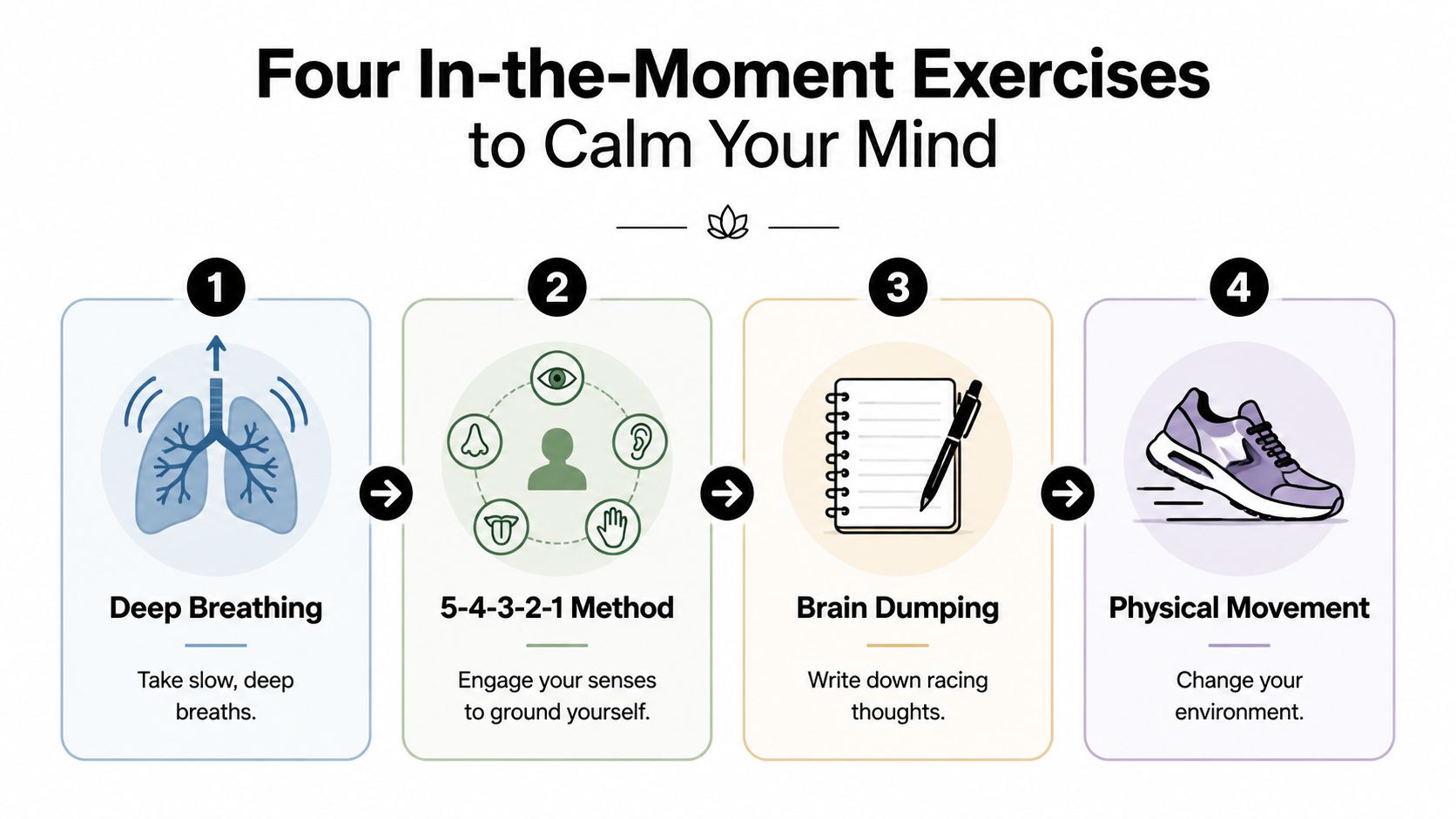
Four In-the-Moment Exercises to Calm Your Mind
When you're triggered, you don't need a perfect mindset. You need a way to get out of the mental chase. The goal is not to prove that everything is fine. The goal is to reduce panic enough that you can think clearly and act with dignity.
This visual can help you remember the basics when your mind goes blank.
Exercise one, the CBT thought reset
This is one of the most effective tools for overthinking relationship anxiety because it interrupts the story before it becomes a fact in your mind. CBT guidance from Grouport recommends identifying the trigger, writing the automatic thought, and generating alternative explanations.
Use this quick script:
- Trigger: “They haven't replied for two hours.”
- Automatic thought: “They're upset with me.”
- Belief strength: “I believe this strongly right now.”
- Alternative explanation: “They may be busy, distracted, resting, or not on their phone.”
- Behavioral check: “I will wait before sending another message and see what actual information appears.”
The point isn't to talk yourself into optimism. It's to stop treating one interpretation as the truth.
Exercise two, grounding through the senses
An anxious brain lives in prediction. Grounding puts you back in the room you are in.
Try the 5-4-3-2-1 method:
- Five things you see
- Four things you feel
- Three things you hear
- Two things you smell
- One thing you taste
This works because attention can't stay fully locked on imagined danger while also orienting to present sensory data.
A guided demonstration can help if your mind is especially activated.
Exercise three, delay the reassurance urge
If you always act the second anxiety spikes, your brain learns that urgency is correct. Delay changes that lesson.
Set a timer. Ten minutes is enough to start. During that window, do not text again, do not ask if everything is okay, and do not reread the same conversation. Sit with the discomfort and label it accurately: “This is activation, not proof.”
You do not have to answer every fear the moment it appears.
Exercise four, breathe like your body matters
People often try to think their way out of panic while ignoring the body that panic is happening in. Slow breathing helps lower the physical charge that keeps obsessive thinking alive.
A simple pattern is inhale gently, pause, exhale longer than you inhaled. If you want structured guidance, The Anxiety Checklist's breathing exercises offer prompts you can follow in real time when your thoughts are racing.
What works best is repetition. Not one heroic attempt. A calm response, repeated often enough that your nervous system stops assuming every relationship stressor is an emergency.
Building Long-Term Resilience to Overthinking
Short-term tools help you survive the spike. Long-term healing helps you stop living on standby. That's where real peace starts to become possible.
The brain and nervous system learn through repetition. If you repeatedly interrupt catastrophic thinking, reduce compulsive checking, and build steadier self-trust, your system can become less reactive over time. Not overnight. But predictably.

What long-term change actually looks like
It rarely looks dramatic. It looks ordinary.
You notice a delayed text and feel a twinge instead of a collapse. You ask a direct question instead of starting a fight. You stop checking your phone every few minutes. You recover faster after a trigger. Those are not small gains. That is healing in daily form.
A practical routine often works better than emotional promises. “I won't overthink anymore” won't hold. “When I'm triggered, I'll journal before I react” can.
A weekly rhythm that retrains safety
Consider building three layers of support.
- Daily nervous system care: A few minutes of breathing, guided meditation, walking, or quiet reflection can lower baseline reactivity.
- Thought tracking: Write down recurring fears and compare them with what actually happened. This helps your brain learn from evidence instead of imagination.
- Relationship reality checks: Once a week, ask yourself what is going well, what feels hard, and what is actually true right now.
For people who want structure, anxiety self-help guides can support this kind of repeated practice with topics like grounding, CBT tools, and panic reduction.
Habits that lower the frequency of spirals
Some changes seem simple, but they matter.
- Protect sleep when you can. An exhausted nervous system interprets more things as threats.
- Keep parts of your identity outside the relationship. Anxiety gets louder when the relationship becomes your only emotional anchor.
- Reduce digital checking rituals. Looking for certainty trains dependence on checking.
- Practice self-respect during calm moments. It's easier to respond well when you already feel grounded in your own worth.
Healing often starts when you stop asking, “How do I never feel anxious?” and start asking, “How do I respond to anxiety in a way that builds trust in myself?”
Don't confuse intensity with truth
Many anxious people are used to strong emotional signals. Calm can feel unfamiliar, even suspicious. That doesn't mean calm is wrong. It may mean your body is still learning a safer baseline.
This is why progress can feel strange at first. Less panic may feel like less passion. Fewer dramatic highs and lows may feel flat. Stay with the process. Peace is quieter than panic, but it is far more sustainable.
How to Talk to Your Partner Without Pushing Them Away
When anxiety takes over, communication often becomes a protest. You want closeness, but the message comes out as accusation, interrogation, or repeated checking. Your partner hears pressure instead of vulnerability.
A better approach is to make the anxiety visible without making your partner the villain. That creates room for connection.

Why reassurance can backfire
Attachment-based therapy guidance describes overthinking as part of a hypervigilance pattern, and it warns about the reassurance-seeking cycle. The recommendation is not “never ask for comfort.” It's to self-soothe first, then make a single clear communication request. That pattern supports co-regulation without turning your partner into a constant anxiety manager, as outlined in this therapy overview on overthinking in relationships.
The trade-off is important. Reassurance gives fast relief. But if you use it every time, your brain never learns that uncertainty is survivable.
What to say instead
Try language that names your experience without assigning intent.
Instead of:
- “Why are you being distant?”
Try:
- “I'm feeling activated, and I'm noticing I'm filling in the blanks. Can I ask a clarifying question?”
Instead of:
- “You never text back when I need you.”
Try:
- “When I don't hear from you for a while, I notice my anxiety spikes. I'm working on that. It would help me if we could talk about what communication feels realistic for both of us.”
Instead of:
- “Are you mad at me? Are you sure? Are you sure?”
Try:
- “I'm anxious right now. I'm going to settle myself first, then I'd like one clear check-in.”
A better conversation structure
Use this sequence:
- Regulate first. Breathe, walk, journal, or pause before starting the conversation.
- Name the feeling. “I'm anxious,” “I'm feeling tender,” or “I'm getting stuck in my head.”
- State the observable issue. Keep it concrete.
- Make one request. Not five. One.
- Listen to the response. Don't cross-examine.
If trust has already been strained, you may also benefit from practical reading on overcoming suspicion and doubt, especially when you're trying to rebuild communication without feeding compulsive checking.
Some of the strongest couples are not the ones who never get triggered. They're the ones who learn how to turn toward each other without letting anxiety run the conversation.
What your partner can do
Your partner doesn't need to become your therapist. But they can become a teammate.
Helpful responses often include:
- Being consistent rather than overly reassuring
- Answering direct questions clearly
- Avoiding contempt or mockery
- Encouraging a pause when the conversation becomes fear-driven
If both of you keep getting pulled into the same pattern, couples therapy can help you interrupt the cycle together instead of blaming each other for it.
If you want practical support between conversations and triggers, The Anxiety Checklist offers tools for grounding, breathing, thought journaling, and longer-term CBT-based self-help. Used consistently, tools like these can help you calm panic, reduce overthinking relationship anxiety, and build the kind of inner steadiness that makes healthy love feel possible again.