

You get through the panic attack. Your heart slows down. The room stops spinning. Maybe everyone around you thinks the hard part is over.
But then comes the strange part.
You’re shaky, wrung out, foggy, sore, and emotionally thin. You may wonder if something is wrong with you because the danger seems gone, yet you still feel wrecked.
That experience has a name many people find helpful: a panic attack hangover. It’s not a character flaw. It’s not you being dramatic. It’s your nervous system recovering after a major alarm response.
If you’re in that aftermath right now, I want to start with this. You are not broken, and you are not stuck like this forever. Recovery is possible. People do heal. Many people go from living in fear of the next attack to living with much more freedom, steadiness, and trust in their own body again.
The Unseen Aftermath of a Panic Attack
A panic attack can feel like a fire alarm going off in every part of your body at once. The attack itself is terrifying. The silence afterward can be as confusing.
You may look “fine” from the outside while feeling completely flattened inside. Maybe you’re back at your desk trying to answer a simple email and the words won’t come. Maybe you made it home and collapsed on the couch, exhausted but too on edge to really rest. Maybe you woke up the next day expecting relief and instead felt like you’d run a race in your sleep.
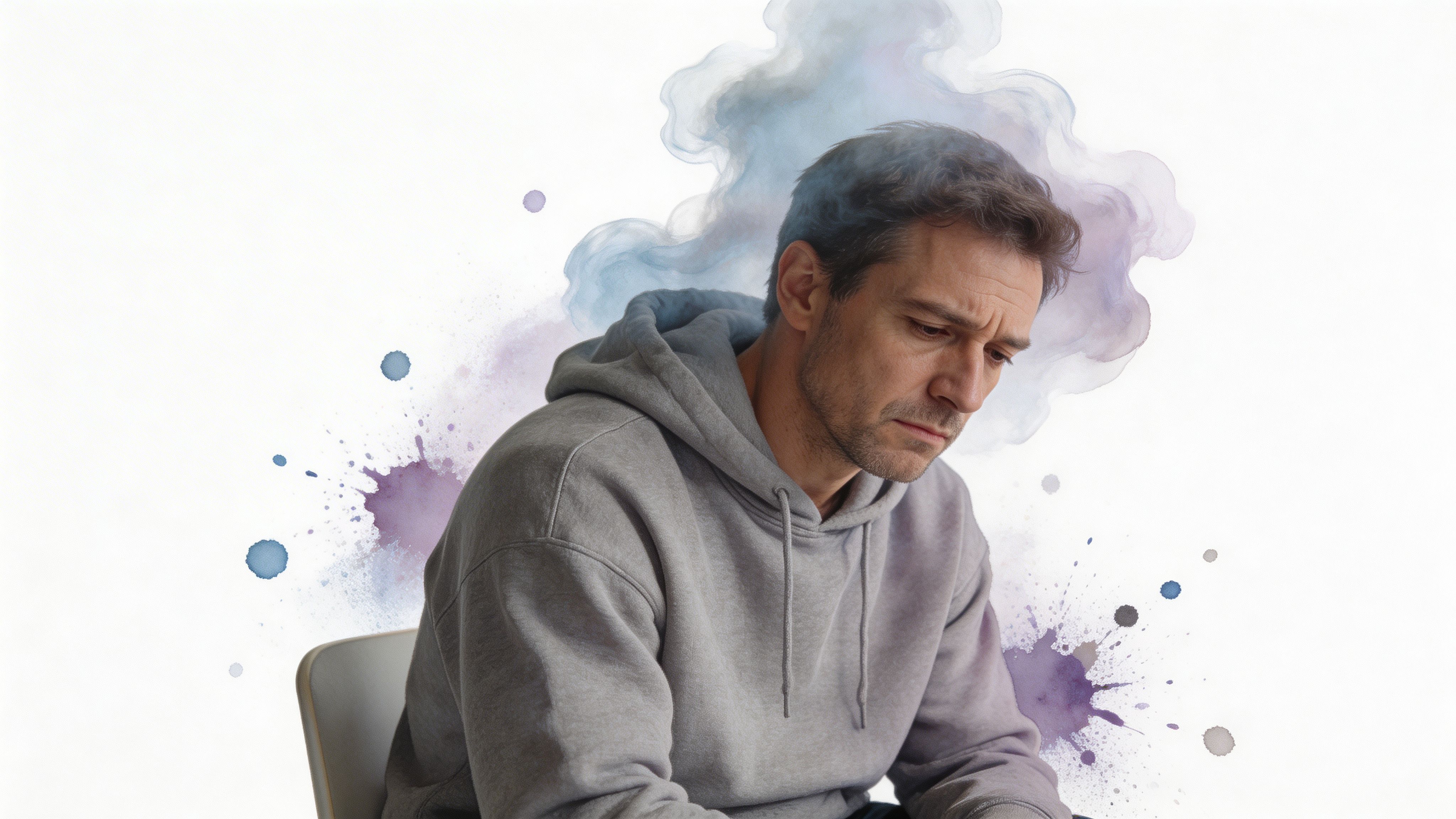
That hidden crash is what many people mean by a panic attack hangover. The panic has passed, but your system hasn’t fully reset yet.
What it can feel like
Some people describe it as being drained and wired at the same time. Others say it feels like jet lag, a flu-like slump, or emotional sunburn. Small tasks can feel hard.
Common reactions include:
- Physical depletion: heavy limbs, soreness, shakiness, or deep fatigue
- Mental fog: trouble focusing, forgetfulness, confusion
- Emotional spillover: irritability, dread, numbness, or feeling fragile
You don’t need to “justify” feeling wiped out after panic. Your body just went through an intense survival response.
For many people, the worst part is not knowing whether this is normal. That uncertainty adds a second layer of fear. Once you understand what’s happening, the aftermath feels less mysterious and less threatening.
The hopeful truth
This is a recovery state, not proof that you’re failing.
A panic attack hangover can be disruptive, but it also gives you information. It tells you your nervous system is overloaded and needs support, not criticism. And when you learn how to respond in a way that helps your body settle, the aftermath becomes shorter, softer, and less scary.
That matters. Because healing from panic starts with changing what happens after the attack, not just during it.
What Exactly Is a Panic Attack Hangover
A panic attack hangover is the lingering aftereffect of a panic attack. It's like an emergency charge on your body’s credit card. During panic, your system spends a lot of energy very fast. Afterward, your body and mind have to pay it back.
That’s why you can feel wrecked long after the peak fear has passed.
Approximately 11% of Americans experience panic attacks annually, and the lingering panic attack hangover can bring fatigue, brain fog, and emotional exhaustion that lasts for hours to weeks, significantly disrupting daily life (The Balance).
It helps to sort symptoms into three buckets
When people are scared, they ask, “Why do I feel so many different things at once?” It becomes clearer when you group symptoms by type.
Physical symptoms
Your body may feel like it finished a sprint it never chose to run.
- Fatigue: the heavy, wiped-out feeling that makes basic tasks seem bigger than they are
- Muscle aches or tension: especially in the chest, shoulders, jaw, neck, or legs
- Headaches or dizziness: common after intense stress
- Nausea or shaky appetite: some people feel hungry, others can’t eat
- Trembling or weakness: your system is still settling
Cognitive symptoms
This is the part that scares people most because it can feel unfamiliar.
- Brain fog: thoughts feel slow, blurry, or hard to hold onto
- Poor concentration: reading, working, or making decisions feels harder
- Detached feeling: you may feel “off,” unreal, or not fully present
Emotional symptoms
The emotional layer doesn’t always disappear when the panic does.
- Residual fear: worry that another attack is about to start
- Irritability: your nerves feel rubbed raw
- Emotional flatness or numbness: some people don’t feel anxious after. They feel empty
- Shame or frustration: especially if the attack interrupted work, family time, or sleep
Practical rule: If your symptoms make more sense as “my nervous system is recovering” than “something mysterious is happening,” you’re looking at a panic attack hangover.
A simple timeline helps
The timing varies, but people feel better when they know what kind of arc to expect.
| Timeframe | Common Physical Symptoms | Common Cognitive & Emotional Symptoms |
|---|---|---|
| First 0 to 3 hours | strong fatigue, soreness, shakiness, drained energy | confusion, fear, sensitivity, trouble thinking clearly |
| Several hours to 2 days | lingering tiredness, tension, headaches, low stamina | brain fog, irritability, dread, low motivation |
| Longer recovery for some people | exhaustion that hangs on, sleep disruption, body heaviness | ongoing unease, emotional exhaustion, harder concentration |
Some people recover within hours. Others need more time, especially if they’ve had repeated attacks, poor sleep, or high stress. If you want a plain-language guide to the attack itself, this overview of a panic attack can help put the hangover in context.
One detail that reduces confusion
A panic attack hangover is not the same thing as an alcohol hangover. The overlap in language can be misleading. In this case, the “hangover” is about the crash after intense stress activation, not about drinking.
That distinction matters because it points you toward the right kind of recovery. Your nervous system needs steadiness, fuel, rest, and reassurance.
Why Your Body and Mind Feel So Drained
The drained feeling after panic makes a lot more sense when you stop treating it like a mystery and start treating it like biology.
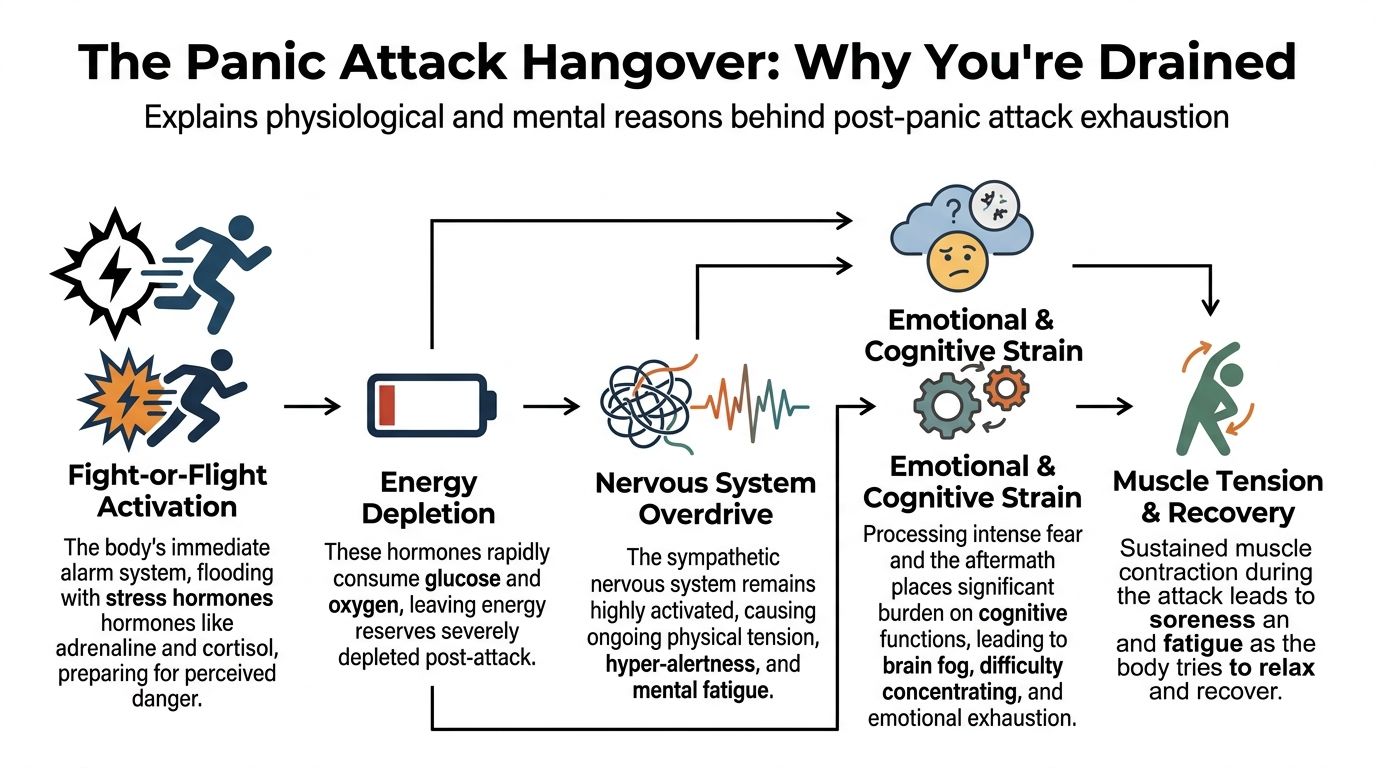
A panic attack pushes your body into a high-alert survival mode. Then, once the threat response falls, you don’t instantly return to normal. You crash out of emergency mode and your body has to clean up the mess.
Panic attack hangovers stem from adrenaline and cortisol crashes after the episode, with symptoms like exhaustion and muscle aches lasting from 10 minutes to a week, after an attack that itself typically lasts 5 to 30 minutes (A Place of Hope).
Your emergency budget gets spent fast
A simple way to think about panic is this. Your body opens the emergency fund.
It pumps out stress hormones, redirects energy, speeds up breathing, tightens muscles, and prepares you to act. That’s useful in real danger. It’s brutal when the danger is a false alarm.
Afterward, you’re left with the bill:
- Muscles are tight and sore because they were bracing
- Energy is low because your body burned through resources
- Breathing patterns may still feel off even after the peak passes
- Your system feels jumpy because it hasn’t fully switched back to calm mode
If you’ve ever felt weak after “just sitting there having a panic attack,” that’s why. Your body wasn’t resting. It was mobilizing.
Your brain is tired too
The hangover isn’t physical alone.
Your mind has processed a wave of fear that felt urgent and real. Even after the body starts coming down, your brain may stay watchful. It scans for danger. It replays symptoms. It asks, “What if that happens again?”
That mental monitoring is exhausting.
Some people also become very sensitive to normal body sensations after an attack. A skipped heartbeat, a warm flush, a little dizziness, normal fatigue. All of it can feel loaded with meaning. That constant checking wears you down.
If you want a deeper plain-English explanation of the body alarm system, this guide to the fight or flight response is useful.
The aftermath often feels intense because your body is trying to slow down while your mind is still standing guard.
Why sleep gets hit so hard
Many people get trapped here.
You’re exhausted, but your nervous system doesn’t trust rest yet. So you go to bed tired and alert. Then you sleep lightly, wake often, or avoid sleep because you’re afraid of feeling symptoms in the dark.
That poor sleep can make the next day’s hangover worse. It can also lower your resilience and make future panic more likely. For many people, learning to reduce cortisol levels naturally fits well into recovery because it supports the bigger goal of helping the body shift out of chronic stress patterns.
What makes the crash feel worse
A few patterns tend to intensify the hangover:
- A more severe attack: the stronger the alarm, the bigger the aftermath can feel
- Repeated attacks close together: your system gets less time to recover
- Poor baseline health or high stress: recovery is harder when you’re already depleted
- Sleep loss: one of the biggest amplifiers of next-day symptoms
None of this means you’re weak. It means your nervous system is carrying a heavy load.
Once you see the hangover as a predictable aftereffect of overactivation, two things happen. First, self-blame drops. Second, your recovery plan gets smarter.
Your Immediate Recovery Toolkit After an Attack
Right after a panic attack, people want one thing. Relief. Not theory. Not perfect insight. Just something that helps.
The best response is gentle and practical. You’re not trying to force yourself back to normal in ten minutes. You’re helping your body feel safe enough to recover.
Start with grounding
Panic scrambles your sense of time, place, and proportion. Grounding helps your brain reconnect with the present.
A simple option is the 5-4-3-2-1 method:
- Name five things you can see
- Touch four things around you
- Notice three sounds
- Identify two smells
- Name one taste
This works because it pulls attention out of threat-monitoring and back into direct sensory reality. If you want more options, this collection of grounding techniques for anxiety is a good resource to bookmark before you need it.
Then stabilize the body
After panic, your body benefits from boring basics.
Try this short checklist:
- Drink water: small sips are fine if your stomach feels off
- Eat something steadying: toast with nut butter, yogurt, eggs, soup, or another simple snack you tolerate well
- Lower stimulation: dim lights, reduce noise, pause doom-scrolling
- Sit somewhere supportive: a couch, bed, or chair where your body can unclench
You don’t need an ideal wellness routine here. You need enough physical support to tell your system, “The emergency is over.”
Use movement carefully
Many people think they should either lie completely still or push themselves to “snap out of it.” Neither extreme helps.
Talkspace notes that progressive muscle relaxation can cut unease by 40%, a 20 to 30 minute light walk can boost endorphins by 25%, and cognitive defusion can reduce rumination by 35% in CBT trials (Talkspace).
That gives you a useful menu.
Option one is release tension on purpose
Progressive muscle relaxation works when your body feels clenched.
- Feet and calves: tense gently, hold briefly, release
- Hands and arms: squeeze, then soften
- Shoulders and jaw: lift or clench lightly, then let go
The key is gentle effort. You’re teaching your muscles the difference between bracing and resting.
Option two is a light walk
A short, easy walk can help discharge leftover activation.
Not a workout. Not punishment. Just motion.
If stepping outside feels difficult, walk slowly inside your home. Even a few minutes of calm movement can help your body complete the stress cycle.
A quick guided practice can help when your brain is too tired to remember steps on its own.
Talk to your thoughts differently
The post-panic mind loves to narrate catastrophe.
It says things like:
- “What if it comes back?”
- “What if I embarrassed myself?”
- “What if this means something is really wrong?”
Cognitive defusion offers a softer response. Instead of arguing with every thought, label it.
Try:
- “I’m having the thought that this will happen again.”
- “My brain is producing a danger story.”
- “This is a stress thought, not an emergency instruction.”
Reset phrase: “My body is recovering. I don’t have to solve everything right now.”
That sentence won’t erase symptoms. It can stop you from adding a second wave of fear.
Give yourself the kind of care you’d offer someone else
This is easy to skip and hard to replace.
A lot of people come out of a panic attack angry at themselves. They call themselves weak, dramatic, inconvenient, broken. That shame adds friction to recovery.
Try a different tone. Talk to yourself like you would talk to a close friend who just had a frightening physical event.
A few examples:
- Instead of “I need to get it together,” say, “That was a lot. I need a minute.”
- Instead of “I’m ridiculous,” say, “My nervous system got overwhelmed.”
- Instead of “I ruined the day,” say, “Today got hard, and I’m recovering.”
That shift matters. Safety isn’t physical alone. It’s relational. The way you speak to yourself after panic either helps your body settle or keeps the alarm humming.
Building Long-Term Resilience to Panic
Immediate recovery helps. Long-term healing changes the pattern.
For many people, the biggest overlooked driver of recurring panic attack hangovers is sleep. Not “getting more sleep” in the abstract, but understanding the loop. Panic disrupts sleep. Poor sleep makes your system more vulnerable. Then the next stressful moment lands on a body and mind that are already underpowered.
That cycle can make life feel smaller than it is.
A key overlooked issue is the feedback loop between panic attack hangovers and sleep disruption. A projected 2025 wearable-data finding reported that 40% of anxiety app users experienced prolonged sleep deficits after panic attacks, which points to the value of tracking recovery patterns over time (Rula).

The sleep and panic loop
Here’s how the trap works.
You have a panic attack. That night, your body is tired but vigilant. You sleep lightly or not much. The next day, you feel more fragile, more reactive, and less able to shrug off normal stress. Then you start fearing bedtime because bedtime has become associated with body sensations, racing thoughts, or another bad night.
That’s how a rough episode becomes a repeating cycle.
Common signs you’re in this loop:
- You dread going to bed because you’re afraid of feeling trapped with your thoughts
- You monitor your body at night instead of letting yourself drift
- You sleep, but don’t feel restored
- You start each day already depleted
A structured plan for the next 72 hours
When sleep gets disrupted after panic, a loose plan is better than vague advice like “just rest.”
The first evening
Keep the goal modest. Don’t chase perfect sleep.
- Dim inputs early: lower light, soften sound, and reduce stimulating content
- Choose simple meals: choose a meal or snack that feels easy on your stomach
- Avoid turning your bed into a battleground: if you’re highly activated, spend a little time calming down before lying down
- Pick one soothing anchor: tea, a warm shower, calm music, a paperback, or a familiar blanket
The next morning
This part matters more than many people realize.
- Get natural light early if you can: this helps reorient your body clock
- Stand up and move gently: a short walk, stretching, or basic morning tasks can help your system rejoin the day
- Don’t over-interpret a rough night: poor sleep after panic is unpleasant, but it doesn’t predict your future
The following day and night
Aim for rhythm, not perfection.
- Keep meals regular
- Use caffeine carefully if you use it at all
- Avoid stacking extra pressure onto yourself
- Return to a familiar bedtime routine even if sleep wasn’t good the night before
A bad night after a panic attack doesn’t mean you’re back at the beginning. It means your nervous system still needs consistency.
Build a sleep routine that anxious brains can trust
General sleep advice can feel too generic when you live with panic. A central issue is helping your body stop treating night as a threat cue.
A helpful guide to good sleep hygiene can support the basics, but for panic-prone sleepers, the most useful routines are the ones that feel repeatable and calming rather than strict.
Try building a short pre-sleep sequence:
- One hour before bed, reduce stimulation
- Ten minutes before bed, do something body-based, such as stretching or progressive muscle relaxation
- If your mind loops, write down the main fear in one sentence
- Use one consistent reassurance phrase, such as “I can rest without forcing sleep”
- If you can’t settle, stay kind to yourself
This sequence works because it creates predictability. Predictability is one of the fastest ways to lower threat sensitivity.
Strengthen the foundation during the day
Long-term resilience isn’t built at night alone. It’s built in ordinary hours.
Food and blood sugar steadiness
You don’t need a perfect diet. You do need enough steadiness that your body isn’t swinging between depleted and overactivated.
A few simple rules help:
- Don’t go long stretches without eating if that tends to make you shaky
- Pair carbs with protein or fat when possible
- Keep one easy fallback food available for days when anxiety kills your appetite
Movement that calms instead of spikes
Exercise can be helpful, but some people with panic get discouraged because intense sensations can feel triggering.
Start with what your nervous system can trust:
- Walks
- Gentle cycling
- Stretching
- Yoga or mobility work
The goal isn’t performance. It’s teaching your body that increased sensation doesn’t always mean danger.
Stress offloading
If your days are packed wall-to-wall, your body never gets a clean recovery window.
Try one intentional downshift each day:
- a short walk without your phone
- a few minutes of slow breathing
- journaling after work
- sitting outside without multitasking
None of these are glamorous. They work because they reduce accumulated load.
Track patterns so recovery becomes less random
One of the hardest parts of panic recovery is feeling like every episode comes out of nowhere.
Tracking changes that.
You don’t need a complicated spreadsheet if that overwhelms you. A note on your phone works. A notebook works. What matters is capturing enough detail to notice patterns.
Track things like:
- When the panic attack happened
- What was happening beforehand
- How you slept the night before
- What the hangover felt like
- What helped
Over time, this turns panic from a shapeless threat into something more understandable. You may notice that poor sleep, skipped meals, conflict, overstimulation, or overwork show up again and again. That knowledge provides an advantage.
If you want to deepen your understanding of anxiety patterns and recovery skills, Anxiety University offers a useful starting point.
Think in terms of nervous system trust
Healing doesn’t always look dramatic. Often it looks like this:
You recover a little faster.
You fear the aftermath a little less.
You sleep a little better after an episode.
You stop rearranging your whole life around the possibility of panic.
That’s resilience. Not the absence of all symptoms, but the return of trust.
Knowing When to Seek Professional Support
Self-help tools can do a lot. Sometimes they’re enough to create significant change. Sometimes they’re a part of what you need.
Getting professional support doesn’t mean you’ve failed at handling anxiety. It means you’re adding skill, structure, and another set of eyes to something that’s been hard to carry alone.
Signs it’s time to reach out
A few patterns deserve extra attention.
- Your panic attacks are becoming more frequent or more intense
- You’re avoiding places, driving, work, exercise, or social plans because of fear
- Your panic attack hangover keeps disrupting daily life for days at a time
- Sleep loss is becoming a regular part of the cycle
- You’re using alcohol or other substances to manage the aftermath
- You’re having thoughts of self-harm or feel unsafe
Any one of these can be enough reason to talk to a doctor or therapist.
Reaching out early is easier than waiting until panic has reshaped your whole routine.
What professional help can look like
Support doesn’t come in one form.
A therapist may help you understand triggers, reduce fear of body sensations, and change the thought patterns and avoidance habits that keep panic going. A doctor may rule out medical issues, discuss treatment options, or help you think through whether medication belongs in your plan.
Some people start with therapy. Some start with primary care. Some want to understand whether seeing a psychiatrist for anxiety makes sense. There isn’t one right entry point. The right one is the one you’ll use.
If you feel embarrassed, read this part twice
Panic comes with shame. People tell themselves they should be able to handle it on their own.
But if you had severe chest pain, fainting spells, or weeks of exhaustion after a physical event, you wouldn’t call yourself weak for getting help. You’d call it responsible.
The same logic applies here.
Professional support can shorten the time you spend guessing, fearing, and white-knuckling your way through recovery. You still do the work, but you don’t have to invent the map by yourself.
Your Path from Surviving to Thriving
A panic attack hangover can make life feel narrow. It can convince you that your body is unsafe, that rest won’t come, and that normal life is always one symptom away from falling apart.
That story feels convincing when you’re in the fog. It isn’t the whole truth.
The fuller truth is this. Your body had an alarm response. Your brain and nervous system need time and support afterward. There are things you can do in the first hour, the first evening, and the following days that make recovery easier. There are also habits that reduce how much power panic has over your life in the long run.
Hold onto the main takeaways
Keep these in front of you:
- A panic attack hangover is genuine: it’s a recovery state, not a personal failure
- Your symptoms make sense: fatigue, fog, soreness, and emotional sensitivity fit the aftermath of a stress surge
- Sleep deserves special attention: it sits at the center of the cycle
- Small tools matter: grounding, hydration, food, gentle movement, and kind self-talk all help
- Patterns can change: many people learn to reduce both the fear of panic and the disruption that follows it
Healing usually looks gradual
Many people don’t wake up one day completely transformed.
They notice smaller wins first. Less fear when symptoms show up. Better recovery after a hard moment. More confidence leaving the house. A little less obsession with scanning the body. More sleep. More life.
Those changes count.
You do not need to wait until anxiety disappears to start living well. You can build safety, meaning, and joy while recovery is unfolding.
A different way to measure progress
If you only measure success by “I never felt anxious,” you’ll miss the true victories.
Try measuring things like:
- how quickly you recover
- how kindly you respond to yourself
- how often you return to your plans after fear shows up
- how much of your day belongs to you instead of to panic
That’s the shift from surviving to thriving.
You’re not trying to become a person who never feels stress. You’re becoming a person who understands their nervous system, supports it wisely, and doesn’t let panic write the rules for their whole life.
And that life, the one with more steadiness, more courage, and more room to breathe, is not reserved for other people. It can be yours too.
If you want a structured way to track triggers, recovery patterns, sleep, habits, and practical coping tools, The Anxiety Checklist is a solid next step. It’s designed to help you turn scattered advice into a clear, personalized system so you can stop guessing and start building a calmer, more confident life.