


Your chest tightens. Your heart starts pounding. Your thoughts go straight to, “I need something now.”
A lot of people in that moment look around for the fastest thing in the medicine cabinet. Benadryl feels like a reasonable choice because it makes you sleepy, and sleepy can sound a lot like calm when panic is hitting hard.
I understand that impulse. When panic feels urgent, any quick fix can seem worth trying.
But with benadryl panic attacks, the logic breaks down fast. What looks like relief can turn into more fear, more body symptoms, and more confusion. The good news is that panic is treatable, and there are safer ways to get through the moment and build a life that no longer revolves around fear.
In a Panic? Reaching for Benadryl Might Be a Mistake
You might be reading this after a rough night.
Maybe you woke up with a jolt, felt your heart slam against your ribs, and convinced yourself something was terribly wrong. Maybe you searched online, saw that Benadryl causes drowsiness, and wondered if it could “knock down” the panic enough to let you breathe again.
That thought makes sense. Panic creates desperation, and desperation looks for speed.
The problem is that Benadryl was not made to treat panic. It is an over-the-counter antihistamine, mainly used for allergies and short-term insomnia. People often confuse the sleepy feeling it causes with real anxiety relief. Those are not the same thing.
Why the shortcut often backfires
Panic attacks already come with intense physical sensations. If you take something that affects your brain and body in a broad, messy way, you may end up feeling more disoriented instead of more secure.
A person in panic often asks:
- Will this stop my racing thoughts
- Will this slow my heart
- Will this help me feel safe again
Benadryl does not reliably do those jobs. In some people, it can even stir up sensations that feel a lot like panic itself.
If you are in the habit of chasing panic with whatever is closest, the first real shift in recovery is learning which tools calm the alarm system and which tools only blur it.
That may sound discouraging at first. It is hopeful.
Once you stop expecting a risky shortcut to save you, you can start using approaches that teach your body and mind a different pattern. If you want a stronger foundation, you can learn about anxiety and panic attacks in a way that makes the whole experience feel less mysterious and less frightening.
There is a path out of this. It starts with understanding what panic really is.
Understanding Panic Attacks and Your Path to Healing
A panic attack is not proof that you are broken.
It is better understood as a misfiring alarm system. Your body is trying to protect you, but it is pulling the fire alarm when there is no fire. That is why the “faulty smoke detector” analogy helps so much.
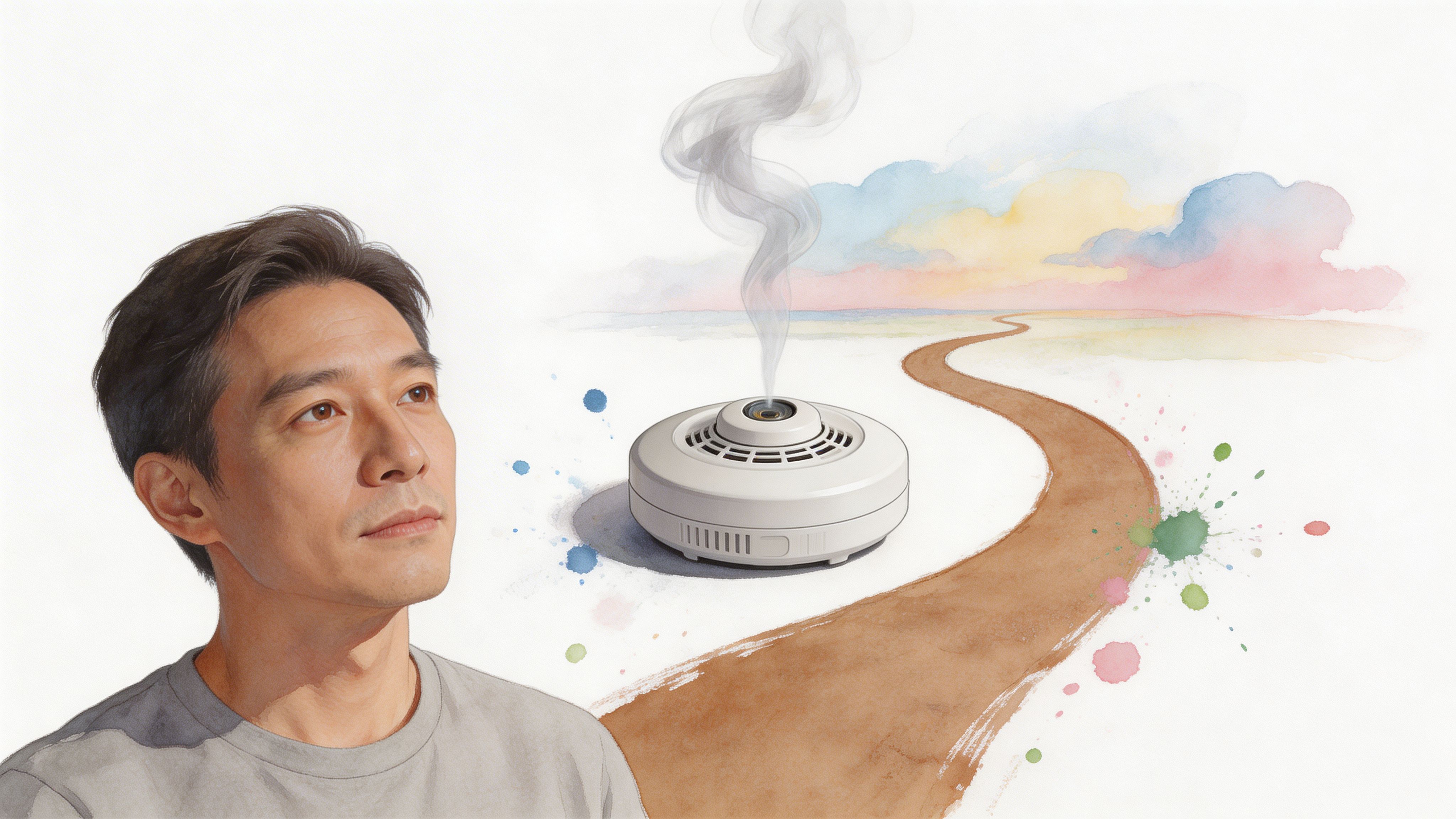
The faulty smoke detector idea
A smoke detector is useful when there is real danger.
But if it goes off every time you make toast, the problem is not that the house is doomed. The problem is that the detector has become too sensitive. Panic works in a similar way. Your brain and body detect threat too quickly, too loudly, and at the wrong times.
That explains why panic can feel so physical. Your body prepares for danger before your thinking mind has time to make sense of what is happening.
Common panic experiences include:
- A racing heart that feels alarming
- Shaking or dizziness that makes you worry you are losing control
- A surge of dread that seems to come out of nowhere
- The urge to escape immediately
These sensations are scary, but scary does not mean dangerous.
One panic attack is not the same as panic disorder
This part confuses many people. Having a panic attack does not automatically mean you have Panic Disorder.
Some people have a panic attack during a stressful period, an illness, after poor sleep, or after a strong body sensation that spooks them. Panic Disorder is a bigger pattern involving recurring attacks and fear of future attacks. If you want a thoughtful outside explanation, this piece on understanding anxiety with panic disorder gives helpful context in plain language.
You can also read more about what a panic attack is and how it works.
Recovery does not mean never feeling anxious again. Recovery means teaching your alarm system to stop treating every spark like a house fire.
That is why healing is possible. You are not trying to become emotionless. You are teaching your system accuracy.
The Deceptive Calm of Benadryl Explained
Benadryl can feel calming for a simple reason. It can make you drowsy.
That is also exactly why it is a poor choice for panic.
Benadryl is diphenhydramine, a first-generation antihistamine designed for allergy relief. Its sedating effect is not a targeted anxiety treatment. It is a side effect of how broadly it acts in the brain and body.
Sedation is not the same as anxiety relief
This is the key distinction.
Benadryl’s mechanism involves non-selective central nervous system receptor antagonism. In plain English, it affects multiple systems at once instead of calming the specific fear circuitry involved in panic. It produces short-term sedation with an onset of 30 to 60 minutes, but that sedation masks symptoms rather than treating anxiety itself, and tolerance can develop within 7 to 14 days according to Pacific Coast Mental Health.
If you are panicking, what you want is not to feel foggy. You want your body to stop sounding a false alarm.
A simple analogy that makes this click
Think of your house alarm going off because of one faulty wire.
A targeted treatment works like an electrician tracing the wiring and fixing the problem. Benadryl works more like shutting off power to the whole house. Yes, the alarm may seem quieter for a while. But the wiring is still faulty, and now the rest of the house is harder to use.
That “whole house shutdown” effect explains why people often feel:
- Sleepy but still mentally afraid
- Groggy instead of grounded
- Temporarily dulled without feeling safe
Why the relief feels convincing at first
Panic is intense. Any drop in that intensity can feel like proof that something is helping.
But a tool that only blunts awareness does not teach your brain a healthier response. It does not help you reinterpret body sensations. It does not reduce fear of fear. It does not build confidence for the next wave.
Here is the practical test:
| Question | If the answer is yes, it is probably real recovery support |
|---|---|
| Does it help you understand what is happening in your body? | More useful |
| Does it leave you clearer, not foggier? | More useful |
| Does it build skill you can reuse? | More useful |
| Does it address the root fear pattern? | More useful |
Benadryl usually fails that test. It may make you sleepy. That is not the same thing as helping you heal.
The Paradoxical Effect and Other Dangers
The biggest reason people should be cautious with benadryl panic attacks is the paradoxical effect.
A paradoxical effect means the drug can do the opposite of what you hoped. Instead of making someone feel settled, it can make them feel activated, uneasy, and physically alarmed.
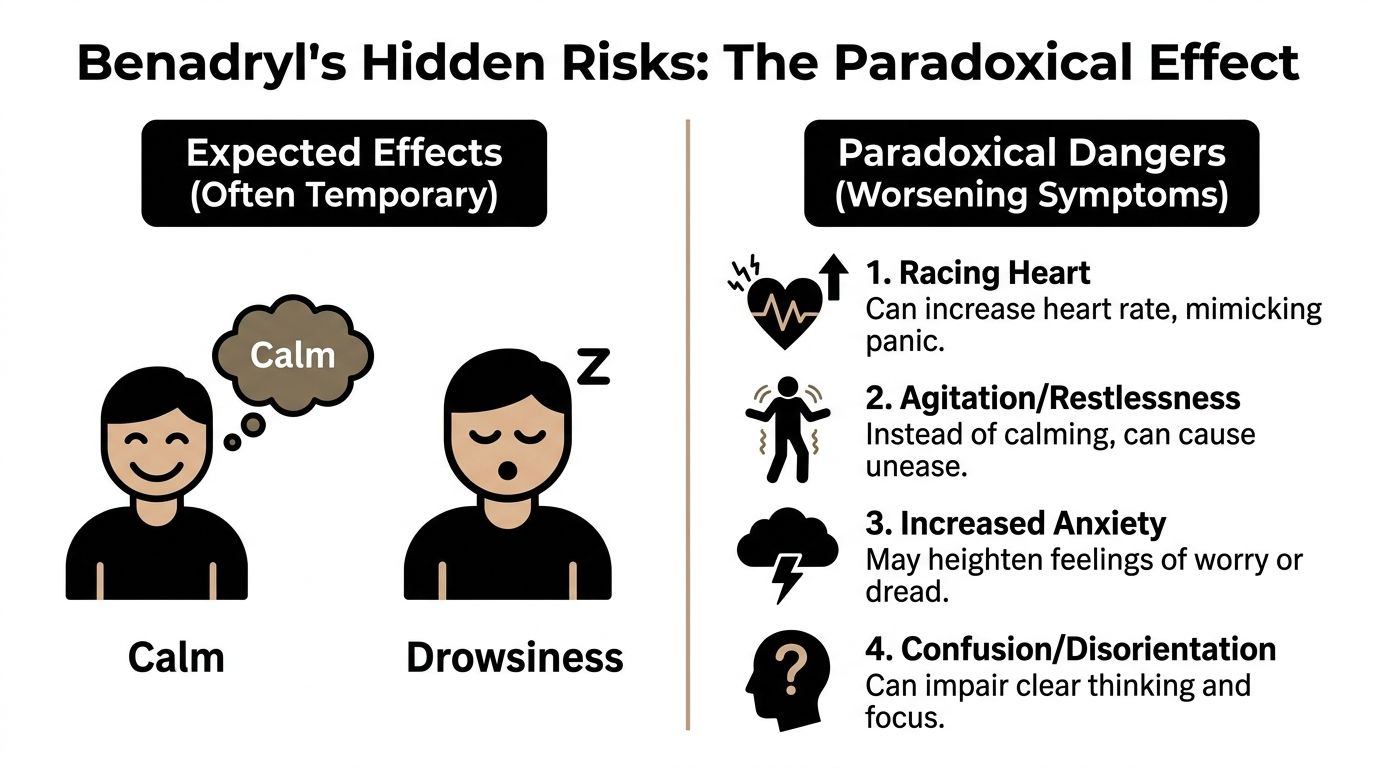
When “calming” starts to feel like panic
Benadryl can paradoxically trigger or worsen panic-like symptoms. Its central nervous system and anticholinergic effects can lead to rapid heartbeat, trembling, and agitation, and this type of paradoxical excitation can occur in 1 to 5% of users according to LIV Hospital.
That matters because those are the very sensations many people already fear during a panic attack.
A common spiral looks like this:
- You feel anxious and take Benadryl hoping to calm down.
- Your body reacts badly with restlessness, a faster heartbeat, or shakiness.
- You notice the sensations and interpret them as worsening panic.
- Fear spikes, which makes the physical symptoms feel even stronger.
That loop can be terrifying.
Why reactions vary so much
Some people feel sleepy. Others feel wired.
Part of that difference may come down to how their bodies process the drug. Healthline notes that paradoxical excitation may involve genetic metabolic differences related to CYP2D6, which can create a very different response in some people. That unpredictability is a big reason this is such a poor self-experiment when panic is already making you feel unsafe.
Other downsides people often overlook
Even when Benadryl does not trigger a paradoxical reaction, it comes with tradeoffs.
- Mental fog: You may feel detached, slow, or cloudy rather than calm.
- Rebound discomfort: When the sedating effect wears off, the original fear pattern is still there.
- Tolerance: Repeated use can make it less effective, pushing people to rely on it more while getting less from it.
- Misreading symptoms: Side effects can blend with anxiety symptoms and make it harder to know what your body is doing.
If you have ever felt wiped out, shaky, and strange the day after intense anxiety, this guide on panic attack hangover may help you understand that aftermath more clearly.
The danger with Benadryl is not only that it may fail. It is that failure can feel like evidence that you are getting worse, when the problem is the tool itself.
Safe and Grounding Techniques for Immediate Relief
When panic hits, you need something you can do with your own body and attention. Not something that muddies the picture.
These tools are simple, but simple does not mean weak. The best grounding skills work because they interrupt the panic cycle in real time.

Try grounding before trying to numb
Grounding works by pulling your attention out of the mental storm and back into the present.
If you want a broader set of tools, these grounding techniques for anxiety can give you more options to practice when you are calm, so they feel familiar when you are not.
Here are four you can use right away.
The 5 4 3 2 1 exercise
This is excellent when your thoughts are spinning.
Look around and name:
- 5 things you can see
- 4 things you can feel
- 3 things you can hear
- 2 things you can smell
- 1 thing you can taste
This technique works because panic pulls you into imagined danger. Sensory detail pulls you back into the room you are in.
Slow, structured breathing
Fast breathing tells your body the threat is still active. Slower breathing sends the opposite message.
A format many people find useful is Box Breathing, where you inhale, hold, exhale, and hold again in equal counts. The exact count matters less than the rhythm and gentleness.
Do not force giant breaths. Gentle breaths are better. Overbreathing can make you feel worse.
A quick guided option can help when your brain is too loud to lead itself:
Temperature change
Cold sensation can interrupt panic fast.
Try splashing cold water on your face, holding a cool compress, or stepping into a cooler space for a moment. The sensation gives your nervous system something concrete to respond to other than fear.
A calm script for the panic wave
Sometimes the most helpful move is not fighting the wave.
Try saying, slowly:
- This is panic
- My body is sounding a false alarm
- I do not need to stop every sensation
- I need to ride this safely
Grounding does not erase panic instantly. It changes your relationship to it. That shift is often the beginning of real recovery.
From Coping in the Moment to Lasting Recovery
Immediate relief matters. Lasting recovery matters more.
If panic has become a pattern, the long-term answer is not stronger sedation. It is a plan that helps your brain stop misreading harmless sensations as danger.
What real treatment aims to do
Evidence-based panic treatment usually focuses on two broad paths.
Therapy, especially CBT, teaches you how panic is maintained. You learn to spot the thought patterns, body checking, avoidance, and catastrophic interpretations that keep the cycle going.
Prescription medication, such as SSRIs, works differently from a sedating antihistamine. These medications are used to regulate relevant neurotransmitter systems over time. They are not a “knock you out” strategy.
Why Benadryl falls short next to evidence-based care
Major health bodies do not recommend Benadryl for panic attacks. It offers only mild, short-term sedation, while SSRIs achieve up to a 60% response rate for long-term panic control, and Benadryl’s usefulness often fades within 1 to 2 weeks of repeated dosing due to tolerance, according to CA Mental Health.
That contrast matters.
One approach teaches your nervous system safety. The other teaches you to chase temporary drowsiness.
Comparing Panic Attack Treatment Approaches
| Feature | Benadryl (Diphenhydramine) | Therapy (CBT) | Prescription Meds (e.g., SSRIs) |
|---|---|---|---|
| Primary purpose | Allergy relief and sedation | Change panic-driving thoughts and behaviors | Regulate anxiety-related pathways over time |
| What it does during panic | May make you drowsy | Helps you respond differently to the alarm | Not a rapid sedative fix |
| Effect on root causes | Does not address them | Directly addresses them | Supports broader symptom reduction over time |
| Reliability | Unpredictable for panic | Skill-based and repeatable | Used as part of evidence-based care |
| Long-term use | Poor fit because tolerance can develop | Designed for long-term recovery | Used for longer-term management under medical care |
| Main downside | Can worsen symptoms in some people | Takes practice and patience | Requires medical guidance and time |
The healing path usually looks less dramatic than people expect
Recovery is often built from steady, unglamorous steps:
- Learning the panic cycle: Understanding why your body reacts the way it does.
- Reducing avoidance: Going back to places or sensations you have started to fear.
- Changing your interpretation: Replacing “I am in danger” with “My alarm system is firing.”
- Building consistency: Practicing skills when calm, not only in crisis.
For many people, the breakthrough comes when they stop asking, “How do I shut this down instantly?” and start asking, “How do I retrain this system?”
If you are ready for that shift, these anxiety recovery steps can help you think beyond emergency coping and toward a full recovery process.
Your Journey to a Fearless Life Starts Now
Panic feels powerful when you are inside it.
It tells you that you need immediate rescue. It tells you that the sensation means catastrophe. It tells you that if you do not stop it right now, something terrible will happen.
None of that is the truth.

Benadryl can look like an easy answer because it is familiar and available. But familiar is not the same as safe, and available is not the same as helpful. For many people, it is a dead end. At worst, it adds new sensations to an already frightened body.
A better road is available.
You can learn what panic is. You can stop fearing every body sensation. You can use grounding skills to get through hard moments. You can build long-term recovery with treatment that matches the problem. And yes, you can live without organizing your whole life around the next attack.
That is the hopeful truth at the center of this whole conversation. Panic is intense, but it is treatable. Anxiety is persuasive, but it is not always accurate. Recovery takes repetition, not perfection.
You do not need a risky shortcut. You need a clear system, steady practice, and enough hope to keep going until your alarm system learns a new pattern.
If you want a practical next step, The Anxiety Checklist offers a structured, action-focused way to work through panic and chronic anxiety. It helps you organize coping tools, understand your triggers, challenge fear patterns, and build the kind of steady progress that leads to a calmer, freer life.