


It's 2 a.m. and your body is still tired, but your mind won't cooperate. One thought turns into five. You replay a conversation, jump to tomorrow's worst-case scenario, then somehow land on something embarrassing from years ago. The faster you try to force your mind to stop, the louder it gets.
That experience is frightening, but it isn't a sign that you're broken. In many cases, racing thoughts anxiety is not just “overthinking.” It's what it feels like when your nervous system is stuck in high alert and your mind starts firing in response. When the body feels unsafe, the brain keeps scanning, predicting, rehearsing, and looping.
If that's where you are right now, start with this: people do recover. People do get their sleep back. People do stop living in fear of the next spiral.
Table of Contents
- You Can Heal From Racing Thoughts and Anxiety
- How to Stop Racing Thoughts in the Moment
- Retrain Your Brain to Interrupt the Cycle
- Build Long-Term Resilience to Anxiety
- Your Pocket Toolkit for Consistent Support
- When to Seek Professional Help for Anxiety
You Can Heal From Racing Thoughts and Anxiety
When racing thoughts hit, it's common to assume the problem is the thought content. They think, “If I could just solve this, I'd calm down.” Often, that doesn't work because the deeper issue is physiological arousal. Your heart is keyed up, your breathing gets shallow, your muscles brace, and your mind starts generating more material to match that state.
That's why racing thoughts anxiety often feels so relentless at night. You're alone with the signal your body is sending, and your brain starts acting like a threat detector. The thoughts feel mental, but the loop is also physical.

There's real hope here. Research from a 6-year follow-up study in the general population shows that 77.8% of individuals with anxiety disorders achieve remission, meaning symptoms either disappear entirely or become manageable enough not to interfere with daily life, according to this 6-year follow-up study on anxiety remission. That matters because it means healing is not rare. It's a common outcome.
Practical rule: Don't judge your future by your worst nights. Anxiety can feel permanent while it's active, but it often isn't.
Some readers also need help distinguishing racing thoughts from other intrusive mental experiences. If your mind latches onto disturbing, repetitive content, this guide on treatment for intrusive thoughts in Massachusetts gives a useful overview of when specialized support may help.
What this means for recovery
If the nervous system is part of the problem, then calming the body isn't a side tactic. It's treatment. Cognitive work matters, but it works better when your body is no longer sounding the alarm.
Three shifts usually help people the most:
- Stop arguing with every thought. A panicked brain can produce convincing nonsense.
- Start treating the body first. Slow the physical alarm before you demand mental clarity.
- Use structured tools repeatedly. Rehearsed skills work better than improvised ones.
If you want trusted, practical reading between sessions or during rough weeks, these evidence-based anxiety resources can help you build that understanding without making you dig through scattered advice online.
How to Stop Racing Thoughts in the Moment
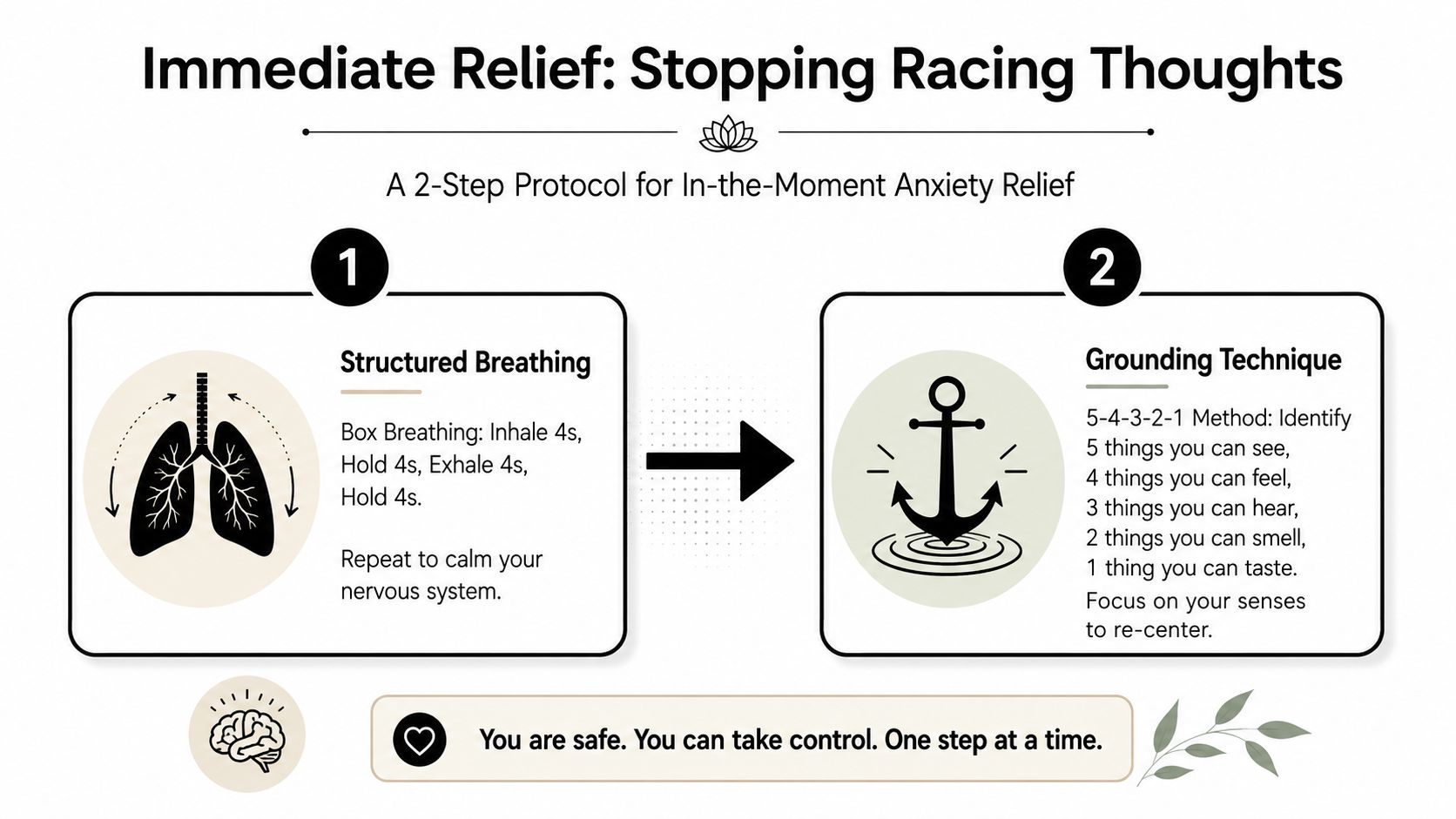
When your thoughts are sprinting, generic advice like “just relax” usually makes things worse. You need a sequence your body can follow. One practical method for acute racing thoughts is a structured breathing and grounding protocol, which pairs a timed breathing pattern with a sensory grounding scan to pull attention out of the loop and back into the present moment.
Start with the visual below, then do the drill exactly in order.
Why the sequence matters
The common mistake is stopping at breathing. Breathing helps, but many people keep thinking while they breathe, which means the loop keeps running. The second step matters because it gives your attention a job that is concrete, sensory, and immediate.
Use this order:
- Do box breathing first. Inhale for 4 seconds, hold for 4 seconds, exhale for 4 seconds, hold for 4 seconds. Repeat for 3 to 4 rounds.
- Then switch immediately to 5-4-3-2-1 grounding. Name 5 things you can see, 4 things you can touch, 3 things you can hear, 2 things you can smell, and 1 thing you can taste.
- If your body is still tight, add muscle release. Tense your shoulders, hands, or legs for a few seconds, then let them go.
Use structure when you're flooded. The brain does better with a script than with vague instructions.
A lot of people also find it easier to follow a guided demonstration than to remember the steps under stress. This short video can help you practice the sequence before you need it most.
A drill you can use anywhere
Think of this as an emergency brake, not a philosophy. You can do it in bed, in the bathroom at work, in your parked car, or before a difficult conversation.
Here's what usually works best in real life:
- Keep your eyes open if closing them makes things worse. Grounding works better when you stay oriented to the room.
- Name real objects, not categories. Say “blue lamp,” “cold countertop,” or “air conditioner hum.”
- Don't wait until you're at a ten. The earlier you use the drill, the easier it is to interrupt the spiral.
- Repeat the whole sequence once if needed. If your mind is still revving, run the same order again.
Some people worry that grounding is just distraction. It's not. The point isn't to avoid reality. The point is to stop feeding an alarm state that makes clear thinking impossible.
If your mind gets especially noisy during stress, these ways to calm an overactive mind can give you more options to pair with the breathing-grounding sequence.
Retrain Your Brain to Interrupt the Cycle
Body-based tools help you regain control in the moment. Long-term change also requires a new relationship with your thoughts. You don't need to make every thought positive. You need to stop treating every anxious thought like an emergency bulletin.
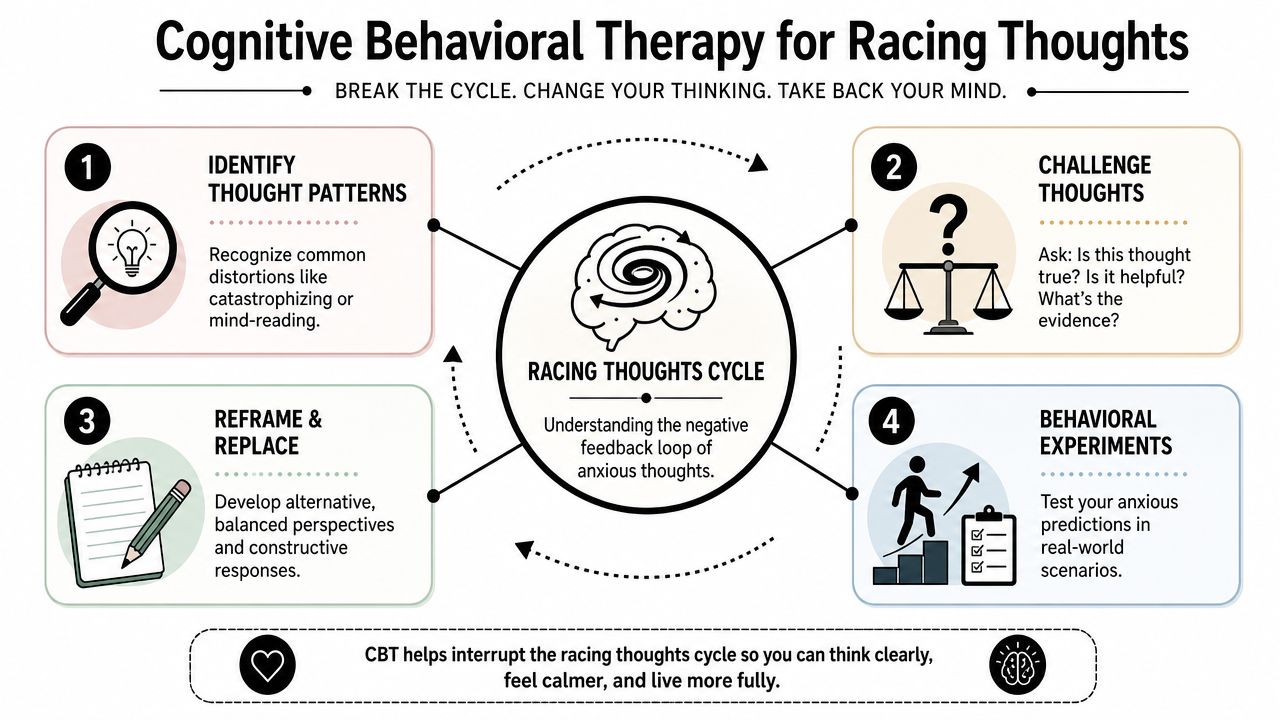
Racing thoughts are a common symptom of Generalized Anxiety Disorder, which affects an estimated 2.7% of U.S. adults in the past year, and Cognitive Behavioral Therapy (CBT) helps people identify and change the counterproductive thinking patterns that fuel these thoughts, according to the National Institute of Mental Health overview of GAD.
Notice the pattern instead of obeying it
CBT starts with one simple move. Notice the thought. Label the pattern. Slow your reaction.
Suppose your mind says, “My boss was quiet today. I'm probably getting fired.” That thought often arrives with force, not proof. Instead of following it, pause and label what's happening.
A quick worksheet in your head might look like this:
| Thought | Pattern | Better question |
|---|---|---|
| “I'm getting fired” | Catastrophizing | What actual evidence do I have? |
| “They think I'm incompetent” | Mind-reading | Do I know that for sure? |
| “If I made one mistake, everything is ruined” | All-or-nothing thinking | Is there a more realistic middle ground? |
Your first thought is often an alarm, not a verdict.
Many people get stuck at this point. They think reframing means pretending everything is fine. It doesn't. It means replacing a distorted thought with one that is more accurate.
Use a balanced response
A balanced response is believable, not sugary. It sounds like this:
- Instead of “Everything is going wrong,” try “I'm anxious, and anxiety is making this feel bigger than it is.”
- Instead of “I won't handle this,” try “I may not like this, but I can respond one step at a time.”
- Instead of “This feeling means danger,” try “This feeling means my system is activated.”
You can deepen this work by testing your predictions. If your brain says, “I can't survive that meeting,” go to the meeting with support, then record what happened. That's how the mind learns. Not through debate alone, but through experience.
If you want a structured way to practice this skill, you can explore CBT techniques for anxiety and start learning how thought records, belief experiments, and behavior changes fit together.
Build Long-Term Resilience to Anxiety
Immediate tools matter. They're not enough on their own if your baseline is chronically tense. If your body spends most days braced, overstimulated, underslept, and disconnected from recovery, racing thoughts will have an easier time taking over.
Long-term resilience is less dramatic than crisis relief, but it's what changes the pattern. The goal is to make your nervous system less reactive before the next hard day arrives.
Move your body and discharge stress
Exercise can reduce anxiety and give the mind a healthier outlet for excess activation. It doesn't have to be intense to help. A brisk walk, a slow stretch session, or regular martial arts practice can all serve as a reset when your body is carrying too much unspent stress.
Some people do especially well with forms of training that combine movement, focus, and repetition. If that approach appeals to you, The ultimate path to discipline offers a useful perspective on how structured physical practice can build steadiness, patience, and self-control over time.
Try this simple standard: pick a form of movement you can repeat even on anxious weeks. The best routine is the one your life can hold.
Create a steadier inner baseline
Resilience usually grows from small habits done often. These are the ones I see help most consistently:
- Protect sleep rhythm. Keep a regular wind-down routine. A tired nervous system gets louder, not quieter.
- Lower stimulation before bed. Give your brain fewer inputs late at night so it doesn't stay in problem-solving mode.
- Journal what keeps looping. A page of unfinished fears is easier to work with than a cloud of them in your head.
- Practice reflection, not just symptom control. Deeper work often involves noticing the beliefs underneath your anxiety, and shadow work for anxiety can be one way to explore those patterns.
A useful trade-off to accept is this: calm isn't built by chasing calm all day. It's built by sending the body repeated signals of safety, rhythm, and completion.
Healing often looks ordinary. Better sleep, more movement, fewer adrenaline spikes, less fear of your own thoughts.
Your Pocket Toolkit for Consistent Support
Individuals don't struggle because they lack insight. They struggle because they can't always access the right tool at the right moment. Racing thoughts can wipe out memory, focus, and perspective fast. That's why a pocket toolkit matters.
What helps between therapy sessions
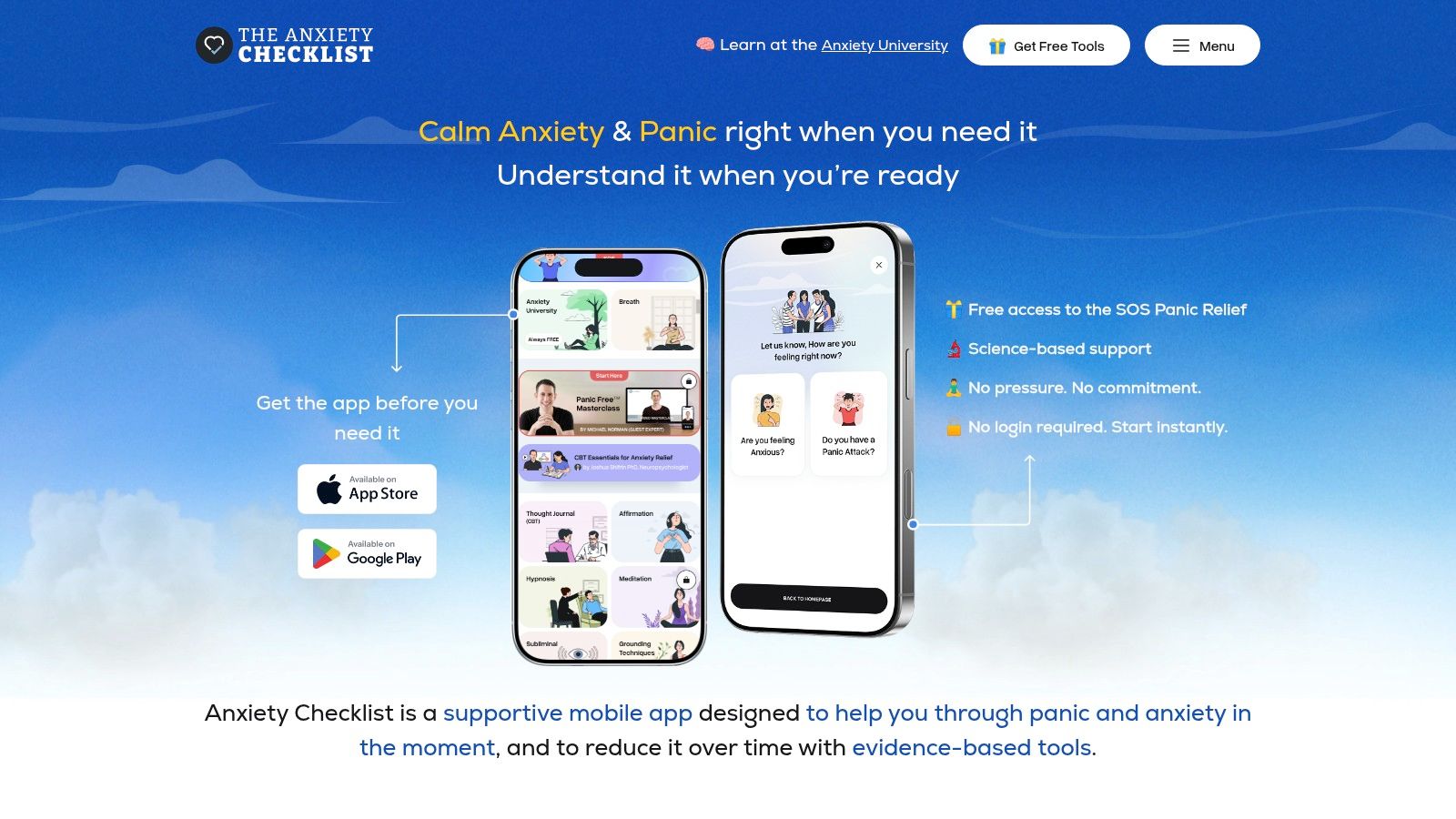
A strong support tool does two jobs. First, it helps during acute spikes, when you're too overwhelmed to think clearly. Second, it helps during calmer hours, when you can practice the skills that make future spikes less intense.
That's why guided prompts, grounding scripts, thought journaling, belief testing, sleep audios, and short meditations can be so useful. They reduce the friction between “I know what helps” and “I can do it right now.”
For immediate support during surges, The Anxiety Checklist's grounding tips can reinforce the same kind of sensory reorientation that helps pull attention away from spiraling.
Consistency beats intensity
The most effective toolkit isn't the one with the most features. It's the one you'll open during hard moments and ordinary days.
Look for something that supports both layers of recovery:
- In-the-moment regulation with grounding, prompts, and simple steps when panic scrambles your thinking.
- Longer-term retraining with tools that help you track patterns, question anxious predictions, and rehearse safer responses.
- Reliable education so you don't have to relearn the basics every time anxiety flares.
People make more progress when support is easy to reach. Not because an app replaces therapy, but because repetition is what teaches the nervous system that it doesn't have to panic every time thoughts speed up.
When to Seek Professional Help for Anxiety
If racing thoughts are hurting your sleep, work, relationships, or ability to function, it's time to consider professional help. That isn't a sign you've failed at self-help. It's a smart next step.
You should be especially careful if your mind feels constantly unmanageable, if panic is becoming more frequent, or if you're organizing your life around avoiding triggers. Anxiety tends to shrink a person's world when it goes untreated. Good treatment helps expand it again.
There's reason to be encouraged. Cognitive Behavioral Therapy leads to remission in 30-40% of people with anxiety disorders. When combined with medication, remission increases to 55-70%, according to this overview of CBT and anxiety remission outcomes. Those numbers don't mean one path is right for everyone. They do mean treatment works for many people, and panic doesn't have to run your life forever.
Ask for help when you notice any of these:
- Daily impairment: You can't focus, rest, or complete normal tasks.
- Relationship strain: You're withdrawing, snapping, or hiding how bad it feels.
- Nighttime escalation: Sleep has become a battle because your mind won't slow down.
- Stalled self-help: You know the tools, but you can't apply them consistently on your own.
The strongest move is often the simplest one. Tell a therapist, doctor, or qualified mental health professional exactly what your racing thoughts feel like and when they show up. Clear treatment starts with clear description.
The Anxiety Checklist can support you whether you need fast relief during a spiral or steady guidance as you build a calmer life. Its free SOS mode, grounding tools, CBT exercises, and educational resources make it a practical companion for healing. If you want support that's accessible and structured, explore The Anxiety Checklist.