



You may be reading this because something feels off in a way that's hard to explain. You're walking through your day, answering texts, making coffee, maybe even having a conversation, but it feels like you're not fully inside your own life. Your hands seem unfamiliar. Your voice sounds far away. You know you're here, but you don't feel here.
That experience can be terrifying, especially if you don't have words for it. Many people immediately fear they're losing control, losing touch with reality, or developing something permanent. But this strange state has a name, and having a name matters. It turns confusion into something you can understand and respond to.
Depersonalization is often tied to anxiety, panic, overwhelm, or trauma. It can feel bizarre, but it isn't a sign that you're "going crazy." For many people, it's a stress response. And when you understand what your brain is doing, the fear around it starts to loosen.
Table of Contents
- That Strange Feeling Has a Name and You Are Not Alone
- What Is Depersonalization Really
- The Many Ways Depersonalization Can Feel
- Why Am I Feeling This Way Exploring the Causes
- How You Can Find Your Way Back to Feeling Real
- Practical Coping Skills for When You Feel Detached
- Your Path Forward to a Panic-Free Life
That Strange Feeling Has a Name and You Are Not Alone
Maybe it happened in the grocery store. You reached for an item on the shelf and suddenly your arm didn't feel like your arm. Or you were talking to someone you love and, instead of warmth or connection, there was only distance. You could still function, but everything felt flat, foggy, or oddly far away.
That can feel isolating because it's so difficult to describe. People often say things like, "I feel like I'm watching myself," or "I feel like a robot," or "I know this is my life, but it doesn't feel like mine." If that sounds familiar, the word for it is depersonalization.
Depersonalization-Derealization Disorder affects about 1% of the general population globally, with prevalence estimates ranging from 0.76% to 1.9%, and brief, transient experiences of depersonalization or derealization are much more common, affecting 26% to 74% of the general population according to this PubMed review on depersonalization-derealization disorder prevalence. That distinction matters. A temporary episode during high stress isn't the same thing as a chronic disorder.
What many people fear
A lot of the panic comes from what people assume the feeling means.
- "I must be losing my mind." Depersonalization can feel intense, but the feeling itself is not proof of psychosis.
- "This means something is permanently broken." In many cases, it's a protective stress response from an overloaded nervous system.
- "No one else feels like this." Many people do. They just rarely talk about it clearly.
You are not the only person who has felt detached from themselves and then recovered.
There is a path forward. Understanding the pattern is often the first step toward relief. If you want more plain-language education about how anxiety symptoms work, Anxiety Checklist Anxiety University offers a helpful place to keep learning.
What Is Depersonalization Really
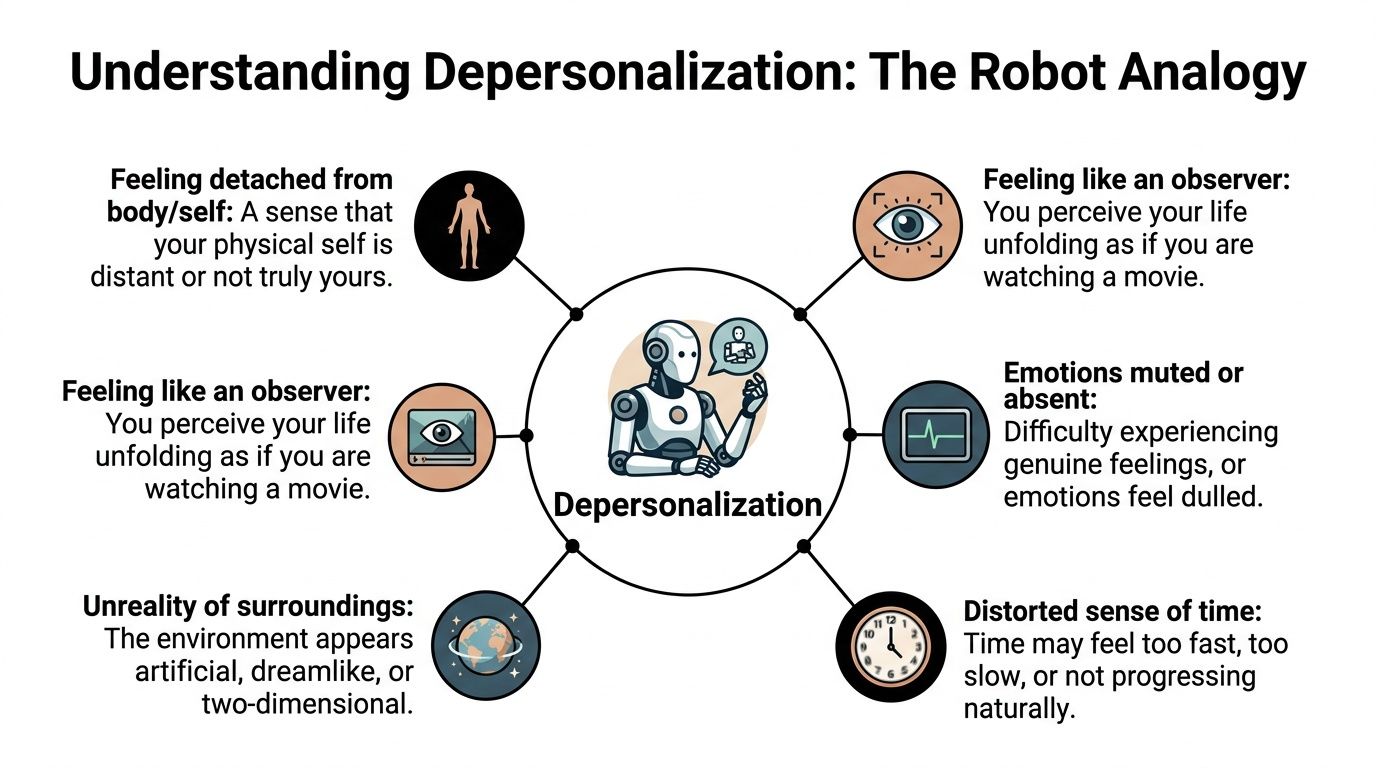
What is depersonalization? It is a change in how you experience yourself. You still know who you are. You usually know where you are, what day it is, and that something feels off. But the normal sense of being connected to your body, your feelings, your thoughts, or even your own memories can suddenly feel thin, muted, or far away.
For some people, the strangest part is not feeling "outside the body." It is feeling emotionally blank while life keeps happening. You may look at someone you love and know you care about them, but the feeling does not come through. You may remember an event, but it can feel like a fact you know rather than an event you experienced firsthand. That is one reason depersonalization is so unsettling. It can affect your sense of self, your emotional warmth, and the felt texture of memory all at once.
Why the brain does this
A helpful way to understand it is to start with stress. When your nervous system senses too much threat, it can shift into protection mode. Instead of letting you feel everything at full volume, it may turn the volume down.
That response works a bit like an electrical circuit breaker in a house. If the load gets too high, the system cuts power to prevent more damage. In the same way, the brain may reduce emotional intensity to help you keep functioning during overwhelm. The tradeoff is that you can end up feeling distant from yourself while staying fully aware of what is happening. The Anxiety Checklist's guide explains this stress response in plain language.
This is also why depersonalization can show up during panic, burnout, trauma, sleep deprivation, or long stretches of high anxiety. In those cases, the feeling of detachment is often a temporary stress reaction. It can pass as the nervous system settles.
A temporary symptom is not always a disorder
This distinction gets missed all the time.
A brief episode of depersonalization during intense stress does not automatically mean you have Depersonalization-Derealization Disorder. The clinical disorder usually involves symptoms that are more persistent, more disruptive, and harder to shake off. The feeling starts interfering with work, relationships, concentration, or your ability to feel present in daily life.
That difference matters because many people get frightened by a short episode and assume the worst. A stress-induced spell of detachment is scary, but it is not the same as a chronic condition. And even when symptoms have become persistent, treatment can help. Recovery is possible.
Depersonalization and derealization are close cousins
People often use these words interchangeably, but they describe two different targets of disconnection.
| Experience | What it usually feels like |
|---|---|
| Depersonalization | Detachment from yourself. Your body, thoughts, emotions, actions, or memories feel unfamiliar, distant, or flat. |
| Derealization | Detachment from surroundings. The world may seem dreamlike, foggy, artificial, visually strange, or emotionally far away. |
Someone with depersonalization may say, "My hands feel like they belong to someone else," or "I know I'm speaking, but it feels automatic." Someone with derealization may say, "The room looks fake," or "Everything feels like a movie set." Many people experience both together, which is one reason the experience can feel so hard to describe.
It is different from psychosis
One of the biggest fears is, "What if this means I am losing touch with reality?"
Depersonalization usually does not work that way. People with depersonalization are often very aware that the experience is strange, internal, and frightening. They know the world has not literally changed, even if it feels changed. That ability to recognize, "This feels unreal, but I know it is a feeling," is a key part of the pattern.
A simple check: if you are repeatedly noticing the strangeness, questioning it, and feeling scared because you know it is not how things usually feel, that fits depersonalization far more closely than psychosis.
That self-awareness often makes people suffer more, not less. You are watching yourself feel disconnected and trying to make sense of it at the same time. The good news is that this pattern is understood, treatable, and far more common than people realize.
The Many Ways Depersonalization Can Feel
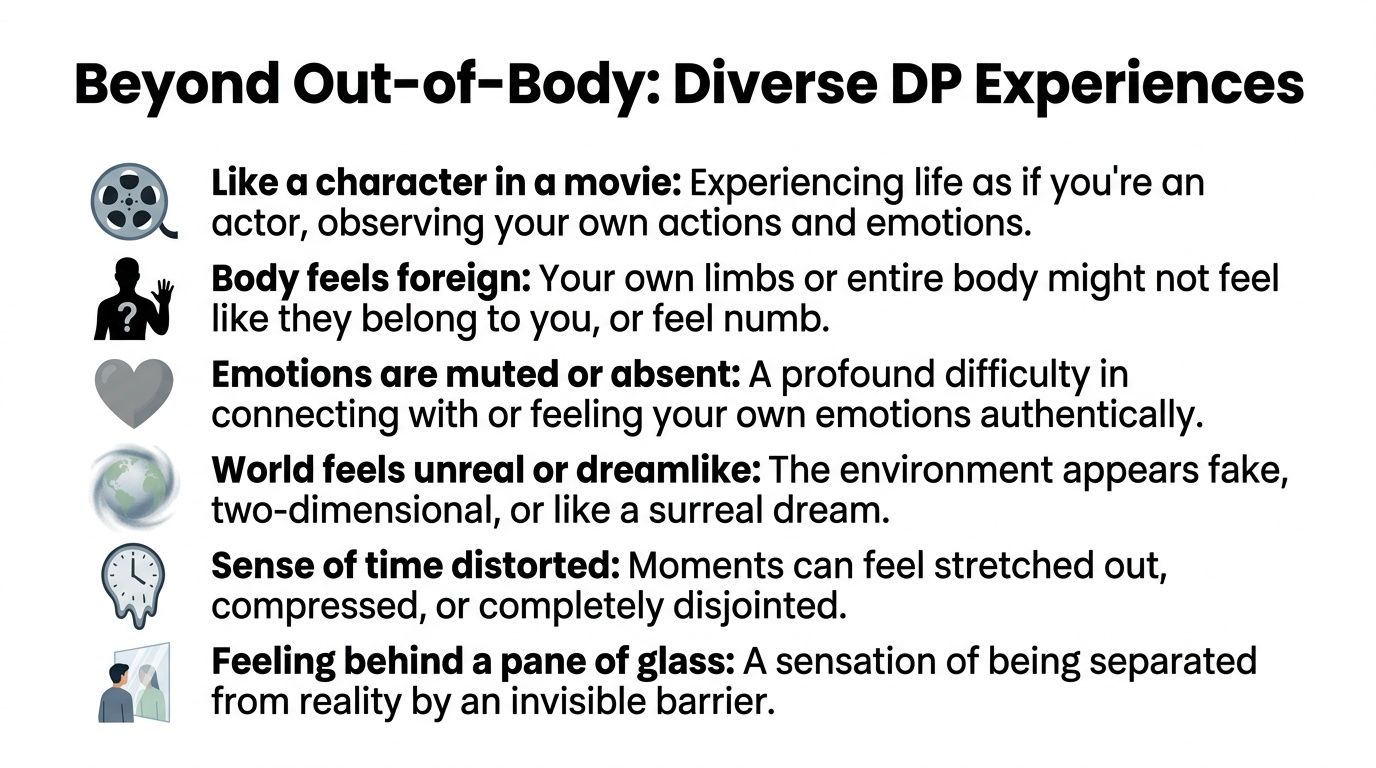
Many people search "what is depersonalization" and find only one description: feeling outside your body. That can happen, but it's not the whole picture. Some of the most distressing symptoms are quieter and easier to miss.
Detachment from your body and actions
This version is often recognized first. You might feel as if you're moving on autopilot or watching yourself do ordinary things from a slight distance.
Common descriptions include:
- Your body feels unfamiliar. Your hands, face, or voice can seem oddly foreign.
- You feel like an observer. It's as if you're watching your own life through a screen.
- Your movements seem automatic. You know you're doing them, but they don't feel fully connected to you.
For some people, even looking in the mirror feels unsettling. They recognize their face, but the sense of "that's me" feels weak.
Emotional numbness can be the main symptom
This part is often neglected, and it's one reason people get confused. They may assume they have only depression, or that they've lost the capacity to love, care, or feel joy.
A 2024 survey of 1,200 patients with DPDR found that 78% reported emotional numbness as their most distressing symptom, while many also struggled with memories feeling unreal or not fully connected to themselves. That fact appears in the verified data provided for this article.
Emotional numbness can look like this:
- Love feels muted. You care about people, but the feeling doesn't land the way it used to.
- Joy doesn't register. Good moments seem distant, flat, or hollow.
- Sadness feels blocked. You may know something is upsetting, yet feel cut off from the emotion.
Sometimes the scariest part isn't feeling outside your body. It's feeling disconnected from your own heart.
Memory distortion and the "robot" feeling
Another missed symptom is the way memory can change. The memory is still there, but it may not feel emotionally attached to you. It's like reading a file about your life instead of remembering your life from the inside.
You might notice:
- Memories feel unreal. Past experiences seem foggy, flat, or oddly impersonal.
- Your personal history feels distant. You know events happened, but they don't feel fully owned.
- You feel robotic. You can still function, but it seems mechanical, like you're performing yourself.
Some people also describe feeling behind glass, inside a dream, or separated from the world by an invisible barrier. These are all recognizable forms of the same basic disconnection.
Why Am I Feeling This Way Exploring the Causes
Depersonalization rarely appears out of nowhere. It often shows up when the nervous system has been stretched too far for too long, or when a sudden shock pushes it past its limit.
For some people, the trigger is a panic attack. For others, it's chronic stress, burnout, grief, trauma, or a long season of running on fear. A person may seem outwardly functional while their inner system is in overdrive. Then one day the brain shifts into detachment.
A protective response that feels alarming
The cruel part is that the response meant to protect you can end up scaring you even more. Anxiety says, "Something is terribly wrong." Your body reacts with more alarm. The detachment deepens. Then fear about the feeling becomes fuel for the feeling.
That loop is one reason depersonalization often travels with high anxiety. Repetitive mental checking can make it louder too. If you notice yourself constantly scanning your thoughts, body, or sense of reality, the cycle can overlap with overthinking and anxiety.
Common patterns behind it
People often recognize themselves in one of these patterns:
- Panic-linked detachment. The episode arrives during or after a surge of fear.
- Long-term overwhelm. Months of stress, poor rest, and tension can wear the system down.
- Trauma-related shutdown. The brain uses distance to reduce emotional pain.
- Emotional overload. When too much feeling seems unmanageable, numbness can take over.
This is why self-blame doesn't help. Depersonalization isn't a personal failure. It's a sign that your system has been trying very hard to cope.
How You Can Find Your Way Back to Feeling Real
A lot of fear starts with one question. Is this a passing stress reaction, or is it becoming a disorder that needs treatment?
That difference matters. A temporary episode of depersonalization can happen when the nervous system is overloaded by panic, exhaustion, grief, or prolonged stress. It can feel frightening, but it often settles as the body calms down. Depersonalization-Derealization Disorder is different because the episodes keep returning or stay long enough to disrupt work, relationships, concentration, or daily routines.
That distinction also helps correct a common misunderstanding. Depersonalization is not only about feeling detached from your body. For many people, the harder part is feeling emotionally flat, cut off from affection or fear, or confused by memories that seem distant and dreamlike. Treatment needs to address the full experience, not just the sensation of feeling outside yourself.
The encouraging part is that this condition is treatable. Recovery usually comes from teaching the brain that the sensations are distressing but not dangerous, much like helping an oversensitive smoke alarm stop reacting to burnt toast as if the house is on fire.
What treatment often looks like
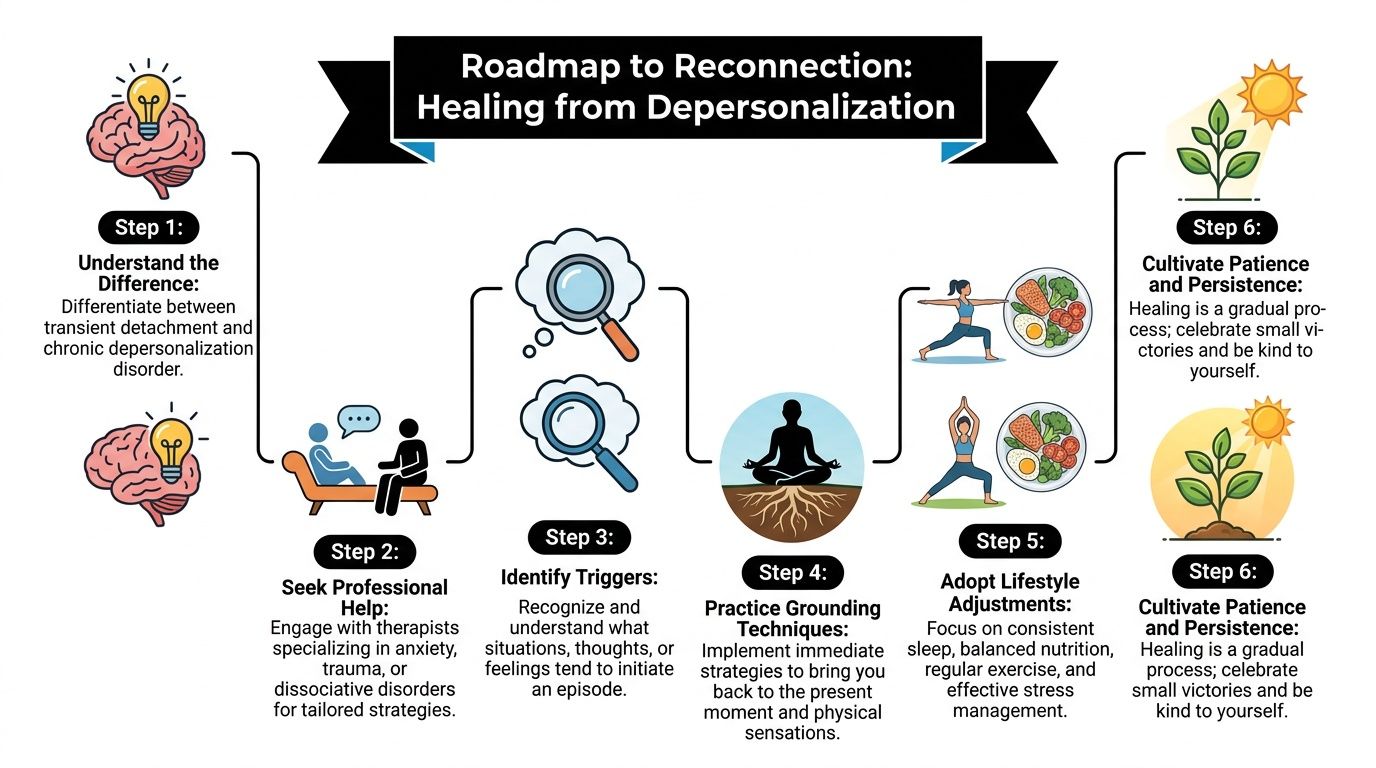
Treatment is often practical, structured, and reassuring. Cognitive Behavioral Therapy is commonly used because it helps people understand the cycle, respond to symptoms with less fear, and return to normal activities step by step.
A therapist may help you build a clear map of what is happening. That usually includes your triggers, the thoughts that show up during an episode, the behaviors that keep the fear going, and the situations where the symptoms ease. The goal is not to study yourself endlessly. The goal is to replace confusion with a pattern you can recognize.
Common parts of treatment include:
A personal symptom map
You identify what sets off the detached feeling, whether that is panic, lack of sleep, emotional overload, or constant self-monitoring.Careful self-observation
You learn to notice symptoms without checking them every few minutes. That shift matters because repeated mental checking can keep the brain stuck on the alarm.Grounding and reorientation
These skills bring attention back to the present through the senses, movement, and simple facts about where you are. A short list of grounding techniques for anxiety can also work well during depersonalization episodes.Testing fearful predictions
Many people privately fear, "If I keep feeling unreal, I will lose control," or "This means my brain is damaged." Therapy helps you examine those thoughts against real experience, which usually lowers the panic around the symptoms.
What helps people reconnect
People often start improving when two things happen at the same time. The nervous system becomes less activated, and the symptoms stop being treated like proof of danger.
That shift can be gradual. One day you notice a few minutes of feeling more present. Then an afternoon. Then the episode still comes, but it no longer convinces you that something terrible is happening. Recovery often looks less like a sudden switch and more like fog thinning.
It also helps to work with someone who understands dissociation. A good therapist does not dismiss the experience, and does not dramatize it either. They help you make sense of the numbness, the distance, and the memory oddness in a calm way that reduces fear.
You do not have to force yourself to feel real by sheer effort. You can learn why this is happening, lower the alarm around it, and let your mind settle back into contact with life.
Practical Coping Skills for When You Feel Detached
When you're in the middle of an episode, insight alone may not be enough. You need something simple and concrete. The goal isn't to force yourself to "feel normal" on command. The goal is to lower fear and help your brain reorient to the present.
Start with sensory grounding. These techniques work by moving attention away from abstract alarm and toward immediate, physical reality.
Try these in the moment
- Use the 5-4-3-2-1 method. Name five things you can see, four you can touch, three you can hear, two you can smell, and one you can taste.
- Change body temperature. Hold ice, splash cold water on your face, or grip a chilled drink.
- Move on purpose. Stomp your feet, stretch your arms, do a few squats, or walk while naming what you see around you.
- Speak out loud. Say your name, the date, where you are, and what you're doing right now.
- Use strong sensory input. A mint, a textured object, or a scented lotion can help anchor attention.
If you want a fuller set of exercises, these grounding techniques for anxiety can also be adapted for depersonalization episodes.
What to say to yourself
Your inner dialogue matters. During depersonalization, harsh self-checking usually makes things worse.
Try short phrases like these:
This is a stress response. It feels strange, but it isn't dangerous.
I don't need to solve this feeling right now. I need to ride it gently.
A brief guided practice can help when your mind goes blank. This video can be useful in that moment:
Hold onto a realistic timeline for improvement
Healing often happens gradually, not all at once. There is a clear timeline for hope: most individuals begin to experience noticeable symptom improvement within 2–4 weeks of starting proper treatment and practicing coping skills, with more complete recovery from moderate anxiety typically occurring within 3–6 months, according to this overview of anxiety recovery timelines.
That doesn't mean every day feels easy. It means progress often starts earlier than anxious minds expect.
Your Path Forward to a Panic-Free Life
Depersonalization can convince you that your life has gone off the rails. It tells you that because you feel unreal, you are unsafe. Because you feel numb, you are broken. Because you feel disconnected, you'll never come back. None of those conclusions are reliable.
What's more accurate is this: your nervous system has been under strain, and it's responding in a way that feels frightening but makes sense once you understand it. The work of recovery is not to fight yourself. It's to teach your brain, little by little, that it doesn't need this level of protection anymore.
When to reach out for more help
Consider professional support if the feeling keeps returning, lasts for long stretches, interferes with work or relationships, or sends you into constant fear. Support can also help if depersonalization is showing up alongside severe anxiety, trauma symptoms, or repeated episodes of panic.
If your symptoms spike during surges of fear, learning more about managing panic attacks can help you understand the broader pattern.
Recovery is not rare
There is solid reason for hope. Long-term, panic-free recovery is not just possible but a statistically common outcome. Research indicates that 7 in 10 people (70%) with a history of generalized anxiety disorder eventually report being free of anxiety symptoms for at least a year, according to this discussion of generalized anxiety recovery rates.
That statistic is about generalized anxiety disorder, not depersonalization alone, but it supports an important truth. Anxiety states can change. People do heal. They do stop living in constant fear.
You don't need to feel perfect today to be on the right path. You need understanding, repetition, and support. A panic-free life may feel far away right now, but many people reach it one ordinary day at a time.
If you want steady support while you work through anxiety, panic, or detachment, The Anxiety Checklist offers practical tools you can use right away. Its always-free SOS mode helps in the moment when your mind goes blank, and its longer-term tools, including grounding exercises, guided support, and CBT-based self-therapy features, can help you build real momentum toward feeling safe, present, and fully yourself again.