

Your heart is racing, your chest feels tight, and your phone is already in your hand. That's the moment many people start searching for a self help app, not because they want another app, but because they want something steady to hold onto when panic makes thinking hard. A good one can give structure, privacy, and a clear next step when your mind goes blank, and that matters when you're trying to heal from anxiety and move toward a panic-free life.
Table of Contents
- What a Self Help App Is and Why People Reach for One
- The Building Blocks Inside a Self Help App
- What the Evidence Says Works
- A Five-Point Checklist for Choosing a Quality Self Help App
- Who a Self Help App Helps and Where It Falls Short
- Wiring a Self Help App Into Your Daily Life and Crisis Moments
- Common Misconceptions About Self Help Apps
- A Hopeful Path Forward and Where Anxiety Checklist Fits
What a Self Help App Is and Why People Reach for One
A woman wakes up at 2 a.m. with a pounding heart. She does not need a lecture, and she does not need to scroll through a generic wellness feed. She needs a tool that can meet her right where she is, on her phone, with something more structured than a meditation playlist and more immediate than waiting for an appointment.
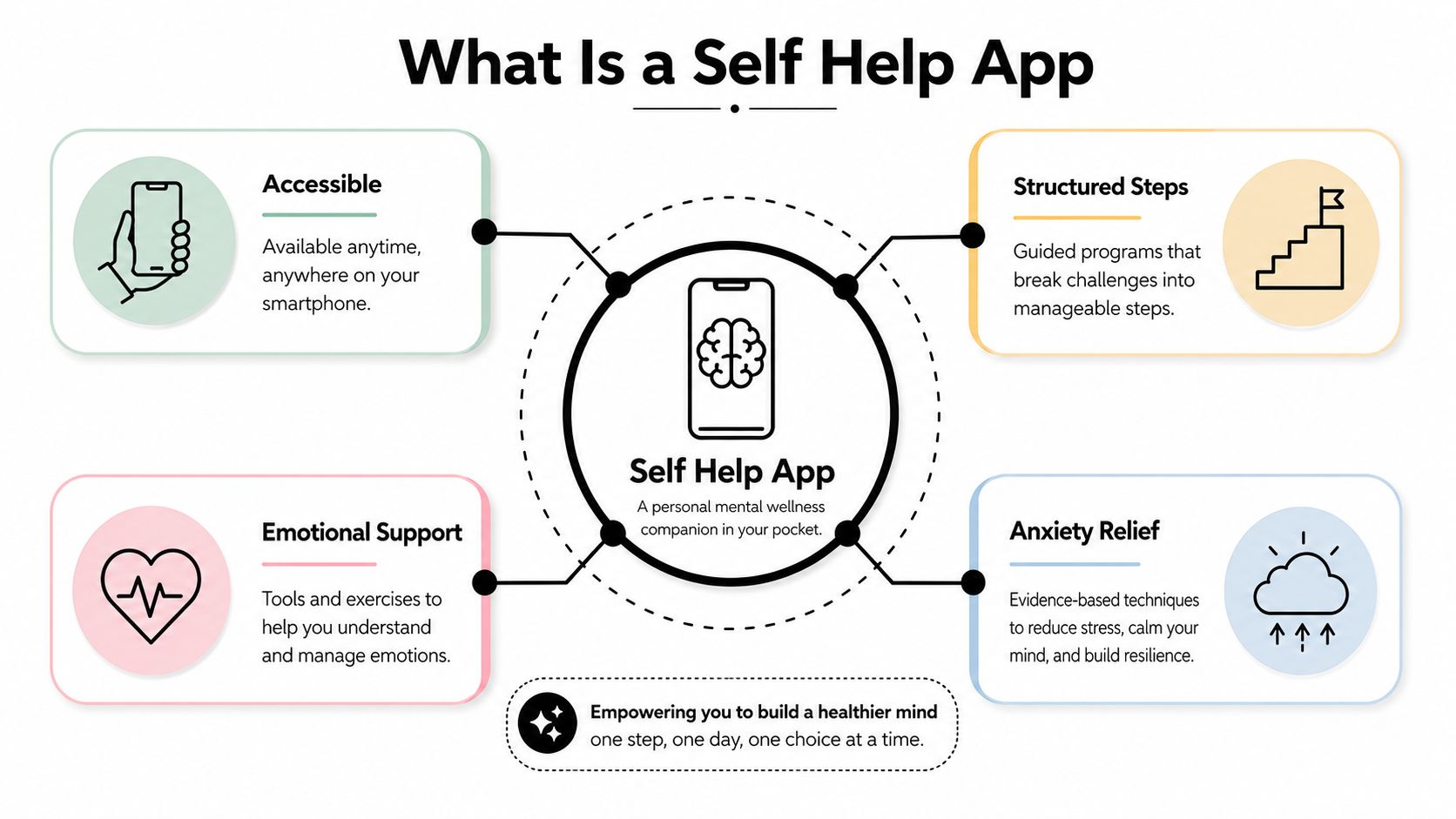
A self help app is a smartphone-based tool that gives structured mental health support without a live clinician in the room. That puts it in a different category from teletherapy platforms, and also from passive apps that only offer music, breathing sounds, or general wellness content. The strongest versions are designed to guide coping, track symptoms, and help users take the next step when anxiety starts to spiral.
The category has grown because people want privacy, speed, and something they can use at odd hours. That growth is happening inside a much larger digital mental health market, estimated at USD 7.48 billion in 2024 and projected to reach USD 17.52 billion by 2030 with a 14.6% CAGR from 2025 to 2030, according to Grand View Research. That scale says something simple. People are not treating these tools like a novelty, they're using them as part of everyday support.
Practical rule: if an app gives you structure when your brain is flooded, it is doing real work.
For readers looking for a grounded starting point, evidence-based anxiety resources can help you separate calm, science-based support from hype. The takeaway is straightforward, a self help app is not a toy, it is a practical companion for the moments when anxiety needs immediate scaffolding.
The Building Blocks Inside a Self Help App
A self help app works like a toolkit. Some tools help you notice what is happening, some help you settle your body, and some help you decide what to do next when panic starts to rise. If you know which tool does which job, it becomes easier to tell whether the app fits your needs or only looks polished on the surface.
Foundation and frame
The foundation starts with intake screening and safety planning, because people do not come to an app with the same needs or the same level of risk. The app should ask enough to point someone toward the right kind of support, instead of handing over content and hoping it lands. That first check matters most when anxiety overlaps with crisis risk or other complicated states, because a careful starting point can keep the rest of the experience useful.
The frame comes from daily routines, mood tracking, and skill building. In plain language, that means short check-ins, sleep audio, walking sessions, and small practices that can be repeated without much effort. A useful starting point is track anxiety with CBT journaling, which shows how thoughts, triggers, and body sensations connect over time. The takeaway is simple, structure helps when your mind feels scattered.
The rooms where coping lives
Inside the app, different parts serve different jobs. CBT tools like thought journaling, belief experiments, and exposure exercises help you test the thoughts that keep panic looping. Grounding techniques and sensory exercises such as 5-4-3-2-1 help when your body is loud and your thinking is narrow.
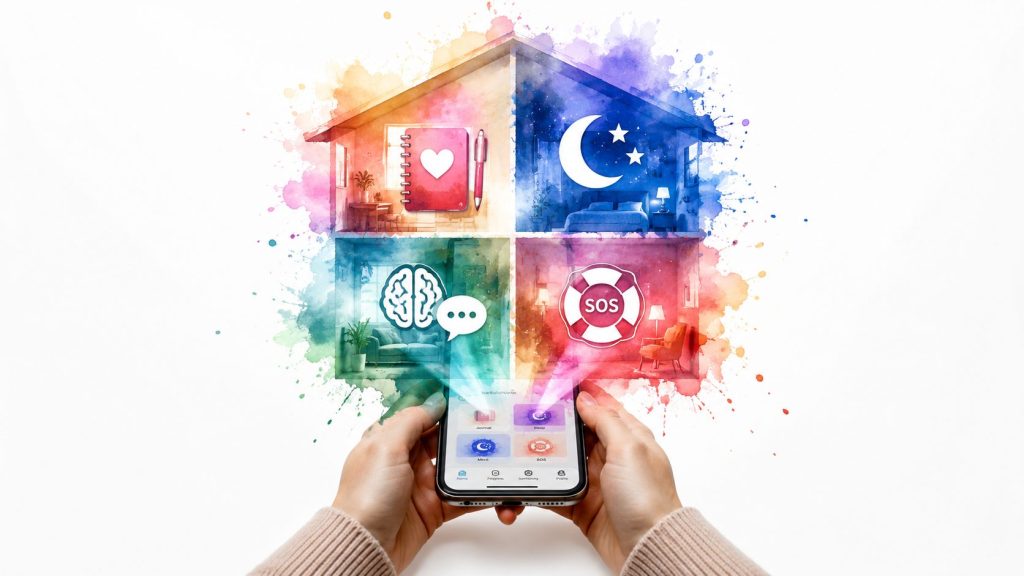
Hypnosis and guided meditation sit in a different part of the toolkit. They are often used to settle the nervous system, especially when sleep or evening wind-down is the problem. A separate SOS mode belongs near the front door of the experience, because when panic hits, the app should not make you search through menus. The takeaway is direct, the right coping tool depends on which part of the anxiety cycle you are in.
The best apps also keep setup simple. Research on mental-health self-care apps points to secure authentication, cloud database integration, and real-time interaction as common system requirements, along with encryption and strong access controls for sensitive data, as discussed by Saigon Technology. The practical point is plain, a self help app should behave like a well-organized toolkit, with each part available when the moment calls for it.
What the Evidence Says Works
Marketing pages love broad promises. Research is narrower, and that is useful. A scoping review of mobile applications for mental health self-care found that the feature patterns most often linked with benefit are self-monitoring, psychoeducation, and guided exercises, with progress tracking and visual feedback helping symptom changes feel easier to see over time, according to ScienceDirect.
Why structure beats vague inspiration
Anxiety is slippery when it stays in the head. Once it becomes structured event data, through mood tags, check-ins, journaling entries, and timeline charts, both the user and the app can spot patterns more clearly. That makes personalization more realistic, because the app has something concrete to work with instead of a wall of free text. The takeaway is simple, structure helps people notice what was hard to see in the moment.
A useful design choice follows from that. The app should reduce cognitive load during high-anxiety moments, not add to it. In practice, that means quick prompts, short actions, and relief tools that appear fast. The same review points toward crisis support that must be reachable from any screen in one tap, because buried help is not real help when someone is overwhelmed. The takeaway is practical, the right design gives the mind less to sort through when it is already overloaded.
Takeaway: the strongest app features are the ones that turn a vague feeling into something you can notice, name, and respond to.
What looks good but does less
Pretty interfaces, endless content libraries, and flashy animations can feel reassuring, but they do not automatically help the user. The research-backed patterns are the ones that support reflection, education, and action. If you want a plain-language companion to that idea, you can browse CBT anxiety strategies and compare them with the features an app offers. The takeaway is clear, useful apps help you observe yourself clearly and act quickly, not just stay occupied.
A Five-Point Checklist for Choosing a Quality Self Help App
People often ask which app is “the best.” That's the wrong first question. A better one is whether the app is built with enough evidence, privacy, usability, and safety to trust during a stressful moment.
The five checks that matter
First, look for clinical evidence. A strong appraisal should name the study design, participant count, timeframe, and a validated anxiety measure such as the GAD-7, as described in Unmind's evidence-based app framework. If the app talks only about feelings and never shows how it was tested, that's a warning sign.
Second, look at privacy. Mental-health data should be treated as highly sensitive, with encryption in transit and at rest, multi-factor authentication, and a transparent data policy, as noted in Saigon Technology's development guidance. Third, check usability. During distress, the app should keep effort low, and a one-tap SOS path should be obvious before you ever need it.
Fourth, ask about cost transparency. Free features, premium layers, and any trial period should be easy to understand before you commit. Fifth, examine crisis safety. The app should include escalation steps, region-appropriate hotlines, and prompts that nudge users toward higher-intensity care when needed.
A quick comparison
| Criterion | What to Look For | Red Flag |
|---|---|---|
| Clinical evidence | Named study design, participant count, timeframe, validated measure | “Clinically inspired” with no details |
| Privacy | Encryption, multi-factor authentication, clear policy | Vague privacy language |
| Usability | One-tap SOS, low cognitive load, easy start | Multiple screens before help appears |
| Cost transparency | Clear free versus premium split | Hidden paywall or confusing trial terms |
| Crisis safety | Escalation steps and local crisis options | No path for urgent situations |
The takeaway is that a serious app should earn your trust before panic tests it, not after. For a simple place to begin evaluating options, an app like Anxiety Checklist app can be judged against the same checklist as any other tool.
Who a Self Help App Helps and Where It Falls Short
Not every hard moment is a self help moment. The most honest guidance says that strong apps should clearly define their scope, explain their limits, include initial screening, and help users step up to higher-intensity care when needed, as outlined in a 2017 NIH review on unguided mental health self-help apps, PMC5688908. That matters because people can waste time if an app tries to serve every need at once.
When it fits
A self help app is usually a good fit for everyday anxiety spikes, between-session reinforcement, and habit-building. It can help when you need a quick reset before a meeting, a way to log triggers after a rough commute, or a guided exercise to use before sleep. Those are the moments when structure helps and a short intervention makes sense.
When it falls short
Live professional care is the better choice for acute crisis, severe depression with suicidal ideation, or active trauma processing. Those situations need human judgment, not just a menu of tools. The goal is not to shame the app, it's to put it in the role it can play.
Research also shows that different groups may benefit from different features. A 2024 study found underserved users, defined as non-female, non-heterosexual, and/or non-White users, used self-reflection features more and appeared to benefit more from them, while better-served users benefited more from peer-support and community functions, according to SAGE Journals. That makes one-size-fits-all advice feel thin, because the right tool depends on the person and the moment.
If you're trying to decide whether connection matters more than solo coping, peer support for mental wellness can be a useful complement to app-based self-help. The takeaway is that a self help app works best as one part of a wider support plan, not as a substitute for every kind of care.
Wiring a Self Help App Into Your Daily Life and Crisis Moments
An app helps most when it becomes routine, not rescue-only. The people who get the most from it usually use it in small, repeatable ways, long before panic turns the volume up. That makes the tool easier to reach when the hard moment arrives.
Daily touchpoints that keep anxiety from building
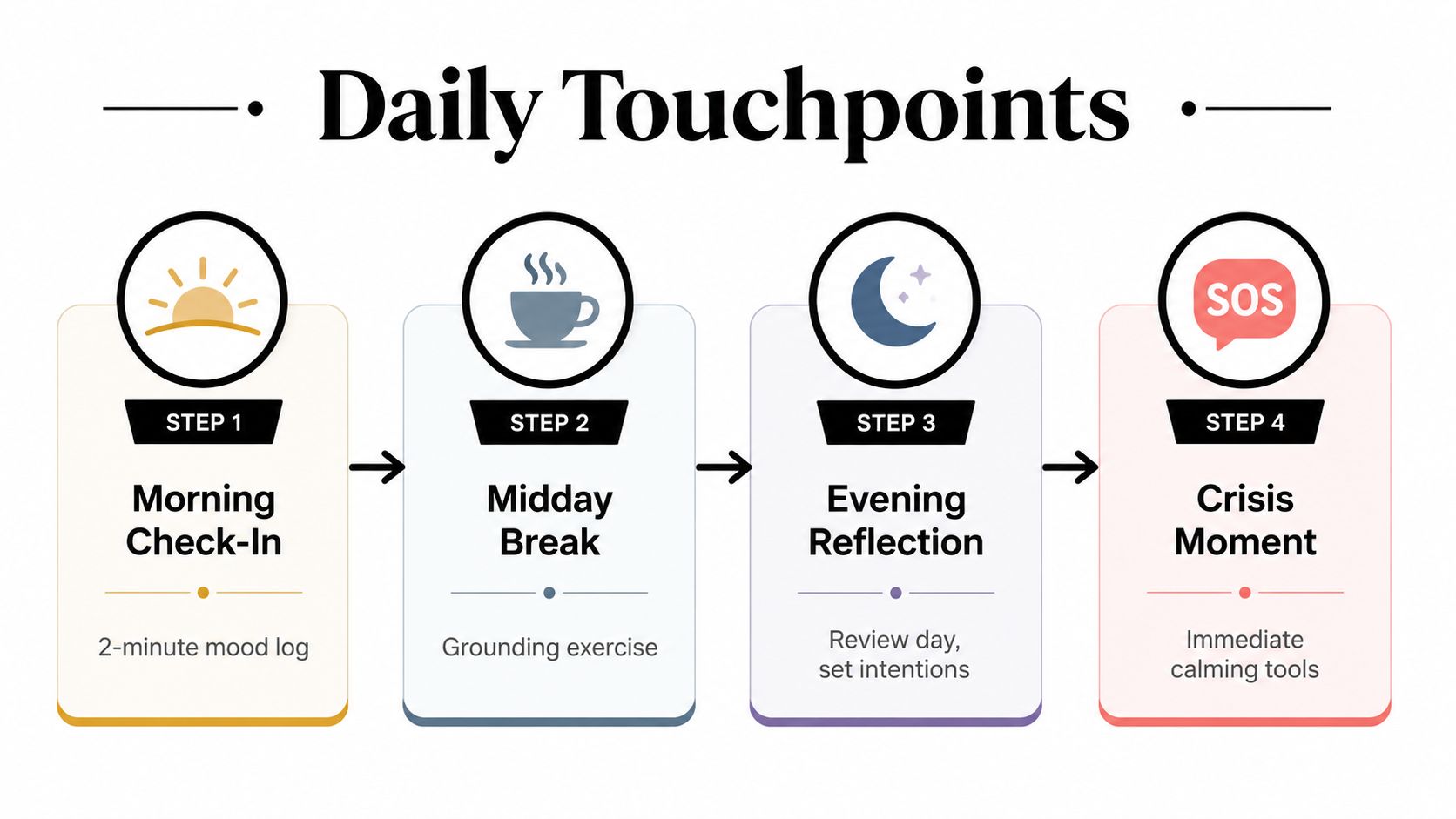
A simple rhythm can look like this. In the morning, spend two minutes on a check-in so you know how you're starting the day. At midday, use a grounding break before stress stacks up. In the evening, do a thought journal or listen to sleep audio. Once a week, review patterns so you can see what keeps helping.
Those small touchpoints matter because anxiety often overwhelms attention. Short sessions are easier to repeat than long ones, and repetition is what makes the relief feel more reliable. For a visual reminder of that routine, the flow below shows how a day can be wired around support.
The right app should also be part of the day outside the screen. Some users pair it with walking, a cup of tea, or a quiet seat before work. If you want guided options beyond text, Interactive Counselling online is a useful reminder that digital support can sit alongside other forms of care.
Crisis planning before panic hits
Do this while calm: bookmark the SOS path, write one personal anchor phrase, and rehearse the steps once so your brain doesn't have to invent them under stress.
Save offline grounding audio if signal is unreliable. Keep the emergency step visible on your home screen if the app allows it. Then add a one-line reminder that feels personal, maybe a memory, a person, or a phrase that steadies you.
If you need a practical starting point for urgent next steps, the anxiety help page is worth keeping close at hand. The takeaway is that an app becomes powerful when you train with it in ordinary hours, not only in the middle of a panic spike.
Common Misconceptions About Self Help Apps
The first myth is that a self help app should replace therapy. It shouldn't. The best apps say so clearly, because a tool that knows its limits is safer than one that pretends to be everything.
The second myth is that more features mean better results. During panic, a long menu can feel like work. A focused app with low cognitive load, obvious entry points, and a clear SOS path often serves the user better than a crowded one.
The third myth is that self help means doing it alone. Strong apps usually include expert-led education, structured lessons, and clear escalation routes, so the user isn't left guessing what to do next. That fits what good care looks like in real life, a mix of self-guided tools and human support when needed.
Privacy fear also keeps people away. Serious apps treat anxiety and mood data as highly sensitive, using encryption and stronger access controls so users can start without feeling exposed. That is not a marketing flourish, it is basic respect for the kind of information people are sharing.
The takeaway is that a good app does less pretending and more guiding, and that honesty makes it more trustworthy when you need help fast.
A Hopeful Path Forward and Where Anxiety Checklist Fits
Recovery from anxiety and panic is possible, and structured self-help can be part of how that happens. A calm, science-based app used consistently can give you more steadiness, more confidence, and more room to breathe when your mind starts to race. For a simple way to understand your own symptom patterns, understanding your anxiety symptoms is a useful companion to the decision process.
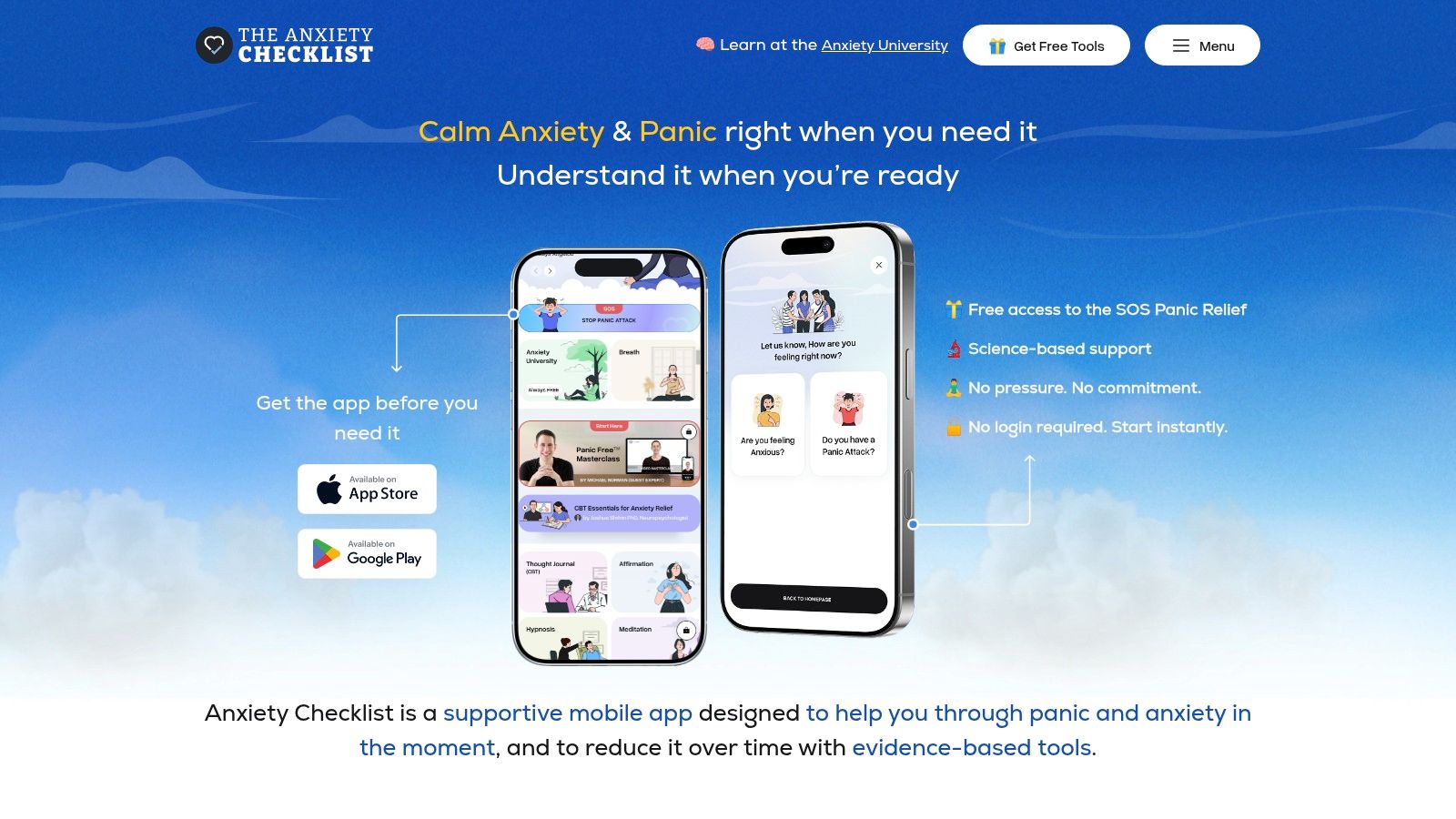
The Anxiety Checklist app fits the criteria discussed here in a straightforward way. It offers an always-free SOS mode for immediate grounding and affirmations, daily tools such as hypnosis, sleep audios, guided meditations, walking sessions, and affirmations, plus deeper CBT self-therapy tools and expert-led education, including a CBT introduction by Dr. Joshua Shifrin, PhD, and the PanicFree Masterclass by Michael Norman.
If you're ready to try a structured approach, visit The Anxiety Checklist and see how a self help app can support you in the moment panic starts and in the quiet work that follows. Start with the free SOS tools, then explore the daily practices that help relief compound over time.