



Your chest tightens. Your heart starts hammering. You feel that jolt of alarm rush through your body before your mind can even catch up.
Maybe it happens when your plane hits turbulence. Maybe it happens when you spot a spider in the corner. Maybe it happens when you only think about getting trapped in an elevator, speaking in public, or being far from home if panic strikes.
In that moment, a common question arises, expressed in different words. “What’s wrong with me?” “Why is my body reacting like this?” “Is this normal fear, or is it something more?”
That question matters. Not because you need a label, but because the answer changes the path forward. If you’re dealing with ordinary fear, your nervous system may settle once the danger passes. If you’re dealing with a phobia, the pattern usually won’t resolve just because you tell yourself to calm down.
Knowing what is the difference between fear and phobia is often the first real turning point in recovery. It replaces confusion with clarity. And clarity gives you options.
Your Heart Is Pounding Is It Fear or a Phobia?
You’re walking home and hear footsteps behind you on a dark street. Your body goes on high alert. That surge makes sense. Your mind scans for danger, your muscles tense, and your body prepares to protect you.
Now consider a different moment. You see a photo of a harmless house spider on your phone and feel the same flood of panic. Or you spend days dreading a future elevator ride, even though you know elevators are used safely by people around you every day. The body reaction can feel similar, but the meaning is not the same.
That’s where people get stuck. They assume that if the body response is intense, the danger must be real. But intensity alone doesn’t tell the whole story.
According to Boston Neurobehavioral Associates on fear versus phobia, the core difference is proportionality. Fear is generally proportionate to an actual threat. A phobia is wildly out of proportion to the genuine danger and often starts interfering with daily life.
Practical rule: Ask not only “What am I feeling?” but “Does this reaction fit the actual level of danger?”
If you live abroad or travel often, this can get even more confusing. Panic symptoms can flare in unfamiliar places, and people may struggle to tell whether they’re responding to stress, fear, or a phobic pattern. Resources like THERAPSY for expat wellbeing can help people make sense of intense anxiety in that context.
Some readers also notice that the fear isn’t only about spiders, planes, or elevators. Sometimes the deepest fear is the sensation itself. If that sounds familiar, learning what is phobophobia can be eye-opening.
The good news is simple. Once you know what you’re dealing with, healing stops being random. You can choose a response that matches the problem.
Understanding Fear Your Body's Natural Alarm System
Fear is not your enemy. Fear is your body’s built-in alarm.
Consider a smoke alarm in your home. When there’s real smoke, you want that alarm to go off. It grabs your attention, mobilizes your body, and helps you act fast. Fear does the same thing. It prepares you to move, protect yourself, and survive.
What healthy fear does
Fear usually has three features.
- It responds to a real threat. If a dog is growling and charging, fear is appropriate.
- It helps you act. You move away, call for help, or get to safety.
- It fades when the danger ends. Once the threat is gone, your body gradually settles.
A good example is turbulence during a rough flight. Many people feel anxious when the plane jolts. Their stomach drops, their palms sweat, and they grip the armrest. That reaction is unpleasant, but it still fits the moment. Once the plane lands safely, the fear typically eases.
Why fear feels so physical
People often think fear is “all in the mind.” It isn’t. Fear lives in the body too.
Your breathing may get shallow. Your pulse may jump. Your attention narrows. That doesn’t automatically mean something is wrong. It means your system is trying to protect you.
Fear says, “Pay attention. Something may need action right now.”
The key is that healthy fear is usually temporary and threat-based. It’s tied to something concrete, and it tends to loosen its grip after the situation passes.
When fear is uncomfortable but still normal
A lot of readers worry because their fear feels messy. Maybe they cry. Maybe they freeze. Maybe they feel embarrassed afterward. None of that automatically makes it a phobia.
Normal fear can still be intense. The difference is that it doesn’t usually reorganize your life around avoidance.
If you want to build a clearer understanding of how anxiety reactions work in general, Anxiety Checklist Anxiety University offers a helpful learning starting point.
Fear isn’t proof that you’re broken. Often, it’s proof that your protection system is working exactly as designed.
When Fear Becomes a Phobia The Four Key Differences
A phobia is what happens when the smoke alarm becomes too sensitive. Instead of responding only to fire, it goes off for burnt toast, steam from the shower, or sometimes just the thought that smoke might appear.
That’s why phobias can feel so frustrating. Many people with a phobia know their reaction doesn’t make logical sense. But insight alone doesn’t switch the alarm off.
According to the National Institute of Mental Health statistics on specific phobia, 12.5% of U.S. adults meet criteria for specific phobia at some point in life. In the past year, 9.1% of U.S. adults experienced specific phobia, including 12.2% of females and 5.8% of males. The same source notes that people diagnosed with specific phobias often have multiple phobias at once, with an average of at least three.
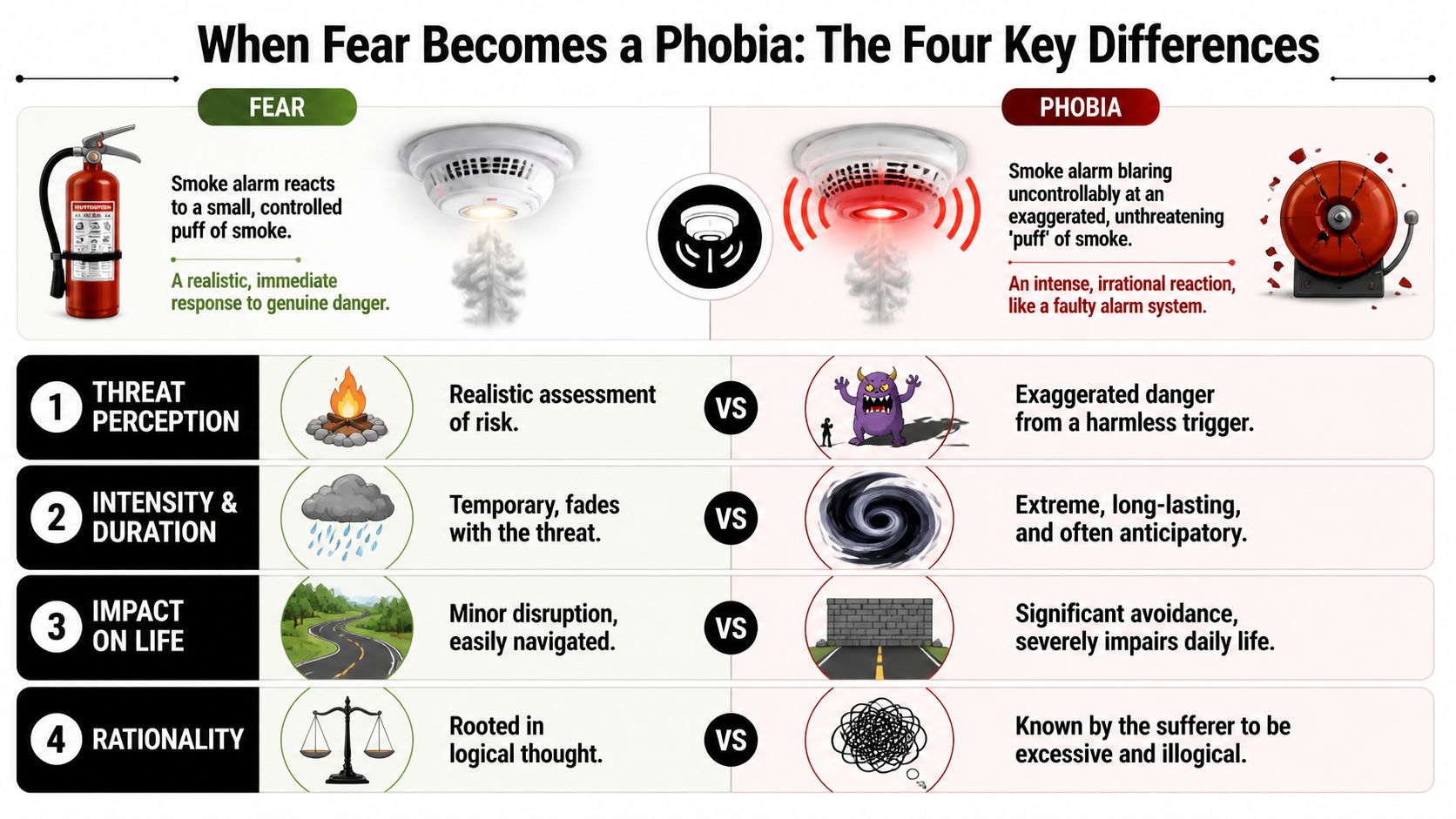
Fear vs Phobia at a glance
| Characteristic | Fear | Phobia |
|---|---|---|
| Threat perception | Matches a real or plausible danger | Greatly exaggerates danger or reacts to a low-risk trigger |
| Intensity | Strong but understandable | Extreme, often overwhelming |
| Duration | Usually settles when danger passes | Persists over time and may appear long before exposure |
| Impact on life | Encourages caution | Drives avoidance and limits daily life |
The first difference is proportionality
Fear fits the facts of the situation. If a ladder feels shaky, caution makes sense.
A phobia goes far beyond caution. A person may feel panic looking out from a secure balcony, seeing a picture of a needle, or thinking about entering a room with a closed door. The reaction is not just strong. It doesn’t match the actual level of danger.
The second difference is persistence
Fear is usually short-lived. A phobia stays.
Some people feel anxious weeks before a flight. Others replay the feared situation over and over in their minds, even when nothing dangerous is happening. The threat lives in anticipation, not only in direct contact.
The third difference is the trigger itself
Fear is tied to something your brain can reasonably classify as threatening.
Phobias can attach to situations, animals, medical procedures, heights, enclosed spaces, storms, or many other cues that are not dangerous in the way the body is reacting to them. The trigger may be real, but the danger signal is miscalibrated.
The fourth difference is life disruption
This is often the clearest sign.
A person with fear may dislike something yet still do it when needed. A person with a phobia starts organizing life around escape and avoidance. They take the stairs to avoid elevators. They skip vacations to avoid flying. They delay medical care because of needles. They say no to opportunities they want.
A useful question is this: “Is this response protecting my life, or shrinking it?”
That distinction is painful, but it also provides a way forward. If fear has become a phobia, you’re not failing. You’re dealing with a treatable pattern.
A Look at Common Phobias and Their Impact
Phobias often look ordinary from the outside. Someone says, “I just don’t like flying,” or “I’m not a fan of needles.” But inside, the experience can be intense enough to shape major life choices.

Situational phobias
These include things like elevators, flying, tunnels, or enclosed spaces.
One person might turn down a promotion because the new office is on a high floor and the elevator feels unbearable. Another may miss a family event because air travel triggers days of dread and panic.
Animal phobias
Spiders, snakes, dogs, or insects are common examples.
For some people, the issue isn’t just the moment of seeing the animal. It’s the constant scanning. They avoid garages, parks, basements, hiking trails, or even certain movies because they might encounter the feared animal.
Natural environment phobias
Heights, water, storms, and similar triggers often fall here.
A person with a height phobia may avoid scenic viewpoints, glass elevators, bridges, or upper hotel floors. Someone with a water-related phobia may skip beach trips, boat outings, or swimming lessons with their children.
Blood injection injury phobias
This category can affect medical care in a direct way.
A person may postpone blood tests, dental work, vaccinations, or needed treatment because the fear becomes overwhelming long before the appointment.
When avoidance starts making decisions for you, the phobia is no longer a private fear. It has become a quality-of-life issue.
If you want to see a broader range of named phobias and how they’re categorized, The Anxiety Checklist phobias can help put language to experiences that often feel isolating.
The common thread isn’t just fear. It’s cost. Lost freedom, delayed care, smaller plans, and a life negotiated around the next escape route.
Exploring the Roots Why Phobias Develop
People often blame themselves for having a phobia. They call themselves weak, dramatic, irrational, or broken.
That story usually isn’t true.
Phobias develop through a mix of biology, learning, and life experience. For many people, there isn’t one single cause. There’s a pattern that formed over time, then got reinforced.

According to the Los Angeles County Department of Mental Health overview of phobias, 19.3% of U.S. adolescents aged 13 to 18 experience a specific phobia in their lifetime. The same source notes that phobias are the most common psychiatric illness among women of all ages and the second most common among men older than 25.
Three common roots
- Biology and temperament matter. Some people are born with a more sensitive threat-detection system. Their nervous system reacts faster and settles more slowly.
- Experience shapes fear learning. A frightening event, a period of high stress, or repeated messages that something is dangerous can strengthen alarm responses.
- Thinking patterns keep the cycle going. Catastrophic predictions, body vigilance, and repetitive mental rehearsal can make the feared situation feel more dangerous than it is.
A lot of readers also notice that their mind keeps looping worst-case scenarios long after the trigger is gone. If that sounds familiar, overthinking anxiety explained can help connect the dots.
Why two people respond differently
Two people can go through similar events and end up in very different places. One develops a phobia. The other doesn’t.
That doesn’t mean one person is stronger. It usually means their brain, stress history, learned associations, and anxiety sensitivity are different. Some people are more likely to fear the trigger itself. Others become frightened of their own fear response and then start avoiding anything that might activate it.
Self-blame makes recovery harder. Curiosity makes it easier. When you understand that a phobia has roots, you can begin to untangle it with skill instead of shame.
Getting a Diagnosis and Knowing When to Seek Help
A diagnosis isn’t a life sentence. It’s a way to name what’s happening so you can respond with precision.
Many people delay help because they think, “It’s not bad enough,” or “I should be able to handle this on my own.” But the better question is whether the fear is controlling choices you want to be making freely.
According to High Focus Centers on the difference between fear and phobia, a key DSM-5 criterion is persistence. For a phobia, the fear, anxiety, or avoidance is typically present for six months or more. That timeline helps separate a clinical phobia from a short-term fear response.
Questions worth asking yourself
- Am I avoiding something important? This might be travel, medical appointments, work tasks, school, dating, or social events.
- Do I spend a lot of time anticipating the feared situation? Sometimes the dread before the event causes more suffering than the event itself.
- Do I know the reaction is excessive, but still feel unable to stop it? That gap between logic and body response is common with phobias.
- Has this pattern lasted a long time? Brief stress spikes happen. Entrenched avoidance is different.
- Is my life getting smaller? This is one of the clearest signs that support would help.
What a professional may look for
A clinician will usually listen for a few themes rather than judging you by one dramatic moment.
Specific trigger pattern
The fear reliably shows up around a particular object or situation.Immediate anxiety response
The trigger causes strong distress, panic symptoms, or urgent avoidance.Disruption
Your routines, opportunities, or relationships are being shaped by the fear.
Seeking help doesn’t mean your fear “won.” It means you’ve stopped asking suffering to prove itself before it deserves care.
If you answer yes to several of those questions, it may be time to talk with a mental health professional. Clarity can bring relief. Once the pattern has a name, treatment gets more straightforward.
Your Path to Healing Evidence-Based Treatments and Tools
The most hopeful truth in this whole conversation is that phobias are treatable. People do get better. They don’t always do it in one dramatic leap, but they do recover by retraining the fear system step by step.

According to the NIMH information on phobias and phobia-related disorders, people differ in how they process threat, and factors such as genetic predisposition, early trauma, and anxiety sensitivity can influence whether fear becomes persistent. That’s why treatment often works best when it’s personalized rather than rigid.
What effective treatment often includes
Exposure-based work helps the brain learn a new message. The feared object or situation is approached gradually and safely, so the nervous system gets repeated evidence that the predicted catastrophe doesn’t occur.
Cognitive work targets the thoughts that fuel fear. People learn to notice overestimation of danger, underestimation of coping, and the habit of catastrophic prediction. If you want a clear plain-language overview, this guide to cognitive behavioral therapy for anxiety is a useful place to start.
Body-based regulation skills can help people stay present long enough to learn. Slow breathing, grounding, and nervous-system regulation don’t cure a phobia by themselves, but they can support the process.
Why avoidance keeps the problem going
Avoidance brings short-term relief, which is why it becomes so sticky.
If you skip the flight, leave the room, or cancel the appointment, your body calms down. The brain then concludes, “Good thing we escaped.” That lesson strengthens the fear. Recovery works in the opposite direction. It teaches, through experience, “I can feel this and still be safe.”
For readers who want a practical explanation of this process, overcoming panic using exposure therapy shows how gradual exposure can reduce fear without forcing reckless leaps.
A short visual explainer can also make the process feel less mysterious:
What healing often looks like in real life
Healing rarely means “I never feel fear again.” It usually means something better.
- You stop building your life around escape.
- You can feel adrenaline without assuming disaster.
- You make choices based on values, not panic.
That’s how people become able to book the trip, attend the appointment, ride the elevator, or walk past the dog park without their world collapsing inward. Recovery is not about becoming fearless in the literal sense. It’s about becoming free.
Living Fearlessly Beyond Fear and Phobia
Fear and phobia can feel similar in the body, but they lead to very different paths. Fear protects you in real danger. A phobia keeps sounding the alarm when the danger isn’t proportionate, and life starts narrowing around avoidance.
Once you understand that difference, you’re no longer trapped in confusion. You can seek the right kind of help, practice the right tools, and stop blaming yourself for a pattern that can be treated.
Healing begins with recognition. Then comes action. And from there, many people build something they once thought was out of reach: a life guided more by choice than by panic.
If you want a practical next step, The Anxiety Checklist gives you a structured way to track triggers, spot anxiety patterns, challenge fearful thinking, and build a recovery plan you can follow. It’s a useful tool if you’re ready to move from “What is happening to me?” to “Here’s how I start getting better.”