


Some months, the panic seems to arrive with a pattern you can’t ignore.
Your chest tightens in the grocery store. Your thoughts start sprinting. You feel unreal, shaky, hot, terrified. Then later, when you look at the calendar, you notice it again. Your period is due in a few days. After a while, that timing can make you question everything. Is this hormones? Is it anxiety? Is something wrong with me?
Nothing is wrong with you. What you’re feeling is real, and for many people, panic attacks during menstruation or in the days leading up to it are part of a recognizable mind-body pattern. The good news is that patterns can be understood. Once you understand them, they stop feeling so random. And when panic stops feeling random, it also starts to lose some of its power.
That Feeling Isn't Just in Your Head
If you’ve ever been told you’re “just emotional” before your period, that kind of comment can make panic feel even lonelier. You’re already scared by what your body is doing. Then someone dismisses it as overreacting.
That dismissal misses the point. There are real biological shifts happening across the menstrual cycle, and for some people those shifts can make the nervous system more reactive. That doesn’t mean every anxious feeling is caused by hormones. It means your body may be giving you a clue worth listening to.

A UVA Health report on premenstrual anxiety and mood symptoms found that over 64% of women reported mood swings or anxiety with every menstrual cycle, and 28.61% said premenstrual symptoms interfered with daily life every cycle while 34.84% said they were sometimes impacted. That tells you something important. This isn’t rare, and it isn’t trivial.
Why validation matters
When panic shows up around your cycle, your brain often adds a second layer of fear:
- “I’m losing control.” The sudden body sensations feel dangerous.
- “Why does this keep happening now?” The timing can feel mysterious.
- “Maybe I’m imagining this.” Dismissive messages from others feed self-doubt.
That last one can be especially painful. Panic already makes you question your body. You don’t need shame piled on top.
Panic tied to your cycle is still panic. It deserves the same seriousness, care, and support as panic at any other time.
There’s hope here. If your symptoms cluster around certain days, that pattern can become useful information instead of a sentence you dread every month. You can learn about anxiety and panic attacks in a broader way, but the key for cycle-related panic is this: understanding the pattern is often the first real step toward changing it.
What healing can look like
Healing doesn’t always start with making panic vanish overnight. Often it starts with a quieter shift. You stop seeing yourself as broken and start seeing yourself as someone with a sensitive system that needs better support.
That’s a very different story. It leads to better questions, better tracking, better conversations with clinicians, and better choices in daily life. And yes, many people do reach a place where panic attacks during menstruation no longer control the month.
Understanding the Menstrual Panic Attack Connection
Your nervous system’s sensitivity can shift across the month. That shift can change how strongly you react to the same stressor, the same body sensation, or the same crowded grocery store.
That is one of the clearest ways to understand panic around your cycle.
A panic attack is your body’s alarm system firing fast. Your heart pounds. Your breathing changes. Your stomach drops. Your mind races to explain the surge. If that happens more often in the same part of your cycle, the goal is not to shrug and say, “Hormones.” The goal is to separate hormonally triggered panic from general anxiety so you can track the pattern and respond with more precision.
When hormones change the background conditions
Hormones do not write every anxious thought. They can, however, change the background conditions your brain and body are working in.
Weather is a useful comparison here. A dry day and a stormy day can involve the same road, the same driver, and the same car. But the drive feels very different. In the same way, a normal work stressor or a harmless body sensation may feel manageable during one phase of your cycle and much more threatening during another.
That does not mean the panic is “all hormonal.” It means hormones may lower the threshold at which your system reacts.
For many people, that looks like this:
- Body sensations grab your attention faster
- Stress that usually feels tolerable feels crowded and sharp
- Fatigue, cramps, nausea, poor sleep, or blood sugar dips leave less room to self-soothe
- A small sensation turns into a scary interpretation within seconds
That last step is often the turning point. A flutter becomes “Something is wrong with my heart.” Lightheadedness becomes “I’m about to pass out.” Once the brain labels the sensation as dangerous, the alarm ramps up.
Why this can feel different from general anxiety
General anxiety often acts like a steady hum in the background. Cycle-related panic often has a time stamp. You may notice a cluster of symptoms in the same few days each month, especially when physical symptoms are already louder.
That pattern gives you something useful to work with.
If your panic spikes before or during your period, ask a more specific question than “Why am I anxious again?” Ask, “Is this a full-month anxiety pattern, or a cycle-linked spike with extra physical triggers?” That question helps you build a better map. Over time, you may notice that panic appears when several factors stack together: a certain cycle phase, poor sleep, skipped meals, pelvic pain, conflict, caffeine, or health anxiety.
This is how tracking becomes practical, not obsessive. You are looking for repeatable conditions, not trying to control every variable.
Panic about panic
There is also a second loop that can keep the problem going. After one frightening episode, you start scanning for the next one. Then normal sensations feel louder. Then fear rises sooner. Then the body produces more sensations for the mind to monitor.
That pattern is common, and learning about the phobophobia and panic attack cycle can help you spot it earlier. Once you can name the loop, you are less likely to treat every sensation as proof that something terrible is starting.
A simple check-in can interrupt that spiral: “What am I feeling?” and “What story am I attaching to it?” The sensation is one thing. The interpretation is another.
A more useful way to frame control
Hormones can make your system more reactive, but they are rarely the whole picture. They set the stage. Sleep, stress, pain, food intake, caffeine, conflict, and fear of bodily sensations can still shape what happens next.
Making that distinction opens the door to real control. Instead of assuming your period causes panic out of nowhere, you can start collecting clues. What day of your cycle were you on? What had you eaten? How did you sleep? Were cramps, bloating, or dizziness already making your body feel unfamiliar? Did panic follow a physical symptom first, or an anxious thought first?
That kind of tracking helps you tell the difference between a hormonally amplified alarm and anxiety that is running all month long. Both deserve care. They just respond best to slightly different plans.
If low progesterone is part of the picture for you, the Venus Health blog on low progesterone gives a helpful overview of symptoms people sometimes notice alongside cycle-related mood changes.
The Science Behind Why Your Cycle Triggers Panic
A lot of people notice a confusing pattern. Panic feels sharper on certain days of the month, then eases enough that they start doubting themselves. That pattern has a biological explanation.
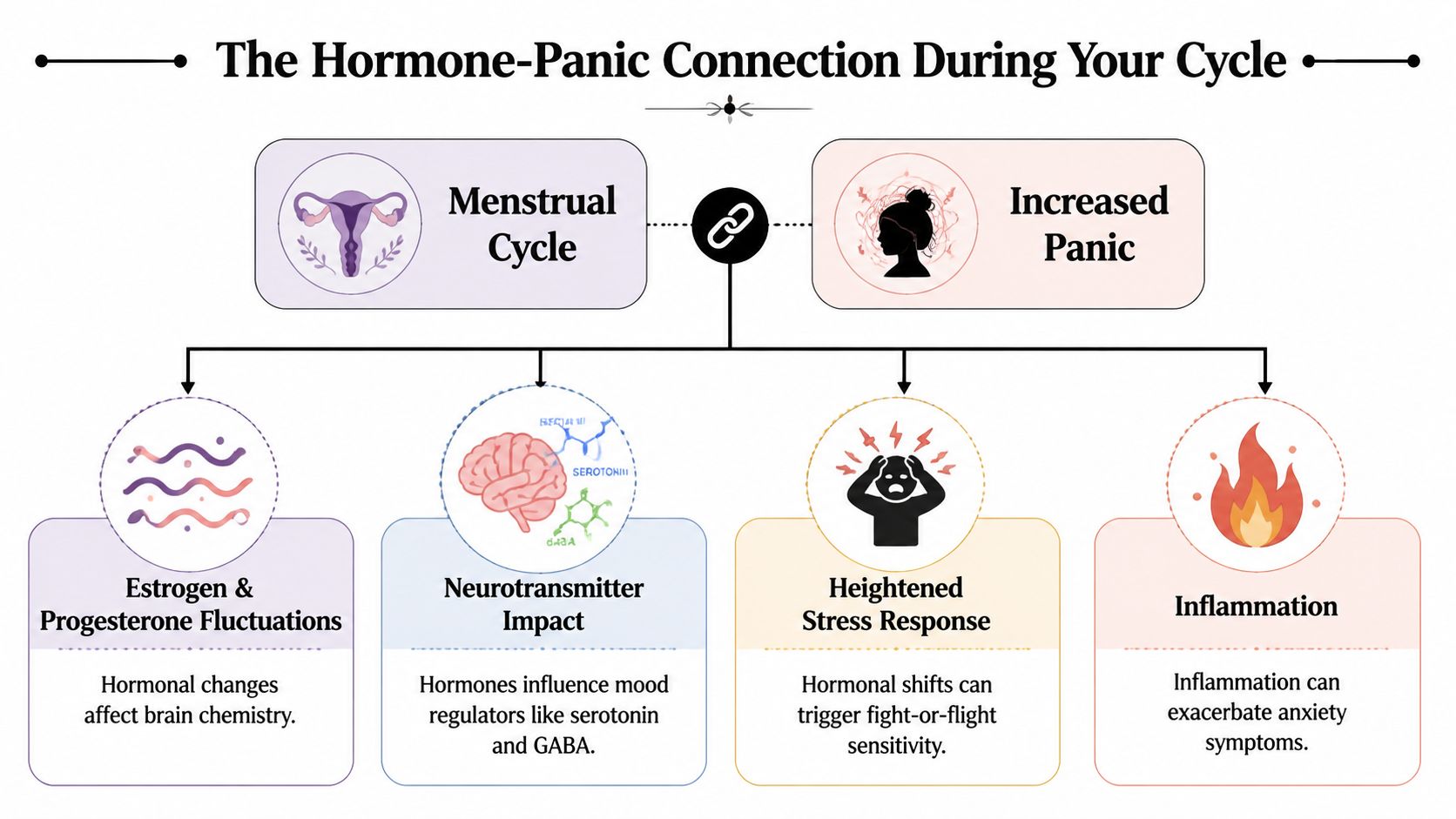
Across the menstrual cycle, estrogen and progesterone rise and fall in a repeating rhythm. If your nervous system is already sensitive to stress, body sensations, or sleep disruption, those shifts can act like a dimmer switch on your alarm system. The danger is not suddenly higher. Your body’s threshold for sounding the alarm may be lower.
Researchers have tracked this for years. In a review of panic disorder and the menstrual cycle, women with panic disorder reported more frequent and more severe panic symptoms during the premenstrual phase. Daily diary studies in that review also found that anxiety and panic often rise in the 5 to 8 days before menses.
The hormonal orchestra
Hormones do more than regulate reproduction. They also affect brain systems involved in calm, alertness, and emotional steadiness.
An orchestra works as a useful comparison. When the timing is steady, the music feels organized. When key instruments change volume all at once, the whole piece feels different. In the late luteal phase, right before bleeding starts, estrogen and progesterone drop. For some people, that shift makes the nervous system more reactive to sensations that would usually stay in the background.
You might notice:
- More internal shakiness
- More irritability, dread, or tension
- Lighter, more broken sleep
- A stronger reaction to normal body sensations such as a racing heart, bloating, dizziness, or warmth
That pattern does not mean hormones fully explain every panic attack. It suggests they can lower the margin between “I noticed a sensation” and “my body just hit the panic button.”
Why brain chemistry can feel less steady before your period
Estrogen and progesterone interact with neurotransmitters involved in mood and stress regulation, including serotonin. When those hormones shift quickly, some people feel as if their emotional shock absorbers have thinned out. Small stressors hit harder. Ordinary physical sensations feel louder.
Progesterone also matters because its byproducts are connected to calming brain pathways. When progesterone falls before menstruation, some people feel less buffered and more physically on edge. If you want a simple overview of how low levels may show up physically and emotionally, this Venus Health blog on low progesterone is a practical companion read.
That helps explain why hormonally triggered panic can feel sudden. The body is reacting faster, and the mind scrambles to explain the reaction after it begins.
A quick map of the cycle
Here’s a simple month-at-a-glance guide.
| Phase (Approx. Days) | Key Hormonal Event | Potential Impact on Anxiety |
|---|---|---|
| Menstrual phase | Bleeding begins, hormone levels are low | Some people feel relief, while others feel physically depleted and more stress-sensitive |
| Follicular phase | Estrogen rises gradually | Energy and emotional steadiness may improve for some |
| Ovulatory phase | Hormonal activity peaks around ovulation | Some feel more resilient, while others become more aware of body changes |
| Luteal phase | Progesterone rises, then estrogen and progesterone fall before menses | Panic, dread, irritability, and body sensitivity may intensify for some people |
Use this table as a map, not a verdict. A map helps you ask better questions. Did the panic show up mainly in the late luteal phase? Did it happen after poor sleep, severe cramps, skipped meals, or extra caffeine? That is how you begin separating hormonally amplified panic from anxiety that runs all month.
If you want a simple place to organize those clues, these panic and anxiety relief tools can help you track symptoms, timing, and patterns in a more structured way.
When symptoms may point toward PMDD
For some people, the premenstrual shift is much more intense. PMDD is one clinical pattern where mood symptoms before menstruation can become severe and can include panic, despair, or extreme irritability.
The existence of PMDD reminds us that severe premenstrual mental health symptoms are not a character flaw. They are a real pattern that deserves care. If your panic reliably surges before your period and eases after bleeding starts, write that down. A repeatable pattern gives you and your clinician something concrete to work with.
Why this section can give you more control
Confusion grows when every bad day gets lumped into one category. General anxiety, panic disorder, health anxiety, sleep deprivation, pain stress, and hormone sensitivity can overlap, but they do not always behave the same way.
A better approach is to look for the sequence.
- Timing. What day of your cycle was it?
- Body cues. Were cramps, bloating, breast tenderness, dizziness, or insomnia already present?
- Spark. Did panic begin after a body sensation, or after a thought spiral?
- Pattern. Does it cluster in the same window each month, or show up randomly?
That sequence turns panic into something you can study instead of just fear. Over time, you may see that your cycle sets the stage, while sleep loss, under-eating, caffeine, conflict, or fear of bodily sensations determine whether the alarm goes off.
Your First Aid Kit for In-the-Moment Panic
When a panic attack hits, your job is not to win an argument with fear. Your job is to help your body come down from alarm. Think of this as first aid, not perfection.
The most useful tools are simple enough to use when your thinking brain feels foggy.
Step one is to stop adding danger
Panic feels urgent, so individuals may accidentally pour fuel on it. They scan their body, search symptoms online, pace, ask for repeated reassurance, or mentally shout “not now.”
Try a different first move. Pause and label what’s happening.
This is panic. It feels intense, but my body is sounding a false alarm.
That sentence matters because it separates discomfort from danger. You don’t need to like the sensations. You just need to stop treating them like proof of catastrophe.
Grounding when your mind is spiraling
Use the 5-4-3-2-1 method when thoughts are racing.
- 5 things you can see. Name them slowly. Blue curtain. White mug. Lamp. Carpet. Window.
- 4 things you can feel. Chair under legs. Shirt on shoulders. Feet in socks. Air on skin.
- 3 things you can hear. Fan. Distant traffic. Refrigerator hum.
- 2 things you can smell. Soap. Coffee.
- 1 thing you can taste. Water, gum, mint, or the taste in your mouth.
This helps because panic pulls you into imagined disaster. Grounding brings you back into the room you’re in.
Breathe in a way that reduces alarm
Many people try to take huge “calming” breaths during panic. That can make them feel more dizzy or air hungry. Softer is better.
Try box breathing:
- Inhale gently.
- Hold briefly.
- Exhale gently.
- Hold briefly.
Keep the breath comfortable. The point isn’t to force relaxation. The point is to give your nervous system a steadier rhythm to follow.
If you want extra structure in daily practice, many people also use panic and anxiety relief tools as part of a broader routine so these skills feel more familiar when they’re needed most.
Rename the sensations
Panic gets louder when every symptom gets translated into threat. A powerful skill is to describe sensations in plain language, without the scary story.
Instead of this:
- “I’m going to pass out.”
- “I’m having a heart problem.”
- “I’m losing my mind.”
Try this:
- “My body feels lightheaded.”
- “My heart is beating fast because adrenaline is active.”
- “My thoughts are loud because I’m scared.”
That shift sounds small, but it changes the entire tone of the episode. You move from catastrophe to observation.
Here’s a short guided practice to keep handy when panic starts climbing:
Give your body one job
During panic, too many instructions can feel overwhelming. Pick one action and repeat it.
Examples:
- Sip cold water.
- Press both feet into the floor.
- Hold a warm mug.
- Walk slowly from one wall to the other and back.
- Place one hand on chest and one on abdomen.
These aren’t magic tricks. They’re anchors. They tell your body, “We are here. We are not running. We can stay.”
What helps and what usually backfires
A quick comparison can save you a lot of frustration.
| Often helps | Often backfires |
|---|---|
| Naming panic clearly | Arguing with every thought |
| Gentle breathing | Gasping for “deep” air |
| Grounding in the room | Frantic symptom checking |
| Soft movement | Sudden escape at all costs |
| Simple self-talk | Reassurance loops that never feel enough |
If one technique doesn’t work instantly, that doesn’t mean you failed. Panic rises and falls like a wave. Your tools help you ride it without adding another wave on top.
Building Long-Term Resilience to Hormonal Panic
Short-term tools matter. But if you want fewer attacks, less dread, and more trust in your body, the long game is where things change most.
That long game starts with one uncomfortable truth. Memory is not a reliable symptom tracker.
A Psychiatric Times discussion of menstrual cyclicity and anxiety points to a real gap between retrospective memory and prospective tracking. Many women report more premenstrual panic when looking back, but some prospective studies don’t confirm the same pattern. In plain language, memory can blur the picture. Objective, daily tracking is the best way to find out whether your panic attacks during menstruation are linked to your cycle or whether other triggers are playing a bigger role.

Track like a scientist, not a critic
Initial tracking efforts are often imperfect. They only write on terrible days. Or they jot “anxious” and nothing else. Or they wait until the end of the month and try to reconstruct what happened.
A better approach is brief, daily, and boring. That’s what makes it useful.
Record:
- Cycle day and whether bleeding has started
- Panic symptoms and what time they hit
- Sleep quality
- Meals and long gaps without eating
- Caffeine, alcohol, and pain
- Stressors like conflict, work overload, travel, or poor sleep
- What helped and what didn’t
After a couple of cycles, patterns often become clearer. You may find the panic really does cluster before menstruation. Or you may notice the bigger factor is skipped meals, insomnia, conflict, or the days when you start fearing symptoms in advance.
Questions to ask your data
A simple symptom log becomes much more powerful when you ask the right questions.
Does the panic follow the same days?
If your attacks reliably intensify in the same premenstrual window, that suggests hormonal timing may be part of the story.
Does it happen only with other stressors?
Maybe the panic appears before your period only when you’re also underfed, underslept, over-caffeinated, or overloaded. That doesn’t make it “less real.” It offers valuable insight.
Does the fear start before the symptoms?
Sometimes the pattern is not “hormones cause panic,” but “I expect panic this week, then I react to every sensation.” That’s still workable. It just points to anticipatory anxiety as a key target.
Data reduces dread because it replaces guesswork with observation.
The daily habits that build a buffer
You can’t eliminate every hormone shift. You can make your nervous system less fragile.
Stabilize blood sugar
If you go long stretches without eating, the body can produce sensations that mimic panic. Shakiness, weakness, nausea, and heart pounding become much easier to misread when your system is already sensitive.
Try making premenstrual days simpler. Eat regularly. Build meals around protein, fiber, and steady energy rather than relying on sugar and caffeine to drag yourself through.
Protect sleep like treatment
Poor sleep narrows your window of tolerance fast. It makes body sensations louder, emotions sharper, and catastrophic thinking easier.
A useful rule is to create a repeatable wind-down, not a perfect one. Dim lights. Reduce doom-scrolling. Keep a notepad nearby if your brain starts listing worries at night.
Move in a way your body can trust
You don’t need punishing workouts to reduce stress reactivity. Gentle consistency often works better than intensity when panic is in the mix.
Walking, stretching, yoga, light strength work, or relaxed cycling can help your body relearn that increased heart rate and body sensations aren’t automatically dangerous. That’s especially helpful if panic has made you avoid movement.
Build skills between attacks
Acute panic is not the best time to learn a new skill. Practice when you’re calm enough to absorb it.
That’s where structured learning can help. If you’re trying to understand thought patterns, behavior loops, and fear conditioning in more detail, The Anxiety Checklist's CBT insights offer a useful overview of how thoughts, sensations, and avoidance keep anxiety going.
Skills worth practicing outside a panic episode
- Interoceptive tolerance. Learning not to fear normal body sensations.
- Thought labeling. Spotting “what if” spirals early.
- Response prevention. Cutting down repeated reassurance or symptom checking.
- Self-compassion. Reducing shame after a rough day.
When to bring in professional help
Tracking is powerful, but you don’t have to figure this out alone. If panic is disrupting work, relationships, sleep, driving, or your willingness to leave the house, bring your data to a clinician. An OB-GYN, primary care doctor, or mental health professional can help distinguish panic disorder, premenstrual exacerbation, PMDD, and other contributors.
That distinction matters. The right plan depends on what pattern you have, not the one fear guessed at.
A Guide for Partners How to Be Their Safe Harbor
If you love someone who gets panic attacks around their cycle, you may feel helpless or confused. You see them go from okay to terrified in minutes. You want to fix it. You also may say the wrong thing without meaning to.
Support works best when it feels steady, not controlling.
What panic looks like from the outside
A partner might look agitated, tearful, frozen, breathless, detached, or desperate to leave. They may ask, “Am I okay?” more than once. They may want you close, then suddenly want space.
That doesn’t mean they’re being dramatic. It usually means their body is in alarm mode and their thinking brain is temporarily less available.
Say this, not that
These small language shifts can change the whole moment.
- Instead of “Calm down”, try “I’m here. You’re safe. We can get through this minute by minute.”
- Instead of “It’s just your period”, try “I believe you. Your body is having a hard time right now.”
- Instead of “Why is this happening again?”, try “What would help most right now, quiet, water, sitting down, or a short walk?”
- Instead of rapid-fire questions, offer one simple choice at a time.
Your job isn’t to argue them out of panic. Your job is to become a calm reference point.
A simple support script
When in doubt, keep it short.
- Orient. “You’re with me at home.”
- Reassure without overexplaining. “This feels scary, but you’re not alone.”
- Anchor. “Can you press your feet into the floor with me?”
- Reduce stimulation. Lower noise, lights, and extra conversation.
- Stay predictable. Don’t panic because they’re panicking.
If they’ve already told you what helps, follow their plan. Some people want touch. Others don’t. Some want a reminder to breathe. Others prefer silence and presence.
How to help between episodes
Support isn’t only about the attack itself. It also includes the days around it.
You can help by:
- Respecting patterns. If certain cycle days are harder, plan with that in mind.
- Encouraging routines. Gentle meals, rest, and movement help more than lectures.
- Reducing shame. Don’t treat hard days like failure days.
- Joining healthy habits. A walk together is more helpful than a speech about self-care.
For some people, movement becomes scary because they associate an increased heart rate with panic. If your partner wants to rebuild confidence with exercise, resources on starting your gym journey can be useful because they address the fear of entering activating environments without making it feel overwhelming.
What not to do
A few common mistakes make panic worse:
- Don’t minimize it. Even if hormones are part of it, the fear is still real.
- Don’t take over completely. Help without sending the message that they can’t cope.
- Don’t force analysis mid-attack. Save detective work for later.
- Don’t keep chasing reassurance loops. Answer once, then return to grounding.
Some of the best support sounds almost plain. “I’m staying with you.” “Let’s sit.” “Feel your feet.” “This will pass.” That kind of steadiness becomes a bridge back to safety.
Your Path Forward to a Panic-Free Life
If panic attacks during menstruation have been running your month, it can feel like your body has become an enemy. But the deeper truth is kinder than that. Your body is not betraying you. It’s signaling sensitivity, stress, and a pattern that needs understanding.
That shift in perspective changes everything. Fear says, “This is random and unstoppable.” Healing says, “This has a pattern, and patterns can be worked with.”
What recovery usually looks like
Recovery is rarely one dramatic breakthrough. More often, it’s a series of smaller wins that start to add up.
You begin to notice the early signs sooner. You stop adding as much catastrophic meaning to sensations. You prepare for vulnerable days instead of dreading them blindly. You sleep a little better, eat more steadily, move without as much fear, and get clearer about which symptoms are cycle-linked and which are part of general anxiety.
That’s how control comes back. Not through force, but through clarity and repetition.
Severe symptoms can still improve
If your symptoms are intense, don’t assume that means you’re stuck. The Cleveland Clinic page on PMDD treatment and management notes that PMDD affects 3% to 8% of women and that targeted therapies, lifestyle adjustments, and prospective daily charting can lead to a 60% to 70% reduction in symptoms. That matters because PMDD includes the severe end of premenstrual anxiety. Even difficult cases can improve.
A hopeful way to frame the work
Try thinking of this process in three layers:
- Understand the pattern. Track what happens.
- Respond differently. Use panic first aid when symptoms rise.
- Strengthen the system. Build routines that make your nervous system less reactive.
That’s a real roadmap. It’s practical, and it gives you something better than blind endurance.
You do not need to trust every sensation. You need to learn which sensations deserve action and which ones need calm observation.
If you want to build on what you’ve learned here, studying effective anxiety management can help you turn insight into daily practice. The important thing is to keep going. A rough cycle doesn’t erase progress. One bad week doesn’t cancel all the healing your brain and body are learning.
A panic-free life may sound far away when you’re in the middle of symptoms. But many people get there by taking the next honest step, then the next one after that. Less confusion. Less fear of fear. More skill. More trust. More peace.
If you want a structured way to put this into action, The Anxiety Checklist can help you organize symptom tracking, notice patterns, and build a practical plan for reducing anxiety and panic over time.