


You may be sitting with a browser tab open for days, knowing you need help and still not making the call. Maybe you’ve rehearsed what you’d say, then gone blank. Maybe the thought of describing a panic attack makes your chest tighten before therapy has even started.
That fear is common. It also doesn’t mean you’re doing this wrong.
Learning how to talk to a therapist about anxiety isn’t a test of eloquence. It’s a skill. You don’t need a polished explanation. You need a starting point, a few usable words, and enough structure to help your therapist understand what anxiety is doing to your body, mind, and daily life.
Your Path to a Panic-Free Life Starts Here
A lot of people think the hardest part of therapy is the work that happens in session. Often, the hardest part comes earlier. It’s the moment you admit that anxiety has narrowed your life. It’s the moment you realize you’re planning around panic, avoiding situations, or staying quiet because you don’t want to fall apart in front of someone else.
That’s where many people get stuck. They tell themselves, “I’ll wait until I can explain it better.” Anxiety loves that bargain because it keeps you isolated.
There is real reason for hope. Anxiety disorders are the most common mental health issue in the United States, and about 75 to 80% of people who receive therapy experience improvement. People who rate their relationship with their therapist highly are 7 times more likely to succeed, which is exactly why open, honest communication matters so much, as summarized by these therapy and mental health statistics.
That changes the frame. Therapy is not a vague leap into the unknown. It’s a practical step that helps many people get better.
What hope looks like at the beginning
Hope rarely starts as confidence. More often, it starts as a small decision.
It sounds like this:
- “I don’t know how to say it, but I know I need help.”
- “I’m tired of organizing my life around panic.”
- “I want to stop feeling afraid of my own body.”
Those are enough.
You do not need to sound calm in order to begin healing.
If you want support outside the therapy room while you gather your thoughts, an anxiety self help platform can help you organize symptoms, patterns, and daily struggles before you ever say them out loud.
What does not work
People often try to make therapy easier by minimizing. They say, “I’m just stressed,” when they’re having panic symptoms. Or they give a tidy summary that leaves out the part that scares them most. That usually slows things down.
What works better is simple honesty. Not dramatic honesty. Specific honesty.
Examples:
- “I avoid places where I think I might panic.”
- “I feel embarrassed about how bad this feels.”
- “I’m scared I’ll freeze while trying to explain it.”
Those statements give a therapist something real to work with. And real is what starts changing things.
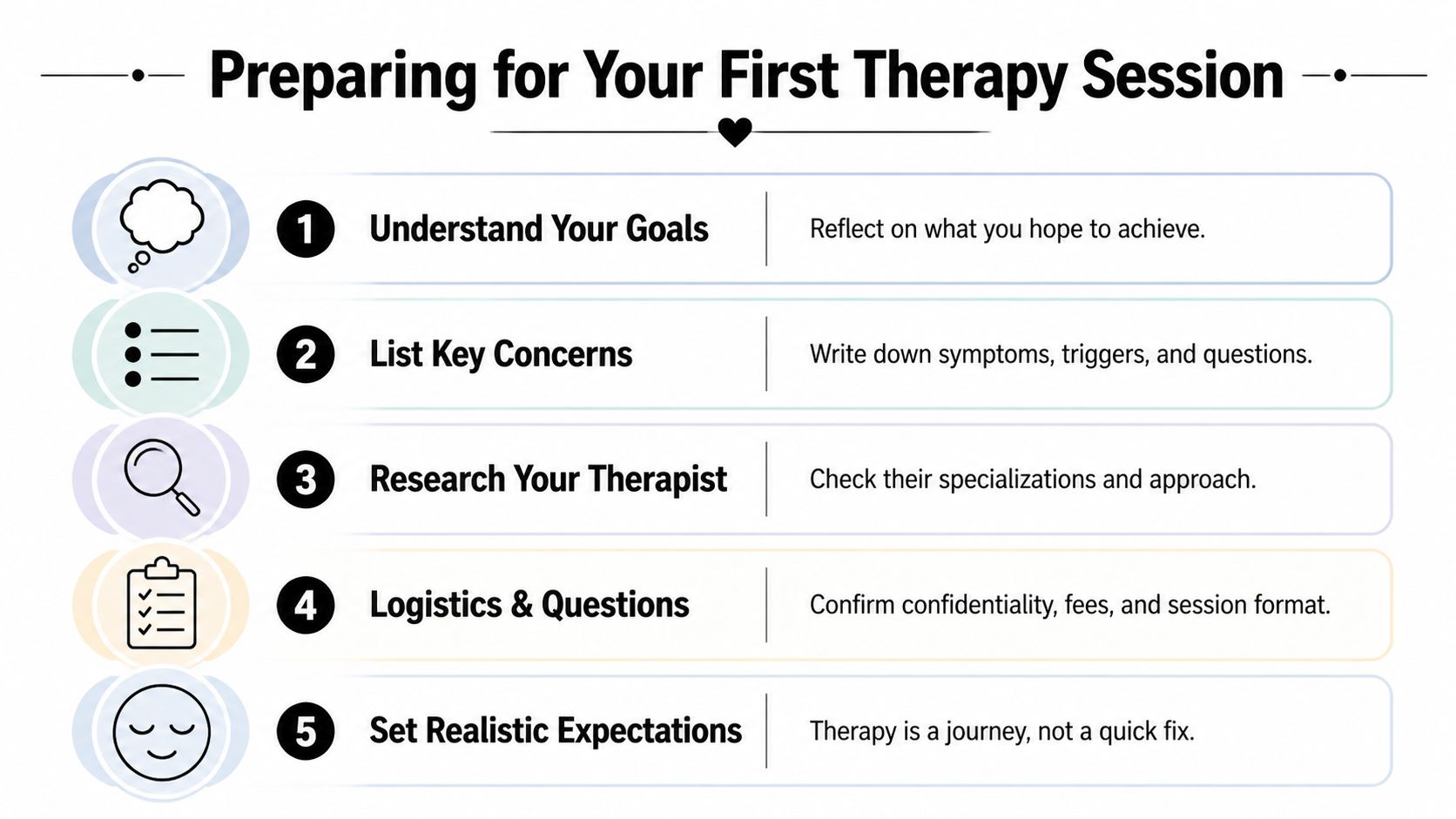
How to Prepare for Your First Therapy Session
Preparation helps because anxiety gets louder in vagueness. If you walk into a first session with only the sentence “I’m anxious,” your therapist can still help, but it takes longer to get clear. Specific details shorten that distance.
Therapeutic practice shows that effective treatment begins with specific communication across three dimensions: physical symptoms, emotional states, and cognitive patterns. That kind of detail helps therapists choose targeted approaches such as CBT or exposure therapy, as explained in this guide on how to talk to your therapist about anxiety.
Use the three-part symptom method
Start with a page in your notes app, a notebook, or a simple document. Divide it into three columns or three short lists.
| Dimension | What to write | Example prompts |
|---|---|---|
| Physical | What your body does when anxiety rises | racing heart, chest tightness, shaking, nausea |
| Emotional | What you feel emotionally | dread, irritability, overwhelm, numbness |
| Cognitive | What your mind says or does | catastrophic thinking, racing thoughts, worst-case scenarios |
This structure matters because people often over-focus on one layer. Some describe only thoughts. Others describe only body sensations. A therapist needs the fuller picture.
Write down recent examples, not your whole history
Don’t try to summarize your entire life before session one. That creates pressure and usually leads to mental gridlock. Instead, bring two or three recent situations that show what anxiety looks like for you.
You might note:
- Where it happened. At work, in a grocery store, driving, at night, during a phone call.
- What your body did. Sweating, dizziness, tight throat, shaky hands.
- What your mind said. “I’m going to lose control,” “I need to get out,” or “Something is wrong with me.”
- What you did next. Left early, texted someone, stayed home, canceled, pushed through.
That gives your therapist something concrete to assess.
Keep your prep short enough to use
Over-preparing can become another form of avoidance. You do not need a perfect dossier.
A useful first-session prep list is often just this:
- Your main reason for coming
- Your top symptoms
- A few common triggers
- What anxiety is stopping you from doing
- What you hope will change
Practical rule: Bring enough detail to get started, not so much detail that preparation becomes its own stressor.
If you want a structured place to deepen your understanding before the session, anxiety learning resources can help you sort symptoms, patterns, and coping ideas into language that’s easier to discuss with a clinician.
Questions worth bringing with you
Many people feel calmer when they know what they want to ask. Keep the questions plain.
Try these:
- “What approach do you usually use for anxiety?”
- “How do you help with panic symptoms?”
- “What should I do if I freeze during session?”
- “How will we know if therapy is helping?”
Good preparation doesn’t make you rigid. It makes you less alone with your thoughts.
Finding the Words to Describe Your Anxiety
Those experiencing anxiety don’t struggle because they have nothing to say. They struggle because anxiety is hard to translate. Internal chaos rarely arrives in neat sentences.
That’s why sentence starters help.

Anxiety counseling often follows a two-part rhythm. First, therapist and client identify triggers across environmental, situational, and temporal patterns. Then they build coping strategies that match those patterns, as described in this overview of talking to a therapist about anxiety. So your job is not to sound impressive. Your job is to give usable clues.
Starter scripts that make the first minutes easier
If you’ve ever thought, “I know what I feel, but I can’t explain it,” use these lines as scaffolding.
Try one of these openings:
- “My anxiety usually shows up in my body first.”
- “A panic attack for me feels like…”
- “The situations I avoid most are…”
- “The thought that keeps repeating is…”
- “The worst time of day for my anxiety is…”
- “When I get triggered, I usually…”
These aren’t scripted in a stiff way. They’re prompts that help you move from foggy distress to information a therapist can work with.
Say what happens before, during, and after
A strong therapy description has sequence. That often matters more than sounding insightful.
For example:
| Stage | What to tell your therapist |
|---|---|
| Before | what set it off, where you were, who was there |
| During | body sensations, thoughts, emotions, urges |
| After | how long it lasted, what you avoided, how drained you felt |
That simple sequence often reveals patterns you miss when you only describe the peak moment.
Examples that sound more like real life
Vague language slows treatment. Precise language helps.
Compare these:
Less useful: “I get anxious socially.”
More useful: “If I’m in a group, I start scanning for a way out, my face gets hot, and I worry I’ll say something strange.”
Less useful: “I panic sometimes.”
More useful: “My panic usually starts with a rush in my chest, then I feel like I can’t get enough air and need to leave.”
Less useful: “Work stresses me out.”
More useful: “My anxiety spikes before meetings, especially when I might be called on without warning.”
When people need help identifying feeling words beyond “stressed” or “bad,” resources on mastering emotions for stronger connections can make it easier to sort fear, shame, dread, irritability, sadness, and overwhelm into clearer language.
Here’s a brief video that can make the communication side of anxiety feel less abstract:
Tell the therapist what anxiety costs you
Symptoms matter. Impact matters just as much.
A therapist needs to know if anxiety is affecting:
- Daily functioning. Sleep, concentration, eating, commuting, errands.
- Relationships. Irritability, withdrawal, reassurance-seeking, conflict.
- Freedom. Avoiding travel, stores, social events, public places, phone calls.
- Self-trust. Fear of bodily sensations, fear of another panic episode, fear of being embarrassed.
“I’ve started planning my days around how to avoid feeling panicky” is a powerful sentence because it captures both symptoms and life impact.
If you’re still unsure how to label what you’re experiencing, a screening tool can help you understand your anxiety symptoms before you bring them into session.
If you cry, ramble, or lose your train of thought
That is still communication.
People often assume they must deliver a clean narrative. But a therapist can work with fragments, pauses, and rough descriptions. In fact, the places where you stumble often point directly to fear, shame, or overwhelm that deserve attention.
Useful fallback lines include:
- “I’m losing my train of thought, but this feels important.”
- “I know I’m explaining this poorly.”
- “This is hard to say out loud.”
- “I don’t have the exact words yet.”
Those are not failures. They are honest markers of where the work begins.
Navigating the Therapy Session When Anxiety Strikes
Sometimes the thing you fear happens in the room itself. Your heart pounds. Your mind blanks. You start monitoring your breathing instead of listening. You feel embarrassed that you’re anxious while talking about anxiety.
That experience has a name. Meta-anxiety is anxiety about discussing anxiety, and it can block people before treatment gets moving. A 2024 study found that pre-session exposure exercises reduced no-shows by 40%, and recent guidance recommends voicing fears directly with language such as, “My heart races thinking about describing my panic episodes,” as noted in this article on overcoming anxiety about therapy tips for your first session.

Say the immediate truth out loud
When anxiety spikes in session, many people try to hide it. That usually makes it worse.
Use direct lines like:
- “I’m getting anxious talking about this right now.”
- “I feel myself freezing up.”
- “My chest is tight and I’m struggling to focus.”
- “Part of me wants to shut down and change the subject.”
This gives the therapist a chance to slow the pace, ground you, and work with what is happening in real time instead of pushing past it.
Grounding cue: If speaking feels hard, even saying “I need a moment” is enough.
Try a brief pre-session exposure exercise
The point is not to feel perfectly calm before therapy. The point is to make the feared action less unfamiliar.
A practical version looks like this:
- Write the first sentence you’re afraid to say
- Read it out loud to yourself once or twice
- Notice the anxiety rise without escaping immediately
- Let your body settle
- Bring that same sentence into the session
Examples:
- “I’m afraid I’m going to panic while talking.”
- “I avoid places because I’m scared of losing control.”
- “I’m embarrassed by how intense this feels.”
That small rehearsal can reduce the shock of first disclosure.
Use grounding that is quiet and portable
You don’t need a dramatic technique. You need something you can use while seated in a therapy office or on a telehealth call.
A few good options:
- Feet on floor. Press both feet down and notice the support under you.
- Exhale longer than inhale. Keep it subtle. No forced breathing.
- Name three visible objects. Chair, window, lamp.
- Hold something textured. A ring, sleeve, tissue, or notebook edge.
For more practical in-the-moment tools, The Anxiety Checklist's grounding advice offers ideas you can adapt before and during sessions.
Ask about pace and process
Therapy works better when you collaborate instead of enduring on your own. If something feels too fast, too abstract, or not useful, say so.
You can ask:
| Situation | What to say |
|---|---|
| The topic feels overwhelming | “Can we slow this down?” |
| You don’t understand the method | “Can you explain why we’re focusing on this?” |
| A suggestion doesn’t fit | “I want to understand the idea, but that doesn’t feel workable for me yet.” |
| You feel lost | “What would be most useful for us to focus on today?” |
A good therapy relationship can tolerate honesty. In fact, honesty is part of what makes it effective.
What usually does not help in the moment
When anxiety hits during session, people often respond in predictable ways that seem protective but keep them stuck.
Common traps include:
- Performing calm instead of naming distress
- Talking in generalities to avoid the feared details
- Leaving out panic symptoms because they feel embarrassing
- Agreeing with everything even when confused or uncomfortable
The better move is almost always the simpler one. Name what is happening. Let the therapist respond to the actual situation, not the edited version.
Practical Steps After Your First Session
The first session is not supposed to solve everything. It’s supposed to create direction. Afterward, many people immediately start grading themselves. They worry they talked too much, not enough, too emotionally, too awkwardly.
That kind of self-review is common, but it isn’t the best measure. A more useful question is whether the session helped clarify what your anxiety looks like and what the next steps might be.

Many people with anxiety also depend on support outside therapy. Family-assisted CBT can enhance outcomes by 25%, and supporters may help by learning how to talk with their loved one about therapy, including attending sessions to learn support skills, as described by Johns Hopkins Medicine’s guidance on helping someone with anxiety.
What to review after you leave
Keep the reflection short. You’re looking for signal, not writing a dissertation.
Ask yourself:
- What felt important in the session
- What I avoided saying
- What the therapist seemed to notice
- What I want to bring back next time
- What skill or idea I’m supposed to practice
A few lines in your phone is enough. This makes the second session much easier.
Build support without making others your therapist
Trusted people can help a lot, but they need a clear role. The goal is support, not constant symptom analysis.
Helpful support can sound like:
- “Do you want help writing down what you want to say next session?”
- “Want me to sit with you before the call starts?”
- “Do you want me to come to a session if your therapist agrees?”
Less helpful support usually sounds like interrogation, pressure, or repeated reassurance loops.
Support works best when it reduces isolation and increases follow-through.
Keep the next step concrete
Progress after session one often comes from one small commitment, not a sweeping life overhaul.
Good examples include:
- Book the next appointment before you lose momentum
- Track one recurring trigger
- Practice one grounding skill
- Write down the sentence you couldn’t say
- Set simple goals for managing panic attacks so treatment has something observable to aim toward
If you have questions about privacy, billing, or how often sessions happen, ask directly. Logistics aren’t side issues. They affect whether therapy stays sustainable, and sustainable care is what gives anxious people a real chance to heal.
You Are Capable of a Life Beyond Anxiety
A lot of people assume healing begins when anxiety disappears. It usually begins earlier, when you stop treating your fear as proof that you can’t do hard things.
Talking to a therapist about anxiety is one of those hard things. It may feel clumsy at first. You may need notes. You may cry, freeze, backtrack, or need help finding words. None of that means you’re failing. It means you’re practicing a new way of responding to anxiety instead of letting it run the conversation.
That is how change starts.
The most hopeful truth is that communication can improve. You can learn to describe panic more clearly. You can learn to name triggers faster. You can learn to stay present long enough to get help with the part that scares you most. A panic-free life may not begin with a dramatic breakthrough. It may begin with one honest sentence.
For people in specific seasons of life, anxiety can also take forms that feel especially isolating. If postpartum anxiety is part of the picture, reclaiming peace after birth offers targeted guidance that can make those conversations easier to start.
You do not need to be fearless before you reach out. You need to be willing. The first call, the first session, the first honest description of what anxiety is doing to you, all of it counts. Healing is possible. People do get better. And you are capable of building a life that is larger than your fear.
If you want practical help organizing symptoms, tracking triggers, and building a steady plan between therapy sessions, The Anxiety Checklist offers structured tools for people working through chronic anxiety and panic. It’s a useful companion if you want more clarity, more follow-through, and a calmer way to turn insight into daily action.