


Your phone lights up with a friend’s name, and your body reacts before your mind does. Your chest tightens. Your stomach drops. You already know the pattern. The call may last an hour. You may end it feeling guilty, wrung out, and oddly angry at yourself for picking up again.
A lot of people with anxiety live inside that cycle for years. They call it being supportive, loyal, easygoing, or “just bad at confrontation.” But its toll shows up later, in racing thoughts, dread before messages, panic after social time, and the quiet fear that every friendship depends on your constant availability.
That fear can heal. A calmer life is possible. One of the most important tools is learning boundaries in friendships.
The First Step to a Panic-Free Life Is Not What You Think
For many anxious people, the first dream is relief. Less panic. Less overthinking. Less emotional whiplash after every interaction. Most assume the answer starts with breathing exercises, better sleep, or learning how to calm down faster.
Those things matter. But many people miss the place where anxiety keeps getting reactivated. It happens in the friendships where you feel responsible for everyone else’s emotions, where you stay on call past your limit, and where you say “it’s fine” when it isn’t.

I know this pattern from the inside. Anxiety often makes kindness and self-abandonment look similar. You want to be a good friend, so you answer when you’re depleted. You listen when you’re already flooded. You over-explain, over-function, and over-accommodate. Then you wonder why your nervous system never feels safe.
When friendship becomes emotional overload
This isn’t rare. A 2023 finding summarized here reports that 68% of anxiety sufferers describe friendship strain from unaddressed emotional overload, and only 22% successfully set boundaries without therapy.
That number matters because it names the problem clearly. If friendships feel draining, confusing, or panic-inducing, that doesn’t mean you’re broken or selfish. It often means your limits haven’t been protected yet.
Boundaries are not a punishment you hand to other people. They are a form of nervous system care.
A healthy boundary can sound simple. “I can’t talk tonight.” “I’m not able to process this with you right now.” “I care about you, and I need more balanced conversations.” But if you have anxiety, those sentences can feel huge because they challenge an old survival strategy. Keep everyone comfortable. Stay liked. Avoid friction at any cost.
Peace usually returns before confidence does
This is the hopeful part. You do not need to feel fearless before you begin. In practice, peace often comes first, and confidence follows later.
Start noticing what happens in your body around certain friendships. Which friend leaves you grounded? Which one leaves you shaky, guilty, or mentally replaying every word? Which conversations feel mutual, and which feel like emotional extraction?
If you want a practical way to track those patterns, the Anxiety Checklist app can help you sort symptoms, triggers, and habits without turning your inner life into guesswork.
Boundaries in friendships aren’t a side skill for “difficult people.” They are often the first serious step toward living with less panic. Not because they eliminate discomfort, but because they stop feeding it.
Why Healthy Boundaries Are Your Best Defense Against Anxiety
Anxiety loves blurred lines. It feeds on ambiguity, obligation, and the sense that you must stay available so nothing goes wrong. When your friendships have no clear limits, your nervous system doesn't get to stand down. It stays alert, scanning for texts, reading tone, anticipating needs, and rehearsing responses.
That’s why boundaries in friendships matter so much. They reduce the background noise that keeps anxiety humming all day.

Weak boundaries keep your mind on duty
When you say yes out of fear, several things happen at once.
- Your body learns that your needs are negotiable. That creates internal instability.
- Your brain starts monitoring social risk constantly. You become more reactive to silence, disappointment, and conflict.
- Your energy gets spent before real stress even arrives. Then a small problem feels enormous.
This is one reason people-pleasing and panic often travel together. You’re not only dealing with life. You’re managing everyone else’s access to you without a clear policy.
A 2024 study on intrapersonal boundaries found that people with strong boundaries rated above 5 out of 7 reported 27% lower anxiety symptoms, while people with permeable boundaries below 4 out of 7 had a 45% higher burnout risk in supportive roles. That’s not a minor lifestyle preference. That’s a mental health variable.
Boundaries lower the pressure on your nervous system
Strong boundaries don’t mean coldness. They mean predictability.
If you know you don’t take calls late at night, your body stops bracing every evening. If you know you won’t become someone’s unpaid crisis line, you stop living with the dread of the next emotional avalanche. If you know you can say, “I have ten minutes, not an hour,” your mind no longer has to choose between resentment and disappearance.
Practical rule: If a friendship requires you to ignore your body’s signals to keep the peace, the peace isn’t real.
Anxiety also tends to distort responsibility. You start believing that if a friend feels hurt, overwhelmed, lonely, or disappointed, you caused it. That belief keeps you over-functioning. Learning how to stop overthinking and worrying helps here because many boundary failures begin in thought loops long before any conversation happens.
A helpful reset is this: your job is to be honest and respectful. Your job is not to prevent every uncomfortable emotion another person has.
Here’s a useful primer if you want to sit with that idea for a minute:
What works and what doesn't
Some approaches calm anxiety over time. Others make it worse.
| Pattern | What usually happens |
|---|---|
| Saying yes when you mean no | Short-term relief, then resentment and exhaustion |
| Delaying replies because you dread engagement | Temporary distance, but more guilt and mental replay |
| Naming your limit early | Initial discomfort, then more stability |
| Offering a smaller version of support | Better consistency and less emotional flooding |
| Waiting until you're overwhelmed | Sharper conflict and more panic before speaking |
The trade-off is real. Boundaries can create short-term anxiety because they interrupt a familiar pattern. But long-term, they reduce exposure to the exact dynamics that keep your system overloaded.
The anxious mind often asks, “Will this upset them?” A better question is, “What happens to me if I keep living without limits?”
Identify Your Needs Before You Speak Your Truth
Most boundary problems start before the conversation. They start in vagueness.
You can’t communicate a clear limit if you only know that something feels “off.” Anxiety often makes this harder because it blurs discomfort, guilt, fear, and actual need. You may feel flooded and still struggle to say what, exactly, needs to change.
Start with an energy audit
Take one sheet of paper or a notes app and list your closest friendships. Don’t judge. Just observe your body and your patterns.
For each friend, answer these questions:
- Before contact: Do I feel open, neutral, tense, or dread-filled?
- During contact: Do I feel heard, careful, trapped, responsible, or relaxed?
- After contact: Do I feel steadier, tired, guilty, resentful, or wired?
- Pattern over time: Is this friendship mutual, or am I usually the container?
If a friendship consistently leaves you dysregulated, that doesn’t automatically mean the person is bad. It means the current structure is costly for you.
Name the category of need
A lot of people try to set boundaries in friendships without sorting the type of limit they need. That leads to messy conversations. “I just need space” can mean ten different things.
Try identifying the need more precisely.
Time boundaries
These protect your schedule and recovery time.
Examples:
- You need evenings to decompress.
- You don’t want last-minute plans.
- You can’t text throughout the workday.
Emotional boundaries
These protect your mental bandwidth.
Examples:
- You can listen, but not absorb.
- You can support a friend, but not be their only support.
- You can care greatly without processing every crisis in real time.
Topic boundaries
These protect sensitive areas where conversations repeatedly derail or destabilize you.
Examples:
- You don’t discuss certain family issues.
- You won’t debate your treatment choices.
- You need some topics handled gently or not at all on hard days.
A boundary gets easier to hold when it becomes specific enough to measure.
Use prompts that get underneath guilt
Anxiety often teaches you to ask, “What do they need from me?” Start adding a second question. “What do I need in order to stay kind without abandoning myself?”
These prompts help:
- What do I keep agreeing to that I resent later?
- Where do I feel pressure to perform calmness, wisdom, or availability?
- What kind of support can I offer well, and what kind wipes me out?
- What would I stop doing if I believed I didn’t have to earn closeness?
- What small change would make one friendship feel safer this week?
If you tend to lose your own voice inside relationships, shadow work prompts for anxiety can help uncover the beliefs driving over-giving, conflict avoidance, and fear of disappointing people.
Write your boundary before you say it
Don’t improvise if you freeze under pressure. Write one sentence per need.
For example:
- “I don’t do long phone calls on weekdays.”
- “I’m not able to be the main person you process crises with.”
- “I need more notice before making plans.”
- “If a conversation turns into constant advice about my life, I’m going to step back.”
Writing matters because it turns a vague emotional ache into a usable decision. Once you know your actual need, the conversation becomes simpler. Not easy, but simpler.
Graceful Scripts for Setting Boundaries
Individuals don’t fail at boundaries because they lack insight. They fail because the moment arrives, their heart races, and they can’t find words that feel both kind and firm.
A useful way to think about this comes from a 2024 study on support boundary creation strategies, which identified three common approaches: indirect strategies used in 55% of cases, direct strategies in 32%, and collaborative strategies in 13%. The same study found that collaborative approaches had the highest long-term sustainability at 95%.
That fits what many anxious people discover in real life. Indirect scripts can help you start, especially if fear is high. But if you want friendships that last and feel healthier, clarity plus collaboration usually works better than hinting.
Sample boundary-setting scripts
| The Situation | A Gentle / Indirect Script | A Clear / Direct Script |
|---|---|---|
| A friend wants to talk for a long time when you’re depleted | “I’m a bit stretched today, so I might not be very present.” | “I can listen for a short bit, but I don’t have capacity for a long call tonight.” |
| A friend vents constantly and never asks about you | “I’ve had less bandwidth lately, so I’m trying to keep conversations lighter.” | “I care about you, but I can’t keep doing one-sided emotional processing.” |
| You keep getting last-minute invitations | “This week’s a lot for me, so spontaneous plans are hard.” | “I usually need more notice to make plans.” |
| A friend gives unsolicited advice that spikes your anxiety | “I’m still sorting this out and not really looking for input yet.” | “I need listening more than advice right now.” |
| You don’t want to text all day | “I’ve been off my phone more lately.” | “I’m not available for ongoing texting during the day.” |
| A friend expects instant responses | “If I’m slow, it usually just means I’m busy or recharging.” | “I don’t reply immediately, and that isn’t a sign something’s wrong.” |
Use collaborative language when the friendship matters
Collaborative wording is useful when you want to preserve closeness, not just create distance. It lets you be honest without making the conversation sound like a verdict.
Try lines like these:
- For mutual support: “I want our friendship to feel good for both of us. Let's discuss what support is realistic.”
- For recurring overwhelm: “I care about staying connected, and I need us to find a way that doesn’t leave me overloaded.”
- For better balance: “I’d like our conversations to feel a bit more mutual. Are you open to that?”
The best script is the one you can actually say without abandoning the point halfway through.
A few rules for anxious communicators
Some scripts fail not because the boundary is wrong, but because the delivery gets tangled in fear. Keep these in mind:
- Don’t over-explain. Long explanations can invite negotiation when your limit is already clear.
- Don’t apologize for having a limit. A brief warm tone is enough.
- Don’t stack five boundaries at once. Pick the one that causes the most distress.
- Don’t use vagueness if the pattern is chronic. Hints often create more confusion.
If your mind instantly predicts rejection, catastrophe, or humiliation, it helps to spend time understanding cognitive distortions before the conversation. Anxiety is famous for turning “I need a limit” into “I’m about to ruin everything.”
Usually, that prediction is old fear talking, not present truth.
Navigating Pushback Guilt and Anxiety Spikes
The hard part of boundaries in friendships often comes after you say the sentence. Your friend may look hurt. You may feel selfish. Your body may react like you’ve done something dangerous.
That reaction is common. It doesn’t mean the boundary was wrong.

A lot of people avoid this stage by fading out instead of speaking clearly. But a recent survey discussed here found that 59% of Gen Zers have disengaged from a friendship to avoid confrontation. That approach may feel safer in the moment, but passive withdrawal often leaves behind confusion and resentment.
When a friend pushes back
Pushback doesn’t always mean hostility. Sometimes it looks like guilt-tripping, sadness, defensiveness, repeated questioning, or acting as if your boundary is a personal rejection.
A useful test is this. Are they reacting to your limit, or are they trying to erase it?
Try these responses:
- If they say you’ve changed: “I’m trying to be more honest about what I can handle.”
- If they demand more explanation: “I’ve shared what I need. I’m not looking to debate it.”
- If they act hurt: “I understand this may feel different, but I’m still being clear about what works for me.”
- If they keep pushing: “I’m going to step back from this conversation for now.”
Their reaction is information. It is not a verdict on your character.
When guilt shows up fast
Guilt is one of the strongest boundary blockers for anxious people. It can arrive even when you’ve done nothing wrong. That’s because guilt often appears when you break an old role, not when you commit an actual harm.
Try these reframes:
- “This feels uncomfortable because it’s new, not because it’s cruel.”
- “I’m disappointing an expectation, not betraying a friend.”
- “If I always ignore my limit, resentment will speak for me later.”
You may also notice a version of guilt that sounds noble. “They need me.” “I’m the only one who gets it.” “I should be able to handle this.” Be careful with that story. It often keeps you trapped in unsustainable closeness.
When your body acts like danger is happening
This is the part many articles miss. Sometimes you set one small boundary and then your nervous system spikes. Racing heart. Shaky hands. Sudden urge to send another message to soften it. Catastrophic thoughts. Replay for hours.
That doesn’t mean the friendship is ending. It often means your body has linked self-protection with social risk.
When that happens:
- Name the activation. “My body is alarmed. That is different from being unsafe.”
- Delay repair texts. Don’t rush to undo your clarity because anxiety wants relief.
- Ground physically. Stand up, walk, sip cold water, exhale longer than you inhale.
- Use one true sentence. “A respectful boundary is allowed, even if my body dislikes it.”
If fear of disapproval runs your social life, it may help to learn more about social anxiety and fear of judgment. A lot of post-boundary panic is really old fear about being seen as difficult, needy, or unlikeable.
A mature friendship can survive your honesty. A one-sided friendship may not. That loss can hurt, but it also clarifies which relationships can hold your true self.
Your Checklist for Building Fearless Friendships
Boundaries in friendships don’t become natural all at once. They become natural through repetition. One honest sentence. One clearer no. One moment of staying with discomfort instead of rushing to fix it.
That practice matters even more now. In a Harvard-centered discussion of the friendship recession, the number of Americans with no close friends is described as having quadrupled since 1990. In a time when connection is getting thinner, good boundaries don’t weaken friendship. They help preserve the relationships that can support your mental health.
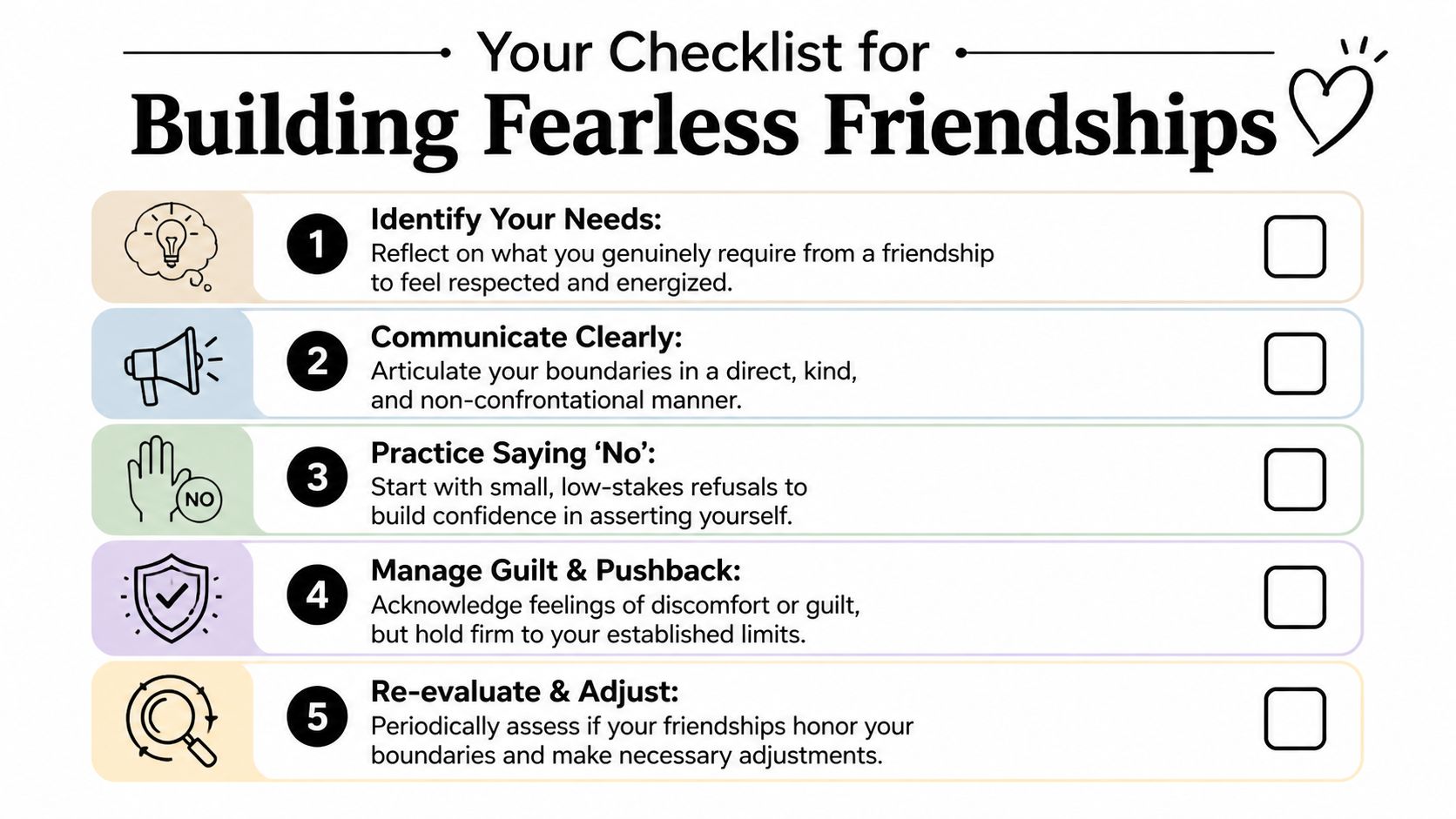
A practical checklist you can use this week
- Identify one draining pattern. Don’t fix your whole social life. Pick the friendship dynamic that creates the most anxiety.
- Write one boundary in a single sentence. Make it concrete enough that you could say it out loud without extra explanation.
- Choose the smallest workable action. Maybe that’s declining one call, shortening one conversation, or asking for more notice before plans.
- Expect discomfort without obeying it. Anxiety may spike. Let the feeling pass without automatically taking your boundary back.
- Watch for mutuality. Healthy friends may need time to adjust, but they usually respond with respect, curiosity, or effort.
- Review the result. Ask yourself what changed in your body afterward. More guilt? More relief? More clarity? That information matters.
- Adjust without quitting. A boundary can be refined. It doesn’t need to be perfect to be valid.
What fearless friendship actually means
Fearless friendship doesn’t mean you never feel awkward. It means fear no longer makes all your relational decisions.
It means you stop confusing access with love. You stop measuring loyalty by exhaustion. You stop proving your worth by how much stress you can absorb without complaint.
Healing from anxiety often looks less like becoming fearless and more like becoming honest.
A panic-free life isn’t built only through calming techniques. It’s also built by creating relationships your nervous system can trust. Boundaries help you do that. They protect your energy, reduce hidden resentment, and make room for friendships that feel steady instead of consuming.
That kind of life is not out of reach. It grows one boundary at a time.
If you want practical help building that kind of life, The Anxiety Checklist offers a structured, action-oriented system for understanding triggers, calming panic patterns, and building healthier habits and support dynamics. If you’re tired of guessing what’s helping and what’s keeping you stuck, it’s a solid place to start.