



Anxiety often starts making sense only after you look backward. You have a panic attack in a supermarket, on a train, in a meeting, or while driving. The moment passes, but your body doesn’t forget. Soon the place itself feels dangerous. Then the anticipation of going there feels dangerous. Then your own symptoms feel dangerous.
That pattern can feel permanent. It isn’t.
One of the most hopeful ideas in anxiety recovery is that fear can be learned, and what is learned can also be relearned. That relearning process is called classical conditioning extinction. It sounds technical, but the lived meaning is simple. Your brain can stop treating a trigger like a threat when you repeatedly experience that trigger without the feared outcome.
Healing from anxiety isn’t about pretending you never learned fear. It’s about helping your nervous system build a stronger safety memory. If you've been stuck in loops of avoidance, body scanning, reassurance seeking, or dread, there is a way forward.
Breaking Anxious Patterns with Classical Conditioning Extinction
A lot of people arrive at recovery exhausted by a strange mismatch. Logically, they know a situation is safe. Physically, they still react as if something terrible is about to happen. Their heart races in a shop. Their chest tightens before a flight. Their stomach drops when they see a message notification or feel a small sensation in their body.
That disconnect is where classical conditioning extinction becomes useful. It explains how a fear response can outlast the event that created it, and it also explains how that response can weaken.
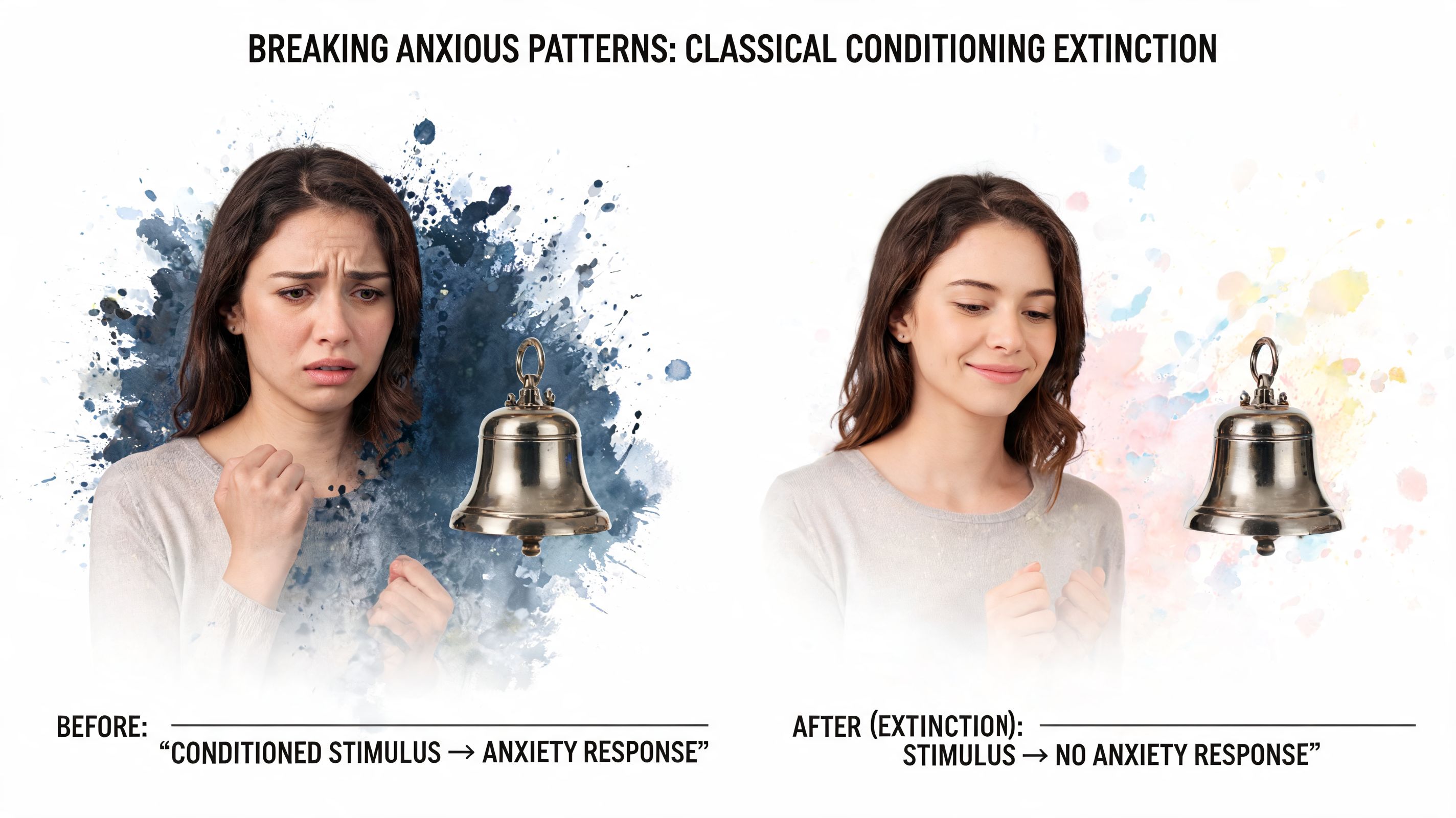
What extinction really means
Extinction doesn't mean you erase your past. It means your brain learns a new rule. The trigger that once predicted danger no longer predicts danger in the same way.
In practice, that might look like staying in the supermarket long enough for your nervous system to discover that panic sensations rise and fall without catastrophe. It might mean hearing your heartbeat pound and not rushing to fix it. It might mean noticing a scary health thought and responding with steadier interpretation instead of alarm. People working on managing health anxiety patterns often find this framework helpful because it shifts the focus from eliminating every sensation to changing the meaning attached to it.
Practical rule: Recovery starts accelerating when you stop treating every trigger as proof of danger and start treating it as an opportunity to teach safety.
Why this brings real hope
Anxiety recovery works better when people understand the mechanism. You're not weak. You're not irrational. Your nervous system learned an association, and learned associations can change through repeated experience.
That’s also why thinking work and behavioral work fit together. If your mind keeps feeding the fear loop with catastrophic interpretations, it helps to use practical tools to manage cognitive distortions alongside exposure-based work. Clear thinking supports relearning. Repeated safe experience locks it in.
What doesn’t work well is waiting to feel fully confident before re-engaging with life. Confidence usually comes after the retraining begins, not before it.
How Your Brain Learns Fear Through Classical Conditioning
Ivan Pavlov's experiments still matter because they gave us a clean model for how neutral things become emotionally loaded. In his early work, dogs learned to salivate to a bell after repeated bell-food pairings. Later, when the bell was presented without food, the salivation response dropped over repeated trials. A concise summary of this process notes that Pavlov paired the bell with food around 100 to 200 times, and the dogs’ salivation then decreased over 10 to 20 trials of the bell alone in extinction work described in this overview of Pavlov's findings.
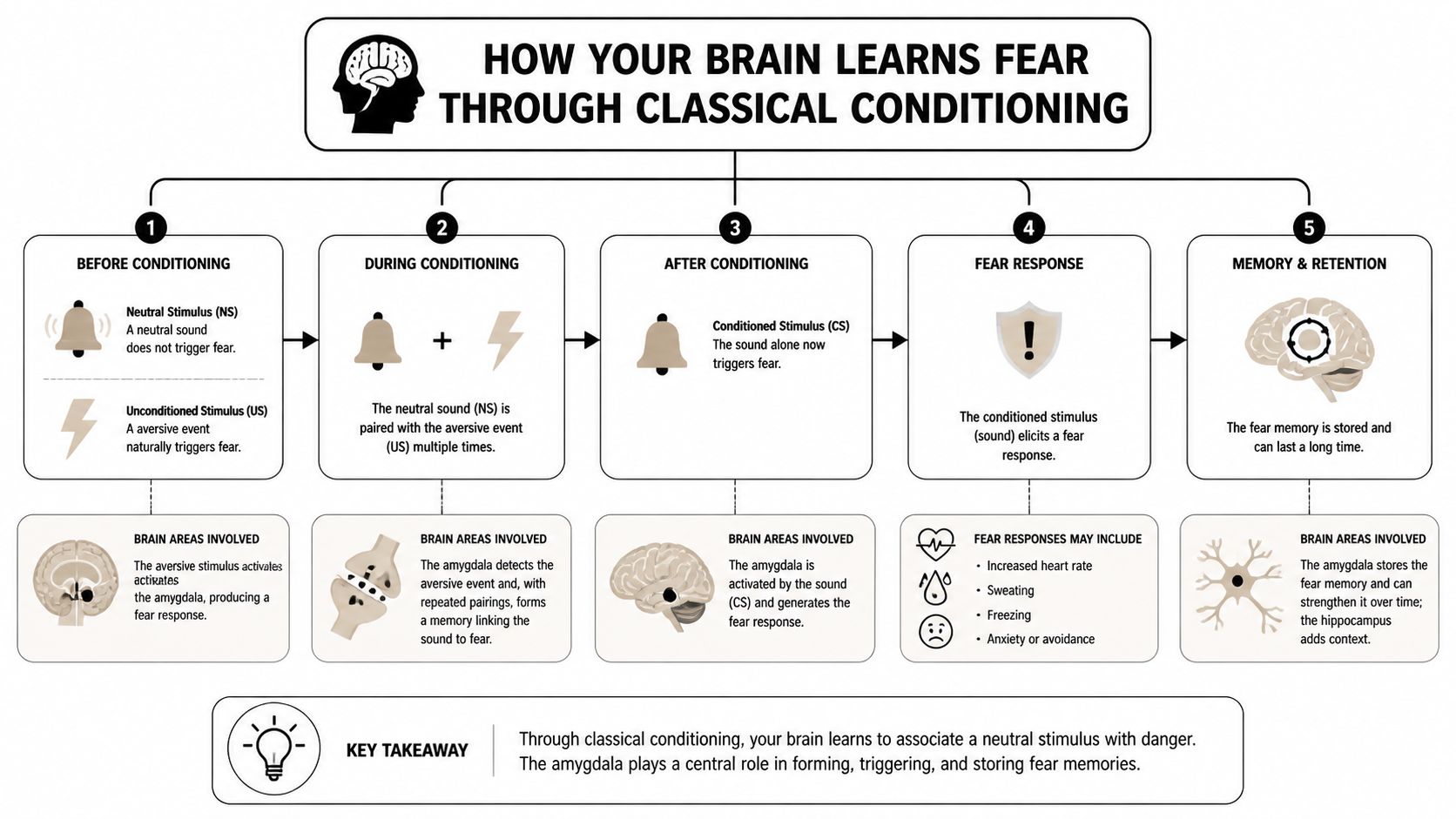
Humans don’t salivate to bells in therapy rooms, but the learning principle is the same. A neutral situation can become a fear trigger if your brain links it to danger.
A real-life anxiety example
Take a first panic attack in a supermarket.
Before that day, the supermarket is neutral. Then panic hits. Your body surges with dizziness, derealization, chest tightness, nausea, or a rush of adrenaline. The panic itself becomes the thing your brain wants to avoid. After that, the supermarket may start triggering fear before anything even happens.
Here’s the basic learning chain:
| Term | In Pavlov's example | In an anxiety example |
|---|---|---|
| Unconditioned Stimulus (US) | Food | The intense panic event or perceived threat |
| Unconditioned Response (UR) | Salivation | Fear, alarm, adrenaline |
| Conditioned Stimulus (CS) | Bell | Supermarket, checkout line, bright lights, being far from an exit |
| Conditioned Response (CR) | Salivation to bell | Anxiety triggered by the supermarket itself |
The important point is this. Your reaction becomes automatic, not chosen. That’s why anxiety can feel so convincing. Your body reacts first, and your mind scrambles to explain it afterward.
Why this learning feels so sticky
Once fear gets attached to a place, sensation, or context, your brain starts scanning for confirmation. You remember the danger cue. You avoid it. That avoidance brings short-term relief, which teaches your system that avoidance was necessary.
People often blame themselves. They say, “I know it’s irrational, so why do I still react?” The answer is that conditioned fear doesn’t ask for your permission.
The response may be learned, but it isn't fake. It’s a real body reaction built on a false alarm.
If you want a stronger foundation for the rest of recovery, it helps to learn about anxiety and panic attacks in clear behavioral terms. Understanding the pattern reduces shame. Reduced shame makes it easier to practice.
The 'Glitches' Spontaneous Recovery Renewal and Reinstatement
One of the most discouraging moments in recovery is this one. You’ve been doing better. A trigger has felt manageable. Then one day the fear surges again and you think, “I’m back at the beginning.”
You’re usually not.
These returns of fear are part of why classical conditioning extinction should be understood as re-learning, not cure in the magical sense. The old association can remain in the background even after you’ve built a stronger safety response.

Spontaneous recovery
Spontaneous recovery is the return of a conditioned response after a rest period. In other words, a fear that seemed quiet can pop back up after time has passed. That doesn’t mean the extinction work failed. It means the original learning wasn’t erased.
A psychology teaching review summarizing extinction notes that after extinction, the fear response can return after rest, and that relearning can happen faster, around 4 to 5 trials compared with 20+ initially, which supports the idea that the original association persists in memory in this explanation of conditioning processes.
Think of spontaneous recovery like an old walking trail you stopped using. The path is overgrown, but under the brush, it still exists. If you stumble onto it, that’s not proof the new road is gone. It means you need to keep using the new road.
Renewal and reinstatement
Renewal happens when fear returns in a different context from where you practiced feeling safe. Someone may do great exposure work in therapy, at home, or on one familiar route, then feel the old panic come back in a new environment.
Reinstatement happens when the system gets reminded of danger again. A strong stress episode, a fresh panic attack, or a similar unconditioned event can make the old fear response reappear.
Here’s a simple comparison:
| Glitch | What it feels like | What it means |
|---|---|---|
| Spontaneous recovery | “I was better, then it came back out of nowhere.” | Time passed, and the old response briefly resurfaced |
| Renewal | “I can do this here, but not there.” | Safety learning hasn't fully generalized across contexts |
| Reinstatement | “After one bad episode, all the fear came rushing back.” | A new threat cue reactivated the old fear network |
What works and what backfires
What works is recognizing these moments quickly and responding with skill. Return to the trigger. Stay long enough to let the nervous system settle. Drop the frantic measuring and emergency behaviors.
What backfires is turning a temporary flare into a verdict. Many people get trapped by the fear of fear itself. If that pattern sounds familiar, it helps to understand phobophobia fear of fear, because the secondary panic about symptoms often becomes more disabling than the original trigger.
A setback in anxiety recovery is often a memory event, not a danger event.
When people understand that, they stop seeing every resurgence as proof they’re broken. They start treating it as expected maintenance.
How Exposure Therapy Uses Extinction to Break the Fear Cycle
Exposure therapy is where classical conditioning extinction becomes practical, structured, and life-changing. The central move is simple. You face the trigger without performing the usual escape, avoidance, or safety ritual, and your brain begins learning a different outcome.
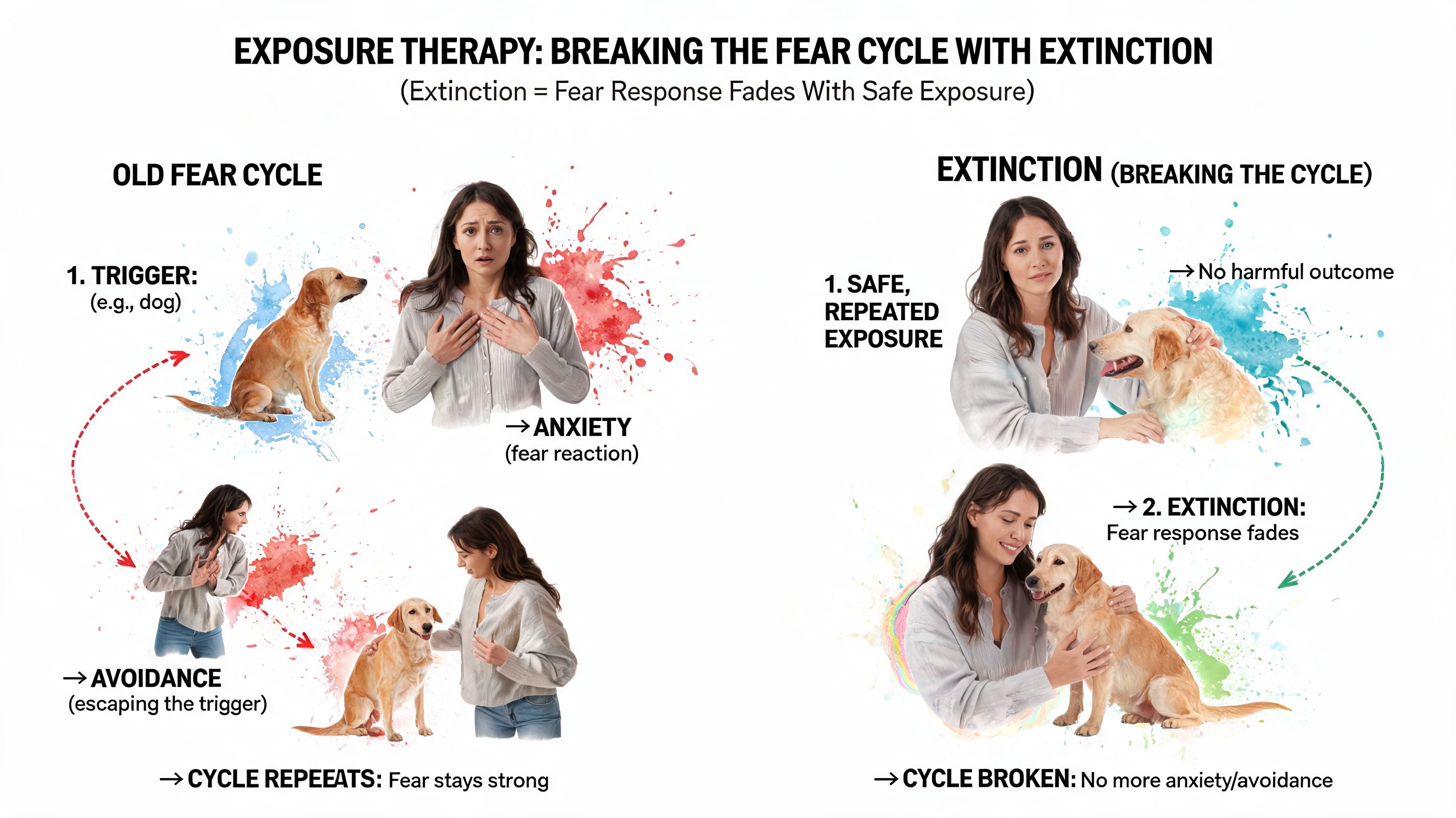
Clinical reviews of extinction-based treatment report that repeated exposure to an anxiety trigger without the feared outcome drives new inhibitory learning, and that meta-analyses of trials in the US and EU found 50 to 70% symptom reduction for specific phobias across 8 to 12 sessions in this review of extinction mechanisms and exposure therapy.
A common recovery pattern
Consider someone who developed a fear of driving after a panic attack on a busy road.
At first, they stop driving on highways. Then they avoid bridges. Then they only drive short familiar routes. Then even being a passenger feels edgy. Their world shrinks, not because the roads became more dangerous, but because avoidance trained the brain to keep treating driving as a threat.
Exposure reverses that pattern through direct experience.
Early step
They sit in the parked car and allow the body sensations to rise without escaping.Next contact
They drive around the block, not to feel calm, but to teach the brain that anxiety can be present without disaster.Broader challenge
They drive on slightly busier roads and resist checking, pulling over, or constantly monitoring their symptoms.Generalization
They practice in different weather, at different times, and on different routes so safety learning doesn’t stay too narrow.
What exposure is and isn't
Exposure is not forcing yourself through terror with gritted teeth. It’s not flooding yourself carelessly. It’s not trying to prove you’ll feel nothing.
It is deliberate learning. You enter the trigger. You remain there. You let the feared prediction fail.
A short contrast makes this clearer:
| Approach | Result |
|---|---|
| Avoid the trigger | Short relief, stronger fear next time |
| Enter the trigger and escape quickly | Confirms “I survived because I got out” |
| Enter the trigger and stay without rituals | Builds new learning that the trigger can be tolerated safely |
Exposure works best when the goal is learning, not immediate comfort.
If you're building a practice plan, these effective tools for anxiety management can help you organize exposures in a way that’s gradual, realistic, and easier to repeat. Repetition matters because the nervous system trusts what it experiences repeatedly, not what it is told once.
Practical Strategies to Prevent Anxiety Relapse
Relapse prevention matters because fear learning can stay dormant in the background. That’s especially important for younger people. Research on fear extinction shows that the prefrontal circuits involved in retaining extinction learning are still maturing in adolescence, which helps explain why relapse rates can be higher in youth, at around 60%, according to this review of developmental fear extinction.
That doesn’t mean recovery is fragile. It means recovery needs structure.
Build relapse prevention into the work
The strongest approach is to assume your brain needs reminders. People do better when they stop asking, “How do I make this fear never come back?” and start asking, “How do I respond skillfully if it does?”
These strategies help.
Practice in more than one place
If you only do exposure in one setting, your brain may learn “safe here” instead of “safe generally.” Work with the same trigger across different contexts. If your fear is supermarkets, don’t stop after one familiar store. Try different layouts, parking situations, and times of day.Stay long enough to learn something new
Quick dips into fear often become disguised reassurance. The point isn’t to touch the edge and flee. The point is to remain present long enough for the feared prediction to lose credibility.Reduce safety behaviors gradually
Water bottles, exit scanning, constant pulse checking, reassurance texting, gripping a “lucky” item, only going with a safe person. These behaviors can keep fear alive if your brain concludes they were the reason nothing bad happened. Drop them thoughtfully, not all at once unless you’re ready.
Use a written plan instead of relying on mood
A relapse plan should exist before the next wobble happens. Otherwise anxious thinking will write the script for you in the moment.
A simple worksheet can include:
Trigger list
Write the places, sensations, thoughts, or situations that still hook you.Predicted catastrophe
Name what your anxiety says will happen.New response
Decide in advance how you’ll stay, what you won’t do, and how you’ll measure completion.Review note
Record what happened, especially if the feared outcome did not occur.
It helps to use a fear ladder for anxiety. A ladder keeps you from swinging between avoidance and overwhelm. It creates steps your nervous system can learn from.
Treat flare-ups as drills
People often respond well to this shift in mindset. A flare-up isn't evidence that healing disappeared. It’s a chance to rehearse your recovery skills under real conditions.
Try this framework during a return of fear:
| Moment | Unhelpful response | Helpful response |
|---|---|---|
| Fear spikes | “This means I’m back to square one” | “This is old learning getting activated” |
| Urge to escape | Leave immediately and avoid future practice | Stay if possible and drop one safety behavior |
| Afterward | Replay the episode as failure | Review what you learned and repeat soon |
Recovery gets sturdier when you practice after a wobble, not only when you feel brave.
Keep your expectations realistic and kind
Anxiety recovery usually improves in layers. People often stop having full panic attacks before they stop fearing panic attacks. They often re-enter avoided places before those places feel natural. They often function better before they feel fully free.
That sequence is normal. Function often leads feeling.
What doesn’t work is using every symptom as a progress test. If you keep asking, “Am I anxious? Is it gone yet? Why is my heart doing that?” you keep your attention locked onto the fear system. Better questions are more behavioral. Did I stay? Did I practice? Did I reduce avoidance? Did I let the prediction fail?
That is how extinction learning becomes durable enough to support a life that feels larger again.
Living a Fearless Life Is a Skill You Can Learn
The deepest relief many people feel in recovery comes from this realization. They do not need to erase every old fear memory to get their life back. They need to build enough new learning that fear stops running the show.
That’s why classical conditioning extinction matters so much. It gives a practical model for healing. Triggers can lose their power. Panic can stop defining your choices. Avoided places can become ordinary again. But the path usually isn’t linear, and it doesn’t need to be.
A commonly missed but important point is that extinction does not erase the original fear conditioning. That persistence helps explain why relapse can happen and why ongoing maintenance matters, as noted in this summary of classical conditioning and extinction. When people understand that, they stop demanding perfection from themselves. They start building resilience instead.
What fearless living actually looks like
Fearless living doesn’t mean never feeling anxiety. It means anxiety no longer gets final authority.
It means you can feel a wave of adrenaline and still stay in line at the store. You can notice a scary thought and not organize your day around neutralizing it. You can have a setback and respond with practice rather than panic about panic.
That is a skill. Skills can be learned, repeated, strengthened, and recovered after interruption.
The hopeful truth
You are not trying to become someone who never learned fear. You are becoming someone who knows how to respond when fear shows up.
That shift changes everything. It turns recovery from a desperate hunt for certainty into a trainable process of building safety memories, reducing avoidance, and trusting your capacity to handle discomfort. Over time, that practice can bring something many anxious people haven’t felt in a long while. Freedom that feels earned, stable, and real.
If you want a structured way to put these ideas into practice, The Anxiety Checklist offers a practical system for tracking triggers, challenging anxious thinking, organizing exposures, and building the day-to-day habits that support lasting recovery.