



You check your phone. No reply.
A few minutes pass, then your mind starts filling in the blanks. Maybe they're upset. Maybe you said too much. Maybe they're pulling away. By the time a simple delay becomes a whole story, your chest is tight, your thoughts are racing, and part of you wants to text again, apologize, shut down, or disappear first.
If that feels familiar, you're not broken and you're not “too much.” Many people with abandonment issues in relationships live with a nervous system that learned to expect loss, distance, or emotional unpredictability. That fear can show up as clinginess, jealousy, overthinking, panic, or the opposite: withdrawal, ghosting, numbness, and acting like you don't care.
The good news is that these patterns can change. You can understand where they come from, learn how they work, and build new ways to feel safe in love. Healing doesn't mean becoming emotionless. It means becoming steadier, kinder to yourself, and less controlled by fear.
Table of Contents
- Feeling Secure in Your Relationships is Possible
- Where Do Abandonment Issues Come From?
- How Abandonment Fears Show Up in Your Life
- The Vicious Cycle of Abandonment Anxiety and Panic
- Your Path to Healing and Feeling Secure
- Building Trust and Communicating With Your Partner
Feeling Secure in Your Relationships is Possible
If abandonment fear has been running your relationships, it can feel exhausting. You might replay conversations, brace for rejection during small disagreements, or need reassurance so often that even comfort stops feeling comforting. Many people wonder, “Why do I react this strongly when part of me knows nothing major happened?”
Fear of abandonment is the deep worry that someone important will leave, pull away, stop caring, or decide you're too much to stay with. It often feels bigger than the present moment because your body is reacting to more than the current text, tone of voice, or conflict. It's reacting to old emotional learning.
That's why shame usually doesn't help. Understanding does.
Practical rule: If your reaction feels intense, there's usually a reason. Intensity doesn't mean weakness. It often means your nervous system is trying to protect you.
Healing starts when you stop treating the fear like proof that something is wrong with you. A calmer relationship life becomes possible when you learn to recognize your triggers, understand your attachment patterns, and practice new responses. Many people also benefit from structured support, including mental health tools for anxiety that help them slow down, ground themselves, and respond more clearly in the moment.
You don't need to become perfectly secure overnight. You just need to begin building safety, one moment at a time.
Where Do Abandonment Issues Come From?
Some people assume abandonment issues in relationships mean they're needy by nature. That's usually not the full story. More often, these patterns grow out of earlier experiences that taught the brain and body that closeness might not be reliable.
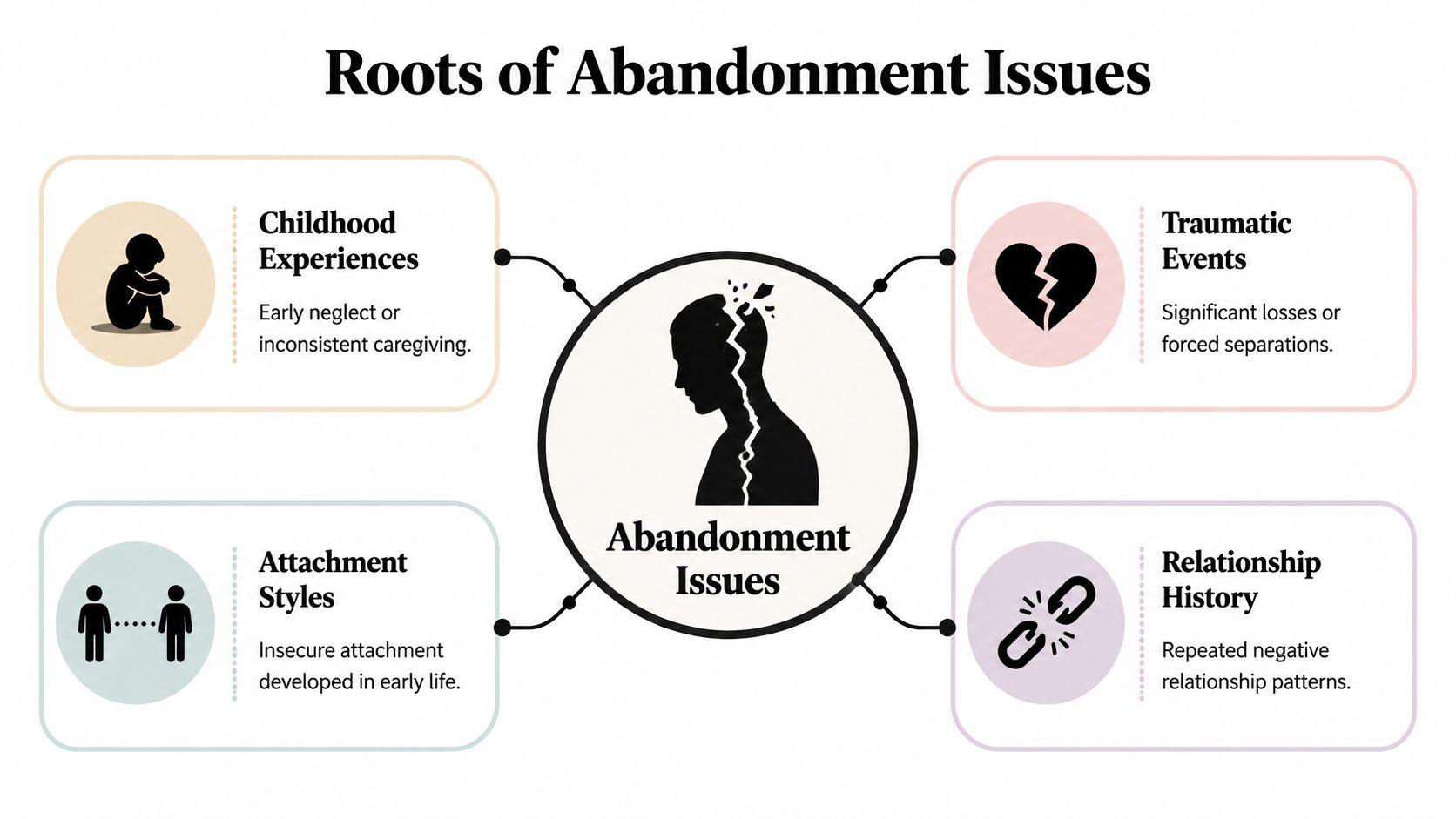
Your early relationships become your template
Think of emotional security like a house. When caregiving is steady, warm, and predictable, the foundation tends to be strong. A child learns, often without words, “People can be there for me. I can need others and still be safe.”
When caregiving is inconsistent, emotionally absent, frightening, or interrupted by loss, the foundation can feel shaky. A person may grow up expecting distance, mixed signals, or sudden disconnection. That expectation can follow them into adult love even when they want closeness.
A peer-reviewed study of 505 women from Poland found a significant link between attachment trauma and fear of abandonment in romantic relationships, with r = .56, and found an even stronger correlation between fear of abandonment and conflict sensitivity, with r = .62 in the Journal of Psychological, Social and Educational Studies research. In simple terms, past attachment wounds were closely tied to present-day relationship anxiety and stronger reactions to conflict.
Attachment styles are survival patterns
People often hear about attachment styles and think of them as personality labels. They're better understood as learned ways of staying emotionally safe.
If you want a simple overview, BetterDatingAI's guide to attachment styles gives a useful summary of how anxious, avoidant, and secure patterns can shape dating and commitment.
A few common patterns:
- Anxious attachment: You may seek reassurance, overread changes in tone, or fear that conflict means the relationship is in danger.
- Avoidant attachment: You may downplay needs, pull away when closeness increases, or leave first so you won't be left.
- Disorganized patterns: You may want closeness intensely, then feel unsafe once you have it.
None of these patterns mean you're doomed. They mean your system adapted.
Some adults don't fear abandonment by clinging. They fear it by staying detached, acting casual, or ending things early.
That's one reason reflective practices can help. Approaches like shadow work for anxiety can help you notice the old beliefs beneath your reactions, such as “I'll be left if I need too much” or “If I care first, I'll lose control.”
Understanding the roots of the fear often brings relief. You stop asking, “What's wrong with me?” and start asking, “What did I learn about love, and what can I learn now instead?”
How Abandonment Fears Show Up in Your Life
Abandonment fear doesn't look the same in everyone. One person texts repeatedly and feels sick when plans change. Another goes quiet, avoids commitment, or ends promising connections the moment feelings deepen. The outside behavior may differ, but the inside fear is often similar.
Common signs of abandonment fears in action
| Behavior / Thought Pattern | What It Looks Like in a Relationship |
|---|---|
| Constant reassurance seeking | Asking if your partner is okay, if they still love you, or if something is wrong after small changes in tone or routine |
| Overanalyzing communication | Reading and rereading texts, worrying about punctuation, response time, or whether a short message means distance |
| Jealousy and comparison | Feeling threatened by friends, exes, work, or anything else that seems to compete for closeness |
| People-pleasing | Hiding needs, overgiving, or agreeing to things you don't want so the other person won't leave |
| Testing behavior | Starting arguments, pulling away, or making indirect comments to see whether your partner will pursue or reassure you |
| Emotional shutdown | Going numb, silent, or “fine” on the surface while feeling hurt or panicked underneath |
| Leaving first | Ending things, ghosting, or acting uninterested before attachment deepens |
A less obvious form of abandonment fear is avoidance. In a 2023 survey, 36% of adults in their 20s and 30s said they had ghosted someone because they feared “getting too attached” or being “left first,” as discussed in this Psychology Today article on unexpected effects of abandonment fears. That matters because it challenges the idea that abandonment fear only looks clingy. Sometimes it looks cool, distant, hard to read, or suddenly gone.
The same fear can look opposite on the outside
Consider two common scenes.
One person notices their partner sounds distracted on a call. Their mind immediately jumps to danger. They ask, “Are you mad at me?” Then again. Then they replay the conversation all night.
Another person has the same fear spike, but instead of moving closer, they detach. They tell themselves they don't care. They stop replying, flirt with someone else, or decide the relationship is “too much drama.”
Both are trying to solve the same emotional problem. Both are trying not to be hurt.
If being alone feels especially activating, that can intensify these patterns. Some people discover that abandonment fears overlap with fear of being alone anxiety, where solitude itself can feel unsafe rather than merely uncomfortable.
The behavior is often the protective shell. The fear underneath is usually, “I don't know if I'll be okay if this connection goes away.”
Seeing your own pattern clearly is not a reason to judge yourself. It's the moment where change becomes possible.
The Vicious Cycle of Abandonment Anxiety and Panic
Abandonment fear often feels sudden, but it usually follows a recognizable chain. A trigger happens, your mind fills in a painful story, your body sounds the alarm, and then the alarm itself convinces you the threat must be real.
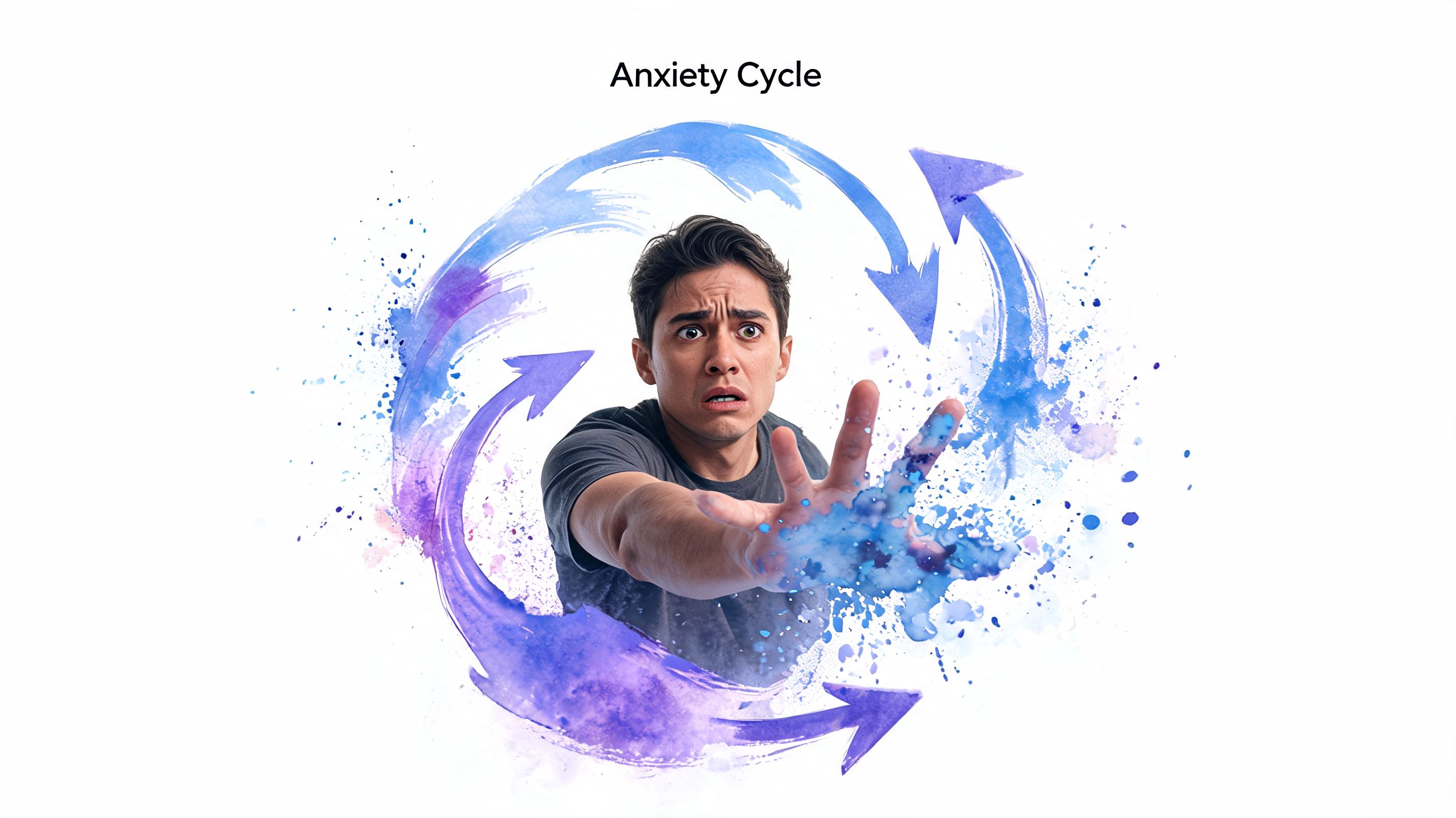
How a small trigger becomes a full body alarm
The trigger may be minor. A delayed text. A flat “okay.” A partner needing space after an argument. For someone with old abandonment wounds, that moment can land like a smoke alarm going off from burnt toast. The reaction is real, even if the danger isn't what it seems.
A common cycle looks like this:
- Something feels off. Your partner is less responsive, distracted, tired, or busy.
- Your mind predicts loss. Thoughts rush in: “They're done with me,” “I'm too much,” “I knew this would happen.”
- Your body activates. Your heart races, your stomach drops, your breathing changes, and your attention narrows.
- You react to get relief. You chase reassurance, shut down, start a fight, apologize excessively, or leave first.
- The pattern feeds itself. The conflict or distance that follows seems to confirm your fear.
Longitudinal research found a direct pathway from childhood fears of abandonment to anxiety in romantic relationships in early adulthood, which then correlated with depressive symptoms, according to this long-term study on parental loss, abandonment fears, and later mental health. That helps explain why reactions can feel so layered. You're not only responding to today. Your system may be repeating an old template.
Why the cycle keeps repeating
Many people say, “I know I'm overreacting, but I still can't stop.” That makes sense. The nervous system is built to protect first and reason later. Once panic starts, your body treats the situation like an emergency.
That's why work focused on treating anxiety at its root cause can be so helpful. If you only argue with the thoughts but ignore the body, the cycle often restarts. And when panic itself becomes frightening, some people get trapped in a second loop that resembles phobophobia and panic attack cycle, where fear of the anxiety symptoms adds more anxiety symptoms.
When your body feels abandoned, logic alone rarely settles it. Safety has to be felt, not just understood.
Once you can identify the sequence, you can begin interrupting it earlier. That's where healing gains traction.
Your Path to Healing and Feeling Secure
Healing abandonment issues in relationships doesn't mean teaching yourself never to need anyone. It means learning how to stay connected to yourself, even when closeness feels uncertain. Real healing is less about becoming tough and more about becoming safe inside your own body and mind.

Start with safety, not self-criticism
Self-attack often keeps the wound open. If your first response is “I'm ridiculous” or “I ruin everything,” your nervous system gets the message that even your pain isn't welcome. A better first step is naming what's happening without shaming it.
Try simple language:
- Name the trigger: “That text delay activated me.”
- Name the fear: “Part of me is scared I'm being left.”
- Name the need: “I need grounding before I decide what this means.”
This slows the spiral. It also creates space between the feeling and the action.
A few grounding tools can help in the moment:
- Breathe longer on the exhale: A slower exhale can signal safety to your body.
- Orient to the room: Look around and name what you see. That reminds your brain you're here, not in the past.
- Delay the reaction: Give yourself a short pause before sending the extra text, making the accusation, or ending the relationship in panic.
Use CBT to interrupt the old story
A longitudinal study found that attachment anxiety predicted post-breakup depression because it fueled self-punishment coping, including rumination and self-blame, in this study on attachment, coping, and post-breakup depression. This is important because many people focus only on the fear of being left, but the suffering often gets worse through the way they talk to themselves after being triggered.
CBT-based thought journaling can help break that loop. Instead of treating every fear as truth, you write it down and test it.
For example:
- Automatic thought: “They're quiet because they don't want me anymore.”
- Emotion: Fear, shame, panic.
- Alternative view: “They may be stressed, distracted, or tired. I don't have enough information yet.”
- Balanced response: “I can check in directly instead of assuming rejection.”
Try this question: “What am I telling myself right now, and what else could also be true?”
That question matters because abandonment fear narrows interpretation. It turns uncertainty into certainty. Journaling, cognitive restructuring, and belief-testing widen the lens again.
If you want more structured learning on these skills, anxiety self-help guides can be useful for building a steady practice between therapy sessions or while you're beginning on your own.
A short teaching resource can also help reinforce these ideas in a more guided format:
Practice new experiences of closeness
Insight helps, but new experiences are what teach your nervous system that closeness can be safe.
That might look like:
- Telling the truth sooner: “I noticed I'm feeling insecure and I'm trying not to spiral.”
- Asking clearly instead of testing: “Could you reassure me?” works better than picking a fight to see if they care.
- Staying present through mild discomfort: Letting someone care for you without immediately doubting it.
- Choosing repair after conflict: Learning that tension doesn't automatically mean abandonment.
Some people also benefit from mindfulness, guided meditations, hypnosis, exposure-based work around vulnerability, or attachment-focused therapy. The method matters less than the repeated experience of this message: “I can feel fear without obeying it. I can feel close without collapsing. I can survive uncertainty.”
Healing is often gradual. That's normal. A secure relationship with yourself is built the same way trust with another person is built. Through repetition, honesty, and follow-through.
Building Trust and Communicating With Your Partner
Abandonment wounds heal faster when they're met with clarity instead of mind reading. If you're in a relationship, communication becomes part of the treatment. Not perfect communication. Honest, steady, non-blaming communication.

What to say when you feel triggered
When you're activated, try to describe your inner experience without turning it into an accusation.
Examples:
- “I'm feeling anxious and I'm noticing my fear of being left is getting loud.”
- “When we stop talking suddenly during conflict, I start filling in the blanks.”
- “I don't need you to fix everything right now. I do need some clarity.”
This approach helps because it invites connection instead of defense.
A useful pattern is:
- State the moment: “When plans changed suddenly…”
- Name the feeling: “…I felt scared and unsettled.”
- Ask for something specific: “Could you tell me when we'll reconnect?”
What helps if you love someone with abandonment fears
Partners can help without becoming full-time reassurance machines. The goal isn't endless proof. The goal is consistent, believable safety.
What tends to help:
- Be clear: If you need space, say when you'll come back to the conversation.
- Be consistent: Follow through on what you say you'll do.
- Don't personalize every trigger: The reaction may be old pain colliding with a current moment.
- Set kind boundaries: Reassurance helps most when it's calm and honest, not forced or resentful.
“I'm here, I care about you, and I need ten minutes to settle before we talk” is often more regulating than vague silence.
Healthy relationships don't require either person to hide their needs. They ask both people to bring those needs into the open, with respect. That's how trust grows. Not through guessing, testing, or panic, but through repeated experiences of being honest and staying connected.
If abandonment fear is fueling anxiety, rumination, or panic, The Anxiety Checklist offers practical support you can use right away. Its free SOS mode is designed for those moments when your mind goes blank and your body feels flooded. For deeper work, it includes CBT tools like thought journaling, belief experiments, guided meditations, hypnosis, and expert-led lessons that can help you retrain the fear patterns behind abandonment anxiety.