


You're sitting next to someone you love, but your body acts like you're in danger. A delayed text feels loaded. A tired tone sounds like rejection. A small misunderstanding turns into a long night of reassurance, shutdown, or both. By the end, one of you feels ashamed, the other feels drained, and both of you wonder the same thing: is anxiety ruining my relationship?
If that's where you are, the pain is real. So is the hope. Anxiety can distort connection, but it doesn't have to define it. When we name the pattern clearly and respond to it skillfully, couples often move from chaos to steadiness, and individuals can learn to live with far less panic and far more trust.
Table of Contents
- It Feels Like a Storm Inside You Both
- Identifying Anxiety's Disguises in Your Relationship
- First Aid for Anxious Moments
- Rebuilding Connection with Structured Communication
- A Practical Guide for Your Partner
- Creating Your Daily Practice for Lasting Calm
It Feels Like a Storm Inside You Both
One partner asks, “Are we okay?” The other says, “Yes, I'm just tired.” That should be the end of it. Instead, the nervous system hears threat. More questions come. The tired partner gets shorter. The anxious partner hears distance. Then both people are reacting to the reaction, not the original moment.
That's the part many couples miss. Anxiety rarely stays private. It enters the room, changes the meaning of neutral events, and pressures both people to manage fear at the same time. One person may feel frantic and desperate for relief. The other may feel cornered, helpless, or blamed for not being able to make the fear disappear.

A lot of this pain is rooted in old injuries, not present facts. A 2024 Thriveworks research study found that 34% of Americans identify past or present romantic relationships as the primary cause of their mental health concerns. The same study reported that 77% said negative experiences with past partners shaped how they approach current and future relationships, including cheating (42%) and gaslighting (28%). It also found that 35% no longer trust others and 30% report damaged self-esteem. When someone has been hurt before, today's disagreement can feel like proof that the past is happening again.
When anxiety starts fearing itself
Sometimes the relationship isn't the only thing that feels unsafe. The anxious person also starts fearing their own internal reactions. They think, “If I spiral again, I'll push my partner away.” That creates a second layer of panic, which is why many people benefit from understanding fear of fear anxiety explained.
Anxiety can make love feel unsafe even when love is present.
What healing usually looks like
Healing doesn't mean never getting triggered. It means the trigger no longer runs the whole relationship. You learn to separate danger from discomfort. You stop treating every anxious thought like an emergency. Your partner learns how to support you without becoming your full-time regulator.
That's a very different future from the one anxiety predicts. It's calmer, more honest, and much less lonely.
Identifying Anxiety's Disguises in Your Relationship
Anxiety doesn't always look like panic. In relationships, it often shows up dressed as control, criticism, silence, jealousy, or constant checking. People think they have a communication problem, when they have a fear problem driving the communication.
A 2016 Journal of Family Psychology study found a significant link between a wife's daily anxiety levels and both partners' perception of poor relationship quality. On higher-anxiety days, wives reported more negative relationship quality, and husbands also experienced distress, especially when they frequently accommodated anxiety symptoms. That matters clinically because it shows the impact is often day by day, not only during major crises.
How anxiety shows up in relationships
| Anxiety's Disguise | What it Looks Like | The Underlying Fear | Impact on Partner |
|---|---|---|---|
| Reassurance-seeking | Repeatedly asking “Do you love me?” or “Are you mad?” | “If I don't check, I'll be blindsided.” | Partner feels pressure to fix a feeling they can't control |
| Conflict avoidance | Saying “It's fine” when it isn't, then shutting down | “If I speak up, I'll be rejected or abandoned.” | Problems stay unresolved and resentment grows |
| Preemptive criticism | Picking apart tone, timing, or effort before the partner can disappoint you | “If I strike first, I won't be hurt first.” | Partner feels attacked and becomes defensive |
| Overanalysis | Reading into texts, pauses, facial expressions, or small changes in routine | “There must be something wrong, and I need to catch it early.” | Neutral moments become emotionally loaded |
| Score-keeping | Mentally tracking who texted first, who apologized, who cared more | “If I don't monitor the balance, I'll end up powerless.” | Connection turns into accounting |
| Cling and pull away | Wanting closeness intensely, then feeling smothered and retreating | “I need you close, but closeness feels risky too.” | Partner feels confused and unstable |
The pattern under the pattern
I often tell couples to stop arguing about the content for a moment and identify the process. The fight about dishes, lateness, sex, or texting may be real. But the repeating injury usually sounds more like this: “I got scared, then I reached badly, then you protected yourself, then I got more scared.”
If you tend to think in extremes, this pattern can become harsher fast. A delayed reply becomes “I'm not important.” One awkward conversation becomes “We're broken.” The same kind of rigid thinking shows up outside relationships too, which is why this piece on the stop all-or-nothing diet mindset is useful beyond food. It illustrates how perfectionistic thinking turns ordinary setbacks into sweeping verdicts.
Clinical shortcut: If your reaction feels much bigger than the event, look for the fear underneath before you argue about the facts.
Questions that help you name it
Use these prompts after a hard moment, not in the middle of one:
- What was I afraid of? Not what was I angry about. What did I fear was happening?
- What did I do next? Checked, accused, withdrew, apologized too fast, demanded certainty.
- What did that invite from my partner? Comfort, defensiveness, distance, silence.
- What story did my mind tell? If you need help catching those loops, start with how to stop overthinking and worrying.
When you can name anxiety's disguise, you stop treating it as your personality or your partner's character flaw. That's where change begins.
First Aid for Anxious Moments
When anxiety spikes, insight usually disappears first. You won't think your way out of a flooded nervous system. You need emotional first aid that is simple enough to use when your mind goes blank.

These tools are not the whole recovery plan. They are what you do in the first few minutes so you don't say something panic is trying to say for you.
Use the body before the story
Start with sensory input. Anxiety pulls attention into prediction and mental threat-scanning. Grounding works by moving attention back into the present body and environment.
- Cold reset. Hold a cold glass, splash cold water on your face, or press a cool pack against your cheeks. The goal is not comfort. It's interruption.
- 5-4-3-2-1 orientation. Name five things you see, four you feel, three you hear, two you smell, and one you taste. Do it slowly and out loud if possible.
- Feet on the floor. Push both feet into the ground and describe the pressure. This sounds basic because it is basic. Basic works when the system is overloaded.
Give yourself one sentence only
Anxious people often make the moment worse by overexplaining. In a spike, use one clear sentence:
- “I'm getting activated and need ten minutes to settle.”
- “My body is alarmed. I don't want to talk from that place.”
- “I need a pause, not distance.”
That last line matters. A pause feels safer to a partner than unexplained withdrawal.
For people who want to go deeper on breathwork, these science-based breathing methods are a practical place to start.
A brief reset you can follow now
This short guided practice can help when you can't organize your thoughts on your own:
What helps and what backfires
Some people try to solve a panic wave by debating the relationship in real time. That almost never goes well. A flooded brain treats explanation as more material to scan for danger.
Try this instead:
- Pause the content. Stop discussing the accusation, fear, or future.
- Regulate first. Use temperature, orientation, or breath.
- Return with a time. “Let's come back in twenty minutes.”
“The goal in an anxious moment is not to settle the relationship. It's to settle the nervous system enough to have a relationship.”
Some people also find it useful to strengthen the body side of stress recovery outside conflict. If that's relevant for you, this guide to stress-reducing vitamins can be a helpful companion to nervous-system work. It doesn't replace therapy skills, but it can support a broader self-care plan.
Rebuilding Connection with Structured Communication
Most couples stuck in anxiety are not dealing with a single bad conversation. They're trapped in a cycle. One partner feels anxious and reaches hard for certainty. The other feels pressured and steps back. The step-back reads as rejection. Anxiety rises again. Then both people act from protection instead of connection.
That cycle is treatable. Meta-analytic reviews of Emotionally Focused Therapy show that 70 to 75% of distressed couples move from distress to recovery, and 90% show significant improvement (reported here). EFT is especially relevant when anxiety drives attachment panic because it helps couples create a more secure bond rather than arguing only about surface behaviors.
The conversation to have after the storm
Don't do repair while one or both of you are still flooded. Repair works best when you're calm enough to stay curious.
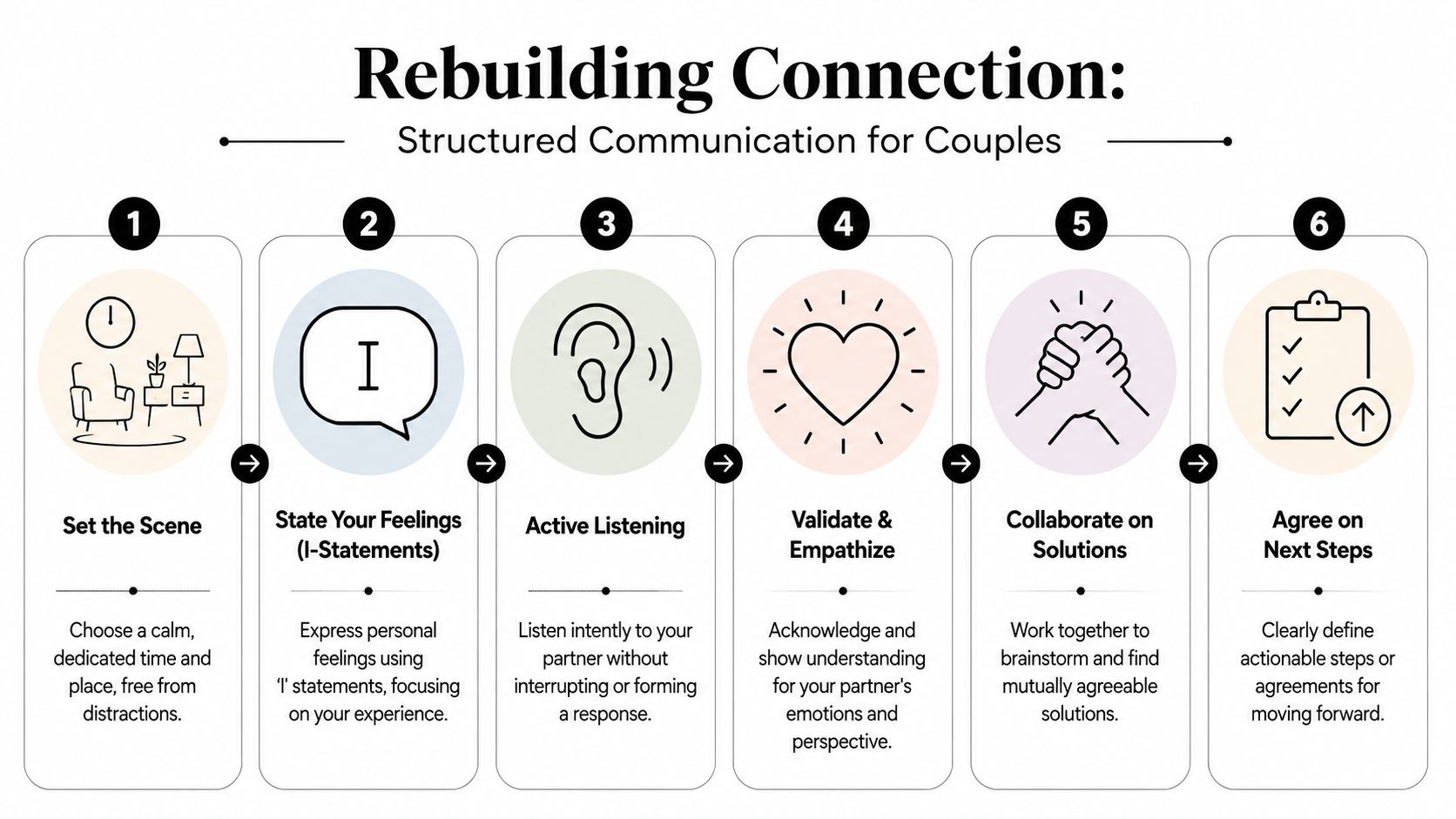
A three-step repair framework
Name the cycle, not the villain
Start by describing the pattern as something that happens between you.
- “When I get scared, I push for reassurance.”
- “When I feel pushed, I shut down.”
- “Then your shutdown scares me more.”
This lowers shame immediately. It also keeps the focus where it belongs. The cycle is the problem.
Translate the protection into vulnerable truth
Under anxious behavior there is usually a more honest sentence.
Instead of:
- “Why didn't you text back?”
- “You never care when I'm upset.”
- “Forget it.”
Try:
- “I got scared that I wasn't important.”
- “I wanted comfort and didn't know how to ask.”
- “I pulled back because I felt like I was failing.”
Repair principle: Softer truth gets a better response than sharper fear.
Make one concrete agreement
Do not end the conversation with vague hope. End it with a plan.
Examples:
- If one of us gets activated, we ask for a pause and give a return time.
- Reassurance happens once, then we shift to self-regulation.
- We don't discuss breakup fears late at night.
- After conflict, we do a ten-minute check-in the next day.
A sample script that works better
Here's a version I'd rather hear in my office than ten minutes of cross-examination:
“When you got quiet earlier, my anxiety told me I'd done something wrong. I started reaching for certainty. I know that can feel intense. What I needed was reassurance and a clear time to reconnect, not a long argument.”
And from the partner:
“I wasn't pulling away from you. I was getting overwhelmed. Next time I can say that directly instead of going silent.”
That is structured communication. Not polished. Not perfect. Just regulated enough to be usable.
Connection outside conflict matters too
Repair isn't only verbal. Couples need ordinary warmth that isn't tied to fixing a problem. A thoughtful gesture, a short note, a predictable ritual after work, or a deliberately kind response can soften the whole climate of the relationship. If you want ideas, this article on gifts that truly connect offers practical ways to express care without making it about grand gestures.
A Practical Guide for Your Partner
If you love someone with anxiety, you may feel like you're always one conversation away from another spiral. You try to be kind. You answer the same question again. You stay calm longer than you want to. Then one day you feel irritated, guilty for feeling irritated, and worried that setting limits will make everything worse.
That reaction makes sense. Existing content often gives partners vague advice and little structure. A 2023 Journal of Family Psychology finding summarized here reported that 68% of partners of anxious individuals experience secondary anxiety themselves, and burnout rates doubled when reassurance-seeking exceeded 5 requests per day. Support without structure can turn into exhaustion.

The reassurance trap
Reassurance helps in the short term. That's why couples get stuck there. The anxious partner feels relief for a moment. The supporting partner feels useful for a moment. Then the fear returns, often faster, and both people learn the wrong lesson: “We have to do this again right now.”
Loving someone well does not mean answering fear endlessly. It means supporting regulation, reality, and boundaries at the same time.
Do this, not that
Do offer one calm answer.
Not five versions of the same answer because panic says the first one didn't count.Do name the feeling.
“I can see you're really scared.”
Not “There's nothing to be upset about.”Do set a limit with warmth.
“I'm here, and I'm not going to keep debating this for the next hour.”
Not “I'm done with this.”Do invite a tool or pause.
“Let's take ten minutes and come back.”
Not “Calm down.”Do protect your own nervous system.
Take breaks, sleep, move your body, and keep your own support.
Not becoming the entire treatment plan.
Scripts that are firm and kind
Try language like this:
“I love you, and I know anxiety is loud right now. I've answered the question once. Let's help your body settle before we talk more.”
Or this:
“I'm not leaving this conversation. I am taking a short break so I can come back steady.”
Or this:
“I want to support you, but I can't be the only thing that helps you feel safe.”
That last sentence is often the turning point.
What partners need to remember
Your job isn't to eliminate your loved one's anxiety. Your job is to be a stable presence while refusing to build the relationship around panic. That's not cold. It's protective.
If you need more language and education for what anxiety and panic do to the mind and body, take time to learn about anxiety and panic attacks. Better understanding usually reduces resentment and improves consistency.
Creating Your Daily Practice for Lasting Calm
Acute tools help you survive the moment. Daily practice changes the baseline that creates the moment. If you want panic to loosen its grip on your relationship, you need a routine that teaches your nervous system safety on ordinary days, not only during hard ones.
I like to think of this as building a scaffolding of safety. Not a huge life overhaul. A repeatable set of small actions that make your body less jumpy, your thoughts less believable, and your reactions less automatic.
A simple daily routine
Start with a short settling practice
Take a few minutes each morning for one regulating activity. That might be slow breathing, a guided meditation, a short walk, or quiet sitting before you check your phone. The goal is consistency, not intensity.
Write down one anxious thought
Catch one recurring fear and put it into words. Then answer it with a more balanced response.
Example:
- Anxious thought: “If my partner seems off, it means our relationship is in trouble.”
- Balanced response: “My partner can be tired, distracted, or stressed without that meaning rejection.”
This is the heart of thought journaling. You are not arguing yourself into fake positivity. You are training your mind to stop treating every possibility like a fact.
Run one small belief experiment
Ask, “What does my anxiety tell me I must do?” Then do a smaller, healthier version instead.
- If anxiety says, “Ask for reassurance again,” wait and self-soothe first.
- If it says, “Avoid the conversation,” stay for two honest minutes.
- If it says, “Check their tone for clues,” return attention to what was said.
That's how change gets real. You practice a new response while your body still feels some discomfort.
Keep the routine light enough to repeat
A good daily plan is one you can do on a bad Tuesday. Keep it simple:
- Morning: one calming practice
- Midday: brief body reset
- Evening: one journal entry or reflection
- Weekly: one honest relationship check-in, done calmly
Healing usually looks ordinary before it looks dramatic.
If you want one place to support that routine, the Anxiety Checklist app brings together real-time calming tools, guided practices, CBT exercises, and education in a way that's easy to return to daily. That kind of structure helps people move from reactive coping to steady progress.
If anxiety is straining your relationship, you don't have to wait until the next spiral to get support. The Anxiety Checklist can help you calm panic in real time and build long-term resilience with guided grounding, breathing, journaling, belief experiments, meditations, and practical education. It's a solid next step if you want support that's available in the hard moments and useful in the quiet ones too.