


You might be holding a workbook right now with a mix of hope and skepticism. Part of you wants relief. Another part is thinking, “If I could just write in a notebook and fix this, I would’ve done it already.”
That reaction makes sense. Anxiety can feel fast, physical, and overpowering. A workbook can look slow and small by comparison.
But a good cognitive behavioral therapy anxiety workbook isn’t asking you to pretend you're fine. It gives you a structured way to understand what anxiety is doing, what keeps it going, and how to respond differently. Over time, those small written steps can change the way your mind and body react.
Table of Contents
- A Hopeful Start to Your Healing Journey
- Understanding the CBT Framework for Anxiety
- Your First Workbook Exercises Demystified
- Building Your Exposure Hierarchy for Lasting Change
- Connecting Your Workbook to Real-Time Relief
- Troubleshooting Challenges and Finding Your Path Forward
A Hopeful Start to Your Healing Journey
Anxiety often tells you that you’re stuck with the brain you have. It says your thoughts are warnings, your body is fragile, and your fear means danger is near. CBT starts with a different idea. A thought is not automatically a fact.
That idea can change a life.
A workbook helps you slow down enough to notice what your mind is doing. Maybe your chest tightens before a meeting and your mind says, “I’ll embarrass myself.” Maybe you feel lightheaded in a grocery store and think, “Something is wrong with me.” The workbook gives those moments a shape. Once you can name the pattern, you can begin to change it.
This approach isn’t fringe or experimental. In a 2023 survey of practitioners using the Think Good Feel Good workbook, 96.2% used it for anxiety disorders, and the same evidence summary notes 50 to 60% remission rates after CBT treatment for youth anxiety. That matters because it shows workbooks are not busywork. Therapists use them because they help people practice change between sessions and build real skills.
You don't need to feel confident before you begin. You begin, and confidence grows from practice.
A workbook also gives you something anxiety hates. A repeatable method. Instead of asking, “What do I do with all these thoughts?” you start asking, “What happened, what did I predict, what did I feel, and what would be a more balanced response?”
If you’re craving steady education alongside practice, https://anxietychecklist.com/anxiety-university offers a large library of anxiety learning tools in one place.
What healing often looks like
Healing usually doesn't arrive as one dramatic breakthrough. It often looks like this:
- You catch a thought sooner. You notice “I’m in danger” before it spirals.
- You pause instead of react. You don't immediately cancel, leave, text for reassurance, or google symptoms.
- You recover faster. The anxious wave still comes, but it doesn't run the whole day.
- You trust yourself more. You learn that fear can rise without requiring obedience.
That is real progress. And it often starts with one page, one exercise, one calmer response than yesterday.
Understanding the CBT Framework for Anxiety
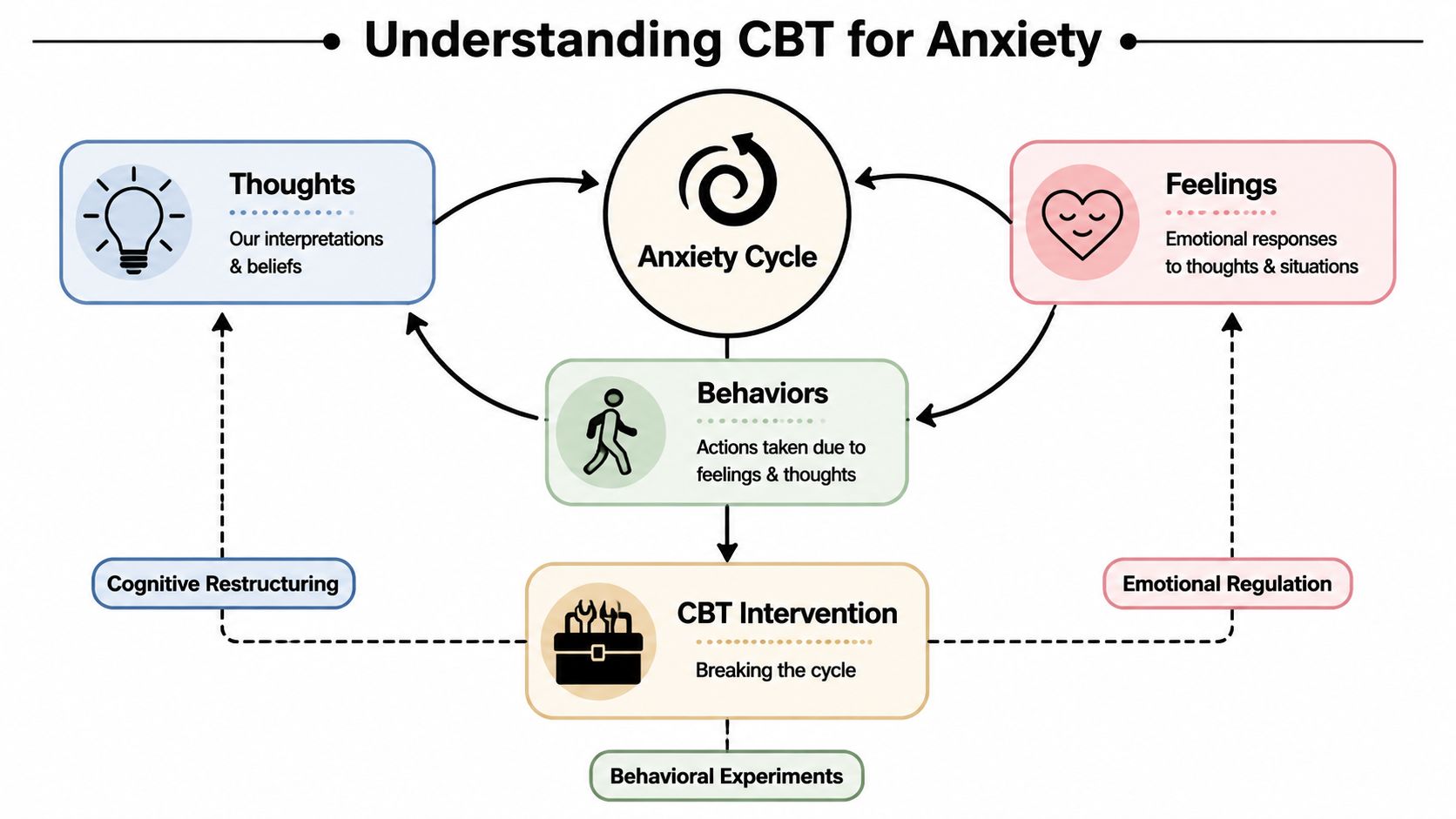
CBT works because anxiety is not random. It follows patterns. Your workbook helps you spot those patterns so you can interrupt them.
Why thoughts matter so much
Take a simple example. A friend sends a short text that says, “Can we talk later?”
One person thinks, “Probably nothing urgent.” They feel mildly curious and go on with their day.
Another person thinks, “I upset them. This is bad.” Their stomach drops, their heart speeds up, and they replay every recent conversation. Then they might send several follow-up texts, check their phone constantly, or avoid replying at all.
Same event. Different interpretation. Different emotional and behavioral outcome.
That’s the heart of CBT. Anxiety is shaped not only by what happens, but by what your mind says the event means.
The A B C model in plain language
Many workbooks use the A-B-C model:
- A means Activating event. What happened.
- B means Belief. What went through your mind about it.
- C means Consequence. How you felt and what you did next.
If A is “my boss emailed and asked to meet,” B might be “I’m in trouble,” and C might be panic, tension, poor sleep, and avoiding work.
Once you write that out, the cycle becomes easier to challenge. You don’t have to argue with every thought in your head. You start with the belief driving the reaction.
If you want a clearer way to identify thinking traps inside that belief, The Anxiety Checklist's guide to distortions can help you recognize patterns like catastrophizing and overgeneralizing.
Practical rule: Anxiety often speaks in certainty. CBT asks you to look for probability, context, and evidence.
There’s good reason to take the worksheet process seriously. A Spring Health review of CBT techniques and worksheets reports that consistent worksheet use over 8 to 12 weeks is associated with 65 to 80% response rates, defined there as a 50% or greater reduction in symptoms.
What readers often get confused about
People often worry that CBT means “just think positive.” It doesn’t.
CBT doesn’t ask you to replace every anxious thought with something cheerful. It asks you to look for a thought that is more accurate, more balanced, and more useful. “I will definitely panic and pass out” might become “I feel very uncomfortable, but I’ve felt this before and gotten through it.”
That kind of shift can lower fear without denying your experience. It also makes the next step possible. Action.
Your First Workbook Exercises Demystified
Many individuals open an anxiety workbook and get stuck at the first worksheet. The page can look clinical. The language can feel stiff. The good news is that the core exercises are simpler than they appear.

How a thought record works
A thought record is one of the most useful tools in a cognitive behavioral therapy anxiety workbook. It helps you capture a moment of anxiety before your mind rewrites it.
Most versions include these parts:
Situation
Write what happened. Keep it concrete. “Got an email from my manager at 4:30 PM asking to talk tomorrow.”Automatic thought
Write the first scary meaning your mind attached to it. “I messed something up. I might get fired.”Emotions and intensity
Name what you felt. Fear, dread, shame, tension. Rate the intensity if your workbook asks for it.Evidence for the thought
This is not where you dump every fear. Write actual supporting evidence. “My manager sounded brief.”Evidence against the thought
Add missing context. “She often schedules check-ins. I have not been told there’s a problem. My last project went well.”Balanced thought
End with a statement that is believable, not magical. “I don’t know what the meeting is about. It could be routine. If there’s feedback, I can handle it.”
The power of the exercise comes from repetition. In some trials summarized in this discussion of Knaus’s workbook approach, users who challenged irrational beliefs through thought records and evidence-gathering reported 60 to 70% reduction in anxiety symptoms after 12 weeks of consistent practice.
Example thought record entry
| Situation | Automatic Thought(s) | Emotion(s) & Rating | Evidence for the Thought | Evidence Against the Thought | New Balanced Thought |
|---|---|---|---|---|---|
| I walked into a friend’s birthday party and saw people already talking in groups. | “I don’t belong here. I’ll look awkward. People will notice I’m anxious.” | Anxiety 85/100, shame 70/100 | I feel shaky. I don’t know everyone there. I was quiet at the last gathering. | My friend invited me because they wanted me there. People are focused on their own conversations. I’ve had awkward moments before and still been accepted. | “I feel anxious, but that doesn’t mean I don’t belong. I can start with one short conversation and let myself warm up.” |
Behavioral experiments in everyday life
A thought record works on paper. A behavioral experiment takes it into real life.
If your thought is “If I speak up in a meeting, everyone will think I sound foolish,” the experiment is not “be fearless.” It’s “test the prediction.” You might make one brief comment, then record what happened.
That’s why CBT often asks you to become a careful observer rather than a harsh judge.
Try this structure:
- Prediction: “If I ask a question, people will think I’m incompetent.”
- Experiment: Ask one genuine question in a meeting.
- Outcome: What did people do or say?
- Learning: Was the prediction fully true, partly true, or not supported?
If you'd like a deeper walkthrough, this guide on using belief experiments for anxiety shows how to test anxious predictions without overwhelming yourself.
“Don’t ask whether you felt anxious. Ask whether your prediction came true.”
That question changes everything. Many people assume anxiety itself proves danger. Behavioral experiments teach a different lesson. Anxiety is a feeling. It is not proof.
Building Your Exposure Hierarchy for Lasting Change
Avoidance gives short-term relief and long-term suffering. Exposure reverses that pattern by helping you face what you've been escaping in a gradual, workable way.
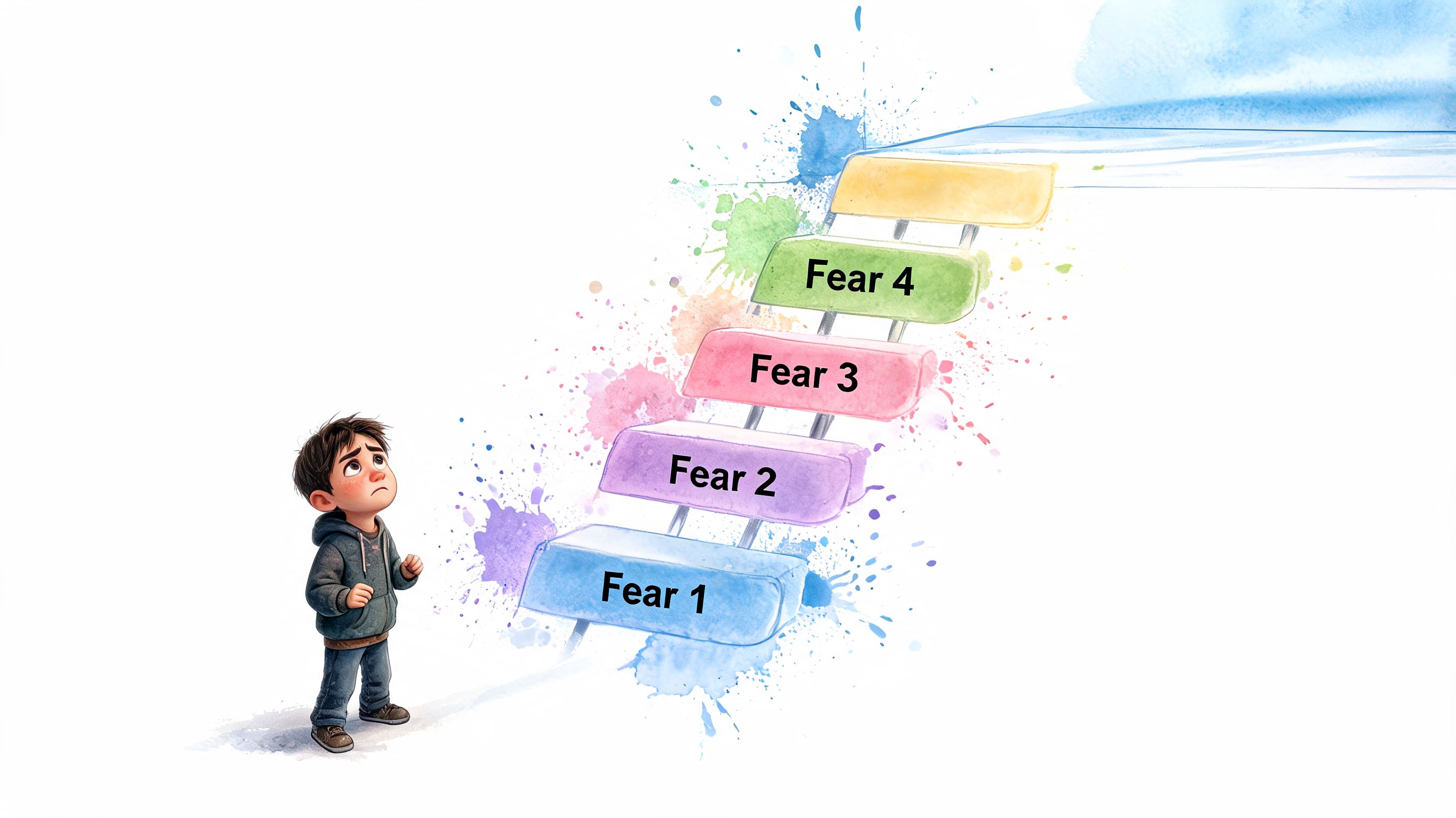
A lot of readers hear “exposure” and think it means being thrown into the deepest fear all at once. That isn’t good CBT. Good exposure is structured. It uses a ladder.
A review discussing evidence grades for treatment notes that exposure has Grade A evidence and benefits from tracking progress over time. That’s one reason many workbooks include exposure pages, even if they don’t always explain how to monitor the process clearly.
What exposure actually means
Exposure means approaching a feared situation, sensation, or uncertainty long enough to learn something new. Usually the new learning is one of these:
- I can tolerate this feeling
- The feared outcome doesn’t happen the way I predicted
- Even if discomfort rises, it falls on its own
- I don’t need a safety behavior to survive the moment
Many people use SUDS, or subjective units of distress, to rate discomfort. You might rank items from easier to harder and climb gradually instead of jumping to the top.
If you'd rather organize those steps digitally, an exposure therapy app can make it easier to build and track a fear ladder.
A fear ladder for chronic worry
Chronic worry often hides behind reassurance-seeking, checking, and mental review. An exposure plan for worry may focus less on dramatic situations and more on reducing those habits.
A gentle fear ladder might look like this:
Lower step
Delay asking your partner for reassurance for a short period when you feel uncertain.Middle step
Send one work email without rereading it excessively.Higher step
Leave a minor household task imperfect and resist checking whether it caused a problem.Harder step
Set aside time to let uncertainty be present without trying to mentally solve it.
Notice what’s happening here. The target isn’t just worry itself. The target is the behavior that keeps telling your brain uncertainty is dangerous.
A fear ladder for panic symptoms
Panic often creates fear of body sensations. A person may begin to avoid stairs, exercise, heat, crowds, driving, or being alone because those situations can trigger dizziness, breathlessness, or a racing heart.
A panic-focused ladder often includes safe, planned practice with sensations. For example:
- Sit still and notice your heartbeat without checking or escaping.
- Take a brisk walk and stay with the physical sensations as they rise and fall.
- Spend time in a store after mild symptoms begin, rather than leaving immediately.
- Drive a familiar route without carrying out your usual safety rituals.
A short video can help make that process feel more concrete.
A gentle reminder: The right pace is not the fastest pace. The right pace is the one that helps you stay engaged long enough to learn.
If you're dealing with intense panic or medical concerns, it's wise to build this plan with a licensed clinician. Exposure is powerful. Support can make it safer and more effective.
Connecting Your Workbook to Real-Time Relief
Many people get discouraged. They understand the worksheet after the panic has passed, but in the middle of a surge they can't think clearly enough to use it.
That’s not failure. That’s how panic works.
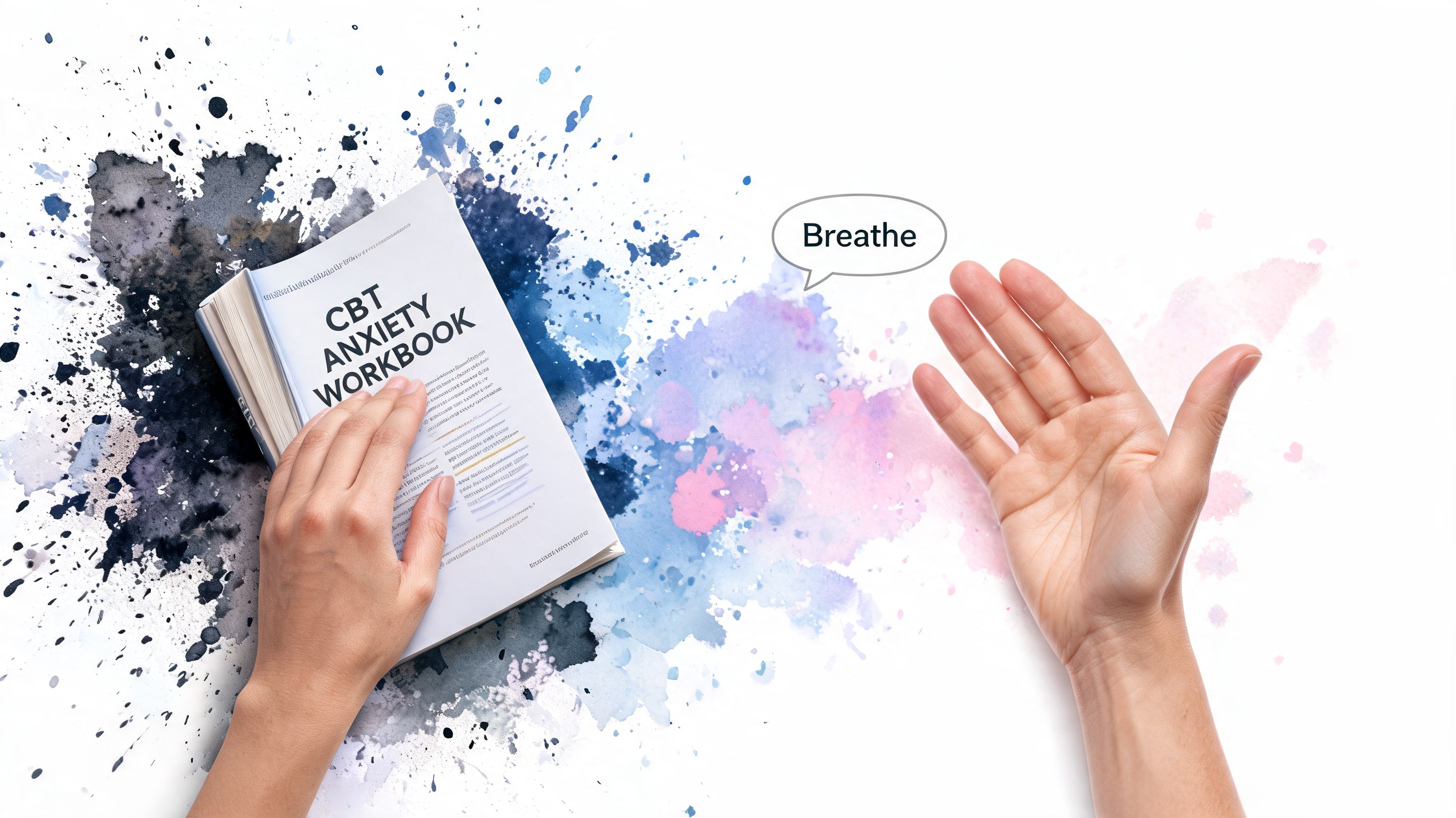
A source discussing gaps in workbook design notes that many CBT workbooks don’t address what to do during an active panic attack, even though 30 to 40% of anxiety sufferers experience panic attacks. That’s an important distinction. A workbook is excellent for reflection and retraining. It’s often not the first tool your brain can access at the peak of alarm.
Regulate then reframe
A helpful way to think about panic is this: regulate first, reframe second.
When your body is in full alarm, start with grounding. Focus on simple actions that lower intensity enough for thinking to return. That might include slow breathing, naming objects in the room, feeling your feet on the floor, or using guided support from science-backed anxiety tools.
Only after the wave softens do you open the workbook.
That sequence matters because panic narrows attention. If you try to reason with a terrified brain too early, you’ll often feel more frustrated. If you first help your nervous system settle, the cognitive tools become available again.
How to use your workbook after the wave passes
Once you're no longer in the sharpest part of panic, turn the episode into data.
Write down:
- What was happening right before the surge
- What your mind predicted
- What sensations showed up
- What you did to cope
- What happened afterward
Then ask two key questions.
First, “What did I fear this meant?”
Second, “What did this episode teach me?”
Maybe you feared, “I’m losing control,” but the episode passed. Maybe you feared, “I can’t handle this in public,” but you stayed long enough to see the fear shift. Those observations become raw material for your next thought record or exposure step.
This is how a workbook becomes a living tool instead of a pile of completed pages. It helps you transform a frightening moment into information, and information into a new response.
Troubleshooting Challenges and Finding Your Path Forward
Some days the workbook will help immediately. Other days it may irritate you, bore you, or make you think, “My thoughts are too true for this.” Those reactions are common.
When the workbook feels hard or pointless
A few roadblocks show up again and again:
You only write when you feel terrible
That can make the workbook feel tied to crisis. Try filling out short entries after mild anxiety too. It builds skill when your brain is more available.Your balanced thought feels fake
Make it smaller. Don’t jump from “I’m doomed” to “Everything is wonderful.” Try “I don’t know yet” or “This feeling is intense, but temporary.”You miss days and assume you failed
Consistency matters, but perfection doesn’t. Return to the next page. Anxiety often turns one missed day into a story about quitting. You don't have to believe that story.You intellectualize everything
Writing insightfully is not the same as practicing differently. If a workbook page gives you clarity, pair it with one small behavioral step.
Healing rarely looks clean. It often looks like repeating the same skill until your brain finally starts to trust it.
When to get extra support
If your anxiety feels constant, if panic is reshaping your life, or if workbook exercises keep stalling, professional help can be the next strong step. A therapist can help you tailor thought records, pace exposure, and sort out when anxiety is mixing with trauma, depression, or perfectionism.
Getting support isn't giving up on self-help. It’s using every tool available.
The path forward is usually not dramatic. It’s built from small honest moments. One worksheet. One resisted compulsion. One exposure step. One panic episode you survive without treating it like proof of danger.
That is how people get better.
If you want support both during anxious moments and between them, The Anxiety Checklist offers help for real-time grounding and longer-term CBT practice. Its always-free SOS mode can guide you when your mind goes blank, and its deeper tools can help you track thoughts, test beliefs, and build exposure steps at your own pace.