


You sit down to answer one email. Your mind jumps to five unfinished tasks, then to the fear that you're already behind, then to the thought that if you start now you'll do it wrong anyway. Ten minutes later, you're restless, tense, distracted, and somehow frozen.
That mix can feel impossible to explain. You may wonder whether you have ADHD, anxiety, or some confusing blend that makes daily life feel harder than it should. A lot of people describe it the same way: a brain that's moving too fast and getting stuck at the exact same time.
If that sounds familiar, there's a reason. ADHD and anxiety often travel together, and when they do, they can blur into each other in ways that leave you feeling overwhelmed and discouraged. The good news is that this pattern is recognized, understandable, and treatable. Clarity is possible, and relief is possible too.
Table of Contents
- The Overwhelming World of ADHD and Anxiety
- The Widespread Link Between ADHD and Anxiety
- Why ADHD and Anxiety Often Occur Together
- The Diagnostic Dilemma Overlapping Symptoms
- Evidence-Based Treatment for Hope and Healing
- Daily Skills for Managing Both Conditions
- Your Path Forward From Confusion to Clarity
The Overwhelming World of ADHD and Anxiety
Some people wake up already bracing for the day. They know what needs to get done, but the task list feels jagged and loud. One part of the mind says, “Start now.” Another says, “Wait until you can do it perfectly.” Then a text arrives, the thought shifts, and the original task disappears under a pile of worry.
That experience isn't laziness, weakness, or lack of discipline. It often reflects ADHD and anxiety comorbidity, where attention problems and fear-based patterns interact in real time. ADHD can make it hard to organize, start, and sustain effort. Anxiety can pile on dread, overthinking, body tension, and a constant sense that something will go wrong.
You can feel scattered and overcontrolled at the same time.
Many people struggle with these distinctions. If you miss deadlines, is that distractibility from ADHD? If you avoid a task, is that procrastination or panic? If your body feels keyed up all day, are you anxious because life feels chaotic, or is anxiety itself driving the chaos?
Those questions matter, but they don't have to trap you. A practical first step is noticing patterns instead of judging yourself. Tools like an anxiety checklist can help you name what's happening when your thoughts are moving too fast to sort out alone.
What people often miss
Relief usually starts when you stop asking, “What's wrong with me?” and start asking, “What is driving this moment?” That small shift can change everything. It turns confusion into observation, and observation into a treatment plan that fits your life.
The Widespread Link Between ADHD and Anxiety
You miss a deadline because your attention keeps slipping. Then the worry starts. After a few rounds of that pattern, the mind can begin to treat every task like a possible threat.
That is part of what makes this pairing so confusing. ADHD and anxiety do not just sit side by side. They often interact, each one changing how the other feels in daily life.
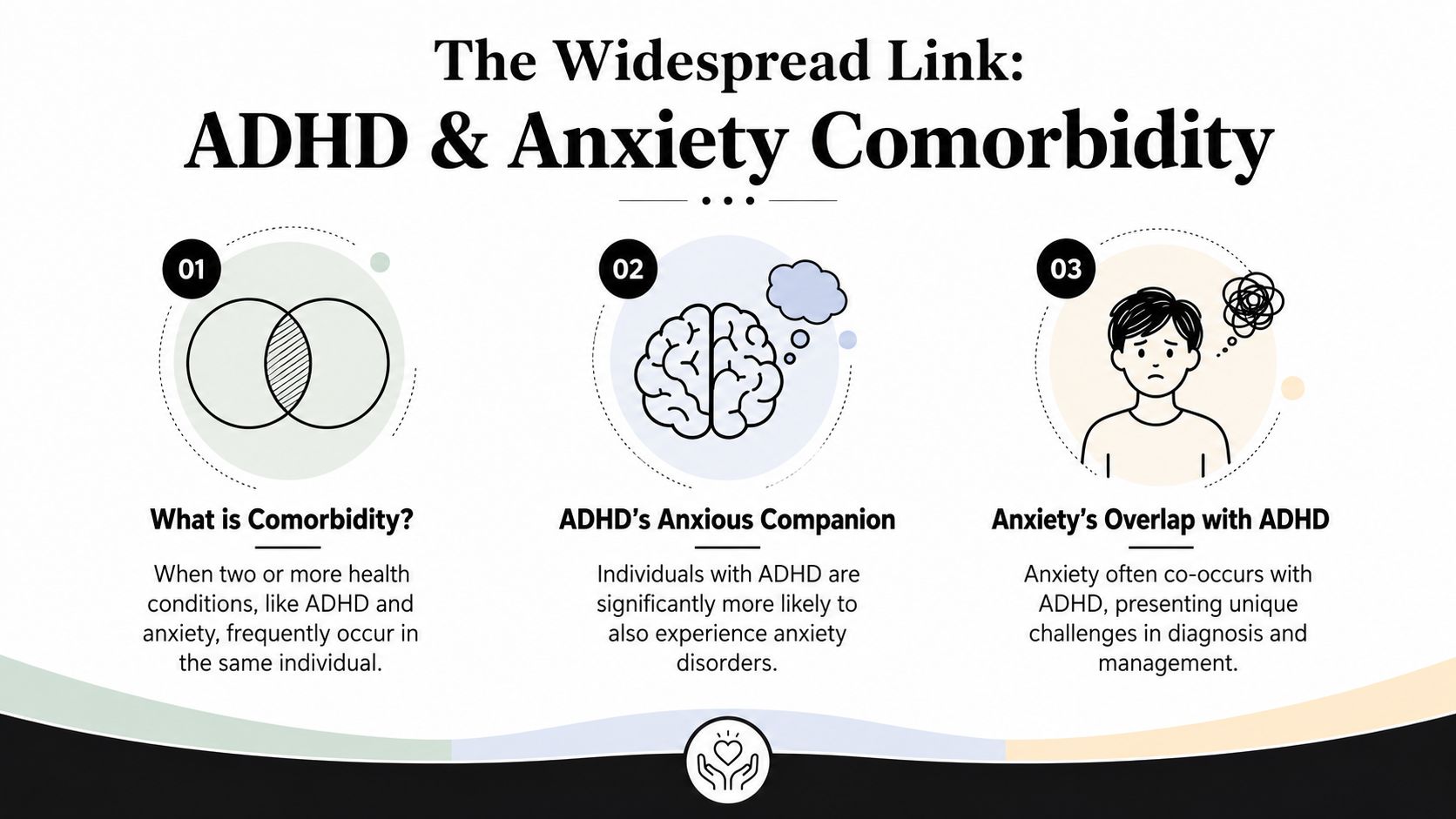
Comorbidity means two conditions appear together often enough that clinicians expect to look for both. In practical terms, it means a person can have a long-standing pattern of attention dysregulation and also deal with chronic worry, panic, or fear in social situations. The result can feel like driving with one foot on the gas and one on the brake. You want to move, but your system is tense at the same time.
What the research shows
The size of the overlap is hard to ignore. The National Comorbidity Survey Replication reported anxiety disorders in 47% of adults with ADHD (National Comorbidity Survey Replication findings).
A lifespan review published in 2019 reached a similar conclusion from a different angle, describing ADHD and anxiety disorders as commonly co-occurring across age groups and estimating about a 25% comorbidity rate with each other in the literature (lifespan review on overlap).
Those numbers matter, but the bigger takeaway is easier to miss. If you have both racing thoughts and attention problems, you are not dealing with a rare or baffling personal flaw. You are dealing with a well-recognized clinical pattern, one that often needs careful sorting rather than a quick label.
Why this overlap matters clinically
The overlap can change the whole picture. Adults with both ADHD and anxiety often have a more difficult course, with more impairment and a more complicated treatment process, according to the same adult study cited above.
The practical framework becomes helpful at this stage. Instead of asking which diagnosis is the "real" one, it is often more useful to ask how the two are feeding each other. ADHD can make life feel inconsistent and hard to control. Anxiety can grow in response to that unpredictability, then add avoidance, perfectionism, and fear of mistakes. Over time, the two can become tangled like crossed wires.
Practical rule: If ADHD symptoms and anxiety symptoms both show up, ask for an evaluation that considers both conditions.
For some people, the anxiety part centers on other people's reactions. Fear of judgment, embarrassment, or being watched can point toward social anxiety, and learning more about how to overcome social anxiety can help you recognize that pattern.
Co-occurring conditions can also extend beyond anxiety alone. The Addiction Resource Center explains how dual-diagnosis patterns can complicate recovery, which is one more reason a full assessment matters when symptoms seem layered or hard to separate.
Why ADHD and Anxiety Often Occur Together
The overlap doesn't happen for just one reason. It usually develops through a mix of biology and life experience. A helpful way to think about it is this: ADHD can create the storm, and anxiety can become the shelter your mind tries to build, even when that shelter stops being useful.

Shared brain patterns and vulnerability
ADHD and anxiety appear to share some overlapping neurobiological dysfunctions, including dopamine-related changes in the frontal lobe, while still remaining distinct diagnoses. That helps explain why they can look connected without being the same thing.
Some people also seem to carry a broader vulnerability toward both attention regulation problems and internal distress. If your brain already struggles with focus, inhibition, or working memory, everyday demands can feel harder to manage. That doesn't automatically create an anxiety disorder, but it can lay the groundwork.
The ADHD effects model
One of the most useful ideas here is the ADHD effects model. Longitudinal analysis supports this model by showing that ADHD symptoms in preschool predict later anxiety, while anxiety symptoms do not predict later ADHD. The explanation is that early executive function deficits and negative social feedback create chronic stressors that trigger anxiety, and treating the primary ADHD often reduces this secondary, reactive anxiety (ADHD effects model research).
That pattern makes intuitive sense. If you repeatedly forget things, lose track of time, miss cues, or struggle to finish what others seem to do easily, your nervous system may learn to stay on guard. You start anticipating mistakes before they happen. You brace for criticism. You over-prepare, avoid, or panic.
Anxiety in this context often isn't random. It can be a learned response to living in a world that has felt hard to manage for a long time.
Life stress can deepen the cycle
This is one reason co-occurring conditions need a broad lens. People who struggle with overlapping mental health patterns may also face sleep problems, substance use, burnout, or emotional overwhelm. Resources on co-occurring conditions, such as this guide from Addiction Resource Center, can help people understand how one condition can intensify another instead of existing in isolation.
When the body stays in alarm mode, it helps to learn more about understanding the fight or flight response. That lens can make racing thoughts, tension, urgency, and shutdown feel less mysterious and less frightening.
The Diagnostic Dilemma Overlapping Symptoms
The hardest part for many people isn't noticing symptoms. It's figuring out what those symptoms mean.
ADHD and anxiety can both look like distractibility, restlessness, sleep trouble, irritability, and procrastination. From the outside, two people may behave the same way. On the inside, the engine driving that behavior can be completely different.
The key question is why
With ADHD, attention often drifts because the brain struggles to regulate focus consistently. The mind gets pulled by novelty, boredom, competing stimuli, or difficulty organizing a sequence of steps.
With anxiety, attention often narrows or fragments because worry takes over. The person isn't only distracted by what's around them. They're caught in internal threat scanning, future-focused fear, or repetitive mental checking.
That's why the most useful question is often not “What am I doing?” but “What is pushing me to do it?”
| Symptom | As a Symptom of ADHD | As a Symptom of Anxiety |
|---|---|---|
| Inattention | Focus slips because of distraction, boredom, poor task regulation, or trouble shifting attention | Focus gets hijacked by worry, fear, mental rehearsal, or threat monitoring |
| Restlessness | Movement may feel stimulating, relieving, or necessary to stay engaged | Movement may reflect tension, agitation, panic, or inability to relax |
| Procrastination | Delay often starts with disorganization, overwhelm, or difficulty initiating | Delay often starts with fear of failure, fear of judgment, or catastrophic thinking |
| Sleep problems | Bedtime may be disrupted by inconsistent routines or difficulty winding down | Bedtime may be disrupted by rumination, physical tension, or anticipatory worry |
| Forgetfulness | Information may not get organized or encoded well in the first place | Memory may suffer because stress narrows attention and crowds working memory |
Everyday examples that make the difference clearer
A student opens an assignment and immediately checks three other tabs, then gets up for a snack, then remembers another task. That pattern leans more ADHD if the main issue is stimulus-driven drift.
A different student opens the same assignment and stays frozen because their mind keeps saying, “If I can't do this perfectly, I'll fail.” That pattern leans more anxiety if the main issue is fear-driven avoidance.
The same person can also have both. They may start with ADHD-related difficulty organizing the task, then spiral into anxious self-criticism because they're behind.
Sometimes the symptom is shared, but the fuel is different.
Age and context matter
Symptoms can shift across different parts of life. In one setting, ADHD may be the louder problem. In another, anxiety may take over. A calm, structured environment might reduce the noise enough that ADHD becomes easier to spot. High pressure, conflict, or uncertainty can make anxiety dominate the picture.
Self-observation proves beneficial. Notice what happens just before you lose focus or avoid a task. Is your mind chasing stimulation, or is it looping on danger? If your mind gets caught in repetitive fear-based thinking, reading about overthinking and anxiety can help you identify that pattern more clearly.
Evidence-Based Treatment for Hope and Healing
A lot of people reach this point feeling discouraged. They worry that having both ADHD and anxiety means treatment will be harder, more confusing, or less likely to work. In practice, the opposite is often true. Once you can tell which symptoms come from overwhelm, which come from fear, and how they feed each other, treatment starts to feel less like guessing and more like following a map.
That shift matters.
A good treatment plan asks a practical question first. What is driving the distress right now? For one person, unfinished tasks and constant forgetfulness may be creating daily panic. For another, anxiety may be so intense that they cannot sleep, start tasks, or tolerate uncertainty long enough to use ADHD strategies. The goal is not to force every person into the same order. The goal is to match treatment to the pattern.
Medication can help more than many people expect
Many people fear that ADHD medication will automatically make anxiety worse. However, the situation is more nuanced. Non-stimulant atomoxetine can be a useful option when both ADHD and anxiety are present, and stimulants are not automatically the wrong choice. If anxiety is being fed by missed deadlines, disorganization, and repeated feelings of failure, improving attention and follow-through can reduce the anxiety source itself.
It helps to picture the problem like a smoke alarm. Sometimes the alarm is the main problem. Sometimes the room is filling with smoke. If ADHD symptoms are creating chaos all day, anxiety may be reacting to that chaos. Reducing the chaos can make the alarm quieter.
Therapy works better when it fits both conditions
Therapy often helps most when it addresses anxious thinking and executive function at the same time. Standard cognitive behavioral therapy can be effective, but insight alone may not carry someone very far if they also forget coping steps, struggle to begin tasks, or lose track of plans once stress rises.
A stronger plan often combines:
- ADHD supports: External reminders, simplified routines, visual planning, and very small task steps.
- Anxiety tools: Cognitive restructuring, exposure work, body-calming skills, and thought records.
- Symptom triage: Starting with the symptom causing the most disruption right now.
Treat the problem that is creating the most impairment first, while keeping both conditions in view.
Research also supports combined care in many cases. A review in BMC Psychiatry found that people with ADHD and anxiety often need more than one treatment approach because co-occurring symptoms can complicate response to a single intervention (BMC Psychiatry review on adult ADHD comorbidity).
Personalized care usually works better than a rigid sequence
Some people do best when ADHD treatment comes first because anxiety is largely reactive. Others need anxiety treated first because panic, insomnia, or constant threat-monitoring blocks everything else. Many need both addressed together, with small adjustments over time.
That is why evaluation and follow-up matter so much. The first plan does not have to be perfect. It has to be specific enough to test, observe, and refine.
Structured education can also help people make sense of their own pattern between appointments. Libraries of evidence-based anxiety resources can support that learning process and make treatment conversations more productive.
Hope grows when the plan fits the person. You do not need to solve every symptom at once. You need the next step that makes life feel a little more manageable, then another step after that.
Daily Skills for Managing Both Conditions
Daily coping matters because the ADHD-anxiety loop often runs on momentum. More chaos creates more worry. More worry creates less focus. The most effective habits interrupt that loop in small, repeatable ways.
A nationally representative Canadian study found that adults with ADHD had four times higher odds of generalized anxiety disorder, and those with GAD were more likely to have experienced adverse childhood events, which is one reason stress-management skills matter so much in this population (Canadian ADHD and GAD study).
Build a calmer day by reducing friction
You don't need a complicated system. You need fewer points where your brain can veer into overload.
- Shrink the starting line: Break tasks into the smallest visible first step. “Open the document” works better than “finish the report.”
- Use one capture place: Keep one notebook, one notes app, or one task list. Scattered reminders create anxiety fast.
- Create landing routines: Put keys, wallet, charger, and medications in the same place every day.
- Lower decision fatigue: Repeat simple meals, clothing choices, and morning sequences when possible.
These are ADHD supports, but they also reduce anxiety because they make the day more predictable.
Calm the body so the mind can follow
When anxiety spikes, reasoning usually isn't the first tool your brain can access. Body-based skills often work faster.
- Grounding: Name what you can see, feel, and hear to interrupt spiraling.
- Breath pacing: Slow, steady breathing can reduce the sense of immediate danger.
- Thought journaling: Write the fear down instead of letting it loop invisibly.
- Timed worry: Give anxious thoughts a container so they don't spread across the whole day.
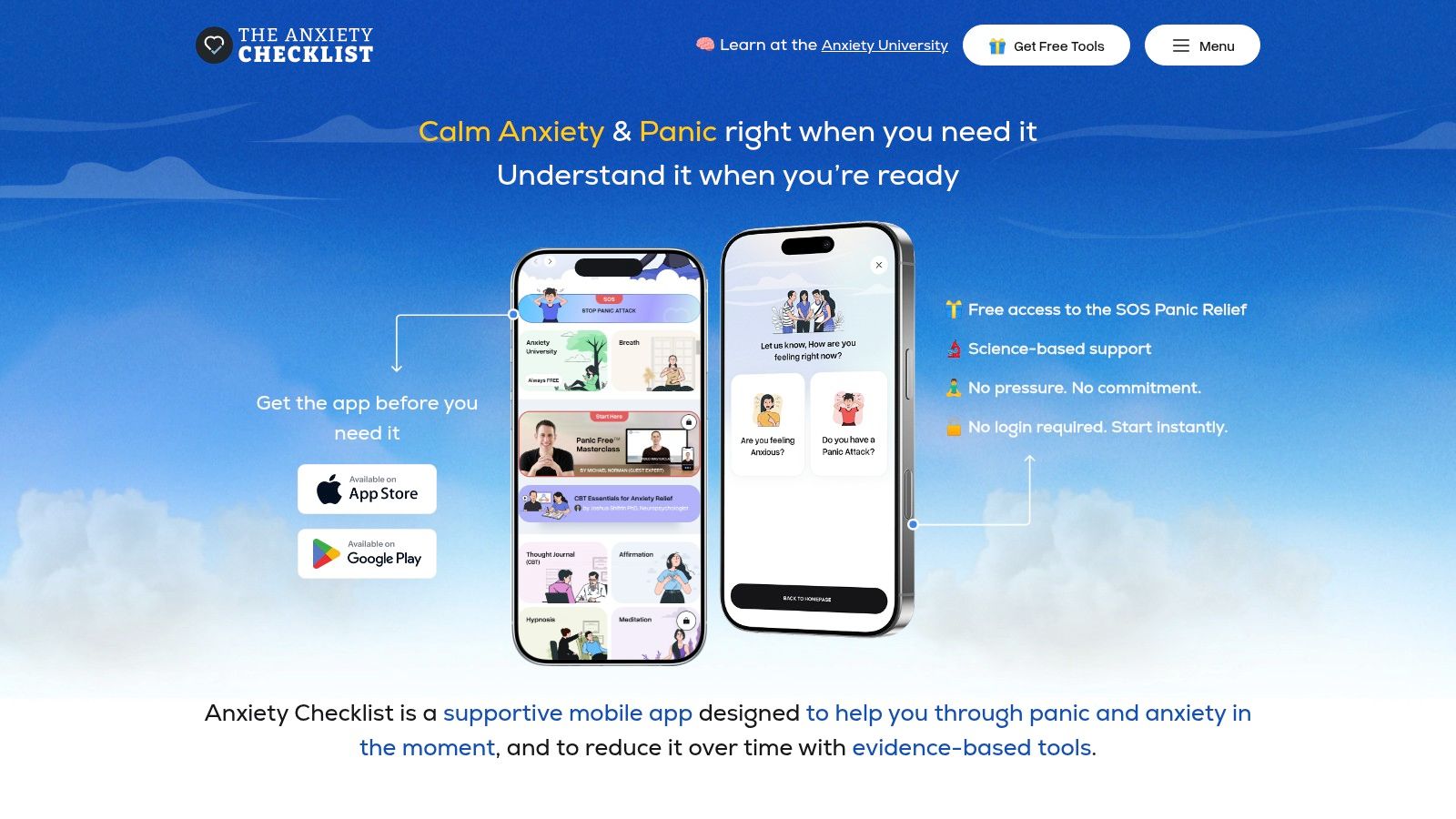
One option people use for this is The Anxiety Checklist, which includes an always-free SOS mode for immediate grounding, plus tools like CBT journaling, guided meditations, sleep audios, and exposure-based exercises.
A short guided explanation can also make the overlap feel easier to grasp:
Use a two-part check-in
At stressful moments, ask yourself two questions:
What is my brain doing?
Losing the thread, chasing stimulation, forgetting steps, looping on danger?What does this moment need?
Structure, movement, reassurance, a timer, a break, a breathing exercise, or one tiny next action?
That habit can turn a vague sense of failure into a specific response. Over time, that's how people move from constant reactivity toward feeling calmer and more in control.
Your Path Forward From Confusion to Clarity
If you've been living with both distraction and dread, there's a reason it has felt so confusing. ADHD and anxiety can overlap, feed each other, and change how symptoms show up from one season of life to another. None of that means you're broken.
It means your mind may need a more accurate explanation.
Once you understand the pattern, the next steps become clearer. You can start noticing whether a moment is driven more by disorganization, overstimulation, fear, or both. You can bring those observations to a clinician. You can build treatment around what's happening instead of guessing.
Seek professional help if your symptoms are disrupting work, school, relationships, sleep, or daily functioning, or if panic, hopelessness, or shutdown are becoming hard to manage on your own. You deserve support that fits the full picture.
Healing doesn't always happen in a straight line. But people do get calmer. They do learn how to sort the signals. They do find ways to live with more steadiness, less fear, and much more self-trust.
If you want structured support while you sort out panic, overthinking, and daily anxiety patterns, The Anxiety Checklist offers practical tools you can use right away, including SOS grounding help, guided calming exercises, and CBT-based self-help resources.